Falls inside the home send over 220,000 people to emergency departments in England every year — and a significant share of those incidents happen in private rented properties where hazards have gone unaddressed. That stark reality is precisely why Building Surveys for Bath, Stair, and Fall Hazards Under Expanded Awaab's Law 2026: PRS Compliance Protocols have moved from a niche surveying concern to a front-line landlord compliance obligation. The 2026 expansion of Awaab's Law into the private rented sector (PRS) creates legally enforceable timelines for identifying and remedying fall hazards, and the professional building survey is now the primary instrument of evidence in both landlord enforcement and tenant claims.
Key Takeaways 📋
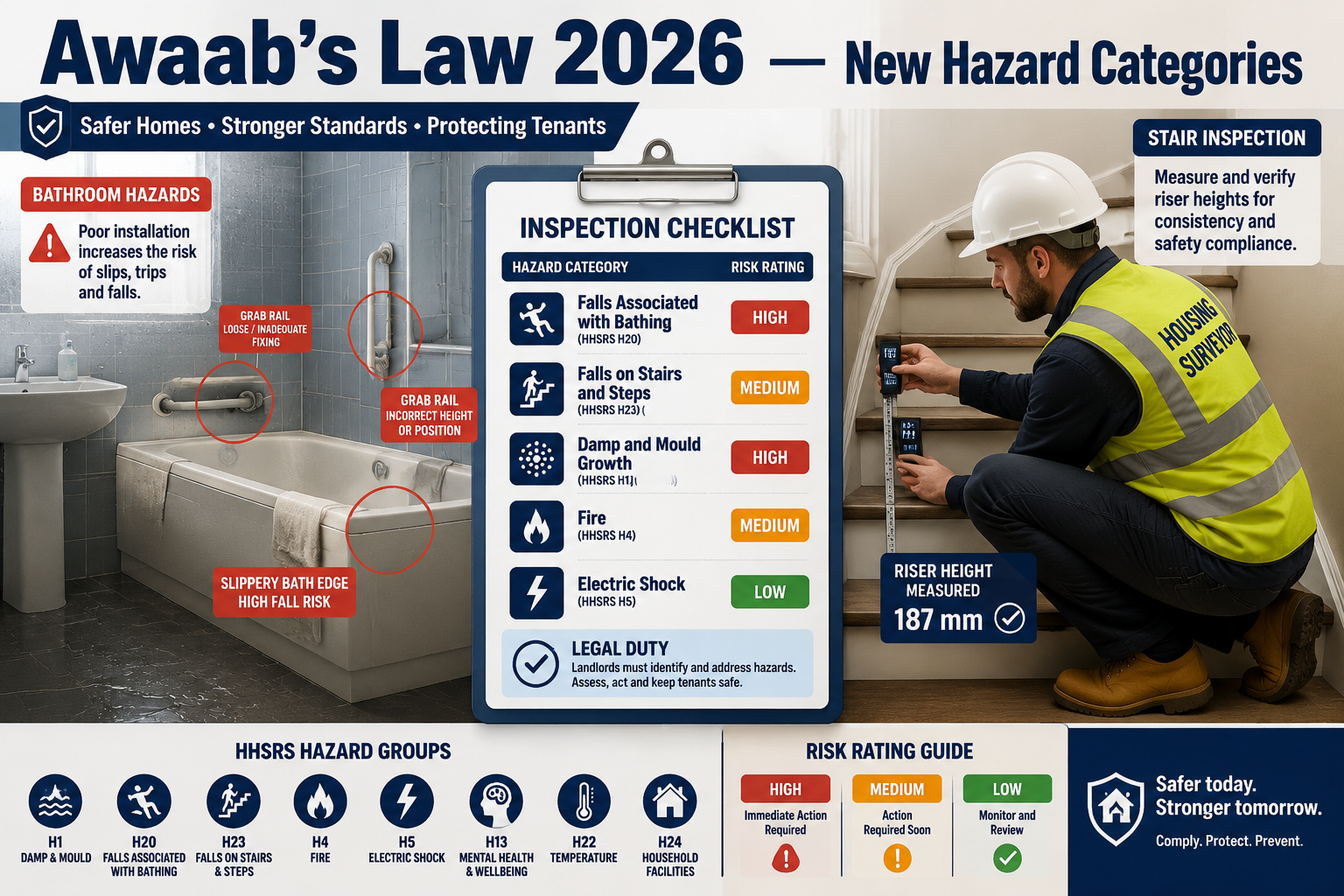
- Awaab's Law 2026 extends mandatory hazard-remediation timelines to private landlords, covering falls from baths, stairs, and other internal trip/slip hazards under HHSRS Category 1 and 2 ratings.
- A RICS-standard building survey is the gold-standard evidence document for both landlord compliance and tenant enforcement action.
- Surveyors must use structured inspection checklists covering stair geometry, bathroom fixtures, flooring, lighting, and handrail integrity.
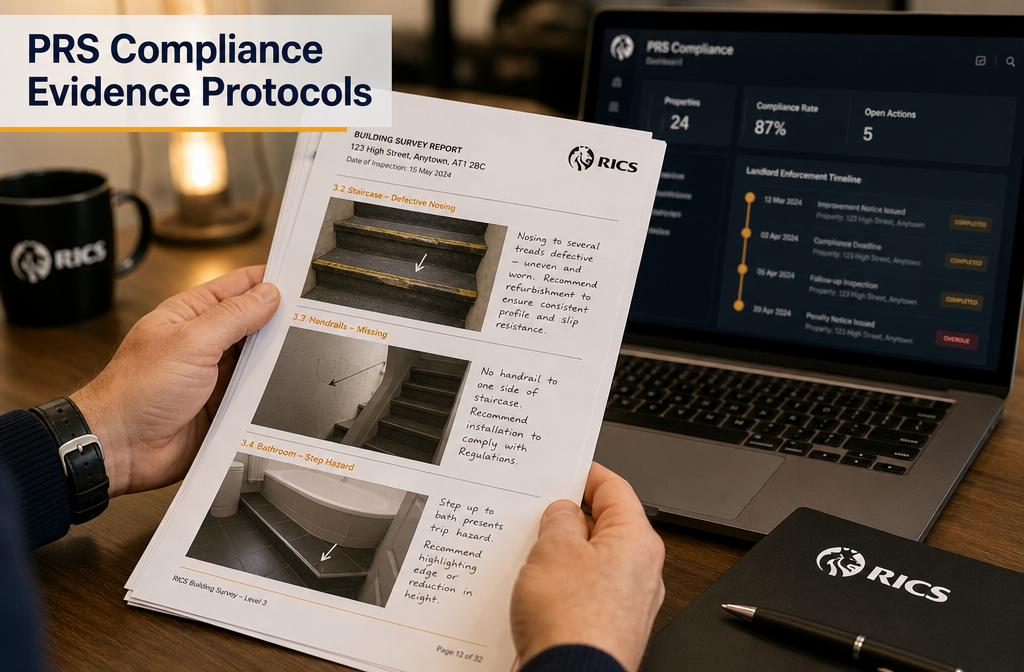
- Photographic evidence, measured data, and risk ratings within survey reports directly determine enforcement timescales under the new regulations.
- Landlords who commission proactive surveys before a tenant complaint reduce legal exposure and demonstrate the reasonable steps defence.
What Awaab's Law 2026 Means for the Private Rented Sector
Awaab's Law was originally enacted through the Social Housing (Regulation) Act 2023, named after two-year-old Awaab Ishak, who died from prolonged exposure to mould in a social housing property. The 2026 expansion brings equivalent obligations to private landlords, covering a broader range of HHSRS (Housing Health and Safety Rating System) hazards — including, critically, falls on stairs, falls on the level, and falls associated with baths and shower areas.
The Core Legal Obligations for PRS Landlords
Under the expanded framework, private landlords must:
| Obligation | Timescale |
|---|---|
| Acknowledge a hazard complaint in writing | Within 14 days |
| Provide an investigation report (or commission a survey) | Within 28 days |
| Begin emergency remedial works (Category 1 hazards) | Within 24 hours |
| Complete non-urgent Category 1 remediation | Within 28 days |
| Address Category 2 hazards | Within a reasonable period (typically 90 days) |
💡 Pull Quote: "The survey report is no longer just a buyer's tool — under Awaab's Law 2026, it is a landlord's legal shield and a tenant's enforcement weapon."
Failure to meet these timescales exposes landlords to civil penalties, rent repayment orders, and potential banning orders under the Housing Act 2004 enforcement regime. This makes professional survey evidence — not informal inspections — the only defensible standard.
Understanding Fall Hazards Under HHSRS: Bath, Stair, and Level Falls
The HHSRS identifies three distinct fall hazard categories relevant to PRS compliance in 2026. Understanding how surveyors assess each one is essential for both landlords commissioning surveys and tenants pursuing claims.
1. Falls on Stairs (HHSRS Hazard 7)
Stair-related falls are among the most serious hazards in residential properties. Surveyors assess:
- Riser height consistency — irregular risers above 220mm or variation of more than 5mm between risers
- Tread depth — minimum 220mm going (horizontal depth) required under Part K of Building Regulations
- Handrail presence and integrity — handrails must be continuous, at 900–1000mm height, and structurally sound
- Stair nosing condition — worn, missing, or poorly contrasting nosings significantly increase trip risk
- Headroom clearance — minimum 2.0m above pitch line
- Lighting adequacy — switches accessible at top and bottom; no dark zones on the flight
2. Falls Associated with Baths and Showers (HHSRS Hazard 8)
Bathroom falls are disproportionately serious for older tenants and those with mobility impairments. Key inspection points include:
- Bath lip height — standard baths with lips above 560mm present elevated transfer risk
- Grab rail provision — absence of grab rails near bath/shower entry points is a flagged deficiency
- Floor surface slip resistance — wet area flooring assessed against BS 7976 pendulum test standards (PTV values below 36 indicate high risk)
- Shower tray lip or level-access provision — raised shower trays above 25mm without a step-assist rail
- Tap and control accessibility — controls reachable without leaning over the bath edge
3. Falls on the Level (HHSRS Hazard 6)
These include trip hazards across all rooms but are particularly common in:
- Uneven or buckled floor coverings
- Threshold strips between rooms with height differences above 6mm
- Loose or missing floor tiles
- Poorly lit hallways and landings
Building Surveys for Bath, Stair, and Fall Hazards Under Expanded Awaab's Law 2026: PRS Compliance Protocols — The Inspection Checklist
A structured inspection checklist is the backbone of any compliant survey report. The following framework reflects current RICS guidance and HHSRS methodology as applied to PRS properties in 2026.
🏠 Pre-Survey Documentation Review
Before the physical inspection, surveyors should obtain:
- Tenancy agreement and property age/construction records
- Any previous HHSRS inspection reports or local authority notices
- Maintenance logs and recent repair records
- Tenant complaint correspondence (if survey is reactive)
- Building Regulations completion certificates for any alterations
🛁 Bathroom and Wet Area Checklist
| Item | Pass Criteria | Risk Rating if Failed |
|---|---|---|
| Bath lip height | ≤560mm | Category 2 |
| Grab rail at bath entry | Present and load-tested | Category 1 if absent for vulnerable tenant |
| Shower floor slip resistance | PTV ≥36 (wet) | Category 1 |
| Shower tray lip height | ≤25mm or step-assist rail fitted | Category 2 |
| Floor tile condition | No cracked or loose tiles | Category 2 |
| Ventilation (condensation control) | Mechanical extract or openable window | Category 2 |
| Tap controls reachable | No lean over bath edge required | Category 2 |
🪜 Staircase Checklist
| Item | Pass Criteria | Risk Rating if Failed |
|---|---|---|
| Riser height uniformity | Max 5mm variation | Category 1 |
| Tread going depth | ≥220mm | Category 1 |
| Handrail presence | Both sides if width >1m | Category 1 if absent |
| Handrail height | 900–1000mm | Category 2 |
| Handrail structural integrity | No movement under 150N lateral load | Category 1 |
| Stair nosing contrast/condition | Visible, intact, non-slip | Category 2 |
| Headroom clearance | ≥2.0m above pitch line | Category 1 |
| Lighting (top and bottom switches) | Present and functional | Category 2 |
| Balustrade infill spacing | ≤100mm gaps | Category 1 (child safety) |
🚶 Level Fall and General Circulation Checklist
- Floor coverings: no buckling, tears, or loose edges
- Threshold strips: flush or ≤6mm upstand
- Hallway and landing lighting: minimum 100 lux at floor level
- External step condition: no cracked or uneven treads
- Door thresholds to external areas: non-slip surface within 1m
For properties with complex structural concerns alongside fall hazards, a RICS Level 3 Building Survey provides the most comprehensive evidence base, covering structural integrity as well as hazard-specific findings.
Producing Survey Evidence That Withstands Enforcement Scrutiny
The quality of a survey report determines whether it can support landlord enforcement action or a tenant's formal complaint. Under Building Surveys for Bath, Stair, and Fall Hazards Under Expanded Awaab's Law 2026: PRS Compliance Protocols, reports must meet a higher evidentiary standard than a standard homebuyer assessment.
What a Compliant Survey Report Must Include
1. Measured Data, Not Descriptions
Riser heights, handrail dimensions, and PTV slip-resistance values must be recorded as measured figures, not subjective assessments like "appears adequate."
2. Photographic Evidence with Scale References
Every identified hazard must be photographed with a scale rule or tape measure visible. Images should be dated and geotagged where possible.
3. HHSRS Hazard Score and Category
The report must calculate or estimate the HHSRS likelihood and harm scores to assign Category 1 or Category 2 status. This directly determines the landlord's remediation timescale.
4. Specific Remediation Recommendations
Vague recommendations ("consider improving handrail") are insufficient. Reports should specify: "Install continuous handrail to BS EN 1527 standard at 950mm height on the right-hand side of the main staircase, fixed at maximum 1.2m centres."
5. Priority Classification
Each defect should be classified as:
- 🔴 Immediate action (Category 1 — 24-hour or 28-day response)
- 🟡 Short-term action (Category 2 — within 90 days)
- 🟢 Monitoring/maintenance (no enforcement risk currently)
For landlords managing multiple units, a stock condition survey provides a portfolio-wide hazard baseline, enabling systematic compliance planning rather than reactive crisis management.
Where a specific defect — such as a single defective staircase or a problematic bathroom — requires focused investigation, a specific defect report can provide the targeted evidence needed without commissioning a full building survey.
Landlord Enforcement Timelines and the Surveyor's Role
Under the 2026 PRS framework, local housing authorities (LHAs) retain enforcement powers under the Housing Act 2004, but the expanded Awaab's Law provisions create a parallel civil enforcement route for tenants. This dual-track system means surveyors may be instructed by either party.
Surveyor Instructions: Two Distinct Scenarios
Scenario A — Landlord-Commissioned Compliance Survey
Landlords commissioning proactive surveys before a complaint is received gain several advantages:
- Evidence of reasonable steps taken to identify hazards
- A documented remediation programme that satisfies the 28-day investigation requirement
- Reduced exposure to rent repayment orders (which can recover up to 12 months' rent)
Scenario B — Tenant-Instructed Survey for Enforcement
Tenants who suspect Category 1 hazards can commission an independent survey to support a formal complaint to the LHA or a civil claim. In this context, the survey report functions as expert evidence, and surveyors may later be required to provide an expert witness report for tribunal or court proceedings.
💡 Pull Quote: "A measured, HHSRS-scored survey report transforms a tenant's complaint from anecdotal concern to legally actionable evidence — and gives landlords a clear, defensible remediation roadmap."
The Schedule of Condition as a Baseline Tool
For landlords entering new tenancies, a schedule of condition report at the outset establishes the property's hazard baseline. This protects against disputed claims about when a hazard first arose and provides a before-and-after comparison if remediation works are carried out.
Choosing the Right Survey Type for PRS Fall Hazard Compliance
Not all surveys are equal in the context of Awaab's Law compliance. The table below helps landlords and tenants select the appropriate survey instrument.
| Scenario | Recommended Survey Type | Why |
|---|---|---|
| Full portfolio hazard audit | Stock Condition Survey | Systematic HHSRS assessment across multiple units |
| Single property, complex structure | RICS Level 3 Building Survey | Full structural and hazard evidence |
| Isolated stair or bathroom defect | Specific Defect Report | Targeted, cost-effective hazard evidence |
| New tenancy baseline | Schedule of Condition | Establishes pre-tenancy hazard status |
| Tenant enforcement action | Expert Witness Report | Tribunal/court-admissible evidence |
For landlords uncertain which survey level is appropriate, comparing different types of survey is a useful starting point before instructing a surveyor.
Common Deficiencies Found in PRS Properties: 2026 Snapshot
Based on HHSRS inspection data and surveying practice, the most frequently identified fall hazards in private rented properties in 2026 include:
- Missing or loose handrails — present in approximately 34% of pre-1960s terraced properties
- Worn stair nosings — particularly common in carpeted stairs with worn pile at the leading edge
- No grab rail in bathrooms — standard in properties not adapted for older or disabled tenants
- Slippery wet room or shower tray surfaces — especially in properties with ceramic tiles and no anti-slip treatment
- Uneven floor coverings at room thresholds — common in properties with mixed flooring types installed at different times
- Inadequate stair lighting — single-switch arrangements leaving mid-flight areas in shadow
Conclusion: Actionable Next Steps for PRS Compliance in 2026
The expansion of Awaab's Law into the private rented sector in 2026 fundamentally changes the risk calculus for landlords who ignore fall hazards. Building Surveys for Bath, Stair, and Fall Hazards Under Expanded Awaab's Law 2026: PRS Compliance Protocols are no longer optional due-diligence exercises — they are the primary mechanism through which compliance is demonstrated, disputed, and enforced.
Actionable Steps for Landlords ✅
- Commission a proactive HHSRS-focused building survey before the next tenancy begins — do not wait for a complaint.
- Use the inspection checklists in this article as a pre-survey self-assessment to identify obvious hazards before a surveyor attends.
- Prioritise Category 1 hazards — stair handrail failures and slippery wet room floors carry the highest legal exposure.
- Document all remediation works with dated photographs and contractor invoices to demonstrate compliance timescales.
- Establish a schedule of condition at the start of each tenancy as a legal baseline.
Actionable Steps for Tenants ✅
- Report hazards in writing to create a documented complaint trail that triggers the Awaab's Law timescale clock.
- Commission an independent survey if the landlord fails to respond within 28 days — this survey becomes your enforcement evidence.
- Contact the local housing authority if Category 1 hazards are not remediated within the statutory period.
The professional building surveyor sits at the centre of this compliance ecosystem. Whether acting for landlord or tenant, a RICS-qualified surveyor with HHSRS expertise provides the measured, documented, and legally defensible evidence that the 2026 framework demands.