Last updated: June 3, 2026
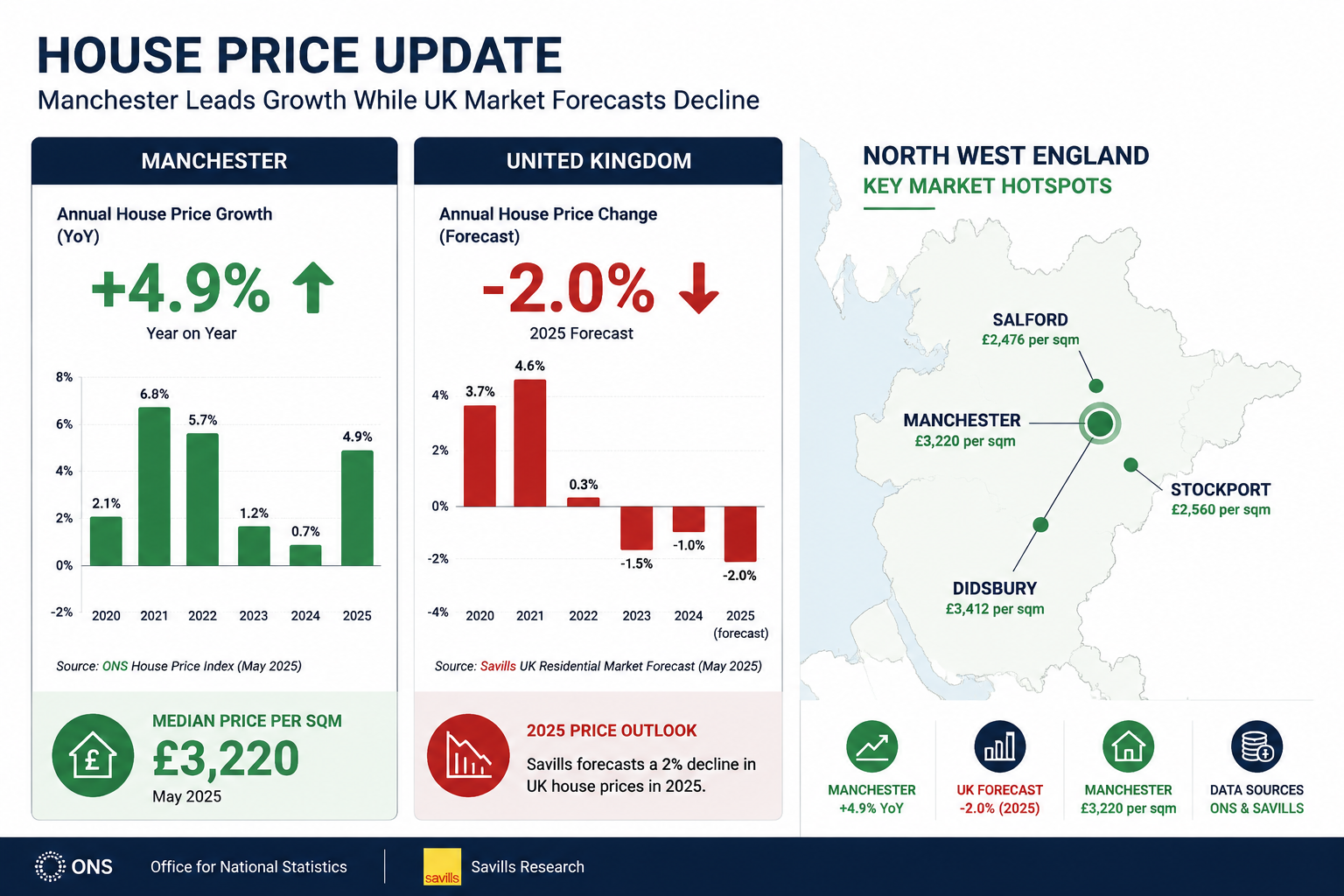
Quick Answer: Manchester's average house price reached £248,000 in March 2026, up 4.9% year-on-year according to ONS data, outpacing the UK national average by a significant margin. While Savills forecasts a -2% national correction and Deutsche Bank warns of -3% to -5% declines, Manchester and the wider North West continue to attract buyers, investors, and landlords. That sustained activity is generating strong demand for RICS-accredited surveyors across Greater Manchester, from HomeBuyer Reports on Victorian terraces to EWS1 cladding assessments on city-centre high-rises.
Key Takeaways
- Manchester's average house price is £248,000 (March 2026, ONS), with a median price of £3,220 per sq m.
- Annual growth of 4.9% outperforms the national picture; real growth after inflation is +1.6%.
- Semi-detached homes rose 3.9% YoY; flats fell 1.4% YoY, reflecting diverging sub-markets.
- First-time buyers in Manchester paid an average of £233,000; mortgage buyers averaged £254,000.
- Industry forecasters including Thornley Groves and Investropa predict a further 3-4% growth in 2026 on tight supply.
- Nationally, two-year fixed mortgage rates hit 5.68% on 1 June 2026, and supply is at its highest since 2015.
- Surveyor demand is rising for Level 2 HomeBuyer Reports, Level 3 Building Surveys, BTL valuations, EWS1 assessments, and Renters' Rights Act 2026 compliance surveys.
- The North West secured 6 of the top 10 spots in England for house price growth in 2026, per Zoopla. [1]
Table of Contents
- How Much Have Manchester House Prices Actually Increased in 2026?
- Are Manchester Property Values Dropping or Rising Right Now?
- What Average Home Price Can You Expect in Manchester Suburbs in 2026?
- How Do Manchester House Prices Compare to Liverpool and Other North West Cities?
- Which Manchester Neighbourhoods Have the Best Investment Potential?
- Which Types of Manchester Properties Are Most Likely to Appreciate in Value?
- Will First-Time Buyers Still Struggle to Purchase in Manchester in 2026?
- What Salary Do You Need to Afford an Average Manchester Home in 2026?
- What Factors Are Driving Surveyor Predictions for the North West Property Market?
- How Manchester House Prices 2026 Are Creating Surveyor Demand Across North West England
- What Risks Should You Know About Investing in Manchester Real Estate?
- What Mistakes Do People Make When Buying Property in Manchester Right Now?
- FAQ
How Much Have Manchester House Prices Actually Increased in 2026?
Manchester's average house price stood at £248,000 in March 2026, representing a 4.9% year-on-year increase, according to ONS and HM Land Registry data. After adjusting for inflation, real growth is approximately +1.6%, which still puts Manchester well ahead of most English cities.
Key price points from the ONS data:
| Buyer / Property Type | Average Price | YoY Change |
|---|---|---|
| All buyers (average) | £248,000 | +4.9% |
| First-time buyers | £233,000 | — |
| Mortgage buyers | £254,000 | — |
| Semi-detached homes | — | +3.9% |
| Flats / apartments | — | -1.4% |
| Median price per sq m | £3,220 | — |
The divergence between house types matters. Semi-detached properties are the clear winners, driven by family buyers competing for limited stock in suburban areas. Flats are under pressure, partly because of cladding uncertainty and an oversupply of new-build city-centre units. [9]
Are Manchester Property Values Dropping or Rising Right Now?
Manchester property values are rising, but the picture is nuanced. The city-wide average masks significant variation between property types, postcodes, and buyer profiles.
The broader national market tells a different story. Savills is forecasting a -2% correction by year-end 2026, and Deutsche Bank has warned of declines in the -3% to -5% range nationally. Two-year fixed mortgage rates reached 5.68% on 1 June 2026, and national housing supply is at its highest level since 2015, with almost a third of existing listings having been price-reduced. Manchester is largely insulated from these pressures because of structural undersupply and sustained inward migration, but buyers should not assume immunity across all property types.
Salford, which borders Manchester, illustrates the risk of treating the region as monolithic. Salford's average house price is £174,643, with a reported 15.7% decrease over the past year and properties taking an average of 435 days to sell, according to Appraised. [10] That contrast with central Manchester's 27-day average time-to-offer [3] underlines why postcode-level due diligence is essential.
What Average Home Price Can You Expect in Manchester Suburbs in 2026?
Suburban Greater Manchester is outperforming both the city centre and the national average. Areas like Stockport, Tameside, and the wider Greater Manchester conurbation recorded average sale prices of £246,503 over the past 12 months, with a 5.1% increase, ahead of the regional average. [2]
Suburban price benchmarks to know:
- Didsbury and Chorlton: Premium pricing driven by school catchment demand and constrained stock. [9]
- Stockport: Strong semi-detached market, popular with families priced out of south Manchester.
- Tameside: More affordable entry points, attracting first-time buyers and investors chasing yield.
- City centre (M1, M2, M3): Strong rental demand but modest capital growth due to new-build completions. [9]
For buyers comparing suburbs, the rule is straightforward: choose inner suburbs with good transport links and limited new-build pipeline if capital growth is the priority; choose outer suburbs or Tameside if yield matters more.
How Do Manchester House Prices Compare to Liverpool and Other North West Cities?
Manchester sits above the North West regional average of £209,115, but it is not the only strong performer. The North West dominated national rankings in 2026, securing 6 of the top 10 spots in England for house price growth, per Zoopla. [1] Wigan and Liverpool led on sale speed, with average times to offer of 32-33 days.
Liverpool offers lower entry prices than Manchester, making it attractive for yield-focused investors. The North West overall averages 6.8% rental yields, with Manchester's growth-led areas delivering 5.5% to 7%, and higher-risk areas like Burnley and Blackpool offering 7.5% to 9%+. [6]
For investors comparing cities, the logic is: choose Manchester if capital growth and tenant quality are priorities; choose Liverpool or Wigan if yield and faster liquidity matter more.
Which Manchester Neighbourhoods Have the Best Investment Potential?
The strongest investment potential in 2026 sits in well-connected suburban areas with constrained supply and strong rental demand. Didsbury, Chorlton, Stockport, and parts of Salford MediaCityUK are consistently cited by agents including Thornley Groves and JonSimon as areas with tight stock and steady buyer competition.
City-centre postcodes (M1-M3) carry higher risk for capital growth investors because new-build completions continue to add supply, and the flat market has declined 1.4% YoY. However, they remain viable for investors prioritising rental income, given strong graduate and professional tenant demand near Spinningfields and NOMA. [9]
A useful decision rule: if buying a flat in a high-rise block built after 2000, always commission an EWS1 assessment before proceeding. Post-Building Safety Act requirements mean lenders increasingly require this, and a missing EWS1 certificate can make a property unmortgageable.
Which Types of Manchester Properties Are Most Likely to Appreciate in Value?
Semi-detached homes are the strongest performers in 2026, up 3.9% YoY. Victorian and Edwardian terraces in inner suburbs are also holding value well, driven by character appeal and limited supply of comparable stock.
Flats, particularly in high-rise city-centre blocks, are the weakest segment at -1.4% YoY. New-build apartments face additional headwinds from service charge inflation and ongoing cladding remediation costs.
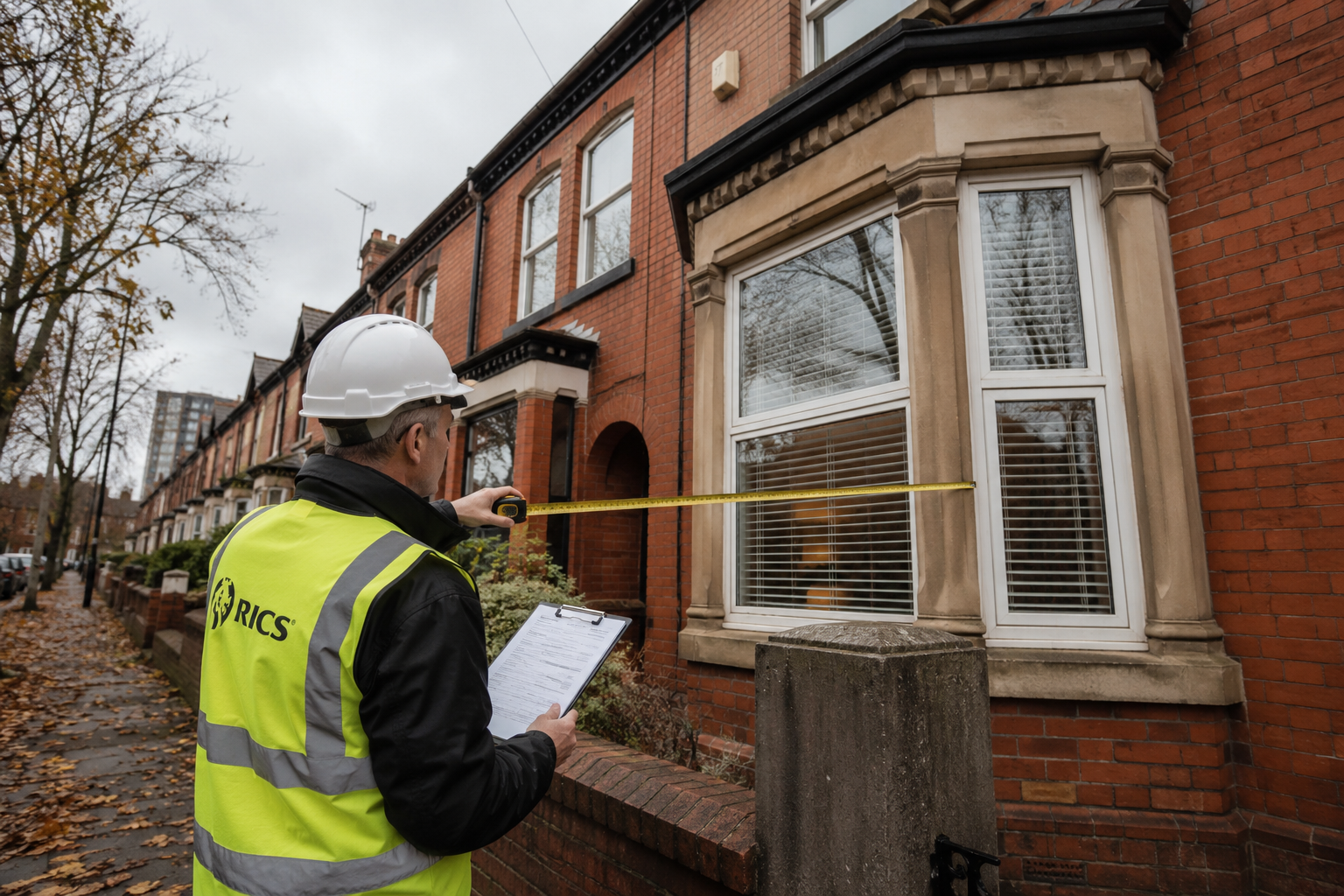
For surveyors, this translates directly into instruction types: RICS Building Surveys (Level 3) are increasingly requested on pre-1919 stock, where hidden defects including damp, subsidence, and original drainage systems create material risk. A RICS HomeBuyer Report (Level 2) remains appropriate for conventional post-1930 properties in sound condition, but buyers of Victorian terraces should always consider upgrading to a Level 3.
Will First-Time Buyers Still Struggle to Purchase in Manchester in 2026?
Yes, first-time buyers face real affordability pressure in Manchester, though conditions are less severe than in London or the South East. The ONS data puts the first-time buyer average at £233,000, which requires a household income of roughly £58,000-£65,000 to pass standard mortgage affordability checks at current rates.
With two-year fixed rates at 5.68% as of 1 June 2026, monthly repayments on a £186,400 mortgage (75% LTV on a £233,000 property) would be approximately £1,180-£1,220 per month, before accounting for service charges or ground rent on leasehold properties.
First-time buyers in Tameside and parts of Oldham face a more accessible market, with entry prices closer to the regional average of £209,115. [2] Those targeting Didsbury or Chorlton will need considerably larger deposits or higher joint incomes.
What Salary Do You Need to Afford an Average Manchester Home in 2026?
At a Manchester average of £248,000 and a standard 4.5x income mortgage multiple, a single buyer would need an income of approximately £55,000. A couple buying jointly could manage on a combined income of around £45,000-£50,000, assuming a 10-15% deposit.
For first-time buyers at £233,000, the income threshold drops slightly: roughly £52,000 solo or £42,000-£46,000 jointly. These figures assume no significant existing debt and standard lender stress-testing at current rates.
The practical implication: a large share of Manchester's workforce, particularly those in hospitality, retail, and early-career professional roles, remains priced out of ownership without family support or shared ownership schemes.
What Factors Are Driving Surveyor Predictions for the North West Property Market?
Manchester house prices 2026 surveyor demand across North West England is being shaped by several converging forces. Industry forecasters including Thornley Groves, TKPG, Investropa, and JonSimon are projecting a further 3-4% price growth through the remainder of 2026, citing tight supply and steady demand as the primary drivers.
Key factors:
- Structural undersupply: Manchester has consistently failed to build enough homes to meet population growth and household formation rates.
- Inward migration: The city continues to attract graduates, young professionals, and businesses relocating from London and the South East.
- Buy-to-let investor activity: Rental yields of 5.5-7% in Manchester's growth areas attract landlords, particularly as they adapt to Renters' Rights Act 2026 compliance requirements. [6]
- Post-Building Safety Act demand: EWS1 assessments and cladding surveys on high-rise blocks are now a legal and commercial necessity, not an optional extra.
- Victorian stock complexity: A large proportion of Greater Manchester's housing stock predates 1919. Surveyors in Northern England are adapting valuation techniques to account for consistent upward price trends in this segment. [7]
Surveyors are also seeing growing demand for RICS Red Book valuations from BTL investors refinancing portfolios and from landlords needing formal valuations for Renters' Rights Act compliance documentation.
How Manchester House Prices 2026 Are Creating Surveyor Demand Across North West England
The sustained strength of Manchester house prices 2026 is directly translating into surveyor demand across North West England. When transaction volumes hold up and prices rise, survey instructions follow: buyers commission more reports, lenders require more valuations, and landlords need compliance documentation.
The specific survey types in demand right now:
- RICS Level 2 HomeBuyer Reports: The default choice for buyers of conventional post-1930 properties. Demand is rising as more buyers enter the market with mortgage offers in hand. See how to choose the right survey for your property type.
- RICS Level 3 Building Surveys: Essential for Victorian and pre-1919 terraces and semis. Greater Manchester has an exceptionally high proportion of this stock, and an RICS chartered building surveyor can identify structural defects, damp, and drainage issues that a Level 2 report would not capture.
- BTL valuations: Buy-to-let investors refinancing or expanding portfolios need formal RICS valuations to satisfy lender requirements. The North West's 6.8% average rental yield is drawing significant investor activity. [6]
- EWS1 and cladding assessments: Post-Building Safety Act, high-rise flat owners and buyers in Manchester city centre require EWS1 certificates. Without one, mortgage finance is frequently unavailable.
- Renters' Rights Act 2026 compliance surveys: Greater Manchester's large private rented sector (PRS) is generating demand for condition reports and schedule of condition documentation as landlords prepare for new regulatory obligations.
- Damp surveys: Manchester's climate and Victorian building stock make damp surveys a frequent instruction, particularly on terraced properties with solid walls and no cavity insulation.
Manchester's commercial property market, including Spinningfields and NOMA, has also created substantial demand for building surveyors and facilities managers, with salaries ranging from £28,000 for graduate surveyors to £70,000 for senior roles. [5]
For anyone commissioning a survey, understanding what a Manchester surveyor looks for during a property inspection is a useful starting point before booking.
What Risks Should You Know About Investing in Manchester Real Estate?
Manchester's outperformance is real, but it is not risk-free. The key risks for 2026 investors are:
- Mortgage rate sensitivity: At 5.68% on two-year fixes, borrowing costs are materially higher than in 2021-2022. Yields that looked attractive at 3% rates are thinner now.
- Flat market weakness: The -1.4% YoY decline in flats is not just a blip. Cladding remediation costs, service charge inflation, and leasehold reform uncertainty are structural headwinds.
- Salford volatility: Salford's 15.7% price decline and 435-day average sale time [10] illustrate that not all Greater Manchester postcodes share Manchester city's trajectory.
- Regulatory costs: Renters' Rights Act 2026 imposes new obligations on landlords. Non-compliance risks fines and reputational damage. Survey and compliance costs need to be factored into yield calculations.
- National market contagion: If Savills' -2% national forecast materialises and sentiment shifts, Manchester is not entirely insulated, particularly at the higher end of the market.
What Mistakes Do People Make When Buying Property in Manchester Right Now?
The most common and costly mistakes in the current Manchester market:
- Skipping or downgrading the survey. Buyers tempted to save money by choosing a Level 1 Condition Report on a Victorian terrace are taking a significant risk. Pre-1919 properties frequently have hidden defects that only a Level 3 Building Survey will identify.
- Treating all Greater Manchester postcodes as equivalent. The gap between Manchester city's 27-day average time-to-offer [3] and Salford's 435-day average [10] is enormous. Research at postcode level, not city level.
- Ignoring EWS1 requirements on flats. Buyers of high-rise flats who do not confirm EWS1 status before exchange risk being unable to obtain mortgage finance or sell the property later.
- Underestimating landlord compliance costs. The Renters' Rights Act 2026 adds regulatory obligations that affect net yield. Factor in survey and compliance costs before calculating returns.
- Assuming new-build means no survey needed. New builds can have defects. A snagging survey or RICS specific defect report protects buyers before the developer's warranty period begins.
FAQ
What is the average house price in Manchester in 2026?
The ONS recorded Manchester's average house price at £248,000 in March 2026, up 4.9% year-on-year. First-time buyers paid an average of £233,000; mortgage buyers averaged £254,000.
Are Manchester house prices likely to keep rising through 2026?
Industry forecasters including Thornley Groves, TKPG, Investropa, and JonSimon project a further 3-4% growth for 2026, based on tight supply and steady demand. This contrasts with Savills' -2% national forecast and Deutsche Bank's -3% to -5% warning for the UK overall.
What type of survey do I need for a Victorian terrace in Manchester?
A RICS Level 3 Building Survey is strongly recommended for any pre-1919 property. Victorian terraces in Greater Manchester frequently have issues with damp, original drainage, structural movement, and inadequate insulation that a Level 2 HomeBuyer Report may not fully capture.
Do I need an EWS1 certificate to buy a Manchester flat?
If the flat is in a building over 11 metres tall (or in some cases lower), lenders will typically require an EWS1 certificate confirming the external wall system is safe. Without one, mortgage finance can be refused. Always check EWS1 status before exchanging contracts on a city-centre flat.
What rental yields can investors expect in Manchester in 2026?
Manchester's growth-led areas deliver rental yields of 5.5% to 7%. The North West overall averages 6.8%, with higher-risk areas like Burnley and Blackpool offering 7.5% to 9%+, according to Property Kiln. [6]
What does the Renters' Rights Act 2026 mean for Greater Manchester landlords?
The Act introduces new compliance obligations for private landlords, including stricter standards for property condition. Greater Manchester's large PRS is generating demand for schedule of condition reports and compliance surveys. Landlords who do not document property condition before new tenancies risk disputes and financial penalties.
Conclusion
Manchester's property market in 2026 is one of the clearest examples of regional divergence in the UK. While the national picture is softening under the weight of elevated mortgage rates, record supply levels, and cautious buyer sentiment, Manchester is posting 4.9% annual price growth, a median price of £3,220 per sq m, and average sale times of 27 days. That strength is not uniform across all property types or postcodes, but it is real and measurable.
For surveyors and property professionals, this environment represents a sustained period of elevated demand. The combination of active transactions, a large Victorian housing stock, post-Building Safety Act cladding requirements, and Renters' Rights Act 2026 compliance obligations is creating a broad and growing market for RICS-accredited services across Greater Manchester and the wider North West.
Actionable next steps:
- If buying a Victorian or pre-1919 property, commission a RICS Level 3 Building Survey before exchange.
- If buying a city-centre flat, confirm EWS1 status and obtain a formal RICS valuation to protect your position.
- If you are a landlord, review Renters' Rights Act 2026 obligations and document property condition with a schedule of condition report.
- If you are an investor, compare survey pricing and factor compliance costs into your yield calculations before committing.
- If you are unsure which survey is right for your property, use the survey selector guide to match your needs to the correct RICS product.
References
[1] 2026 House Price Growth How Does Your Postcode Stack Up – https://www.zoopla.co.uk/discover/property-news/2026-house-price-growth-how-does-your-postcode-stack-up/?utm_source=openai
[2] edwardmellor.co.uk – https://edwardmellor.co.uk/?s=sales&utm_source=openai
[3] Manchester – https://www.appraised.uk/property-market/manchester?utm_source=openai
[4] Manchester August 2025 Sales Market Update What Does Falling Buyer Prices Mean For Your Propertys Value – https://www.mhhg-estateagents.co.uk/all-articles/manchester-august-2025-sales-market-update-what-does-falling-buyer-prices-mean-for-your-propertys-value?utm_source=openai
[5] North West – https://yprecruit.co.uk/sectors/property-services/north-west/?utm_source=openai
[6] Btl Yields North West – https://propertykiln.co.uk/guide/btl-yields-north-west?utm_source=openai
[7] Northern England Property Valuations 2026 Surveyor Techniques For Upward Price Trends In Recovering Markets – https://princesurveyors.co.uk/blog/northern-england-property-valuations-2026-surveyor-techniques-for-upward-price-trends-in-recovering-markets/?utm_source=openai
[8] North West Surveyors – https://www.coreconsultuk.com/north-west-surveyors?utm_source=openai
[9] Manchester House Prices May 2026 North West Uk Property Growth Leads The Nation – https://manchestersurveyors.com/manchester-house-prices-may-2026-north-west-uk-property-growth-leads-the-nation/?utm_source=openai
[10] Salford – https://www.appraised.uk/property-market/salford?utm_source=openai