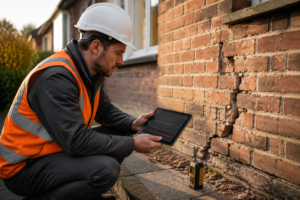
Roughly 40% of party wall disputes in England and Wales stem from disagreements about whether damage existed before construction work began or was caused by it [2]. Now add fibre broadband retrofit programmes racing through millions of terraced homes and apartment blocks, and that dispute risk multiplies sharply. Understanding the correct building survey protocols for fibre broadband retrofits: defect risks and party wall overlaps in 2026 is no longer a niche concern for specialist surveyors — it is a practical necessity for every property professional involved in high-speed internet upgrades.
This article guides surveyors, building owners, and property managers through the key inspection steps, defect risks, and legal triggers that arise when fibre cables are installed in shared or adjoining structures.
Key Takeaways
- Fibre broadband retrofits can trigger the Party Wall etc. Act 1996 when groundworks or wall penetrations affect shared structures in multi-unit buildings.
- A comprehensive schedule of condition, completed before any installation work begins, is the single most effective tool for preventing post-installation disputes.
- Thermal imaging is now a standard diagnostic tool under RICS 8th Edition protocols for detecting hidden defects around cable penetrations and party walls.
- Level 3 Building Surveys are strongly recommended for older or non-standard construction properties undergoing fibre retrofit works.
- Surveyors must inspect rear facades, basements, and party wall junctions — areas routinely missed in pre-construction documentation.
Why Fibre Broadband Retrofits Create Unique Survey Challenges
The UK government's target to deliver gigabit-capable broadband to the majority of premises has accelerated installation activity across the country's ageing housing stock. Many of these properties — Victorian terraces, Edwardian semis, converted flats — were never designed with data infrastructure in mind. Installers must route cables through walls, floors, and ceilings, often penetrating structures that are shared between neighbouring properties.
This creates a specific set of risks that standard broadband surveys were never designed to capture:
- Structural penetrations through load-bearing walls or party walls
- Moisture ingress pathways created by poorly sealed cable entry points
- Concealed pre-existing defects exposed or worsened during drilling
- Vibration damage to fragile historic masonry from drilling activity
- Inadequate fire stopping where cables pass through compartment walls
Properties with non-standard construction methods require particular attention. Altered or converted buildings may have concealed voids, unusual wall compositions, or previous modifications that make cable routing unpredictable and potentially damaging [6]. A Level 3 Building Survey is the appropriate starting point for any property where the construction type is uncertain or where previous alterations have been carried out.
"The cable route is only as safe as the wall it passes through. Surveyors must understand the full construction history of a property before any drilling begins."
Core Building Survey Protocols for Fibre Broadband Retrofits: Defect Risks and Party Wall Overlaps in 2026
Pre-Installation Inspection: The Schedule of Condition
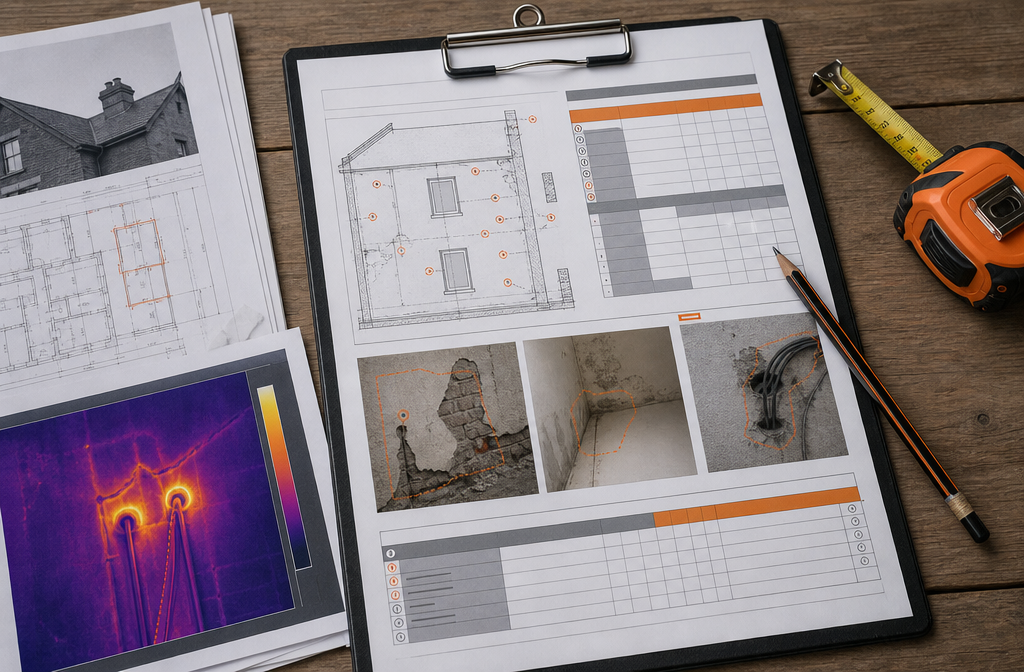
The most critical document in any fibre retrofit project is the schedule of condition. This is a detailed photographic and written record of the property's state before work commences. Given that approximately 40% of party wall disputes arise from arguments over pre-existing versus construction-related damage [2], this document carries significant legal weight.
A robust schedule of condition for a fibre retrofit should cover:
| Area | What to Document |
|---|---|
| Party walls (both sides) | Existing cracks, staining, damp patches, previous repairs |
| Cable entry points | Wall surface condition, any existing holes or conduits |
| Rear facades | Pointing condition, render cracks, window reveals |
| Basements and sub-floor voids | Moisture levels, existing structural movement |
| Ceilings and floors | Evidence of previous water damage, deflection |
| Communal areas (flats) | Shared corridor walls, riser ducts, fire stopping |
Research consistently shows that rear facades, basements, and party walls are the areas most frequently omitted from pre-construction surveys, leading to avoidable disputes later [4]. A schedule of condition report commissioned before installation work begins provides a defensible baseline for all parties.
Thermal Imaging as a Diagnostic Standard
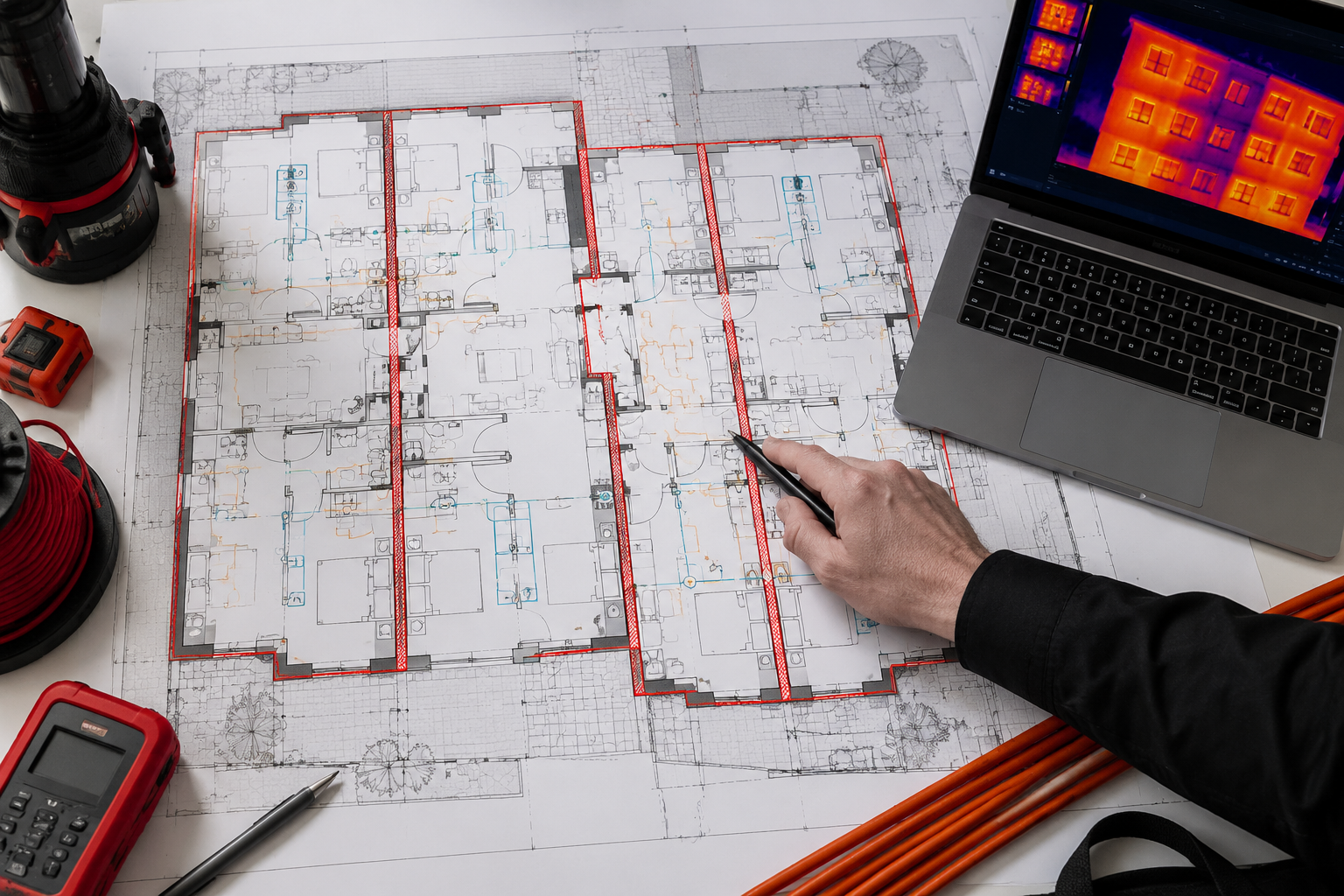
RICS 8th Edition protocols now actively support the use of thermal imaging cameras in party wall surveys and pre-construction inspections [1]. This technology has become particularly valuable in fibre broadband retrofit contexts for several reasons.
Thermal imaging can detect:
- Hidden moisture behind wall finishes at proposed cable entry points
- Voids and cavities in party walls that could be compromised by drilling
- Cold bridges that indicate structural discontinuities
- Previous repair patches that may not be visible to the naked eye
For listed buildings, conservation areas, and older masonry construction, thermal imaging is especially beneficial because it is entirely non-invasive [1]. Surveyors can identify problem areas without causing any damage to the fabric of the building — a critical consideration when working near protected structures.
The 2026 protocols advocate for thermal imaging surveys to be carried out before any excavation or penetration work begins, providing clear photographic evidence of a wall's condition prior to the installation team arriving on site [9].
Identifying Cable-Related Defect Risks
When inspecting a property for a fibre retrofit, surveyors should focus on four primary defect categories:
1. Penetration Damage
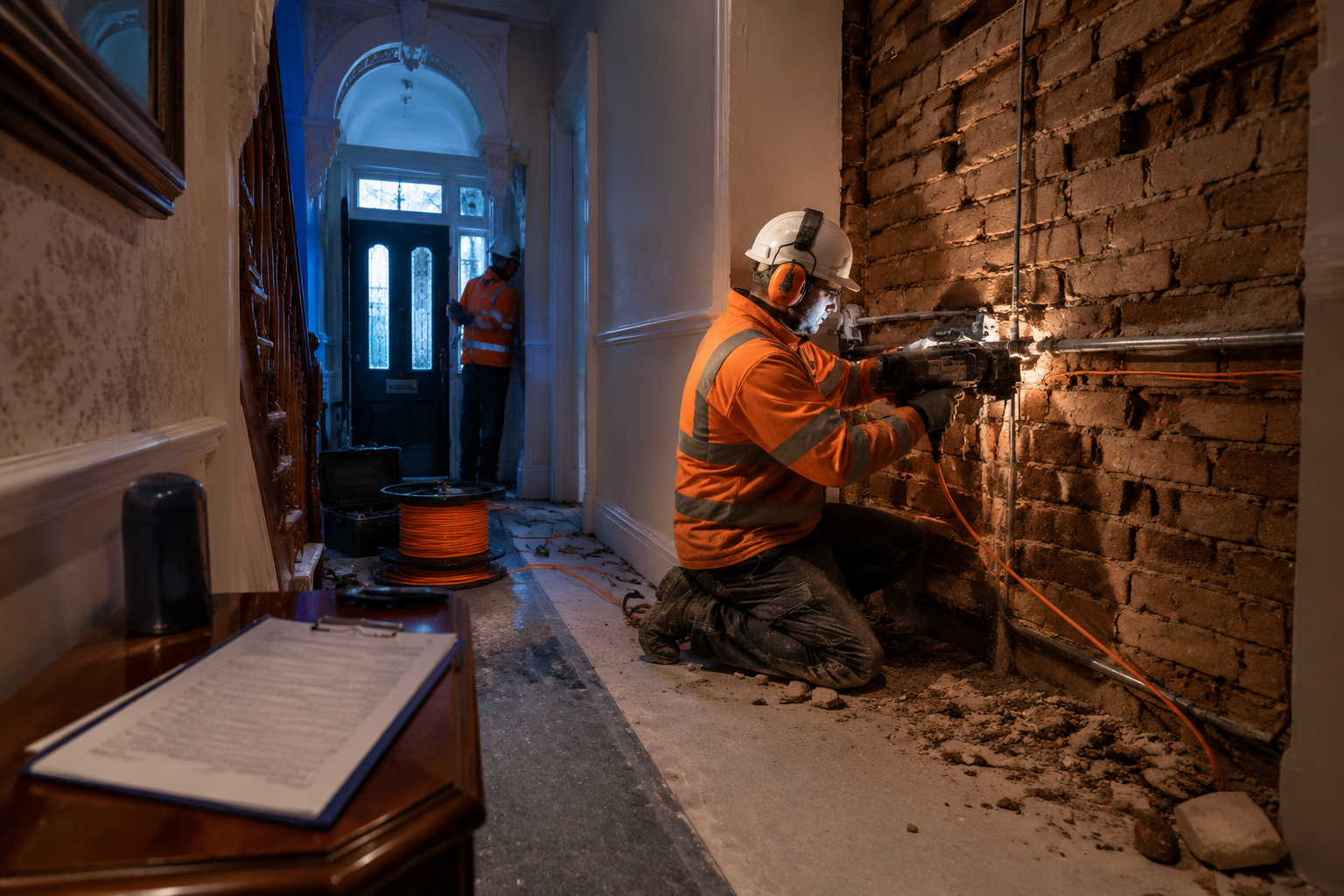
Drilling through masonry, particularly older lime mortar joints, can cause micro-fractures that propagate over time. In party walls, this vibration can loosen pointing on the neighbour's side — damage that may not become visible for months.
2. Moisture Ingress
Any new penetration through an external or party wall creates a potential water pathway. Poorly sealed cable entry points are a common source of damp complaints in the months following installation. Surveyors should assess the existing waterproofing strategy for the wall and specify appropriate sealant requirements.
3. Fire Compartmentation Breaches
In converted flats and multi-unit buildings, cables often pass through walls and floors that form part of the building's fire compartmentation strategy. Breaching these without appropriate fire-stopping materials is a serious building regulations compliance issue.
4. Structural Interference
In rare but significant cases, installers have routed cables through walls containing concealed structural elements — lintels, padstones, or reinforcement. A specific defect survey can identify these risks before drilling begins.
Party Wall Act Triggers in Multi-Unit Fibre Installations
When Does the Party Wall etc. Act 1996 Apply?
The Party Wall etc. Act 1996 is the primary legislation governing works that affect shared walls and structures in England and Wales [8]. Many property owners and even some contractors are surprised to discover that fibre broadband installations can trigger its requirements.
The Act is most likely to apply in the following retrofit scenarios:
- Groundworks for external duct runs within three metres of a neighbouring building, where the excavation depth exceeds the neighbour's foundation depth [3]
- Notifiable works to a party wall, including cutting into the wall to insert cable conduits or junction boxes
- Works to a party fence wall where surface-mounted cable routes are fixed to the shared structure
The three-metre rule under the Act is particularly relevant for fibre installations that involve external duct runs or new service entry points at ground level [3]. If any excavation is required — even shallow trenching for external duct routes — surveyors must assess whether the works fall within the statutory distance from the neighbouring property's foundations.
Serving Notice: The Correct Process
Where the Party Wall etc. Act applies, the building owner (or the party commissioning the installation) must serve formal notice on all adjoining owners before work begins. Failure to do so can result in injunctions halting the works and significant legal costs.
Key notice requirements:
- Party Structure Notice: Required at least two months before works begin when notifiable works to a party wall are planned
- Line of Junction Notice: Required at least one month before works begin for new structures at or astride the boundary
- Three-Metre Notice (Section 6): Required at least one month before excavation works within three metres of an adjoining structure
For properties in converted buildings or purpose-built flats, the question of who qualifies as an "adjoining owner" can be complex. Leaseholders, freeholders, and management companies may all have relevant interests. Surveyors should consult detailed party wall guidance to ensure all parties are correctly identified and notified.
The Schedule of Condition and Party Wall Awards
Where a party wall surveyor is appointed, the Party Wall Award will typically include a schedule of condition as an annexed document. This schedule forms the evidential basis for any damage claims made after the works are complete.
For fibre retrofit projects, the schedule should specifically record:
- The condition of all wall surfaces on both sides of the party wall
- Any existing cracks, with measurements and photographs
- The condition of mortar joints at the proposed penetration points
- Moisture readings taken with a calibrated damp meter
Understanding damage to property in party wall scenarios is essential for surveyors preparing these documents. Without a thorough pre-works record, attributing responsibility for any post-installation damage becomes extremely difficult.
Specific Inspection Protocols for Different Property Types
Victorian and Edwardian Terraces
These properties present the highest concentration of party wall risk in fibre retrofit programmes. Solid brick construction, lime mortar joints, and shared chimney stacks all create complications for cable routing.
Surveyors inspecting these properties should:
- Check the condition of mortar joints at all proposed penetration points
- Assess whether chimney breast removal has occurred (a common source of hidden structural weakness)
- Identify any previous cable or pipe penetrations and assess their current condition
- Review the party wall insulation status, as retrofit insulation works may have already altered the wall composition
Converted Flats and Purpose-Built Apartment Blocks
Multi-unit buildings introduce additional complexity because fibre cables typically need to travel through communal risers, ceiling voids, and shared corridors before reaching individual units.
Key inspection considerations:
- Identify the building's existing riser duct locations and capacity
- Assess fire stopping condition at all floor penetrations
- Review the lease to understand obligations regarding alterations to the structure
- Confirm whether a managing agent or freeholder consent is required before works begin
For commercial properties or larger residential blocks, a commercial building survey may be appropriate to assess the full scope of infrastructure requirements.
New Build and Modern Construction
While newer properties generally present fewer hidden defect risks, they introduce different challenges. Lightweight steel frame or timber frame construction requires careful attention to:
- Vapour control layer integrity at cable penetrations
- Acoustic performance of separating walls (drilling can compromise sound insulation)
- Manufacturer warranty conditions, which may be voided by unauthorised penetrations
Common Mistakes Surveyors Must Avoid
The most frequently cited errors in pre-installation survey documentation share a common theme: incomplete coverage [4]. The following checklist highlights the areas most often missed:
- Rear facades and back additions (particularly in terraced properties with rear extensions)
- Sub-floor voids and basement walls
- The neighbour's side of the party wall (where access can be arranged)
- Loft spaces and roof voids where cables may be routed
- Existing service penetrations that could be enlarged or re-used
RICS guidance on residential retrofits also emphasises the need to assess potential consequences of installation works, including increased moisture levels and ventilation disruption [5]. A fibre cable installation that seals an existing air brick or ventilation opening, for example, could create damp conditions that emerge long after the installer has left site.
Surveyors should also be alert to the risk of obstruction in party wall situations, where the physical routing of cables creates access issues for future maintenance or repair of the shared structure.
Conclusion
The convergence of national fibre rollout programmes and the UK's ageing housing stock has created a genuine gap between installation speed and survey rigour. Addressing building survey protocols for fibre broadband retrofits: defect risks and party wall overlaps in 2026 requires surveyors to combine traditional building pathology skills with an updated understanding of Party Wall Act triggers and modern diagnostic tools.
Actionable next steps for surveyors and property owners:
- Commission a schedule of condition from a qualified RICS surveyor before any fibre installation work begins, paying particular attention to party walls, rear facades, and basement areas.
- Use thermal imaging as standard practice for any property where hidden defects are suspected or where the construction type is uncertain.
- Assess whether the proposed cable route triggers the Party Wall etc. Act 1996, particularly where groundworks or wall penetrations are involved in multi-unit buildings.
- Ensure fire stopping and moisture sealing specifications are included in the installation brief, not left to the installer's discretion.
- For older, converted, or non-standard construction properties, commission a full building survey before works commence to identify hidden structural risks.
Working with an RICS Chartered Building Surveyor who understands both the technical and legal dimensions of retrofit works is the most reliable way to protect all parties involved — from the property owner to the adjoining neighbour.
References
[1] Thermal Imaging Applications In Party Wall Surveys Rics 8th Edition Protocols For Hidden Defect Detection – https://wimbledonsurveyors.com/thermal-imaging-applications-in-party-wall-surveys-rics-8th-edition-protocols-for-hidden-defect-detection/?utm_source=openai
[2] Schedules Of Condition In Party Wall Agreements Best Practices For 2026 Pre Work Documentation – https://partywallsurveyorlondon.uk/blogs/schedules-of-condition-in-party-wall-agreements-best-practices-for-2026-pre-work-documentation/?utm_source=openai
[3] Knowledge Article Party Wall Act 3 Metre Rule – https://www.aylingassociates.com/knowledge-article-party-wall-act-3-metre-rule.html?utm_source=openai
[4] Common Pitfalls In Existing Conditions Documentation And How To Avoid Them – https://saltusllc.com/common-pitfalls-in-existing-conditions-documentation-and-how-to-avoid-them/?utm_source=openai
[5] Energy Efficiency Retrofits In Cautious 2026 Markets Valuation Impacts And Building Survey Protocols Under Rics Guidance – https://princesurveyors.co.uk/blog/energy-efficiency-retrofits-in-cautious-2026-markets-valuation-impacts-and-building-survey-protocols-under-rics-guidance/?utm_source=openai
[6] Non Standard Construction And Building Surveys Identifying Hidden Risks In Converted And Altered Properties – https://princesurveyors.co.uk/blog/non-standard-construction-and-building-surveys-identifying-hidden-risks-in-converted-and-altered-properties/?utm_source=openai
[7] Party Wall Surveying For Rear Extensions And Side Returns The Real Structural Risks Behind Routine Works – https://nottinghillsurveyors.com/blog/party-wall-surveying-for-rear-extensions-and-side-returns-the-real-structural-risks-behind-routine-works?utm_source=openai
[8] Party Walls – https://www.rics.org/consumer-guides/party-walls?utm_source=openai
[9] Thermal Imaging Revolution In Party Wall Surveys 2026 Protocols For Detecting Hidden Defects Before Excavations – https://nottinghillsurveyors.com/blog/thermal-imaging-revolution-in-party-wall-surveys-2026-protocols-for-detecting-hidden-defects-before-excavations?utm_source=openai