
A single instructing decision — whether to appoint a joint expert or a party-appointed surveyor — can shift the total cost of a property dispute by tens of thousands of pounds. In boundary disputes alone, using separate party-appointed experts can push combined costs to between £20,000 and £30,000, while a single joint expert (SJE) can cap shared fees at roughly £5,000 to £10,500 [1]. That gap is not a technicality. It is the difference between a proportionate resolution and a financially ruinous legal battle.
Understanding Joint Expert vs Party-Appointed Expert Surveyors: How Instructing Choices Shape Property Disputes and Costs is therefore essential for anyone facing a valuation dispute, a building defect claim, or a party wall disagreement. The choice of instruction model shapes not only what is spent, but how quickly a matter resolves, how courts perceive the evidence, and whether a surveyor's opinion carries the weight it needs to carry.

Key Takeaways
- Appointing a single joint expert (SJE) can reduce shared expert costs by 50% to 75% compared with separate party-appointed surveyors in lower-value disputes.
- Courts in England and Wales increasingly direct parties toward SJEs in claims where proportionality demands it, particularly under CPR Part 35.
- Party-appointed experts remain valuable in complex, high-value disputes where competing methodologies and detailed technical scrutiny are genuinely necessary.
- All expert surveyors — whether jointly or separately instructed — owe their primary duty to the court, not to the instructing party, under RICS standards and CPR rules.
- Early instruction of a qualified surveyor, before positions harden, consistently produces better outcomes and lower overall costs.
What the Two Instruction Models Actually Mean
Before weighing the pros and cons, it is worth being precise about what each model involves.
A Single Joint Expert (SJE) is appointed by agreement between both parties — or directed by the court — to provide one independent report that both sides share. The SJE answers questions from both parties, attends any required hearings, and is paid jointly. The expert's overriding duty is to the court [6].
A party-appointed expert is instructed by one side only. That expert still owes a duty to the court under CPR Part 35, but is engaged, briefed, and paid by a single party. Where both sides appoint their own expert, the result is two separate reports that may reach very different conclusions — and a court that must decide which to prefer, or find a middle ground.
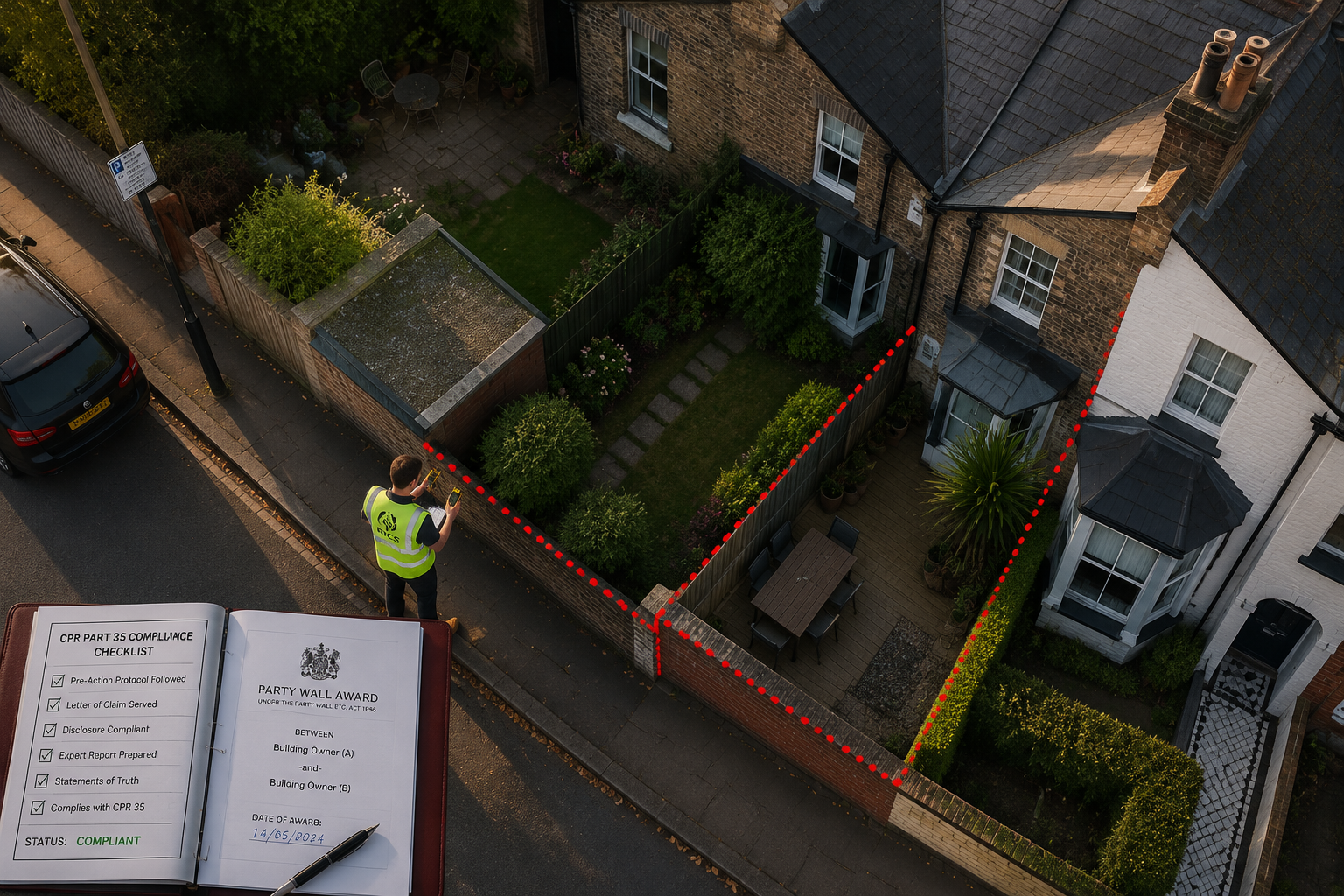
A third model exists under the Party Wall etc. Act 1996: the agreed surveyor. This is a single surveyor appointed by consent to act for both the building owner and the adjoining owner in producing a party wall award. It is distinct from an SJE in litigation, but shares the same principle of shared instruction and cost efficiency [7].
The Case for Single Joint Expert Surveyors
Cost Efficiency and Proportionality
The financial argument for SJEs is compelling. Courts apply a strict proportionality principle: the cost of expert evidence must bear a reasonable relationship to the value of the claim [4]. In lower-value disputes — a boundary disagreement over a strip of land worth £15,000, for example — instructing two separate experts at £8,000 to £15,000 each makes the expert costs alone dwarf the subject matter.
An SJE sidesteps this problem. Shared fees mean shared costs, and a well-scoped joint instruction can resolve many standard valuation or defect disputes within a budget that leaves room for the parties to actually benefit from the outcome.
Under the Party Wall etc. Act 1996, the agreed surveyor model produces similar savings. Research indicates it reduces costs by 25% to 35% compared with separate appointments and typically speeds up the award process [7]. For disputes involving damage to property in party wall situations, this efficiency gain is significant.
Perceived Impartiality and Court Reception
Courts and tribunals respond well to SJE evidence. Because the expert has no single-party paymaster to satisfy, their opinion is perceived as genuinely independent [3]. Judges are less likely to spend time scrutinising the methodology of an SJE's report for signs of partisan bias. In straightforward valuation disputes or standard defect assessments, this can translate directly into shorter hearings and clearer outcomes.
Streamlined Proceedings
Where both parties rely on the same expert, there is no "battle of the experts" at trial. There are no competing reports to reconcile, no cross-examination designed to undermine a rival surveyor's credentials, and no need for a joint statement of agreed and disagreed issues (though the court may still require one). Proceedings move faster, and the risk of irreconcilable technical positions is eliminated [3].
The Case for Party-Appointed Expert Surveyors
Complex and High-Value Disputes
Not every dispute suits a single shared expert. In complex or high-value cases — major structural defect claims, large commercial valuations, or disputes involving novel legal questions — courts may permit or even encourage party-appointed experts precisely because the issues require detailed, competing analysis [2].
When a dispute turns on which valuation methodology is correct, or whether a specific defect was caused by the building owner's works or pre-existing conditions, having two experts who have each examined the evidence independently and reached their own conclusions can genuinely assist the court. The judge benefits from hearing two rigorous, methodologically distinct analyses rather than one that may have been unconsciously shaped by the need to appear balanced.
For cases involving expert witness services in high-value litigation, a party-appointed surveyor with deep specialism in the precise issue in dispute may be the only appropriate choice.
Control Over Instruction and Scope
A party-appointed expert can be briefed more precisely on the specific issues that matter to that party's case. The instructing solicitor can work closely with the surveyor to ensure the report addresses every technical point the party intends to rely on. With an SJE, both parties submit questions, and the expert must address all of them — which can dilute focus or produce a report that satisfies neither side fully.
Strategic Advantages in Negotiation
Before proceedings are formally issued, a party-appointed surveyor's report can serve as a powerful negotiating tool. A well-evidenced expert opinion, prepared by a credible RICS-qualified surveyor, can shift the other party's position and prompt settlement without litigation. This pre-litigation use of party-appointed expertise is entirely legitimate and often underused.
How Instructing Choices Shape Property Disputes and Costs: A Practical Comparison
The table below summarises the key differences between the two instruction models across the most common dispute types.
| Factor | Single Joint Expert | Party-Appointed Expert |
|---|---|---|
| Cost (typical range) | £5,000 – £10,500 shared [1] | £20,000 – £30,000 combined [1] |
| Court preference | Strongly favoured in lower-value claims [2] | Permitted in complex/high-value claims [2] |
| Perceived impartiality | High – no single paymaster [3] | Subject to scrutiny for bias |
| Control over scope | Limited – both parties submit questions | High – instructing party directs scope |
| Speed of resolution | Generally faster | Can extend proceedings |
| Best suited for | Boundary disputes, standard valuations, defect claims under £100,000 | Complex structural claims, large commercial disputes, novel legal issues |
| CPR Part 35 compliance | Required [6] | Required [6] |
CPR Part 35 and the Overriding Duty to the Court
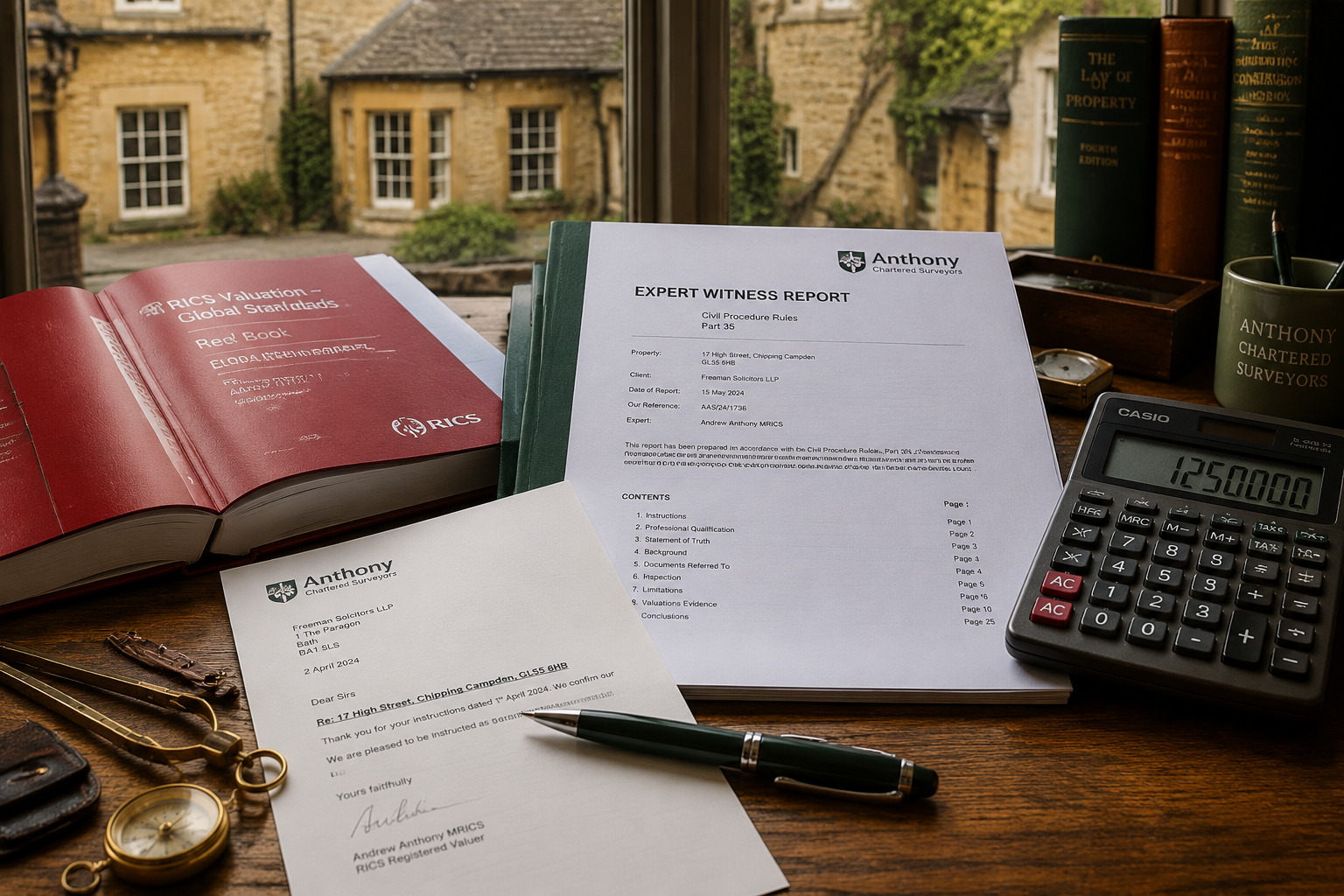
Regardless of instruction model, every expert surveyor operating in English and Welsh court proceedings must comply with CPR Part 35. This rule is unambiguous: the expert's duty is to the court, not to the party that instructed or is paying them [6].
In practice, this means:
- The report must contain a declaration of truth and a statement of the expert's understanding of their duty to the court.
- The expert must disclose any conflict of interest, including prior involvement in the same matter in a different capacity.
- The expert must be willing to discuss their report with the opposing expert and produce a joint statement of agreed and disagreed issues if directed.
- The expert must not act as an advocate for their instructing party.
RICS standards reinforce these obligations. The RICS 5th edition guidance on expert witnesses requires surveyors to maintain impartiality and comply with procedural rules regardless of whether they are party-appointed or jointly instructed [6]. A particularly important point for 2026 practice: surveyors who previously acted in a party wall capacity on the same dispute must fully disclose this prior involvement and assess whether it creates a material conflict before accepting an expert witness instruction [8].
Party Wall Disputes: A Special Case
Party wall disputes sit at an interesting intersection of the two models. Under the Party Wall etc. Act 1996, the agreed surveyor functions similarly to an SJE — one professional, shared cost, independent award. Where parties cannot agree on a single surveyor, each appoints their own, and those two surveyors then appoint a third as umpire if they cannot agree.
When a party wall dispute escalates to court proceedings — for example, where a neighbour has carried out works without a party wall agreement or where no party wall notice was served — the litigation expert witness question arises separately from the party wall surveyor question.
A full CPR-compliant expert witness report for a party wall dispute in 2026 typically ranges from £2,500 to £8,000 or more, depending on complexity and whether court attendance is required [4]. The average hourly rate for expert witnesses has risen to approximately £465 in 2026, reflecting increased demand and the growing complexity of property disputes [8].
Property valuations in party wall damage claims must now also account for climate-related risk factors, including flood exposure and energy efficiency ratings, when calculating diminution in value [8]. This adds a layer of technical complexity that can make party-appointed expertise — with its deeper specialism — more appropriate than a joint instruction in some damage claims.
The Bias Question: Real Risk or Overstated Concern?
One of the most persistent criticisms of party-appointed experts is that they are inherently biased toward the party that pays them. The concern is not entirely unfounded. Research and judicial commentary have noted that party-appointed experts sometimes shade their opinions — consciously or otherwise — in favour of their instructing party.
However, the picture is more nuanced than a simple "joint good, party-appointed bad" narrative.
A skilled, RICS-qualified party-appointed surveyor who understands their CPR duty and their professional obligations will produce a report that withstands cross-examination precisely because it is honest about the limits of the evidence and the range of defensible opinions. A report that overstates the instructing party's case will be demolished in court and will damage the instructing party's credibility far more than a balanced report would.
The real risk of bias is not in the instruction model itself — it is in the selection of an expert who lacks the professional integrity or the technical depth to resist pressure from an instructing party. Choosing a RICS Chartered Building Surveyor with a demonstrable track record in expert witness work mitigates this risk substantially.
When to Instruct Early — and Why It Matters
Early instruction of a qualified surveyor — before legal positions harden and litigation costs begin to escalate — consistently produces better outcomes in property disputes [5]. This applies to both instruction models.
For parties considering an SJE, early agreement on a joint instruction avoids the adversarial dynamic that develops once solicitors have exchanged letters of claim. For parties who need their own expert, early instruction allows the surveyor to inspect the property before evidence is disturbed, to review documents before they are selectively disclosed, and to advise on the strength of the case before significant legal costs are incurred.
The party wall FAQ and schedule of condition guidance resources are useful starting points for property owners who want to understand their position before engaging formal expert instruction. A schedule of condition report prepared before works begin can also significantly reduce the scope of any subsequent dispute about what damage was caused by the works.
Choosing the Right Model: A Decision Framework
The decision between a joint expert and a party-appointed expert is not always straightforward, but the following framework covers the most common scenarios.
Choose a Single Joint Expert when:
- The claim value is below £100,000 and proportionality is a concern.
- The technical issues are well-defined and do not require competing methodological approaches.
- Both parties are willing to cooperate on instruction and want to reduce costs.
- The court has directed or strongly encouraged an SJE.
- The dispute involves a standard residential valuation or a clearly defined building defect.
Choose a Party-Appointed Expert when:
- The claim is high-value or involves complex technical issues where competing analyses add genuine value.
- The instructing party needs to explore a specific technical theory that may not be adequately addressed in a joint instruction.
- Pre-litigation negotiation requires a credible expert opinion to shift the other party's position.
- The other party has already instructed their own expert and a joint instruction is no longer feasible.
- The dispute involves novel legal or technical issues where the court will benefit from two independent analyses.
Consider the agreed surveyor model when:
- The dispute arises under the Party Wall etc. Act 1996 and both parties are willing to cooperate.
- Cost efficiency is a priority and the technical issues are not highly contentious.
Conclusion
The question of Joint Expert vs Party-Appointed Expert Surveyors: How Instructing Choices Shape Property Disputes and Costs deserves careful attention from the outset of any property dispute — not as an afterthought once litigation is already underway.
The evidence is clear on several points. SJEs reduce costs, streamline proceedings, and are increasingly preferred by courts in lower-value claims. Party-appointed experts remain essential in complex, high-value disputes where technical rigour and competing methodologies genuinely serve the interests of justice. And in all cases, the quality, independence, and professional integrity of the surveyor matters more than the instruction model alone.
Actionable next steps for anyone facing a property dispute in 2026:
- Seek early legal and surveying advice before positions harden — the cost of early instruction is almost always lower than the cost of correcting a mistake made without expert input.
- Assess the value and complexity of the dispute honestly. If the claim is below £100,000 and the technical issues are well-defined, propose a joint instruction to the other side before issuing proceedings.
- If a party-appointed expert is the right choice, select a RICS-qualified surveyor with a demonstrable track record in expert witness work and a clear understanding of CPR Part 35 obligations.
- In party wall matters, consider whether the agreed surveyor model can resolve the dispute before it reaches the courts — and document the condition of affected properties with a schedule of condition before any works begin.
- Wherever possible, instruct a surveyor who will give an honest assessment of the merits rather than one who will tell you what you want to hear. Courts can tell the difference, and so can opposing solicitors.
The instructing choice made at the start of a dispute shapes everything that follows. Making it deliberately, with full awareness of the cost and procedural implications, is one of the most effective steps any party can take toward a proportionate and successful resolution.
References
[1] Single Joint Expert Vs Party Appointed Surveyors In Boundary Disputes Cost Benefit Analysis For 2026 Resolutions – https://kingstonsurveyors.com/single-joint-expert-vs-party-appointed-surveyors-in-boundary-disputes-cost-benefit-analysis-for-2026-resolutions/?utm_source=openai
[2] When Do You Need An Expert Witness Surveyor A Uk Guide To Valuation Defect And Boundary Disputes – https://manchestersurveyors.com/when-do-you-need-an-expert-witness-surveyor-a-uk-guide-to-valuation-defect-and-boundary-disputes/?utm_source=openai
[3] Valuation Expert Witness – https://www.samconveyancing.co.uk/news/conveyancing/valuation-expert-witness?utm_source=openai
[4] Expert Witness Surveyors In Party Wall Disputes Cpr Compliance And Case Studies From Recent Uk Litigation – https://wimbledonsurveyors.com/expert-witness-surveyors-in-party-wall-disputes-cpr-compliance-and-case-studies-from-recent-uk-litigation/?utm_source=openai
[5] Expert Witness Surveyors In Boundary And Access Disputes What Evidence Courts Expect Beyond Title Plans – https://kingstonsurveyors.com/expert-witness-surveyors-in-boundary-and-access-disputes-what-evidence-courts-expect-beyond-title-plans/?utm_source=openai
[6] Expert Witnesses Single Joint Experts And Independent Experts – https://www.rics.org/dispute-resolution-service/drs-information-hub/expert-witnesses-single-joint-experts-and-independent-experts?utm_source=openai
[7] Agreed Surveyor Vs Separate Surveyors Pros Cons And Cost Implications Under The Party Wall Act – https://partywallsurveyorlondon.uk/blogs/agreed-surveyor-vs-separate-surveyors-pros-cons-and-cost-implications-under-the-party-wall-act/?utm_source=openai
[8] Expert Witness Surveyors In Party Wall Disputes 2026 Court Trends And Report Essentials – https://partywallsurveyorlondon.uk/blogs/expert-witness-surveyors-in-party-wall-disputes-2026-court-trends-and-report-essentials/?utm_source=openai