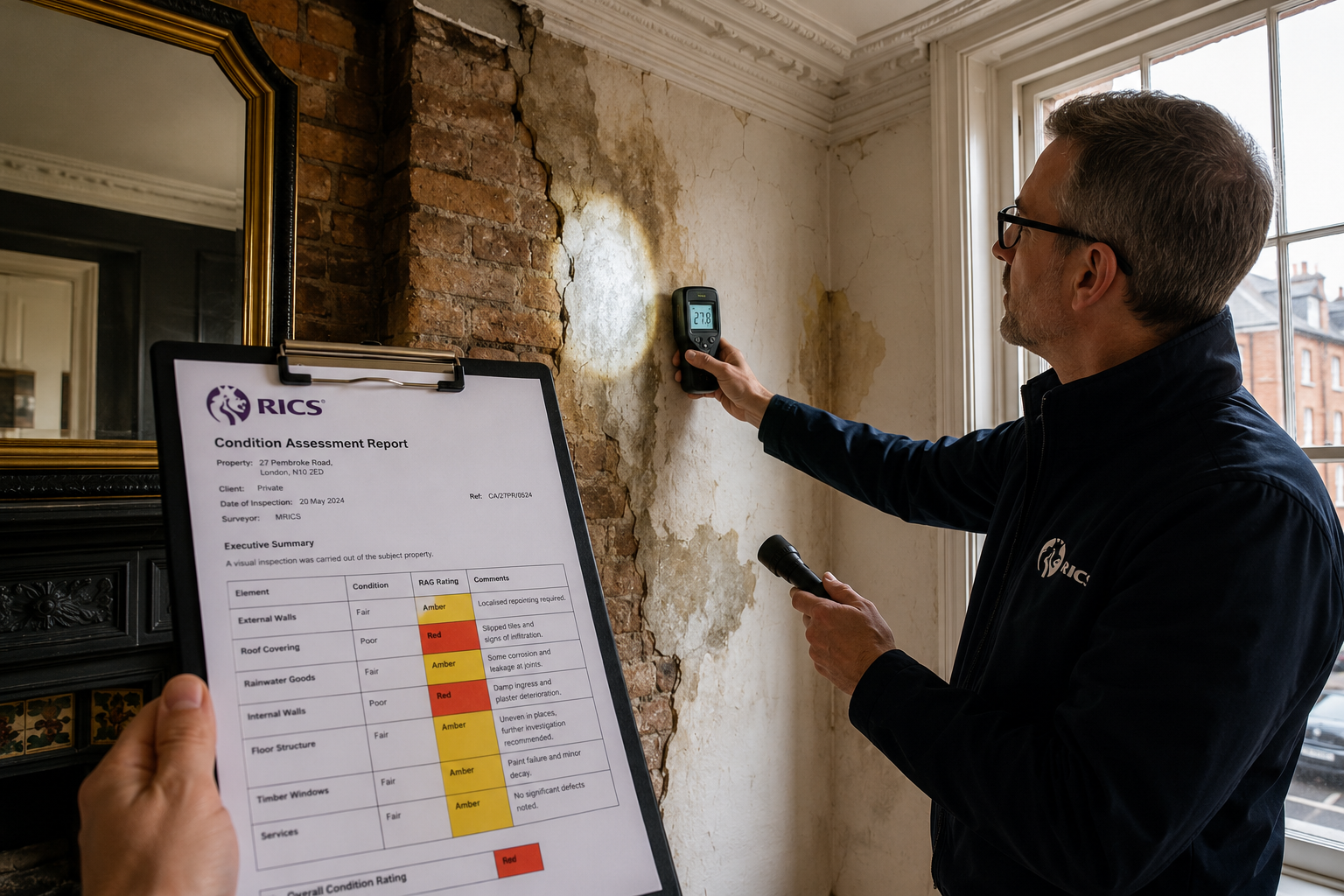
RICS net buyer enquiries stood at -26% heading into spring 2026 — a figure that tells a story not just of hesitation, but of a market demanding greater transactional certainty before commitments are made. Against this backdrop, the conversation around Cautious Spring 2026 Buyer Demand and Building Survey Certainty: Protocols for Mandatory Condition Assessments has moved from industry discussion to operational urgency. With government reforms on upfront property information gathering accelerating, surveyors, buyers, and conveyancers face a pivotal moment to refine how condition assessments are structured, delivered, and acted upon.
Key Takeaways
- Spring 2026 buyer demand remains cautious, with homes spending an average of 64 days on the market — the longest period in six years [2].
- RICS buyer enquiry figures at -26% signal that transaction certainty, not just price, is the dominant buyer concern in 2026.
- Mandatory condition assessment protocols are being refined ahead of anticipated government reforms requiring upfront property information.
- A structured building survey — particularly a Level 2 or Level 3 RICS assessment — is now a critical risk-management tool, not merely an optional extra.
- Regional market variation means that survey protocols must be calibrated to local property stock, age, and construction type.
The Spring 2026 Housing Market: Cautious Demand in Context
The spring 2026 housing market presents a paradox. On one hand, new listings and contract signings have reached their highest levels since 2022, with activity visible across the majority of the top 50 metropolitan areas [1]. On the other hand, homes sold in January 2026 spent an average of 64 days on the market before going under contract — the longest span in six years, and approximately a week longer than the year prior [2]. Pending home sales declined 3.3% year over year [2], and inventory increases have largely been absorbed by price cuts and relistings rather than genuine demand recovery [4].
This is not a market in freefall. It is a market recalibrating. Approximately one-third of home sellers are now listing despite holding mortgage rates below 5%, suggesting the so-called "lock-in effect" is beginning to ease [3]. Yet buyers remain selective, risk-aware, and increasingly focused on what they are actually purchasing — not just the price they are paying.
"In a cautious market, the building survey is no longer a formality. It is the primary instrument through which buyers validate their financial commitment."
Seasonal patterns have also shifted. Since 2021, the housing market has demonstrated increased spring activity at the expense of the traditional summer peak, linked to earlier household mobility patterns [6]. This compression of the active buying window makes pre-purchase due diligence — including condition assessments — more time-sensitive than ever.
Regional divergence adds further complexity. Washington D.C. saw pending sales rise 9.3% year over year in April 2026, yet performance varied sharply between sub-markets, with some areas underperforming relative to stronger neighbouring regions [5]. In the UK context, similar dynamics apply: Manchester, London, and the South East each present distinct property stock profiles that demand tailored survey approaches.
Why Cautious Spring 2026 Buyer Demand and Building Survey Certainty Are Inseparable
The relationship between buyer caution and survey certainty is not coincidental — it is structural. When buyers are uncertain about economic conditions, mortgage affordability, or future property values, they place greater weight on what they can control: the known condition of the asset they are acquiring.
The Risk Profile of the Cautious Buyer
The cautious spring 2026 buyer typically exhibits three behaviours:
- Extended due diligence timelines — more time spent reviewing survey findings before proceeding.
- Greater price renegotiation activity — using survey findings as leverage to adjust agreed purchase prices.
- Higher withdrawal rates — abandoning transactions where survey reports reveal unexpected defects without sufficient clarity on remediation costs.
This profile makes the quality and completeness of condition assessments directly consequential to transaction completion rates. A vague or insufficiently detailed survey report does not reassure a cautious buyer — it amplifies uncertainty.
The RICS Framework and Mandatory Assessment Standards
The Royal Institution of Chartered Surveyors (RICS) provides the professional framework within which condition assessments operate. The three-tier survey structure — from the entry-level Condition Report through to the comprehensive RICS Level 3 Building Survey — is designed to match assessment depth to property risk profile.
For cautious buyers in 2026, the Level 3 survey has become the default recommendation for:
- Properties built before 1930
- Properties with visible structural concerns
- Properties that have undergone significant alteration or extension
- Any property where the buyer intends to carry out renovation works
The RICS Level 2 HomeBuyer Survey remains appropriate for conventional, well-maintained properties of standard construction — but surveyors must be explicit with clients about the boundaries of this scope.
Key principle: Survey type selection is itself a protocol decision. Recommending an insufficient survey level to reduce cost or time is a professional risk that undermines the very certainty buyers are seeking.
Protocols for Mandatory Condition Assessments: A Structured Approach
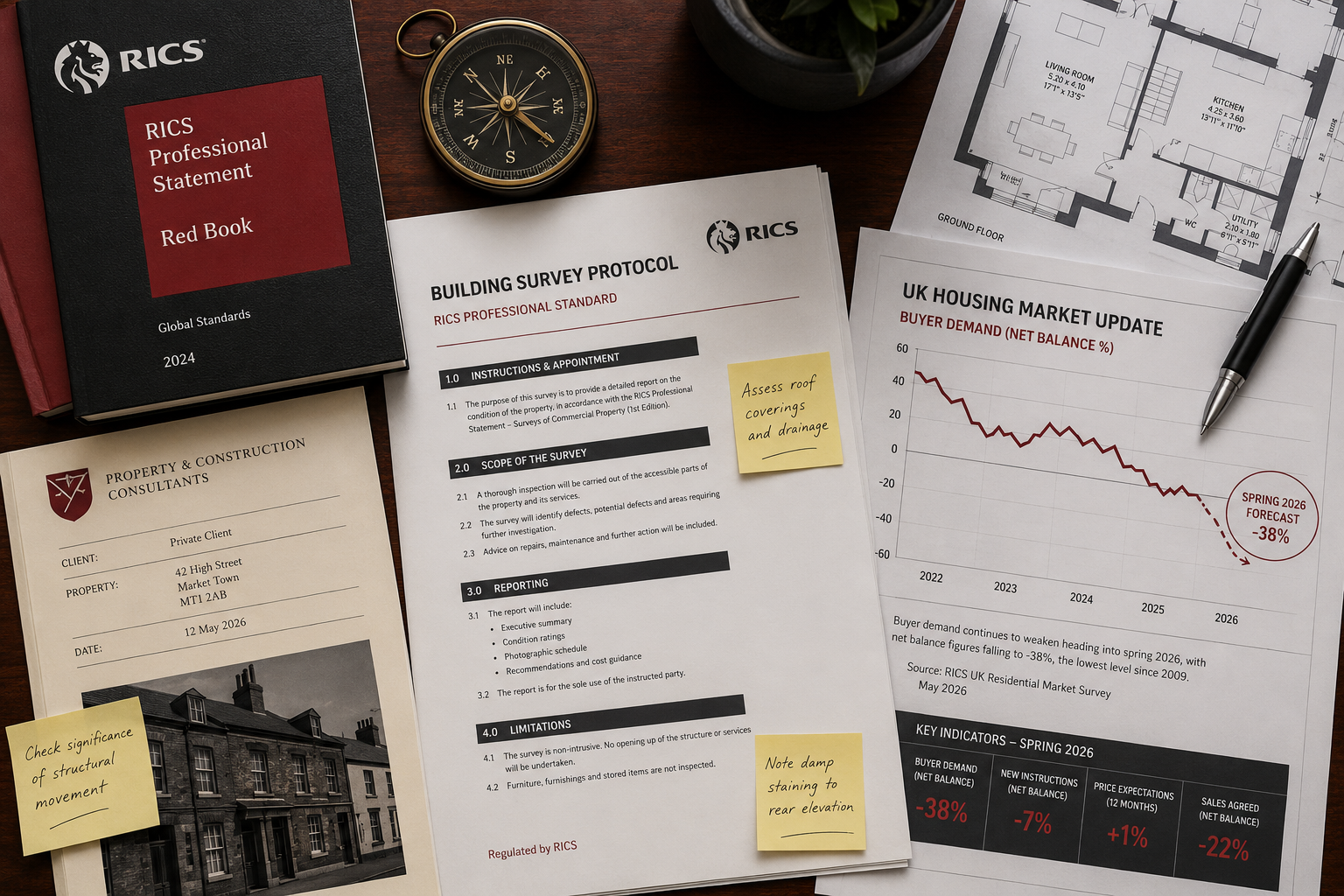
The phrase "mandatory condition assessments" reflects an emerging regulatory direction in the UK, where government proposals for upfront property information — including standardised condition data — are moving toward implementation. Surveyors and conveyancers who establish robust protocols now will be best positioned when formal requirements arrive.
Core Protocol Elements for 2026
A well-structured mandatory condition assessment protocol should address the following components:
| Protocol Element | Description | Responsibility |
|---|---|---|
| Pre-instruction property screening | Review of available property data, planning history, and EPC rating before survey appointment | Surveyor / Client |
| Scope definition and client briefing | Written confirmation of survey level, inclusions, and exclusions | Surveyor |
| On-site inspection methodology | Systematic room-by-room and external assessment using RICS condition rating system | Surveyor |
| Specialist referral triggers | Defined thresholds for recommending structural engineering, damp, or asbestos specialists | Surveyor |
| Report delivery standards | Turnaround time, format, and condition rating clarity | Surveyor / Firm |
| Post-report client consultation | Structured discussion of findings and recommended next steps | Surveyor |
Each element carries weight. The pre-instruction screening stage, for example, can identify properties with known flood risk, planning enforcement notices, or historical subsidence — factors that should influence survey scope before the surveyor sets foot on site.
Specialist Referral Protocols
One of the most significant gaps in current practice is the inconsistent application of specialist referral triggers. A general building survey cannot substitute for a dedicated asbestos survey on a pre-2000 property, nor can it replace a structural engineering assessment where load-bearing wall alterations are suspected.
Mandatory condition assessment protocols should include written referral criteria, such as:
- Asbestos: Any property constructed or significantly refurbished before 2000 where intrusive works are planned.
- Structural concerns: Visible cracking patterns consistent with subsidence, lintel failure, or roof spread.
- Damp and timber: Where moisture readings exceed defined thresholds or visible fungal growth is present.
- Drainage: Where drain runs are inaccessible or the property has a history of drainage issues.
Embedding these triggers within a formal protocol removes the ambiguity that currently leads to under-referral — and, consequently, to post-purchase disputes.
The Schedule of Condition as a Transactional Tool
Beyond the buyer-focused survey, the schedule of condition has an increasingly important role in spring 2026 transactions. For properties subject to party wall works, lease renewals, or dilapidations liability, a formally documented baseline condition record protects all parties.
Surveyors should proactively recommend schedules of condition in any transaction where:
- Neighbouring construction works are planned or underway
- The property is leasehold with dilapidations obligations
- The buyer intends to carry out works affecting shared structures
This proactive approach aligns with the broader movement toward upfront information and reduces the risk of post-completion disputes that erode buyer confidence in the market.
Regional Considerations and Survey Calibration
The UK property market is not monolithic. A Victorian terraced property in Manchester presents entirely different condition risks from a 1960s flat in London or a rural farmhouse in Hampshire. Cautious Spring 2026 Buyer Demand and Building Survey Certainty: Protocols for Mandatory Condition Assessments must therefore be understood as a framework that requires regional and property-type calibration, not a single uniform checklist.
Manchester and the North West
Manchester's property stock is dominated by Victorian and Edwardian terraced housing, with a significant proportion of purpose-built flats from the post-war era. Common defects in this stock include:
- Chimney stack deterioration — a frequent finding in pre-1950 properties
- Solid wall damp penetration — particularly in back-to-back terraces
- Flat roof failures — common in 1960s-1980s extensions and outbuildings
- Inadequate subfloor ventilation — leading to timber decay in suspended floor structures
Working with a RICS Chartered Building Surveyor who understands the local stock profile ensures that condition assessments are calibrated to the actual risk profile of the property — not a generic national template.
London and the South East
London's diverse property stock — from Georgian townhouses to modern high-rise developments — demands equally diverse survey approaches. Chartered surveyors operating across London must be alert to issues including:
- Subsidence risk — particularly in clay-heavy areas of South and East London
- Cladding and fire safety compliance — critical for post-Grenfell leasehold assessments
- Basement conversion structural integrity — increasingly common in higher-value areas
- Service infrastructure age — electrical and plumbing systems in pre-war stock frequently require full replacement
For buyers in outer London and the South East, local chartered surveyor expertise provides the granular knowledge that national survey firms often cannot match.
Preparing for Government Reforms: Upfront Information and Survey Integration

The direction of travel in UK housing policy is clear: upfront property information, including standardised condition data, will become a formal requirement for property listings. The Law Commission and various industry bodies have advocated for a system where buyers receive meaningful condition information before making an offer — reducing the volume of abortive transactions and the associated costs borne by all parties.
For surveyors, this reform trajectory has several practical implications:
1. Earlier instruction timelines
Surveys commissioned at listing stage rather than post-offer will require firms to manage capacity differently. Protocols must accommodate faster turnaround without compromising inspection quality.
2. Standardised condition rating communication
The RICS condition rating system (1 = no repair needed, 2 = defects requiring attention, 3 = serious defects) will need to be communicated in formats accessible to non-specialist buyers. Plain-language summaries alongside technical findings are no longer optional.
3. Integration with conveyancing workflows
Survey findings will increasingly feed directly into the conveyancing process, with solicitors and conveyancers referencing condition data when raising enquiries and drafting contract terms. Surveyors who align their reporting formats with conveyancing workflows will provide measurably greater value.
4. Liability framework clarity
As surveys move earlier in the transaction timeline and are potentially shared with multiple parties, the professional liability framework must be clearly defined. RICS guidance on reliance letters and third-party liability will become more frequently invoked.
Buyers and sellers who understand these changes — and who engage qualified surveyors early — will be better positioned to navigate the reformed transaction process. Reviewing survey pricing structures in advance allows buyers to budget appropriately and avoid the false economy of under-surveying a high-value asset.
Conclusion: Actionable Steps for Buyers, Sellers, and Surveyors in Spring 2026
The convergence of cautious buyer demand, rising inventory, and imminent regulatory reform makes spring 2026 a defining period for building survey practice. The protocols surrounding Cautious Spring 2026 Buyer Demand and Building Survey Certainty: Protocols for Mandatory Condition Assessments are not bureaucratic overhead — they are the mechanism through which transaction confidence is built and sustained.
For buyers:
- Commission a survey at the appropriate RICS level for the property type — do not default to the cheapest option.
- Request a post-report consultation with the surveyor to discuss findings in plain language.
- Use survey findings as a structured negotiation tool, supported by specialist remediation cost estimates where needed.
- For leasehold purchases, consider whether a schedule of condition is warranted alongside the main survey.
For sellers:
- Consider commissioning a pre-listing condition assessment to identify and address defects before they become buyer objections.
- Ensure that any previous survey reports, planning consents, or specialist investigations are available upfront.
- Price realistically from the outset — the spring 2026 market data shows that overpriced listings are being relisted rather than sold [4].
For surveyors and firms:
- Formalise written protocols for survey scope selection, specialist referral triggers, and post-report client communication.
- Invest in training for plain-language report writing — technical accuracy and accessibility are not mutually exclusive.
- Engage with RICS guidance on upfront information reforms and begin aligning reporting formats with anticipated regulatory requirements.
The cautious buyer of spring 2026 is not an obstacle to market activity. They are a signal that the market is maturing — and that the professionals who serve them must match that maturity with rigour, clarity, and well-defined protocols.
References
[1] Spring 2026 Housing Market Progress Report – https://www.realtor.com/research/spring-2026-housing-market-progress-report?utm_source=openai
[2] Housing Market Update 2026 Housing Market Mood – https://www.redfin.com/news/housing-market-update-2026-housing-market-mood/?utm_source=openai
[3] Coldwell Banker Mortgage Rate Lock In Effect Eases One In Three Home Sellers Are Giving Up A Sub 5 Rate To List This Spring 302751081 – https://www.prnewswire.com/news-releases/coldwell-banker-mortgage-rate-lock-in-effect-eases-one-in-three-home-sellers-are-giving-up-a-sub-5-rate-to-list-this-spring-302751081.html?utm_source=openai
[4] Housing Inventory Pricing Gap 2026 – https://www.housingwire.com/articles/housing-inventory-pricing-gap-2026/?utm_source=openai
[5] Housing Market April 2026 Bright Mls Pending Sales Listings – https://www.axios.com/local/washington-dc/2026/05/14/housing-market-april-2026-bright-mls-pending-sales-listings?utm_source=openai
[6] arxiv – https://arxiv.org/abs/2605.21358?utm_source=openai