Global data centre investment surpassed $500 billion in committed capital by early 2026, and with that scale of money in motion, valuation disputes have become one of the fastest-growing categories of commercial property litigation. Expert Witness Valuations in Data Centre Investment Disputes: 2026 Market Evidence and RICS Standards sits at the intersection of two fast-moving worlds: a physical asset class redefining real estate fundamentals, and a professional standards environment that has undergone its most significant overhaul in a decade. For surveyors, legal teams, and investors preparing for tribunal or arbitration proceedings, understanding how these forces interact is no longer optional — it is a competitive necessity.
Key Takeaways
- Data centre valuations are uniquely complex because value drivers — power density, Annualized Adjusted Base Rent (AABR) per kilowatt, tenant credit quality, and location — differ fundamentally from standard commercial property metrics.
- RICS Red Book Global Standards (effective January 2025) and the updated ESG standard (effective April 2026) now form the mandatory framework for any expert witness instructed on a data centre dispute in UK or international proceedings.
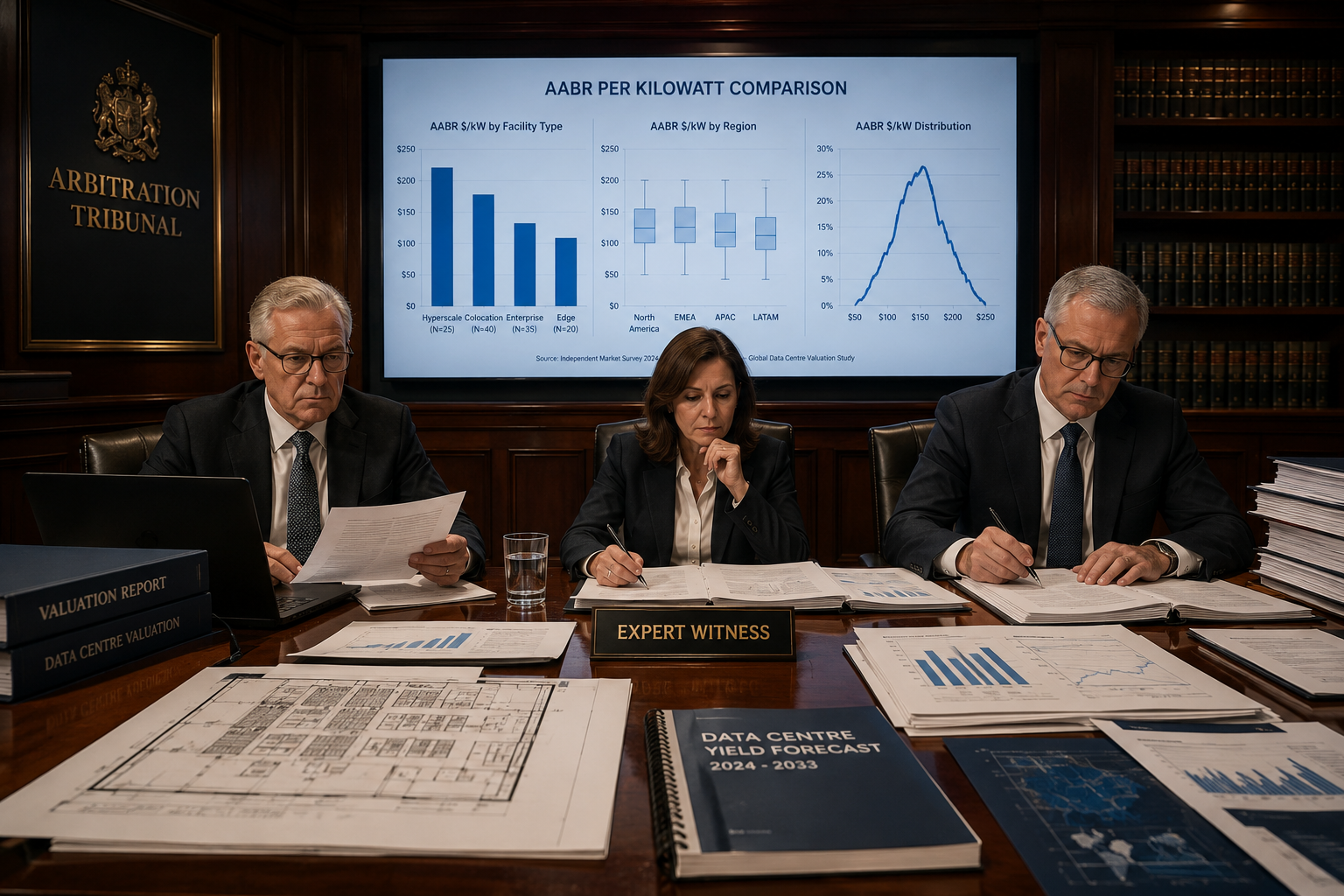
- Annualized Adjusted Base Rent per kilowatt is highly correlated with appraised portfolio value and is frequently the central contested figure in investment disputes.
- AI-assisted valuation tools are now subject to RICS professional standards, meaning expert witnesses must demonstrate responsible use of any automated modelling in their evidence.
- Robust comparable transaction analysis, yield forecasting, and an understanding of power infrastructure costs are the three pillars of defensible expert evidence in this asset class.
Why Data Centre Investment Disputes Are Rising in 2026
The data centre sector has attracted institutional capital at a pace that few asset classes match. Digital Realty Trust (DLR) carried a market capitalisation of approximately $66.46 billion as of June 2026, while Equinix (EQIX) stood at roughly $107.83 billion with a price-to-earnings ratio of 75.53. These figures reflect not just operational performance but the premium investors place on long-term contracted income from hyperscale and colocation tenants.
That premium is also the source of conflict. When a sale, refinancing, or partnership restructure triggers a formal valuation, the gap between a buyer's and seller's view of fair market value can run into hundreds of millions. The contested variables include:
- Power density assumptions (measured in kilowatts per rack or per square metre)
- Lease structure and AABR per kilowatt — a metric shown to be highly correlated with appraised value [4]
- Tenant concentration risk — a facility dominated by a single hyperscale tenant carries different risk pricing than a multi-tenant colocation campus
- Location and power grid access — proximity to renewable energy sources and grid capacity increasingly affects yield expectations
- ESG adjustments — now a formal valuation input under updated RICS standards [1]
When parties cannot agree, they appoint expert witnesses. The quality of that expert evidence — its methodology, its market grounding, and its compliance with current professional standards — often determines the outcome.
The RICS Standards Framework Governing Expert Witness Valuations in Data Centre Investment Disputes: 2026 Market Evidence and RICS Standards
The Red Book and Its 2025 Updates
The RICS Red Book Global Standards, updated with effect from January 31, 2025, provides the foundational rulebook for any valuation submitted as expert evidence [3]. The updated edition aligns with the International Valuation Standards (IVS) and introduces new content on:
- Modelling methodologies and their documentation requirements
- Valuation approaches for specialist assets, including data centres
- The formal incorporation of ESG considerations into market value assessments
For an expert witness, compliance with the Red Book is not a formality. Tribunals and courts expect to see that the valuer has followed mandatory requirements and can justify any departures from standard approaches. A valuation that cannot demonstrate Red Book compliance is vulnerable to challenge on procedural grounds before the substantive figures are even examined.
RICS also provides specific sector guidance for valuers instructed to provide market value or market rent for data centre properties, including a glossary of sector-specific terms and a structured outline of the valuation process [6]. Any expert instructed on a data centre matter should treat this guidance as required reading.
ESG Integration: The April 2026 Standard
Effective April 30, 2026, RICS published the fourth edition of its global professional standard on ESG and sustainability in commercial property valuation [1]. This is directly relevant to data centre disputes for two reasons.
First, data centres are among the most energy-intensive commercial assets in existence. A facility's power usage effectiveness (PUE) ratio, its reliance on renewable energy certificates, and its carbon footprint are now legitimate inputs into a market value assessment — not peripheral considerations.
Second, in a dispute context, an opposing expert who ignores ESG factors in their valuation methodology can be cross-examined on whether their evidence reflects current market practice. The April 2026 standard gives the tribunal a clear benchmark.
"The integration of ESG factors into commercial property valuation is no longer aspirational — it is a mandatory professional standard with direct implications for the defensibility of expert evidence."
AI and Automated Valuation Models
RICS introduced its professional standard on the responsible use of artificial intelligence in surveying practice, effective from March 9, 2026 [5]. This matters for data centre expert witnesses because AI-assisted modelling is increasingly used to process large datasets of comparable transactions, forecast yield movements, and stress-test income assumptions.
The standard does not prohibit AI use. It requires that the expert can explain, justify, and stand behind any AI-generated output included in their evidence. A valuation that relies on a machine-learning model without adequate disclosure of its inputs, training data, and limitations is now professionally non-compliant — and legally exposed.
For expert witness services involving data centres, this means building a clear audit trail: what tools were used, what data fed them, and how the expert exercised professional judgement over the outputs.
Methodology: How Expert Witnesses Build Defensible Data Centre Valuations
The Three Primary Valuation Approaches
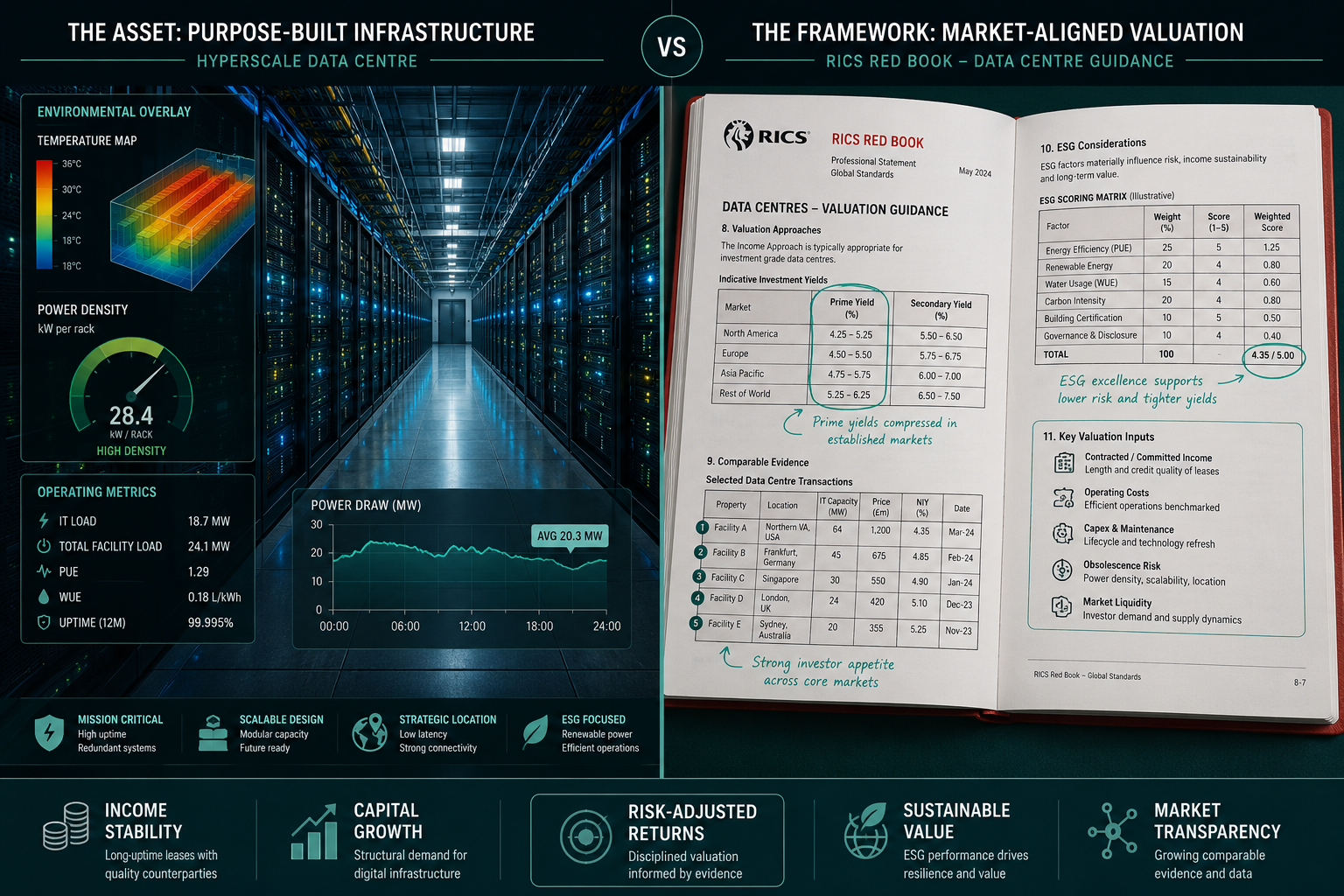
Data centre valuations in dispute contexts typically draw on three approaches, often in combination:
| Approach | Description | Common Use in Disputes |
|---|---|---|
| Income Capitalisation | Capitalises contracted and market rent at an appropriate yield | Primary method for income-producing assets |
| Discounted Cash Flow (DCF) | Projects future cash flows and discounts to present value | Used where lease expiry, capex cycles, or power upgrades affect income profile |
| Depreciated Replacement Cost (DRC) | Estimates cost of replacing the asset, less depreciation | Applied where comparable market evidence is thin |
The income capitalisation approach is most frequently contested. The two variables that drive the most dispute are the passing or market rent and the capitalisation yield. A 25 basis point difference in yield on a £500 million data centre portfolio can move the valuation by tens of millions of pounds.
Annualized Adjusted Base Rent Per Kilowatt
Research published in April 2026 by Charles River Associates identifies AABR per kilowatt as the single metric most correlated with a data centre portfolio's appraised value [4]. The report notes that AABR per kilowatt varies based on:
- Data centre size — larger campuses typically command lower per-kW rents due to economies of scale for tenants
- Tenant concentration — single-tenant facilities may trade at a premium or discount depending on the tenant's credit rating
- Tenant credit quality — investment-grade hyperscale tenants support tighter yields
- Location — markets with constrained power supply and high demand (Northern Virginia, London, Frankfurt, Singapore) command premium rents
In a dispute, both sides will typically commission their own AABR analysis. The expert witness must demonstrate that their comparable selection is defensible — that the transactions chosen reflect the subject property's specification, age, power density, and market positioning.
Comparable Transaction Evidence
The data centre investment market is less transparent than mainstream commercial property. Many transactions are structured as share sales, joint ventures, or sale-and-leaseback arrangements, which can obscure the true economic terms. Expert witnesses must work harder to extract usable comparable evidence, including:
- Published REIT portfolio valuations and transaction disclosures
- Broker research on headline yields and rent levels
- Planning applications and building specifications that allow like-for-like comparison
- Power purchase agreements that affect net operating income
For commercial property valuations, the principle of using the best available market evidence applies equally to data centres — but the expert must be transparent about the limitations of the evidence base and how those limitations have been addressed.
Power Infrastructure and Reinstatement Costs
Data centres are capital-intensive to build and maintain. In disputes involving insurance, compulsory purchase, or total loss scenarios, the reinstatement valuation becomes critical. The cost of replacing a facility's uninterruptible power supply (UPS) systems, cooling infrastructure, and raised floor environments can dwarf the shell-and-core construction cost.
Expert witnesses instructed on reinstatement matters should be familiar with RICS guidance on RICS reinstatement and build cost valuations and should engage specialist mechanical and electrical quantity surveyors where the technical specification exceeds their direct expertise.
Preparing Expert Evidence for Tribunal: Practical Standards
Duties of the Expert Witness
In English proceedings, the expert witness's primary duty is to the court or tribunal, not to the instructing party. This is established by CPR Part 35 and applies equally in arbitration and expert determination. For data centre disputes, this duty has practical implications:
- The expert must acknowledge uncertainty in yield assumptions rather than presenting a single figure as definitive
- Where two methodologies produce materially different results, both should be disclosed and the expert's preference explained
- ESG adjustments, AI-assisted modelling, and any departures from Red Book methodology must be declared
The Joint Expert Process
Many data centre disputes proceed through a joint expert meeting before tribunal. The parties' experts meet, identify areas of agreement and disagreement, and produce a joint statement. In practice, the areas of agreement often narrow the dispute significantly — experts may agree on the income figure but disagree on the yield, or agree on the methodology but dispute the comparable selection.
Preparation for the joint meeting is as important as preparation for the hearing itself. The expert who has documented their methodology clearly, referenced current RICS standards, and stress-tested their assumptions against alternative scenarios is better positioned to defend their position under challenge.
Working with RICS-Registered Valuers
Instructing parties should ensure their expert witness is registered with RICS and holds the appropriate competencies for specialist commercial valuation. For data centre matters, relevant experience in technology real estate, infrastructure assets, or large-scale industrial property is a significant advantage.
The RICS Global Valuation Conference held in June 2026 addressed economic volatility, evolving global standards, and technological advancements — all of which bear directly on data centre expert evidence [2]. Experts who engage with continuing professional development in these areas are better equipped to give evidence that reflects current market conditions.
Key Dispute Scenarios and How Expert Evidence Addresses Them

Scenario 1: Acquisition Price Disputes
A buyer and seller disagree on the market value of a data centre campus at the date of exchange. The buyer argues that power constraints in the local grid reduce the facility's income potential; the seller argues that contracted AABR with an investment-grade hyperscale tenant supports a premium yield. Expert witnesses on each side will present comparable transaction evidence, yield analysis, and an assessment of the power infrastructure's impact on value.
Scenario 2: Lease Renewal and Rent Review Disputes
Data centre leases often contain complex rent review provisions tied to power consumption, service levels, or index-linked adjustments. When a rent review is disputed, the expert witness must assess market rent at the review date using the hypothetical lease assumptions specified in the lease — which may differ significantly from the actual lease terms.
Scenario 3: Partnership and Joint Venture Disputes
Institutional investors frequently hold data centre assets through joint ventures. When a partner seeks to exit, disputes arise over the valuation used to price the departing partner's interest. These cases often involve overlapping valuation and accounting standards, and the expert witness must navigate both.
Scenario 4: AI Infrastructure and Emerging Asset Types
The rapid growth of AI-optimised data centres — facilities designed for GPU-intensive workloads rather than general colocation — has created a new valuation frontier. These assets command significantly higher power densities (often 50–100 kW per rack versus 5–10 kW for traditional facilities) and attract different tenant profiles. Comparable evidence is scarce, and expert witnesses must exercise greater reliance on the DRC approach or DCF modelling with explicit assumptions about market rent evolution.
For complex structural or technical assessments that support valuation evidence, RICS commercial building surveys provide a foundation for understanding the physical condition and specification of the asset being valued.
Conclusion: Actionable Steps for Surveyors and Legal Teams
Expert Witness Valuations in Data Centre Investment Disputes: 2026 Market Evidence and RICS Standards demands a level of technical, legal, and market awareness that goes well beyond standard commercial property practice. The following steps will strengthen any party's position in a data centre valuation dispute.
For expert witnesses:
- Confirm Red Book compliance and document any departures from standard methodology before submitting evidence
- Integrate ESG factors in line with the April 2026 RICS standard — failure to do so creates a cross-examination vulnerability
- Disclose any AI or automated modelling tools used, in line with the March 2026 RICS AI standard
- Build AABR per kilowatt analysis from the most current and comparable transaction evidence available
- Engage specialist mechanical and electrical consultants where power infrastructure costs are in dispute
For legal teams instructing experts:
- Appoint a valuer with demonstrable experience in technology real estate or infrastructure assets
- Confirm RICS registration and check for relevant continuing professional development in data centre valuation
- Brief the expert on the specific lease structure, power specifications, and tenant profile of the subject asset early in the process
- Allow sufficient time for the expert to attend the property and review technical due diligence materials
For investors and asset managers:
- Commission a pre-dispute valuation review before entering negotiations or litigation — understanding the range of defensible values is a significant strategic advantage
- Ensure that internal valuations used for financial reporting are Red Book compliant, as these may be disclosed in proceedings
- Keep records of AABR, power consumption, and tenant covenant strength data, as these will be central to any expert evidence
The data centre investment market will continue to attract capital and, inevitably, disputes. The parties who prepare most thoroughly — with expert evidence grounded in current RICS standards, robust market data, and transparent methodology — will be best placed to achieve a favourable outcome.
References
[1] Rics Publishes Updated Global Standard Esg Sustainability Commercial Property Valuation – https://www.rics.org/news-insights/rics-publishes-updated-global-standard-esg-sustainability-commercial-property-valuation?utm_source=openai
[2] Global Valuation Conference 2026 – https://academy.rics.org/global-valuation-conference-2026?utm_source=openai
[3] Red Book Global – https://www.rics.org/profession-standards/rics-standards-and-guidance/sector-standards/valuation-standards/red-book/red-book-global?utm_source=openai
[4] Data Center Valuations And Potential Disputes – https://www.crai.com/insights-events/publications/data-center-valuations-and-potential-disputes/?utm_source=openai
[5] What Surveyors Think Ai – https://ww3.rics.org/uk/en/modus/technology-and-data/surveying-tools/what-surveyors-think-ai.html?utm_source=openai
[6] Valuation Standards – https://www.rics.org/profession-standards/rics-standards-and-guidance/sector-standards/valuation-standards?utm_source=openai
[7] Rics Standards – https://www.isurv.com/downloads/176/rics_standards?utm_source=openai
[8] Public Sector Valuations – https://www.rics.org/profession-standards/rics-standards-and-guidance/sector-standards/valuation-standards/public-sector-valuations?utm_source=openai
[9] Valuation – https://www.expertinstitute.com/expert-witness/valuation/?utm_source=openai