
Around 20 million homes in England were built before 1970, and the English Housing Survey confirms that damp, condensation, mould and structural hazards remain disproportionately concentrated in this older stock [2]. For buyers, owners and landlords navigating Victorian terraces, Edwardian semis and inter-war properties, a standard mortgage valuation offers almost no protection. Defect-focused building surveys for older UK housing stock — covering damp, subsidence and structural movement — exist precisely to bridge that gap, turning visible warning signs into actionable, costed intelligence before contracts are exchanged or remedial budgets committed.
Key Takeaways
- Pre-1970s properties carry a significantly higher risk of damp, subsidence and structural movement than newer homes, and standard Level 2 surveys often cannot diagnose these issues adequately.
- A Level 3 Building Survey (or a targeted specific defect survey) is the recommended approach for older, defect-prone housing stock.
- Rising damp, penetrating damp and condensation each have distinct causes and require different remedial strategies — accurate diagnosis is essential before any works begin.
- Subsidence and structural movement in Victorian, Edwardian and inter-war homes are not always emergencies; understanding crack classification and monitoring protocols prevents both under- and over-reaction.
- Survey findings directly influence purchase price negotiations, insurance terms, mortgage decisions and long-term maintenance planning.
Why Older UK Housing Stock Demands a Different Survey Approach
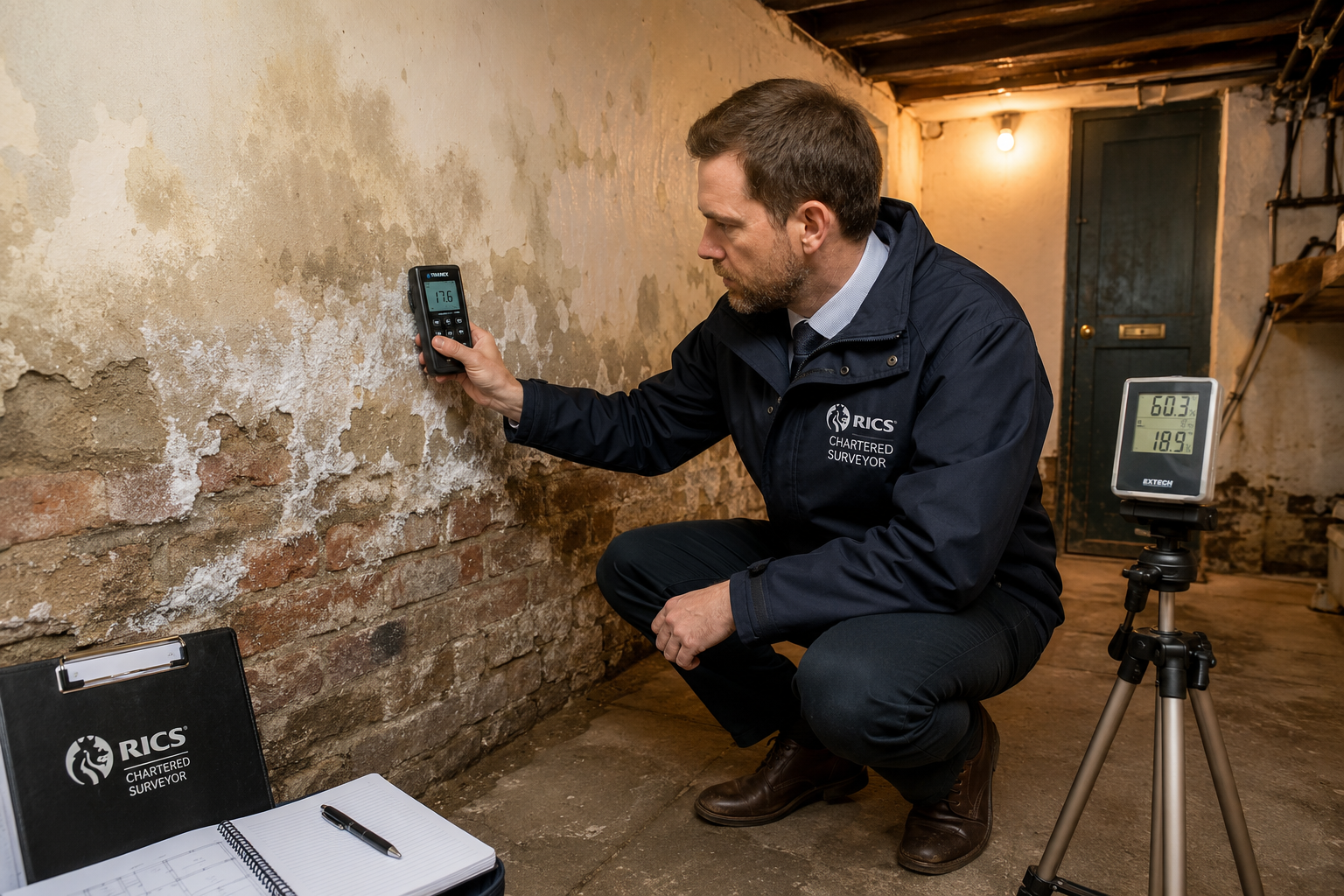
The UK has one of the oldest housing stocks in Europe. Victorian (pre-1901), Edwardian (1901-1914) and inter-war (1919-1939) properties were built using construction methods, materials and tolerances that differ fundamentally from modern building regulations. Solid brick walls without cavity insulation, lime mortar pointing, shallow strip foundations, suspended timber ground floors and the near-universal absence of damp-proof courses in the earliest stock all create conditions that modern surveys must interpret through a period-appropriate lens.
A Level 2 HomeBuyer-style report, while useful for straightforward modern properties, is generally insufficient where there are known or suspected defects requiring deeper investigation [1]. Industry guidance consistently recommends that for pre-1970s houses, period properties, listed buildings, unusual construction or homes with visible defects, a Level 3 Building Survey is the safer choice, because it allows intrusive investigation and detailed diagnosis [1].
For buyers who have already had a general survey and received a flagged concern, a specific defect report offers a targeted alternative — commissioning a specialist to investigate one issue in depth rather than repeating a full inspection.
Understanding which survey type is appropriate is itself a significant decision. A useful starting point is comparing different types of survey to match the level of investigation to the age, condition and complexity of the property in question.
The Role of the English Housing Survey
The English Housing Survey (EHS) is the UK government's primary dataset on housing conditions. Its 2023-2024 statistical release on drivers and impacts of housing quality confirms that Category 1 hazards under the Housing Health and Safety Rating System — including damp, mould and structural instability — are more prevalent in older dwellings and the private rented sector than in newer or owner-occupied homes [2]. This is not merely academic: EHS data directly informs local authority enforcement, landlord obligations and the policy context within which surveyors operate in 2026.
Damp in Victorian, Edwardian and Inter-War Properties: Diagnosis Before Prescription
Damp is the single most commonly reported defect in older UK housing stock, yet it is also the most frequently misdiagnosed. The consequences of misidentification are significant: treating condensation as rising damp, for example, can result in thousands of pounds spent on unnecessary chemical injection and tanking, while the actual cause — poor ventilation — remains unaddressed.
Surveyors conducting defect-focused building surveys for older UK housing stock distinguish between three primary damp categories:
| Damp Type | Primary Cause | Typical Location | Diagnostic Indicator |
|---|---|---|---|
| Rising damp | Absent or failed DPC; capillary action | Lower 1m of internal walls | Tide marks, salt crystallisation, hygroscopic salts |
| Penetrating damp | Failed pointing, defective flashings, cracked render | External-facing walls, around openings | Damp patches following rainfall, no tide mark |
| Condensation | Inadequate ventilation, cold bridging | Corners, north-facing walls, windows | Black mould growth, seasonal variation |
Rising Damp
Rising damp occurs when groundwater travels upward through masonry by capillary action, typically where no damp-proof course (DPC) exists or where an existing DPC has failed. In Victorian properties, DPCs — where present at all — were often slate, bitumen felt or engineering brick courses that have since cracked or been bridged by raised external ground levels or internal floor screeds.
A surveyor will use a calibrated moisture meter to take readings at multiple heights, looking for the characteristic declining moisture gradient above a tide mark. Crucially, a competent surveyor will also test for hygroscopic salts using a carbide meter or laboratory analysis, since hygroscopic salts can retain moisture and produce false positives on standard electrical resistance meters long after the original damp source has been resolved.
Penetrating Damp
Penetrating damp is more common in solid-walled properties — the dominant construction type in Victorian and Edwardian housing — than in cavity-walled buildings. Without an air gap to interrupt moisture transfer, any failure in the external envelope (failed pointing, cracked render, defective window sills, blocked gutters or deteriorated flashings) allows water to track directly through the wall thickness.
During a RICS building survey, the surveyor will systematically inspect the external envelope, roof drainage, chimney stacks and window surrounds, correlating external defects with internal moisture readings. Thermal imaging cameras are increasingly used to map cold spots and moisture pathways that are invisible to the naked eye.
Condensation and Mould
Condensation is the most prevalent damp form in the existing housing stock and is often confused with structural damp by untrained observers [2]. In older properties with solid walls, low internal temperatures and limited mechanical ventilation, warm moist air deposits moisture on cold surfaces — particularly in bathrooms, kitchens and poorly heated bedrooms.
A defect-focused survey will assess ventilation provision, thermal bridging at junctions and the presence of extractor fans, trickle vents and adequate heating. The distinction matters enormously for remediation: condensation requires ventilation and insulation upgrades, not chemical injection.
Subsidence and Structural Movement in Period Properties: Understanding the Risks
Subsidence is the downward movement of the ground beneath a building's foundations, causing the structure above to settle unevenly. It is one of the most feared defects in older UK housing stock, partly because of its association with expensive insurance claims and partly because visible cracking — its most common symptom — is widely misunderstood.
Not all cracking indicates active subsidence. In fact, the majority of cracks in Victorian, Edwardian and inter-war properties are the result of thermal movement, settlement, shrinkage or minor structural adjustment rather than ongoing ground movement. A subsidence survey conducted by a chartered surveyor will classify cracks systematically before recommending any action.
Crack Classification
The Building Research Establishment (BRE) crack classification system, widely used by structural engineers and surveyors, provides a standardised framework:
| BRE Category | Crack Width | Description | Typical Action |
|---|---|---|---|
| 0 | Hairline (<0.1mm) | Negligible | Monitor only |
| 1 | Up to 1mm | Fine | Redecoration |
| 2 | 1-5mm | Slight | Minor repairs |
| 3 | 5-15mm | Moderate | Investigation required |
| 4 | 15-25mm | Severe | Structural repair |
| 5 | >25mm | Very severe | Major stabilisation |
Categories 3 and above in older properties warrant specialist investigation, including a structural engineering assessment to determine cause, direction of movement and whether the process is active or historic.
Common Causes of Subsidence in Older Housing Stock
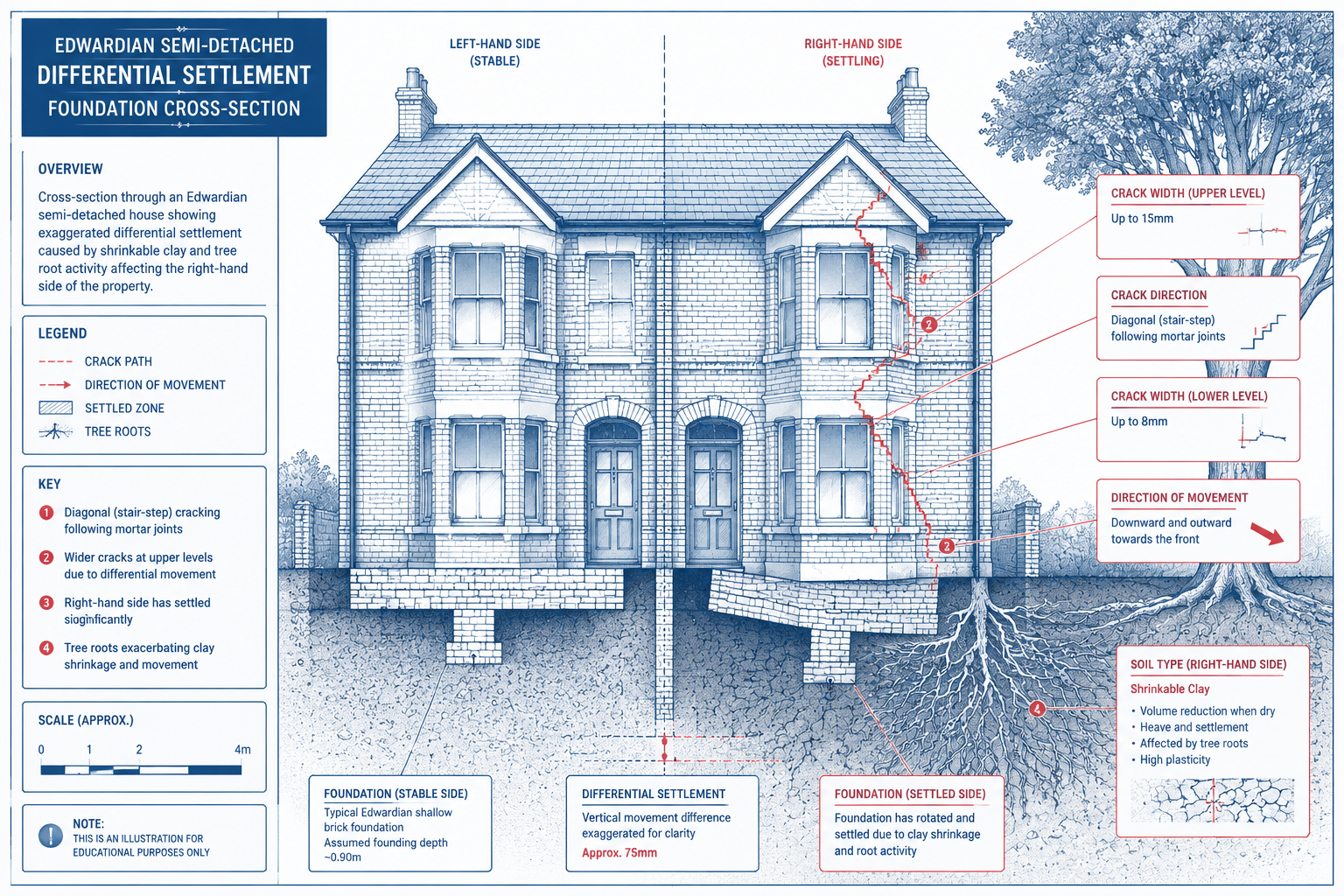
Clay shrinkage is the leading cause of subsidence in the UK, particularly in London and the South East where shrinkable clay soils predominate. During dry summers, clay contracts; during wet winters, it expands. Victorian and Edwardian properties with shallow strip foundations — typically 450-600mm deep — are particularly vulnerable to this seasonal cycle.
Tree root activity exacerbates clay shrinkage by extracting moisture from the soil, creating localised desiccation beneath and adjacent to foundations. Surveyors will note the proximity, species and approximate age of trees during inspection, since high water-demand species (oak, poplar, willow) within a distance equal to their mature height represent a material risk.
Drain leakage is a frequently overlooked cause. Fractured Victorian-era clay drainage pipes beneath or adjacent to foundations can wash away fine soil particles (a process called piping or suffosion), creating voids beneath footings. A CCTV drain survey is often recommended alongside a building survey where subsidence is suspected.
Leaking water mains and sewer surcharge can similarly soften load-bearing soils beneath shallow foundations, particularly in older urban areas where infrastructure dates from the same era as the housing.
Differential Settlement vs. Active Subsidence
An important distinction for buyers is between long-term differential settlement — which may have occurred decades ago and stabilised — and active subsidence, which is ongoing. Historic settlement in Victorian properties is extremely common and does not necessarily represent a current risk or an insurable event. A surveyor's role is to assess the evidence for activity: fresh cracking through recent decoration, progressive crack widening recorded by tell-tales, or distortion of door and window frames that previously functioned normally.
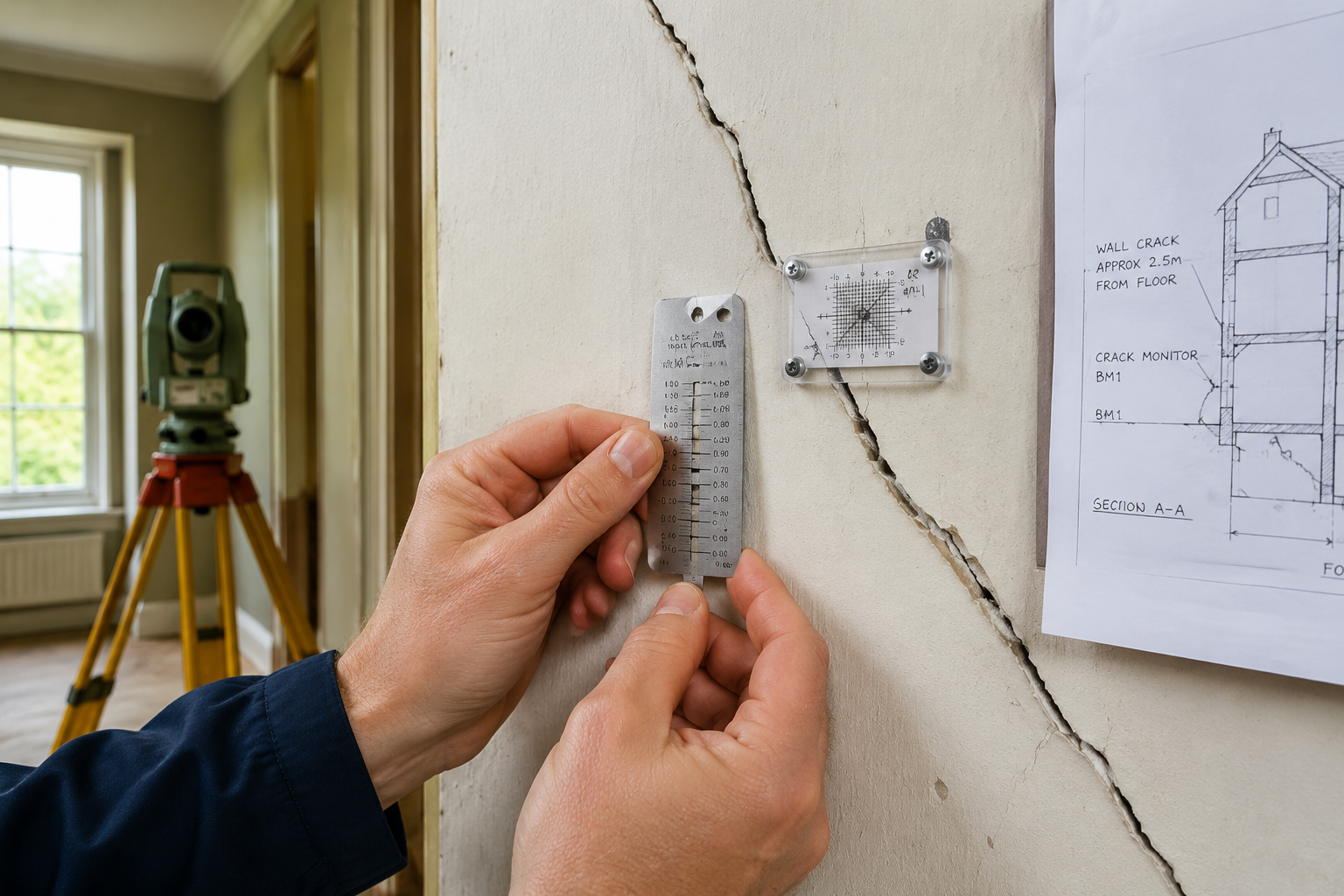
Where monitoring is required, monitoring surveys using crack gauges, precise levelling or digital photogrammetry can track movement over time, providing the evidence base needed to distinguish active from historic movement before committing to expensive remediation.
How Defect-Focused Surveys Are Conducted: From Inspection to Report
A defect-focused building survey for older UK housing stock follows a structured methodology that goes beyond the visual inspection of a standard Level 2 report [5]. The process typically involves:
Pre-inspection research: Review of historic maps, planning records, geological data (particularly soil type and shrinkage potential) and any available previous survey reports. This contextualises findings before the surveyor sets foot on site.
Systematic external inspection: Examination of the roof covering, chimney stacks, parapets, gutters, downpipes, external walls, window and door surrounds, damp-proof course level, external ground levels and drainage. Binoculars and, increasingly, drone surveys are used to access inaccessible roof slopes and high-level details safely.
Internal inspection with intrusive investigation: Where a Level 3 survey is commissioned, the surveyor may lift inspection hatches, move furniture and lift loose floorboards to inspect sub-floor voids, joists and the condition of the ground below suspended timber floors. Moisture meter readings are taken systematically. Thermal imaging may be deployed.
Specialist referrals: A competent surveyor will identify the limits of their own expertise and recommend specialist input — a structural engineer for Category 3+ cracking, a drainage contractor for CCTV surveys, or a damp specialist for complex moisture investigations — rather than speculating beyond the evidence.
The survey report: The output of a defect-focused survey is a prioritised schedule of defects, typically using a traffic-light or numbered condition rating system. Each defect is described, its probable cause explained, its urgency categorised and a remedial recommendation provided. For serious defects, indicative cost ranges are included to support purchase price negotiations or insurance discussions [10].
"A defect-focused survey is not simply a list of problems — it is a risk-ranked decision-making tool that enables buyers, owners and lenders to act with confidence."
Specialist firms now market specific defect surveys targeting a single issue — damp penetration, cracking, roof spread, or structural movement — often instructed after a general survey flags a concern [5]. These targeted inspections are designed to support remedial specifications, contractor quotes or negotiations with insurers and freeholders [5].
How Survey Findings Affect Valuations and Purchase Decisions
Defect-focused building surveys for older UK housing stock do not exist in isolation from financial decision-making. Their findings feed directly into several consequential processes:
Purchase price negotiation: A costed schedule of defects provides objective evidence for renegotiating the agreed purchase price. A Category 3 crack requiring underpinning investigation, or a roof requiring full replacement, represents a quantifiable liability that a buyer is entitled to price into their offer.
Mortgage lending decisions: Lenders may decline to lend, reduce the loan-to-value ratio or impose a retention — withholding a portion of the mortgage advance until specified works are completed — where a survey identifies serious structural defects or active subsidence.
Insurance implications: Buildings insurance for properties with a history of subsidence is significantly more expensive and may carry high excesses. Disclosure obligations mean that survey findings, once documented, must typically be declared to insurers. Understanding the nature and extent of movement before exchange allows buyers to obtain insurance quotes and factor premiums into affordability calculations.
Listed building and conservation area considerations: For listed Victorian or Edwardian properties, any remedial works — including damp-proofing, repointing or structural repairs — may require listed building consent. A surveyor familiar with heritage construction will identify where modern remedial techniques (such as chemical DPC injection or cement-based repointing) may be inappropriate or prohibited, and recommend lime-compatible alternatives.
Choosing the Right Survey for an Older Property in 2026
For pre-1970s housing, the survey choice hierarchy in 2026 is clear:
- Level 3 Building Survey — the default recommendation for Victorian, Edwardian and inter-war properties, particularly where defects are visible or suspected [1].
- Specific Defect Survey — appropriate where a particular issue (damp, cracking, roof spread) requires targeted investigation, either as a standalone instruction or as a follow-up to a general survey [5].
- Structural Engineering Report — required where crack classification reaches Category 3 or above, or where subsidence is actively suspected.
- Level 2 HomeBuyer Report — generally insufficient for older stock with known defects, though may be appropriate for post-1970s properties in good condition [1].
The RICS specific defect survey and the full building survey represent the two primary tools available to buyers and owners of older UK housing stock. Selecting between them — or combining them — depends on the age of the property, the nature of any visible defects, and the purpose of the instruction.
Conclusion
Defect-focused building surveys for older UK housing stock — covering damp, subsidence and structural movement — are not a luxury reserved for grand period homes. They are a practical necessity for anyone buying, owning or managing Victorian, Edwardian or inter-war property in 2026. The English Housing Survey confirms that these defects remain concentrated in the oldest parts of the housing stock [2], and the consequences of misdiagnosis — whether over-spending on unnecessary remediation or under-estimating a serious structural risk — can be severe.
Actionable next steps for buyers and owners:
- Commission a Level 3 Building Survey for any pre-1970s property, regardless of its apparent condition.
- If a general survey flags damp or cracking, instruct a specific defect survey before proceeding to exchange.
- Where cracking reaches BRE Category 3 or above, obtain a structural engineering report and consider a monitoring survey before agreeing remediation.
- Obtain specialist drainage investigation (CCTV survey) where subsidence is suspected and the property has Victorian-era clay drainage.
- Factor survey findings into purchase price negotiations, insurance enquiries and long-term maintenance budgeting before committing to a purchase.
The cost of a thorough defect-focused survey — typically a few hundred to low thousands of pounds — is negligible against the potential cost of undiagnosed structural movement, mismanaged damp or an undisclosed subsidence history. In older UK housing stock, informed decisions begin with the right survey.
References
[1] Which Survey Is Best For Older Homes – https://surveymatch.co.uk/which-survey-is-best-for-older-homes/
[2] English Housing Survey – https://www.gov.uk/government/collections/english-housing-survey
[5] Specific Defect – https://www.sjmsurveyors.co.uk/residential/specific-defect
[10] Major Defects Building Survey Bristol – https://www.eastonbevins.co.uk/major-defects-building-survey-bristol