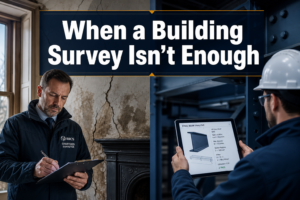
Roughly 30% of property transactions in England and Wales are delayed or fall through after a survey is received — and a significant proportion of those collapses trace back not to genuinely dangerous defects, but to misunderstood survey language. When a 'Defect' Is Just Age and Wear: How Building Surveyors Should Explain Condition, Risk and Proportionate Repair sits at the heart of a persistent communication failure in the built environment profession. Buyers read the word "defect" and assume the worst. Sellers feel ambushed. Solicitors field panicked calls. Yet in many cases, the surveyor's report is simply describing a 1930s semi-detached house that looks exactly like a 1930s semi-detached house.
This article addresses that communication gap directly, offering a structured framework for how building surveyors can classify age-related wear, explain typical component lifespans, and communicate the difference between monitoring, maintaining, and acting urgently — without either alarming clients unnecessarily or underselling genuine risk.
Key Takeaways
- Not every item flagged in a building survey is a serious defect; many observations reflect normal age-related wear consistent with a property's construction date.
- The RICS condition rating system (Ratings 1, 2, and 3) provides a structured, traffic-light framework for communicating urgency and severity.
- Surveyors have a professional duty to distinguish between "monitor," "maintain," and "urgent repair" — and to explain what each means in plain language.
- Proportionate repair advice considers the property's age, value, and realistic remaining lifespan of components, not just the presence of deterioration.
- Clear, jargon-free communication in survey reports reduces transaction fall-throughs and builds long-term client trust.
The Communication Gap That Costs Transactions
A buyer receives a 60-page Level 2 Home Survey. On page 14, they read: "Evidence of defective pointing to the front elevation. Recommend repair." On page 22: "Roof covering shows signs of wear. Monitor and maintain." By page 30, the buyer is convinced the house is falling apart.
This is the core problem. The word "defect" carries catastrophic connotations in everyday English. In surveying, it is a technical term that simply means something is not performing as intended — which, in a 90-year-old building, is entirely expected and often entirely manageable.
The language gap is real, and it has consequences:
- Buyers renegotiate or withdraw based on misread risk levels
- Sellers feel their property has been unfairly characterised
- Surveyors face complaints for being either "too alarming" or "not alarming enough"
- Solicitors and estate agents spend hours managing expectations that a clearer report would have set correctly
The solution is not to soften findings or omit observations. It is to contextualise them. A surveyor's job is not just to find things — it is to explain what those things mean for this property, at this age, in this condition, at this price point.
Understanding the Condition Rating System
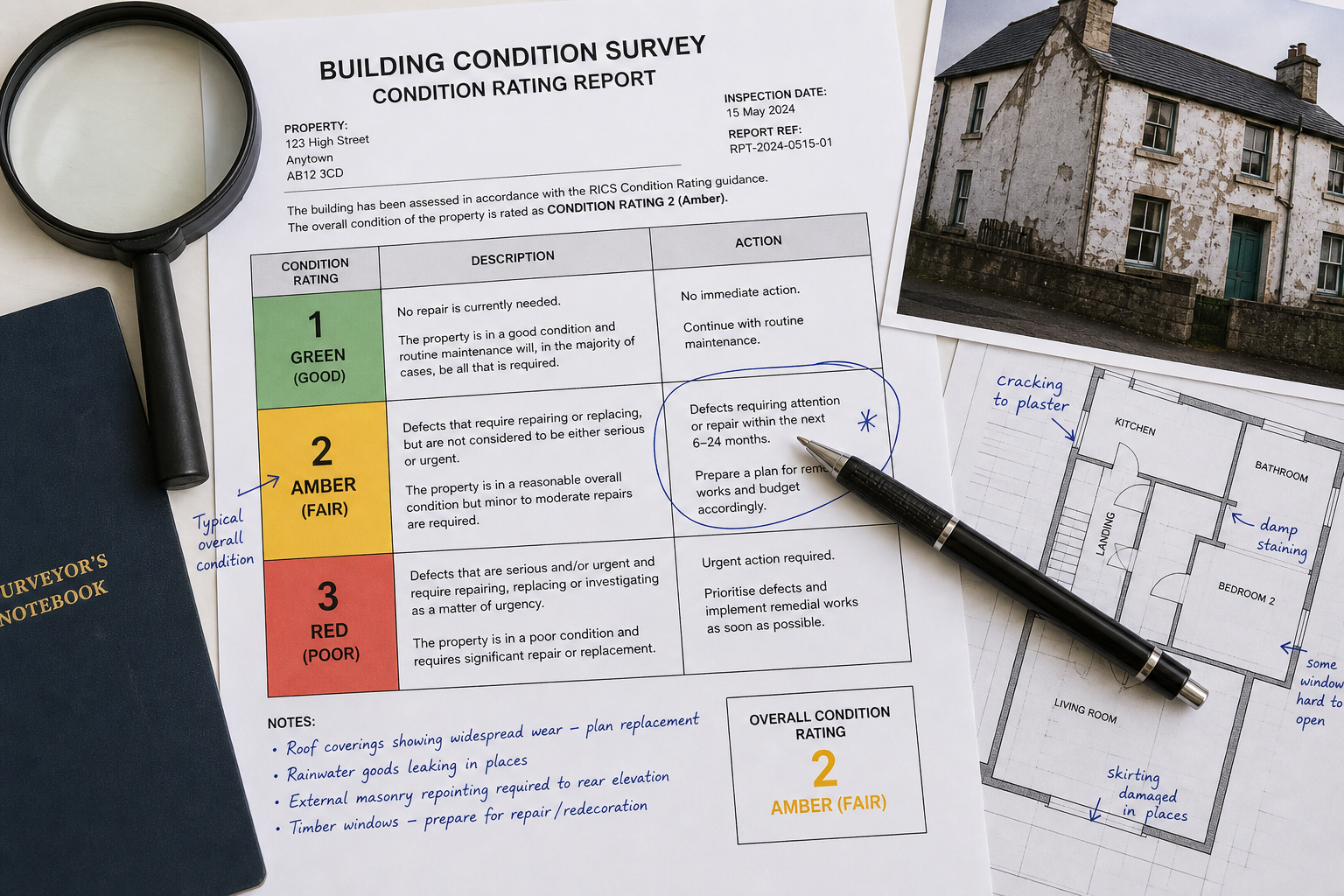
The RICS condition rating system provides a ready-made framework for communicating severity. Used in Level 2 and Level 3 surveys, it assigns one of three ratings — plus a "Not Inspected" category — to each element of the property [1].
| Rating | Meaning | Typical Action Required |
|---|---|---|
| Condition Rating 1 | No repair needed; routine maintenance only | Budget for ongoing upkeep |
| Condition Rating 2 | Defects present but not serious or urgent | Plan and budget for repair |
| Condition Rating 3 | Serious or urgent defects requiring immediate action | Act before or shortly after purchase |
| NI | Not inspected due to access restrictions | Consider further investigation |
Condition Rating 1 covers elements that are functioning as intended. Routine maintenance — clearing gutters, repainting external woodwork, repointing isolated mortar joints — falls here. These are not defects in any meaningful sense; they are the cost of property ownership.
Condition Rating 2 is where most age-related wear sits. A roof covering approaching the end of its serviceable life, single-glazed windows in an older property, or a boiler over 10 years old will often receive a Rating 2. This does not mean the element has failed. It means the buyer should budget for future expenditure and plan accordingly.
Condition Rating 3 is reserved for items that pose a safety risk, are actively failing, or require immediate professional intervention. Structural movement, active water ingress, or unsafe electrical installations belong here [1].
The critical professional skill is applying these ratings consistently and then explaining them in language that matches their actual severity — not treating a Rating 2 as though it were a Rating 3.
When a 'Defect' Is Just Age and Wear: Recognising Normal Deterioration
The most important distinction a building surveyor can draw is between deterioration that is consistent with age and deterioration that is abnormal or accelerated. Understanding this distinction is central to the principle of When a 'Defect' Is Just Age and Wear: How Building Surveyors Should Explain Condition, Risk and Proportionate Repair.
Typical Component Lifespans
Surveyors who understand typical component lifespans can contextualise their findings far more effectively. When a client knows that a concrete tile roof has a serviceable life of 40-60 years and the property is 45 years old, a recommendation to "monitor and plan for future replacement" lands very differently than an uncontextualised note about "roof defects."
Approximate serviceable lifespans for common building elements:
- Concrete roof tiles: 40-60 years
- Clay roof tiles: 60-100+ years
- UPVC windows: 20-35 years
- Timber sash windows (maintained): 100+ years
- Gas boiler: 10-15 years
- Lead flashings: 50-100 years
- Flat felt roofs: 10-20 years
- External render (sand/cement): 20-40 years
- Cavity wall insulation (blown fibre): 25-40 years
When a surveyor notes that a flat felt roof on a 1980s extension "shows signs of wear and is approaching the end of its serviceable life," that is not an alarm — it is a factual observation about a 40-year-old flat roof doing exactly what 40-year-old flat roofs do.
The Three Categories of Observation
A practical framework for survey reporting distinguishes three types of action:
Monitor: The element shows signs of wear or minor deterioration that does not yet require intervention. The client should keep an eye on it and seek professional advice if the condition changes.
Maintain: Routine maintenance is needed to prevent further deterioration. This includes tasks like repainting, repointing, clearing drainage channels, or servicing mechanical plant.
Urgent repair: The element is failing, poses a safety risk, or will cause consequential damage to other building elements if not addressed promptly.
Surveyors who use these three categories consistently — and explain what each means in plain English — give clients a genuinely useful tool for prioritising expenditure. For properties where maintenance history is being formally documented, a schedule of condition can provide a baseline record that supports future planning.
Proportionate Repair: Matching the Response to the Risk
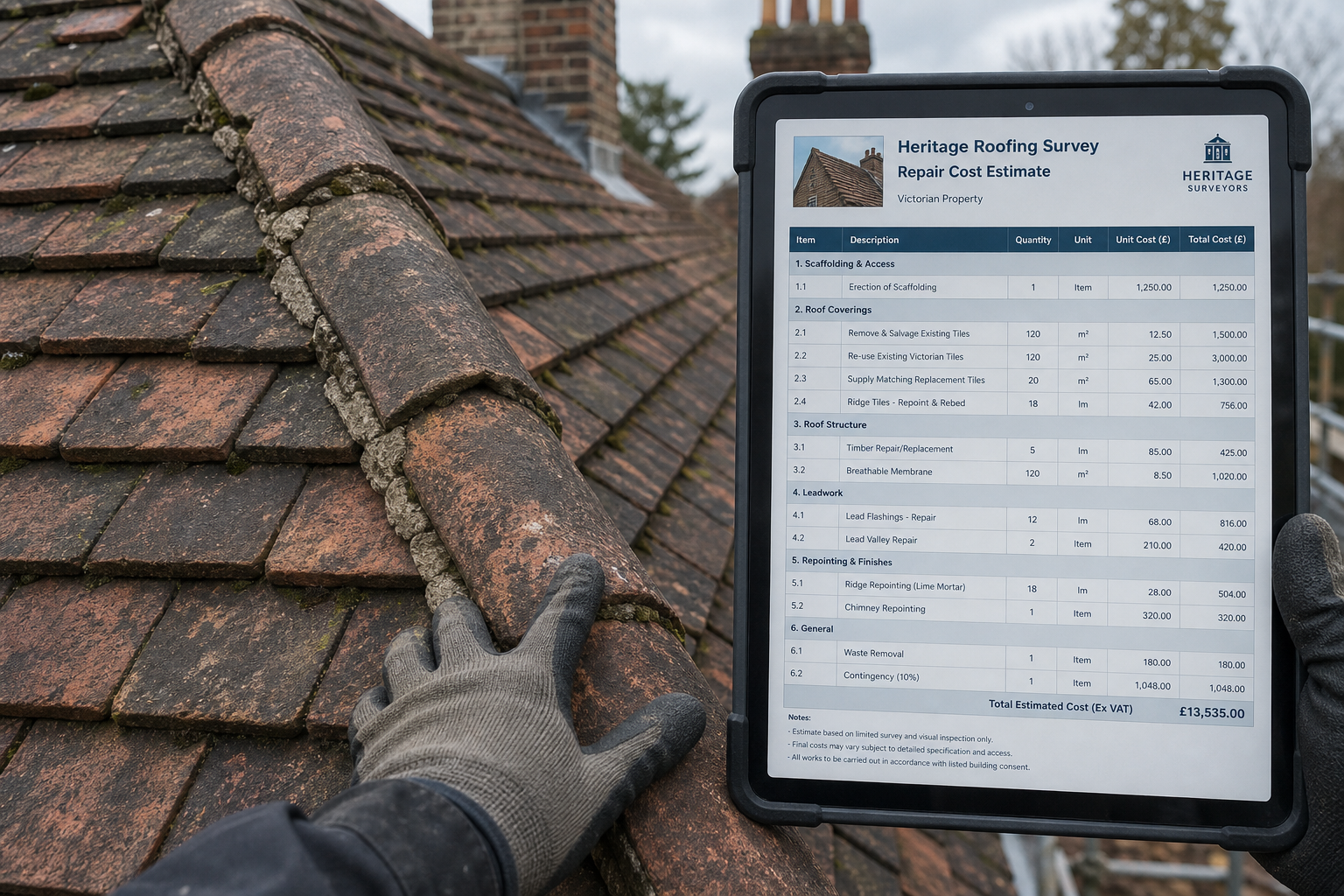
Proportionate repair advice is one of the most underused tools in a building surveyor's communication toolkit. The principle is straightforward: the recommended response to a defect should be proportionate to the property's age, value, condition, and the realistic remaining lifespan of the element in question.
A £180,000 terraced house with a 15-year-old boiler does not warrant the same response as a £1.2 million period property with a failing heating system that services underfloor pipework throughout three floors. The risk profile, the cost implications, and the consequential damage potential are entirely different.
Factors That Inform Proportionate Advice
1. Property age and construction type
A Victorian terrace built in 1890 will have solid walls, original timber floors, and single-skin chimney stacks. These are not defects — they are characteristics. A RICS commercial building survey or a residential Level 3 survey on such a property should explain what is normal for the construction type, not simply flag every deviation from modern building standards.
2. Consequential damage potential
Some elements, if left unaddressed, cause damage far beyond their own scope. A failed valley gutter, for example, can saturate roof timbers, damage ceilings, and promote rot throughout a roof structure. The proportionate response here is urgent — not because the gutter itself is expensive, but because the consequential damage is.
3. Remaining serviceable life
If a boiler has 2-3 years of serviceable life remaining, the proportionate advice is to budget for replacement in the near term. If it has failed, the advice is to replace it before completion. These are different recommendations with different urgency levels.
4. Cost relative to property value
A £3,000 re-roofing job on a £400,000 property is a different conversation than the same cost on a £120,000 flat. Surveyors who contextualise repair costs relative to transaction value help clients make genuinely informed decisions.
"The surveyor's role is not to produce a list of everything that could be better — it is to help the client understand what matters, what to plan for, and what to do right now."
For clients purchasing older or non-standard properties, understanding which survey level is appropriate is itself part of proportionate advice. A Level 2 survey on a substantially extended Victorian property may not provide the depth of investigation the property warrants [2].
How Surveyors Should Structure Their Explanations
The structure of a survey report is as important as its content. Even accurate findings, poorly organised, can mislead. The following principles support clear, proportionate communication.
Lead With Context, Not Conclusion
Before listing observations for a roof, for example, a brief contextual statement helps enormously: "The property was constructed circa 1935. The roof covering consists of the original clay plain tiles, which are consistent with the construction date and have a serviceable life well in excess of 100 years when maintained. The following observations are made in that context."
This framing does not soften the findings — it places them in a framework the client can use.
Use Plain Language Alongside Technical Terms
Technical accuracy is non-negotiable. But technical accuracy and plain language are not mutually exclusive. "Spalling brickwork to the chimney stack" should be followed by: "This means the face of some bricks is flaking away, likely due to frost action over many years. It is a common condition in chimney stacks of this age and should be repaired to prevent further deterioration and potential water ingress."
Separate Maintenance from Defects
A survey that lists routine maintenance items alongside structural concerns in the same section, with the same formatting, invites misreading. Consider separate sections or clear sub-headings that distinguish:
- Items requiring urgent attention
- Items requiring planned repair within 1-3 years
- Routine maintenance items
- Items to monitor
This structure mirrors the approach used in stock condition surveys for larger estates, where prioritisation of maintenance spend is a core output [4].
Quantify Where Possible
Vague language creates anxiety. "The roof may need attention in the future" is less useful than "The roof covering has an estimated remaining serviceable life of 10-15 years. Budgeting approximately £8,000-£12,000 for re-roofing within that timeframe is advisable."
Clients can act on numbers. They cannot act on uncertainty.
The Surveyor's Duty of Care in Context
A building surveyor's professional duty is to provide an accurate, impartial, and useful assessment of the property's condition. That duty includes the obligation to communicate findings in a way that enables the client to make informed decisions — not just to document observations.
The RPSA Survey Inspection and Reporting Standards make clear that reports should be written for the lay reader, with technical terms explained and findings contextualised [9]. This is not a soft recommendation — it is a professional standard.
For properties where condition is being formally recorded at the start of a tenancy or lease, a detailed schedule of condition provides a photographic and written baseline that can protect both landlord and tenant from future disputes about what was pre-existing wear and what constitutes damage [5].
At the end of a lease, a dilapidation survey assesses the property against its lease obligations — and here, the distinction between age-related wear and tenant-caused damage becomes legally and financially significant. Claims can run into substantial sums, and a surveyor who has clearly documented pre-existing condition has a far stronger foundation for defending or pursuing those claims [6].
For clients who need a focused assessment of a single element — a roof, a chimney, a suspected area of damp — a specific defect report provides targeted analysis without the scope of a full survey, and is often the proportionate response when a general survey has already been completed.
When a 'Defect' Is Just Age and Wear: Practical Guidance for Surveyors
Bringing together the principles above, the following practical guidance supports better communication of condition, risk, and proportionate repair.
Before writing the report:
- Establish the property's age and construction type as the baseline for all observations
- Identify which elements are at or near the end of their serviceable life versus those showing abnormal deterioration
- Determine which findings are consequential (i.e., likely to cause further damage if unaddressed) and which are self-contained
In the report:
- Use the condition rating system consistently and explain what each rating means in the context of this property
- Distinguish clearly between monitor, maintain, and urgent repair
- Provide estimated costs or cost ranges where possible
- Use plain language alongside technical terms
- Avoid loading the summary section with items that belong in the routine maintenance category
In client communication:
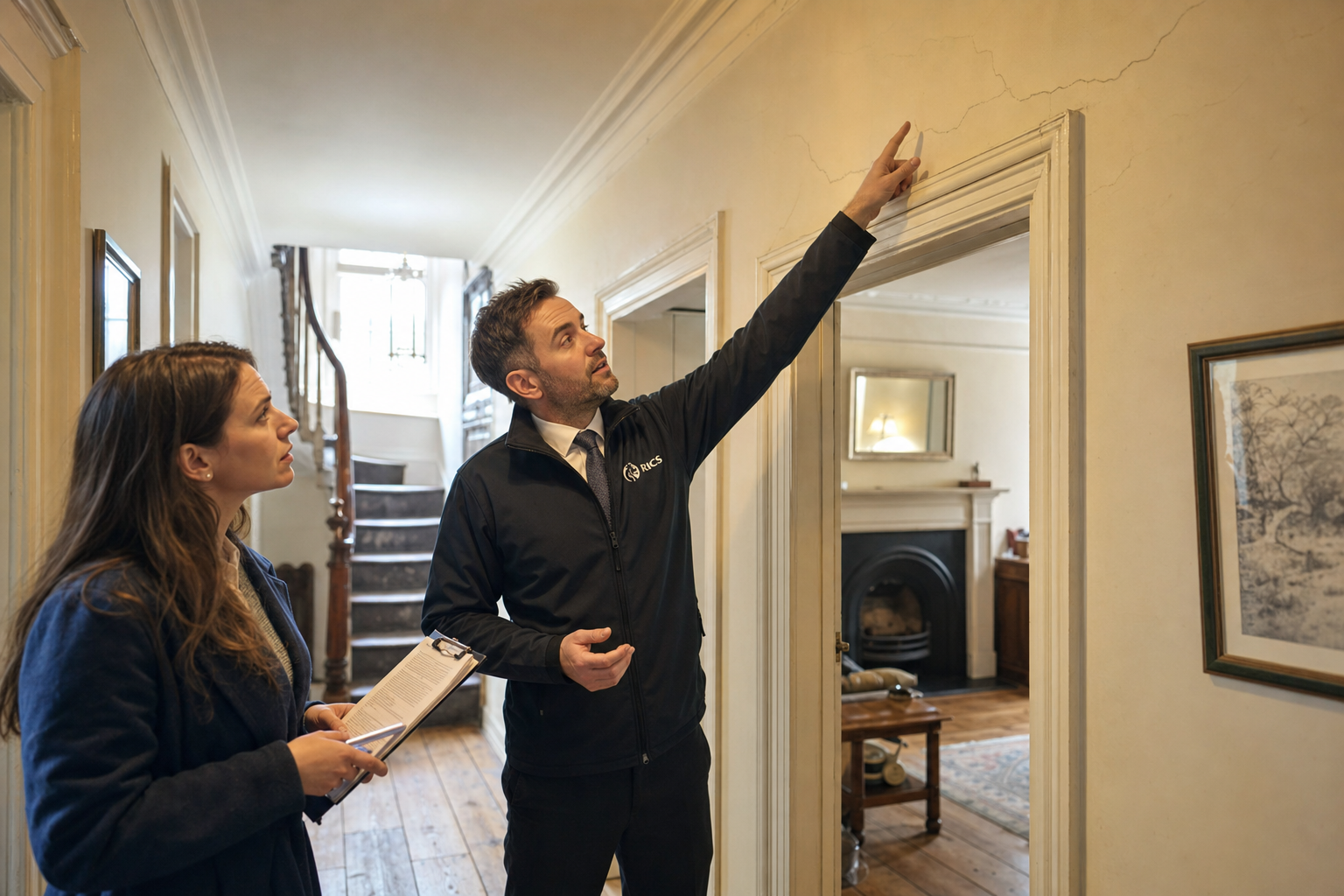
- Offer a brief verbal or written debrief after the report is issued
- Invite questions specifically about items the client found alarming
- Reinforce the distinction between "this is what a 90-year-old house looks like" and "this is something that needs immediate attention"
For clients who want to understand what surveyors specifically look for during an inspection, a detailed overview of the property inspection process can help set expectations before the report arrives.
Conclusion
The gap between what a surveyor writes and what a client understands is one of the most consequential communication failures in property transactions. When a 'Defect' Is Just Age and Wear: How Building Surveyors Should Explain Condition, Risk and Proportionate Repair is not just a professional challenge — it is a client service imperative.
Actionable next steps for building surveyors:
- Adopt the monitor / maintain / urgent repair framework as a consistent structural element of all reports
- Include a brief contextual statement for each major building element that references the property's age and construction type
- Provide estimated cost ranges for recommended repairs wherever possible
- Separate routine maintenance items from genuine defects in report formatting
- Offer a post-report debrief as standard practice, not an optional extra
- Review report language regularly against the question: "Would a lay reader understand the difference between a serious problem and normal wear?"
Clients who receive clear, proportionate, well-contextualised survey reports make better decisions. They complete purchases with realistic expectations, budget appropriately for future maintenance, and are far less likely to pursue complaints or renegotiate based on misunderstanding. That outcome serves everyone in the transaction — and it starts with a surveyor who understands that explaining condition is just as important as recording it.
References
[1] Survey Condition Ratings Explained – https://anslow-building-surveyors.co.uk/guides/survey-condition-ratings-explained?utm_source=openai
[2] Level 2 Vs Level 3 Survey – https://anslow-building-surveyors.co.uk/guides/level-2-vs-level-3-survey?utm_source=openai
[3] Property Condition Assessment – https://rimkus.com/article/property-condition-assessment/?utm_source=openai
[4] Introduction To Condition Surveys – https://assets.publishing.service.gov.uk/media/5f8480b58fa8f50455cd95d3/Introduction_to_condition_surveys.pdf?utm_source=openai
[5] Schedule Of Condition – https://www.gjsdillon.co.uk/service/building-surveying-project-consultancy/schedule-of-condition/?utm_source=openai
[6] Dilapidation Survey – https://www.aylingassociates.com/knowledge/dilapidation-survey?utm_source=openai
[9] RPSA Survey Inspection and Reporting Standards Edition 1 v5.2 Nov 20 – https://www.rpsa.org.uk/rpsadocs/RPSA%20Survey%20Inspection%20and%20Reporting%20Standards%20Edition%201%20v5.2%20Nov%2020.pdf?utm_source=openai