
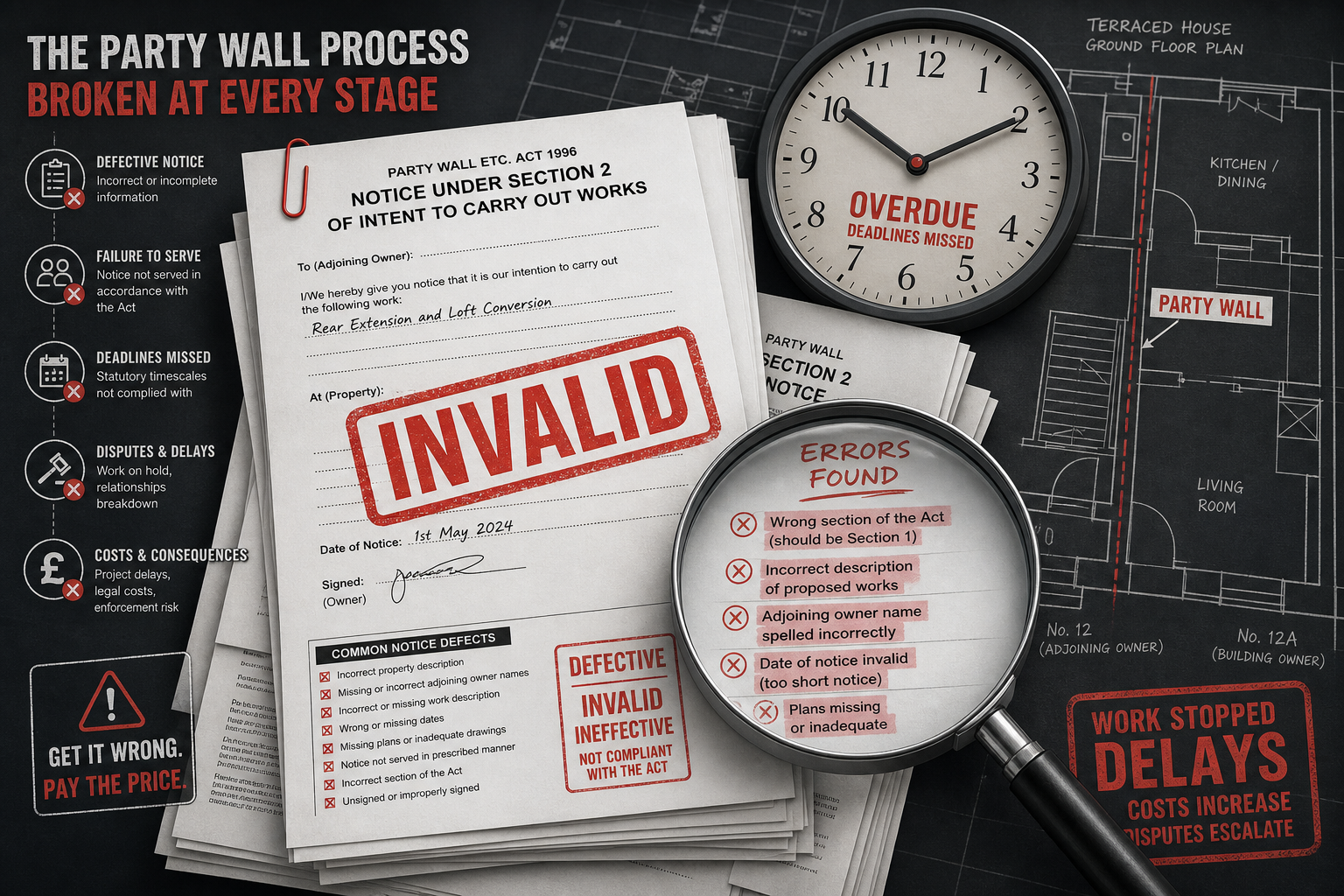
Roughly one in three party wall notices contains a defect serious enough to invalidate the entire process before work even begins. [1] That single statistic explains why so many building projects in England and Wales stall, face legal challenges, or end up in county court — not because of structural problems, but because of paperwork failures. Understanding the most common reasons party wall awards get delayed, challenged, or ignored is the first step toward avoiding costly disruptions on both sides of a shared wall.
The Party Wall etc. Act 1996 was designed to create a clear, fair framework for managing construction work near shared boundaries. In practice, however, the process is riddled with opportunities for error. Poor notices, slow or absent responses, unclear award wording, fee disputes, and surveyor conduct issues all contribute to friction that can set a project back by weeks or months.
Key Takeaways
- Invalid or incorrectly served party wall notices are the single most frequent cause of delays and procedural challenges.
- A neighbour's silence in response to a notice is treated as dissent under the Act, automatically triggering the surveyor appointment process.
- Awards can be challenged in county court on grounds including jurisdictional defects, procedural errors, and unjust terms.
- Surveyor impartiality failures have led courts to invalidate awards entirely.
- A structured prevention checklist — covering notice service, scope clarity, fee agreements, and award wording — eliminates the majority of common failure points.
Why Invalid Notices Are the Root Cause of Most Delays
The party wall process begins with a valid notice, and this is precisely where most problems originate. Research indicates that approximately 30% of party wall notice failures stem from improper service methods. [1] Common errors include:
- Serving notice by email only, without postal confirmation
- Addressing the notice to a tenant rather than the freeholder
- Citing the wrong section of the Act for the type of work being carried out
- Omitting mandatory details such as the proposed start date or a description of the works
- Failing to allow the correct notice period before works commence [6]
Why this matters: An invalid notice means the surveyor appointed under that notice lacks jurisdiction. Any award produced on the back of a defective notice can be challenged and potentially set aside by a court. [2] This means the entire process must restart, adding weeks or months to a project timeline.
"Notices missing key details or citing incorrect sections of the Act can quickly lead to disputes and delays." [4]
The correct notice period under the Act varies by work type: 14 days for a Line of Junction notice, one month for a Party Structure notice, and one month for an Excavation notice. Serving a notice even one day late relative to a planned start date can force a project to pause. For projects involving excavation near a neighbouring structure, understanding the requirements of an excavation notice under the Party Wall Act is essential before any ground is broken.
The Problem of Serving Notice on the Wrong Person
One of the most overlooked notice errors involves identifying who actually owns the adjoining property. In leasehold situations, the freeholder must be served — not just the occupying tenant. If a building owner serves notice only on a tenant, the notice is invalid, even if the tenant acknowledges it. This is a particularly common mistake in urban areas with high concentrations of leasehold flats.
How Neighbour Responses — or the Lack of Them — Trigger Disputes
Even when a notice is served correctly, the adjoining owner's response (or non-response) can become a significant source of delay. Under the Party Wall etc. Act 1996, silence is not consent. If a neighbour fails to respond within 14 days of receiving a notice, they are deemed to have dissented, and a dispute is considered to have arisen. [3]
This automatic dissent triggers the surveyor appointment process, which adds time and cost to the project. The building owner must then appoint a surveyor, and the adjoining owner either appoints their own or agrees to a single agreed surveyor. If the adjoining owner refuses to engage at all, the building owner's surveyor can appoint a surveyor on their behalf after a further 10-day notice period.
Why Neighbours Ignore or Challenge Notices
Several underlying reasons explain why adjoining owners delay or resist the party wall process: [4]
| Reason | Description |
|---|---|
| Fear of damage | Concern that construction will harm their property or foundations |
| Cost confusion | Uncertainty about who pays surveyor fees and remedial costs |
| Prior tensions | Existing neighbourly disputes that spill into the party wall process |
| Lack of awareness | Simply not understanding what the notice means or requires |
| Distrust of the process | Belief that the process favours the building owner |
Early, informal communication between neighbours before formal notices are served can prevent many of these reactions. When adjoining owners feel informed and respected, they are far less likely to become obstructive. [4] For anyone dealing with a situation where a neighbour is carrying out works without a party wall agreement, the dynamics are even more fraught, as trust has already broken down.
The Role of a Schedule of Condition
One practical tool that reduces neighbour anxiety — and therefore reduces the likelihood of challenges — is a pre-works schedule of condition. This document records the existing state of the adjoining property before construction begins, providing an objective baseline if damage claims arise later. A properly prepared schedule of condition protects both parties and removes a common source of post-works disputes.
The Grounds on Which Party Wall Awards Are Challenged
Understanding the most common reasons party wall awards get delayed, challenged, or ignored requires a clear look at the legal grounds for challenge. Under Section 10(17) of the Party Wall etc. Act 1996, either party may appeal an award to the county court within 14 days of service. Courts have intervened on several distinct grounds. [2]
Jurisdictional Defects
An award is vulnerable to challenge if the surveyor who made it lacked jurisdiction. This typically occurs when:
- The original notice was invalid (as discussed above)
- The works described in the award fall outside the scope of the Act
- The award purports to cover matters unrelated to the notifiable works
Courts have been consistent in treating jurisdictional defects as fundamental. An award made without jurisdiction is not merely voidable — it may be treated as a nullity. [2]
Procedural Errors
Procedural failures represent another significant category of challenge grounds. These include: [2]
- Failure to give proper notice before making an ex-parte award — If a surveyor proceeds to make an award without giving the other party adequate opportunity to participate, this is a serious procedural flaw.
- Improper selection of the third surveyor — The third surveyor must be selected by the two appointed surveyors, not by one party alone.
- Failure to serve the award correctly — The award must be served on both the building owner and the adjoining owner.
Unreasonable or Unjust Terms
Courts retain the power to modify or rescind awards where the terms are demonstrably unjust. Examples include: [2]
- Compensation figures that bear no reasonable relationship to actual loss
- Working hour restrictions so severe they make the project commercially unviable
- Conditions that go beyond what is reasonably necessary to protect the adjoining owner
Surveyor Impartiality Failures
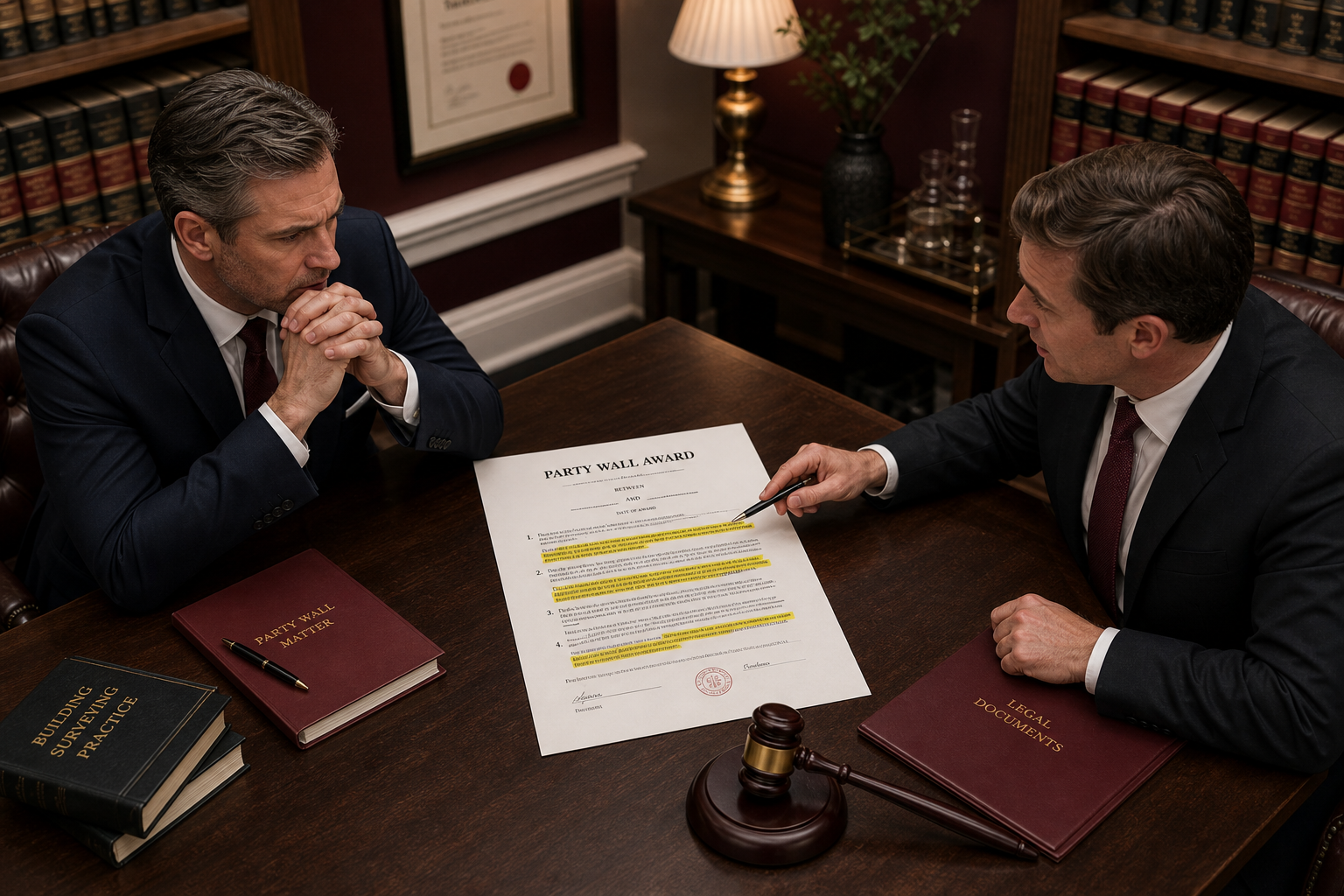
A surveyor's duty of impartiality is not merely a professional expectation — it is a legal requirement. Courts have invalidated awards where a surveyor failed to give balanced consideration to both parties' concerns. [5] An appointed surveyor who acts purely as an advocate for the party who appointed them, rather than as a quasi-judicial decision-maker, risks having their award set aside entirely.
This is a nuanced area. A surveyor may legitimately represent their appointing owner's interests in negotiations, but when it comes to making or agreeing an award, they must act impartially. The distinction is not always obvious in practice, which is why working with experienced chartered surveyors who understand their statutory duties is so important.
Vague Award Wording and Scope Disputes
Even awards that survive challenge can cause significant practical problems if the wording is imprecise. Vague descriptions of permitted works, unclear access rights, or ambiguous compensation triggers create fertile ground for disagreement during construction.
Common wording failures include:
- Describing works in general terms rather than by reference to specific drawings
- Failing to specify the hours during which access is permitted
- Leaving compensation triggers undefined (for example, "if damage occurs" without specifying how damage is assessed)
- Not identifying which party bears the cost of specific remedial works
Best practice: Awards should reference specific, dated drawings and specifications. Any access rights granted should state the days, hours, and notice period required. Compensation provisions should specify the mechanism for assessment — ideally by reference to an independent surveyor or agreed methodology.
Understanding what a party wall dispute actually involves helps both building owners and adjoining owners engage more constructively with the award drafting process.
Fee Disputes as a Source of Delay
The cost of party wall proceedings is a recurring source of tension. Under the Act, the building owner generally pays the reasonable fees of both surveyors. However, disputes arise when:
- The adjoining owner appoints a surveyor who charges disproportionately high fees
- The building owner disputes the reasonableness of fees without a clear mechanism for resolution
- Surveyors fail to agree on the allocation of costs between multiple works or multiple adjoining owners
The Act does provide a mechanism: the appointed surveyors can include a costs award within the party wall award itself. However, if surveyors cannot agree, the matter falls to the third surveyor — adding further delay and cost.
Fee disputes are rarely about the money alone. They frequently reflect deeper mistrust between the parties, which is why addressing communication breakdowns early is so important.
Prevention: A Practical Checklist for Surveyors and Property Owners
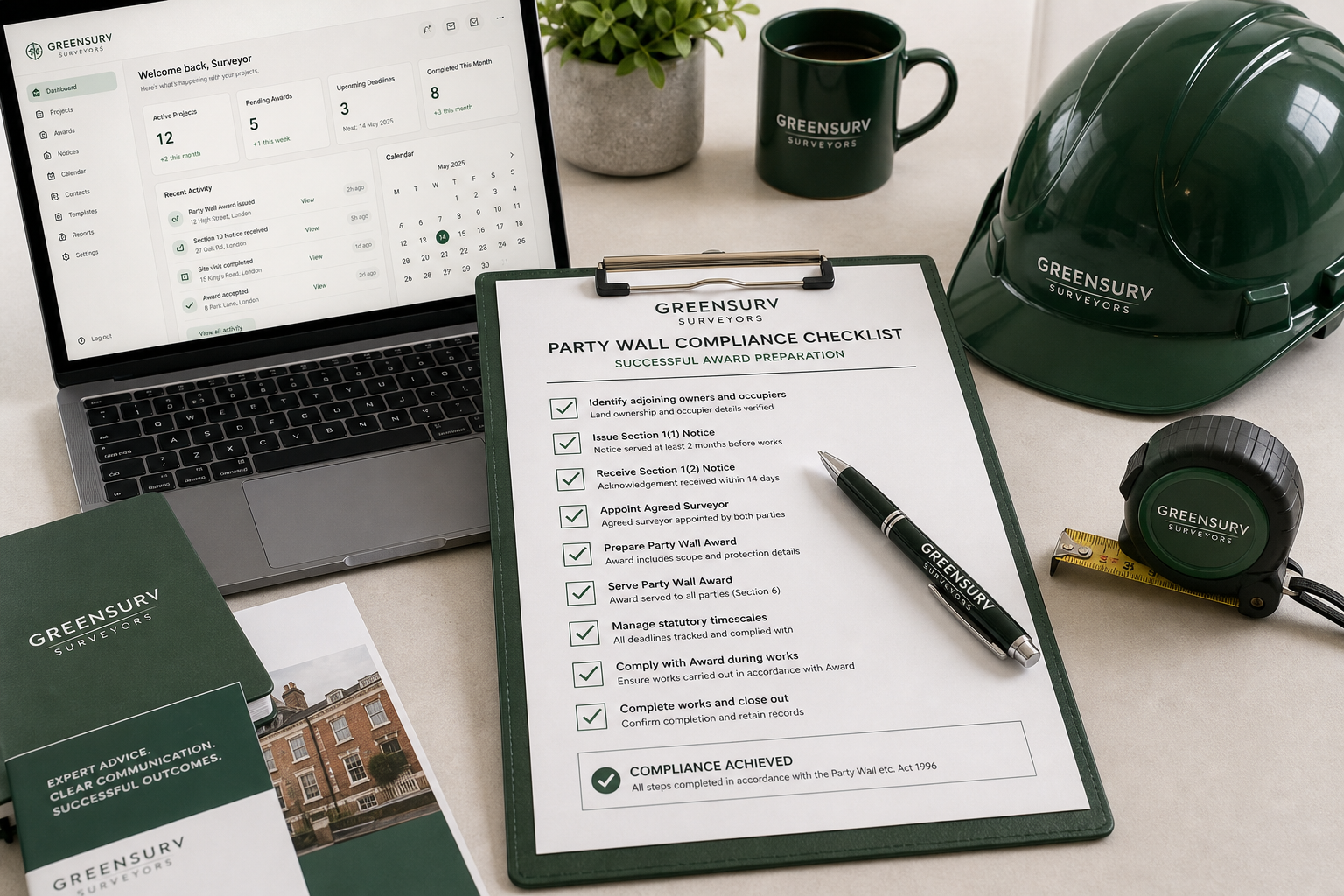
The most common reasons party wall awards get delayed, challenged, or ignored are almost entirely preventable. The following checklist addresses the recurring process failures identified throughout this article.
Before Serving Notice
- Confirm the correct identity and address of all adjoining owners (freeholders, not just tenants)
- Identify the correct notice type and statutory notice period for each element of the works
- Serve notice by first-class post and retain proof of postage; do not rely on email alone [1]
- Ensure the notice includes all mandatory information: description of works, proposed start date, building owner's address
- Allow adequate time before the planned start date to accommodate the full dispute resolution process if needed [6]
During the Surveyor Appointment Process
- Confirm that appointed surveyors understand their duty of impartiality under the Act [5]
- Agree the third surveyor selection before any dispute arises, not after
- Prepare a schedule of condition of the adjoining property before works begin
- Communicate openly with the adjoining owner throughout — do not let the formal process replace neighbourly dialogue [4]
When Drafting the Award
- Reference specific, dated drawings and specifications within the award
- Define access rights precisely: days, hours, notice period required
- Specify the mechanism for assessing any compensation claims
- Confirm the costs allocation and ensure fees are proportionate
- Serve the award correctly on both parties and retain proof of service
If a Challenge Arises
- Note the 14-day appeal window from the date of service
- Seek specialist legal advice immediately if a challenge is received
- Consider whether the underlying concern can be resolved by agreement, avoiding court proceedings
- Engage an expert witness surveyor if the matter proceeds to county court
Conclusion
The party wall process is not inherently adversarial. The Act provides a workable framework that, when followed correctly, protects both building owners and their neighbours. The problems arise when notices are served carelessly, responses are ignored, award wording is left vague, or surveyors lose sight of their statutory duties.
In 2026, the volume of residential construction and extension work in England and Wales means party wall disputes remain a daily reality for surveyors, solicitors, and homeowners alike. The good news is that the vast majority of delays, challenges, and instances of non-compliance trace back to a small number of recurring process failures — all of which are preventable with proper preparation.
Actionable next steps:
- If planning construction work near a shared boundary, engage a qualified surveyor at the earliest possible stage — before drawings are finalised.
- Serve notices correctly, to the right people, by the right method, with the right notice period.
- Invest in a schedule of condition to protect both parties from post-works disputes.
- Ensure any award produced is specific, clearly worded, and properly served.
- If a dispute has already arisen, seek specialist advice promptly — the 14-day appeal window moves quickly.
Taking these steps does not guarantee a dispute-free project, but it removes the most common failure points that cause party wall awards to be delayed, challenged, or ignored.
References
[1] Invalid Party Wall Notices Surveyor Strategies To Avoid Injunctions And Delays In 2026 – https://wimbledonsurveyors.com/invalid-party-wall-notices-surveyor-strategies-to-avoid-injunctions-and-delays-in-2026/?utm_source=openai
[2] Can Party Wall Awards Be Challenged The Grounds Time Limits And Practical Steps For Surveyors And Owners – https://partywallsurveyorlondon.uk/blogs/can-party-wall-awards-be-challenged-the-grounds-time-limits-and-practical-steps-for-surveyors-and-owners/?utm_source=openai
[3] What Happens If Your Neighbour Ignores A Party Wall Notice – https://www.expresspartywall.com/what-happens-if-your-neighbour-ignores-a-party-wall-notice/?utm_source=openai
[4] Party Wall Disputes – https://echelonpartywall.co.uk/resources/guides/party-wall-disputes/?utm_source=openai
[5] Party Wall Surveyor Impartiality In 2026 Balancing Client Duties With Adjoining Owner Protections – https://partywallsurveyorlondon.uk/blogs/party-wall-surveyor-impartiality-in-2026-balancing-client-duties-with-adjoining-owner-protections/?utm_source=openai
[6] Party Wall Issues – https://www.tatesurveyingservices.co.uk/advice/party-wall-issues/?utm_source=openai