Over 20% of buyers who commissioned Level 3 building surveys in 2026 uncovered serious defects that could have derailed their transactions entirely [7]. That single statistic reframes how buyers, sellers, and developers should think about due diligence — and it places party wall risk assessments at the centre of every deal that involves a shared or adjoining structure.
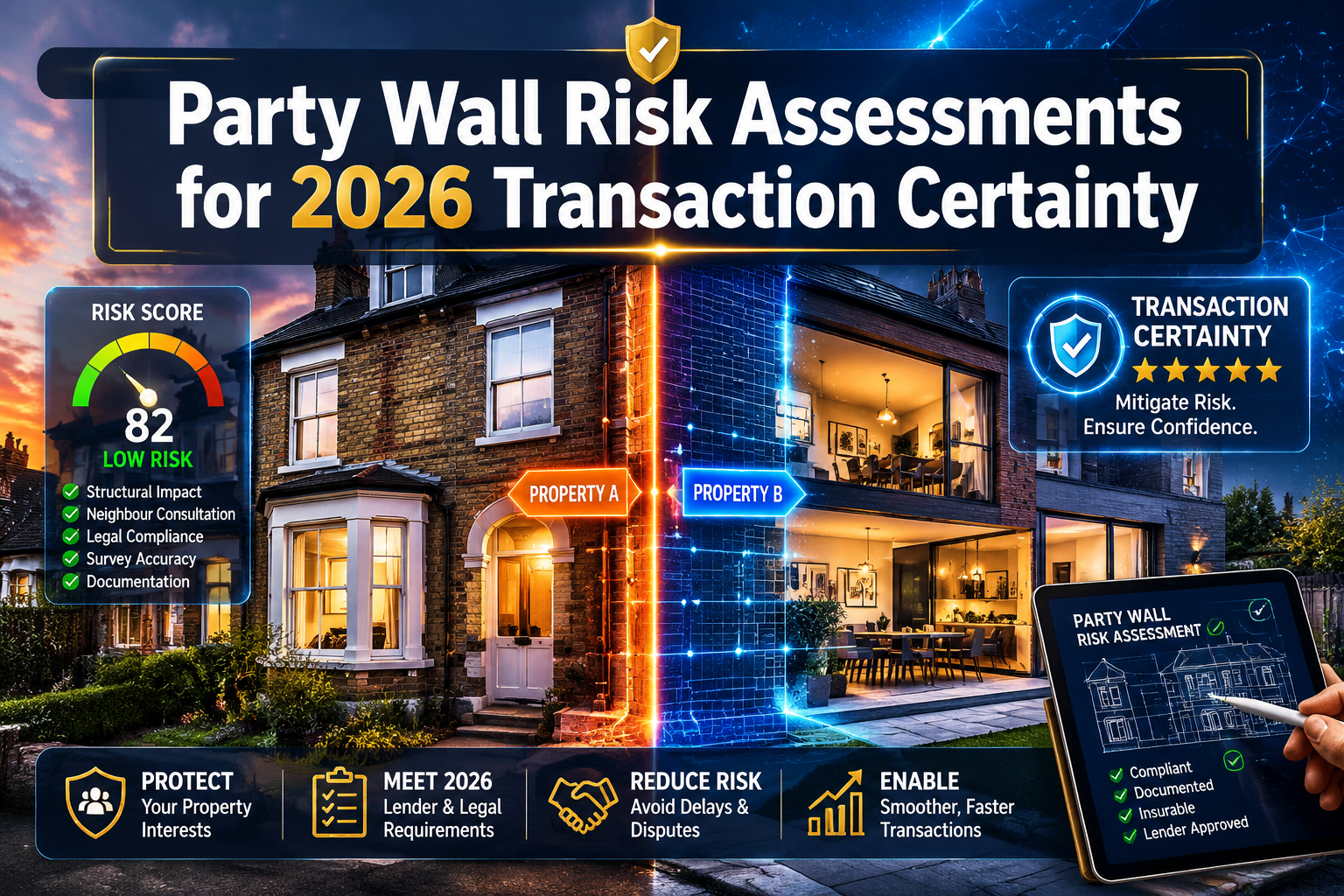
Party Wall Risk Assessments for 2026 Transaction Certainty: Enhancing Deals with Greater Data-Driven Clarity is no longer a niche concern for specialist surveyors. It is a mainstream priority in a market where the Landmark Information Group's February 2026 analysis identified "certainty" as the single most important driver shaping property transactions this year [10]. Fragmented data, delayed processes, and unresolved boundary disputes are the enemies of deal flow — and party wall issues sit squarely at the intersection of all three.
Key Takeaways
- Party wall risk assessments are now a core component of transaction due diligence, not an optional add-on.
- Data-driven clarity — combining structural surveys, monitoring data, and digital risk scoring — reduces the likelihood of deal fall-throughs and post-completion disputes.
- The 2026 market environment, characterised by rising M&A complexity and geopolitical uncertainty, demands proactive rather than reactive risk management.
- Unresolved party wall matters can affect valuations, mortgage approvals, and legal completion timelines.
- Integrating RICS-compliant survey data with property-level risk scores gives all parties a shared, defensible evidence base for negotiation.
Why 2026 Is a Turning Point for Transaction Risk Management
The property and construction sectors entered 2026 facing a convergence of pressures that have made risk clarity more commercially valuable than at any point in the previous decade. The BRG M&A Disputes Report for 2026 recorded a measurable rise in transaction disputes driven by complexity and geopolitical volatility [3]. Simultaneously, the Bipartisan Policy Center's March 2026 roundtable on permitting certainty highlighted how inconsistent regulatory standards create delays that erode deal value [4].
In the UK context, these global trends translate directly into the party wall arena. Developers and buyers are dealing with:
- Increased urban densification — more loft conversions, basement extensions, and rear additions that trigger party wall obligations
- Heightened lender scrutiny — mortgage providers demanding clearer evidence of structural risk before approving finance
- Climate risk integration — as of January 2026, climate risk data has become central to real estate underwriting, with disputes over property risk scores highlighting the need for transparent, accurate assessments [5]
- Digital transformation pressures — the 47th Annual Deltek Clarity Architecture and Engineering Industry Study found that 42% of firms believe they risk losing market share within two years without significant digital transformation [8]
Against this backdrop, party wall risk assessments are evolving from compliance formalities into strategic deal instruments.
"Certainty is the top priority in 2026 — and that certainty must be built on data, not assumptions."
— Landmark Information Group, February 2026 [10]
What Party Wall Risk Assessments Actually Cover
A party wall risk assessment goes beyond confirming that a Party Wall etc. Act 1996 notice has been served. A comprehensive assessment examines the physical, legal, and commercial dimensions of any shared or adjoining structure to produce a risk-stratified picture that all transaction parties can rely upon.
Structural and Physical Condition
The physical inspection component evaluates:
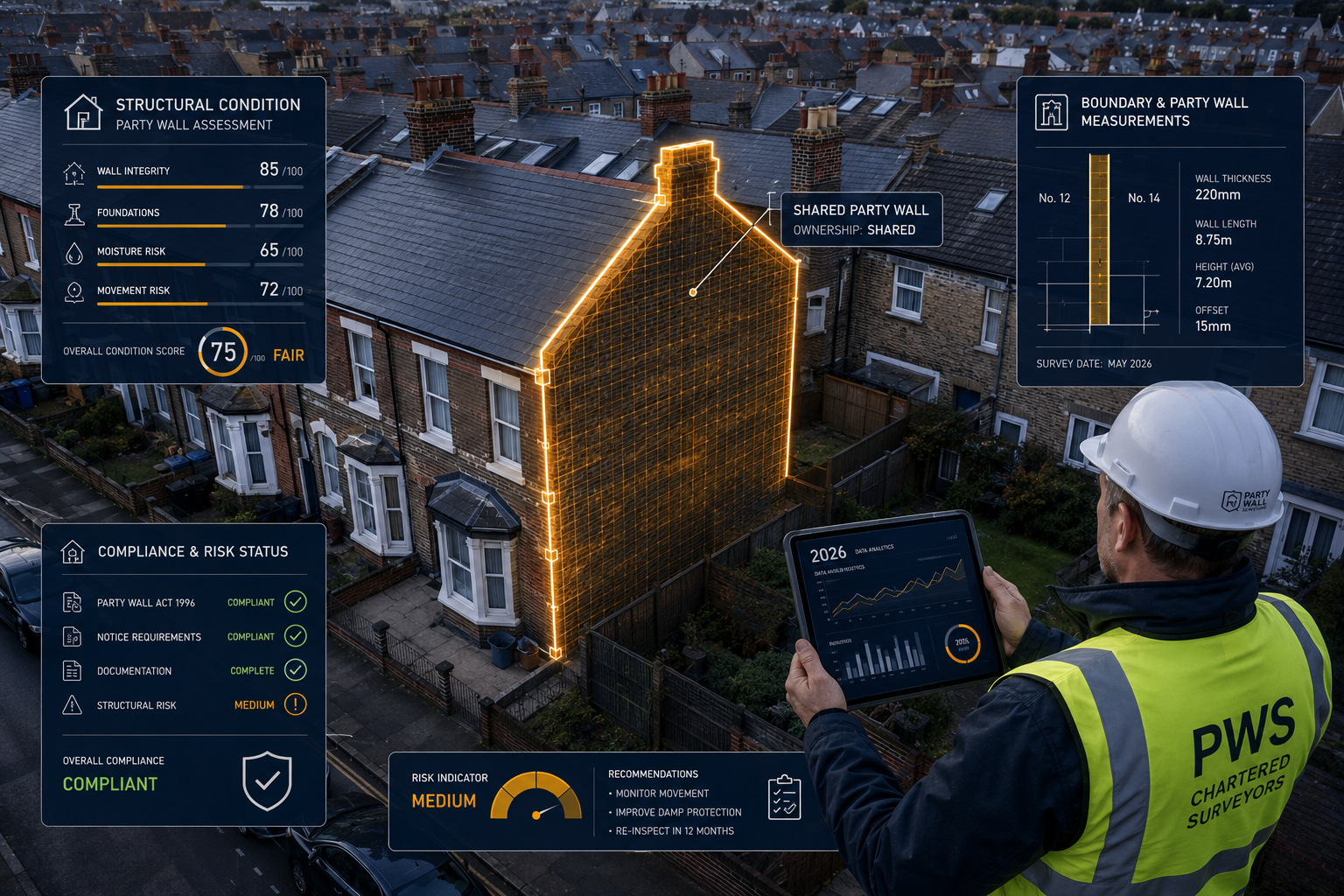
- The current condition of the party wall, including cracks, movement, damp penetration, and previous repair history
- The depth and type of foundations on both sides of the boundary
- Evidence of previous works that may have weakened the structure
- Proximity to drainage runs, tree roots, and other subsurface risks
For properties involving loft conversions or extensions, the assessment must account for additional loading on shared walls. Understanding how loft conversions interact with party wall obligations is essential before any structural works begin, as undisclosed alterations can become significant liabilities during a sale.
Legal and Compliance Standing
The legal component of a party wall risk assessment checks:
| Risk Factor | What Is Assessed |
|---|---|
| Notice compliance | Whether valid notices were served under the 1996 Act |
| Award documentation | Whether a party wall award exists and is enforceable |
| Dispute history | Any recorded or unresolved party wall disputes |
| Unauthorised works | Evidence that a neighbour has carried out works without a party wall agreement |
| Boundary clarity | Whether the party wall boundary aligns with title register data |
Commercial and Transaction Risk
This dimension quantifies the financial exposure attached to identified risks. It includes estimated remediation costs, likely delays to completion, and the probability that a lender or insurer will require further investigation before proceeding.
How Data-Driven Clarity Strengthens Party Wall Risk Assessments for 2026 Transaction Certainty
The phrase "data-driven clarity" is used frequently in 2026 property discussions, but its practical meaning in the party wall context deserves unpacking. Three developments are reshaping how assessments are conducted and communicated.
Integration of Digital Monitoring Data
Monitoring surveys now play a significant role in pre-transaction party wall assessments. Crack monitoring, inclinometer readings, and settlement gauges installed during or after previous works provide a longitudinal record of structural behaviour. This time-series data is far more persuasive to lenders and buyers than a single-point inspection, because it demonstrates whether movement is historic and stable or ongoing and progressive.
The revised ALTA/NSPS Land Title Survey Standards, effective February 23, 2026, reflect a similar philosophy: updated measurement and data presentation standards are designed to give all stakeholders greater confidence in boundary resolutions and site risk visibility [1]. While these standards apply primarily in the US context, they signal a global direction of travel toward standardised, high-precision survey data that supports transaction certainty.
AI-Assisted Risk Scoring
A May 2026 study by First American Data and Analytics and DealGround found that 66% of commercial real estate professionals use AI tools weekly or daily, yet only 5% trust these tools for critical deal decisions [2]. This trust gap is significant. It suggests that AI-generated risk scores are being produced in volume but are not yet replacing professional judgement — they are supplementing it.
In the party wall context, AI tools are being used to:
- Cross-reference title register data with planning history and building control records
- Flag properties where the 3-metre rule may be triggered by proposed excavation works
- Score the probability of dispute based on historical patterns in comparable transactions
The key is that these outputs must be validated by a qualified surveyor. Data without professional interpretation is not clarity — it is noise.
Standardised Reporting Formats
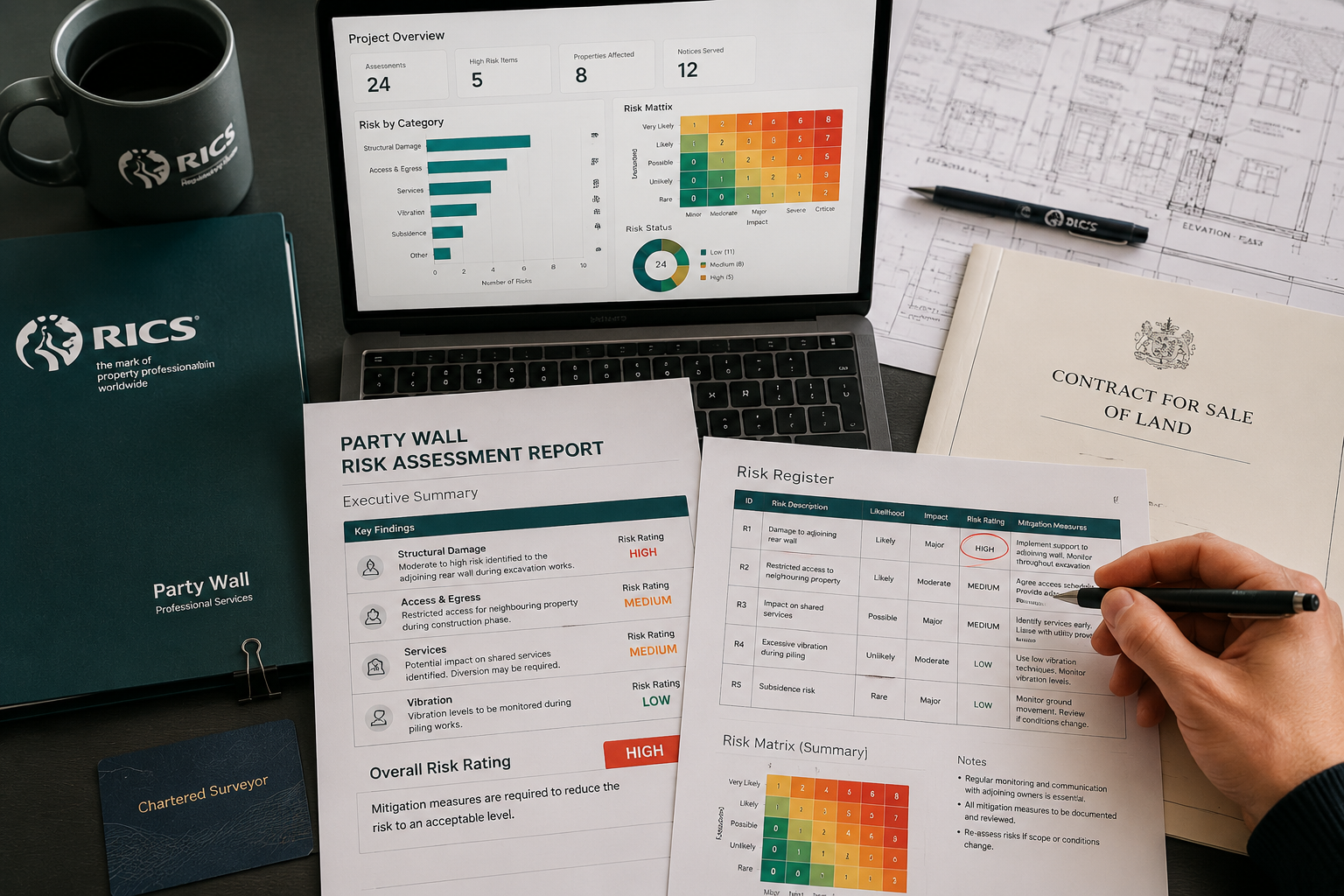
One of the most practical improvements in 2026 is the move toward standardised party wall risk report formats that can be shared directly with solicitors, mortgage valuers, and buyers without requiring translation. A well-structured report cross-references physical findings with legal compliance status and attaches a clear risk rating — low, medium, or high — with supporting evidence for each classification.
This standardisation aligns with the broader industry push described by Landmark Information Group: reducing friction by improving transparency and efficiency across the transaction chain [10].
The Cost of Getting It Wrong: Disputes, Damage, and Deal Collapse
Failing to conduct a thorough party wall risk assessment before exchange carries consequences that extend well beyond the cost of the assessment itself.
Deal Fall-Through Risk
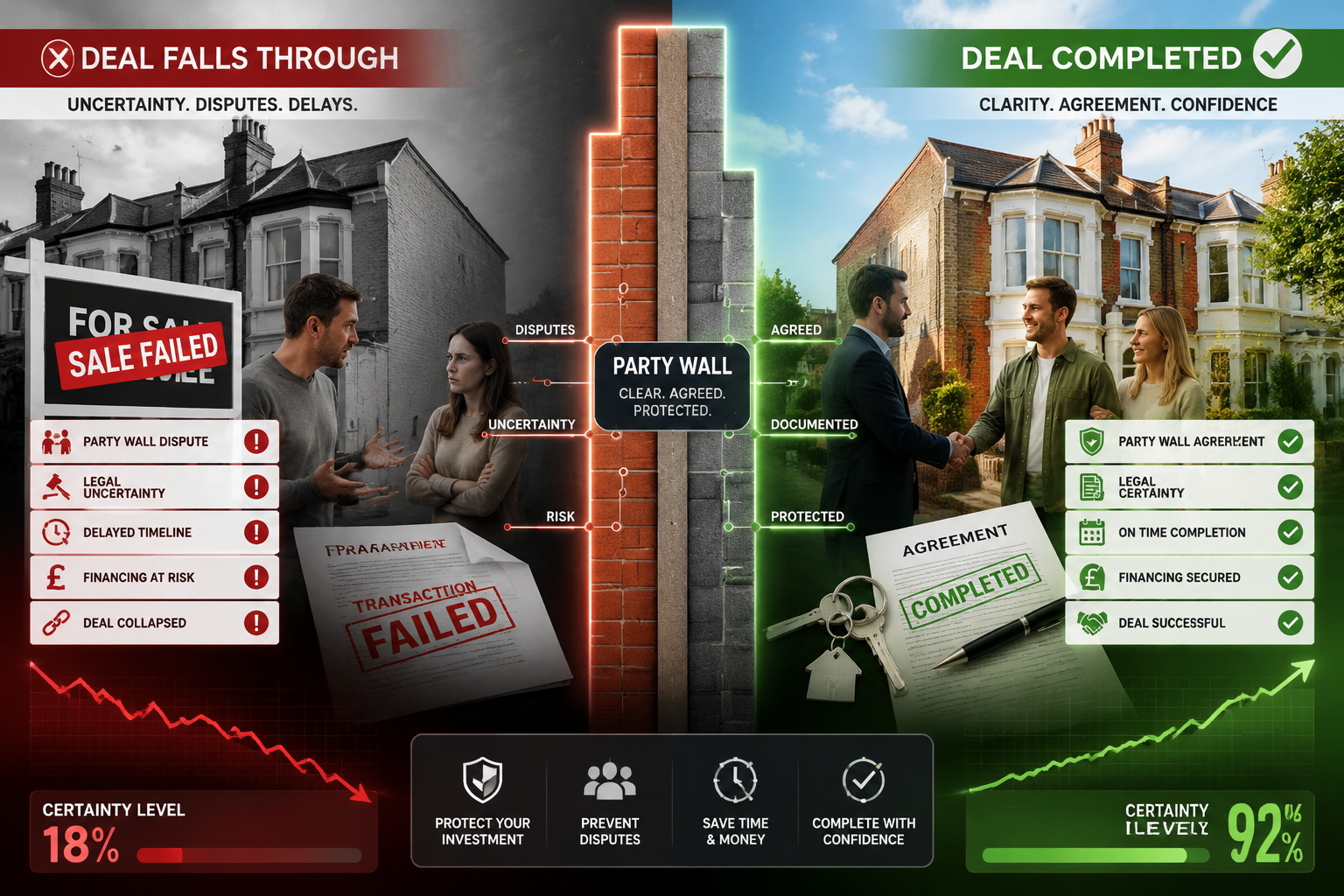
Data from June 2026 confirms that over one in five buyers who commissioned Level 3 surveys found defects serious enough to threaten the transaction [7]. Party wall defects — undisclosed damage, missing awards, or evidence of unauthorised works — fall squarely into this category. A deal that collapses after exchange costs both parties in legal fees, survey costs, and lost time.
Post-Completion Liability
Damage to property caused by party wall works is a recurring source of post-completion disputes. When a buyer discovers that a neighbour's previous extension damaged the shared wall and no award was ever obtained, the remediation cost falls on the new owner — unless the risk was identified and priced into the transaction beforehand.
Valuation Impact
Unresolved party wall matters affect RICS Red Book valuations. A valuer who identifies an unresolved dispute or structural risk at a shared wall is obliged to reflect that uncertainty in the valuation figure. This can trigger a downward revision that affects mortgage lending, which in turn can delay or collapse the transaction.
The cost of a party wall risk assessment is modest relative to the cost of any one of these outcomes. Understanding what a party wall survey costs is the first step toward treating it as a standard line item in transaction due diligence rather than an optional extra.
Practical Steps for Buyers, Sellers, and Developers in 2026
The following framework translates the principles of data-driven party wall risk assessment into actionable steps for each party in a transaction.
For Buyers
- Commission a party wall risk assessment as part of pre-exchange due diligence, not after exchange when leverage is reduced.
- Request copies of all party wall awards and notices relating to previous works at the property.
- Ask the seller to confirm in writing whether any works affecting the party wall have been carried out in the last ten years.
- Instruct a structural survey if the assessment identifies medium or high risk, to quantify remediation costs before negotiating the purchase price.
For Sellers
- Obtain a party wall risk assessment before listing to identify and resolve issues that could derail a sale.
- Ensure all party wall awards are accessible and can be provided to buyers' solicitors promptly.
- Address any dilapidation or structural concerns at the party wall before marketing begins.
- Price the property to reflect the assessed risk level, supported by documented evidence.
For Developers
- Integrate party wall risk assessments into the earliest stage of site appraisal, particularly for schemes involving excavation near boundaries where the 3-metre rule may apply.
- Use monitoring survey data to demonstrate structural stability to funders and planning authorities.
- Maintain a complete documentary record of all notices, awards, and inspection reports as part of the project file — this becomes a transaction asset when the completed scheme is sold.
Enhancing Deals with Greater Data-Driven Clarity: The Surveyor's Role in 2026
The surveyor's role has expanded significantly in 2026. Where once a party wall surveyor was primarily a dispute resolver, the modern practitioner is increasingly a transaction enabler — someone who produces the data-rich, professionally validated evidence that allows deals to proceed with confidence.
This shift is consistent with broader trends in the built environment sector. The Deltek Clarity study found that firms embracing digital transformation are better positioned to win work and retain clients [8]. Surveyors who can deliver party wall risk assessments in standardised digital formats, with clear risk ratings and supporting data, are more valuable to transaction teams than those who produce narrative-only reports.
Working with RICS-registered valuers and chartered surveyors ensures that party wall risk assessments meet the professional standards that lenders, solicitors, and courts require. This matters because an assessment that does not meet RICS standards may not be accepted by a mortgage lender, regardless of its technical content.
The Colliers January 2026 land transaction report noted that well-positioned, clearly documented sites are expected to outperform in a market where buyers are cautious and lenders are selective [9]. Party wall risk assessments are part of what makes a site "well-positioned" — they remove uncertainty from the equation and give all parties a shared, defensible evidence base.
Conclusion
Party Wall Risk Assessments for 2026 Transaction Certainty: Enhancing Deals with Greater Data-Driven Clarity represents a genuine shift in how the property industry approaches shared-boundary risk. The evidence from 2026 is consistent: transactions fail when data is absent, disputes escalate when documentation is incomplete, and deals succeed when all parties have access to clear, professionally validated risk information.
The actionable steps are straightforward:
- Treat party wall risk assessments as standard due diligence, not optional extras
- Integrate monitoring survey data and digital risk scoring into assessment reports
- Ensure all party wall documentation is complete, accessible, and RICS-compliant before marketing or exchange
- Work with qualified chartered surveyors who can produce reports in formats accepted by lenders and solicitors
- Address identified risks proactively — before they become negotiating liabilities or post-completion disputes
In a market defined by caution and a collective demand for certainty, the party wall risk assessment is one of the most cost-effective tools available for protecting deal value and accelerating transaction timelines.
References
[1] Alta Surveys Revised 2026 – https://www.bvna.com/needs/alta-surveys-revised-2026?utm_source=openai
[2] Fa Dna Dealground Ai Adoption 20260512 – https://www.firstam.com/news/2026/fa-dna-dealground-ai-adoption-20260512.html?utm_source=openai
[3] Ma Disputes Report 2026 – https://www.thinkbrg.com/insights/publications/ma-disputes-report-2026/?utm_source=openai
[4] Permitting Certainty Roundtable Takeaways – https://bipartisanpolicy.org/issue-brief/permitting-certainty-roundtable-takeaways/?utm_source=openai
[5] Climate Risk Scores And Real Estate Transactions What Buyers Sellers And Developers Need To Know Now – https://kjk.com/2026/01/30/climate-risk-scores-and-real-estate-transactions-what-buyers-sellers-and-developers-need-to-know-now/?utm_source=openai
[7] Fall Through Risk Mitigation Via Pre Exchange Building Surveys Level 3 Protocols For 2026s Cautious Buyer Market – https://nottinghillsurveyors.com/blog/fall-through-risk-mitigation-via-pre-exchange-building-surveys-level-3-protocols-for-2026s-cautious-buyer-market?utm_source=openai
[8] The Latest Deltek Clarity Industry Studies Highlight Ai Challenges – https://www.deltek.com/en/about/media-center/press-releases/2026/the-latest-deltek-clarity-industry-studies-highlight-ai-challenges?utm_source=openai
[9] How Land Will Trade In 2026 – https://www.colliers.com/en/news/phoenix/how-land-will-trade-in-2026?utm_source=openai
[10] From Fragmentation To Flow Why Certainty Is The Top Priority In 2026 – https://www.landmark.co.uk/news-insights/blog/from-fragmentation-to-flow-why-certainty-is-the-top-priority-in-2026/?utm_source=openai