Fewer than one in three office-to-residential conversion disputes that reach tribunal in the UK result in expert valuation evidence being accepted without challenge — a sobering figure that underscores just how technically demanding these cases have become. As the Class MA permitted development right (PDR) regime continues to expand in 2026, the intersection of planning law, structural feasibility, and RICS-compliant valuation methodology has never been more consequential for property professionals, developers, and legal teams.
Expert Witness Roles in 2026 Commercial-to-Residential Conversion Valuations: RICS Standards for PDR Expansions sit at the heart of an increasingly active dispute landscape. With the UK government accelerating its push to convert under-used commercial stock into housing, the volume of valuation disagreements — over purchase prices, compensation, development appraisals, and compulsory acquisition — is rising sharply. Understanding what courts and tribunals expect from expert witnesses in these cases is no longer optional knowledge for chartered surveyors.
Key Takeaways
- Expert witnesses in PDR conversion valuations owe their overriding duty to the court or tribunal, not to the instructing party, and must remain independent throughout.
- RICS Red Book methodology governs how market value, alternative use value, and residual valuations are prepared and presented in evidence.
- Class MA PDR eligibility is not automatic: prior approval risks, vacancy conditions, and size limits must be explicitly addressed in any valuation report.
- Courts regularly reject evidence from valuers who stray beyond their area of competence — dual expertise in valuation and PDR planning is increasingly essential.
- Structural surveys and yield assessments are foundational inputs that directly affect the credibility and accuracy of conversion valuations used in dispute resolution.
The 2026 PDR Landscape and Why Valuation Disputes Are Multiplying
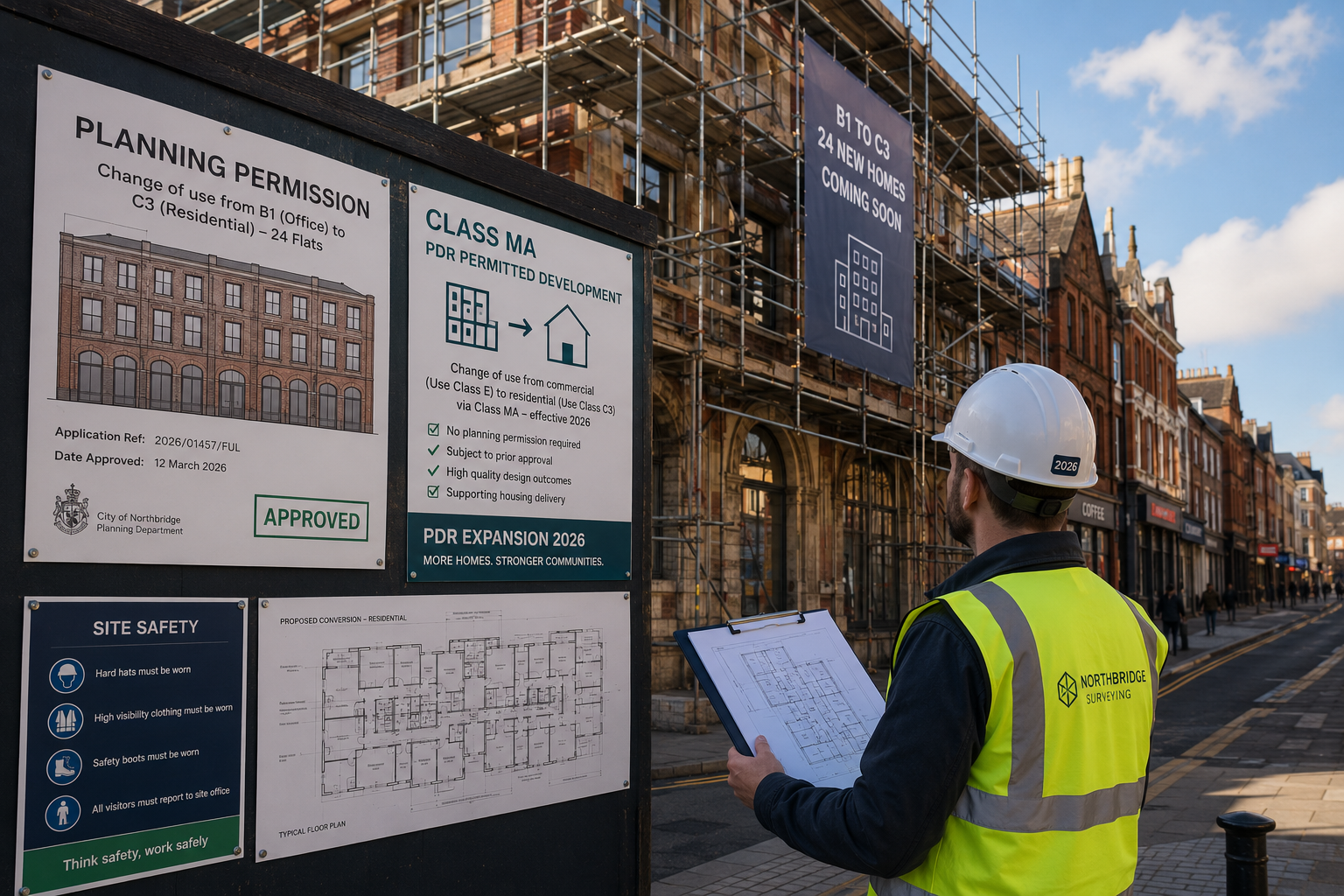
The UK's Class MA commercial-to-residential PDR, introduced in August 2021, allows buildings within Use Class E — covering offices, retail, and a range of other commercial uses — to convert to Class C3 residential without full planning permission, subject to prior approval conditions. By 2026, successive rounds of planning reform have broadened the scope of eligible buildings and relaxed some prior approval criteria, reflecting the government's stated ambition to accelerate housing delivery through existing commercial stock [9].
This policy direction has had a direct effect on the frequency and complexity of property valuation disputes. Developers acquiring commercial assets specifically for PDR-enabled conversion must justify purchase prices based on residential end values rather than commercial yields. Vendors, meanwhile, often contest whether the PDR uplift has been properly captured. Lenders, local authorities, and compulsory purchase bodies each have their own stake in how conversion potential is valued.
The result is a growing caseload at the Upper Tribunal (Lands Chamber), the First-tier Tribunal (Property Chamber), and in arbitration proceedings — all of which require expert valuation evidence that is both technically rigorous and procedurally compliant [3].
Key drivers of increased dispute volume in 2026:
- Expanded Class MA eligibility covering more building types and larger floor areas
- Increased government pressure on local authorities to approve prior approval applications
- Rising residential values in secondary towns and cities making conversion economics viable
- Greater lender scrutiny of PDR-based valuations used to support development finance
- More frequent compulsory purchase orders targeting under-used commercial land
For chartered surveyors instructed as expert witnesses, this environment demands a precise understanding of both the RICS standards that govern their conduct and the technical methodology that underpins persuasive valuation evidence. Exploring the expert witness services available from qualified RICS surveyors provides a useful starting point for understanding what instructing parties should expect.
RICS Standards Governing Expert Witness Conduct in Conversion Valuations
The Overriding Duty to the Court
The foundation of any expert witness engagement is the principle that the expert's duty runs to the court or tribunal, not to the client who pays the fee. RICS' guidance note "Surveyors acting as expert witnesses," amended in February 2023 and remaining the primary standard in 2026, states this obligation explicitly. An expert who advocates for their instructing party rather than providing objective analysis risks having their evidence excluded entirely [3].
In commercial-to-residential conversion cases, this duty has particular practical weight. Developers instructing valuers to support a high acquisition price, or vendors seeking to maximise compensation, may exert pressure — consciously or otherwise — on the conclusions reached. The RICS standard requires experts to disclose any contingent fee arrangements and to flag potential conflicts of interest at the outset of the instruction.
"The expert's function is to assist the court with specialist knowledge, not to act as an advocate for the party that retained them."
Transparency of Assumptions and Separation of Fact from Opinion
RICS guidance requires that expert valuation reports clearly separate factual findings from professional opinion. In PDR conversion valuations, this distinction is especially important because the valuation outcome depends on a chain of assumptions — each of which may be contested.
A compliant report will explicitly state:
- Whether PDR under Class MA genuinely applies to the subject property
- What prior approval conditions are likely to be imposed and their cost implications
- The basis of value adopted (market value in existing use, alternative use value, or gross development value)
- The methodology used (comparable sales, residual valuation, or income capitalisation)
- The sensitivity of the final figure to changes in key inputs such as build costs or residential yield
Courts have repeatedly found against expert witnesses who presented contested planning assumptions as settled facts, or who failed to acknowledge the range of reasonable professional opinion [4]. Transparent scenario analysis — showing how the valuation changes if PDR is refused or if build costs increase by 10 to 15 percent — is now considered best practice rather than optional.
Competence Boundaries and Dual Expertise
One of the most common grounds for challenging expert evidence in PDR conversion disputes is that the valuer has strayed beyond their area of competence. A residential valuation specialist who opines on the likelihood of prior approval being granted, without planning expertise to support that opinion, provides evidence that opposing counsel can readily undermine [3].
The practical implication is that complex PDR conversion cases often require either a single expert with demonstrable competence in both valuation and planning, or a team of experts whose respective evidence is clearly delineated. Where a commercial building survey reveals structural deficiencies that affect conversion viability, a structural engineer may also need to provide supporting evidence.
RICS Red Book Methodology for PDR Conversion Valuations
Basis of Value and the PDR Uplift Problem
The RICS Valuation — Global Standards (Red Book) require that any valuation prepared for use in dispute resolution adopts a clearly defined basis of value, consistent with International Valuation Standards. In commercial-to-residential conversion cases, the choice of basis is itself a contested issue [6].
Three bases of value commonly arise in these disputes:
| Basis of Value | Definition | Typical Application |
|---|---|---|
| Market Value (existing use) | Price achievable as commercial property | Vendor's minimum expectation |
| Alternative Use Value (PDR) | Value reflecting conversion potential | Developer's acquisition rationale |
| Gross Development Value | Total residential value on completion | Residual valuation starting point |
The gap between existing use value and alternative use value can be substantial — sometimes representing a doubling or tripling of the commercial figure in high-demand residential markets. Expert witnesses must explain clearly which basis they have adopted and why, and must acknowledge that the opposing party's expert may legitimately adopt a different basis [8].
Residual Valuation: The Core Methodology
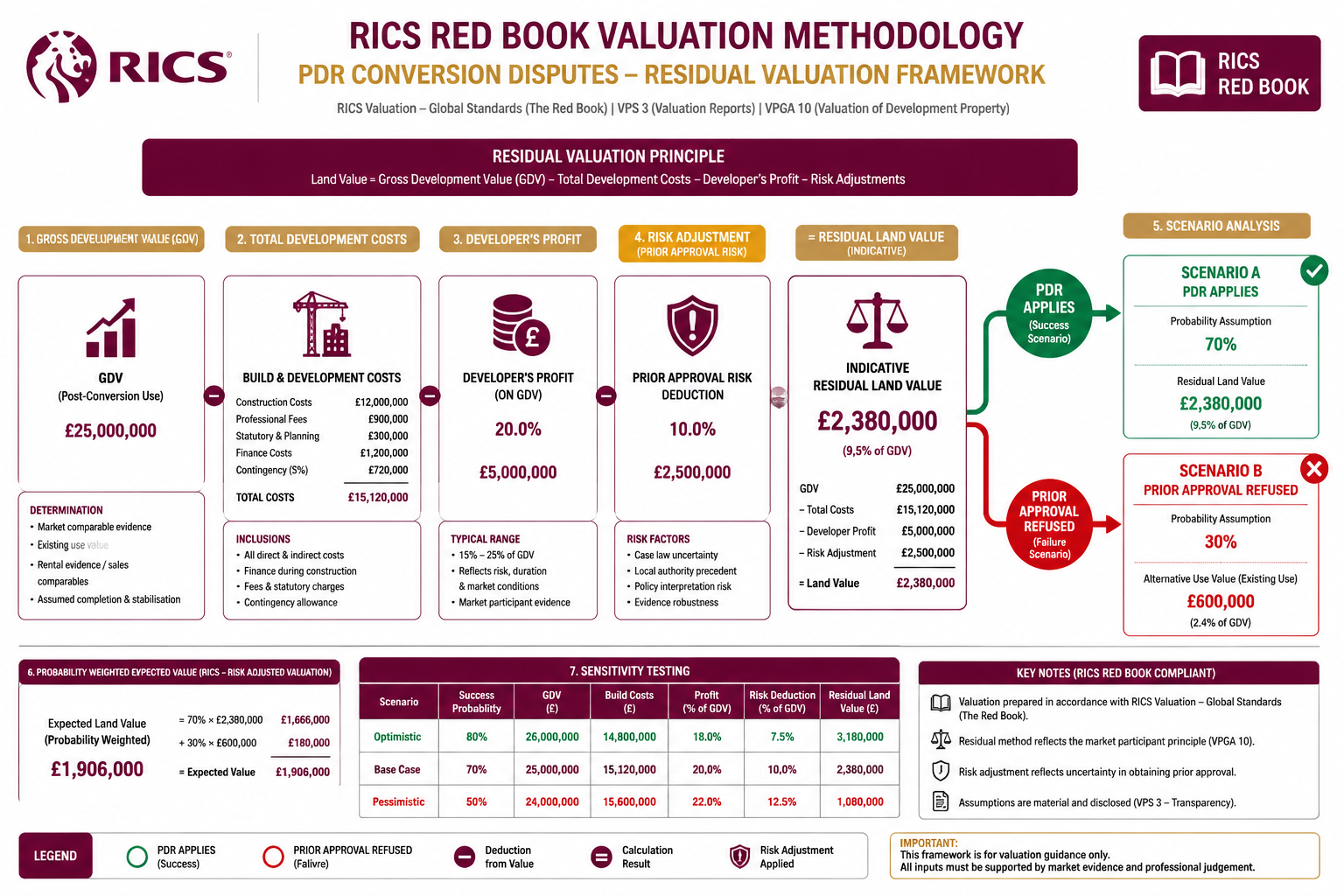
For most PDR conversion disputes, the residual method is the primary valuation tool. The expert calculates the gross development value of the completed residential scheme, then deducts all costs of conversion, finance, and developer's profit to arrive at a residual land value — which represents what a rational developer would pay for the property [6].
Typical residual valuation components for a Class MA conversion:
- Gross Development Value (GDV): Residential sales values based on comparable transactions, adjusted for unit mix, floor area, and location
- Construction and conversion costs: Based on BCIS data, contractor quotes, or specialist cost consultant input — a structural survey is essential to identify abnormal costs
- Professional fees: Typically 10 to 15 percent of construction costs
- Finance costs: Based on prevailing lending rates and the development programme
- Marketing and sales costs: Usually 1.5 to 3 percent of GDV
- Developer's profit: Typically 15 to 20 percent of GDV or 20 to 25 percent of total costs
- Contingency: 5 to 10 percent of construction costs, reflecting prior approval and structural uncertainty
The credibility of a residual valuation in evidence depends heavily on the quality of the inputs. Courts scrutinise build cost assumptions closely, particularly where a full building survey has not been carried out prior to the valuation date [5].
Yield Assessments and Capitalisation Rates
Where the residential end product includes build-to-rent units or affordable housing elements, income capitalisation methods become relevant alongside or instead of the residual approach. Yield assessments in 2026 must reflect current market conditions, including the impact of higher interest rates on residential investment yields and the specific risk profile of PDR-converted stock [8].
Expert witnesses should note that PDR-converted buildings sometimes achieve lower yields than purpose-built residential stock, reflecting concerns among institutional investors about floor-to-ceiling heights, natural light, and acoustic performance. Failing to account for this discount in the GDV calculation is a common source of challenge in cross-examination [9].
Structural Surveys and Their Role in PDR Conversion Evidence
Why Structural Condition Drives Valuation Outcomes
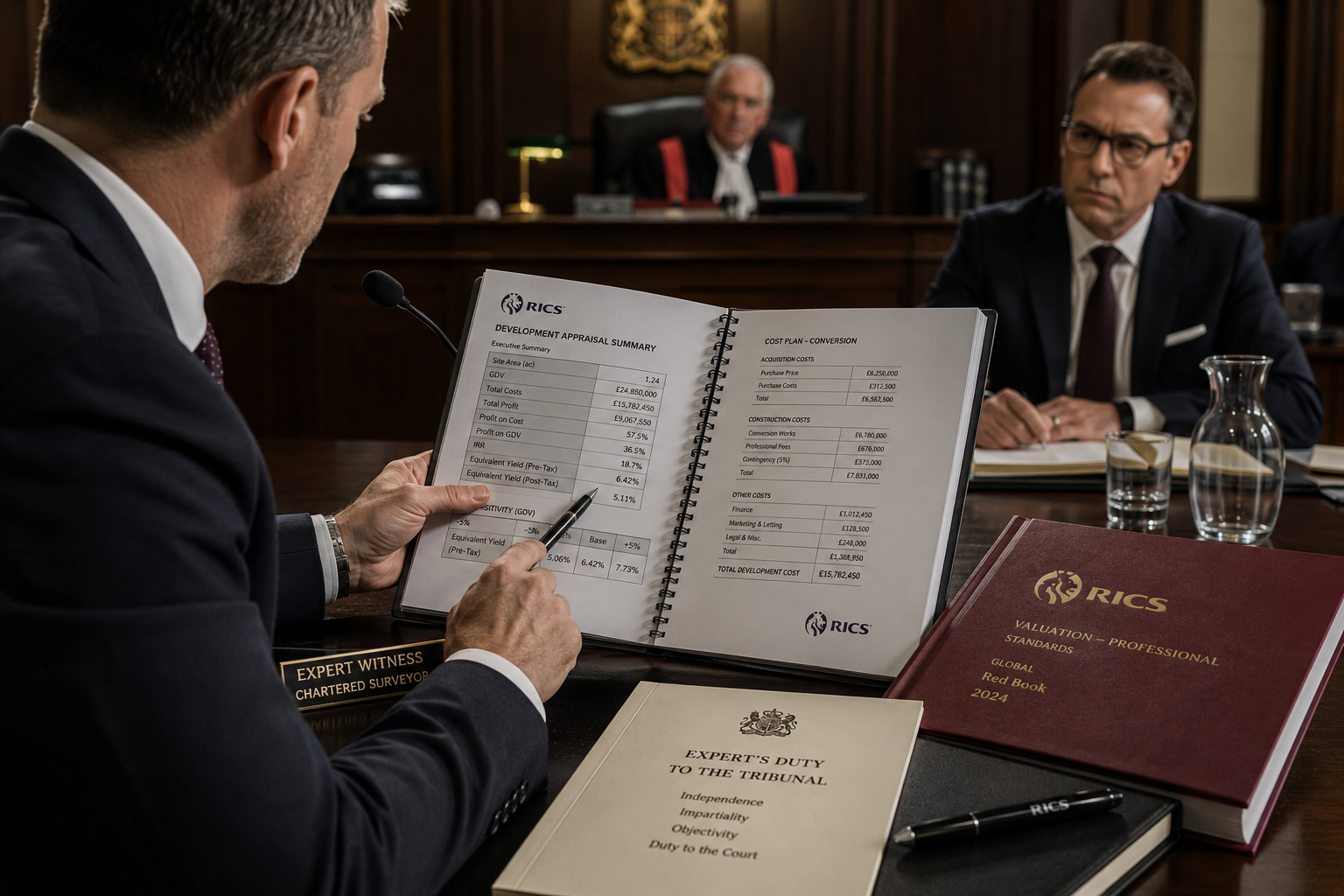
The economic viability of a commercial-to-residential conversion under Class MA depends critically on the structural condition of the existing building. A concrete-framed 1970s office block presents entirely different conversion economics to a Victorian brick warehouse, even if both enjoy identical PDR eligibility on paper [7].
Expert witnesses who prepare valuation evidence without reference to a thorough structural assessment risk producing figures that are fundamentally unreliable. Courts have found against valuers who assumed standard conversion costs without investigating the actual structural condition of the subject property [5].
Key structural factors affecting conversion viability and therefore valuation include:
- Floor-to-ceiling heights: Minimum standards for habitable rooms may require structural interventions in low-ceiling commercial buildings
- Facade condition: Cladding replacement, window upgrades, and thermal performance improvements can add significantly to costs
- Floor loading capacity: Residential use patterns differ from commercial, and structural upgrades may be required
- Asbestos and hazardous materials: Remediation costs can be substantial in pre-1990s commercial stock
- Services and mechanical infrastructure: Complete replacement of heating, ventilation, and electrical systems is typical
For expert witnesses preparing evidence in 2026 PDR conversion disputes, commissioning or reviewing a detailed commercial building survey before finalising valuation assumptions is not merely best practice — it is a professional obligation under RICS standards.
Prior Approval Conditions and Their Valuation Impact
Under Class MA, prior approval is required for matters including transport impacts, contamination, flood risk, and — critically — the provision of natural light to habitable rooms. In 2026, local planning authorities have become more sophisticated in imposing conditions that require structural modifications as a prerequisite for prior approval.
An expert witness who values a PDR conversion without modelling the cost of likely prior approval conditions is presenting an incomplete picture to the tribunal. The RICS standard on transparent assumptions requires that these risks be quantified, even if only as a range, and that the valuation explicitly state whether prior approval has been granted, is pending, or remains theoretical [3].
Expert Witness Roles in 2026 Commercial-to-Residential Conversion Valuations: Practical Standards for Instructing Parties
Understanding Expert Witness Roles in 2026 Commercial-to-Residential Conversion Valuations: RICS Standards for PDR Expansions from the perspective of instructing solicitors and developers is equally important. The following practical standards help ensure that expert evidence will withstand tribunal scrutiny.
Selecting the Right Expert
The expert must hold current RICS membership and be able to demonstrate recent, relevant experience in both commercial property valuation and residential development appraisal. Where the dispute turns significantly on PDR eligibility, the expert should either hold planning qualifications or be prepared to work alongside a planning expert whose evidence is clearly separated [4].
Reviewing an expert witness report from a qualified RICS surveyor illustrates the standard of documentation and methodology that tribunals expect to see.
The Letter of Instruction
The letter of instruction must clearly define the valuation date, the basis of value to be adopted, the scope of the expert's remit, and any assumptions the expert is asked to make. Overly prescriptive instructions that effectively direct the expert's conclusions will undermine the independence of the evidence and may result in the report being challenged or excluded [1].
Joint Expert Meetings and Statements of Agreed Facts
In most tribunal proceedings, opposing experts are required to meet, identify areas of agreement, and produce a joint statement. Expert witnesses in PDR conversion cases should approach these meetings constructively. Narrowing the issues — for example, agreeing on GDV while maintaining different views on build costs — focuses the tribunal's attention on the genuinely contested questions and reduces hearing time [2].
For valuations that also touch on specialist areas such as RICS Red Book compliant assessments or lease extension valuations, the same principles of transparency and methodological rigour apply.
Conclusion
Expert Witness Roles in 2026 Commercial-to-Residential Conversion Valuations: RICS Standards for PDR Expansions represent one of the most technically demanding areas of property dispute work. The combination of evolving PDR legislation, complex structural variables, and rigorous RICS methodology requirements means that only well-prepared, genuinely independent experts are likely to provide evidence that courts and tribunals find persuasive.
Actionable next steps for professionals involved in PDR conversion disputes:
- Commission a full structural survey before finalising any valuation. Abnormal conversion costs are the single most common source of valuation challenge in these cases.
- Adopt a clearly defined basis of value from the outset and document the rationale in the report, distinguishing existing use value from alternative use value with PDR uplift.
- Quantify prior approval risks explicitly. Do not treat PDR eligibility as a binary assumption — model the range of likely outcomes and their cost implications.
- Ensure the expert's competence covers both valuation and PDR planning, or engage complementary experts with clearly delineated roles.
- Approach joint expert meetings as an opportunity to narrow issues, not as adversarial encounters — tribunals respond positively to experts who demonstrate objectivity.
- Review the RICS "Surveyors acting as expert witnesses" guidance before accepting any instruction in this area, and ensure full compliance with its disclosure and independence requirements.
The 2026 PDR expansion represents a significant opportunity for developers, investors, and communities seeking to address the housing shortage through the adaptive reuse of commercial stock. Ensuring that valuation disputes arising from these projects are resolved on the basis of credible, RICS-compliant expert evidence is essential to the functioning of that market.
References
[1] Real Estate Expert Witnesses What Do They Do – https://www.frontlinerepartners.com/blog/real-estate-expert-witnesses-what-do-they-do/
[2] Real Estate Expert Witness – https://glginsights.com/articles/real-estate-expert-witness/
[3] Valuers Expert Witnesses Land Reference Proceedings Standards Ismail Gbkpc – https://www.linkedin.com/pulse/valuers-expert-witnesses-land-reference-proceedings-standards-ismail-gbkpc
[4] Valuers As Expert Court Witnesses – https://www.leesonvaluers.com.au/blog/valuers-as-expert-court-witnesses
[5] Expert Witness Knowing The Property Better Than Anyone – https://www.workingre.com/expert-witness-knowing-the-property-better-than-anyone/
[6] How Calculate Property Valuation Report Appraiser – https://vertexeng.com/insights/how-calculate-property-valuation-report-appraiser/
[7] Converting Vacant Office Space Into Housing – https://www.americanprogress.org/article/converting-vacant-office-space-into-housing/
[8] Commercial Real Estate Expert Witness – https://seakexperts.com/keywords/commercial-real-estate-expert-witness
[9] A Community Guide To Office To Residential Conversion Part 1 Economics – https://www.brookings.edu/articles/a-community-guide-to-office-to-residential-conversion-part-1-economics/
[10] Commercial Property Valuation – https://www.law.com/expert-witness/directory/commercial-property-valuation/