
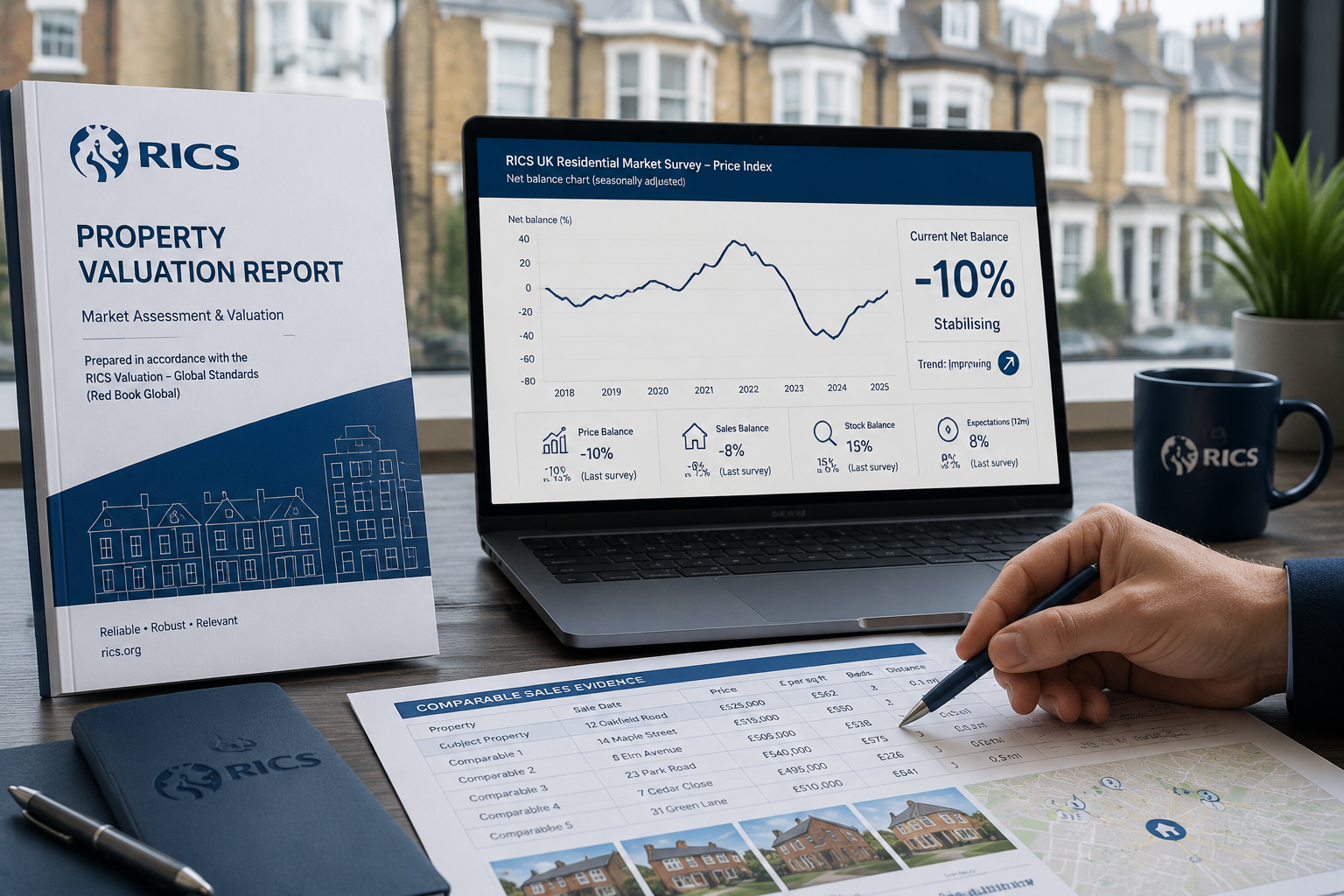
The RICS Residential Market Survey for January 2026 recorded a net balance of -10% for national house prices — a figure that signals neither freefall nor recovery, but a genuine plateau. For chartered surveyors, that plateau is both a challenge and an opportunity. When prices are moving sharply in one direction, valuation adjustments follow a clear logic. When they stabilise, the margin for error narrows, and the quality of methodology becomes the deciding factor.
Valuing stabilised national house prices in early 2026: RICS techniques for balanced market assessments are therefore more relevant than ever. Surveyors operating across England must navigate improving buyer enquiries, cautious sales expectations, and a regulatory environment that is actively evolving — all while delivering defensible, Red Book-compliant valuations that lenders, buyers, and sellers can rely on. [9]
Key Takeaways
- The January 2026 RICS net balance of -10% for national house prices marks a stabilisation phase, requiring precise valuation methodology rather than trend-following.
- RICS recognises three core valuation approaches — market, income, and cost — each with specific methods suited to different property types and market conditions. [3]
- Time adjustments and regional variation analysis are critical tools when comparable evidence spans a period of price movement.
- Updated RICS standards on cladding, effective November 2026, add new compliance obligations for valuers assessing multi-storey residential buildings. [1]
- The Red Book continues to evolve, with RICS responding to IVSC consultation in April 2026 as preparation for the 2028 edition. [8]
What Market Stabilisation Means for Valuers in 2026
A stabilising market is not a static one. Buyer enquiries were reported as improving in the January 2026 RICS survey, even as the headline price balance remained negative. That combination — cautious optimism alongside flat or marginally declining prices — creates a specific set of valuation challenges.
The core problem is comparables. When prices have been falling and then level off, recent sold prices may reflect a trough that no longer accurately represents current market sentiment. Equally, asking prices may have adjusted upward in anticipation of recovery. Surveyors must therefore apply careful time adjustments to any comparable evidence drawn from the preceding six to twelve months.
RICS guidance on valuation adjustments in stabilising markets emphasises three priorities [9]:
- Recency of evidence: Comparables from the most recent three months carry greater weight than those from six or twelve months prior.
- Regional granularity: National averages mask significant local variation. A -10% net balance nationally does not mean every postcode has moved identically.
- Buyer behaviour signals: Improving enquiry levels are a leading indicator. Valuers should note these in their market commentary even when they cannot yet be quantified in sold prices.
For surveyors working across different regions, understanding the factors that influence property valuation — including location, condition, tenure, and local supply — is essential when calibrating adjustments to national trends.
RICS Core Valuation Approaches for Balanced Market Assessments
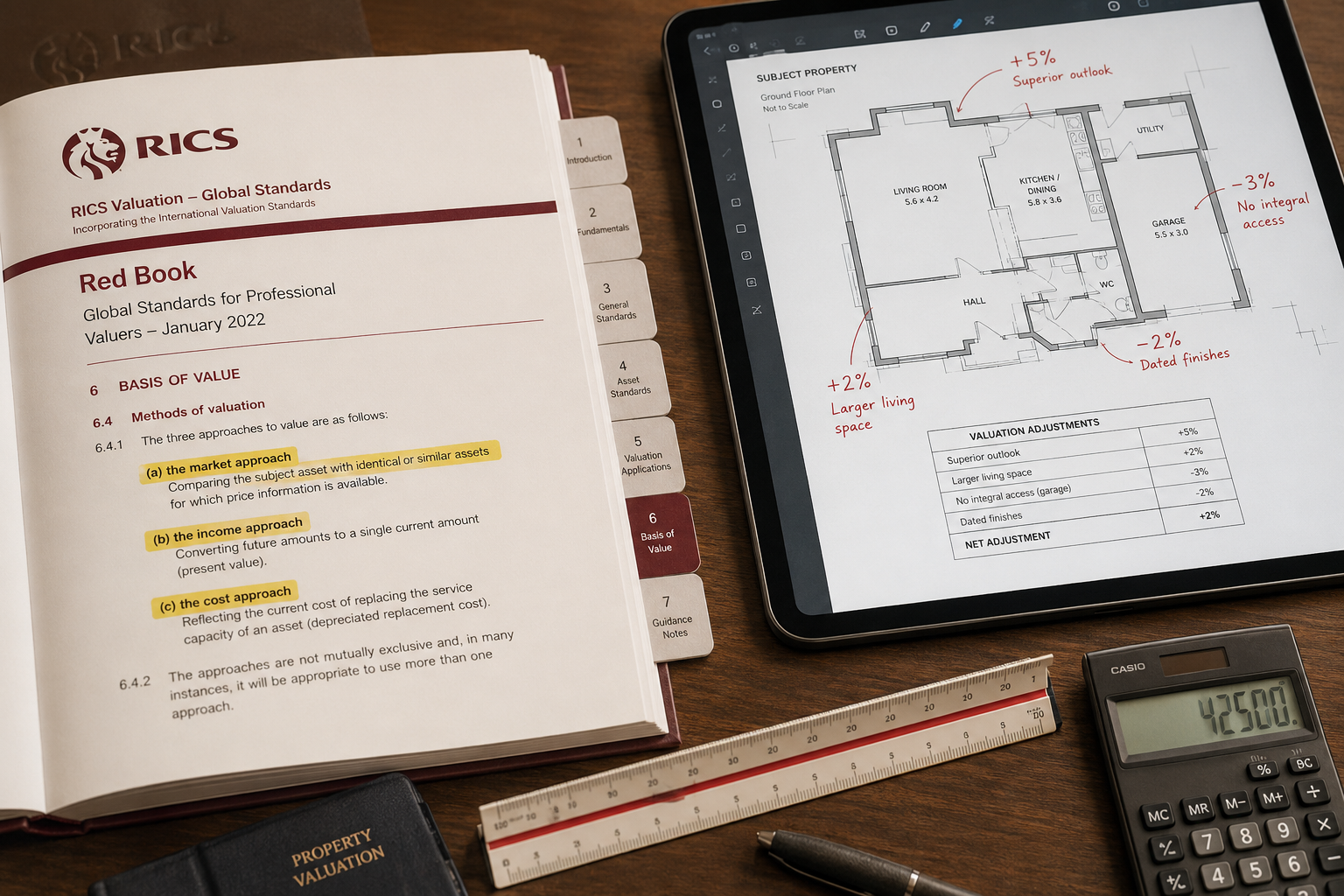
The foundation of any credible valuation in 2026 remains the RICS Red Book framework, which recognises three primary approaches to value. Each is appropriate in different circumstances, and a balanced market assessment may draw on more than one. [3]
The Market Approach
The market approach uses comparable transactions to determine value. It is the most commonly applied method for residential property and relies on the principle of substitution — a buyer will not pay more for a property than the cost of acquiring an equivalent alternative.
In a stabilising market, the market approach requires particular care:
| Adjustment Factor | Reason for Adjustment |
|---|---|
| Time | Recent price movement must be reflected |
| Condition | Comparable properties may differ in repair state |
| Size and layout | Floor area differences require per-square-metre calibration |
| Tenure | Freehold versus leasehold affects value materially |
| Location micro-factors | Street, aspect, and proximity to amenities |
Surveyors should document each adjustment clearly. A well-evidenced comparable analysis is the strongest defence against challenge, whether from a lender, a client, or a tribunal.
For properties in Manchester and the wider North West, a Manchester valuation report provides a locally calibrated assessment that accounts for the specific dynamics of that market, which has shown more resilience than some southern regions in the current cycle.
The Income Approach
The income approach is most relevant for investment properties, where value is derived from the income the asset can generate. In residential terms, this typically means applying a yield to the achievable market rent.
In early 2026, rental markets in many urban areas remain tight. That can support income-based valuations even where capital values are flat. Surveyors should ensure that the yield applied reflects current investor appetite, which has been affected by higher borrowing costs and changes to landlord taxation.
The Cost Approach
The cost approach estimates value by reference to the cost of constructing an equivalent building, adjusted for depreciation. It is most relevant for:
- Specialist or unusual properties with few comparables
- New-build properties where the market approach is limited by lack of resale evidence
- Properties requiring reinstatement valuation for insurance purposes
The cost approach is also the default method for heritage assets. RICS notes that approximately 20% of English housing pre-dates 1919, meaning a significant proportion of the national stock requires specialist consideration that standard comparable analysis cannot fully address. [5]
"In a balanced market, the most defensible valuation is one that demonstrates awareness of all three approaches — even if only one is ultimately applied."
Specific RICS Techniques for Valuing Stabilised National House Prices in Early 2026
Valuing stabilised national house prices in early 2026 using RICS techniques for balanced market assessments demands more than selecting the right approach. It requires applying a set of specific tools that account for the current market's particular characteristics.
Time Adjustments in a Flat Market
When prices have been falling and then stabilise, time adjustments become more nuanced. A straightforward monthly index adjustment may overstate the decline if the market has already found its floor. Surveyors should:
- Cross-reference multiple indices (Halifax, Nationwide, Land Registry HPI) rather than relying on a single source.
- Apply a conservative adjustment that reflects the direction of travel, not just the most recent data point.
- Note in the valuation report where the adjustment has been moderated due to stabilisation signals.
Regional Variation Analysis
The national -10% net balance conceals significant regional divergence. Some northern cities have shown stronger resilience, while parts of the South East have experienced sharper corrections linked to affordability constraints and higher mortgage costs.
A Manchester valuation in early 2026 will require different assumptions to one carried out in Oxfordshire or Surrey. Surveyors must source local comparable evidence rather than applying national trends mechanically.
Cladding and EWS1 Compliance
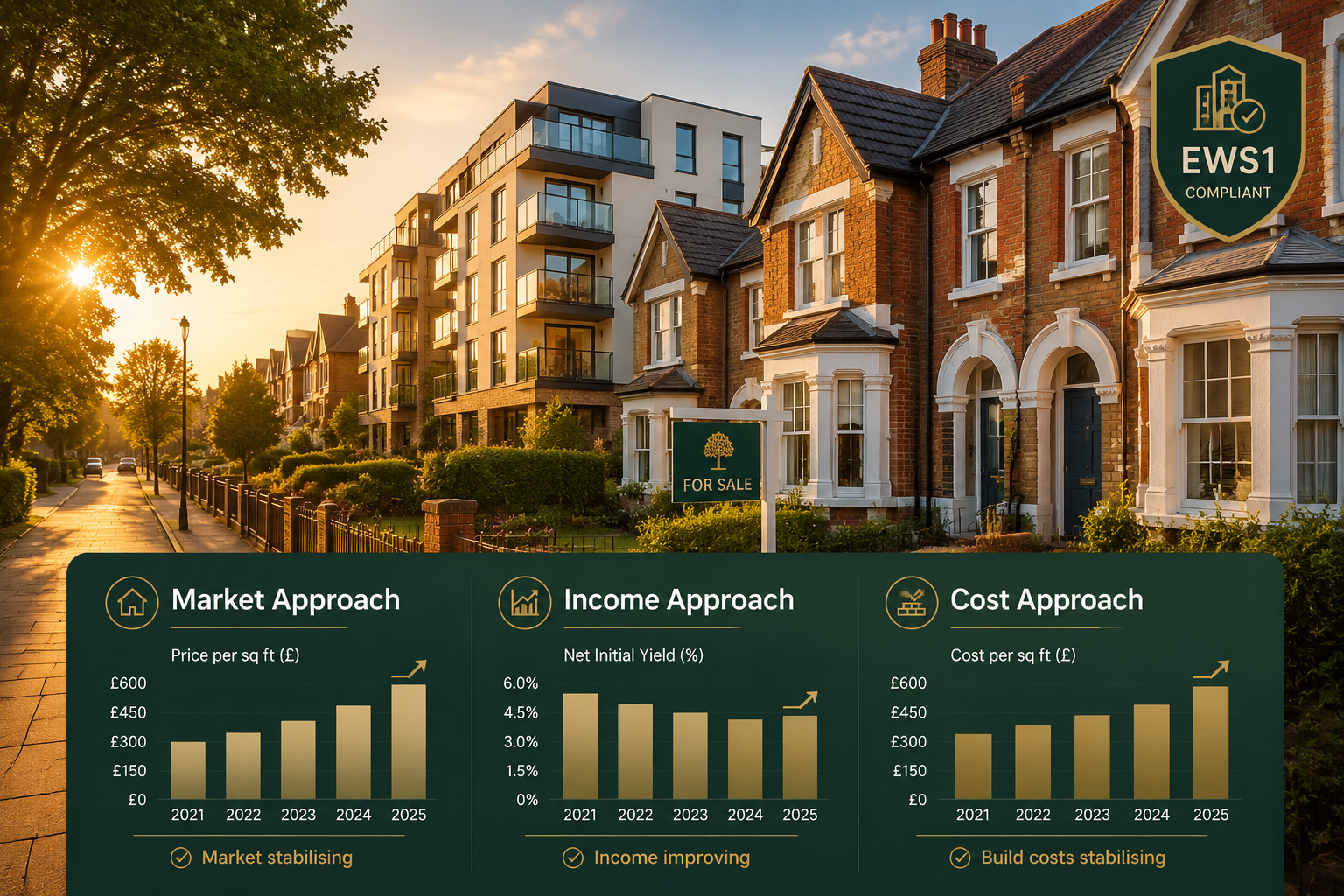
RICS published the second edition of its UK professional standard for secured lending valuations of multi-storey, multi-occupancy residential buildings with cladding, effective from November 1, 2026. This standard clarifies when an EWS1 form should be requested and how its absence or presence should be reflected in a valuation. [1]
For surveyors valuing flats in buildings above 11 metres, this standard is now mandatory reading. Failure to apply it correctly exposes both the valuer and the lender to significant risk. The standard does not eliminate the need for professional judgement, but it provides a clear framework for when external wall system assessments must be factored into the valuation figure.
Sustainability and Climate Risk
RICS has increasingly emphasised the need for valuers to account for climate-related risks. Extreme weather events — flooding, subsidence from drought, and overheating — can materially affect value, and valuers who ignore these factors risk producing assessments that do not reflect the full risk profile of a property. [4]
In practice, this means:
- Checking flood risk zone classifications for all properties in at-risk areas
- Noting where a property's EPC rating may affect mortgageability or future saleability
- Considering the cost of adaptation works where climate vulnerability is identified
The RICS Global Valuation Conference scheduled for June 2026 is specifically addressing these emerging risks, alongside sustainability, new technologies, and global standards — reflecting how central these issues have become to professional practice. [2]
Heritage Properties
With around one in five English homes built before 1919, surveyors regularly encounter properties that do not fit neatly into standard comparable frameworks. [5] Listed buildings, properties in conservation areas, and those with unusual construction methods all require additional expertise.
For these properties, a RICS Level 3 Building Survey is often the appropriate starting point, providing the detailed structural and condition information that a valuation of a heritage asset requires.
Regulatory and Standards Context in 2026
The valuation profession is not operating in a static regulatory environment. Several significant developments in 2026 are reshaping the standards that surveyors must apply.
Red Book Evolution
In April 2026, RICS submitted a formal response to the International Valuation Standards Council's Exposure Draft consultation. This contribution feeds into the development of the Red Book 2028, which will follow the final publication of updated International Valuation Standards. [8] Surveyors should monitor these developments closely, as changes to the IVS will cascade into Red Book requirements and ultimately into day-to-day valuation practice.
RICS APC Valuation Competency
For candidates working toward RICS membership through the Assessment of Professional Competence, the valuation competency requires demonstrated understanding of all three core approaches and their appropriate application. [6] In a stabilising market, examiners are likely to probe candidates on how they handle limited comparable evidence and how they document professional judgement.
Costs and Accessibility
As of April 2026, the average cost of a RICS house valuation is approximately £354, with a range of £337 to £605 depending on property size and location. [10] This cost context matters for clients making decisions about whether to commission independent valuations alongside mortgage valuations, particularly in a market where lenders' automated valuation models may not fully capture local nuance.
For clients considering a Help to Buy valuation or a Right to Buy valuation, the cost of a professional RICS assessment is modest relative to the financial decisions it informs.
Applying RICS Techniques Across Different Property Types
The techniques described above apply differently depending on the property type being assessed. The table below summarises the primary approach and key considerations for common residential property categories in early 2026.
| Property Type | Primary Approach | Key 2026 Considerations |
|---|---|---|
| Standard residential (freehold) | Market (comparables) | Time adjustments, regional variation |
| Leasehold flat | Market + income | Cladding compliance, lease length, service charges |
| New-build | Cost + market | Limited resale comparables, developer incentives |
| Heritage/listed | Cost + specialist | Pre-1919 construction, conservation obligations |
| Buy-to-let investment | Income | Yield compression, landlord tax changes |
| Right to Buy | Market | Discount calculation, statutory framework |
For commercial property, a separate but related methodology applies. Surveyors can explore the valuation of commercial property framework for guidance on income-based and investment approaches in that sector.
Practical Steps for Surveyors Conducting Balanced Market Assessments
Surveyors conducting residential valuations in early 2026 should follow a structured process to ensure their assessments are defensible and compliant.
Step 1 — Source recent local comparables. Prioritise transactions from the past three months. Where these are limited, extend the search window but apply explicit time adjustments.
Step 2 — Document market conditions. Include a brief market commentary in every report. Reference the current net balance data and note whether local conditions align with or diverge from the national picture.
Step 3 — Apply the appropriate valuation approach. Select the primary method based on property type and available evidence. Consider whether a secondary approach provides a useful cross-check.
Step 4 — Address specific risk factors. Check cladding status for flats in multi-storey buildings. Note EPC ratings and flood risk. Identify any heritage or unusual construction issues.
Step 5 — State assumptions clearly. Every valuation rests on assumptions. State them explicitly so that the reader understands the basis of the figure and the conditions under which it might change.
Step 6 — Review against Red Book requirements. Ensure the report format, content, and disclosures comply with current RICS standards, including any updates effective in 2026.
Conclusion
Valuing stabilised national house prices in early 2026 using RICS techniques for balanced market assessments is a discipline that rewards precision, local knowledge, and methodological rigour. The January 2026 net balance of -10% does not tell surveyors what a specific property is worth — it tells them that the market is at an inflection point where professional judgement matters more, not less.
The actionable priorities for surveyors are clear:
- Apply time adjustments carefully and document the reasoning behind them.
- Use regional data to avoid over-reliance on national averages.
- Ensure full compliance with the updated RICS cladding standard effective November 2026.
- Monitor Red Book developments as the IVS consultation process moves toward the 2028 edition.
- Consider all three valuation approaches, even when only one is applied as the primary method.
For clients and property owners, commissioning a properly scoped RICS valuation from a qualified chartered surveyor remains the most reliable way to understand what a property is worth in the current environment. The cost is modest; the value of an accurate, defensible figure is not.
References
[1] Rics Publishes Updated Standard For Multi Storey Residential Buildings With Cladding – https://www.rics.org/news-insights/rics-publishes-updated-standard-for-multi-storey-residential-buildings-with-cladding?utm_source=openai
[2] Global Valuation Conference 2026 – https://academy.rics.org/global-valuation-conference-2026?utm_source=openai
[3] Apc 5 Valuation Methods – https://ww3.rics.org/uk/en/journals/property-journal/apc-5-valuation-methods.html?utm_source=openai
[4] Real Estate Valuation Extreme Conditions – https://ww3.rics.org/uk/en/journals/property-journal/real-estate-valuation-extreme-conditions.html?utm_source=openai
[5] Valuing Heritage Assets – https://ww3.rics.org/uk/en/journals/property-journal/valuing-heritage-assets.html?utm_source=openai
[6] Apc Valuation Competency Advice – https://ww3.rics.org/uk/en/journals/property-journal/apc-valuation-competency-advice.html?utm_source=openai
[7] Valuation For Non Valuers 3 Part Series – https://www.rics.org/training-events/online-training/scheduled/valuation-for-non-valuers—3-part-series?utm_source=openai
[8] Red Book Global – https://www.rics.org/profession-standards/rics-standards-and-guidance/sector-standards/valuation-standards/red-book/red-book-global?utm_source=openai
[9] Valuation Adjustments For Stabilising Prices Rics Techniques For Accurate Appraisals In Early 2026 Recovery – https://kingstonsurveyors.com/valuation-adjustments-for-stabilising-prices-rics-techniques-for-accurate-appraisals-in-early-2026-recovery/?utm_source=openai
[10] Rics Valuation Cost – https://www.comparemymove.com/guides/surveying/rics-valuation-cost?utm_source=openai