
A survey conducted in April 2026 found that 74.4% of landlords experienced a rise in property ownership costs [7] — yet institutional investors continue to expand their buy-to-let portfolios at scale. The difference between those who grow profitably and those who absorb costly surprises almost always comes down to one thing: the quality of their pre-acquisition survey process. Building Survey Protocols for Institutional Buy-to-Let Acquisitions: Risk Mitigation in 2026 Landlord Shifts has become a defining discipline for professional landlords navigating a market reshaped by legislative reform, tightening compliance standards, and shifting tenant leverage.
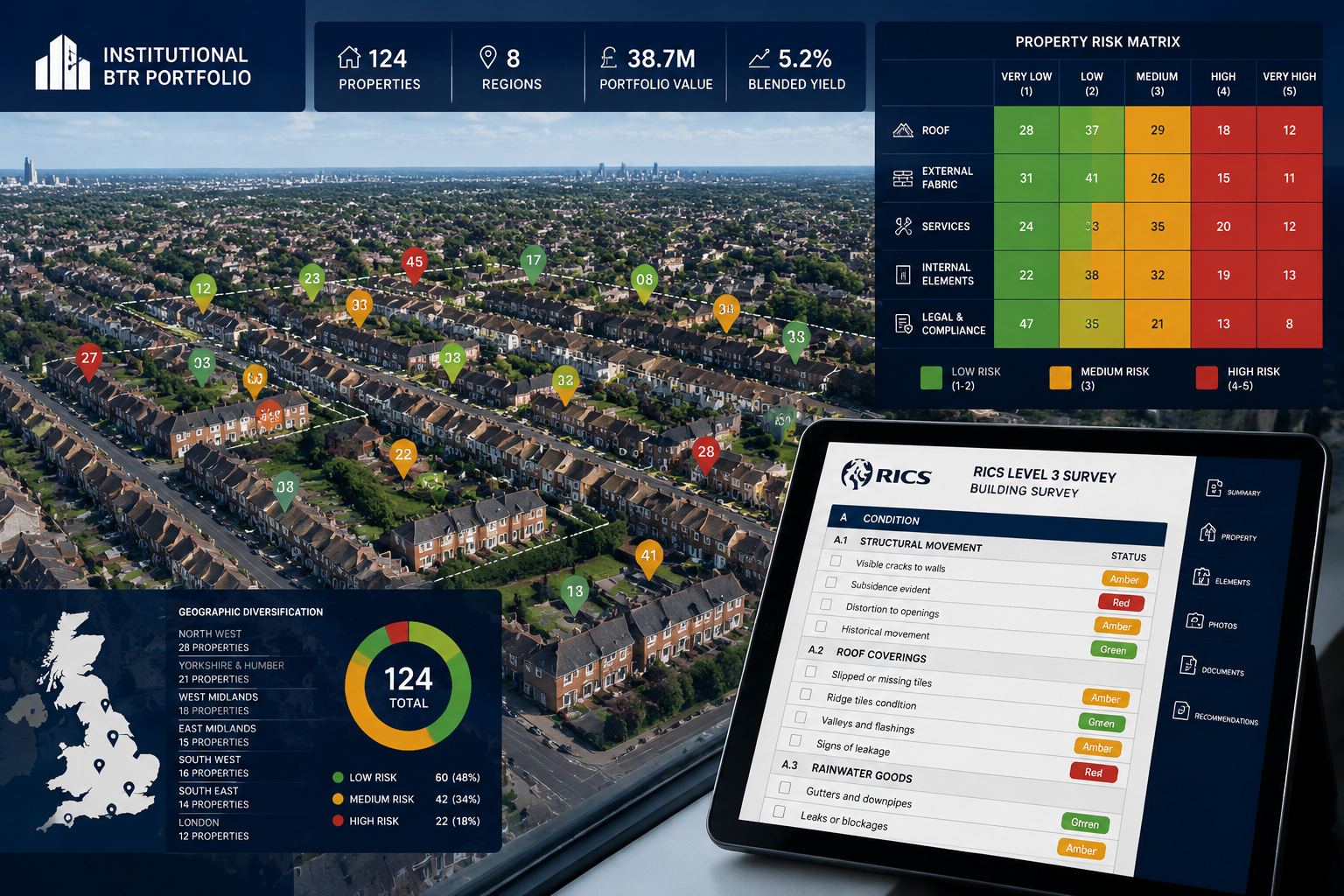
Key Takeaways
- The Renters' Rights Act, effective May 2026, eliminated Section 21 "no-fault" evictions and converted all ASTs to assured periodic tenancies, raising the compliance stakes for every acquisition.
- Institutional investors now use multi-tiered survey strategies — from desktop reviews to RICS Level 3 Building Surveys — matched to each asset's risk profile.
- Risk-weighted defect scoring enables portfolio managers to prioritize capital expenditure and negotiate acquisition prices with precision.
- Digital reporting platforms and AI-assisted inspection tools are accelerating due diligence timelines without sacrificing depth.
- Yield-impacting defects, particularly those touching tenant health and safety, carry the highest regulatory and financial exposure in 2026.
The 2026 Regulatory Landscape Reshaping Acquisition Due Diligence
The legislative environment surrounding buy-to-let property in England shifted fundamentally on 1 May 2026. The Renters' Rights Act came into full effect, automatically converting all existing assured shorthold tenancies (ASTs) into assured periodic tenancies, removing fixed-term structures, and abolishing Section 21 "no-fault" evictions entirely [1]. For institutional landlords, this is not merely a tenancy management issue — it is a due diligence imperative.
When eviction routes narrow, the condition of a property at acquisition becomes far more consequential. A defect that might previously have been deferred and addressed between tenancies now carries the risk of a complaint, a rent repayment order, or enforcement action under the Homes (Fitness for Human Habitation) Act 2018. The financial exposure of acquiring a non-compliant asset has increased substantially.
What this means for acquisition teams:
- Structural defects, damp, and hazardous conditions must be identified and costed before exchange — not after.
- Compliance with the Decent Homes Standard and EPC minimum requirements must be verified at the survey stage.
- Any defect that could trigger a tenant complaint under the new assured periodic tenancy framework should be classified as a priority risk.
Institutional buyers who rely on a basic mortgage valuation rather than a full structural survey are accepting risk that the 2026 regulatory environment no longer tolerates. As detailed in our guide on whether a mortgage valuation is the same as a survey, these are fundamentally different instruments with very different purposes.
Designing Effective Building Survey Protocols for Institutional Buy-to-Let Acquisitions: Risk Mitigation in 2026 Landlord Shifts

Institutional portfolio growth requires a survey framework that is both rigorous and scalable. A single-property approach — commissioning an individual survey on an ad hoc basis — cannot support bulk acquisitions efficiently. The most effective protocols in 2026 operate on three tiers, with each level of assessment matched to the risk profile of the asset.
Tier 1: Desktop Analysis and Pre-Visit Screening
Before any physical inspection, acquisition teams should conduct a structured desktop review. This includes:
- Historic planning records and building regulations certificates
- Land Registry title and lease documentation
- EPC ratings and any outstanding enforcement notices
- Flood risk, subsidence risk, and environmental data layers
- Previous survey reports where available
This phase filters out assets with unacceptable risk profiles before survey costs are committed. It also informs the scope of the physical inspection that follows.
Tier 2: RICS Level 2 HomeBuyer Report
For lower-risk assets — typically modern apartments, recently refurbished properties, or those with recent survey history — a RICS HomeBuyer Survey (Level 2) provides a cost-effective baseline. It covers visible defects, condition ratings, and a market valuation, but does not include detailed investigation of concealed elements.
This tier is appropriate when:
- The property is post-2000 construction with no known structural concerns
- The acquisition price is at the lower end of the portfolio range
- Desktop screening has returned a clean profile
Tier 3: RICS Level 3 Building Survey
For older stock, period properties, or any asset flagged during desktop review, a RICS Level 3 Building Survey is the appropriate instrument. This is the most comprehensive residential survey available, covering structural integrity, concealed defects, roof condition, drainage, damp, and a full assessment of repair liabilities.
Institutional investors acquiring Victorian terraces, converted properties, or any asset above a defined value threshold should treat the Level 3 survey as non-negotiable. The cost of the survey is trivial relative to the cost of an unidentified structural defect discovered post-completion.
"Multi-tiered survey strategies, including desktop analyses, RICS Level 2 HomeBuyer Reports, and RICS Level 3 Building Surveys, match the depth of assessment to the asset's risk profile." [3]
For commercial or mixed-use buy-to-let assets, a RICS commercial building survey provides the equivalent depth of analysis within a commercial property framework.
Standardising Inspection Checklists Across Property Types
One of the most significant operational advances in institutional survey practice is the adoption of standardised inspection checklists tailored to property typology [2]. A Victorian terrace carries entirely different risk categories than a 2015-built apartment block. Treating them with the same generic checklist produces inconsistent data that is difficult to aggregate at portfolio level.
Effective standardisation includes:
| Property Type | Key Risk Categories | Recommended Survey Level |
|---|---|---|
| Victorian / Edwardian terrace | Damp, subsidence, roof, drainage | RICS Level 3 |
| 1960s-1980s flat | Cladding, flat roof, service age | RICS Level 3 |
| Post-2000 apartment | EPC compliance, snagging, services | RICS Level 2 |
| Commercial conversion | Structural, fire compliance, M&E | Commercial survey |
| Mixed-use freehold | All of the above | Full structural + commercial |
Standardised checklists also enable portfolio-wide benchmarking. When every survey uses the same data fields and condition ratings, acquisition teams can compare defect profiles across assets, identify systemic issues in a target geography, and build accurate capital expenditure forecasts.
Risk-Weighted Defect Scoring: Turning Survey Data into Investment Decisions
The evolution from narrative survey reports to quantified, risk-weighted defect scoring represents one of the most important methodological advances in institutional due diligence [2]. A traditional survey describes defects. A risk-weighted survey assigns each defect a score based on four dimensions:
- Severity — Is this a Category 1 (urgent), Category 2 (soon), or Category 3 (monitor) defect?
- Rectification cost — What is the estimated cost of repair, including professional fees and VAT?
- Tenant impact — Does this defect affect habitability, health, or safety?
- Regulatory compliance — Does this defect create exposure under the Homes Act, EPC regulations, or the Decent Homes Standard?
Each defect receives a composite score, and the aggregate score for the property determines the acquisition recommendation: proceed, proceed with price adjustment, or decline.
This scoring approach delivers three direct benefits:
- Negotiation leverage. A quantified defect schedule with costed remediation provides a factual basis for price reduction requests. Sellers cannot easily dispute a RICS-endorsed cost estimate.
- Capital expenditure planning. Portfolio managers can forecast refurbishment costs across a batch acquisition with confidence, supporting accurate yield modelling.
- Regulatory risk management. Defects that create compliance exposure are surfaced and prioritised before they become enforcement issues.
For properties where specific defects require deeper investigation — damp, subsidence, or structural movement — specialist surveys should be commissioned alongside the primary building survey. A damp survey or subsidence survey provides the granular data needed to score these risks accurately.
Digital Integration and AI-Assisted Survey Workflows
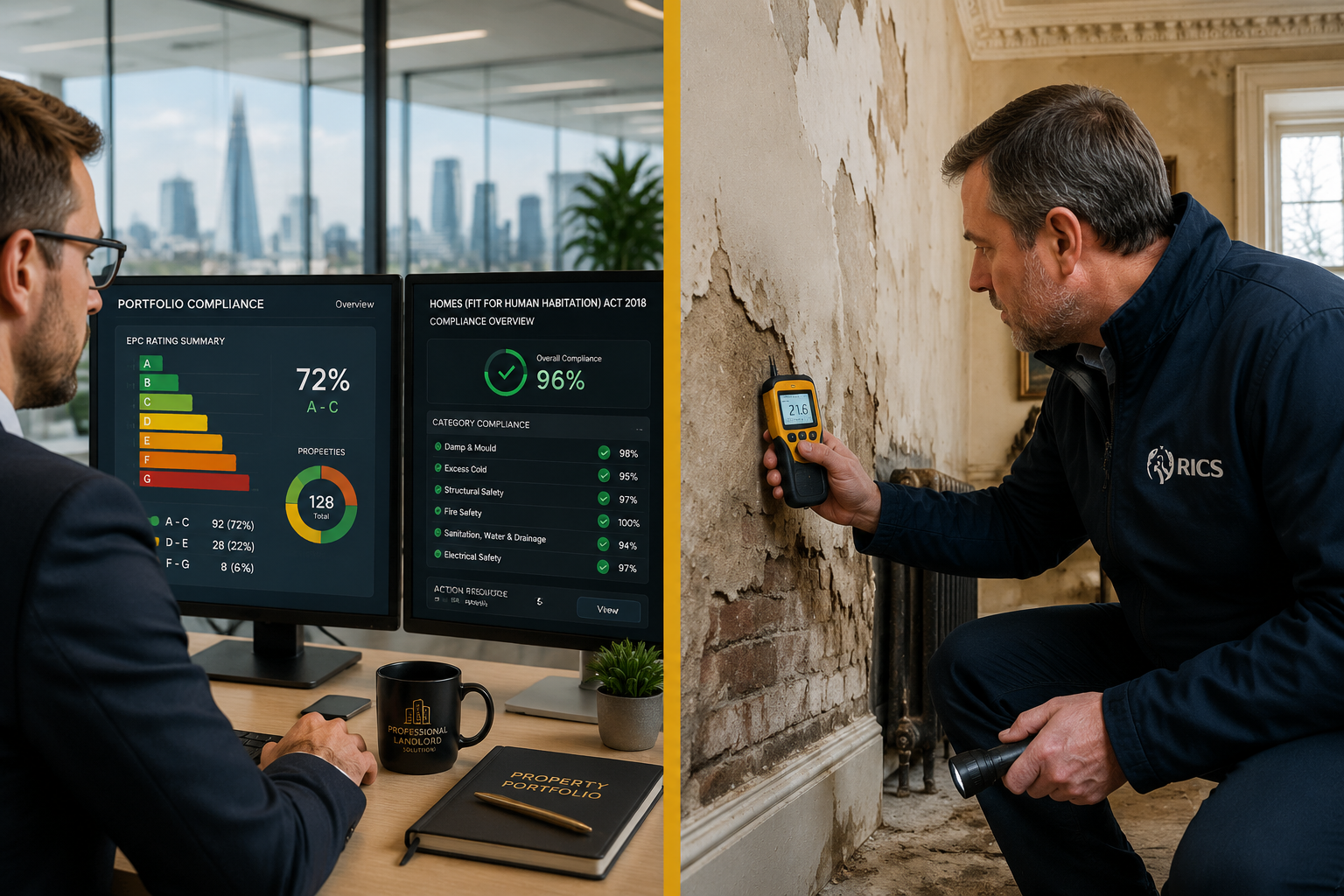
The operational demands of institutional portfolio acquisition — multiple properties, compressed timelines, multiple surveyors — have driven rapid adoption of digital reporting platforms [2]. In 2026, leading institutional buyers are integrating survey data directly into portfolio management systems through real-time defect logging tools.
Key capabilities of modern digital survey platforms include:
- Automated report generation from structured inspection data, reducing turnaround time from days to hours
- Photographic defect tagging with GPS coordinates and condition ratings embedded in the report
- Portfolio-level dashboards aggregating defect scores, compliance status, and capex forecasts across all assets under review
- Integration with EPC registers and planning portals for automatic cross-referencing during desktop review
Multifamily operators are also increasingly using AI tools for leasing, marketing, and operational efficiency [6], and the survey sector is following a similar trajectory. AI-assisted image analysis can flag potential defects in inspection photographs before the surveyor's written assessment is complete, accelerating triage on large portfolios.
However, digital tools are not a substitute for professional judgment. The RICS-chartered building surveyor remains the authoritative voice on defect classification, structural risk, and compliance implications. Technology accelerates the process; expertise determines the outcome.
Tenant-Focused Defect Prioritisation and the Compliance Imperative
Under the Renters' Rights Act 2026, the legal relationship between landlord and tenant has shifted materially [1]. With Section 21 removed, landlords cannot use the threat of a no-fault eviction to manage difficult tenancy situations arising from property condition disputes. This makes pre-acquisition defect identification a direct legal risk management activity.
Defects that carry the highest compliance exposure in 2026:
- Category 1 HHSRS hazards — damp and mould, excess cold, structural collapse risk, falls on stairs
- EPC below Band E — unlawful to let under current regulations; Band D minimum proposals under active consultation
- Fire safety deficiencies — smoke alarms, carbon monoxide detectors, fire door compliance
- Electrical installation condition — EICR failures or installations over 10 years old without certification
- Structural movement — any active cracking, subsidence, or settlement requiring investigation
A schedule of condition report at acquisition creates a documented baseline of the property's state, which is valuable both for managing tenant expectations and for defending against dilapidations claims at the end of a tenancy.
For portfolio managers overseeing large numbers of existing units, a stock condition survey provides a systematic assessment of the entire portfolio's compliance and maintenance profile — essential for prioritising capital expenditure and demonstrating regulatory due diligence.
Bulk Acquisition Strategies: Streamlining Due Diligence at Scale
Institutional landlords acquiring five, ten, or fifty properties simultaneously face a practical challenge: how to maintain survey quality without creating bottlenecks that delay exchange. Several strategies have emerged to address this.
Phased survey scheduling. Rather than commissioning all surveys simultaneously, acquisition teams phase inspections in order of risk profile — highest-risk assets first. This allows early identification of deal-breakers without holding up the entire portfolio transaction.
Panel surveyor arrangements. Institutional buyers establish pre-agreed relationships with RICS-accredited surveying firms capable of deploying multiple surveyors simultaneously across a geographic area. This compresses timelines significantly on bulk acquisitions.
Scope standardisation. Using pre-agreed survey scopes and report templates across all panel surveyors ensures that output is consistent and directly comparable, regardless of which firm conducted the inspection.
Conditional exchange structures. Legal teams increasingly use survey findings as conditions precedent in bulk purchase agreements, allowing price adjustments or selective withdrawal from individual units without collapsing the wider transaction.
The operational costs of running these protocols are real, but they are dwarfed by the cost of acquiring a portfolio with unidentified structural liabilities, non-compliant units, or properties that cannot lawfully be let under 2026 EPC standards. With 74.4% of landlords already reporting rising ownership costs [7], the margin for unplanned capital expenditure has narrowed considerably.
Conclusion: Actionable Next Steps for Institutional Buyers in 2026
Building Survey Protocols for Institutional Buy-to-Let Acquisitions: Risk Mitigation in 2026 Landlord Shifts is not a theoretical framework — it is a practical competitive advantage. The institutions that systematically apply tiered survey strategies, risk-weighted defect scoring, and digital integration will acquire portfolios with known, manageable risk profiles. Those that cut corners on due diligence will absorb the consequences through unplanned capital expenditure, compliance enforcement, and yield compression.
Actionable next steps for institutional acquisition teams:
- Audit your current survey protocol against the three-tier model. If your process does not differentiate survey depth by asset risk profile, revise it before the next acquisition cycle.
- Implement standardised, property-type-specific inspection checklists across all panel surveyors to enable portfolio-level data aggregation.
- Adopt risk-weighted defect scoring in all survey briefs. Require surveyors to provide condition ratings, cost estimates, and compliance flags in a structured, machine-readable format.
- Commission specialist surveys — damp, structural, subsidence — wherever the primary survey identifies Category 1 or 2 defects requiring further investigation.
- Ensure all acquisitions include a schedule of condition report to establish a legally defensible baseline under the Renters' Rights Act framework.
- Engage a RICS-chartered surveying firm with institutional portfolio experience and the capacity to scale across bulk acquisitions.
The 2026 landlord landscape rewards preparation. A robust survey protocol is the foundation on which profitable, compliant, and scalable institutional portfolios are built.
References
[1] Renters Rights Act An Overview For Landlords – https://www.gov.uk/guidance/renters-rights-act-an-overview-for-landlords?utm_source=openai
[2] Building Survey Defect Reporting In Institutional Buy To Let Portfolios Rics Standards For Professional Landlord Due Diligence – https://manchestersurveyors.com/building-survey-defect-reporting-in-institutional-buy-to-let-portfolios-rics-standards-for-professional-landlord-due-diligence/?utm_source=openai
[3] Buy To Let Valuation Surge 2026 Survey Strategies For Institutional Investors In A Recovering Market – https://nottinghillsurveyors.com/blog/buy-to-let-valuation-surge-2026-survey-strategies-for-institutional-investors-in-a-recovering-market?utm_source=openai
[4] Apartment Metros See Shift Toward Renters – https://www.credaily.com/briefs/apartment-metros-see-shift-toward-renters/?utm_source=openai
[5] Rental Market Shifts Redefine Peak Season – https://www.credaily.com/briefs/rental-market-shifts-redefine-peak-season/?utm_source=openai
[6] Multifamily Trends 2026 Market Shifts And Tech Disruption – https://www.credaily.com/briefs/multifamily-trends-2026-market-shifts-and-tech-disruption/?utm_source=openai
[7] 2026 Independent Landlord Survey – https://www.avail.com/education/articles/2026-independent-landlord-survey?utm_source=openai