RICS lettings data recorded more than 50 prospective tenants chasing every available rental property in key UK urban markets during late 2025 — a supply-demand imbalance that is already generating a sharp rise in rent review disputes, lease renegotiations, and tribunal referrals heading into 2026. Against that backdrop, Expert Witness Valuations for 2026 Rental Market Disputes: Navigating Tenant Demand and Landlord Instructions has become one of the most technically demanding and procedurally scrutinised areas of property practice. Landlords are pressing for premium rents supported by demand evidence; tenants are challenging those figures with equal vigour. Expert valuers caught between competing instructions need robust protocols, transparent methodology, and a clear understanding of what tribunals expect.

Key Takeaways
- Rising tenant demand and constrained supply are the primary drivers of 2026 rental market disputes, and expert witnesses must evidence market rent carefully using triangulated methodology.
- Tribunals are scrutinising valuation reports more closely than ever, requiring transparent comparables analysis, income approach, and regulatory impact assessments in a single coherent document.
- Landlord instructions that seek to justify premium rents must be tested against "tenant demand quality," not just headline demand figures.
- Rapid regulatory change — including reforms to security of tenure and rent controls in devolved jurisdictions — is a distinct valuation variable that expert reports must now quantify.
- Short-term rental and serviced-apartment disputes require specialist methodology that separates residential demand from tourism-driven occupancy.
Why 2026 Is a Pivotal Year for Rental Market Disputes
Three converging forces make 2026 unusually litigious for the private rented sector.
First, supply remains critically constrained. Landlord exits accelerated through 2024 and 2025 as mortgage costs, energy efficiency requirements, and regulatory uncertainty eroded returns. Fewer available properties mean higher competition among tenants, which in turn inflates asking rents and creates fertile ground for disputes about whether a quoted rent genuinely reflects "market rent" or simply reflects scarcity exploitation.
Second, official rental price statistics are now a standard reference point in tribunal evidence. The ONS Private Rental Prices Index and RICS Residential Market Survey data are routinely cited in expert reports as benchmarks, and tribunals have come to expect cross-referencing between these indices and the surveyor's own comparable evidence. An expert report that ignores published indices without explanation risks being challenged on methodology alone [8].
Third, the regulatory landscape has shifted materially. The Renters' Rights Act, rent control provisions in Scotland and Wales, and local licensing schemes have all altered the risk profile of rental investment. Expert witnesses instructed in rent review or lease disputes are increasingly asked to quantify how these regulatory changes affect rental value and investment yield — a task that goes well beyond traditional comparable analysis [9].
For landlords and tenants alike, the quality of expert witness evidence will often determine the outcome. Understanding how that evidence is constructed, tested, and presented is therefore essential for all parties.
The Role of the Expert Witness in Rental Valuation Disputes
An expert witness in a rental market dispute is not an advocate. The duty runs to the court or tribunal, not to the instructing party. That distinction is fundamental and is reinforced by Civil Procedure Rules Part 35 in England and Wales. It means that a valuer instructed by a landlord to support a high rent must still disclose evidence that cuts against that figure if it is material [1].
What Courts and Tribunals Expect
Tribunals hearing rent disputes — including the First-tier Tribunal (Property Chamber), the Upper Tribunal (Lands Chamber), and county courts dealing with lease disputes — have become increasingly exacting about the content and structure of expert reports. The following elements are now considered baseline requirements:
| Report Element | Why It Matters |
|---|---|
| Clearly stated instructions | Identifies whether the expert is acting as single joint expert or for one party |
| Statement of independence | Required under CPR Part 35 and equivalent tribunal rules |
| Methodology explanation | Tribunals reject "black box" valuations without transparent reasoning |
| Comparable evidence schedule | Must include adjustments for date, location, size, and condition |
| Regulatory impact commentary | Required where new landlord-tenant rules affect value |
| Sensitivity analysis | Increasingly expected where market conditions are volatile |
A well-structured expert witness valuation report will address each of these elements systematically, rather than presenting a headline figure and a brief narrative.
Single Joint Expert vs. Party-Appointed Expert
In lower-value rental disputes, the tribunal may direct the parties to share a single joint expert (SJE). This reduces cost but places significant pressure on the expert to balance competing instructions without appearing to favour either side. In higher-value commercial lease disputes or complex residential rent review cases, each party typically appoints its own expert, and the experts may be directed to produce a joint statement identifying areas of agreement and disagreement before the hearing.
Pull quote: "The expert's overriding duty is to the tribunal, not to the client who pays the fee. In 2026's contested rental market, that distinction is being tested more frequently than at any point in the past decade."
Methodology for Expert Witness Valuations for 2026 Rental Market Disputes: Navigating Tenant Demand and Landlord Instructions
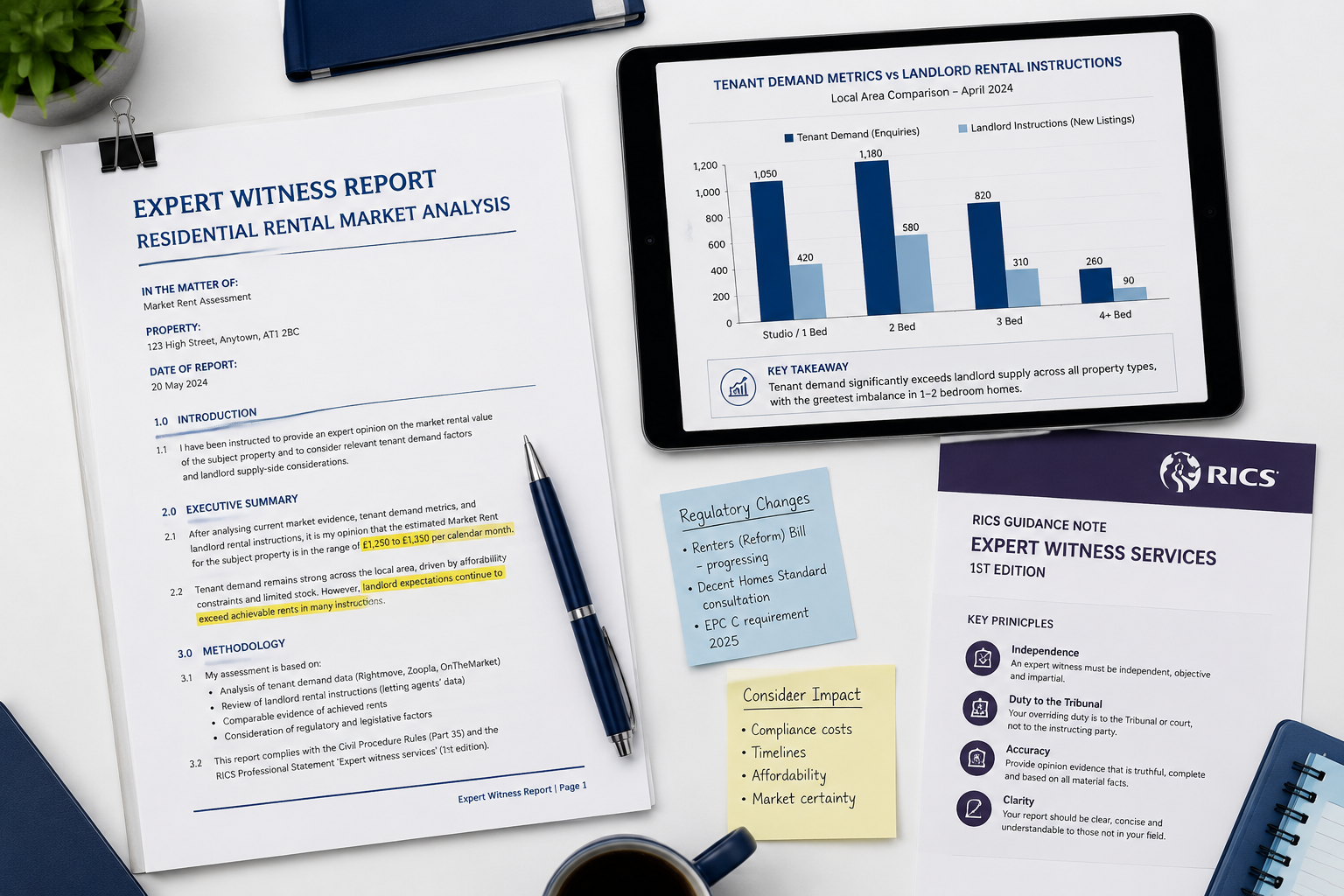
The methodological standard expected of expert witnesses in rental disputes has risen considerably. Tribunals are now scrutinising valuation methodology more closely, and 2026 expert reports are expected to provide transparent triangulation between at least two — and ideally three — valuation approaches [6].
The Comparable Evidence Approach
The comparable evidence (or "market rent") approach remains the primary method in most residential and commercial rental disputes. The expert identifies genuinely comparable lettings — similar property type, location, size, condition, and lease terms — and adjusts them to reflect differences from the subject property.
Critical adjustments in 2026 include:
- Date of transaction: Rental values have moved significantly in many markets over 12-18 month periods. Comparables more than 12 months old require explicit time adjustments supported by index evidence.
- Incentive packages: Rent-free periods and landlord contributions to fit-out have fluctuated. A comparable let at a higher headline rent but with six months rent-free is not directly comparable to a let without incentives.
- EPC rating: Energy efficiency has become a material factor in tenant demand and achievable rent, particularly for commercial property and higher-end residential.
- Regulatory compliance status: Properties that are fully compliant with current licensing and safety requirements command a premium over those requiring remediation.
The Income Approach
Where the dispute concerns investment value or yield rather than passing rent, the income approach — capitalising the estimated market rent at an appropriate yield — becomes relevant. Expert witnesses using this approach must justify their yield selection by reference to comparable investment transactions and current market sentiment [3].
Quantifying the Impact of Regulatory Change
This is the area where 2026 expert reports most frequently diverge from traditional practice. Where a new rent control mechanism, licensing requirement, or security of tenure provision materially affects the rental value or investment yield of the subject property, the expert must quantify that impact explicitly rather than noting it as a general market observation [9].
A structured approach might include:
- Establish the "pre-regulation" market rent using comparables from before the relevant change.
- Identify the specific regulatory constraint and its direct effect on achievable rent or landlord flexibility.
- Apply a percentage adjustment supported by market evidence of how similar regulatory changes have affected comparable markets.
- Cross-reference against any published guidance from RICS or government bodies on regulatory impact.
For properties subject to RICS Red Book valuation standards, the expert must also confirm compliance with the relevant RICS Valuation — Global Standards and any applicable UK national supplement.
Navigating Tenant Demand and Landlord Instructions: Practical Protocols
The tension between tenant demand evidence and landlord instructions is the defining challenge in Expert Witness Valuations for 2026 Rental Market Disputes: Navigating Tenant Demand and Landlord Instructions. Landlords instructing experts to support premium rents will often point to high demand as justification. Tenants will challenge whether that demand is genuine, sustainable, and relevant to the specific property.
Assessing "Tenant Demand Quality"
Headline demand figures — such as the number of enquiries per listing or average days on market — are useful but insufficient. Tribunals are increasingly focused on "tenant demand quality," which considers:
- Creditworthiness of prospective tenants: High enquiry volumes from tenants who do not meet affordability criteria do not support a premium rent.
- Nature of demand: Is demand driven by genuine residential need, corporate relocation, or short-term factors such as local events or temporary displacement?
- Sustainability: Demand driven by a temporary supply shortage may not support a long-term rent review uplift.
- Geographic specificity: Citywide demand statistics do not automatically apply to a specific postcode or property type.
Expert witnesses should document their demand analysis with specific evidence — letting agent records, void period data, and local market reports — rather than relying on generalised market commentary [5].
Handling Conflicting Instructions
When instructed by a landlord, the expert must still consider and disclose evidence that supports a lower rent if that evidence is material. Failure to do so risks the report being excluded or given little weight by the tribunal. Practically, this means:
- Selecting comparables objectively, not cherry-picking the highest achievable rents.
- Applying adjustments consistently and in both directions.
- Acknowledging market conditions that may have softened since the review date.
- Disclosing any limitations in the available comparable evidence.
The same principles apply in reverse when instructed by a tenant. Selecting only the lowest comparables without adjustment is equally problematic.
For disputes involving commercial property valuations, the expert must also consider the specific lease terms — upward-only rent review clauses, break options, and alienation provisions — all of which affect the market rent that a hypothetical tenant would agree to pay.
Short-Term Rental and Serviced Apartment Disputes

Short-term rental and serviced-apartment disputes represent a fast-growing niche within rental market litigation. Platforms such as Airbnb and Vrbo have created a parallel rental economy that intersects with — but is legally distinct from — the traditional private rented sector. Expert witnesses in these disputes face a specific methodological challenge: separating residential demand from tourism-driven demand [7].
Why the Distinction Matters
A property let on a short-term basis in a high-tourism location may achieve significantly higher gross income than the same property let on an assured shorthold tenancy. However, that higher income reflects:
- Seasonal volatility and occupancy risk.
- Higher management costs and platform fees.
- Regulatory exposure to local authority short-term letting restrictions.
- Greater wear and maintenance costs.
An expert who simply annualises peak short-term rental income to produce a "market rent" figure will produce a misleading valuation that a competent opposing expert will dismantle in cross-examination [7].
Local Regulatory Caps
Several local authorities in England and Scotland have introduced or are actively pursuing short-term letting controls, including registration schemes and occupancy caps. Expert witnesses must assess whether these controls are in force, pending, or merely proposed, and must quantify their effect on achievable income and therefore on rental value. This requires engagement with local planning evidence as well as market data — a multidisciplinary task that underlines the importance of instructing an expert with specific short-term rental experience [6].
For properties that straddle the boundary between residential and commercial use, a Manchester valuation report or equivalent local market assessment can provide the granular comparable evidence that generic national data cannot supply.
Presenting Expert Evidence Effectively in Tribunals
The quality of the underlying analysis counts for nothing if the expert cannot present it clearly and withstand cross-examination. Several practical points are worth emphasising for 2026 disputes.
Report Structure
A well-structured expert report in a rental dispute should follow a logical sequence:
- Instructions and scope — what the expert was asked to do and by whom.
- Property description — factual account of the subject property, its condition, and its lease terms.
- Market overview — current conditions in the relevant rental market, supported by published data.
- Comparable evidence — schedule of comparables with full details and adjustments.
- Valuation — the expert's opinion of market rent, with methodology explained.
- Regulatory impact — specific commentary on any relevant legislative changes.
- Statement of truth — required under CPR Part 35.
Withstanding Cross-Examination
Cross-examination in rental disputes typically focuses on three areas: the selection of comparables, the adjustments applied, and the expert's independence. Experts who can demonstrate that their comparable selection was systematic rather than selective, that their adjustments are supported by market evidence, and that they considered evidence adverse to their client's case will generally perform well under examination.
It is also worth noting that dilapidations surveys and schedule of condition evidence frequently intersects with rental market disputes — particularly where the condition of the property at the review date is disputed and affects the comparability of the subject property with the chosen comparables.
The Joint Statement Process
Where both parties have appointed experts, the tribunal will usually direct the experts to meet and produce a joint statement before the hearing. This document identifies:
- Facts agreed between the experts.
- Valuation issues on which they agree.
- Issues on which they disagree, with a brief explanation of why.
The joint statement is not an opportunity for either expert to advocate for their client. It is a procedural tool to narrow the issues for the tribunal and reduce hearing time. Experts who approach it adversarially risk criticism from the tribunal.
Conclusion: Actionable Steps for Expert Witnesses in 2026 Rental Disputes
The combination of constrained supply, rising rents, regulatory upheaval, and heightened tribunal scrutiny makes 2026 an exceptionally demanding environment for expert witnesses in rental market disputes. The following steps will position any valuation expert to produce defensible, high-quality evidence.
1. Audit your comparable database now. Rental markets have moved quickly. Comparables from 2023 or early 2024 may require significant time adjustments. Build a current, location-specific database before accepting instructions.
2. Engage with regulatory change as a valuation variable. Do not treat new landlord-tenant legislation as background context. Quantify its effect on rental value and yield using a structured, evidenced approach.
3. Separate demand quality from demand volume. High enquiry numbers are not the same as strong market rent evidence. Document the creditworthiness, nature, and sustainability of tenant demand.
4. Comply with RICS standards and CPR Part 35. Every report should include a statement of independence, a clear methodology explanation, and a statement of truth. Non-compliance is the fastest route to having your evidence excluded.
5. Prepare for the joint statement process. Approach expert meetings constructively. Narrowing agreed issues benefits the tribunal and enhances your credibility as an independent expert.
6. Seek specialist instruction where appropriate. Short-term rental disputes, commercial lease reviews, and regulated tenancy disputes each require specific expertise. Accepting instructions outside your area of competence exposes both you and your client to risk.
For parties seeking qualified, RICS-accredited expert witness support in rental market disputes, Manchester Surveyors' expert witness services provide the methodological rigour and tribunal experience that 2026's contested rental market demands. Those requiring a Red Book-compliant valuation as the foundation for their expert report can access that service directly through the same team.
The rental market disputes of 2026 will be won or lost on the quality of expert evidence. The protocols outlined above provide a practical framework for producing that evidence to the standard that courts and tribunals now expect.
References
[1] Expert Witness And Litigation – https://www.strettons.co.uk/commercial/expert-witness-and-litigation/
[3] Expert Witness Valuation – https://eqvista.com/company-valuation/expert-witness-valuation/
[5] Valuation – https://www.gilmartinley.co.uk/expertise/valuation
[6] Expert Witness Property Valuations – https://www.valuationsnsw.com.au/expert-witness-property-valuations.html
[7] The Importance Of Expert Witnesses In Short Term Rental Litigation – https://expertinfo.com/the-importance-of-expert-witnesses-in-short-term-rental-litigation/
[8] Appraisal Valuation Expert Witness – https://seakexperts.com/specialties/appraisal-valuation-expert-witness
[9] Valuation Disputes – https://www.stout.com/en/services/valuation-disputes