
Over 160,000 social rented homes in England were recorded with the most serious Category 1 hazards under the Housing Health and Safety Rating System (HHSRS) in recent years — yet tenants historically had few enforceable tools to compel landlords to act within defined timeframes. Awaab's Law changed that equation permanently. Understanding expert witness roles in Awaab's Law compliance disputes and the surveyor evidence required for hazard remediation timelines has become one of the most practically urgent areas of property law in 2026.
This article examines how chartered surveyors function as expert witnesses in tribunal proceedings, how reports must be structured to satisfy statutory deadlines, and what the expanded 2026 hazard categories demand from evidence standards.
Key Takeaways
- Awaab's Law imposes legally binding remediation timelines: emergency hazards within 24 hours, significant damp and mould investigated within 10 working days and remediated within 5 working days post-investigation.
- Chartered surveyors acting as expert witnesses must produce structured, independently verifiable reports that document hazard causation, timeline compliance, and remediation adequacy.
- As of 2026, the law has expanded beyond damp and mould to cover fire risks, electrical hazards, excess cold, and excess heat.
- RICS-accredited surveyors are expected to follow updated evidence standards including systematic condition surveys, progressive monitoring data, and third-party verification.
- Failure by landlords to comply with statutory timelines creates direct grounds for enforcement action, making surveyor evidence central to both prosecution and defence.
The Legal Framework: What Awaab's Law Requires in 2026
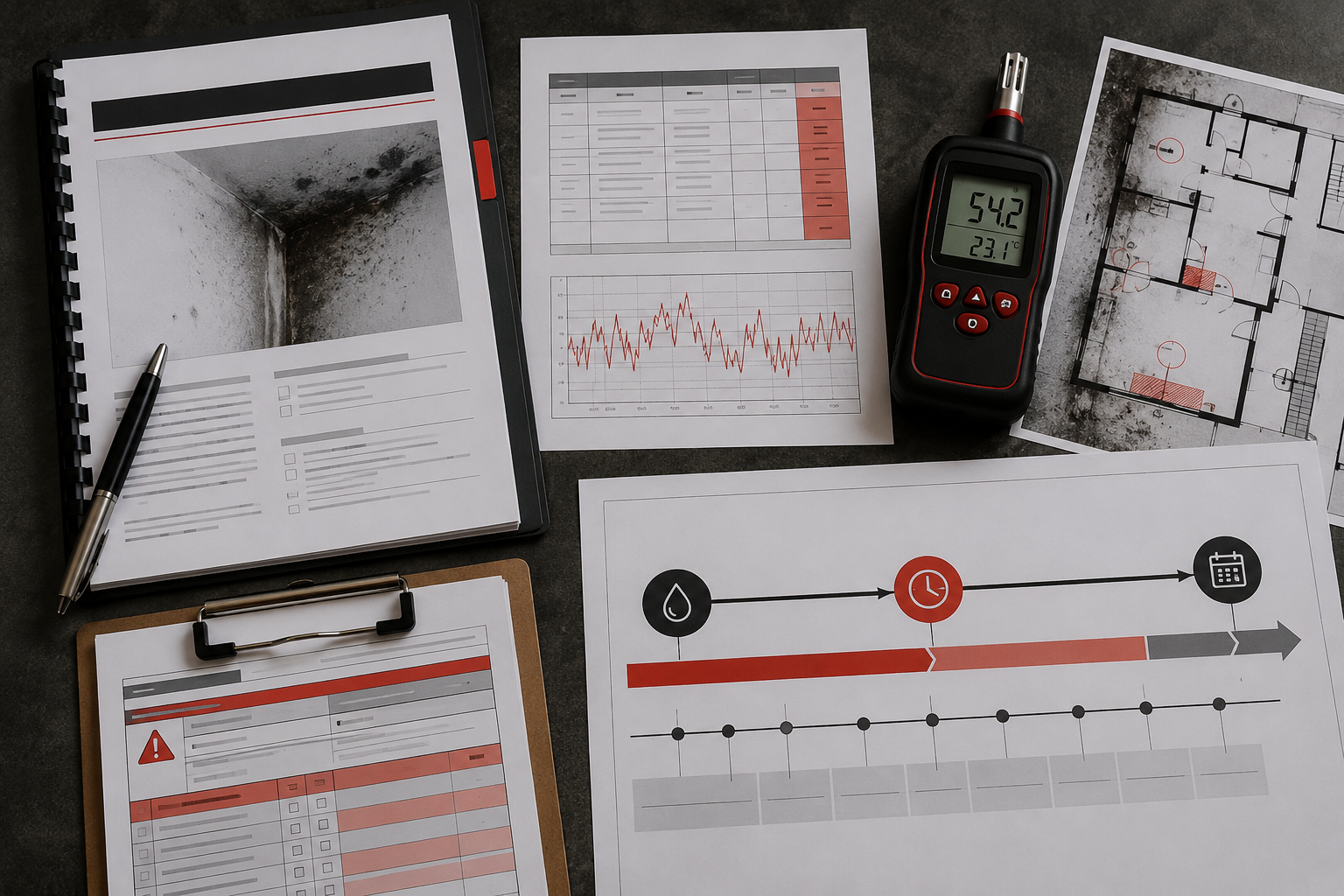
Awaab's Law — named after two-year-old Awaab Ishak, who died in 2020 from prolonged exposure to mould in a Rochdale social housing property — was enacted through the Social Housing (Regulation) Act 2023. Phase 1 came into force in October 2025, covering emergency hazards and significant damp and mould issues. Subsequent phases are progressively expanding the scope of prescribed hazards [7].
The statutory timelines are precise and non-negotiable:
| Hazard Type | Investigation Deadline | Remediation Deadline |
|---|---|---|
| Emergency hazard | 24 hours | Immediate (make safe) |
| Significant damp and mould | 10 working days | 5 working days after investigation |
| Other prescribed hazards (Phase 2+) | To be confirmed by regulation | To be confirmed by regulation |
These timelines apply to social landlords — local authorities and registered providers of social housing. Failure to comply exposes landlords to enforcement action by the Regulator of Social Housing and potential legal proceedings [2].
Crucially, resident panel research commissioned by the government found that tenants consistently preferred even shorter timelines than those proposed, indicating that the statutory minimums represent a floor, not an acceptable standard [8]. This sentiment is already influencing how tribunals assess whether landlords acted with reasonable urgency.
The Role of the HHSRS in Evidence Frameworks
The Health and Housing Safety Rating System remains the primary analytical tool for classifying hazard severity. Under Awaab's Law, surveyors must apply HHSRS methodology rigorously to determine whether a hazard crosses the threshold for emergency status or falls within the significant damp and mould category. The classification directly determines which timeline applies — making accurate HHSRS scoring a critical component of expert witness evidence.
Expert Witness Roles in Awaab's Law Compliance Disputes: Structuring Surveyor Evidence
When a dispute reaches a tribunal or court, the expert witness roles in Awaab's Law compliance disputes are defined by both procedural rules and the specific technical demands of the legislation. A surveyor's report is not merely a technical document — it is a legal instrument that must withstand cross-examination.
Core Components of a Compliant Expert Witness Report
RICS has updated its guidance to align with Awaab's Law, requiring surveyors to provide systematic condition surveys, progressive monitoring data, and third-party verification [1]. A well-structured expert witness report for hazard remediation timeline disputes should contain the following elements:
1. Hazard Identification and Classification
- Precise description of each hazard observed
- HHSRS scoring with supporting calculations
- Photographic evidence with date and time stamps
- Instrument readings (moisture meters, hygrometers, thermal imaging cameras) with calibration certificates
2. Causation Analysis
Establishing causation is among the most contested aspects of Awaab's Law disputes. Surveyors must demonstrate a direct link between the identified defect and the reported hazard. This requires:
- Temporal correlation evidence (when did the defect first appear relative to the hazard?)
- Explanation of the physical mechanism causing harm
- Exclusion of alternative causes (e.g., lifestyle condensation versus structural water ingress) [1]
A damp survey conducted by a qualified surveyor should distinguish between rising damp, penetrating damp, and condensation — each with different causation profiles and different implications for landlord liability.
3. Timeline Documentation
This is where many landlords face the greatest exposure. The expert witness must reconstruct the chronology of events:
- Date of tenant complaint or notification
- Date of landlord acknowledgement
- Date of inspection (and whether it fell within the statutory window)
- Date remediation works commenced and completed
- Any gaps or delays, with explanations
Written records, email correspondence, work order systems, and contractor invoices all form part of this evidential chain. Where gaps exist, the surveyor must comment on their significance.
4. Remediation Specification Assessment
Expert witnesses must evaluate whether proposed or completed remediation measures actually address the identified hazard. This involves assessing technical adequacy, timeline feasibility, and cost reasonableness [1]. A landlord who completes works within the statutory deadline but uses a method that fails to resolve the underlying cause has not achieved compliance in substance.
A schedule of dilapidations or a specific defect report can provide the technical scaffolding for this assessment, documenting pre- and post-remediation conditions in a format courts and tribunals can readily evaluate.
Mandatory Reporting Obligations for Emergency Hazards
For emergency hazards, the reporting obligations are immediate. Surveyors are required to provide verbal briefings at the time of inspection and written confirmations within 24 hours [4]. For significant damp and mould, a comprehensive investigation must be completed within 14 days of the complaint, with a written summary delivered to the tenant within 48 hours of the investigation concluding.
These obligations mean that surveyors instructed by landlords must be prepared to operate under compressed timeframes without compromising the quality of evidence produced. Instrument calibration, site access protocols, and report templates should all be prepared in advance.
"The statutory timelines under Awaab's Law are not aspirational targets — they are enforceable legal obligations. A surveyor's evidence that a landlord missed a deadline by even a single working day can be determinative in tribunal proceedings."

Integrated Risk Assessments and the 2026 Hazard Expansions
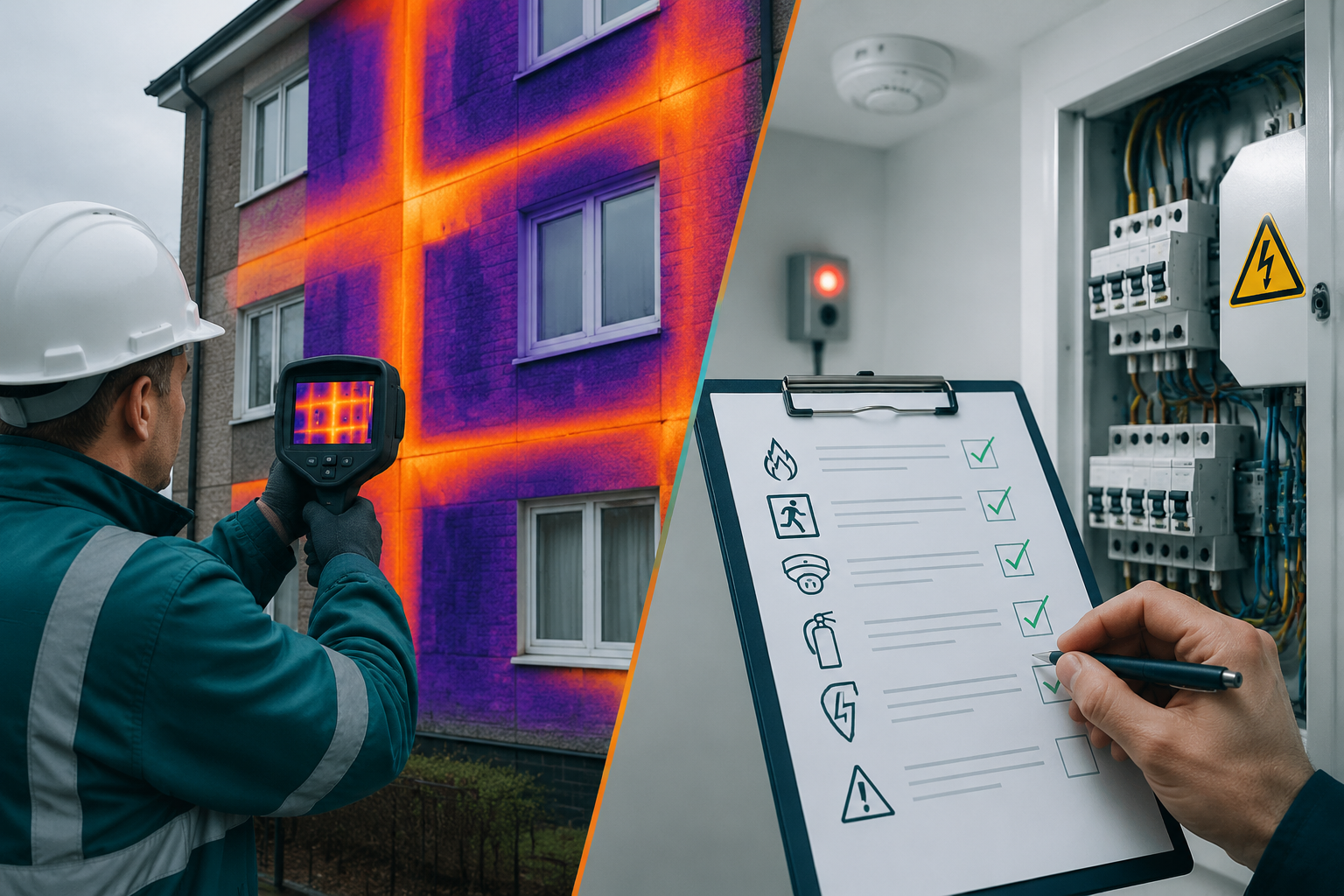
One of the most significant developments for expert witness roles in Awaab's Law compliance disputes in 2026 is the expansion of prescribed hazard categories beyond damp and mould. As of 2026, the law now encompasses fire risks, electrical hazards, excess cold, and excess heat [3]. This demands a fundamentally different approach to survey methodology.
Moving Beyond Single-Hazard Assessments
Under the original Phase 1 framework, many surveyors focused almost exclusively on damp and mould. The 2026 expansion requires what practitioners now describe as integrated risk assessments — evaluating interconnected hazards rather than isolated issues [1].
A property with significant damp may also present:
- Compromised fire safety (damaged fire doors, blocked escape routes)
- Electrical hazards (water ingress near consumer units or sockets)
- Excess cold (failed or inadequate heating systems exacerbating condensation)
Each of these hazard categories now carries its own statutory timeline obligations. An expert witness who identifies only the primary damp hazard while overlooking secondary fire or electrical risks may produce a report that is technically accurate but legally incomplete.
Chartered surveyors with RICS accreditation are expected to maintain competency across all prescribed hazard categories. Where a surveyor lacks specialist expertise in a particular area — such as electrical hazards — the RICS guidance requires them to either obtain appropriate training or commission a specialist sub-report that can be incorporated into the expert witness evidence [6].
Protocols for Identifying Expanded Hazard Categories
Updated survey protocols for 2026 include:
- Fire risk indicators: Condition of fire doors, smoke alarm functionality, means of escape, storage of combustible materials
- Electrical hazard indicators: Visible wiring defects, damp proximity to electrical installations, age and condition of consumer units
- Excess cold indicators: Heating system adequacy, insulation levels, window and door sealing, thermal bridging identified through infrared thermography
- Excess heat indicators: Ventilation adequacy, solar gain through glazing, cooling provisions
A stock condition survey provides a systematic baseline for identifying these hazard categories across a landlord's housing portfolio, enabling proactive compliance rather than reactive crisis management.
Challenges Facing Expert Witnesses Under the Expanded Framework
Surveyors acting as expert witnesses face several specific challenges in 2026 [6]:
- Instrument calibration: All measurement tools must have current calibration certificates. Uncalibrated instruments produce inadmissible readings.
- Maintaining qualifications across hazard categories: The expanded hazard list requires broader competency than many surveyors historically maintained.
- Considering alternative causes: Tribunals expect expert witnesses to engage with the landlord's alternative explanations rather than dismissing them without analysis.
- Withstanding cross-examination: Reports must be internally consistent, logically structured, and supported by reproducible methodology.
The RICS CPD requirements for 2026 reflect these demands, with updated modules covering HHSRS assessment for the expanded hazard categories and expert witness report writing under Awaab's Law.
Tenant Rights, Landlord Duties, and the Surveyor's Position
Awaab's Law grants tenants in the social rented sector legally enforceable rights to safe housing with defined remediation timelines [5]. This fundamentally alters the power dynamic in housing disrepair disputes and elevates the importance of independent surveyor evidence.
When Surveyors Are Instructed by Tenants
Tenants seeking to enforce Awaab's Law compliance may instruct their own surveyor to produce evidence of:
- The existence and severity of a prescribed hazard
- The date on which the landlord was notified
- Whether the landlord's response fell within statutory timelines
- Whether completed remediation was technically adequate
A property inspection report from an RICS-accredited surveyor carries significant weight in tribunal proceedings. The surveyor's independence and professional obligations to the court — rather than to the instructing party — are fundamental to this weight.
When Surveyors Are Instructed by Landlords
Social landlords facing compliance disputes may instruct surveyors to demonstrate:
- That hazards were identified and classified correctly
- That statutory timelines were met
- That remediation measures were technically adequate and proportionate
- That any delays were caused by circumstances beyond the landlord's control (e.g., tenant access refusal)
In this context, a dilapidation survey or monitoring survey documenting pre-existing conditions and post-remediation outcomes can be decisive evidence.
The Expert Witness's Overriding Duty
Regardless of which party instructs them, a surveyor acting as an expert witness owes their primary duty to the tribunal or court — not to the instructing party. This is codified in Civil Procedure Rules Part 35 and reinforced by RICS professional standards. An expert witness who tailors their opinion to favour the instructing party risks both professional disciplinary action and the exclusion of their evidence.
This independence is precisely what makes surveyor evidence credible in Awaab's Law disputes. A report that acknowledges weaknesses in the instructing party's position, engages honestly with contrary evidence, and reaches conclusions supported by reproducible methodology will always carry more weight than one that reads as advocacy.
Practical Steps for Surveyors Preparing Expert Witness Reports
The following checklist summarises best practice for surveyors preparing expert witness evidence in Awaab's Law compliance disputes:
- Confirm RICS accreditation and relevant CPD is current across all applicable hazard categories
- Ensure all instruments are calibrated and certificates are available for disclosure
- Document site access arrangements and any limitations on the inspection
- Apply HHSRS methodology systematically and record scoring rationale
- Photograph all hazards with date/time metadata intact
- Reconstruct the landlord's compliance timeline from available documentary evidence
- Assess causation by identifying the physical mechanism, temporal correlation, and alternative explanations
- Evaluate remediation adequacy against the technical standard required to resolve the hazard
- Produce a written report that is logically structured, internally consistent, and free of advocacy
- Comply with mandatory reporting timeframes where acting as the inspecting surveyor rather than a retrospective expert
Conclusion
The expansion of Awaab's Law in 2026 has transformed the role of the chartered surveyor from a technical adviser into a central figure in legally enforceable housing safety disputes. Expert witness roles in Awaab's Law compliance disputes now demand a level of rigour, breadth, and procedural awareness that goes well beyond a standard condition report.
Actionable next steps for professionals and property owners:
- Commission a proactive stock condition survey to identify prescribed hazards before complaints arise, creating a documented baseline that demonstrates good faith compliance.
- Ensure surveyor instructions are clear and timely — particularly for emergency hazards where the 24-hour window leaves no margin for delay.
- Retain RICS-accredited surveyors with current CPD covering the full range of 2026 prescribed hazard categories, not just damp and mould.
- Build robust documentation systems that record the date and nature of every tenant complaint, every inspection, and every remediation action — this chronological record is the foundation of any compliance defence.
- Engage expert witnesses early in any dispute, before positions become entrenched, to obtain an objective assessment of the strength of the evidence on both sides.
The stakes in Awaab's Law disputes are high — for tenants whose health depends on prompt remediation, and for landlords whose regulatory standing depends on demonstrable compliance. Rigorous, independent surveyor evidence is the mechanism through which both interests are properly served.
References
[1] Expert Witness Roles In Structural Collapse Disputes Under Awaabs Law 2026 Evidence Standards For Party Wall Awards – https://wimbledonsurveyors.com/expert-witness-roles-in-structural-collapse-disputes-under-awaabs-law-2026-evidence-standards-for-party-wall-awards/?utm_source=openai
[2] Awaabs Law Guidance For Social Landlords Timeframes For Repairs In The Social Rented Sector – https://www.gov.uk/government/publications/awaabs-law-guidance-for-social-landlords/awaabs-law-guidance-for-social-landlords-timeframes-for-repairs-in-the-social-rented-sector?utm_source=openai
[3] Building Surveys For Damp And Mould Post Awaabs Law Expansion Protocols For Identifying Prescribed Hazards In 2026 – https://nottinghillsurveyors.com/blog/building-surveys-for-damp-and-mould-post-awaabs-law-expansion-protocols-for-identifying-prescribed-hazards-in-2026?utm_source=openai
[4] Awaabs Law Compliance In Rental Surveys Detecting And Reporting Damp Mould And Housing Hazards – https://wimbledonsurveyors.com/awaabs-law-compliance-in-rental-surveys-detecting-and-reporting-damp-mould-and-housing-hazards/?utm_source=openai
[5] Awaabs Law Frequently Asked Questions – https://www.ipswich.gov.uk/housing/council-tenants/awaabs-law-frequently-asked-questions?utm_source=openai
[6] Expert Witness Challenges In Awaabs Law 2026 Hazard Extensions Evidence Standards For Excess Cold Falls And Fire Risks – https://wimbledonsurveyors.com/expert-witness-challenges-in-awaabs-law-2026-hazard-extensions-evidence-standards-for-excess-cold-falls-and-fire-risks/?utm_source=openai
[7] Awaab S Law – https://westberks.gov.uk/article/45590/Awaab-s-Law?utm_source=openai
[8] Repairs Maintenance And Awaabs Law Resident Panel Report Accessible Version – https://www.gov.uk/government/publications/social-housing-resident-panel-reports-2022-to-2023/repairs-maintenance-and-awaabs-law-resident-panel-report-accessible-version?utm_source=openai