One in five UK mortgage applications faced complications due to a down-valuation in early 2026 — a figure that has rattled buyers, sellers, and estate agents across the country. When a lender's surveyor places a value on a property that sits below the agreed purchase price, the entire transaction can stall, collapse, or require painful renegotiation. Yet despite how common this scenario has become, many buyers still don't fully understand why it happens or what they can do about it.
This guide unpacks Down-Valuations Explained: How Surveyors Justify Market Value in a Volatile UK Housing Market, walking through the mechanics of the valuation process, the evidence surveyors rely on, and the practical steps available to everyone involved in a transaction.
Key Takeaways 📌
- A down-valuation occurs when a lender's surveyor values a property below the agreed purchase price, directly affecting how much a mortgage lender will advance.
- Surveyors use comparable sales evidence (known as "comps") and RICS-approved methodology to justify their figures — not personal opinion.
- In 2026, down-valuations rose 15% quarter-on-quarter, with London and the South East most affected.
- Buyers, sellers, and agents each have concrete options when a down-valuation occurs — including renegotiation, formal challenge, or bridging the gap with a larger deposit.
- Understanding the key factors of valuation before agreeing a purchase price is the single most effective preventive measure.
What Is a Down-Valuation and Why Does It Matter?
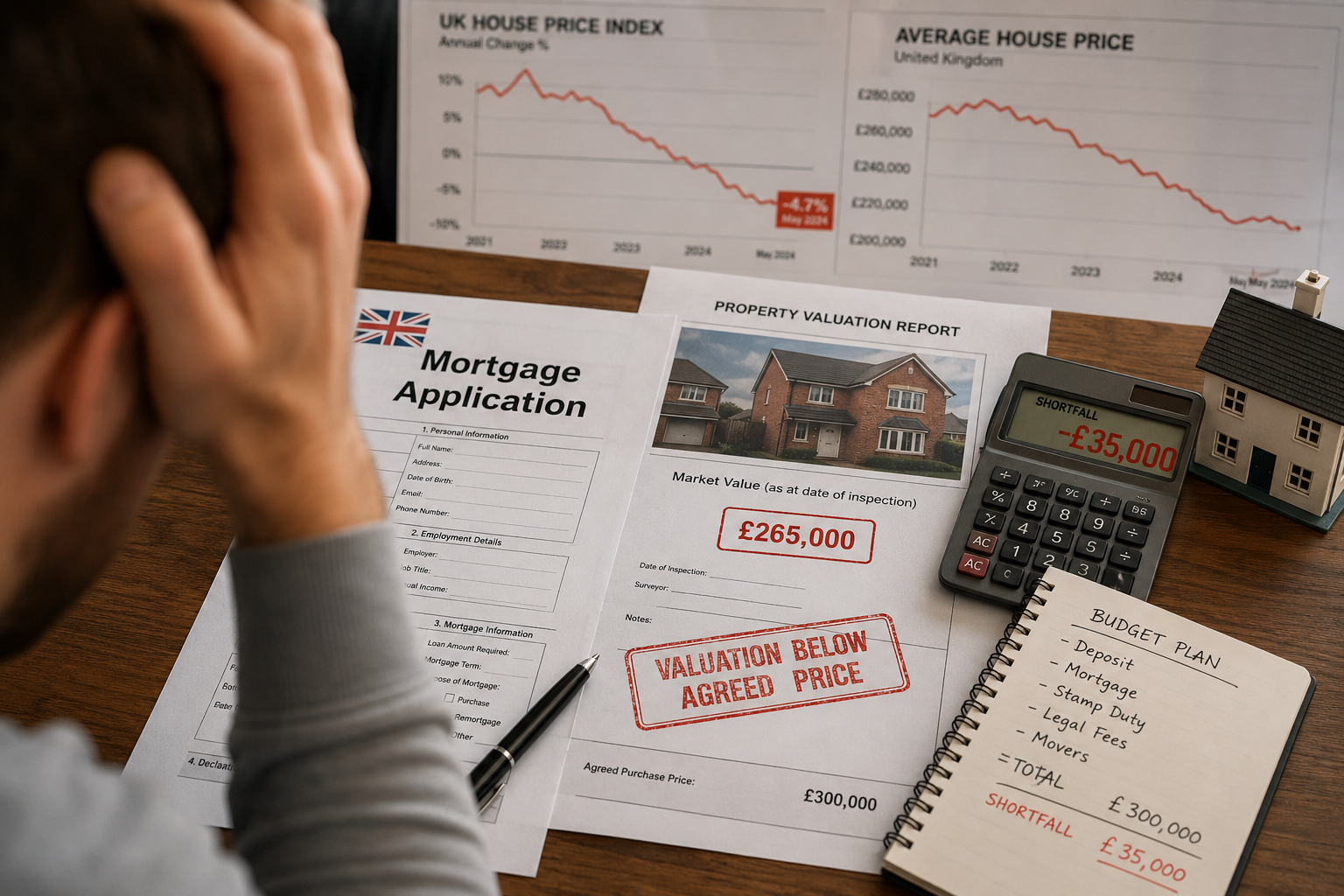
A down-valuation (also called a "mortgage valuation shortfall") happens when the surveyor instructed by a mortgage lender assesses a property's market value as lower than the price a buyer has agreed to pay. The lender will only advance funds based on the surveyor's figure — not the agreed price — which creates an immediate financial gap.
A Simple Example
| Agreed Purchase Price | Surveyor's Valuation | Mortgage at 80% LTV | Shortfall |
|---|---|---|---|
| £400,000 | £370,000 | £296,000 | £30,000 |
In this scenario, the buyer must either find an extra £30,000, renegotiate the price down to £370,000, or walk away entirely.
💬 "Down-valuations are a natural response to market uncertainty and serve to protect both lenders and buyers from overpaying." — Dr. Emily Carter, Housing Economist, University of Oxford (April 2026)
This protection function is important to understand. Surveyors are not acting against buyers — they are acting as an independent check on whether the agreed price reflects demonstrable market evidence.
How Surveyors Justify Market Value: The Methodology Behind the Numbers
Understanding Down-Valuations Explained: How Surveyors Justify Market Value in a Volatile UK Housing Market requires a clear look at how RICS-registered valuers actually reach their conclusions.
The Comparable Sales Method
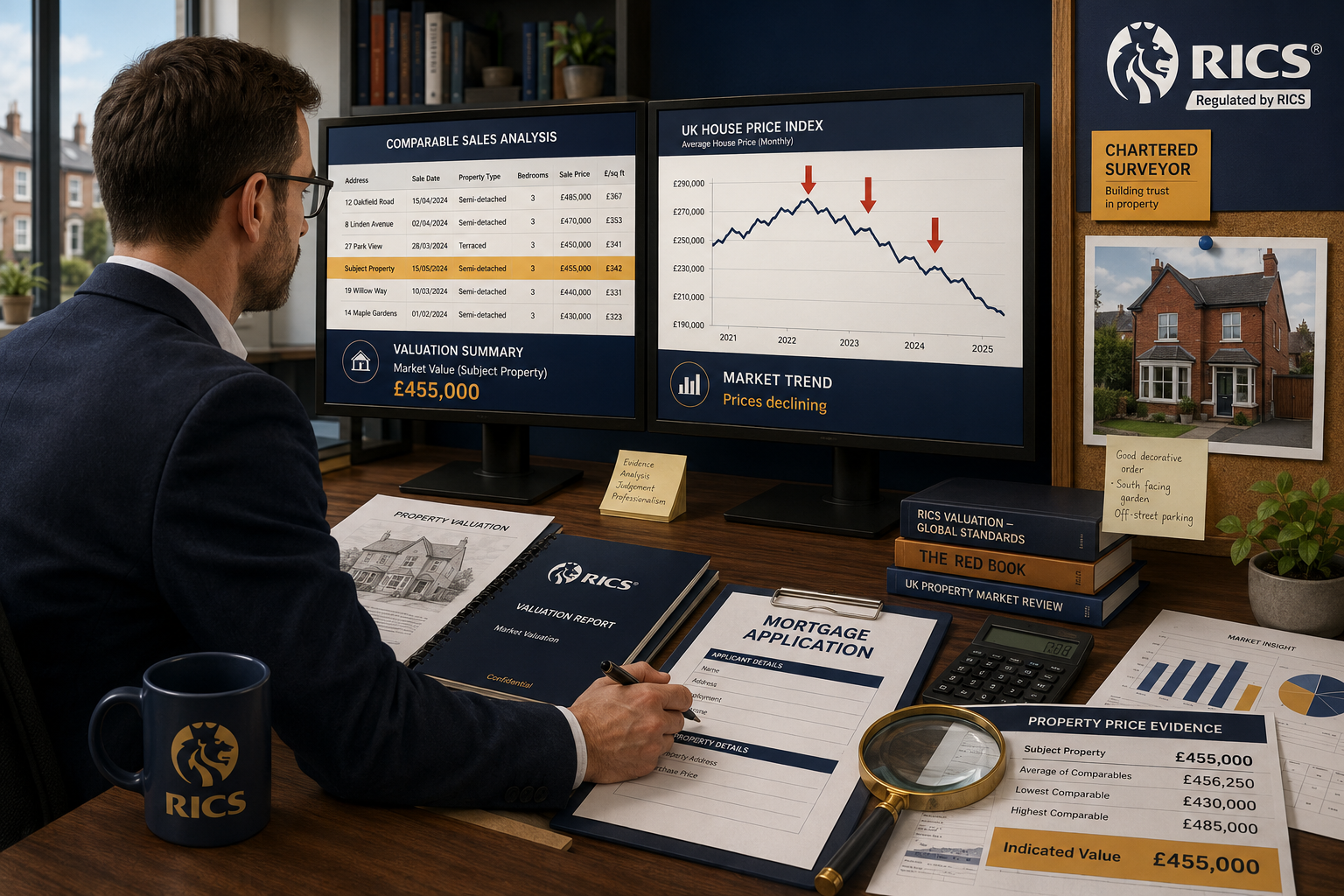
The primary tool in any residential valuation is the comparable sales approach — analysing recent sales of similar properties in the same area. Surveyors look for:
- 🏠 Properties of similar size, type, and age
- 📍 Sales within a tight geographic radius (ideally the same street or postcode)
- 📅 Transactions completed within the last 3–6 months (shorter windows in volatile markets)
- 🔧 Properties in a similar condition to the subject property
When comparable evidence is thin — as is often the case in rapidly shifting markets — surveyors must apply adjustments to account for differences in condition, specification, or timing. This is where professional judgement plays a significant role, and where buyers sometimes feel the process is subjective.
In reality, RICS-registered surveyors follow the RICS Red Book valuation standards, a globally recognised framework that governs how valuations must be conducted, documented, and justified. These standards were updated in March 2026 to specifically address how surveyors should handle rapid market fluctuations when assessing value.
Adjusting for Market Volatility
In a stable market, comparable evidence from six months ago is broadly reliable. In a volatile market — like the UK housing market in 2026 — a six-month-old sale can be significantly misleading. Surveyors must therefore:
- Weight recent evidence more heavily, even if the sample size is smaller
- Apply downward adjustments when the market trend is clearly declining
- Flag uncertainty in their reports where evidence is limited
- Consider macroeconomic indicators such as interest rate movements and mortgage availability
The Association of Residential Surveyors confirmed in April 2026 that members are actively adjusting valuations to reflect current conditions, including recent comparable sales and broader economic signals. This is not conservatism for its own sake — it is professional obligation.
Structural and Condition Factors
A down-valuation is not always purely about market conditions. Physical defects identified during a survey inspection can also reduce the assessed value. Issues such as:
- Damp or subsidence
- Roof deterioration
- Outdated electrical or heating systems
- Non-standard construction
…can all contribute to a lower valuation figure. For buyers concerned about structural issues, commissioning a RICS Home Survey before exchange provides an independent view of the property's condition — separate from the lender's valuation.
The Scale of the Problem in 2026: Data and Regional Patterns
The scale of down-valuations in the current market is significant. According to RICS data from April 2026, down-valuations rose 15% compared to the previous quarter, driven by market instability following interest rate adjustments and shifting buyer demand.
A study by the UK Finance Association found that 20% of mortgage applications in early 2026 faced complications directly linked to down-valuations — leading to renegotiations, increased deposit requirements, or transaction collapses.
Regional Breakdown 📊
ONS data from May 2026 highlights clear geographic patterns:
| Region | Down-Valuation Prevalence | Key Driver |
|---|---|---|
| London | Very High | Price volatility, thin comparable evidence |
| South East | High | Rapid price corrections in commuter belt |
| North West | Moderate | More stable price growth, better comparable data |
| Yorkshire & Humber | Lower | Steadier market conditions |
| Scotland | Lower | Different legal framework, slower price swings |
London and the South East are disproportionately affected because property prices in these regions have experienced the most dramatic swings. When prices move quickly in either direction, the gap between what buyers agree to pay and what surveyors can justify with hard evidence widens considerably.
For buyers and sellers in London specifically, working with chartered surveyors in London who have deep local market knowledge can make a material difference to the accuracy and defensibility of a valuation.
The Human Cost
A survey by Property Market Insights in May 2026 found that:
- 35% of buyers had experienced at least one down-valuation in their current property search
- 40% of sellers had seen a transaction affected by a down-valuation
- The most common outcome was price renegotiation, followed by transaction delays
These figures represent real disruption — chains collapsing, moving dates shifting, and significant legal and survey costs being incurred twice when sales fall through.
What Buyers, Sellers, and Agents Can Realistically Do
This is where Down-Valuations Explained: How Surveyors Justify Market Value in a Volatile UK Housing Market becomes practically useful. A down-valuation is not necessarily the end of a transaction. There are several credible routes forward.

For Buyers 🏡
1. Request the Surveyor's Evidence
Buyers are entitled to ask their lender for the basis of the valuation, including the comparable sales used. If the comparables appear outdated or geographically inappropriate, this is grounds for a formal challenge.
2. Commission an Independent Valuation
A second opinion from an independent RICS-registered valuer — separate from the lender's surveyor — can provide evidence to support a challenge. Understanding valuation costs upfront helps buyers budget for this option.
3. Renegotiate the Purchase Price
The most common resolution. Armed with the surveyor's figure, buyers have a legitimate basis to return to the seller and request a price reduction. In a market where sellers are already aware of down-valuation risks, many will negotiate rather than lose the sale.
4. Bridge the Gap
If the property is genuinely worth the agreed price to the buyer and they have the funds available, increasing the deposit to cover the shortfall is a valid option — though it requires careful financial planning.
5. Switch Lenders
Different lenders use different panel surveyors, and valuations can vary. Switching mortgage product or lender may result in a different — potentially higher — valuation. Note that this adds time and cost to the process.
For Sellers 🏘️
- Price realistically from the outset. Reviewing recent comparable sales before listing reduces the risk of an agreed price that cannot be supported by a surveyor. Estate agents should be challenged to provide hard evidence for their suggested asking price.
- Address known defects before listing. Structural or condition issues that reduce value are better resolved — or at least disclosed — before a surveyor visits.
- Be prepared to renegotiate. In the current market, flexibility on price is often the fastest route to a successful completion.
For Estate Agents 🤝
Agents play a critical role in managing expectations. Overvaluing properties to win instructions is a well-documented problem in UK estate agency — and in a volatile market, it directly increases the risk of down-valuations derailing transactions. Agents who provide realistic, evidence-based pricing advice serve their clients better in the long run.
Challenging a Down-Valuation: The Formal Process
A formal challenge — known as a "valuation appeal" — is possible but requires strong evidence. The process typically involves:
- Gathering comparable evidence — recent sales of genuinely similar properties at or above the agreed price
- Submitting a written challenge to the lender, including the evidence pack
- Requesting a second inspection or a desk-based review by a senior valuer
- Escalating to RICS if the surveyor's conduct appears to breach professional standards
It is worth noting that challenges succeed most often when buyers can demonstrate that the surveyor used outdated, geographically distant, or genuinely dissimilar comparables. Challenges based solely on the buyer's desire to proceed at the agreed price are unlikely to succeed.
For buyers in specific areas, local expertise matters enormously. Chartered surveyors in Surrey or chartered surveyors in Battersea, for example, will have access to hyperlocal sales data that a panel surveyor covering a wide geographic area may not have weighted appropriately.
Prevention: Getting the Valuation Right Before It Becomes a Problem
The most effective response to a down-valuation is avoiding one in the first place. Several practical steps reduce the risk significantly:
Before Making an Offer
- Research recent sold prices (not asking prices) on Land Registry and Rightmove's sold prices tool
- Ask the estate agent for the specific comparables they used to arrive at the asking price
- Consider whether the property has any features that might be difficult for a surveyor to value positively — unusual construction, non-standard layout, or significant deferred maintenance
Choosing the Right Survey
A homebuyer survey or full building survey commissioned independently — before exchange — gives buyers a clear picture of condition issues that might affect value. This knowledge allows buyers to factor potential costs into their offer, rather than being surprised after a mortgage valuation.
Understanding What Drives Value
The key factors of valuation include location, size, condition, tenure, and comparable evidence. Buyers who understand these factors are better placed to assess whether an asking price is defensible — and to negotiate from a position of knowledge rather than emotion.
The Regulatory and Policy Landscape in 2026
The UK government has taken notice of the scale of the problem. In May 2026, the Ministry of Housing announced a review of residential valuation practices, with the stated aim of ensuring that valuations reflect current market realities while supporting housing market stability. The review is expected to examine:
- The adequacy of comparable evidence requirements
- The independence of lender panel surveyors
- Consumer rights in the valuation challenge process
Analysts from the National Housing Federation predict that down-valuations will remain a feature of the market throughout 2026 as prices seek equilibrium following a period of significant volatility. Their advice to buyers and sellers is consistent: remain flexible, stay evidence-focused, and do not allow emotional attachment to a price to override market reality.
Conclusion: Turning a Down-Valuation from a Crisis into a Negotiation
A down-valuation is not a judgment on a buyer's taste or a seller's home. It is a professional assessment, grounded in evidence, that the agreed price exceeds what the market can currently support. In a volatile market, this happens frequently — and in 2026, it is happening more than ever.
The key is to treat a down-valuation as information, not a verdict. Armed with an understanding of how surveyors justify market value, buyers and sellers can respond strategically rather than reactively.
Actionable Next Steps ✅
- Before agreeing a price — research sold prices, not asking prices, and challenge agents to justify their figures with comparable evidence.
- Commission an independent survey — a RICS Home Survey gives you an independent condition assessment before the lender's valuation.
- If a down-valuation occurs — request the evidence used, assess whether comparables are appropriate, and consider a formal challenge if the evidence is weak.
- Renegotiate with evidence — use the surveyor's figure as a negotiating tool, not just a problem.
- Seek local expertise — a locally experienced chartered surveyor will have the hyperlocal data needed to support or challenge a valuation effectively.
The UK housing market in 2026 rewards those who understand the process. Down-valuations, handled correctly, are a negotiating opportunity — not a dead end.