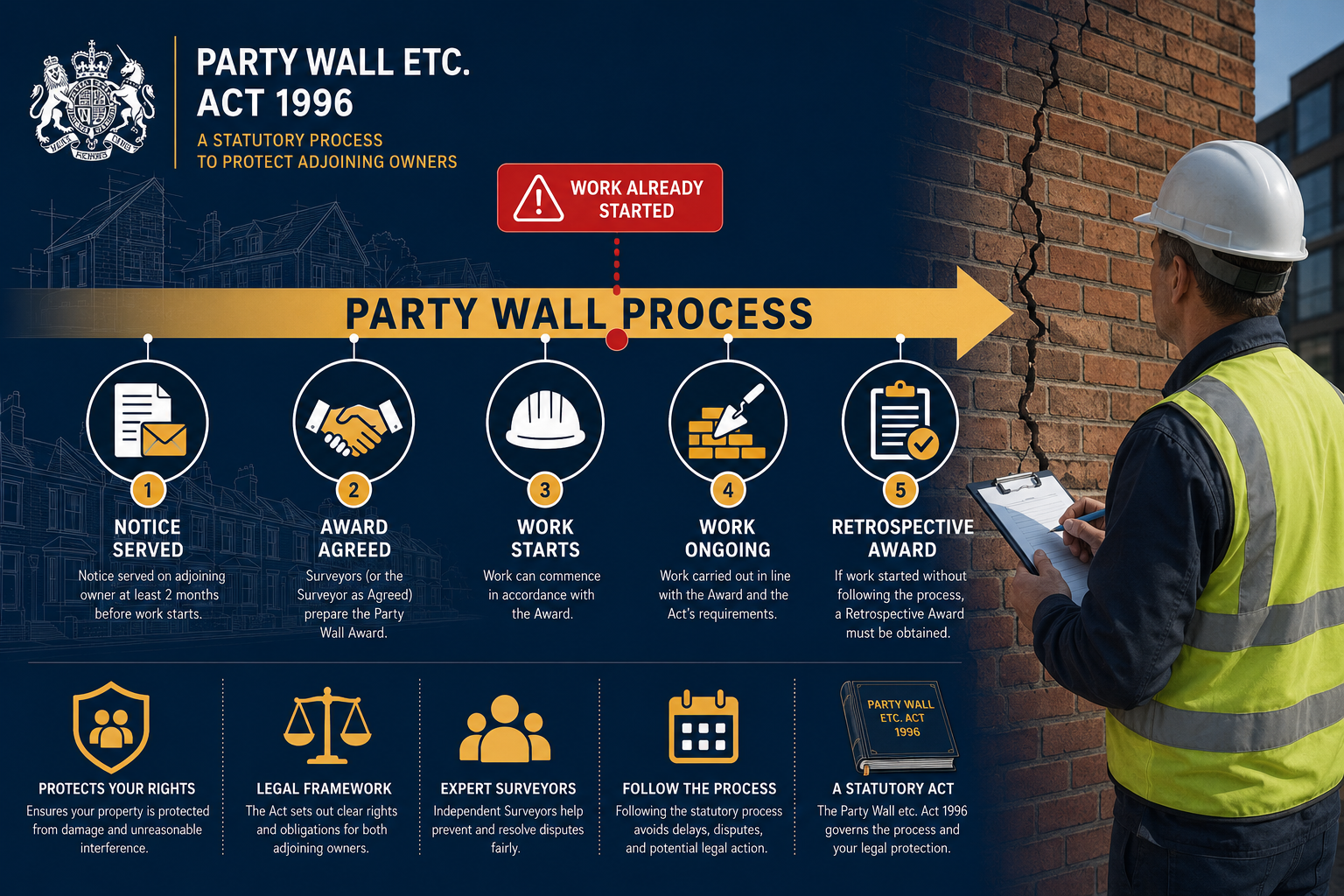
Nearly one in three party wall disputes involves work that has already begun before the formal process is complete — yet most property owners assume the statutory framework simply no longer applies. That assumption is wrong, and it can be costly. Understanding Party Wall Awards After Work Has Already Started: What Surveyors Can Still Do is essential for building owners, adjoining owners, and the surveyors caught in the middle of an already-moving project.
This guide cuts through the confusion. It explains the legal landscape, the practical limits of retrospective action, and — critically — what skilled surveyors can still achieve once bricks are already being laid.
Key Takeaways 📋
- A retrospective party wall award can still be valid if proper notices were served before work began, even if the award itself was not finalised first.
- Where no notice was ever served, the Party Wall etc. Act 1996 has limited statutory reach over completed works — but other legal remedies remain available.
- Surveyors can still document damage, agree compensation, and protect both parties' interests after work has started.
- Once an award is served, both parties have a 14-day window to appeal in the county court [5].
- In 2026, updated RICS guidance is reinforcing surveyor independence and clarifying jurisdiction in exactly these messy, mid-works scenarios [4].
The Messy Reality: Why Work Often Starts Before Awards Are Finalised
Construction rarely waits for paperwork. Contractors book slots weeks in advance, planning permissions expire, and building owners — often unaware of the full requirements of the Party Wall etc. Act 1996 — press ahead. The result is a situation that is far more common than the textbooks suggest: a project underway, an adjoining owner alarmed, and a surveyor called in after the fact.
There are broadly two distinct scenarios that surveyors encounter:
| Scenario | Notice Served? | Award in Place? | Retrospective Action Possible? |
|---|---|---|---|
| A | ✅ Yes | ❌ Not yet finalised | ✅ Yes — award can still be made |
| B | ❌ No | ❌ No | ⚠️ Limited — Act has reduced reach |
Understanding which scenario applies determines almost everything about what a surveyor can and cannot do.
Scenario A: Notice Served, Award Not Yet Agreed
This is the more straightforward situation. If a building owner served valid notices and the adjoining owner did not consent (or consent was not recorded), the dispute resolution machinery of the Act is already engaged. In these cases, certain disputes can still be resolved through a formal award, even after the completion of works [1].
The surveyor's appointment remains valid. The award can address:
- The manner in which completed works were carried out
- Compensation for any damage caused
- Access rights that were exercised during the works
- Outstanding costs and surveyor fees
💬 "The statutory process does not simply evaporate because a builder moved faster than the paperwork. Where notices exist, the framework endures."
Scenario B: No Notice Was Ever Served
This is where the situation becomes significantly more complicated. Where no notices were served before work commenced, the Act does not hold statutory authority over the completed works, which limits the applicability of retrospective awards [1]. The surveyor cannot simply conjure jurisdiction from thin air.
For more context on the implications of skipping this step entirely, see this detailed guide on what happens when no party wall notice has been served.
However, "limited statutory reach" does not mean "no recourse." Common law remedies — including claims in nuisance, negligence, and trespass — remain fully available to an adjoining owner whose property has been affected.
Party Wall Awards After Work Has Already Started: What Surveyors Can Still Do
Even mid-project, a qualified surveyor brings substantial value. The role shifts from preventative to responsive, but it remains both meaningful and legally grounded.
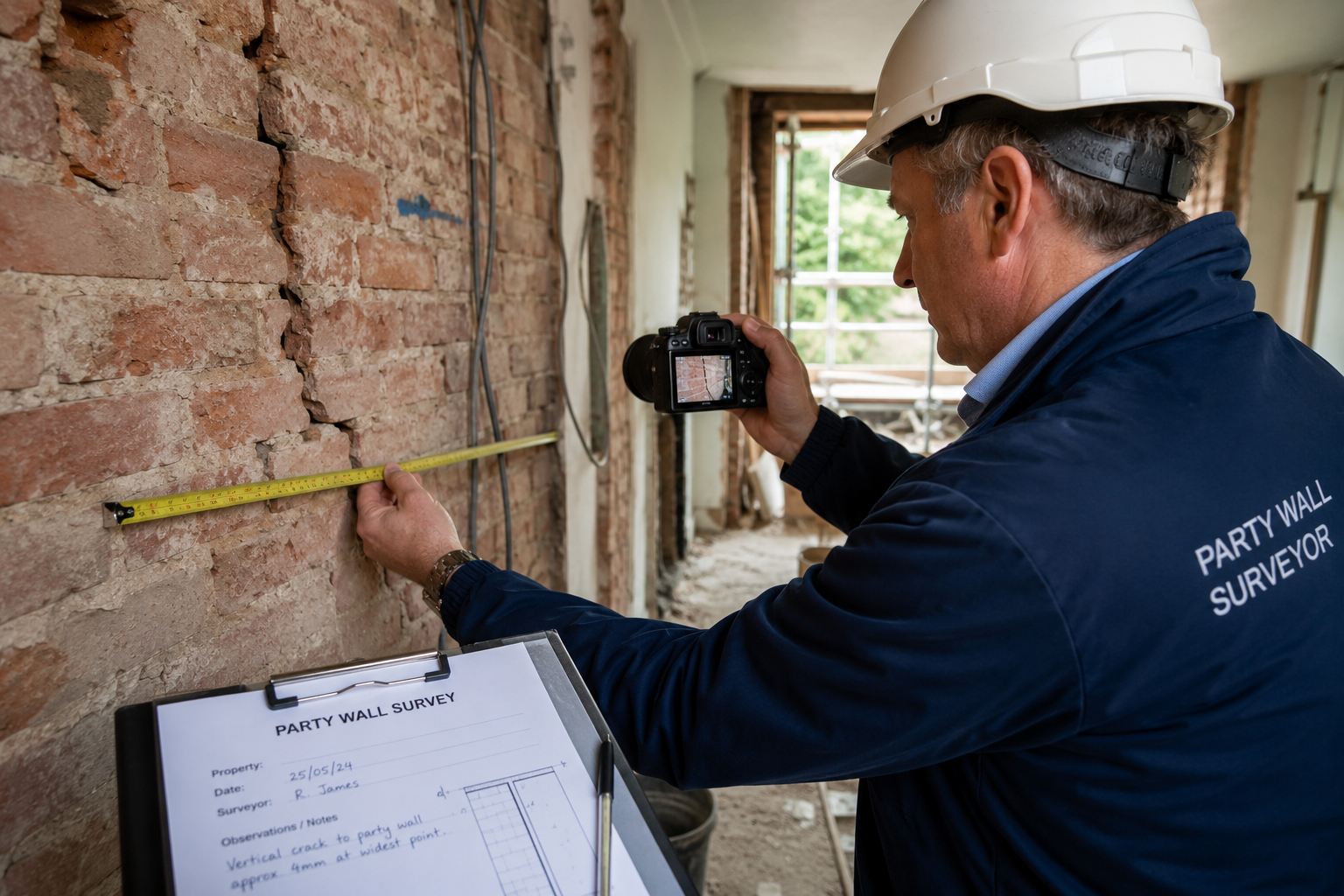
1. 📸 Conducting a Retrospective Schedule of Condition
One of the most important tools available is the schedule of condition report. Ideally prepared before work begins, it can still be carried out during or after works to establish a baseline — or to document the state of affairs at the point the surveyor was appointed.
A retrospective schedule captures:
- Existing cracks, settlement, and structural movement
- The condition of shared walls, floors, and ceilings
- Any damage that can be attributed to the notifiable works
This documentation is critical if the adjoining owner later pursues a damage claim. Without it, causation becomes extremely difficult to prove.
2. 🔍 Investigating and Documenting Damage
Surveyors can address issues arising after a party wall notice has been served but before the award is agreed upon [2]. This includes inspecting damage to the adjoining property and producing a formal record that can be incorporated into a late award or used in subsequent legal proceedings.
For a comprehensive overview of how damage claims work in this context, the guide on damage to property in party wall situations provides essential background.
Key damage types surveyors document:
- Cracking to plasterwork and masonry
- Movement in floors or ceilings adjacent to the party wall
- Damage to drainage or foundations
- Vibration-related damage from demolition or piling
3. 📄 Agreeing a Retrospective Award
Where notices were properly served, surveyors retain the authority to produce a formal award even after works have commenced or been completed [1]. This award can:
- Ratify the manner in which works were carried out
- Set out compensation payable to the adjoining owner
- Record agreed remedial works
- Allocate surveyor costs between the parties
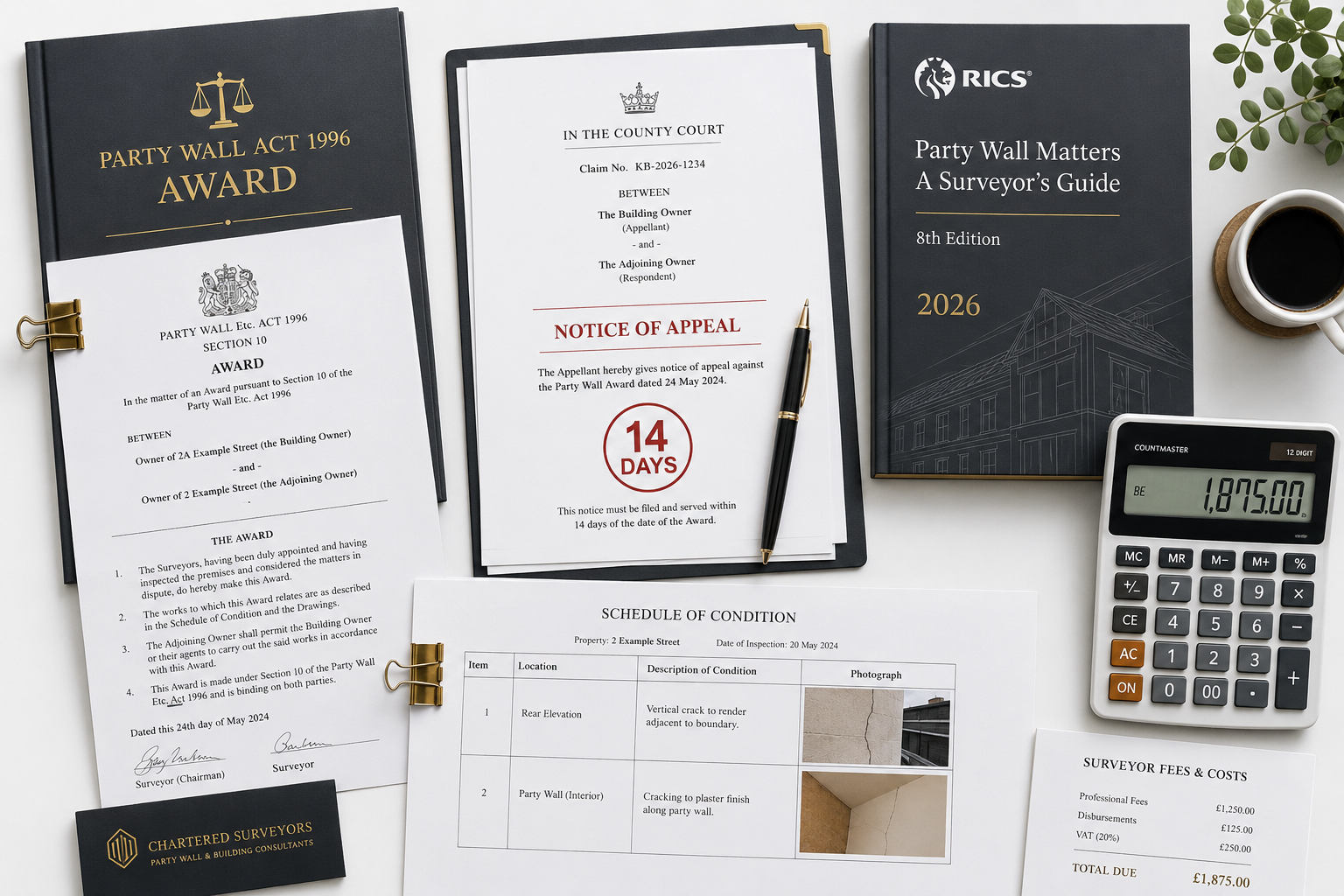
The award must be signed and dated by the agreed surveyor or by two of the three surveyors, as appropriate, and served in compliance with Section 10(14) of the Act [7]. Once served, both parties have 14 days to appeal it in the county court; if no appeal is made within this period, the award becomes final and binding [5].
4. 🏁 Undertaking a Final Inspection
The necessity of final inspections is a topic of genuine debate within the profession. While some practitioners argue it is not strictly mandatory, the RICS recommends it as best practice to ensure compliance and address potential issues [3]. In mid-works or post-works scenarios, a final inspection serves a particularly important function: it closes the loop on what was authorised versus what was actually done.
A final inspection typically covers:
- Verification that works match the award's specifications
- Identification of any unremediated damage
- Confirmation that temporary protection measures have been removed
- Sign-off that the party wall has been made good
What Surveyors Cannot Do Once Work Has Started
Honesty matters here. There are genuine limits to what the statutory framework permits, and a surveyor who overstates their authority does their client no favours.
Surveyors cannot:
- ❌ Handle disputes or matters arising from work conducted before any party wall award was in place [2]
- ❌ Issue an award with retrospective authority where no notice was ever served
- ❌ Compel a building owner to undo completed works through the Act alone (though courts can)
- ❌ Extend the validity of an award indefinitely — works must typically commence within 12 months of an award being served [6]
⚠️ Important: If a building owner's works are complete and no notice was ever served, the adjoining owner's most effective route is likely a civil claim — not a party wall award. A surveyor can still assist by providing expert evidence, but the statutory machinery has limited traction.
The 12-Month Validity Rule
A party wall award stipulates that authorised works must commence within 12 months of the award being served. If work does not begin within this period, a new award may be required [6]. In retrospective scenarios, this rarely causes problems — the works are already underway — but it is a useful reminder that awards are not open-ended instruments.
The 2026 RICS Guidance Update: What Changes for Mid-Works Situations
In April 2026, the Royal Institution of Chartered Surveyors initiated a consultation on the draft 8th edition of Party Wall Legislation and Procedure, aiming specifically to clarify surveyor independence and jurisdiction [4]. For mid-works scenarios, the key developments are:
Surveyor Independence Reinforced
The draft 8th edition emphasises that a party wall surveyor's appointment is personal and statutory, requiring independence from client instruction [4]. This is particularly significant in retrospective cases, where building owners sometimes attempt to instruct surveyors to minimise findings or delay awards.
Clearer Jurisdiction Boundaries
The updated guidance is expected to provide clearer rules on what surveyors can address retrospectively — reducing the grey areas that have historically led to disputes about the scope of late awards.
Practical Implication for 2026
Surveyors operating under the new guidance will have stronger professional backing when insisting on proper documentation, independent damage assessments, and fair cost allocation — even when appointed after works have begun.
For those seeking expert guidance from chartered surveyors in North London or chartered surveyors in West London, the 2026 RICS update reinforces the importance of engaging a properly independent professional rather than one recommended solely by the building owner.
Who Pays? Cost Responsibilities in Retrospective Scenarios
Cost allocation in retrospective party wall situations follows the same general principle as standard cases: the building owner undertaking the works is typically responsible for the reasonable costs of the award process, including surveyor fees [6].
However, complications arise when:
- The adjoining owner appoints their own surveyor after damage has already occurred — these fees are generally still recoverable from the building owner
- Works were carried out without any notice — cost recovery may need to proceed through civil litigation rather than the Act
- Both parties share responsibility for delays in agreeing the award — in rare cases, costs may be apportioned differently
For a full breakdown of what the party wall process typically costs, the cost of party wall surveys and awards guide provides detailed figures and worked examples.
Practical Steps: What to Do Right Now If Work Has Already Started
Whether acting as the building owner, the adjoining owner, or the surveyor, the priority is the same: establish the facts, protect the position, and engage the correct process immediately.
For Adjoining Owners 🏠
- Do not wait — instruct a qualified party wall surveyor as soon as possible
- Request a schedule of condition report to document current damage
- Check whether valid party wall notices were ever served — this determines which legal route applies
- If no notice was served, take legal advice on common law remedies alongside the party wall process
- Review the party wall FAQ to understand your rights clearly
For Building Owners 🔨
- Stop and assess — continuing works without proper authorisation increases legal exposure
- Engage a party wall surveyor immediately to determine whether retrospective award is possible
- Cooperate fully with the adjoining owner's surveyor — obstruction increases costs and delays
- Understand that proceeding without a party wall agreement carries real legal and financial risk
For Surveyors 📐
- Clarify at the outset which scenario applies (notice served vs. no notice)
- Document everything from the moment of appointment — photographs, measurements, written records
- Act independently and in accordance with the 2026 RICS draft guidance [4]
- Advise clients honestly about the limits of retrospective awards where no notice was served [2]
- Ensure any award is properly served under Section 10(14) of the Act [7]
Conclusion: It Is Never Too Late to Protect Your Position
The core message of Party Wall Awards After Work Has Already Started: What Surveyors Can Still Do is this: the situation is rarely as hopeless as it first appears, but it is also rarely as straightforward as starting from scratch.
Where notices were properly served, a skilled surveyor retains meaningful authority — to document damage, produce a binding award, allocate costs fairly, and close the process with a final inspection. Where no notice was served at all, the statutory route is narrowed, but civil remedies and expert surveyor evidence remain powerful tools.
The 2026 RICS guidance update reinforces what good practitioners have always known: surveyor independence and thorough documentation are not optional extras. They are the foundation of a process that protects both parties, regardless of when in the construction timeline a surveyor is called in.
Actionable next steps:
- ✅ Engage a qualified, independent party wall surveyor immediately — do not delay
- ✅ Establish whether valid notices were served before any other decisions are made
- ✅ Commission a schedule of condition report at the earliest opportunity
- ✅ Understand the 14-day appeal window once any award is served [5]
- ✅ Review costs and responsibilities upfront to avoid disputes escalating further
References
[1] Party Wall Agreement After Works Completed – https://www.aylingassociates.com/knowledge/party-wall-agreement-after-works-completed?utm_source=openai
[2] Party Wall Awards – https://www.ladbrokeassociation.org/party-wall-awards/?utm_source=openai
[3] Should My Surveyor Undertake A Final Inspection – https://www.partywalladvice.com/2022/06/05/should-my-surveyor-undertake-a-final-inspection/?utm_source=openai
[4] Party Wall Awards Explained Surveyor Roles Notice Periods And Dispute Resolution Under 2026 RICS Guidance – https://wimbledonsurveyors.com/party-wall-awards-explained-surveyor-roles-notice-periods-and-dispute-resolution-under-2026-rics-guidance/?utm_source=openai
[5] What Happens After A Party Wall Award – https://fpws.uk/what-happens-after-a-party-wall-award/?utm_source=openai
[6] Party Wall Awards – https://www.partywallslimited.com/services/party-wall-awards?utm_source=openai
[7] Jan 22 Party Wall Legislation And Procedure 7th Edition – https://www.rics.org/content/dam/ricsglobal/documents/standards/jan_22_party_wall_legislation_and_procedure_7th_edition.pdf?utm_source=openai