Nearly 40% of green marketing claims made by businesses across the EU were found to be exaggerated, false, or deceptive — and the UK property sector is not immune. As developers compete to attract eco-conscious buyers and ESG-focused investors, sustainability claims have become one of the most powerful — and most abused — tools in property marketing. Understanding the surveyor red flags for 'greenwashed' developments is now a core professional competency, not an optional extra.
From inflated EPC ratings to unverified low-carbon materials claims, the gap between what is promised on a brochure and what exists in the brickwork can be significant. This guide equips surveyors, buyers, and lenders with the knowledge to interrogate sustainability claims rigorously, distinguish genuine performance improvements from superficial green features, and apply the latest RICS standards to UK property valuations and building surveys in 2026.
Key Takeaways 🔑
- RICS mandates ESG integration in all commercial property valuations from 30 April 2026, making greenwashing scrutiny a professional requirement [1]
- EPCs alone are insufficient — actual energy performance data must be cross-referenced against design specifications
- Red flags include vague certifications, missing performance data, and marketing language that outpaces documented evidence
- A 'carbon bubble' risk exists when properties are overvalued due to unrecognised environmental liabilities [3]
- Surveyors must now combine technical inspection skills with ESG literacy to protect buyers, lenders, and the integrity of valuations
Why Greenwashing in Property Is a Growing Risk in 2026
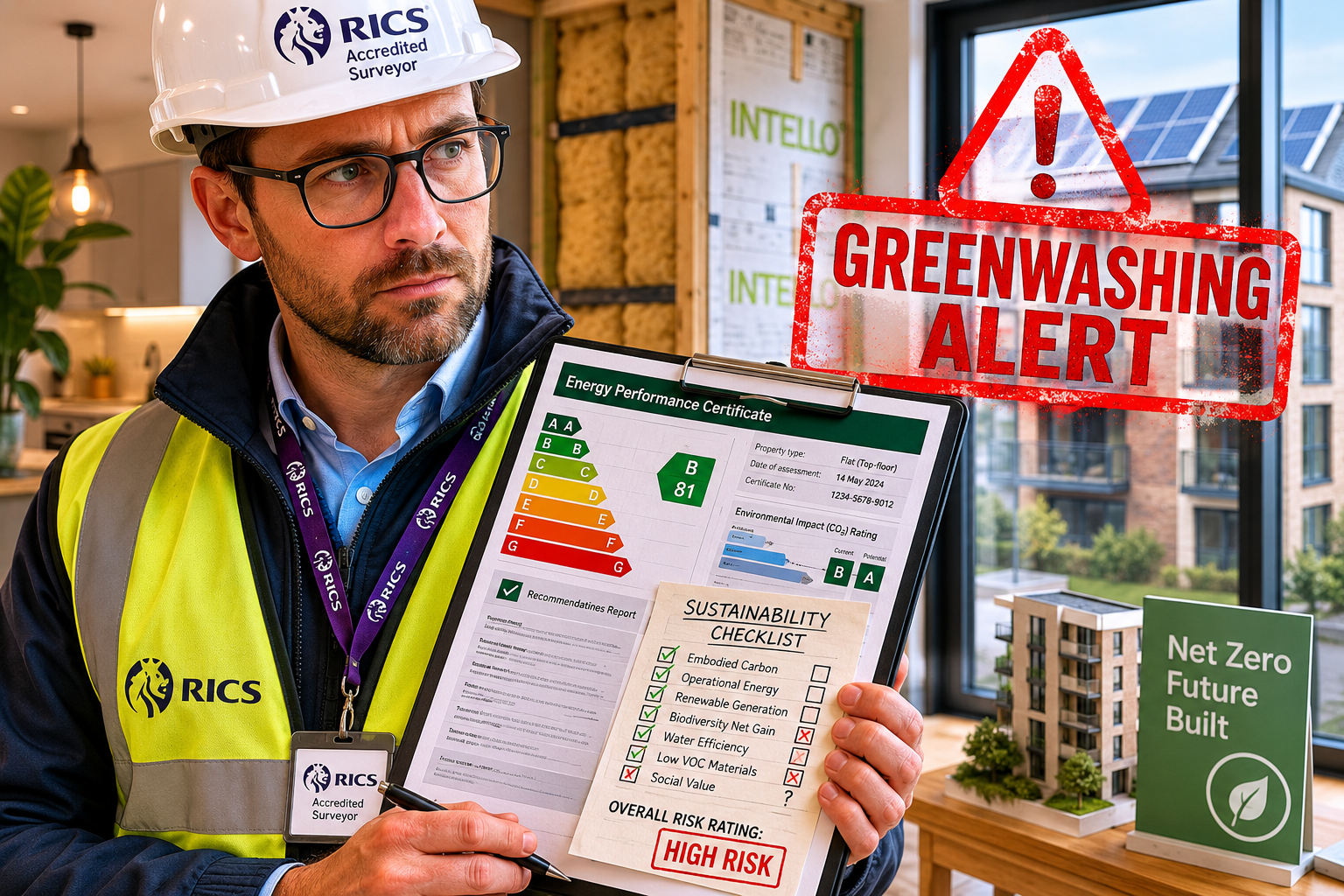
The UK property market has seen a sharp rise in developments marketed with sustainability credentials — from "net zero ready" apartments to commercial buildings claiming BREEAM Excellent ratings. Yet the evidence underpinning these claims is often thin, unverified, or deliberately misleading.
Effective 30 April 2026, the Royal Institution of Chartered Surveyors (RICS) now requires all commercial property valuations to systematically incorporate environmental, social, and governance (ESG) factors. This is a landmark shift — ESG considerations have moved from optional commentary to mandatory assessment criteria [1]. For surveyors, this means that failing to identify and flag greenwashed sustainability claims is no longer just a professional oversight; it is a compliance failure.
💬 "The market does not yet fully price in sustainability features, creating a 'valuation deadlock' where surveyors must navigate between marketing claims and verifiable data." — RICS Property Journal [3]
The stakes are high. Properties that fail to meet incoming environmental standards may face significant valuation reductions, while those falsely claiming compliance could expose buyers and lenders to stranded asset risk [4]. A so-called 'carbon bubble' — where properties are systematically overvalued due to unrecognised climate-related liabilities — is a real and growing concern across the UK market [3].
For anyone commissioning a RICS building survey or a formal property valuation, understanding how surveyors should interrogate green claims is essential.
Core Surveyor Red Flags for 'Greenwashed' Developments: What to Look For
🚩 Red Flag 1: EPC Ratings That Don't Match Reality
The Energy Performance Certificate (EPC) is the most commonly cited sustainability credential in UK property marketing. However, EPCs are modelled assessments — they reflect theoretical energy performance based on design inputs, not actual measured consumption.
Key questions a surveyor must ask:
- Was the EPC produced at design stage or post-completion?
- Does the EPC reflect the as-built specification, or an earlier design iteration?
- Is there operational energy data (actual bills, smart meter readings) to validate the rating?
A development marketed as EPC 'A' rated but lacking post-occupancy performance data is an immediate red flag. Surveyors should request Display Energy Certificates (DECs) for commercial buildings, which reflect actual energy use rather than modelled estimates.
🚩 Red Flag 2: Vague or Unverifiable Sustainability Certifications
Phrases like "eco-friendly," "sustainable design," "low-carbon construction," and "green materials" carry no legal weight without supporting documentation. Surveyors assessing sustainability claims in UK property valuations should demand specifics:
| Claim Type | What to Request | Red Flag Indicator |
|---|---|---|
| BREEAM Rating | Official certificate with unique reference | No certificate number or expired assessment |
| Net Zero / Carbon Neutral | Third-party verified carbon calculation | Self-declared with no auditor sign-off |
| Sustainable Materials | Chain of custody certificates (e.g., FSC timber) | Generic supplier statements only |
| Renewable Energy | MCS installation certificate | No MCS number or unregistered installer |
| Thermal Performance | SAP calculations or PHPP report | Marketing brochure figures only |
RICS guidance on environmental and sustainability valuation explicitly calls for surveyors to scrutinise certifications and actual building performance data rather than accepting marketing claims at face value [2].
🚩 Red Flag 3: Sustainability Features That Are Cosmetic, Not Structural
One of the most common forms of greenwashing in new residential and commercial developments is the installation of visible but low-impact green features — sedum roofs, a handful of EV charging points, or decorative solar panels — while the core fabric of the building remains thermally poor.
Surveyors should assess:
- U-values of walls, roofs, and floors against Part L of the Building Regulations
- Air permeability test results (airtightness) — genuine low-energy buildings will have these
- Thermal bridging details — a common weak point in otherwise well-insulated buildings
- Mechanical ventilation with heat recovery (MVHR) — is it installed, commissioned, and maintained?
- Glazing specifications — triple glazing vs. standard double glazing makes a significant difference
A building with a wildflower roof but single-skin cavity walls with no insulation upgrade is a textbook case of superficial greenwashing. The RICS home survey process provides a structured framework for assessing these fabric-level performance indicators.
🚩 Red Flag 4: Missing or Inconsistent Documentation
Genuine sustainable developments generate a paper trail. Surveyors should expect — and request — the following:
- As-built drawings showing insulation specifications
- Commissioning records for renewable energy systems and MVHR
- O&M manuals (Operation and Maintenance) for green building systems
- Planning conditions related to sustainability — and evidence they were discharged
- Warranties for solar PV, heat pumps, and other low-carbon systems
When documentation is absent, incomplete, or inconsistent with the marketing narrative, that is a significant red flag. Developers who genuinely invest in sustainability are proud to share their evidence. Those who don't often deflect with further marketing language.
🚩 Red Flag 5: Overreliance on Offsetting Claims
Some developments claim carbon neutrality primarily through carbon offset schemes rather than genuine reductions in operational or embodied carbon. While offsetting has a legitimate role, it should be the last resort — not the primary strategy.
Surveyors should ask:
- What percentage of the carbon claim is based on actual reduction vs. offsetting?
- Are the offsets verified (e.g., Gold Standard, Verified Carbon Standard)?
- Is there a time-limited offset that expires without a replacement plan?
A development claiming net zero primarily through purchased offsets, with no evidence of fabric improvement or renewable energy integration, warrants serious scrutiny.
How to Assess Sustainability Claims in UK Property Valuations and Building Surveys: The RICS Framework
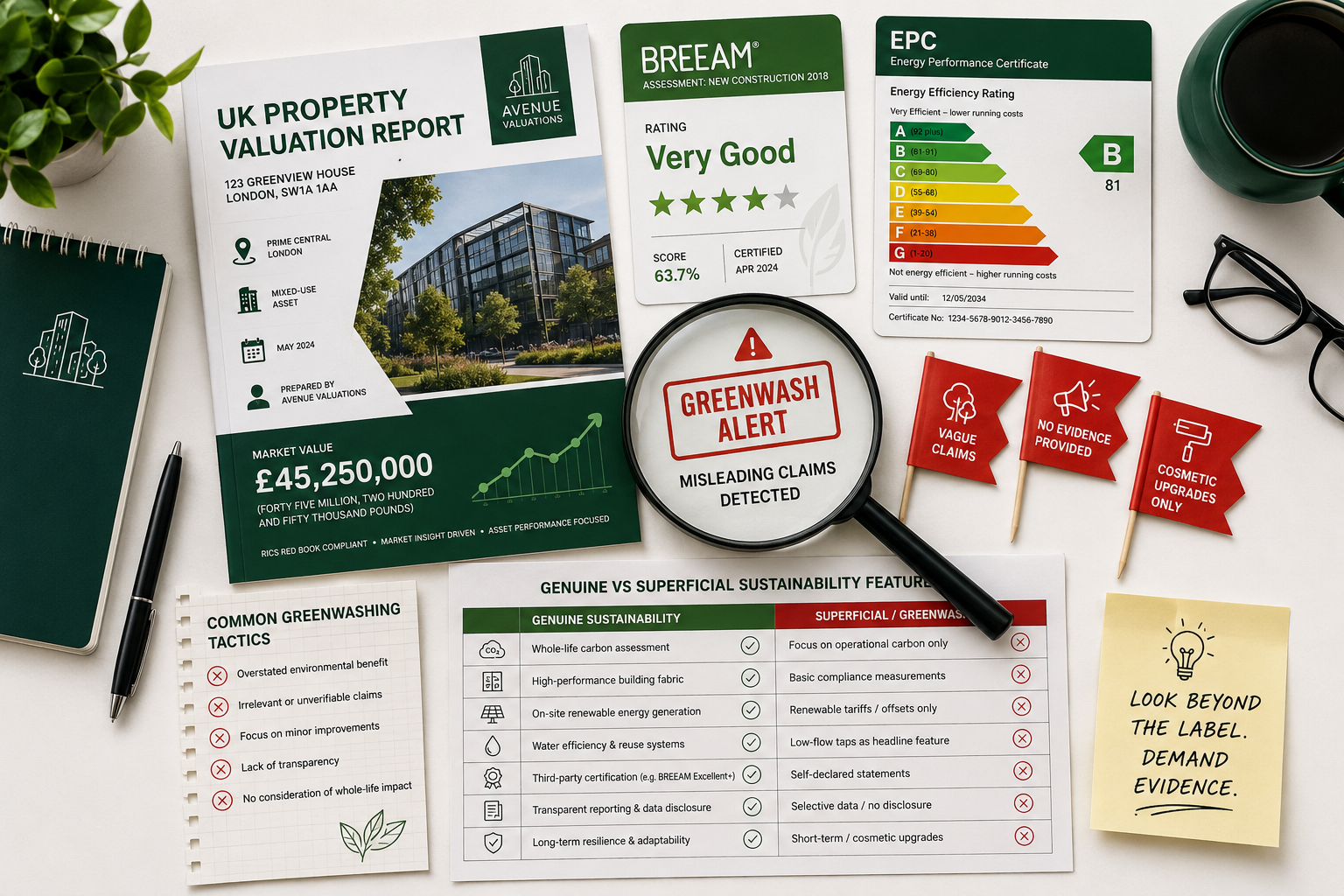
The RICS sustainability considerations checklist provides a structured approach for valuers to systematically evaluate environmental and social factors [2]. This moves the assessment beyond gut instinct and into a repeatable, defensible methodology.
The Four Pillars of ESG Valuation Assessment
1. Environmental Performance
- Energy efficiency (EPC, DECs, operational data)
- Carbon footprint (embodied and operational)
- Water efficiency and flood risk
- Biodiversity net gain compliance
2. Physical Climate Risk
- Flood zone classification and resilience measures
- Overheating risk (particularly relevant post-2022 Building Regulations)
- Subsidence and ground stability — especially relevant for subsidence surveys in areas with known geological risk
3. Regulatory Compliance
- Minimum Energy Efficiency Standards (MEES) compliance
- Future-proofing against incoming EPC C requirements for commercial lettings
- Planning conditions related to sustainability
4. Market Evidence
- Comparable sales data for genuinely sustainable properties
- 'Green premium' or 'brown discount' evidence in the local market
- Investor appetite for ESG-compliant assets
📌 Important: The RICS valuation deadlock problem — where the market has not yet fully priced sustainability — means valuers must use reasoned professional judgement alongside market evidence, particularly where comparable data is limited [3].
For commercial properties, engaging a chartered surveyor with specific ESG competency is increasingly important, particularly given the mandatory RICS requirements now in force.
The Role of Technology in Identifying Greenwashing
Artificial intelligence and data analytics tools are increasingly being used to cross-reference sustainability claims against verified datasets [4]. These include:
- Smart meter data aggregators that reveal actual energy consumption patterns
- Satellite-based thermal imaging to identify heat loss inconsistencies
- Building information modelling (BIM) verification tools
- AI-powered EPC analysis that flags anomalies between modelled and actual performance
Surveyors who combine traditional inspection skills with these emerging tools are significantly better placed to identify discrepancies between claimed and actual performance.
For complex commercial assessments, a commercial building survey should now routinely incorporate ESG performance review as a core deliverable.
Protecting Buyers and Lenders: Practical Guidance
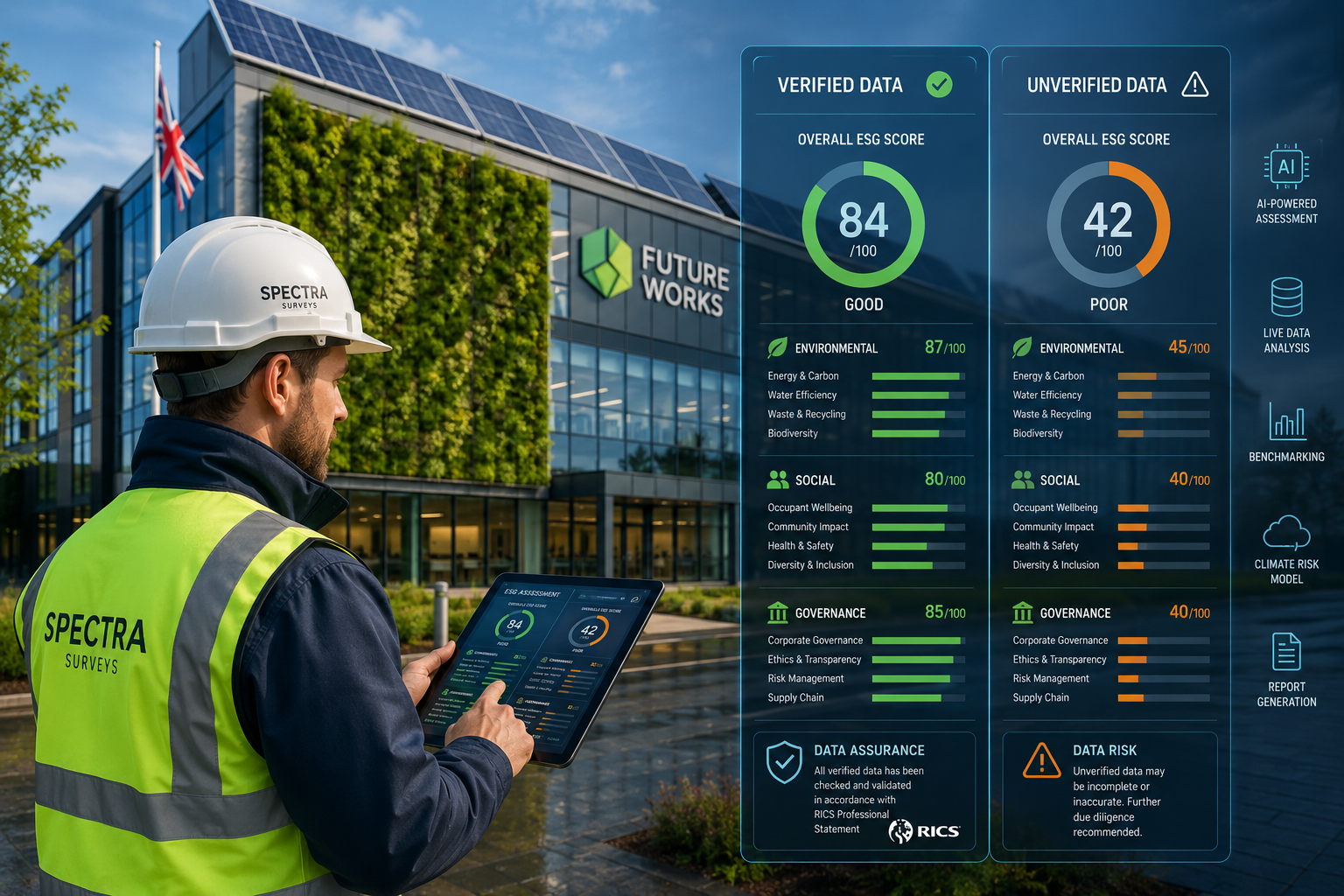
The consequences of greenwashing extend beyond the immediate transaction. Buyers who purchase a property on the basis of inflated sustainability claims may face:
- Higher energy bills than projected
- Remediation costs to bring the property up to genuine standards
- Reduced resale value as the market becomes more discerning
- Mortgage complications if lenders apply green mortgage criteria that the property cannot meet
Lenders, meanwhile, face stranded asset risk if properties in their portfolios fail to meet future minimum standards [4].
A Practical Checklist for Surveyors 📋
Before signing off on any valuation or survey report involving sustainability claims, surveyors should confirm:
- EPC is post-completion and reflects as-built specification
- All certifications carry verifiable reference numbers
- Fabric performance data (U-values, airtightness) is documented
- Renewable energy systems have MCS or equivalent certification
- Carbon claims are third-party verified, not self-declared
- Offsetting is supplementary, not the primary carbon strategy
- Planning sustainability conditions have been formally discharged
- O&M documentation is complete and handed over
Understanding valuation costs and the scope of different survey types is also important — buyers should know that a basic mortgage valuation will not provide the level of ESG scrutiny described here. A full RICS building survey or Level 3 survey is the appropriate vehicle for this depth of assessment.
For those seeking a formal property valuation that incorporates ESG factors, a Red Book valuation from a qualified RICS valuer is the gold standard — particularly now that ESG integration is mandatory for commercial properties [1].
Training, Competency, and the Future of Green Surveying
Surveyors are actively encouraged to undergo specialist training in ESG assessment to meet the demands of the evolving regulatory landscape [2]. Key competency areas include:
- Carbon literacy — understanding embodied vs. operational carbon
- EPC methodology — knowing how ratings are calculated and where they can be manipulated
- Sustainability certification frameworks — BREEAM, WELL, NABERS, Passivhaus
- Climate risk assessment — physical and transition risk
- Market analysis — identifying green premiums and brown discounts in comparable evidence
The RICS has made clear that valuer competency in ESG is not a future ambition — it is a present requirement [1]. Surveyors who cannot demonstrate this competency risk both professional censure and the delivery of advice that materially harms their clients.
Conclusion: From Scepticism to Scrutiny
The rise of greenwashing in UK property is not a fringe concern — it is a systemic market risk that affects buyers, lenders, investors, and the credibility of the surveying profession. The good news is that the tools, frameworks, and regulatory requirements to address it are now firmly in place.
Actionable next steps for surveyors and property professionals in 2026:
- Familiarise yourself with the RICS ESG mandatory requirements effective from April 2026 and ensure your valuation reports reflect them
- Adopt the RICS sustainability checklist as a standard component of every relevant survey or valuation
- Request documentation proactively — do not accept marketing materials as evidence
- Invest in ESG training to build the competency required by RICS guidance
- Use technology tools to cross-reference claimed and actual performance data
- Advise clients clearly on the difference between a mortgage valuation and a full building survey when sustainability assessment is needed
For buyers and investors, the message is equally clear: commission the right level of survey, ask the hard questions, and never accept a green label without the evidence to back it up.
References
[1] Rics Update The New Standard For Esg In Commercial Property Valuation – https://utopi.co.uk/news-and-insights/rics-update-the-new-standard-for-esg-in-commercial-property-valuation/?utm_source=openai
[2] Environmental And Sustainability Valuation – https://www.isurv.com/info/108/environmental_and_sustainability_valuation?utm_source=openai
[3] Esg Valuation Deadlock – https://ww3.rics.org/uk/en/journals/property-journal/ESG-valuation-deadlock.html?utm_source=openai
[4] Esg And Valuation Can Property Valuations Be Future Proofed – https://www.fishergerman.co.uk/insights/news/esg-and-valuation-can-property-valuations-be-future-proofed?utm_source=openai