Over 70% of expert witness reports submitted in UK civil litigation are returned for revision or challenged on admissibility grounds — and building surveyors account for a significant share of those rejections. The reason is rarely a lack of technical knowledge. It is almost always a failure to comply with Practice Direction 35 (PD35) and the Civil Procedure Rules (CPR) Part 35 framework that governs expert evidence.
Understanding the Practice Direction 35 Essentials for Building Surveyors Acting as Expert Witnesses: Report Writing and Court Preparation is not optional for any RICS-qualified professional who steps into the expert witness role. Whether the dispute involves boundary encroachments, dilapidations claims, or structural defects, the rules are the same — and the consequences of getting them wrong can be severe, including cost penalties and loss of professional credibility. [4]
Key Takeaways 📋
- PD35 mandates impartiality: An expert's overriding duty is to the court, not to the instructing party — this must be explicitly declared in every report.
- Structured report format is non-negotiable: Reports must include qualifications, scope, factual findings, expert opinion, material instructions, and a statement of truth.
- Conflict of interest checks must happen before instruction: The RICS 5th edition standard (2026) requires proactive disclosure of any potential conflicts.
- Site visit checklists protect admissibility: Systematic documentation during inspections underpins the factual foundation of any opinion.
- Expertise limitations must be acknowledged: Overstating competence is a disciplinary and legal risk; referring out is a professional strength.
Understanding the Legal Framework: CPR Part 35 and PD35 Explained
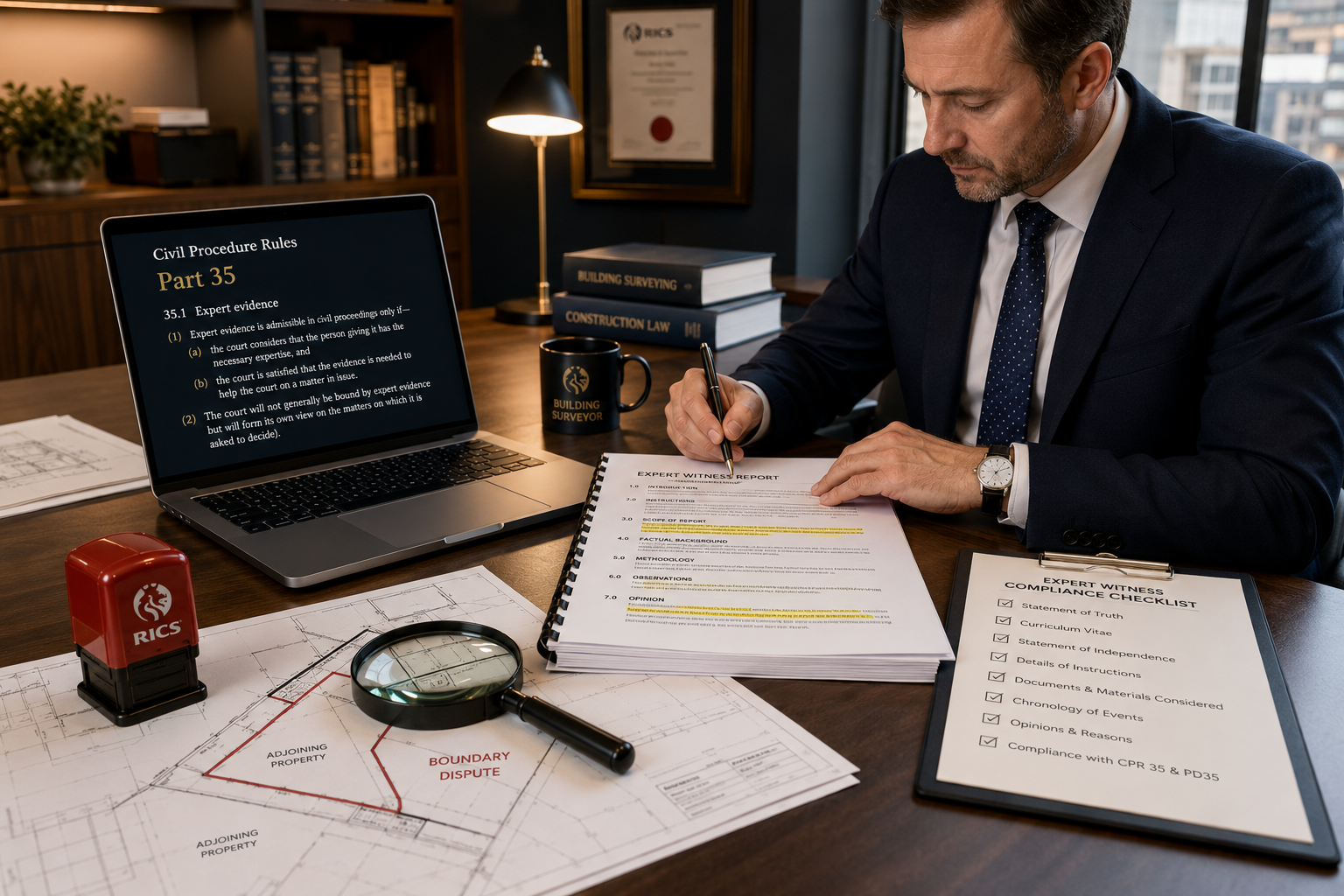
What CPR Part 35 Actually Requires
The Civil Procedure Rules Part 35 establishes the foundational rules for expert evidence in English and Welsh civil courts. Three core principles underpin everything:
- Independence: Expert evidence must be the independent product of the expert, uninfluenced by the pressures of litigation. [4]
- Objectivity: Experts must provide unbiased opinions within the boundaries of their expertise.
- Duty to the court: The expert's primary obligation is to assist the tribunal — not to advocate for the instructing party. [5]
Practice Direction 35 supplements these rules with specific procedural requirements. It details exactly how reports must be structured, what declarations must be included, and how experts should handle questions from opposing parties.
💬 "An expert witness who forgets their duty to the court is no longer an expert witness — they are an advocate without a licence." — A principle embedded throughout PD35 guidance.
The RICS 5th Edition Standard: What Changed in 2026
In October 2025, RICS launched a public consultation to update its "Surveyors Acting as Expert Witnesses" professional standard, responding to emerging risks including conditional fee arrangements and technology-related challenges. [1] The resulting 5th edition, published in early 2026, introduced several important updates:
| Area | Previous Guidance | 5th Edition Update |
|---|---|---|
| Conditional fees | Limited guidance | Explicit prohibition on fee structures that compromise impartiality [2] |
| Technology use | Not addressed | Guidance on AI tools and digital evidence handling |
| Conflict of interest | General principles | Mandatory proactive checks and disclosure protocols [2] |
| Terms of engagement | Recommended | Mandatory clear written instructions before accepting instruction [1] |
For building surveyors handling expert witness instructions, the 5th edition is now the benchmark against which all professional conduct will be measured.
Practice Direction 35 Essentials for Building Surveyors: Report Writing Requirements
The Mandatory Structure of a Compliant Expert Report
PD35 does not leave report structure to personal preference. A compliant expert witness report from a building surveyor must include all of the following sections: [4]
✅ Mandatory Report Sections Checklist:
- Cover page — case name, court, expert's full name and qualifications
- Statement of instructions — substance of all material instructions (written and oral) [5]
- Qualifications and expertise — relevant professional credentials and experience
- Scope of inspection — what was inspected, when, under what conditions
- Factual findings — observed conditions, measurements, photographic evidence
- Expert opinion — clearly distinguished from facts, with reasoned basis
- Areas outside expertise — explicit acknowledgement of limitations
- Summary of conclusions — concise, jargon-free
- Statement of truth — confirming opinions are genuine, complete, and independent [4]
- Declaration of compliance — confirming awareness of tribunal rules and PD35 [6]
One critical and frequently missed requirement: the report must be addressed to the court, not to the instructing solicitor or client. [4] This is not a formality — it signals to the judge that the expert understands their primary duty.
Writing the Opinion Section: Clarity Over Complexity
The opinion section is where many building surveyors struggle. Technical language that impresses colleagues can alienate judges and juries. The RICS supplementary practice information advises writing opinions that are: [7]
- Accessible — assume the reader has no specialist knowledge
- Reasoned — every opinion must trace back to observed facts or established professional standards
- Bounded — state clearly where certainty ends and inference begins
- Proportionate — the depth of analysis should match the complexity of the issue
For disputes involving dilapidations surveys or schedules of dilapidations, the opinion section must specifically address the standard of repair at the relevant date, the cost of remediation, and any betterment arguments — each as a distinct, numbered opinion.
Handling Uncertainty and Expertise Limitations
One of the most professionally honest — and legally protective — things a building surveyor can do is explicitly state what falls outside their expertise. PD35 requires this. [4] The RICS 5th edition reinforces it. [2]
Practical examples of appropriate limitation statements:
- "The cause of the subsidence observed is consistent with clay shrinkage. However, a geotechnical engineer should be instructed to confirm subsoil conditions."
- "Electrical installation testing falls outside the scope of this inspection. A qualified electrical engineer's report is recommended."
Attempting to opine beyond one's competence is not only a breach of PD35 — it is a disciplinary matter under RICS Rules of Conduct. Surveyors working on complex structural matters may wish to consider structural engineering support as a complementary instruction.
Site Visit Checklists and Preparing for Boundary Disputes and Dilapidations Claims
The Site Visit: Your Evidential Foundation
Every expert opinion rests on the quality of the site inspection. Courts scrutinise whether the factual basis of an opinion is sound. A poorly documented site visit can unravel an otherwise compelling report.
🔍 Pre-Visit Preparation Checklist:
- Obtain and review all relevant title documents, lease plans, and historic surveys
- Check planning history and building regulations records
- Review any previous survey reports or correspondence relating to the dispute
- Confirm access arrangements and notify all parties as required
- Prepare a structured inspection pro forma specific to the dispute type
📸 During the Site Visit — Documentation Standards:
- Photograph all relevant defects, boundaries, and conditions with date-stamped images
- Record measurements independently (do not rely solely on existing plans)
- Note weather conditions, access limitations, and any areas not inspected
- Document any discussions with occupants or other parties present
- Collect samples or arrange specialist testing where appropriate (e.g., damp surveys or asbestos surveys)
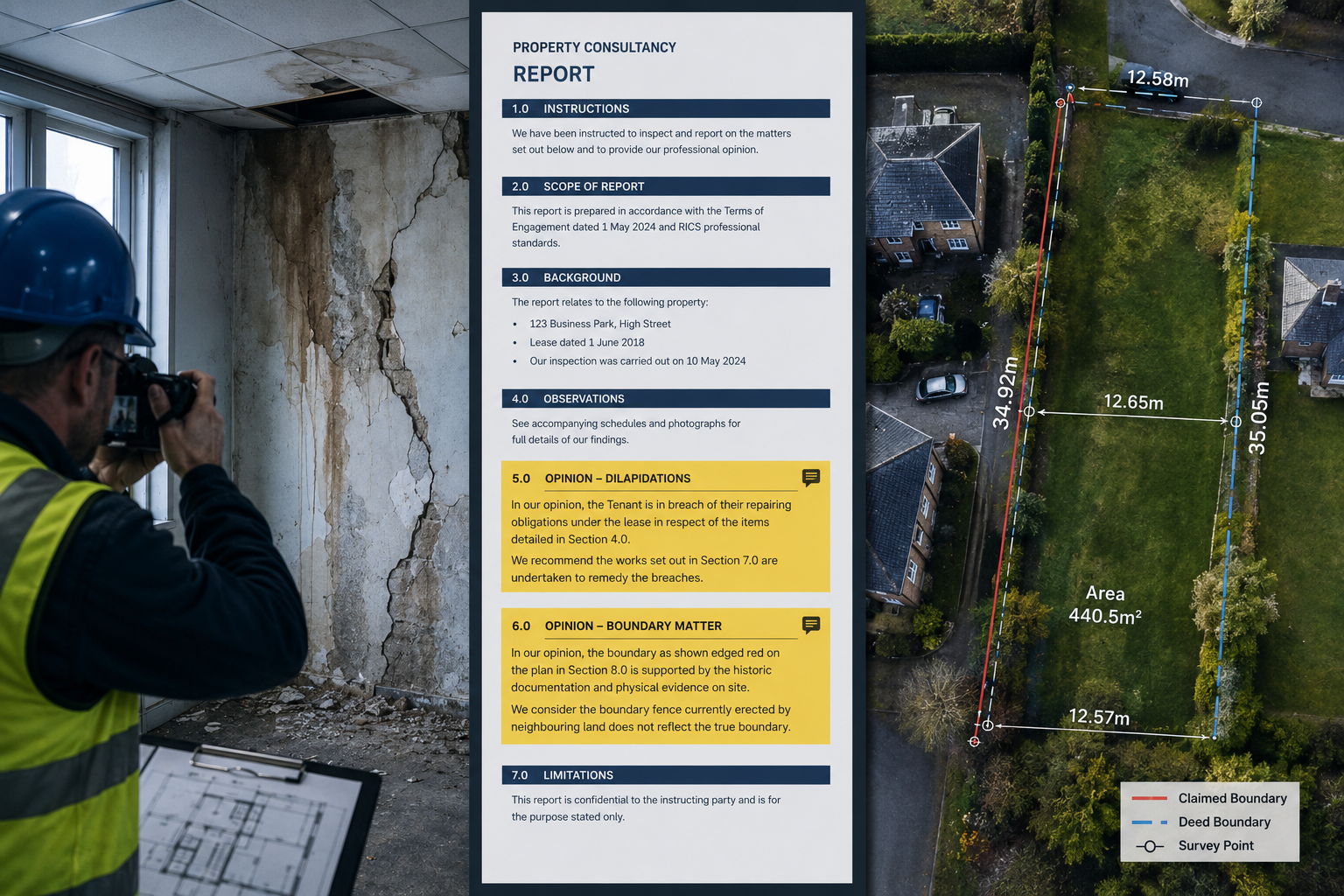
Boundary Disputes: Specific PD35 Considerations
Boundary disputes present unique challenges for building surveyors acting as expert witnesses. The factual and legal elements are often intertwined, and it is essential to maintain the distinction between what is a surveying opinion and what is a legal determination.
Key principles for boundary dispute reports:
- Identify the legal boundary versus the physical boundary — these frequently differ, and conflating them is a common error.
- Reference the title plan accurately — note its limitations (OS plans are not to be used as definitive boundary evidence without qualification).
- Apply the relevant presumptions — hedge ownership, wall ownership, and the ad medium filum rule should be addressed where applicable.
- Avoid advocacy — present the evidence for both interpretations before stating which is, in the expert's professional opinion, more consistent with the available evidence.
A schedule of condition report prepared at the outset of a lease or neighbourly works can be invaluable corroborating evidence in boundary and dilapidations disputes.
Dilapidations Claims: Structuring the Expert Opinion
In dilapidations matters, the expert surveyor must address the terminal schedule, the diminution in value cap (Section 18(1) of the Landlord and Tenant Act 1927), and the reasonableness of claimed remediation costs. Each element requires a separate, clearly labelled opinion.
Dilapidations Expert Report — Opinion Structure:
| Opinion Area | What to Address |
|---|---|
| Breach identification | Which items constitute a breach of the repairing covenant |
| Standard of repair | The appropriate standard given the age, character, and locality of the premises |
| Remediation costs | Reasonable costs at the relevant date, with contractor quotes or pricing data |
| Section 18(1) cap | Whether the landlord's loss is limited by diminution in value |
| Supersession | Whether claimed works would have been rendered unnecessary by subsequent redevelopment |

Practice Direction 35 Essentials for Court Preparation and Giving Evidence
Before the Hearing: Procedural Obligations
Court preparation begins long before the hearing date. Under PD35 and CPR Part 35, building surveyors have ongoing obligations once instructed: [5]
📋 Pre-Hearing Compliance Checklist:
- Respond to Part 35 Questions from the opposing party within the required timeframe
- Participate in any directed without prejudice expert meetings
- Produce a Joint Statement (Scott Schedule format in construction/dilapidations matters) identifying agreed and disputed issues
- Notify the instructing solicitor immediately if any new evidence changes your opinion
- Review the trial bundle and ensure your report references are consistent with paginated documents
The joint expert meeting is not a negotiation. Its purpose is to narrow issues for the court. Surveyors must approach it with the same impartiality required throughout the process. [6]
Integrity, Impartiality, and the Conditional Fee Trap
The RICS 5th edition places integrity and impartiality at the heart of the expert witness role. [1] The updated standard specifically addresses the risk posed by conditional fee arrangements — where an expert's remuneration is linked to the outcome of the case. This is incompatible with the expert's duty to the court and is now explicitly prohibited under the revised RICS standard. [2]
💬 "An expert who is paid more if their client wins has already failed their primary duty — before they have written a single word."
Surveyors should also be alert to more subtle forms of pressure: repeated requests to "strengthen" language, instructions to omit unfavourable findings, or pressure to agree with the instructing party's position. Any such pressure should be resisted and, where appropriate, documented.
Giving Evidence in Court: Practical Guidance
When called to give oral evidence, the building surveyor's demeanour and approach are as important as the content of the report. Key principles:
- Listen to the question asked — answer that question only; do not volunteer additional information
- Acknowledge uncertainty — "In my professional opinion" and "on the balance of probabilities" are appropriate qualifiers
- Maintain composure under cross-examination — aggressive questioning is a tactic; respond calmly and factually
- Refer to your report — ask the court's permission to refer to specific sections when needed
- Correct errors immediately — if a mistake in the report is identified, acknowledge it promptly and clearly
For surveyors operating across different jurisdictions, it is worth noting that the same PD35 framework applies whether the instruction originates from a chartered surveyor in central London or a regional practice — the procedural obligations are uniform across England and Wales.
Conflict of Interest: The Pre-Instruction Checklist
The RICS 5th edition dedicates significant attention to conflict of interest management. [2] Before accepting any expert witness instruction, surveyors must complete a structured conflict check:
⚠️ Conflict of Interest Pre-Instruction Checklist:
- Have you previously acted for either party in any capacity?
- Do you have a financial interest in the outcome of the dispute?
- Have you previously inspected or reported on the property in question?
- Do you have a personal relationship with any party, witness, or legal representative?
- Does your firm have any commercial relationship that could create a perceived conflict?
If any check reveals a potential conflict, disclose immediately to the instructing solicitor before accepting the instruction. The decision to proceed must be made by the parties, not unilaterally by the expert. [2]
Conclusion: Actionable Next Steps for Building Surveyors
Mastering the Practice Direction 35 Essentials for Building Surveyors Acting as Expert Witnesses: Report Writing and Court Preparation is a career-defining skill. The technical knowledge that makes a building surveyor valuable in the field must be paired with procedural discipline to be effective in litigation.
Actionable next steps for 2026:
- Obtain and read the RICS 5th edition standard — it is the definitive professional benchmark for all expert witness work from 2026 onwards.
- Audit your existing report templates against the PD35 mandatory checklist above — identify and close any gaps before your next instruction.
- Create a site visit pro forma specific to the dispute types you handle most frequently (boundary disputes, dilapidations, structural defects).
- Establish a conflict of interest protocol within your practice — make it a mandatory pre-instruction step, not an afterthought.
- Consider specialist training — RICS and the Academy of Experts both offer accredited expert witness training that builds courtroom confidence.
- Never accept conditional fee arrangements for expert witness work — the reputational and disciplinary risks are not worth any commercial benefit.
The courts rely on building surveyors to bring clarity to complex technical disputes. Meeting that responsibility with rigour, honesty, and procedural precision is what separates a trusted expert witness from one who is challenged, discredited, or never instructed again.
For surveyors looking to understand the full scope of professional obligations, the RICS chartered building surveyor standards provide the broader context within which expert witness work sits.
References
[1] Surveyors Acting As Expert Witnesses – https://www.rics.org/profession-standards/rics-standards-and-guidance/sector-standards/dispute-resolution-standards/surveyors-acting-as-expert-witnesses
[2] Viewcompounddoc (RICS Consultation Response) – https://consultations.rics.org/surveyorsasexpertwitness/viewCompoundDoc?docid=16248980&partid=16250356&pfv=y
[3] Building Surveyors As Expert Witnesses Evidence Standards For Construction Claims And Dilapidations In 2026 – https://wimbledonsurveyors.com/building-surveyors-as-expert-witnesses-evidence-standards-for-construction-claims-and-dilapidations-in-2026/
[4] PD Part 35 – https://www.justice.gov.uk/courts/procedure-rules/civil/rules/part35/pd_part35
[5] Part 35 (CPR) – https://www.justice.gov.uk/courts/procedure-rules/civil/rules/part35
[6] Surveyors Acting as Expert Witnesses (RICS Feb 2023 Amendment) – https://www.rics.org/content/dam/ricsglobal/documents/standards/Surveyors%20acting%20as%20expert%20witnesses_Feb2023amend.pdf
[7] Viewcompounddoc (RICS Supplementary Practice Information) – https://consultations.rics.org/surveyorsasexpertwitness/viewCompoundDoc?clientUID=&docid=16251220&partid=16251540&sessionid=&voteid=