Only 37% of party wall disputes that reach a full deadlock are resolved without escalating to the courts — and in most cases, the difference comes down to whether the third surveyor mechanism was used correctly. Third Surveyor Activation in Party Wall Deadlocks: RICS 8th Edition Protocols and Cost Recovery Tactics for 2026 is now one of the most critical competencies a property professional can hold, especially as RICS launched its consultation on the draft 8th edition of Party Wall Legislation and Procedure in April 2026, with the consultation period closing on 5 June 2026 [1].
This guide breaks down exactly when and how to trigger the third surveyor process, what the updated RICS guidance demands in terms of impartiality and procedure, and how costs are properly recovered — all without unnecessary escalation.
Key Takeaways 📌
- The third surveyor mechanism under Sections 10(10) and 10(11) of the Party Wall etc. Act 1996 is the primary statutory route for resolving deadlocked disputes between party-appointed surveyors.
- The RICS 8th Edition draft guidance (consultation closed June 2026) introduces clearer procedural standards for referrals, jurisdiction checks, and fee transparency [1][2].
- All referrals to the third surveyor must be made in writing, with clearly defined issues and supporting documents attached [2].
- Cost recovery is determined by the surveyors making the award, weighing factors such as cause of defects and shared wall use [4].
- Surveyors must verify jurisdiction before proceeding — acting outside jurisdiction exposes them to serious legal and financial risk [3][5].
Understanding the Third Surveyor Role Under the Party Wall etc. Act 1996
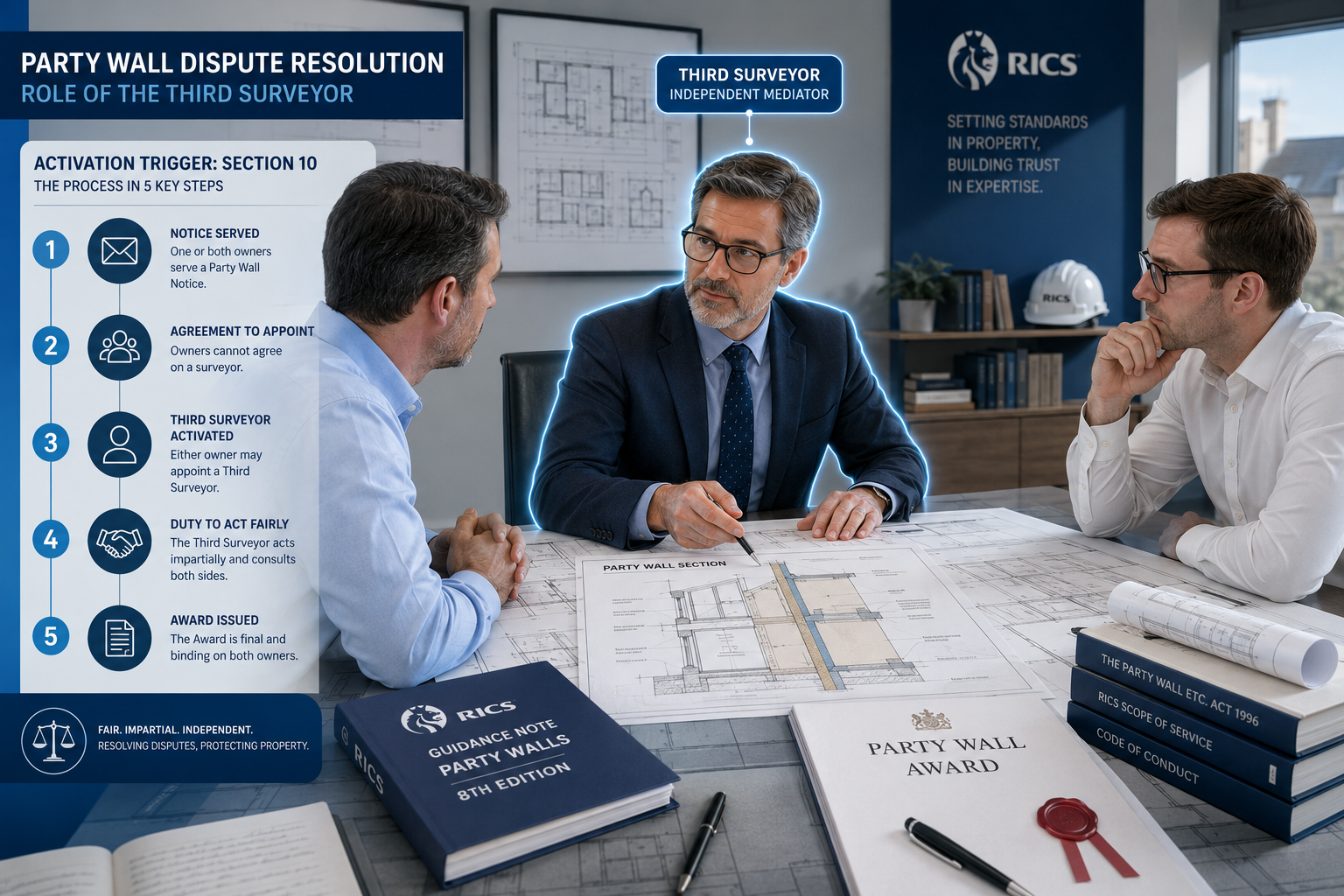
Before activating the third surveyor process, it is essential to understand the statutory framework that governs it. The Party Wall etc. Act 1996 provides a structured mechanism for resolving disputes between building owners and adjoining owners. When each party appoints their own surveyor and those surveyors cannot agree, the matter is referred to a pre-selected third surveyor.
This is not mediation. The third surveyor has statutory authority to make a binding award — and that distinction matters enormously.
The Three-Surveyor Structure Explained
| Role | Appointed By | Function |
|---|---|---|
| Building Owner's Surveyor | Building owner | Represents interests; drafts/reviews award |
| Adjoining Owner's Surveyor | Adjoining owner | Represents interests; counters/reviews award |
| Third Surveyor | Both surveyors jointly | Decides disputed matters; issues binding award |
💡 Pull Quote: "The third surveyor is not a tie-breaker — they are a statutory decision-maker with full authority to resolve matters the two appointed surveyors cannot agree upon."
The third surveyor must be selected at the outset of the surveyor appointment process, not after a dispute arises. The RICS 8th Edition draft guidance reinforces that party-appointed surveyors must inform their appointing owners of the third surveyor's identity as soon as the selection is made [2]. This is a procedural step that is frequently overlooked and can cause costly delays.
For a broader overview of how party wall disputes arise and what they involve, see this detailed guide on what is a party wall dispute.
When to Activate the Third Surveyor: Triggers and Conditions
Not every disagreement between surveyors warrants third surveyor activation. Understanding the correct triggers prevents premature escalation and unnecessary cost.
Valid Triggers for Referral
Under Sections 10(10) and 10(11) of the Act, either party-appointed surveyor may refer a matter to the third surveyor when:
- ✅ The two appointed surveyors cannot reach agreement on the terms of an award
- ✅ One surveyor refuses to act or is unavailable to participate
- ✅ A specific dispute arises mid-process that falls within the Act's scope
- ✅ There is a disagreement over the scope of works covered by the notice
What Does NOT Qualify
- ❌ General dissatisfaction with the other surveyor's communication style
- ❌ Disputes about matters outside the Act's jurisdiction (e.g., purely contractual disagreements)
- ❌ Attempts to use the third surveyor as a cost-pressure tactic
⚠️ Important: Before any referral, surveyors must confirm they have proper jurisdiction. The RICS 8th Edition draft guidance is explicit: surveyors must verify that a genuine dispute exists between the owners and that the subject matter falls under the Act's provisions [3]. Acting outside jurisdiction creates legal exposure and may render an award void.
This jurisdiction check is not a formality. It requires confirming:
- A valid party wall notice was properly served
- The adjoining owner dissented or failed to respond within the statutory period
- The works in question are covered under the Act
For situations where no notice was served at all, see what happens if no party wall notice was served.
RICS 8th Edition Protocols and Cost Recovery Tactics for 2026: Step-by-Step Referral Process
The RICS 8th Edition Protocols and Cost Recovery Tactics for 2026 bring significantly greater procedural clarity to the referral process. The draft guidance, released for consultation in April 2026, sets out a structured approach designed to minimise cost and delay [1][2].
Step 1: Written Referral with Defined Issues
All referrals to the third surveyor must be in writing. This is not merely best practice — it is now a core procedural expectation under the 8th Edition draft [2].
The written referral must include:
- A clear statement of the specific issues in dispute
- Copies of all relevant documents (notices, responses, draft awards, correspondence)
- A summary of the positions taken by each party-appointed surveyor
- Confirmation that jurisdiction has been verified
💡 Vague referrals waste everyone's time and money. A well-drafted referral letter dramatically reduces the third surveyor's need for clarification, cutting both time and fees.
Step 2: Third Surveyor Reviews and Requests Further Information
The third surveyor may request additional documents or clarification before proceeding. Both party-appointed surveyors are obligated to respond promptly. Delays at this stage directly increase costs.
Step 3: Hearing or Paper Determination
The third surveyor may resolve the matter:
- On the papers (reviewing documents only) — faster and cheaper
- At a hearing — appropriate for complex or high-value disputes
The RICS 8th Edition guidance encourages paper determinations where possible to reduce costs [2].
Step 4: The Third Surveyor's Award
The award issued by the third surveyor is binding on all parties. It must:
- Define the works permitted
- Set out any conditions attached to those works
- Address costs (see below)
- Be served on all parties
For detailed guidance on what a party wall award contains and how it operates, see party wall award guidance.
Cost Recovery and Apportionment: What the 8th Edition Says
Cost recovery is one of the most contested areas in party wall practice. The RICS 8th Edition Protocols and Cost Recovery Tactics for 2026 address this head-on, building on the framework established in the 7th Edition [4].
What Costs Are Recoverable?
Reasonable costs that can be included in an award include:
| Cost Type | Recoverable? |
|---|---|
| Party-appointed surveyor fees | ✅ Yes |
| Third surveyor fees | ✅ Yes (usually) |
| Reasonable legal adviser fees | ✅ Potentially |
| Unnecessary or excessive fees | ❌ No |
| Costs caused by unreasonable conduct | ⚠️ May be awarded against that party |
The 8th Edition strengthens the requirement for fee transparency, with clearer rules on fee structures designed to reduce overcharging disputes [1]. Surveyors are expected to provide transparent fee information to their appointing owners from the outset.
Who Pays?
Responsibility for costs is determined by the surveyors making the award, taking into account:
- The cause of the dispute — who triggered it and whether it was avoidable
- Shared use of the wall — costs may be split where both owners benefit
- Reasonableness of conduct — a party acting unreasonably may bear a greater share
- The nature of the works — building owners generally bear costs for works they initiate [4]
💡 Pull Quote: "Cost apportionment is not automatic. Surveyors must actively consider the circumstances and record their reasoning in the award — vague cost clauses invite challenge."
Tactics for Efficient Cost Recovery in 2026
- Document everything — every communication, every decision, every delay
- Refer early — prolonged deadlocks compound costs; early referral is cheaper
- Use paper determinations where the issues are clear-cut
- Challenge excessive fees through the award process, not after
- Ensure the third surveyor's fee is agreed or capped before the referral proceeds
For a full breakdown of what party wall work typically costs and how fees are structured, see cost of party wall.
Impartiality Standards and Professional Conduct Under the 8th Edition
A point that cannot be overstated: party wall surveyors are not advocates. Their appointment is personal and statutory, independent of client instructions. The RICS 8th Edition draft guidance reinforces that surveyors must act impartially and diligently, adhering to RICS Rules of Conduct at all times [6].
This has practical implications for third surveyor activation:
The Impartiality Trap
Party-appointed surveyors sometimes fall into the trap of acting as advocates for their appointing owners rather than as statutory officers. This leads to:
- Manufactured deadlocks designed to force third surveyor referral
- Inflated cost claims
- Procedurally flawed awards that are vulnerable to appeal
The 8th Edition is explicit: surveyors who act outside their statutory role risk disciplinary action under RICS Rules of Conduct and may face personal cost liability [5][6].
What Impartiality Looks Like in Practice
- Engaging constructively with the opposing surveyor before triggering referral
- Not taking instructions from the appointing owner on the substance of the award
- Disclosing any potential conflicts of interest to the third surveyor
- Maintaining full records of all decisions and reasoning
Implementation challenges have been noted across the profession in 2026, particularly regarding jurisdiction verification and procedural accuracy [5]. Surveyors who invest in understanding the 8th Edition protocols early will be better positioned to avoid costly errors.
Protecting the Adjoining Owner: Schedules of Condition and Damage Claims
One of the most effective ways to prevent disputes from escalating to third surveyor level is thorough pre-works documentation. A properly prepared schedule of condition records the state of the adjoining property before works begin, providing an objective baseline for any subsequent damage claims.
The RICS 8th Edition also introduces protocols for integrating thermal imaging into party wall surveys — a non-invasive technology that can detect hidden defects such as damp and structural anomalies before they become contested issues [7]. Early detection reduces the likelihood of post-works disputes reaching the third surveyor stage.
For guidance on preparing a schedule of condition, see schedule of condition guidance and the full schedule of condition resource.
If damage does occur and a dispute arises, the process for claiming through the party wall framework is covered in detail at damage to property in party wall.
Common Scenarios Requiring Third Surveyor Activation in 2026
Understanding Third Surveyor Activation in Party Wall Deadlocks: RICS 8th Edition Protocols and Cost Recovery Tactics for 2026 is most useful when applied to real-world scenarios:
🏗️ Scenario 1: Loft Conversion Dispute
A building owner's surveyor and the adjoining owner's surveyor cannot agree on whether steel beam installation requires additional structural protection for the party wall. Neither will budge. → Third surveyor activated to determine the appropriate specification. For context on loft conversion party wall requirements, see loft conversions party wall.
🧱 Scenario 2: Insulation Works Disagreement
The adjoining owner's surveyor objects to the proposed method of installing insulation on the party wall, citing risk of moisture ingress. The building owner's surveyor disagrees. → Third surveyor activated to determine the acceptable method. See party wall insulation for related guidance.
💰 Scenario 3: Fee Dispute
Both surveyors have agreed the award terms but cannot agree on cost apportionment. → Third surveyor activated specifically to determine the costs clause.
🔇 Scenario 4: Surveyor Refuses to Act
The adjoining owner's surveyor stops responding. After reasonable attempts to engage, the building owner's surveyor refers the matter to the third surveyor under Section 10(7). → Third surveyor proceeds to make the award without the non-participating surveyor.
Conclusion: Actionable Next Steps for 2026
The third surveyor mechanism is one of the most powerful — and most underused — tools in party wall practice. When deployed correctly under the RICS 8th Edition Protocols and Cost Recovery Tactics for 2026, it resolves deadlocks efficiently, protects all parties, and avoids the far greater cost and delay of court proceedings.
✅ Actionable Next Steps
- Select the third surveyor at appointment stage — do not wait for a dispute to arise
- Inform appointing owners of the third surveyor's identity immediately upon selection [2]
- Verify jurisdiction rigorously before any referral — confirm a genuine dispute exists and the subject matter falls under the Act [3]
- Draft written referrals carefully — define the issues precisely and attach all relevant documents [2]
- Pursue paper determinations where issues are clear to minimise cost
- Document cost reasoning in every award — vague cost clauses invite challenge [4]
- Stay current with the 8th Edition — the consultation closed June 2026 and final guidance will shape practice standards for years ahead [1]
- Commission a schedule of condition before works begin to prevent disputes from arising in the first place
Whether acting as a building owner's surveyor, an adjoining owner's surveyor, or a third surveyor, the professionals who master these protocols in 2026 will deliver faster, cheaper, and more defensible outcomes for their clients.
References
[1] Rics Launches Consultation On Updated Party Wall Practice Guidance – https://www.rics.org/news-insights/rics-launches-consultation-on-updated-party-wall-practice-guidance?utm_source=openai
[2] Viewcompounddoc (Sections 10(10) and 10(11) Procedural Guidance) – https://consultations.rics.org/party_walls_8th_edition_guidance/viewCompoundDoc?docid=16799988&partId=16803956&sessionid=&voteid=&utm_source=openai
[3] Viewcompounddoc (Jurisdiction Verification) – https://consultations.rics.org/party_walls_8th_edition_guidance/viewCompoundDoc?docid=16799988&partId=16802324&sessionid=&voteid=&utm_source=openai
[4] Party Wall Legislation And Procedure RICS 7th Edition 2019 – https://communities.rics.org/gf2.ti/f/200194/60044389.1/PDF/-/party-wall-legislation-and-procedure-rics%207th%20ed%202019%20web.pdf?utm_source=openai
[5] Rics 8th Edition Party Wall Guidance 2026 Implementation Challenges And Surveyor Compliance Strategies – https://wimbledonsurveyors.com/rics-8th-edition-party-wall-guidance-2026-implementation-challenges-and-surveyor-compliance-strategies/?utm_source=openai
[6] Party Wall Legislation And Procedure (RICS Standards) – https://www.rics.org/profession-standards/rics-standards-and-guidance/sector-standards/building-surveying-standards/party-wall-legislation-and-procedure?utm_source=openai
[7] Thermal Imaging Applications In Party Wall Surveys Rics 8th Edition Protocols For Hidden Defect Detection – https://wimbledonsurveyors.com/thermal-imaging-applications-in-party-wall-surveys-rics-8th-edition-protocols-for-hidden-defect-detection/?utm_source=openai