Last updated: May 21, 2026
Quick Answer: Greater Manchester's development pipeline in 2026 is the largest in a generation. Manchester City Council has announced an approximately £86 million boost for affordable housing and regeneration, while the UK-first Good Growth Fund is expanding from roughly £1 billion to nearly £2 billion. With around 5,500 residential units forecast to complete this year and a further 15,332 homes holding planning permission, demand for building surveys, RICS valuations, party wall work and dilapidations services across Greater Manchester is rising sharply. Developers, investors and homeowners who understand the scale of this pipeline can plan their professional services needs well ahead of construction start dates.
Table of Contents
- What Exactly Is Manchester's Good Growth Fund?
- How Much Money Is Being Invested in City Regeneration?
- Which Neighbourhoods Will Be Most Impacted?
- How Does 2026 Regeneration Compare to Previous Manchester Development?
- Who Qualifies for Good Growth Fund Proposals?
- What Types of Projects Get Priority Funding?
- Are There Restrictions on How Good Growth Fund Money Can Be Used?
- How Long Will the Surveying and Selection Process Take?
- What Are the Biggest Challenges with Manchester Urban Regeneration?
- How Will This Fund Change Manchester's Economic Landscape?
- What Does This Mean for Surveying Demand Across Greater Manchester?
- Common Mistakes Applicants Make When Submitting Proposals
- FAQ
What Exactly Is Manchester's Good Growth Fund? {#good-growth-fund}
The Good Growth Fund is a Greater Manchester Combined Authority (GMCA) grant programme designed to fund capital projects that deliver inclusive economic growth across the city-region. It is the first fund of its kind in the UK at this scale, originally launched with roughly £1 billion in committed investment and now expanding to almost £2 billion through new partnerships and central government backing.
The fund targets projects that create jobs, improve public spaces, support community infrastructure and unlock housing delivery in areas where private investment alone would not be sufficient. It operates alongside — but is distinct from — other GMCA programmes such as the Brownfield Housing Fund and the Local Regeneration Fund.
Key characteristics of the Good Growth Fund:
- Administered by the GMCA with input from the ten Greater Manchester local authorities
- Covers capital expenditure (physical assets, land, construction) rather than revenue costs
- Prioritises areas of economic deprivation and housing need
- Requires match funding in most cases, either from local authority budgets, Homes England, or private developers
- Linked to the GMCA's broader ambition to become carbon-neutral and deliver genuinely affordable homes
The Manchester regeneration 2026 Good Growth Fund surveying demand story begins here: every project unlocked by this fund requires professional surveying input at multiple stages, from pre-acquisition valuations through to post-completion snagging and dilapidations assessments.
How Much Money Is Being Invested in City Regeneration? {#investment-scale}
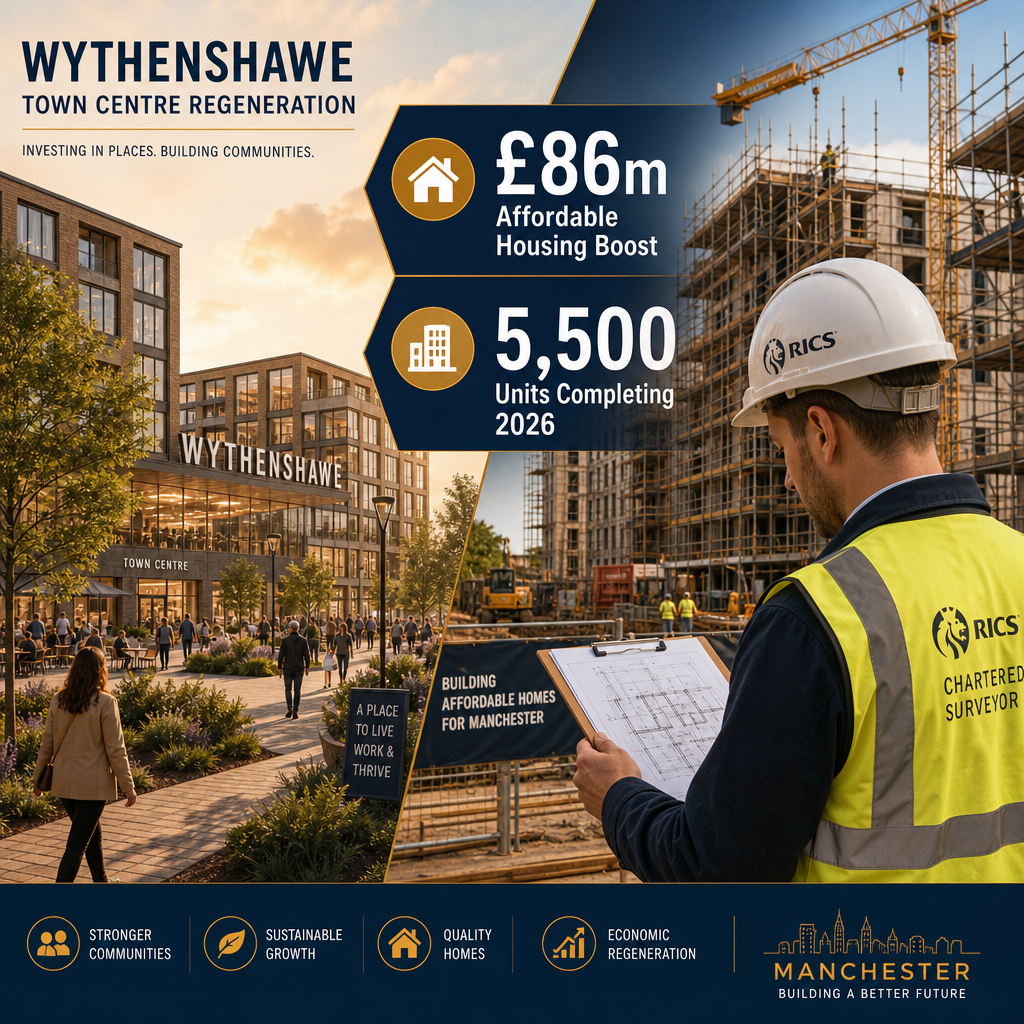
The headline figure for 2026 is substantial. Manchester City Council has announced an approximately £86 million package for affordable housing and regeneration, combining council resources, Good Growth Fund allocations and Homes England grant. The Good Growth Fund itself is growing from approximately £1 billion to nearly £2 billion, reflecting both increased government backing and new private-sector partnerships.
Specific investment commitments reported for 2026 include:
| Scheme | Total Programme Value | Public Funding Confirmed |
|---|---|---|
| Wythenshawe Town Centre | ~£500 million | £20m Local Regeneration Fund + £11.9m council |
| Moss Side Reno Site | Part of £86m package | Affordable housing grant |
| Castlefield / Water Street | Not publicly disclosed | Good Growth Fund contribution |
| Wider affordable housing programme | ~£86m (council announcement) | Mixed public sources |
Around 880+ affordable homes are expected to start on site or enter formal consultation in 2026, with many priced at social rent or Manchester Living Rent levels. Approximately 5,500 residential units are forecast to complete across Greater Manchester this year — the second-highest annual total since the Manchester Crane Survey began tracking completions. A further 15,332 homes currently hold planning permission and are at various stages of the development pipeline.
Note: All figures above are as reported by Manchester City Council and the GMCA at the time of publication. Actual outcomes may vary depending on construction progress, funding drawdown and market conditions.
Which Neighbourhoods Will Be Most Impacted? {#neighbourhoods}
Several distinct areas across Greater Manchester are at the centre of the 2026 regeneration programme. Each carries different implications for the type and volume of surveying work required.
Wythenshawe Town Centre is the single largest scheme by programme value. The £500 million regeneration plan includes retail, residential, community and public realm improvements. The public funding package (£20 million Local Regeneration Fund plus £11.9 million from Manchester City Council) is intended to de-risk the site and attract private development partners. For surveyors, this means demand for commercial property surveys, land valuations, schedule of condition reports and party wall notices as demolition and new construction proceed.
Moss Side — Reno Site is a more focused residential scheme delivering 212 affordable homes, with a target on-site start date of December 2026. At this scale, expect demand for stock condition surveys, structural assessments and RICS valuations as the scheme moves from planning to construction.
Castlefield and Water Street is a mixed-use area where new homes and a new public park are planned. This scheme sits in a sensitive historic environment, which typically increases the complexity — and cost — of pre-construction surveys, particularly structural and damp investigations on adjacent Victorian-era buildings.
Other areas with significant pipeline activity include Ancoats, Collyhurst and parts of Salford and Rochdale, where brownfield land is being brought forward. The Victoria North programme (a separate 15,000-home scheme in north Manchester) continues in parallel but is covered in detail elsewhere.
How Does 2026 Regeneration Compare to Previous Manchester Development? {#comparison}
The 2026 pipeline is historically significant. The forecast of approximately 5,500 residential completions is the second-highest annual total recorded by the Manchester Crane Survey since it began, which places 2026 in the same tier as the peak years of the mid-2010s build-to-rent boom — but with a much higher proportion of affordable and social-rent homes.
Earlier cycles were dominated by city-centre private-sale apartments and student accommodation. The 2026 wave is different in three ways:
- Geographic spread — schemes are concentrated in inner suburbs (Wythenshawe, Moss Side, Castlefield) rather than just the city centre
- Tenure mix — a much larger share of affordable, social-rent and Manchester Living Rent homes
- Public funding leverage — the Good Growth Fund and Local Regeneration Fund are explicitly designed to unlock sites that the private market would not develop alone
For surveyors, this shift matters. Affordable housing schemes typically require more RICS Red Book valuations for grant compliance, more stock condition surveys for registered providers, and more dilapidations work on cleared sites with existing structures.
Who Qualifies for Good Growth Fund Proposals? {#who-qualifies}
Good Growth Fund applications are open to a broad range of organisations, but eligibility criteria apply. The fund is not available to individuals or purely private commercial developers seeking profit-driven projects without a clear public benefit.
Eligible applicants typically include:
- Greater Manchester local authorities and their development arms
- Registered social landlords and housing associations
- Community Development Finance Institutions (CDFIs)
- Anchor institutions (universities, NHS trusts, cultural organisations)
- Business Improvement Districts and town centre partnerships
- Private developers in formal joint venture with a public-sector partner
Not eligible:
- Purely speculative residential development with no affordable housing component
- Revenue costs (staffing, marketing, management)
- Projects outside the ten Greater Manchester boroughs
Match funding is generally required. The proportion varies by project type and location, but applicants should expect to demonstrate that Good Growth Fund money is genuinely unlocking investment that would not otherwise occur — what the GMCA calls "additionality."
What Types of Projects Get Priority Funding? {#priority-projects}
The GMCA has been clear about its priorities for the 2026 funding cycle. Projects that combine multiple policy objectives score highest in assessment.
Priority project types:
- Affordable and social-rent housing on brownfield land
- Town centre and high street regeneration with a residential component
- Community infrastructure in areas of deprivation (health centres, sports facilities, cultural venues)
- Green infrastructure and climate adaptation (parks, flood mitigation, active travel routes)
- Employment space for SMEs in growth sectors (advanced manufacturing, digital, life sciences)
The Wythenshawe and Moss Side schemes score well across several of these criteria simultaneously — brownfield delivery, affordable homes, town centre improvement and community benefit. Projects that address only one criterion are less competitive.
For property professionals, priority projects tend to generate the most complex surveying requirements: multi-phase developments need structural surveys, phased valuations, and ongoing monitoring surveys as construction progresses.
Are There Restrictions on How Good Growth Fund Money Can Be Used? {#restrictions}
Yes, and these restrictions have direct implications for how projects are structured and what professional services are procured.
Good Growth Fund money cannot be used for:
- Revenue or operational expenditure
- Refinancing existing debt
- Projects that have already started on site before funding approval
- Land acquisition where the applicant already owns the site (in most cases)
- VAT that is recoverable by the applicant
It can be used for:
- Site preparation, demolition and remediation
- Construction and fit-out costs
- Professional fees directly associated with the capital project (including surveys and valuations required for grant compliance)
- Public realm and infrastructure works
The restriction on pre-commencement start is particularly important for developers. Starting any physical works — including demolition or site clearance — before formal funding approval can disqualify a project. This means pre-application surveys and valuations must be commissioned carefully, as they are allowable costs but the timing of physical works is tightly controlled.
How Long Will the Surveying and Selection Process Take? {#timeline}
The Good Growth Fund assessment process is not quick. From expression of interest to funding agreement, applicants should plan for a minimum of six to twelve months, depending on project complexity and the completeness of their submission.
Typical timeline:
- Expression of Interest — assessed within 4–8 weeks
- Full Business Case submission — preparation typically takes 3–6 months
- GMCA appraisal and approval — 8–16 weeks
- Funding agreement and due diligence — 4–8 weeks
- First drawdown — subject to satisfying pre-conditions (which often include survey reports and valuations)
For the Manchester regeneration 2026 Good Growth Fund surveying demand picture, this timeline means that many of the surveys commissioned in 2026 relate to schemes that entered the pipeline in 2024 or 2025. Surveyors working in Greater Manchester should expect a sustained pipeline of instructions rather than a single spike.
What Are the Biggest Challenges with Manchester Urban Regeneration? {#challenges}
Manchester's regeneration programme faces several well-documented challenges that affect both project delivery and the demand for professional services.
Ground conditions and contamination are a persistent issue on brownfield sites. Many of Manchester's inner-suburb sites have industrial histories involving chemicals, heavy metals or asbestos-containing materials. Asbestos surveys and ground investigation reports are frequently required before any planning application can be determined, let alone before construction starts.
Viability remains a tension. The Good Growth Fund exists precisely because many sites in Greater Manchester cannot be developed viably without public subsidy. As construction costs have risen since 2022, the gap between what a scheme costs to build and what it generates in value has widened on some sites, requiring larger public contributions and more complex financial modelling — which in turn requires more RICS Red Book valuations and viability assessments.
Party wall and neighbour disputes increase as development intensifies in established residential areas. Schemes in Moss Side, Wythenshawe and Castlefield are all in areas with existing housing stock, meaning party wall notices, schedules of condition and dispute resolution work are a growing part of the surveying caseload.
Planning delays can compress construction programmes, pushing multiple scheme starts into the same window and creating short-term capacity pressures for contractors and surveyors alike.
How Will This Fund Change Manchester's Economic Landscape? {#economic-impact}
The Good Growth Fund, combined with the £86 million affordable housing package, is expected to have measurable effects on Greater Manchester's economy over the next three to five years — though precise impact figures should be treated as projections rather than guaranteed outcomes.
Anticipated effects include:
- Creation of construction-phase jobs across Greater Manchester, particularly in Wythenshawe and Moss Side where local employment targets are built into funding agreements
- Increased housing supply at social rent and Manchester Living Rent, which supports workforce retention in key sectors
- Improved town centre footfall and retail viability in Wythenshawe, where the £500 million programme is designed to reverse long-term decline
- Higher land values in regenerating neighbourhoods, which affects both property valuations and the financial viability of adjacent development
For investors and developers, the key implication is that areas currently priced as secondary or tertiary locations may reprice as regeneration schemes complete. Early-stage land acquisition in these areas carries higher risk but potentially higher returns — and requires careful RICS valuation advice to assess current and projected values accurately.
What Does the Development Pipeline Mean for Surveying Demand Across Greater Manchester? {#surveying-demand}
The Manchester regeneration 2026 Good Growth Fund surveying demand story is, at its core, a story about volume and complexity arriving simultaneously. With approximately 5,500 completions forecast for 2026 and 15,332 homes in the planning pipeline, the demand for professional surveying services is at a multi-year high.
Building surveys and structural assessments are required at acquisition, during construction monitoring and at practical completion. New-build buyers in particular benefit from snagging surveys to identify defects before the developer's warranty period begins.
RICS valuations are needed at multiple points: for mortgage purposes, for grant compliance, for shared ownership and Help to Buy schemes, and for registered social landlords acquiring completed units. The RICS homebuyer survey remains the most commonly instructed report for residential purchasers in the sub-£500,000 price range.
Party wall work is growing in line with the density of development activity in established neighbourhoods. Any developer excavating within three or six metres of a neighbouring structure, or building on or near a party wall, must serve formal notices. The volume of party wall notices being served across Greater Manchester in 2026 reflects the intensity of activity in Moss Side, Castlefield and Wythenshawe.
Dilapidations work arises at both ends of the development cycle: when commercial or industrial buildings are cleared to make way for new schemes, and when newly completed commercial units are let and eventually vacated. The dilapidations surveyor role is particularly relevant in town centre regeneration schemes like Wythenshawe, where existing retail units are being cleared and replaced.
Choosing the right survey type depends on the property and transaction. For guidance on matching survey type to circumstance, see which survey do you need.
Common Mistakes Applicants Make When Submitting Good Growth Fund Proposals {#mistakes}
Several recurring errors reduce the competitiveness of Good Growth Fund applications. These are drawn from publicly available GMCA guidance and sector commentary — not from confidential appraisal records.
Starting works before approval. As noted above, any physical intervention on site before a funding agreement is in place can disqualify the project. Even site clearance counts.
Underestimating professional fees. Applicants sometimes budget tightly for construction costs but overlook the surveys, valuations, legal fees and project management costs that are allowable under the fund. A well-structured budget includes these from the outset.
Weak additionality case. The GMCA needs to be satisfied that the project would not happen without public funding. Applicants who cannot demonstrate this clearly — with financial modelling and market evidence — score poorly.
Ignoring community benefit. The "Good Growth" framing is deliberate. Projects that cannot articulate how local residents and businesses will benefit, beyond the construction phase, are at a disadvantage.
Submitting incomplete surveys. Pre-application surveys (ground investigations, structural assessments, heritage appraisals) are often required as supporting evidence. Submitting a business case without them typically results in requests for further information that delay the process.
FAQ {#faq}
Q: What is the Good Growth Fund in simple terms?
A: It is a Greater Manchester Combined Authority grant programme that funds capital projects delivering inclusive economic growth. It is the first fund of its kind in the UK at this scale and is expanding to nearly £2 billion in 2026.
Q: How many affordable homes will be built in Manchester in 2026?
A: Manchester City Council has announced that approximately 880+ affordable homes will start on site or begin formal consultation in 2026, many at social rent or Manchester Living Rent levels. These figures are as reported and may change.
Q: What is Manchester Living Rent?
A: Manchester Living Rent is a below-market rent level set by Manchester City Council, calculated to be affordable to households on average local incomes. It sits above social rent but below open-market rent.
Q: Do I need a survey if I am buying a new-build home in a regeneration area?
A: Yes. New-build properties are not exempt from defects, and a snagging survey before legal completion gives buyers a documented list of issues the developer must rectify under warranty.
Q: What is a party wall notice and when is it required?
A: A party wall notice is a formal legal document served on neighbouring property owners before carrying out works that affect a shared wall, boundary or nearby excavation. It is required under the Party Wall etc. Act 1996 and is particularly relevant in densely developed regeneration areas.
Q: How long does a RICS building survey take in Greater Manchester?
A: A Level 2 RICS Homebuyer Survey typically takes two to four hours on site, with a report delivered within five to ten working days. A Level 3 full building survey on a larger or older property may take a full day on site. See survey pricing for current cost guidance.
Q: Can private developers apply for Good Growth Fund money?
A: Private developers can apply, but only in formal joint venture with a public-sector partner and where the project delivers clear public benefit, including affordable housing. Purely speculative schemes without a public benefit component are not eligible.
Q: Is the Victoria North programme part of the Good Growth Fund?
A: Victoria North is a separate 15,000-home programme in north Manchester with its own funding structure. It is distinct from the Good Growth Fund schemes covered in this article, though both contribute to Greater Manchester's overall housing pipeline.
Conclusion: Actionable Next Steps for Developers, Investors and Homeowners
The scale of Manchester's 2026 development pipeline is not theoretical. With approximately £86 million in committed public funding, a Good Growth Fund approaching £2 billion, 5,500 residential completions forecast and 15,332 homes in the planning pipeline, the demand for professional surveying services across Greater Manchester is at a sustained high.
For developers and investors:
- Commission pre-acquisition structural surveys and RICS valuations early — capacity constraints are real when multiple large schemes are on site simultaneously
- Budget for party wall notices and schedules of condition in any scheme adjacent to existing residential or commercial property
- Engage a dilapidations surveyor at the start of any project involving the clearance of existing commercial space
For homeowners in regeneration areas:
- If a neighbouring development is planned, seek advice on your party wall rights before works begin
- If purchasing in a regeneration area, do not rely on a mortgage valuation alone — commission an independent RICS home survey to understand the condition of the property
For Good Growth Fund applicants:
- Include survey and valuation costs in your budget from the outset
- Do not start any physical works on site before your funding agreement is signed
- Ensure your business case includes independent market evidence and financial modelling
The Manchester regeneration 2026 Good Growth Fund surveying demand picture is one of sustained, broad-based activity across multiple neighbourhoods and tenure types. The professionals who prepare now — and who understand the specific requirements of publicly funded development — will be best placed to serve this market over the next three to five years.
References
- Manchester City Council, Affordable Housing and Regeneration Investment Announcement, 2026
- Greater Manchester Combined Authority, Good Growth Fund Programme Documentation, 2025
- Deloitte / Manchester City Council, Manchester Crane Survey 2026, 2026
- Greater Manchester Combined Authority, Brownfield Housing Fund and Local Regeneration Fund Guidance, 2025
- UK Government, Homes England Grant Funding Guidance, 2025