
Nearly one in three UK property transactions that fall through do so because of issues uncovered during surveys — yet most buyers receive their Level 3 report, feel overwhelmed by the red-flagged defects, and either walk away or do nothing with the information. That is a costly mistake in both directions.
Turning a Level 3 Building Survey into a repair strategy — prioritising works, costs and negotiation tactics for UK buyers — is the skill that separates confident purchasers from panicked ones. A Level 3 report is not a list of reasons to abandon a purchase. It is a diagnostic roadmap that, when read correctly, tells buyers exactly what to fix first, what it will cost, and how to use that information at the negotiating table. [1]
Key Takeaways 📋
- A Level 3 building survey is an in-depth diagnostic tool, not just a warning document — it explains causes, urgency, and likely repair costs. [1]
- Defects should be sorted into three priority tiers: urgent/safety-critical, short-term (within 1–3 years), and long-term maintenance.
- Realistic cost banding — not precise quotes — is the correct first step before renegotiation.
- A well-structured repair schedule gives buyers leverage to renegotiate the purchase price or request remedial works before exchange.
- Not all red-rated items are deal-breakers; context, cause, and cost determine whether a defect is a problem or an opportunity.
What a Level 3 Survey Actually Tells You
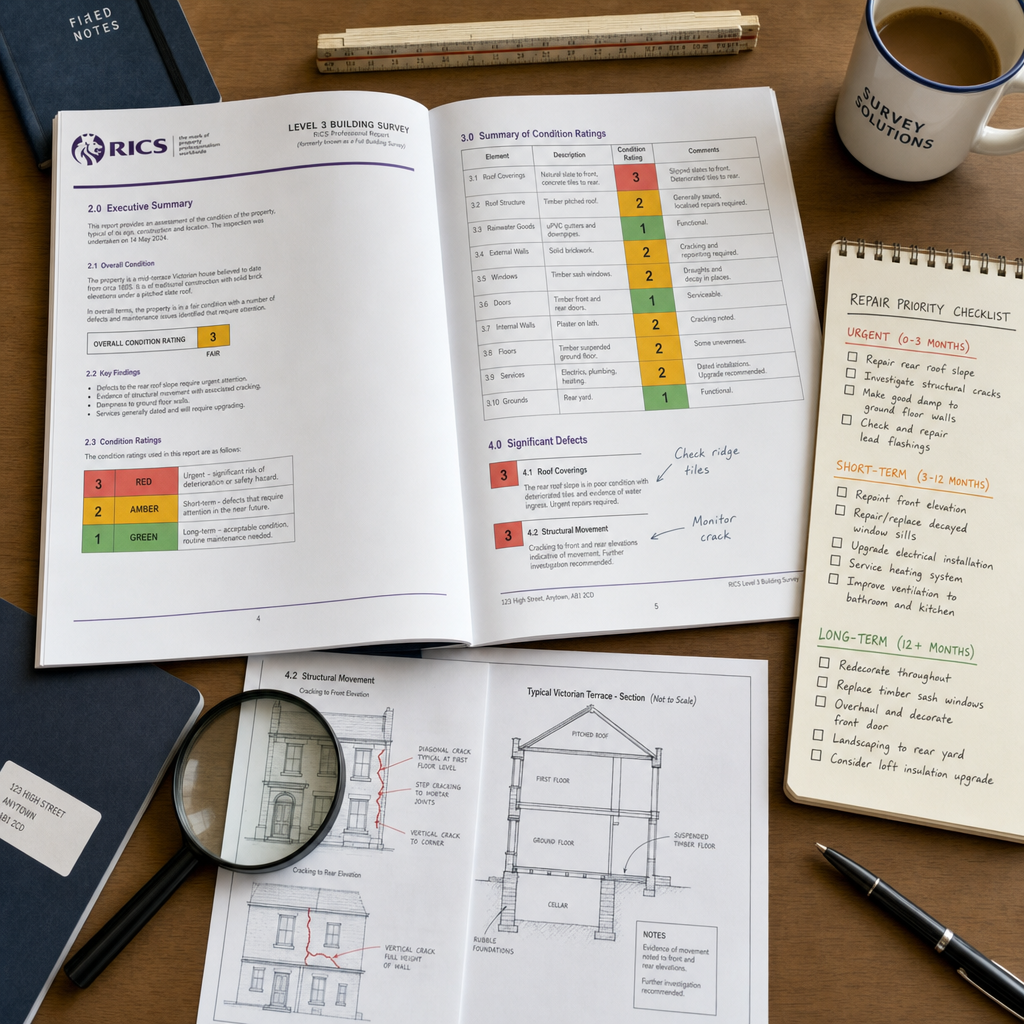
Before turning findings into a strategy, it helps to understand what the report contains. A RICS Level 3 building survey is the most comprehensive residential inspection available. Running to 20–30+ pages, it covers the structure, materials, causes of defects, urgency of repairs, and likely cost ranges — going far beyond the surface-level observations of a Level 1 or Level 2 report. [1][3]
The RICS condition rating system uses three categories:
| Rating | Meaning | Action Required |
|---|---|---|
| Condition 3 🔴 | Serious defects requiring urgent attention | Immediate action or renegotiation |
| Condition 2 🟡 | Defects requiring repair but not urgent | Budget and plan within 1–3 years |
| Condition 1 🟢 | No significant repair needed currently | Monitor and maintain |
💬 "A Level 3 survey looks at the structure, the materials, the causes of defects, and the urgency and likely cost of repairs — giving buyers the fullest picture possible before purchase." [3]
Critically, the report also explains why a defect exists. A crack rated Condition 3 caused by historic, stable settlement is very different from one caused by active subsidence. The cause determines both the cost and the risk — and therefore how hard to negotiate.
For buyers unsure whether a Level 3 is the right choice, comparing different types of survey is a useful starting point before commissioning any inspection.
Step 1: Reading the Report Strategically — Not Emotionally
The first instinct when a 30-page report arrives full of amber and red ratings is alarm. Resist it. The process of turning a Level 3 building survey into a repair strategy begins with a structured re-read, not a panic.
Separate Findings by Category
Work through the report and group every defect into one of four buckets:
- Safety-critical — anything posing immediate risk to occupants (structural instability, dangerous electrics, gas issues, asbestos)
- Weather-tight — defects that will worsen rapidly if left (roof coverings, gutters, flashings, window seals)
- Structural integrity — issues affecting the building's long-term stability (subsidence, lintel failure, wall tie corrosion)
- Cosmetic and maintenance — items that are unpleasant but low-risk (decorative plasterwork, dated kitchens, minor damp)
This categorisation immediately reduces the emotional weight of the report. Many buyers discover that the majority of their red-rated items fall into category four — significant-looking, but not structurally threatening.
Ask the Surveyor for Clarification
Surveyors are required to be available for follow-up questions. A short call to clarify the cause and likely progression of the top three or four Condition 3 items is invaluable. Ask specifically:
- Is this defect active or historic?
- What happens if it is left for 12 months?
- What type of contractor is needed?
This context is essential before any cost estimation begins. For complex structural findings, a structural survey or engineering assessment may be warranted as a follow-up step.
Step 2: Building a Prioritised Repair Schedule
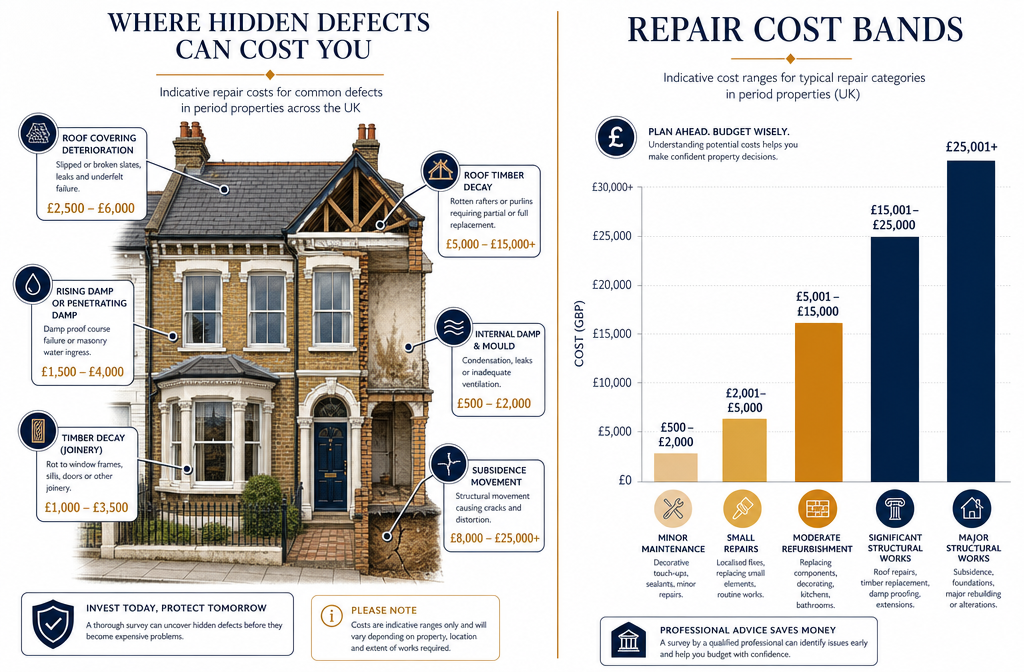
With defects categorised, the next task is building a phased repair schedule — the practical core of turning a Level 3 building survey into a repair strategy for UK buyers.
The Three-Tier Repair Framework
Tier 1 — Urgent (0–6 months post-purchase)
These are safety-critical and weather-tight items that cannot wait. Budget for these before exchange, not after.
Typical examples: Failed roof covering, dangerous electrics, active water ingress, structural movement
Tier 2 — Short-Term (6 months–3 years)
Defects that are serious but not immediately dangerous. These should be planned and budgeted in the first year of ownership.
Typical examples: Repointing, chimney repairs, window replacement, damp treatment
Tier 3 — Long-Term (3–10 years)
Maintenance and improvement items that can be addressed as funds allow.
Typical examples: Boiler replacement, kitchen/bathroom refurbishment, external decoration
Realistic Cost Banding for 2026
Precise quotes require contractors on-site. At the survey stage, cost bands are the appropriate tool. The table below reflects 2026 UK market rates for common defect categories: [4][9]
| Defect Type | Typical Cost Band (2026) |
|---|---|
| Full roof re-covering (3-bed semi) | £8,000 – £18,000 |
| Chimney rebuild/repointing | £1,500 – £6,000 |
| Damp-proof course injection | £800 – £3,500 |
| Electrical rewire (3-bed house) | £3,500 – £7,500 |
| Structural crack repair (minor) | £500 – £2,500 |
| Wall tie replacement | £1,500 – £5,000 |
| Window replacement (full house) | £5,000 – £15,000 |
| Timber treatment (rot/woodworm) | £500 – £3,000 |
⚠️ Important: These are planning figures only. Always obtain at least three contractor quotes before finalising any budget.
For properties with suspected drainage issues — a common finding in older UK homes — a specialist drainage survey can provide precise scope and costs before exchange.
Similarly, pre-1980 properties may require an asbestos survey to identify hidden risks that could significantly affect Tier 1 costs.
Step 3: Turning the Repair Strategy Into Negotiation Leverage
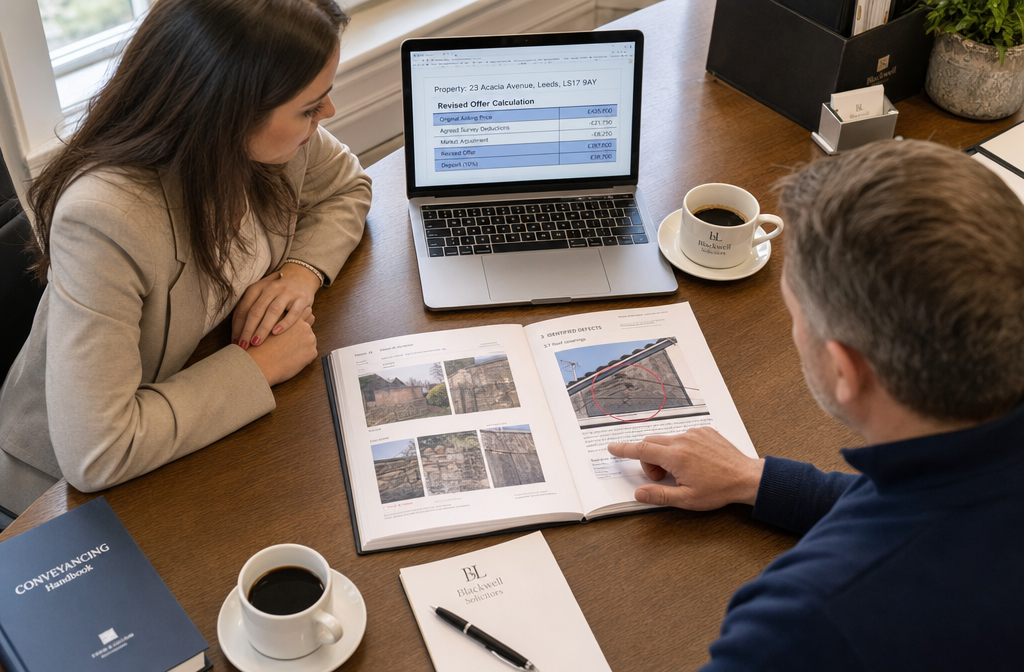
This is where the real value of turning a Level 3 building survey into a repair strategy — prioritising works, costs and negotiation tactics for UK buyers becomes clear. A well-prepared repair schedule is not just a budget tool; it is a negotiating document.
The Negotiation Mindset
Sellers are not obligated to reduce the price or carry out repairs. But buyers with a costed, evidenced repair schedule are in a far stronger position than those who simply say "the survey was bad." Specificity wins negotiations.
Three Negotiation Approaches
1. Price Reduction
The most common route. Present the seller with a summary of Tier 1 and Tier 2 costs, supported by the surveyor's report. Request a reduction equivalent to the mid-point of the cost band, not the top. This signals reasonableness and is more likely to be accepted.
Example: Roof re-covering quoted at £8,000–£14,000 → request a £10,000–£11,000 reduction.
2. Remedial Works Before Exchange
In some cases — particularly where the seller is motivated — asking the seller to carry out specific repairs before exchange is viable. This works best for discrete, well-defined items like chimney repairs or damp treatment. Ensure any agreed works are specified in writing and tied to a retention clause or re-inspection.
3. Retention at Completion
A solicitor can hold a sum in retention post-completion until agreed works are verified. This is useful when a seller agrees to fix something but the work cannot be completed before exchange. Always take legal advice on the appropriate mechanism.
What Not to Do ❌
- Do not present the full survey to the seller or agent — share only a concise summary of costed items.
- Do not negotiate on cosmetic items — focus exclusively on Tier 1 and Tier 2 defects.
- Do not over-claim costs — inflated figures undermine credibility and stall negotiations.
- Do not withdraw without exploring options — a Condition 3 rating is not automatically a deal-breaker. [2][5]
When to Walk Away
Some findings genuinely do warrant withdrawal. Active subsidence without a clear resolution pathway, severe structural failure, or contaminated land are examples where the cost and risk may exceed the property's value. The structural engineering assessments available from specialist surveyors can provide the definitive second opinion needed in these cases.
Proposed RICS reforms in 2026 are also pushing toward greater transparency in the buying process, with building surveys potentially becoming a more standardised part of transactions. [7] This makes understanding how to use survey findings strategically an increasingly valuable skill for all UK buyers.
Common Mistakes Buyers Make With Level 3 Findings
Even buyers who commission a Level 3 survey often fail to extract full value from it. The most frequent errors include:
- Treating every Condition 3 item as equal — a failed roof tile and active subsidence are both red-rated, but they are not comparable risks or costs.
- Skipping the follow-up call — the written report cannot capture every nuance; a 20-minute call with the surveyor is almost always worth the time.
- Negotiating too quickly — rushing to the phone the day the report arrives, without a costed schedule, weakens the buyer's position.
- Ignoring the maintenance section — Level 3 reports include ongoing maintenance advice that can prevent future Tier 1 defects from developing. [8]
- Forgetting specialist surveys — damp surveys and drainage investigations flagged in the report should be actioned before exchange, not after.
For buyers who want a focused assessment of a single high-risk item rather than a full re-survey, a specific defect report can provide targeted expert opinion at lower cost.
Turning Survey Findings Into a Post-Purchase Plan
Not every defect can be resolved through negotiation. Some sellers will not move on price, and some buyers will proceed regardless. In these cases, the repair schedule becomes a post-purchase financial plan.
Practical Steps After Exchange
- Obtain contractor quotes for all Tier 1 items within the first month of ownership.
- Set a maintenance reserve — industry guidance suggests budgeting 1–2% of property value annually for maintenance on older homes.
- Sequence works logically — always address weather-tight issues before internal decorative works to avoid repeating labour.
- Keep the survey report — it is a legal document and may be relevant for insurance purposes, future sales, or expert witness proceedings.
- Re-inspect after major works — particularly for structural repairs, a follow-up inspection confirms the defect has been properly addressed.
Level 3 surveys are increasingly valued not just at purchase but as a baseline document for ongoing property management. [6] In 2026, with UK housing stock ageing and energy efficiency requirements tightening, understanding the full condition of a property at the point of purchase has never been more important.
Conclusion: From Overwhelmed to In Control
A thick survey report full of amber and red ratings is not a problem — it is information. The buyers who benefit most from turning a Level 3 building survey into a repair strategy — prioritising works, costs and negotiation tactics — are those who treat the document as a planning tool rather than a verdict.
Actionable Next Steps ✅
- Re-read the report with the four-category framework (safety, weather-tight, structural, cosmetic).
- Call the surveyor to clarify the cause and urgency of the top Condition 3 items.
- Build a three-tier repair schedule with realistic 2026 cost bands for each defect.
- Commission any specialist surveys (drainage, damp, asbestos, structural) flagged in the report before exchange.
- Prepare a concise negotiation summary — costed, evidenced, and focused on Tier 1 and 2 items only.
- Engage a solicitor to structure any agreed price reductions, remedial works, or retentions correctly.
- Use the schedule as a post-purchase budget if negotiation is unsuccessful or partially successful.
The Level 3 survey is the most powerful tool available to a UK property buyer. Used strategically, it transforms uncertainty into a clear, costed, actionable plan — and that is worth far more than the survey fee.
References
[1] What Does A Level 3 Survey Include 2025 – https://surveymatch.co.uk/what-does-a-level-3-survey-include-2025/
[2] What Sort Of Survey Should I Have – https://hoa.org.uk/advice/guides-for-homeowners/i-am-buying/what-sort-of-survey-should-i-have/
[3] Watch – https://www.youtube.com/watch?v=fKTVS0xu9dE
[4] Level 3 Survey Cost – https://www.comparemymove.com/guides/surveying/level-3-survey-cost
[5] Level 3 Building Surveys For First Time Buyers In 2026 Navigating Affordability Surge And Reform Risks – https://wimbledonsurveyors.com/level-3-building-surveys-for-first-time-buyers-in-2026-navigating-affordability-surge-and-reform-risks/
[6] Level 3 Building Surveys For First Time Buyers In 2026 Spotting Risks Amid Affordability Improvements – https://nottinghillsurveyors.com/blog/level-3-building-surveys-for-first-time-buyers-in-2026-spotting-risks-amid-affordability-improvements
[7] RICS Home Buying Reform Proposals 2026 How Building Surveys Become Mandatory And Transform The Buying Process – https://princesurveyors.co.uk/blog/rics-home-buying-reform-proposals-2026-how-building-surveys-become-mandatory-and-transform-the-buying-process/
[8] RICS Home Survey Level 3 – https://www.rellimsurveyors.co.uk/rics-home-survey-level-3
[9] Home Survey Cost Level 2 3 – https://www.bookabuilderuk.com/blog/home-survey-cost-level-2-3
[10] Level 2 V Level 3 Survey – https://www.canterburysurveyors.com/blog/level-2-v-level-3-survey/