
Nearly 40% of party wall disputes that escalate to formal third-surveyor referrals involve small-scale residential developments — and the majority of those disputes were avoidable with proper upfront planning. As 2026 brings a sharp uptick in urban densification, party wall surveying for small developers: avoiding costly disputes on backland, infill and airspace schemes has never been more critical to understand. Garden plots, rooftop extensions and tight infill sites are now the frontline of residential development — and every one of them sits close to someone else's wall [1][2].
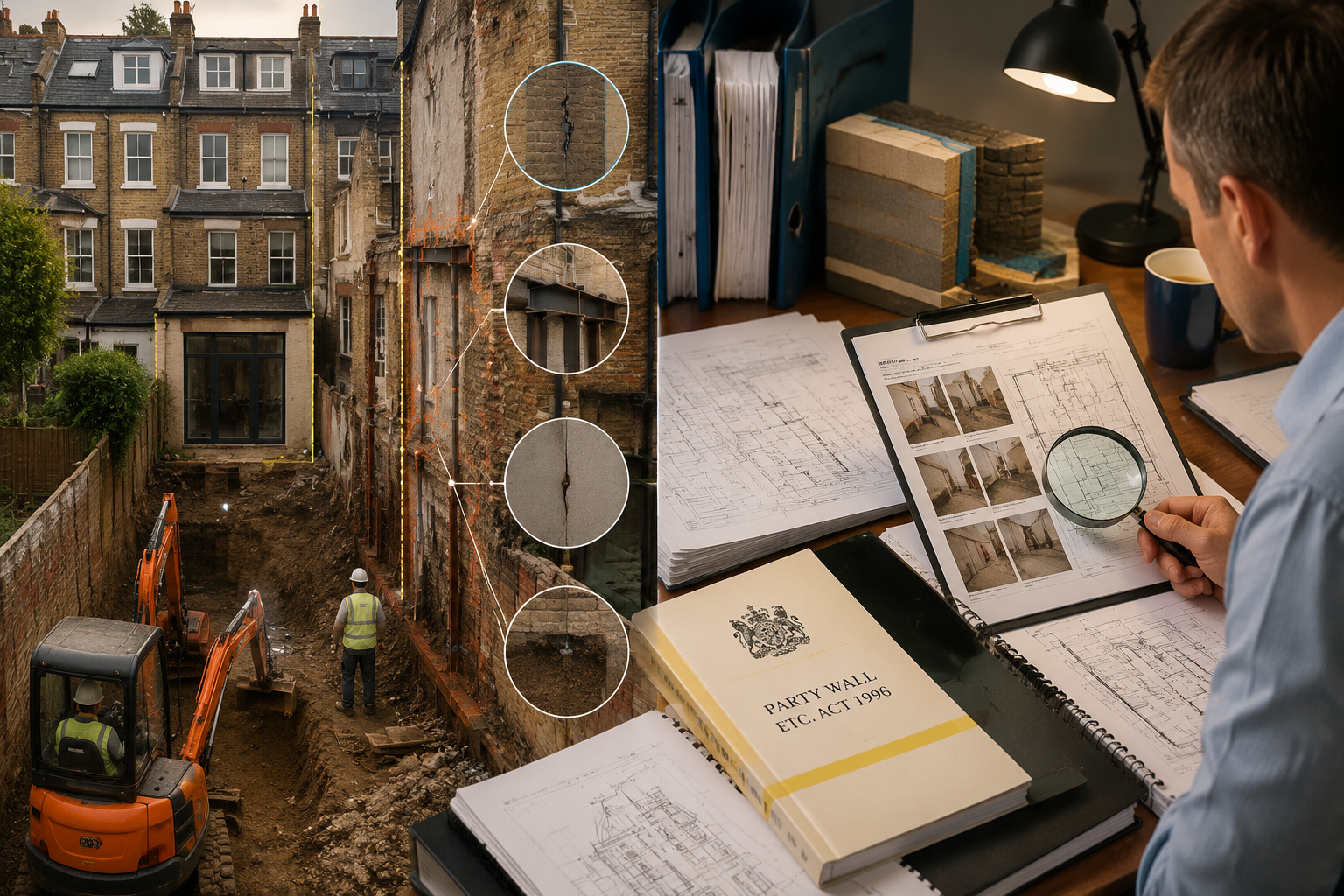
Key Takeaways 📋
- Backland, infill and airspace schemes almost always trigger the Party Wall etc. Act 1996 — failing to serve notices on time can halt a project entirely.
- A thorough schedule of condition prepared before works begin is the single most effective tool for defeating post-construction damage claims.
- Higher gross development values (GDV) in 2026 mean neighbours and their advisers are more assertive — cutting corners on party wall fees is a false economy.
- The draft RICS 8th Edition Party Wall Guidance (under consultation in 2026) is tightening competence and record-keeping expectations, especially for high-risk constrained sites.
- Securing an agreed surveyor appointment early can dramatically reduce costs and lead times compared to running parallel surveyor appointments.
Why Densification Is Raising the Party Wall Stakes in 2026
Urban intensification is reshaping the development landscape. Local authorities across England and Wales are under mounting pressure to deliver housing on constrained urban land — and small developers are responding by targeting backland plots behind Victorian terraces, narrow infill gaps between buildings, and rooftop airspace above existing structures [2].
These schemes share one uncomfortable characteristic: they are almost always surrounded by occupied properties with shared or adjacent boundaries. That means the Party Wall etc. Act 1996 is almost always engaged, often in multiple directions simultaneously.
💬 "A modest saving on party wall fees can be wiped out by a single contested defect claim or injunction." — Industry commentary, 2026 [1]
Residential values rising in the 2–5% range in key urban markets make these schemes financially attractive [1]. But higher gross development value (GDV) cuts both ways. Neighbours and their professional advisers are increasingly aware that a well-timed injunction or a credible damage claim carries real leverage. The financial stakes of a dispute — or even a delay — have never been higher for small developers operating on thin margins.
The Three High-Risk Scheme Types
| Scheme Type | Typical Party Wall Triggers | Key Risks |
|---|---|---|
| Backland / Garden Plot | Excavation near boundary, new foundations, boundary walls | Undermining adjoining foundations, drainage disruption |
| Infill Between Terraces | Works to or near shared walls, new structure abutting neighbours | Structural loading on party walls, vibration damage |
| Airspace / Rooftop | Works to roof structure, raising height, shared chimney stacks | Structural stress on existing party wall, loss of light |
The Legal Framework: What Triggers the Act on Constrained Sites
The Party Wall etc. Act 1996 applies in England and Wales and covers three main categories of notifiable work:
- Works to a party wall or party structure (Section 2) — including cutting into, raising, underpinning or demolishing a shared wall.
- New buildings at or astride the boundary line (Section 1) — directly relevant to infill schemes.
- Excavation within 3 or 6 metres of a neighbouring structure (Section 6) — particularly relevant to backland schemes with new foundations.
For small developers, the 3-metre rule under Section 6 is frequently overlooked. Any excavation within 3 metres of a neighbour's building that goes deeper than their foundations — or within 6 metres if it intersects a 45-degree line drawn from the base of their foundations — requires a notice and, if the neighbour dissents, a party wall award.
On backland sites, where new foundations are often close to existing rear walls and fences, this trigger is almost inevitable. On airspace schemes, Section 2 works to the roof structure or shared chimney stacks are the usual trigger — and party wall issues around shared chimneys are a common source of disputes that could easily be avoided with early surveyor involvement.
What Happens If No Notice Is Served?
Failing to serve a valid party wall notice before starting work is one of the most expensive mistakes a small developer can make. The adjoining owner can seek an injunction to stop works entirely — and courts have shown little sympathy for building owners who proceed without following the Act. The costs of a halt, plus legal fees, plus remediation, routinely dwarf the cost of proper compliance [3].
For a detailed breakdown of the consequences, see what happens if no party wall notice is served and what if you do not have a party wall agreement.
Party Wall Surveying for Small Developers: Avoiding Costly Disputes on Backland, Infill and Airspace Schemes — The Schedule of Condition
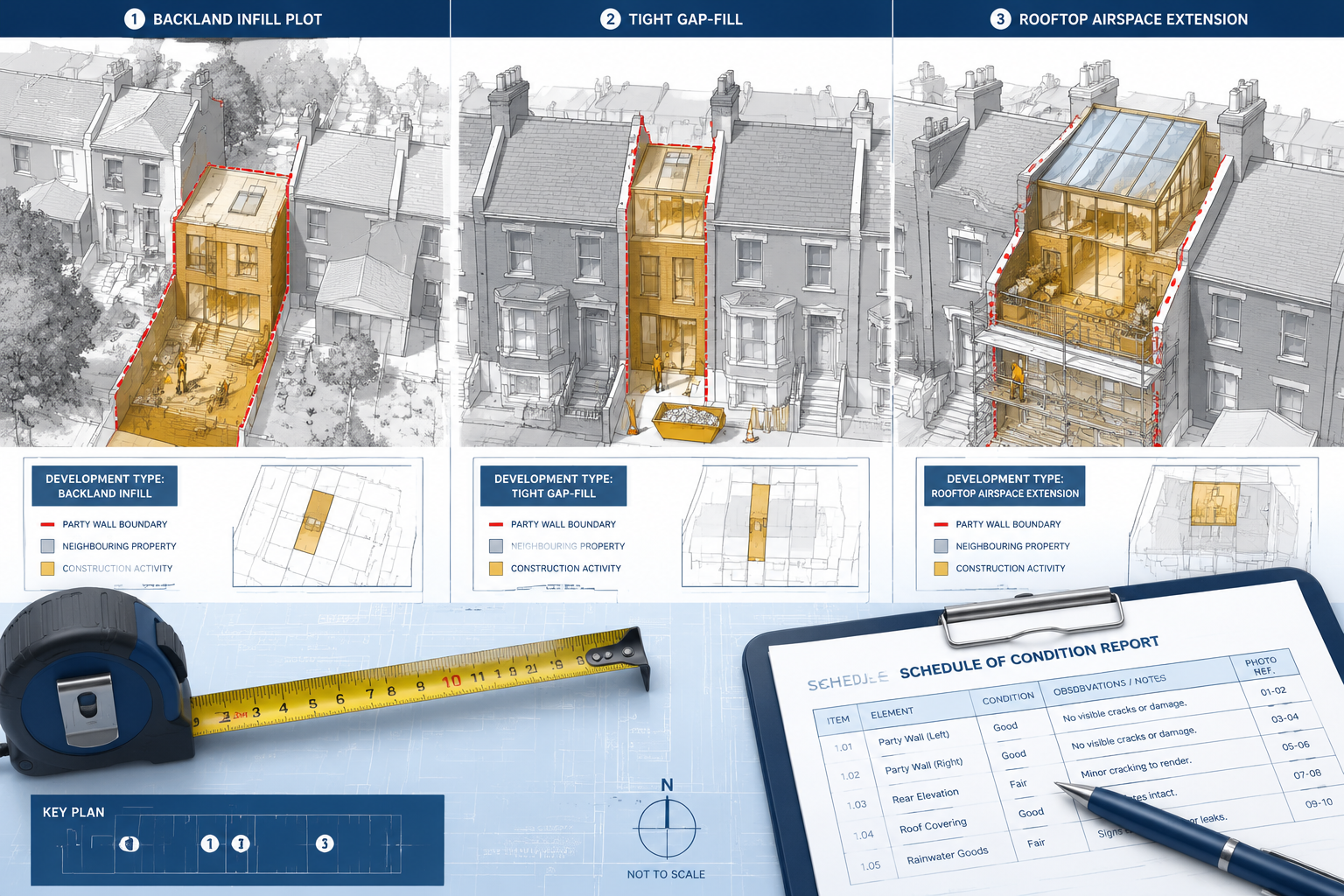
Of all the tools available to a small developer, the schedule of condition is the most underused and the most valuable. It is a detailed, photographic and written record of the state of a neighbouring property before any works begin.
Without it, any crack, settlement or damage that appears during or after construction becomes a matter of disputed opinion. With it, a developer has a clear baseline against which any claim must be measured.
🛡️ A well-prepared schedule of condition is your best defence against speculative post-works claims.
For backland and infill schemes, where vibration, ground movement and structural loading are genuine risks, a thorough schedule of condition should cover:
- All internal rooms adjacent to the works, including floors, walls, ceilings and joinery
- External elevations facing the development, including brickwork, render, windows and doors
- Drainage inspection where excavation is close to shared drainage runs
- Roof and chimney condition on airspace schemes, particularly where shared stacks are involved
The schedule of condition guidance published by experienced practitioners makes clear that rushed, low-quality schedules generate more post-works claims — not fewer. The surveyor's time spent on a thorough pre-works record is almost always recovered many times over in avoided dispute costs [6].
Agreed Surveyor vs. Separate Surveyors: The Cost Equation
When a neighbour dissents from a party wall notice, they are entitled to appoint their own surveyor. In 2026, fee benchmarks for party wall work are trending upward, and the appointment of separate surveyors (one for the building owner, one for each adjoining owner) on contentious small schemes is increasingly common [6].
For a small developer with two or three adjoining owners, this can mean:
- Multiple surveyor fees, all payable by the building owner
- Longer lead times for agreed awards (sometimes 6–12 weeks)
- Greater scope for disagreement and third-surveyor referrals
The alternative — securing an agreed surveyor appointment — requires early relationship-building with neighbours and a surveyor who both parties trust. It is not always achievable, but when it is, it can reduce costs significantly and accelerate the programme [7].
Building the Party Wall Award for High-Risk Schemes
The party wall award is the formal document that sets out the rights and obligations of both parties during and after the works. For backland, infill and airspace schemes, a standard-form award is rarely sufficient. The award needs to be carefully scoped to the specific risks of the site [4].
Key provisions that experienced surveyors build into awards for constrained urban schemes include:
🔧 Working Hours and Noise Controls
Dense urban sites often adjoin residential properties occupied during the day. Awards should specify permitted working hours, maximum noise levels for specific operations (particularly percussive drilling and piling), and notification requirements for particularly disruptive activities.
🏗️ Structural Monitoring
For airspace schemes where additional load is placed on existing party walls, and for backland schemes with deep excavations, the award should require structural monitoring — typically crack monitoring gauges and settlement pins — with agreed trigger levels that pause works if movement exceeds defined thresholds.
💧 Drainage Protection
Backland schemes frequently require excavation near shared or combined drainage runs. The award should require a pre-works CCTV drainage survey and specify reinstatement obligations if drains are disturbed. For further guidance on this, drainage surveys are a valuable pre-works tool.
🔑 Access Rights
Many party wall works require access to the adjoining owner's property — to inspect, monitor or carry out protective works. The award must specify the terms of that access, including notice periods, accompanied access requirements and reinstatement obligations.
For a comprehensive overview of what a well-drafted award should contain, the party wall award guidance resource is an essential reference.
Party Wall Surveying for Small Developers: Avoiding Costly Disputes on Backland, Infill and Airspace Schemes — The 2026 RICS Guidance Update

The draft RICS 8th Edition Party Wall Guidance, under consultation in 2026, is expected to tighten expectations across several areas that are directly relevant to small, higher-risk schemes [5]:
What's Changing
- Competence requirements: Surveyors acting on high-risk schemes (including airspace and deep excavation projects) will be expected to demonstrate specific competence, not just general party wall experience [5].
- Record-keeping: More rigorous documentation of the surveyor's reasoning, correspondence and decision-making is expected — reducing the scope for disputes about what was agreed and why [5].
- Fair fees: The guidance addresses concerns about fee inflation and the practice of running up costs unnecessarily, which has been a particular issue in contentious small-scheme appointments [6].
- Proportionality: Awards should be proportionate to the actual risks of the scheme — a principle that benefits small developers if applied correctly, but which requires surveyors to engage properly with the specific site conditions [7].
For small developers, the practical implication is clear: appoint surveyors who are genuinely experienced in constrained urban schemes, not just general practitioners who handle party wall work as a sideline. The 8th Edition consultation signals that the profession is moving toward higher accountability — and developers who appoint well-qualified surveyors will be better protected [5].
Loft Conversions and Airspace: A Special Case
Rooftop and airspace schemes — including both traditional loft conversions and more ambitious rooftop additions — present particular challenges because the works often affect the party wall at roof level, where structural conditions are less predictable and access for inspection is more difficult.
The specific party wall considerations for loft conversions and airspace developments include the need to assess the existing party wall's capacity to carry additional loads, the condition of shared chimney stacks, and the impact of raising or altering the roof line on the adjoining property's structure and amenity.
Practical Checklist for Small Developers 📝
Use this checklist to reduce party wall risk on backland, infill and airspace schemes:
- Identify all adjoining owners before planning permission is granted — not after
- Engage a qualified party wall surveyor during the design stage, not at the last minute
- Serve notices at the correct time: Section 1 notices — 1 month before works; Section 2 notices — 2 months before works; Section 6 notices — 1 month before works
- Commission a thorough schedule of condition covering all properties within the likely zone of influence
- Negotiate an agreed surveyor where possible to reduce costs and lead times
- Scope the award specifically to the risks of the scheme — do not accept a generic template
- Build party wall lead times into the programme — awards can take 6–12 weeks in contentious cases
- Budget for monitoring on deep excavation and airspace schemes
- Keep records of all correspondence, notices, consents and inspections throughout the project
Conclusion: Proactive Party Wall Management Pays for Itself
The economics of party wall surveying for small developers — avoiding costly disputes on backland, infill and airspace schemes — are straightforward: the upfront cost of proper compliance is almost always a fraction of the cost of a dispute, an injunction or a contested damage claim.
In 2026, with urban densification accelerating, GDVs rising and neighbours increasingly well-advised, the margin for error is shrinking. The developers who will protect their margins are those who treat party wall compliance as a core part of project management — not an afterthought.
Actionable next steps for small developers:
- Appoint a qualified party wall surveyor at design stage — before planning, if possible, to identify constraints early.
- Commission a schedule of condition as soon as notices are served — do not wait for dissent.
- Engage neighbours early with clear, plain-English communication about the works and their rights — many disputes stem from poor communication, not genuine legal disagreement.
- Review the draft RICS 8th Edition guidance and ensure your appointed surveyor is preparing for the new competence expectations.
- Build realistic party wall timelines into your programme and budget — a 6–8 week buffer for the award process is prudent on any contentious scheme.
For expert guidance on party wall matters, schedules of condition and dispute resolution, Manchester Surveyors provides specialist support across a wide range of residential and mixed-use development schemes.
References
[1] Party Wall Challenges For 2026 New Build Expansions Surveys For 2 5 Price Growth And Defect Risks – https://kingstonsurveyors.com/party-wall-challenges-for-2026-new-build-expansions-surveys-for-2-5-price-growth-and-defect-risks/
[2] Party Wall Surveys In Mixed Use Development Navigating 2026s Urban Intensification Projects – https://princesurveyors.co.uk/blog/party-wall-surveys-in-mixed-use-development-navigating-2026s-urban-intensification-projects/
[3] Party Wall Surveys For Infrastructure Projects 2026 Protocols In High Demand Regions Like Staffordshire – https://nottinghillsurveyors.com/blog/party-wall-surveys-for-infrastructure-projects-2026-protocols-in-high-demand-regions-like-staffordshire
[4] Residential Vs Commercial Land Survey Complete Guide 2026 – https://structurasurveying.com/residential-vs-commercial-land-survey-complete-guide-2026/
[5] Rics 8th Edition Party Wall Guidance 2026 Whats Changed And How Surveyors Must Adapt – https://wimbledonsurveyors.com/rics-8th-edition-party-wall-guidance-2026-whats-changed-and-how-surveyors-must-adapt/
[6] The Reality Of Party Wall Surveying In 2026 Fees Disputes And Daily Challenges From Industry Pros – https://www.canterburysurveyors.com/blog/the-reality-of-party-wall-surveying-in-2026-fees-disputes-and-daily-challenges-from-industry-pros/
[7] Party Wall Surveys And The 2026 Construction Recovery Preparing For Increased Development Activity – https://wimbledonsurveyors.com/party-wall-surveys-and-the-2026-construction-recovery-preparing-for-increased-development-activity/