Nearly one in three party wall disputes that reach a surveyor in 2026 involve works that have already been completed — meaning the legal protections the Party Wall etc. Act 1996 was designed to provide were never activated in the first place. This guide unpacks the full process for handling Retrospective Party Wall Awards in 2026: Surveyor Protocols for Post-Work Damage Claims and Compliance Fixes, covering everything from surveyor appointments and schedules of condition to cost recovery and real-world case risks.
Whether a building owner overlooked their legal obligations or an adjoining owner only noticed damage after the dust settled, the retrospective route is complex — but navigable with the right professional guidance.
Key Takeaways
- ✅ Retrospective party wall awards are not explicitly provided for under the Act but can be formalised as legally binding voluntary arrangements between parties after works are complete. [4]
- ✅ Three core scenarios trigger retrospective awards: unintended oversight, emergency works, and post-completion neighbour disputes. [4]
- ✅ Both parties must consent to the retrospective process; surveyors cannot impose it unilaterally.
- ✅ Costs are significantly higher retrospectively — surveyor fees, remedial works, and potential legal costs all escalate without a pre-work agreement. [5]
- ✅ A Schedule of Condition is the cornerstone document — its absence after works makes damage attribution far harder to prove. [2]
Why Retrospective Awards Exist: The Legal Gap the Act Leaves Open
The Party Wall etc. Act 1996 is fundamentally a preventive piece of legislation. It requires building owners to serve formal notices before any notifiable works begin — whether that involves cutting into a party wall, excavating near a neighbour's foundations, or building up to a boundary. The Act's protections — surveys, scheduled conditions, dispute resolution — are designed to operate prospectively, not in hindsight. [4]
Yet the reality of residential construction in 2026 is messier. Builders start early. Homeowners misunderstand their obligations. Extensions go up without a single notice being served. When the adjoining owner then discovers cracked plasterwork, a shifted chimney breast, or a subsiding garden wall, they have limited statutory recourse under the Act itself — because the Act's machinery was never engaged.
"Retrospective agreements carry greater risk and complexity compared to proactive, pre-work arrangements; acting before works begin is always preferable." [10]
This is where the retrospective award fills the gap. It is not a creature of statute — the Act makes no explicit provision for it — but it functions as a surveyor-facilitated voluntary arrangement that mimics the protections of a formal Award. [8] Both parties must agree to engage the process. If one refuses, the aggrieved neighbour must pursue remedies through civil litigation instead, which is far more costly and time-consuming.
Understanding what happens if you do not have a party wall agreement is the essential first step for any property owner caught in this situation.
The Three Scenarios That Demand Retrospective Action
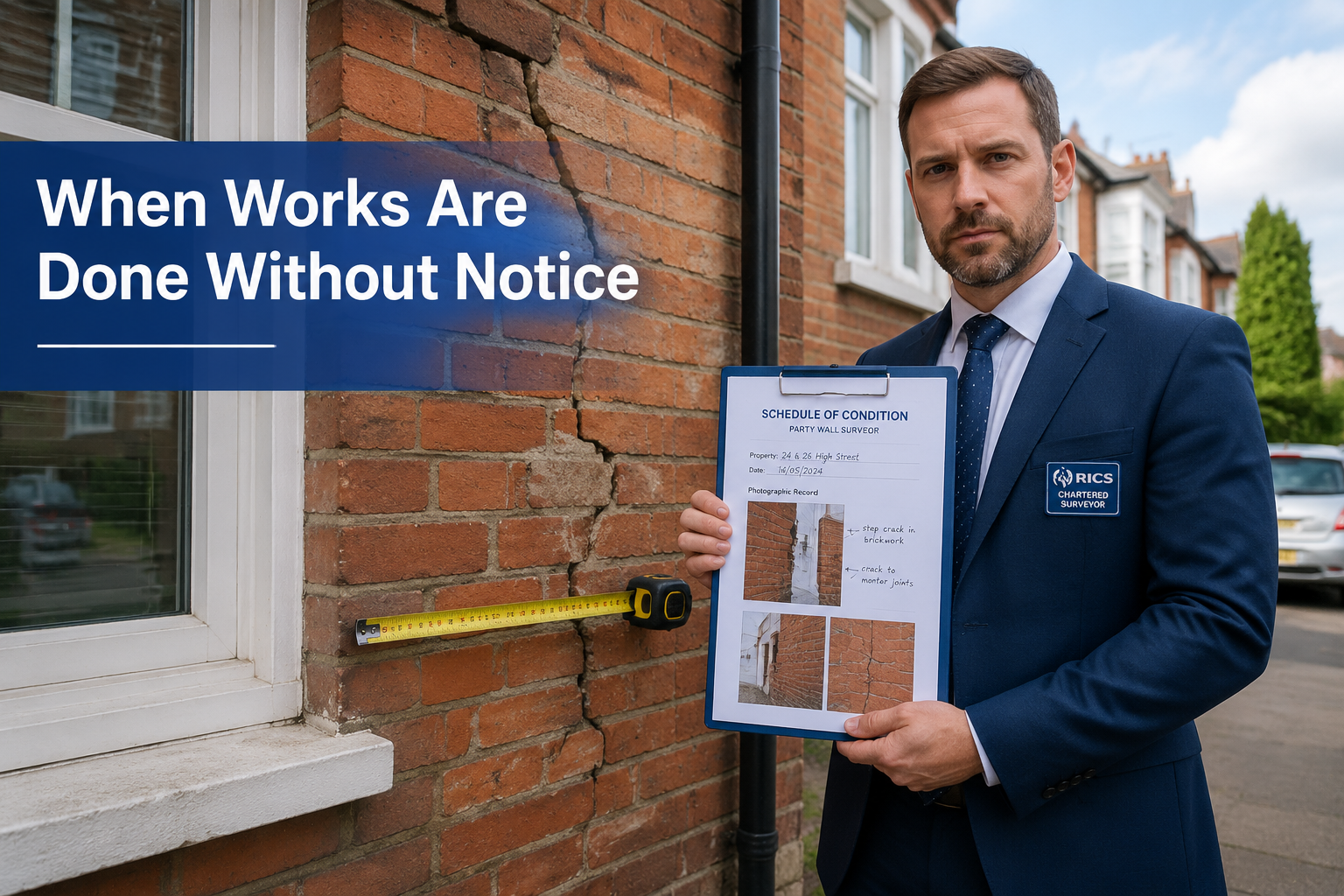
Not all retrospective situations are equal. Surveyors in 2026 typically encounter three distinct triggers, each carrying different risk profiles and resolution strategies. [4]
1. 🏗️ Unintended Oversight
The most common scenario. A homeowner undertakes a loft conversion or rear extension, genuinely unaware that the Party Wall etc. Act applies to their works. By the time a neighbour raises concerns — or a surveyor is consulted — the structural works are finished. This is particularly prevalent in loft conversions involving party wall obligations, where the interaction between roof timbers and shared walls often goes unrecognised.
Key risk: Without a pre-work Schedule of Condition, any cracks or damage discovered post-completion become a "he said, she said" dispute. Causation is extremely difficult to prove.
2. 🚨 Emergency Works
Occasionally, structural failure demands immediate intervention — a collapsed retaining wall, a dangerous chimney stack, or urgent underpinning. There is simply no time to serve a two-month notice and wait for a surveyor's Award. Emergency works may proceed, but a retrospective award should be formalised as soon as practically possible to document what was done and protect both parties. [4]
3. 🔍 Post-Completion Neighbour Disputes
The adjoining owner notices damage — hairline cracks, door frames out of square, damp penetration — weeks or months after the building owner's contractors have left site. They contact the building owner, who denies responsibility. A retrospective award process can provide an independent, documented assessment of whether the damage is attributable to the notifiable works. [4]
At-a-Glance: Scenario Comparison
| Scenario | Typical Trigger | Main Challenge | Retrospective Award Benefit |
|---|---|---|---|
| Unintended Oversight | Owner unaware of Act | No baseline condition record | Formalises liability framework |
| Emergency Works | Structural danger | Speed vs. compliance | Documents scope post-facto |
| Post-Completion Dispute | Neighbour raises damage | Causation proof | Independent damage attribution |
Retrospective Party Wall Awards in 2026: Surveyor Protocols for Post-Work Damage Claims and Compliance Fixes — Step by Step
The process for drawing up a retrospective award is more involved than a standard pre-work award. Here is the protocol that experienced surveyors follow in 2026.
Step 1: Establish Mutual Consent
Before any surveyor can act, both the building owner and the adjoining owner must agree to engage the retrospective process. [2] This is the critical distinction from a standard award, where the Act compels participation once a dispute is deemed to have arisen. In the retrospective context, there is no statutory compulsion — participation is voluntary.
If the building owner refuses to engage, the adjoining owner's options are:
- Negotiate directly (risky without professional support)
- Pursue a civil claim for nuisance or negligence
- Seek an injunction (expensive and rarely proportionate for minor damage)
Step 2: Appoint Surveyors
Once both parties consent, surveyor(s) must be appointed. There are two models: [2]
- Agreed Surveyor: A single, jointly appointed surveyor acts for both parties. This is faster and cheaper, but requires a high degree of mutual trust.
- Two Surveyors: Each party appoints their own surveyor. The two surveyors then collaborate to produce the Award. If they cannot agree, a Third Surveyor (pre-selected) makes the final determination.
In 2026, standard party wall surveyor rates run at £150–£200 per hour, with a typical award costing approximately £1,000 under straightforward circumstances. [2] Retrospective awards, given their complexity, routinely exceed this figure.
💡 Pro Tip: The building owner is responsible for paying surveyor costs in the majority of cases — including where the retrospective process was necessitated by their failure to serve notices. [2]
Step 3: Inspect the Completed Works
Surveyors conduct a thorough inspection of the completed works and the adjoining property. This is the most technically demanding phase of the retrospective process. The inspection covers:
- Structural integrity of the party wall, foundations, and any affected elements
- Visible damage — cracks, settlement, moisture ingress, displaced masonry
- Scope of works actually carried out vs. what a standard notice would have described
- Compliance with Building Regulations and any relevant planning conditions
For damage to property in party wall situations, the surveyor's inspection report becomes the primary evidence base for any subsequent claim.
Step 4: Prepare a Retrospective Schedule of Condition
This is the cornerstone document — and the one most painfully absent when no pre-work agreement was in place. [2]
A Schedule of Condition records the current state of the adjoining property with:
- Dated, high-resolution photographs
- Written notes describing existing cracks, defects, and structural features
- Reference measurements for any movement or displacement
- Copies provided to both parties
Without a pre-work baseline, the retrospective schedule can only document the current condition. Attributing specific damage to the notifiable works — rather than pre-existing deterioration or other causes — requires professional judgement and, sometimes, specialist structural investigation. [2]
For detailed guidance on what a proper schedule involves, see this schedule of condition guidance.
Step 5: Draft the Retrospective Award
The formal Award document must meet the same standards as a prospective Award under the Act. Under 2026 regulatory expectations, a legally enforceable party wall award must contain: [1]
- ✅ Clear identification of all parties and their properties
- ✅ Description of the works carried out (retrospective scope)
- ✅ Schedule of Condition (current state of adjoining property)
- ✅ Assessment of any damage and its likely cause
- ✅ Required remedial measures, timelines, and responsible party
- ✅ Costs allocation between parties
- ✅ Surveyor signatures and date of Award
Step 6: Implement Remedial Measures
Where damage is confirmed and attributed to the notifiable works, the Award will specify remedial works the building owner must carry out. These might include:
- Repointing or rebuilding sections of party wall
- Crack injection and structural repairs
- Redecoration of affected internal surfaces
- Underpinning or foundation stabilisation in severe cases
Timelines for completion should be realistic but firm. Delays in remediation can cause further deterioration, increasing costs and neighbour tensions.
The Real Cost of Skipping Notices: Case Risks in 2026
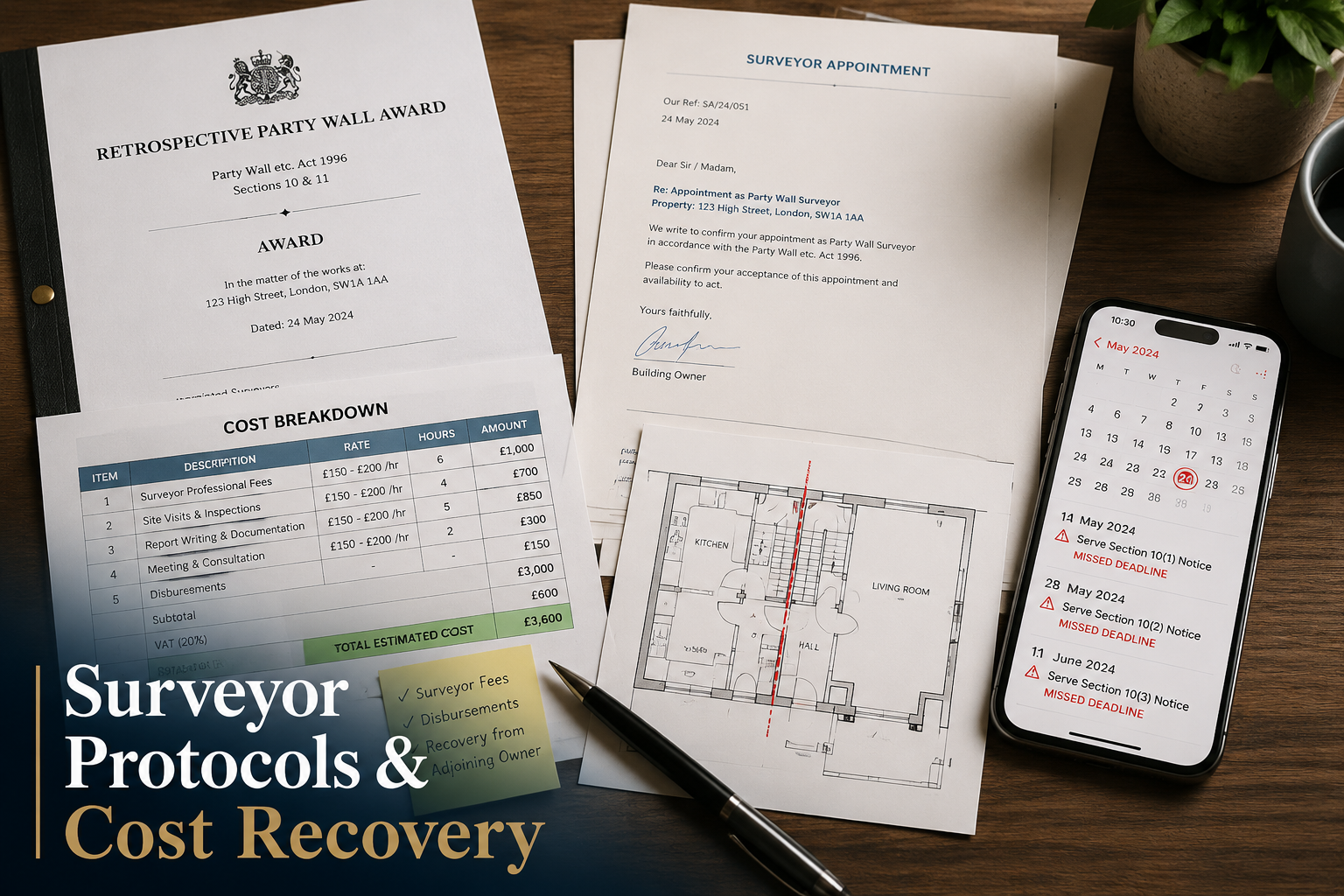
The financial and legal consequences of bypassing the formal notice process are significant — and in 2026, they are well-documented.
💰 Escalating Costs
Retrospective agreements are significantly more expensive and contentious than proactive arrangements. [5] Consider the compounding costs:
| Cost Element | Pre-Work Award | Retrospective Award |
|---|---|---|
| Surveyor fees | ~£1,000 | £1,500–£3,000+ |
| Remedial works | Prevented/minimised | Full repair costs |
| Legal advice | Rarely needed | Often required |
| Builder delay costs | £100–£300/day if notices served late | N/A (works done) |
| Neighbour relations | Preserved | Often damaged |
⚖️ Legal Exposure
A building owner who carries out notifiable works without serving notice is technically in breach of the Act. While the Act itself does not create a criminal offence, the adjoining owner can seek an injunction in the County Court to halt works — or, post-completion, to compel remediation. [7]
If the adjoining owner can demonstrate that the lack of a pre-work Schedule of Condition has prejudiced their ability to prove damage, courts have shown sympathy for their position. This can result in the building owner bearing a higher burden of proof to demonstrate that damage pre-existed their works.
🏠 A Cautionary Scenario
Consider a homeowner in a semi-detached property who undertakes rear extension works — including excavation within three metres of the neighbour's foundations — without serving notice. (For reference on excavation thresholds, see the Party Wall 3-metre rule.) Six months later, the neighbour notices significant cracking to their rear kitchen wall and contacts a surveyor.
Without a pre-work Schedule of Condition, the building owner cannot prove the cracks pre-existed their excavation. The retrospective award process reveals that the cracks are consistent with differential settlement caused by the excavation. The building owner faces: surveyor fees for both parties, structural repair costs of £8,000–£12,000, and a strained neighbourly relationship that persists for years.
Had notices been served and a Schedule of Condition prepared, the scope of liability would have been clear from day one — and preventive measures could have been specified in the Award before a single spade entered the ground.
Compliance Fixes: What Surveyors Recommend in 2026
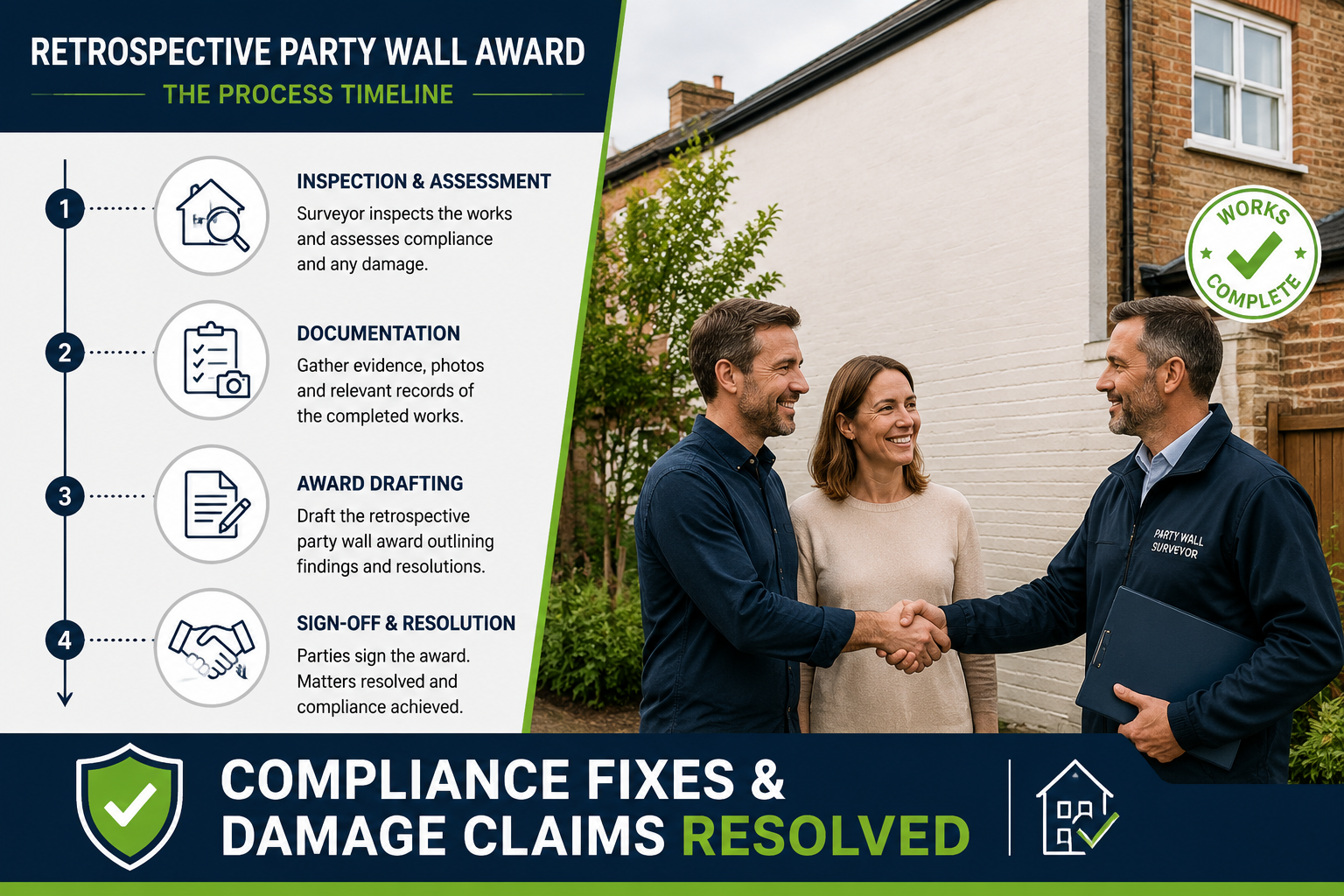
For building owners who discover mid-project or post-completion that they should have served notices, surveyors recommend the following compliance pathway.
Immediate Steps
- Stop any ongoing works that could cause further damage or complicate the retrospective process
- Do not attempt to conceal or repair damage before a surveyor has inspected — this can be interpreted as an admission of liability and destroys evidence
- Contact a qualified party wall surveyor immediately — look for RICS-accredited professionals with specific party wall experience
- Notify the adjoining owner proactively and in writing — demonstrating good faith significantly improves the prospects of a consensual retrospective process
For Adjoining Owners
If a neighbour has carried out works without a party wall agreement and damage has occurred:
- Document everything — photograph all damage with timestamps immediately
- Do not carry out your own repairs until a surveyor has inspected and the cause is established
- Request a retrospective award process in writing — create a paper trail
- Seek independent surveyor advice before agreeing to any settlement offered directly by the building owner
When to Seek Party Wall Consent Proactively
The clearest lesson from retrospective cases is that proactive consent is always preferable. [10] Even where works have already begun, pausing to formalise arrangements — however belatedly — is better than pressing on and hoping for the best. A chartered surveyor can advise on the most appropriate route depending on the stage of works and the nature of the relationship with the adjoining owner.
Conclusion: Act Retrospectively, But Act Quickly
Retrospective party wall awards are a pragmatic lifeline when the formal notice process has been missed — but they are not a consequence-free alternative to doing things right from the start. The process demands mutual consent, professional surveyor involvement, rigorous documentation, and a willingness to fund remediation where damage is confirmed.
Actionable next steps for 2026:
- 🔎 Building owners: If works are planned, serve notices before breaking ground. If works are done, engage a surveyor immediately and approach the retrospective process in good faith.
- 🏠 Adjoining owners: Document damage thoroughly, seek independent advice, and request a formal retrospective award rather than accepting informal assurances.
- 📋 Both parties: Understand that a Schedule of Condition — even a retrospective one — is the single most important document in any party wall dispute.
- 💼 Always use RICS-accredited surveyors with demonstrable party wall experience to ensure the Award will withstand scrutiny if challenged.
The cost of getting it wrong — financially, legally, and relationally — far exceeds the cost of getting it right.
References
[1] Evergreen Guide To Party Wall Awards Drafting Enforceable Agreements Under 2026 Regulatory Updates – https://nottinghillsurveyors.com/blog/evergreen-guide-to-party-wall-awards-drafting-enforceable-agreements-under-2026-regulatory-updates
[2] Party Wall Agreement – https://hoa.org.uk/advice/guides-for-homeowners/i-am-improving/party-wall-agreement/
[3] Party Wall Awards Explained Surveyor Roles Notice Periods And Dispute Resolution Under 2026 RICS Guidance – https://wimbledonsurveyors.com/party-wall-awards-explained-surveyor-roles-notice-periods-and-dispute-resolution-under-2026-rics-guidance/
[4] Can A Retrospective Party Wall Award Be Agreed Without Notices Being Served – https://www.tayross.com/blogs/can-a-retrospective-party-wall-award-be-agreed-without-notices-being-served
[5] Party Wall Notices In 2026 Housing Recovery Timing Strategies For First Time Buyer Extensions – https://princesurveyors.co.uk/blog/party-wall-notices-in-2026-housing-recovery-timing-strategies-for-first-time-buyer-extensions/
[6] Retrospective Party Wall Awards – https://www.coburnspartywall.co.uk/retrospective-party-wall-awards.html
[7] Party Wall Awards Explained Enforcing Agreements And Avoiding Injunctions In 2026 – https://www.canterburysurveyors.com/blog/party-wall-awards-explained-enforcing-agreements-and-avoiding-injunctions-in-2026/
[8] Retrospective Party Wall Agreements In 2026 Surveyor Protocols For Resolving Unnotified Works And Damage Claims – https://kingstonsurveyors.com/retrospective-party-wall-agreements-in-2026-surveyor-protocols-for-resolving-unnotified-works-and-damage-claims/
[9] Party Wall Retrospective Agreements Resolving Disputes After Works Complete Surveyor Protocols And Client Recovery Strategies – https://nottinghillsurveyors.com/blog/party-wall-retrospective-agreements-resolving-disputes-after-works-complete-surveyor-protocols-and-client-recovery-strategies
[10] Party Wall Agreements Vs Formal Awards When Adjoining Owners Consent And How To Draft Binding Settlements In 2026 – https://partywallsurveyorlondon.uk/blogs/party-wall-agreements-vs-formal-awards-when-adjoining-owners-consent-and-how-to-draft-binding-settlements-in-2026/