Over 1 million construction projects in England and Wales are affected by the Party Wall etc. Act 1996 every year — yet a significant proportion of property owners still begin notifiable works without proper legal protection in place. Party Wall Awards by Chartered Building Surveyors: RICS Services, Fee Structures, and Case Studies for 2026 represent the gold standard of compliance, dispute prevention, and professional accountability in shared-boundary construction. With RICS actively consulting on the 8th edition of its Party Wall Legislation and Procedure guidance in 2026 [4], this is a pivotal moment for property owners, developers, and surveyors alike to understand exactly how these awards work, what they cost, and what they protect.

Key Takeaways 📋
- A Party Wall Award is a legally binding document comprising three parts: the award itself, a schedule of condition, and construction drawings — all governed by the Party Wall etc. Act 1996.
- RICS-regulated chartered building surveyors provide the highest standard of party wall services, with updated 2026 guidance under active consultation.
- Fees vary significantly depending on whether an agreed surveyor or two separate surveyors are appointed, with typical costs ranging from £700 to £3,000+.
- Integrating party wall services with structural surveys can reduce overall project costs and improve efficiency — a model used by leading firms across England.
- Proceeding without a Party Wall Award exposes building owners to injunctions, compensation claims, and project delays.
What Is a Party Wall Award and Why Does It Matter in 2026?
A Party Wall Award (also called a "party wall agreement" in common usage, though technically distinct) is the formal legal instrument that governs how notifiable construction works near or on a shared boundary must be carried out. It is produced by two party wall surveyors — one appointed by each property owner — or by a single "agreed surveyor" acting impartially for both parties [6].
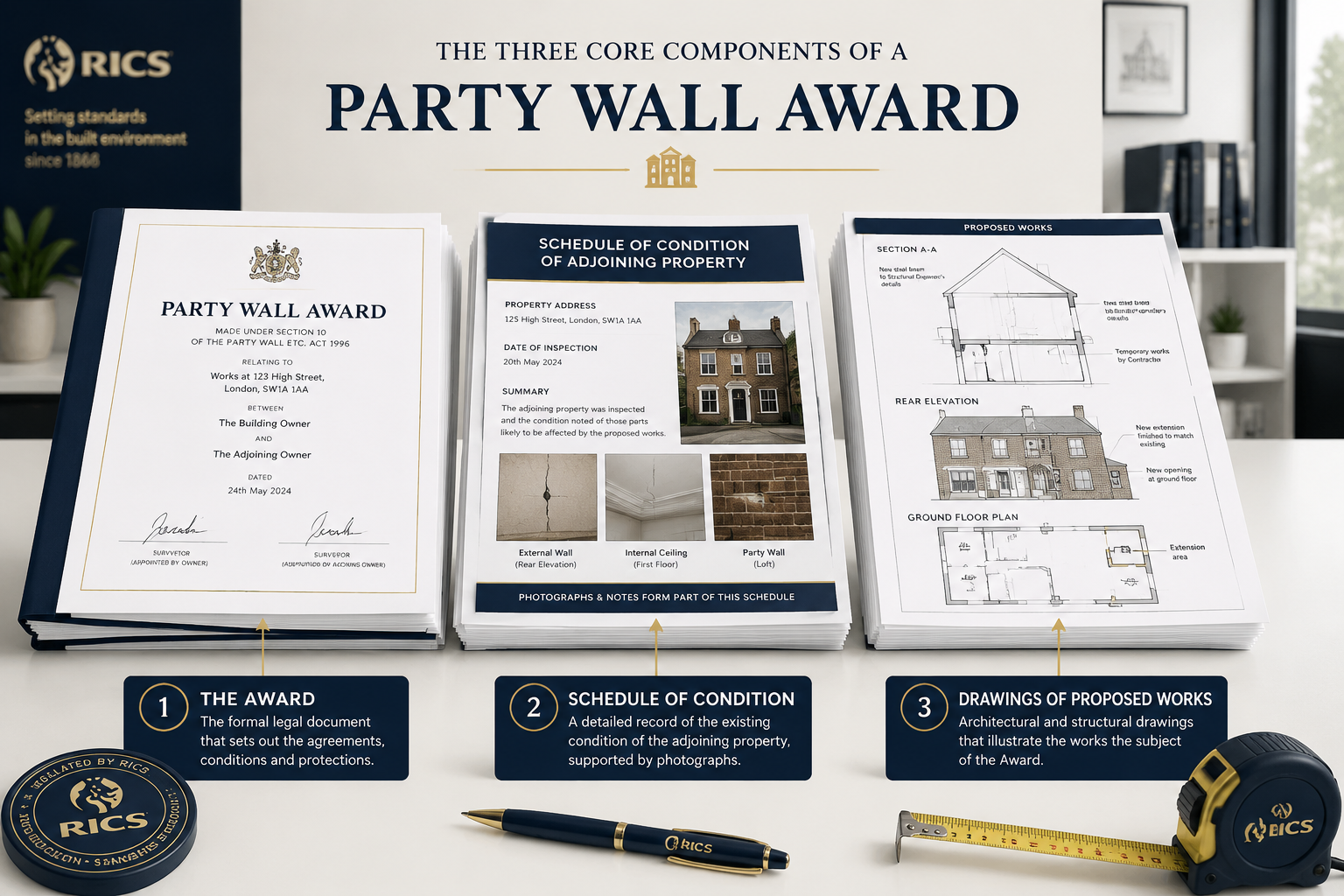
The award contains three core components [6]:
- The Award itself — sets out the rules, conditions, and permissions governing the proposed works
- A Schedule of Condition — a photographic and written record of the adjoining property's pre-works condition
- Construction Drawings — detailed plans showing the scope and nature of the proposed works
💡 "The Schedule of Condition is arguably the most protective element of a Party Wall Award — it creates an indisputable baseline if damage claims arise after works are completed."
For a deeper understanding of the schedule of condition process and its importance, property owners should review current RICS guidance before serving any notices.
When Is a Party Wall Award Required?
The Party Wall etc. Act 1996 applies to three main categories of work:
| Work Type | Example | Notice Required |
|---|---|---|
| Works on or to a party wall | Removing a chimney breast, inserting a beam | Yes — Party Structure Notice |
| Excavation near a neighbour's foundations | Basement conversions, new footings within 3–6m | Yes — Notice of Adjacent Excavation |
| New walls at or astride the boundary | Garden walls, extensions to the boundary line | Yes — Line of Junction Notice |
Understanding what triggers a party wall agreement is the first step for any property owner planning significant building works.
RICS Services and the 2026 Regulatory Landscape for Party Wall Awards by Chartered Building Surveyors
RICS Consultation on the 8th Edition Practice Guidance
In a significant development for the profession, RICS launched a formal consultation on the draft 8th edition of Party Wall Legislation and Procedure during April and May 2026 [4]. The consultation targets surveyors, legal professionals, and dispute resolution practitioners across England and Wales, with the explicit aim of supporting competence and consistency in party wall professional work [1].
Stakeholders with input can contact RICS directly at Khicks@rics.org [4]. This level of engagement signals that 2026 represents a watershed year for party wall practice standards.
A new Party Wall Guide was also highlighted at the RICS 2026 Conference on May 7th [5], reinforcing the profession's commitment to raising the bar for practitioners. The RICS May 2026 Newsletter [2] further confirmed these developments as priority items for the chartered surveying community.
Why Choose an RICS-Regulated Surveyor?
Not all party wall surveyors carry the same level of professional accountability. Choosing an RICS chartered building surveyor provides several distinct advantages:
- ✅ Mandatory professional indemnity insurance
- ✅ Adherence to the RICS Rules of Conduct
- ✅ Access to the RICS Dispute Resolution Service
- ✅ Continuous professional development requirements
- ✅ Regulated fee transparency standards
RICS-regulated firms operating across England — from chartered surveyors in London to regional specialists — must follow the same professional standards, ensuring consistent quality regardless of location.
Integration with Structural Surveys: A Cost-Effective Model
One of the most underutilised strategies in residential and commercial construction is the integration of party wall services with structural building surveys. Leading RICS firms now offer combined packages that pair party wall award preparation with RICS Level 3 Building Surveys, creating a single, cohesive assessment of both the proposed works and the existing condition of all affected structures.
Why does this matter? Because a structural survey conducted before works begin can:
- Identify pre-existing defects that might otherwise be blamed on construction
- Inform the Schedule of Condition with greater technical depth
- Reduce the likelihood of post-works disputes
- Provide the building owner with a comprehensive risk picture
Firms like RSL Law (a legal practice working alongside RICS surveyors) have championed this integrated model, pairing legal notice preparation with technical surveying to deliver end-to-end party wall compliance at a lower combined cost than engaging separate professionals. This approach reflects a broader industry trend toward multidisciplinary project management that benefits both building owners and adjoining owners.
Fee Structures for Party Wall Awards by Chartered Building Surveyors: RICS Services in 2026
Understanding How Fees Are Calculated
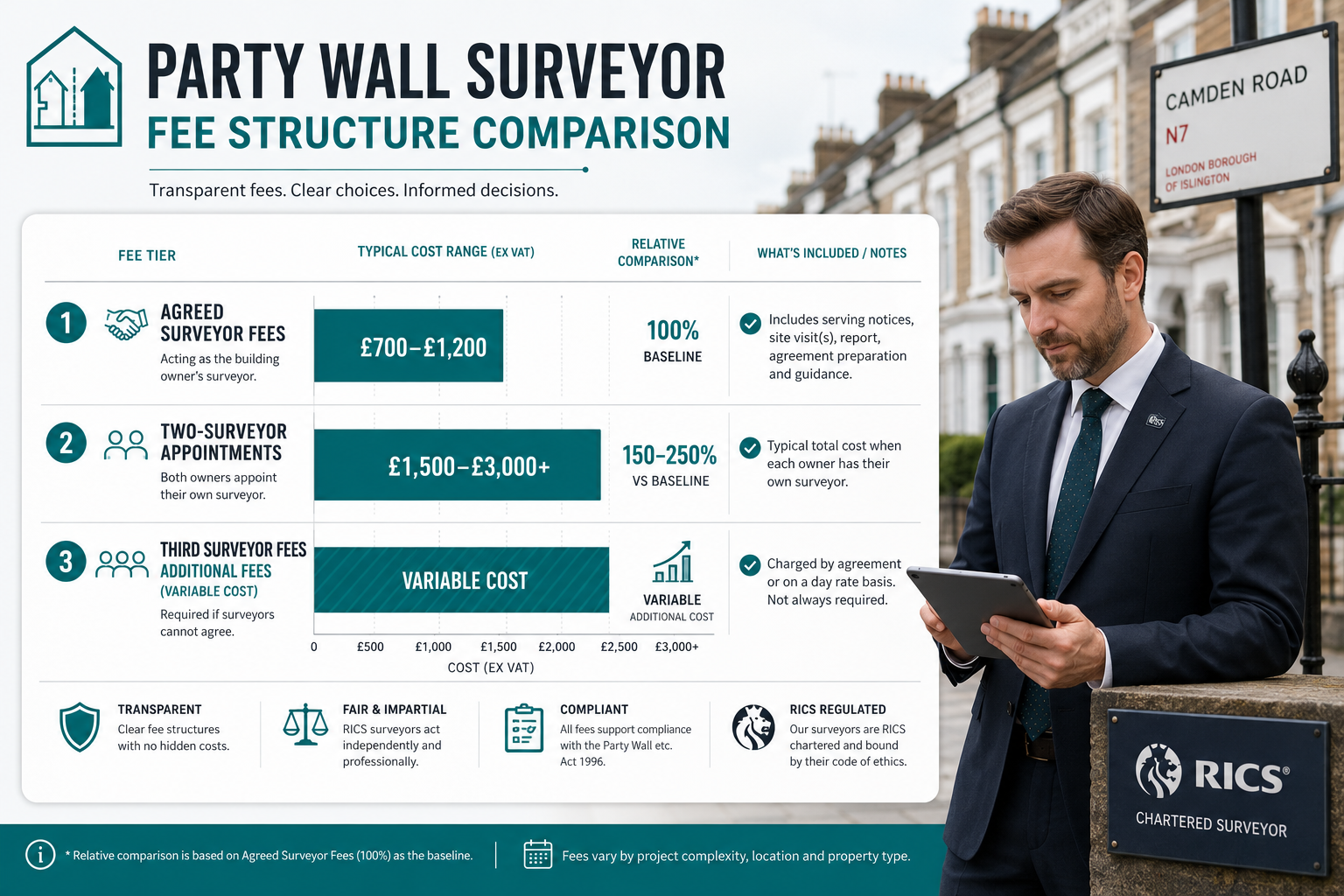
Party wall surveyor fees in 2026 are not fixed by statute. Instead, they reflect the complexity of the works, the number of adjoining owners, and the appointment structure chosen [3]. The two primary models are:
1. Agreed Surveyor Model (Single Appointment)
Both the building owner and adjoining owner agree to appoint one impartial surveyor to act for both parties. This is the most cost-effective route.
- Typical fee range: £700 – £1,200 for straightforward residential works
- Best suited to: simple loft conversions, single-storey extensions, minor structural works
- Advantage: faster process, lower combined cost, single point of contact
2. Two-Surveyor Model (Separate Appointments)
Each party appoints their own surveyor. If the two surveyors cannot agree, they jointly select a Third Surveyor to adjudicate.
- Building owner's surveyor fee: £800 – £1,500+
- Adjoining owner's surveyor fee: £600 – £1,200+ (typically paid by the building owner)
- Third surveyor fee (if required): £1,500 – £3,000+ per dispute
- Best suited to: complex works, contentious neighbourly relationships, high-value properties
What Drives Costs Higher?
| Cost Factor | Impact on Fees |
|---|---|
| Multiple adjoining owners | Each owner may require separate appointment |
| Basement or excavation works | Higher complexity = higher fees |
| Damage claims arising during works | Additional inspection and report fees |
| Third surveyor referrals | Significant additional cost |
| Urgent or expedited awards | Premium rates may apply |
⚠️ Important: The building owner is almost always responsible for paying both surveyors' reasonable fees. This is a statutory requirement under the Party Wall etc. Act 1996.
What Happens If You Skip the Award?
Proceeding without a valid Party Wall Award is a serious legal risk. Failing to obtain a party wall agreement can result in:
- Court injunctions halting works mid-project
- Compensation claims for damage to adjoining properties
- Significant legal costs
- Delays of weeks or months to construction programmes
If a neighbour is already carrying out works without a party wall agreement, adjoining owners have legal remedies available — but acting quickly is essential.
Case Studies: Party Wall Awards in Practice for 2026
Case Study 1: Loft Conversion in a Victorian Terraced Row — Manchester
Project: A homeowner in a mid-terrace Victorian property planned a full loft conversion involving steel beam installation through the party wall.
Challenge: Two adjoining owners on either side, both requiring separate notices and potential separate surveyor appointments.
Solution: The building owner engaged an RICS chartered building surveyor who proposed the agreed surveyor model to both neighbours. One neighbour consented; the other appointed their own surveyor.
Outcome:
- One Party Wall Award produced under the agreed surveyor model (fee: £950)
- One Award produced under the two-surveyor model (combined fee: £2,100)
- Schedule of Condition completed for both properties with photographic records
- Works completed without dispute; pre-existing crack in neighbour's plasterwork documented and excluded from any post-works claim
Key lesson: Proactive engagement with neighbours before serving formal notices significantly increases the likelihood of the agreed surveyor model being accepted.
Case Study 2: Basement Excavation in a London Townhouse — West London
Project: A developer in West London planned a full basement excavation beneath a semi-detached property, with new footings within 3 metres of the adjoining owner's foundations.
Challenge: The adjoining owner was concerned about structural damage and appointed their own surveyor immediately upon receiving notice.
Solution: The developer's RICS-regulated firm commissioned a specific defect survey of the shared wall prior to works, integrating findings into the Schedule of Condition. A structural engineer's report was also included in the award documentation.
Outcome:
- Full Party Wall Award produced within 6 weeks of notice
- Detailed monitoring regime agreed (crack gauges installed on party wall)
- Minor cracking appeared during works — the pre-works Schedule of Condition confirmed it was pre-existing
- Damage to property in party wall claim avoided; project completed on schedule
- Combined surveying and party wall fees: £4,200 (two-surveyor model, complex works)
Key lesson: Investing in a thorough pre-works condition survey is the single most effective way to protect against post-works damage claims.
Case Study 3: Commercial Extension — Integration of Party Wall and Building Survey Services
Project: A commercial property owner in the Home Counties planned a rear extension that would involve building up to the boundary line and modifying a shared garden wall.
Solution: The owner's RICS firm offered an integrated package combining party wall notice preparation, award drafting, and a full RICS building survey of the existing structure.
Outcome:
- Party Wall Award produced under agreed surveyor model (fee: £1,100)
- Building survey identified a pre-existing drainage defect unrelated to proposed works — saving the owner from a potential future dispute
- Total combined fee: £2,800 (versus an estimated £3,500+ if services had been procured separately)
Key lesson: The integrated RICS service model delivers measurable cost savings and reduces professional coordination risk.
Frequently Asked Questions About Party Wall Awards 🔍
Q: How long does a Party Wall Award take to produce?
Once notice is served, the adjoining owner has 14 days to respond. If they dissent or fail to respond, the surveyor appointment process begins. Awards are typically produced within 4–8 weeks of the dissent, though complex cases can take longer.
Q: Can a Party Wall Award be appealed?
Yes. Either party may appeal a Party Wall Award to the County Court within 14 days of receiving it. Appeals are relatively rare but do occur in high-value or contentious cases.
Q: Does a Party Wall Award expire?
Awards do not have a fixed expiry date, but works must generally commence within 12 months of the award being made, or a fresh notice may be required.
For answers to more common questions, the party wall FAQ resource provides clear, plain-English guidance.
Conclusion: Actionable Next Steps for Property Owners in 2026
Party Wall Awards by Chartered Building Surveyors: RICS Services, Fee Structures, and Case Studies for 2026 demonstrate that professional compliance is not a bureaucratic hurdle — it is a genuine shield against costly disputes, legal delays, and neighbourly conflict.
With RICS actively updating its practice guidance through the 8th edition consultation [4] and new guidance highlighted at the 2026 Conference [5], this is the year to ensure that any planned works are handled by a properly regulated professional.
Your Next Steps ✅
- Determine if your works are notifiable under the Party Wall etc. Act 1996 — when in doubt, consult an RICS chartered building surveyor early.
- Serve notices at the right time — typically 1–2 months before works begin (2 months for excavation works).
- Explore the agreed surveyor model with your neighbour before formal notice — it saves time and money for both parties.
- Integrate party wall services with a structural survey to create a comprehensive pre-works record and reduce overall professional fees.
- Choose an RICS-regulated surveyor to ensure accountability, insurance protection, and compliance with the latest 2026 practice standards.
The cost of getting a Party Wall Award right is always lower than the cost of getting it wrong.
References
[1] James Kavanagh — RICS Launches Consultation on Updated Party Wall Practice Guidance – https://www.linkedin.com/posts/james-kavanagh-65448b17_rics-launches-consultation-on-updated-party-activity-7448044807869988865-vPZF
[2] RICS Newsletter 7 May 2026 – https://www.linkedin.com/pulse/rics-newsletter-7-may-2026-rics-jxyte
[3] Party Wall Surveyor Cost — HomeOwners Alliance – https://hoa.org.uk/advice/guides-for-homeowners/i-am-improving/party-wall-surveyor-cost/
[4] RICS Launches Consultation on Updated Party Wall Practice Guidance – https://www.rics.org/news-insights/rics-launches-consultation-on-updated-party-wall-practice-guidance
[5] Coopers Building Surveyors — RICS 2026 Conference May 7th – https://www.linkedin.com/posts/coopersbuildingsurveyors_rics-2026-conference-may-7th-i-am-very-activity-7424420997174403072-cvoV
[6] What Is a Party Wall Award — Redmond Associates – https://redmondassociates.co.uk/surveying/party-wall/what-is-a-party-wall-award