A thread on a popular UK home improvement subreddit recently racked up over 400 comments after a homeowner asked a deceptively simple question: "Do I need a party wall notice just to chase a cable into my kitchen wall?" The answers ranged from "absolutely not" to "you could be sued" — and almost none of them were fully correct. This confusion sits at the heart of Chasing Party Wall Structures: RICS Guidance on Drilling, Fixing, and Notifiable Works Without Full Awards in 2026, a topic that affects thousands of homeowners and contractors every year.
The Party Wall etc. Act 1996 draws a clear but often misunderstood line between routine maintenance and notifiable works. Getting that line wrong — in either direction — can lead to disputes, delays, and costly legal proceedings. With RICS actively consulting on its 8th edition of Party Wall Legislation and Procedure guidance in 2026 [1], there has never been a better moment to clarify exactly where chasing, drilling, and minor fixing works stand.
Key Takeaways
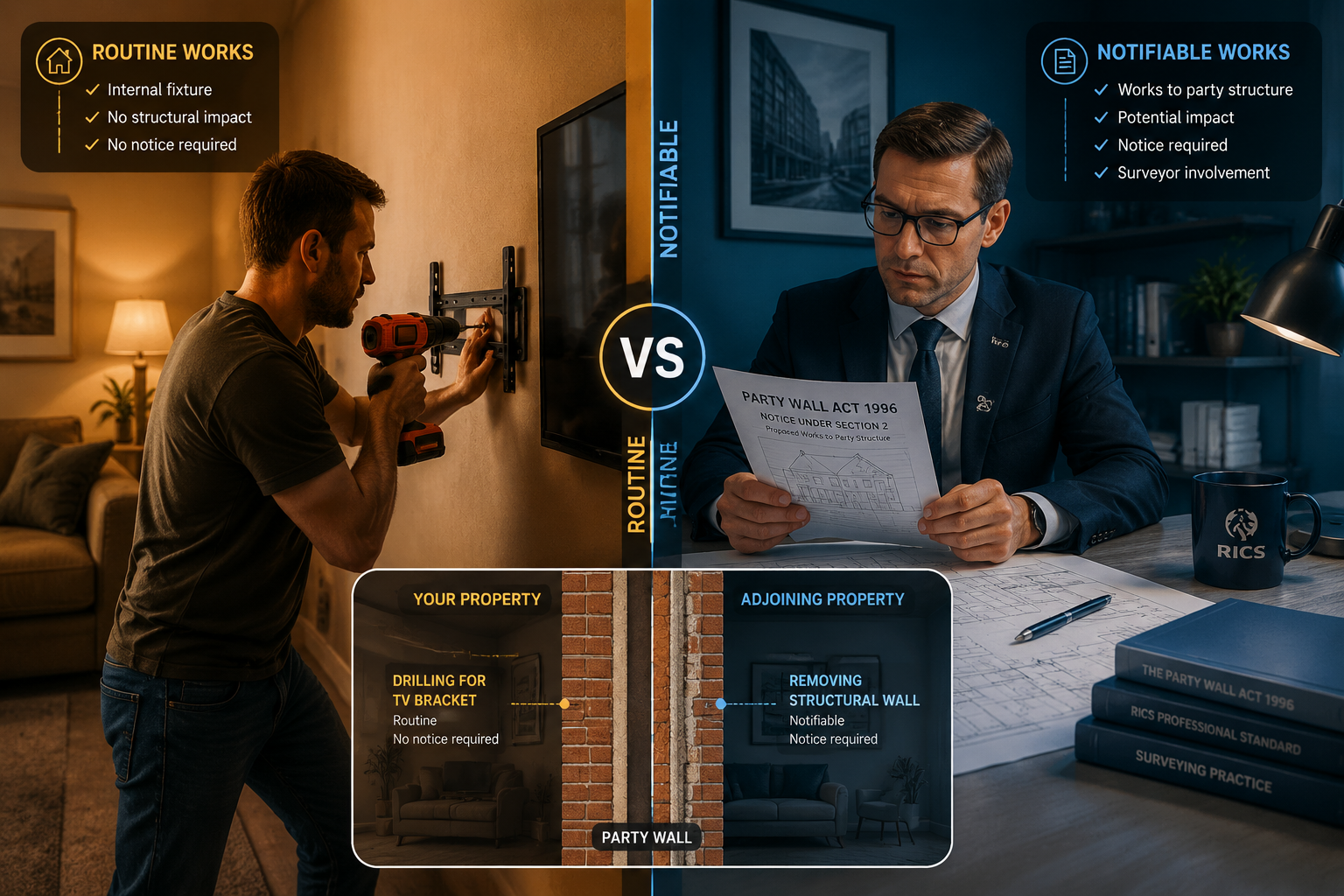
- 🔩 Not all drilling or chasing into a party wall triggers the Party Wall Act — depth, structural impact, and wall type are the deciding factors.
- 📋 RICS is consulting on its 8th edition guidance (April–May 2026), which will update professional standards for party wall practice across England and Wales [1].
- ⚠️ Working without a required award carries serious legal and financial risk, including injunctions and liability for neighbour damage.
- ✅ A Schedule of Condition report is a practical, low-cost tool that protects both parties even when a full award is not required.
- 🏗️ The current benchmark remains the RICS 7th edition (January 2022) until the 8th edition is formally published [3].
What the Party Wall Act Actually Covers (and What It Doesn't)
The Party Wall etc. Act 1996 applies in England and Wales and governs three main categories of work:
- Works to an existing party wall or structure (Section 2)
- New building on or at the boundary line (Section 1)
- Excavation near a neighbouring building's foundations (Section 6)
The critical word in everyday disputes is "works" — and the Act is specific about what qualifies. Section 2 lists notifiable works including cutting into a party wall, raising or underpinning it, demolishing and rebuilding it, and inserting a damp proof course. What it does not automatically include is every drill hole or surface chase.
"The Act is not triggered by every interaction with a party wall — it is triggered by works of a structural or potentially damaging nature."
— RICS 7th Edition Guidance, January 2022 [3]
The Chasing Question: Depth and Intent Matter
Chasing refers to cutting a channel (a "chase") into a wall surface to conceal pipes, cables, or conduits. Whether this triggers the Act depends on several factors:
| Factor | Low Risk (Likely Not Notifiable) | Higher Risk (Potentially Notifiable) |
|---|---|---|
| Depth of chase | Surface plaster only (≤25mm) | Into the masonry or brick leaf |
| Wall type | Single-leaf non-structural | Structural party wall |
| Chase length | Short horizontal runs | Long vertical or deep horizontal runs |
| Proximity to joints | Away from mortar joints | Through or adjacent to structural joints |
| Purpose | Cosmetic cable concealment | Structural fixing or pipe insertion |
As a general principle, chasing into the plaster finish only of a party wall — without breaking into the masonry — is widely considered routine maintenance and does not require a party wall notice. However, chasing into the brick or block work of a party wall, particularly for runs longer than a metre or at significant depth, enters notifiable territory.
This is exactly the nuance that online forums routinely miss. The RICS helpline regularly fields calls from surveyors and homeowners confused about precisely this boundary [4].
RICS Guidance in 2026: The 8th Edition Consultation and Current Standards
Where the Guidance Stands Right Now
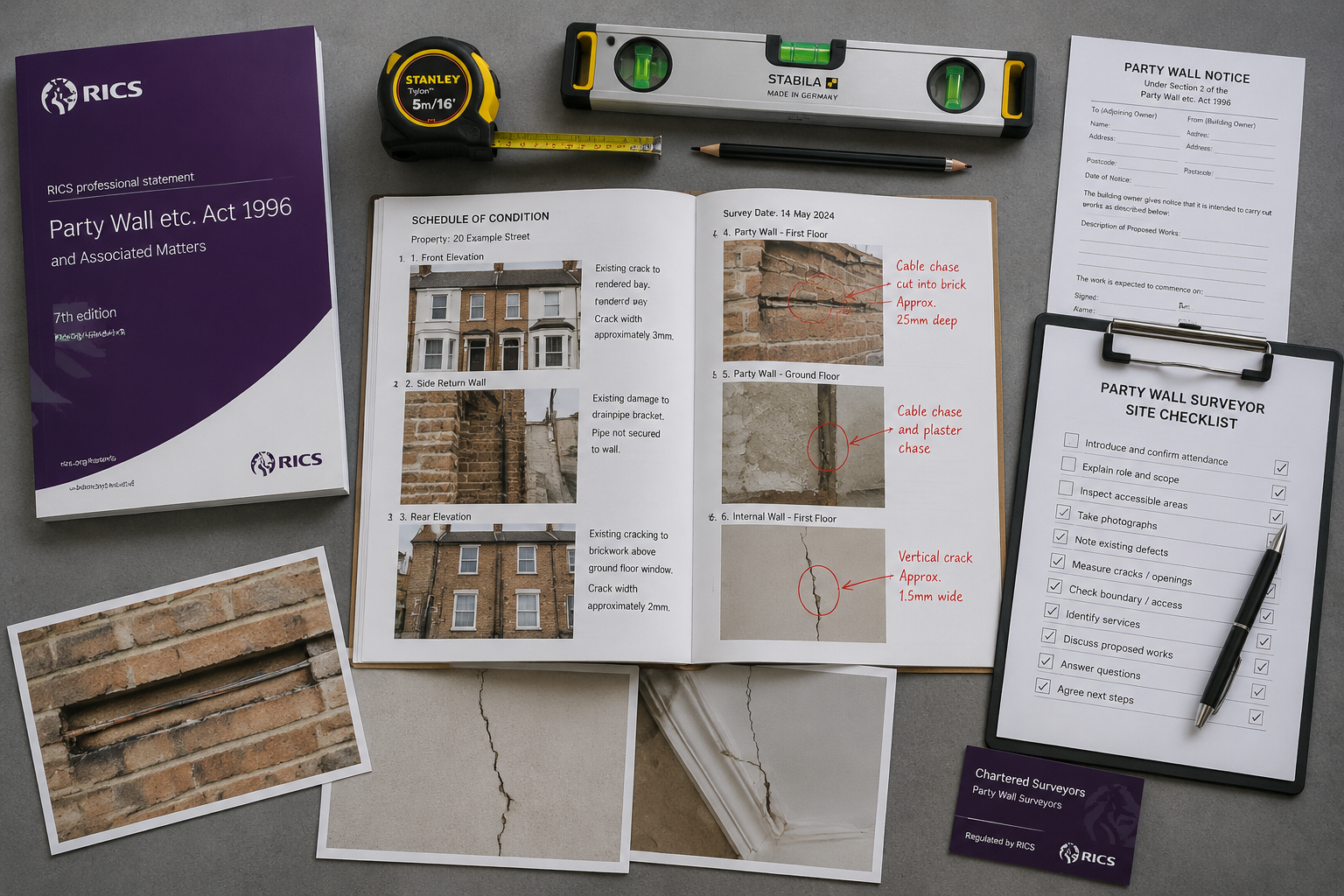
The current authoritative benchmark for party wall practice is the RICS 7th Edition of Party Wall Legislation and Procedure, published in January 2022 [3]. This guidance note sets out professional standards for chartered surveyors acting under the Act, covering everything from serving notices correctly to drafting awards and handling disputes.
In April 2026, RICS launched a formal consultation on the 8th edition of this guidance [1]. The eight-week consultation window (running through May 2026) targets surveyors, legal professionals, and dispute resolution practitioners working in England and Wales [1]. The goal is to establish updated, uniform professional standards that reflect how party wall practice has evolved — including the growing volume of minor works disputes that stem from exactly the kind of chasing and drilling confusion described above [5].
Until the 8th edition is formally published, the 7th edition remains the operative standard for all party wall practitioners [3].
What the 8th Edition Is Expected to Address
While the full consultation draft is not publicly released, commentary from industry professionals on LinkedIn and within the surveying community [2][5] suggests the 8th edition will likely:
- Provide clearer guidance on minor and incidental works that sit near the Act's threshold
- Update advice on Schedule of Condition reports and their role in low-risk works
- Reflect changes in dispute resolution practice since 2022
- Improve consistency in how surveyors advise clients on notifiable versus non-notifiable works
For anyone involved in Chasing Party Wall Structures: RICS Guidance on Drilling, Fixing, and Notifiable Works Without Full Awards in 2026, monitoring the 8th edition's publication is essential professional due diligence.
The Role of a Chartered Surveyor
Navigating these distinctions is precisely why engaging an RICS Chartered Building Surveyor adds genuine value. A qualified professional can assess the specific wall construction, the proposed works, and the applicable section of the Act — and give a defensible opinion on whether a notice is required. This is not a job for a forum thread.
Notifiable vs. Non-Notifiable: A Practical Checklist for 2026
The following checklist is designed for homeowners and contractors assessing whether proposed chasing, drilling, or fixing works require a party wall notice. It reflects the current 7th edition standards [3][4] and should be reviewed against the 8th edition once published.
🔍 Step 1 — Identify the Wall Type
- Is the wall a party wall (shared with a neighbour) or a party fence wall (boundary wall, not part of a building)?
- Is it a party structure (e.g., a floor or ceiling between flats)?
- Is it a load-bearing wall or a non-structural partition?
If the wall is not a party wall or structure as defined by the Act, the Act does not apply at all.
🔍 Step 2 — Assess the Work Proposed
Likely NOT notifiable:
- ✅ Drilling holes for picture hooks, curtain rails, or TV brackets (standard fixings)
- ✅ Surface chasing into plaster only for cables (≤25mm depth, not into masonry)
- ✅ Replacing like-for-like fixtures (e.g., sockets, switches) in existing chases
- ✅ Painting, plastering, or surface decoration
Likely NOTIFIABLE under Section 2:
- ❌ Chasing into the masonry of a party wall for pipes or conduits
- ❌ Cutting away or breaking out any part of the party wall
- ❌ Inserting a damp proof course through a party wall
- ❌ Underpinning or raising the party wall
- ❌ Cutting in flashings or inserting beams into the party wall
🔍 Step 3 — Consider the Risk Even If Not Notifiable
Even when works are technically below the Act's threshold, the risk of damage to a neighbouring property remains real. Vibration from drilling, weakening of plaster bonds, and accidental over-drilling can all cause harm that a neighbour may pursue through civil law — regardless of whether the Act applies.
Best practice: Commission a Schedule of Condition report before any works near a party wall, notifiable or not. This creates a dated photographic and written record of the neighbour's property condition, providing clear evidence if a dispute arises later.
What Happens If You Get It Wrong?
Working Without a Required Award
Proceeding with notifiable works without serving the correct notice and obtaining either the neighbour's written consent or a formal party wall award is a serious mistake. The consequences include:
- Injunctions — a court can order works to stop immediately
- Mandatory reinstatement — the building owner may be ordered to undo completed works
- Damages — liability for any loss or damage suffered by the adjoining owner
- Increased costs — retrospective awards and legal fees can far exceed the original cost of serving notice
The question of what happens if you do not have a party wall agreement is one of the most common — and most urgent — queries surveyors receive.
The "Agreed Surveyor" Route for Minor Works
Where works are notifiable but relatively minor, the Act allows both parties to appoint a single agreed surveyor rather than each appointing their own. This is a faster and cheaper route to a valid award. For simple chasing works that do cross the notifiable threshold, an agreed surveyor can often produce an award efficiently — protecting both parties without the full cost of a contested process.
Practical Guidance for Specific Scenarios
Scenario A: Chasing for a New Radiator Pipe 🔧
A homeowner wants to run a new central heating pipe from a boiler on an internal wall, chasing through the party wall to reach a radiator on the other side.
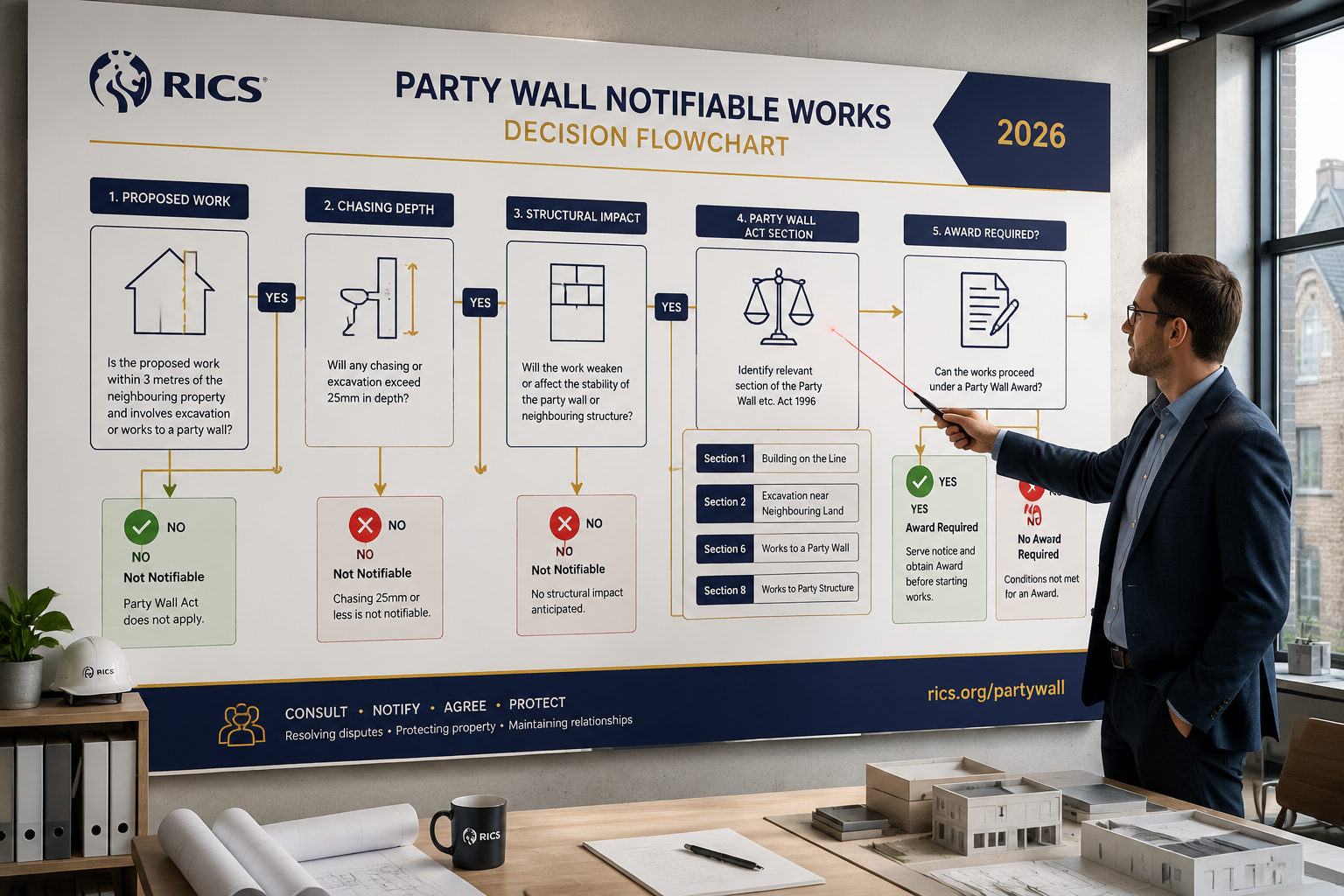
Assessment: This involves cutting through the full thickness of the party wall — clearly notifiable under Section 2(2)(f) of the Act. A party wall notice must be served at least one month before works begin. If the neighbour consents in writing within 14 days, no award is needed. If not, surveyors must be appointed.
Scenario B: Fixing a TV Bracket 📺
A homeowner drills four 60mm holes into a party wall to fix a heavy TV bracket using wall plugs and bolts.
Assessment: Standard fixings into a party wall, even relatively deep ones, are generally considered routine and not notifiable — provided they do not cut away or remove material from the wall structure. However, if the wall is unusually thin or the fixings are into a structural joint, professional advice is warranted. A structural survey can confirm wall construction before works proceed.
Scenario C: Chasing for an Electric Cable 💡
An electrician wants to chase a 20mm-deep channel horizontally across 2 metres of a party wall to conceal a new circuit cable.
Assessment: This is the grey area most commonly debated. If the chase is into plaster only, it is likely not notifiable. If it breaks into the masonry, it may be. The RICS 7th edition guidance [3] and the current RICS helpline position [4] both suggest that the depth into the structural fabric is the determining factor. When in doubt, serve notice — it costs far less than a dispute.
Scenario D: Shared Chimney Works 🏠
Works involving a shared chimney breast or flue almost always engage the Act, as chimneys built on the boundary line are typically party structures. For detailed guidance, see our dedicated resource on party wall shared chimneys.
The Schedule of Condition: Your Best Protection for Minor Works
Even where a full party wall award is not required, a Schedule of Condition is one of the most valuable tools available. This document:
- Records the pre-works condition of the adjoining property with photographs and written descriptions
- Is prepared by a qualified surveyor and is time-stamped and signed
- Provides clear evidence in any later dispute about whether damage was caused by the works
- Can be agreed jointly by both parties' surveyors or commissioned unilaterally by the building owner
For works involving party wall insulation — another area where chasing and drilling are common — a Schedule of Condition is particularly advisable given the potential for thermal bridging investigations to reveal pre-existing issues.
Conclusion: Actionable Next Steps for 2026
The confusion around chasing and minor works is not going away on its own — but it is being addressed. Chasing Party Wall Structures: RICS Guidance on Drilling, Fixing, and Notifiable Works Without Full Awards in 2026 sits at the intersection of everyday home improvement and a legal framework that many people only discover after something goes wrong.
Here is what to do right now:
-
Identify your wall type before any works begin. Is it a party wall, a party structure, or an internal wall? This single question determines whether the Act applies at all.
-
Apply the depth and intent test to any proposed chasing or drilling. Surface plaster only? Likely fine. Into the masonry? Get professional advice.
-
Commission a Schedule of Condition report for any works near a party wall, regardless of whether they are notifiable. The cost is modest; the protection is significant.
-
Serve notice proactively if there is any genuine doubt. A one-month notice costs nothing but time. An injunction costs thousands.
-
Monitor the RICS 8th edition — expected to be published after the May 2026 consultation closes [1]. This will be the new professional benchmark for all party wall work in England and Wales.
-
Engage a qualified professional. An RICS Chartered Building Surveyor can assess your specific situation, advise on notifiability, and act as agreed surveyor if an award is needed — saving time, money, and neighbourly relations.
The party wall framework exists to protect everyone involved. Used correctly, it is not a bureaucratic obstacle — it is a practical tool for managing shared structures fairly and transparently.
References
[1] Rics Launches Consultation On Updated Party Wall Practice Guidance – https://www.rics.org/news-insights/rics-launches-consultation-on-updated-party-wall-practice-guidance
[2] James Kavanagh 65448b17 Rics Launches Consultation On Updated Party Activity 7448044807869988865 Vpzf – https://www.linkedin.com/posts/james-kavanagh-65448b17_rics-launches-consultation-on-updated-party-activity-7448044807869988865-vPZF
[3] Jan 22 Party Wall Legislation And Procedure 7th Edition – https://www.rics.org/content/dam/ricsglobal/documents/standards/jan_22_party_wall_legislation_and_procedure_7th_edition.pdf
[4] Party Wall Legislation And Procedure Rics – https://architecturaltechnology.com/static/3282c34e-20b1-4390-8c59fe50803c1521/party-wall-legislation-and-procedure-rics.pdf
[5] Security For Expenses Ltd Rics Has Launched A Consultation To Update Activity 7451922224065712128 R17n – https://www.linkedin.com/posts/security-for-expenses-ltd_rics-has-launched-a-consultation-to-update-activity-7451922224065712128-R17N
[6] Seventh Edition Of Rics Guidance Note Party Wall Legislation And Procedure Published – https://architecturaltechnology.com/resource/seventh-edition-of-rics-guidance-note-party-wall-legislation-and-procedure-published.html
[7] Party Walls Consumer Guide 2022 – https://www.ricsfirms.com/media/1294/party-walls-consumer-guide-2022.pdf