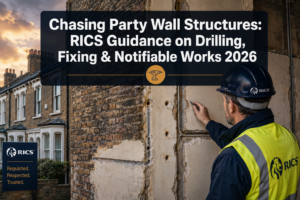
Over 60% of party wall disputes in England and Wales involve procedural errors that could have been avoided with correct notice-serving — a sobering reminder of why the RICS Boundaries and Party Walls Working Group Guidance Note remains the most critical reference document for practising surveyors today. As urban densification accelerates across UK cities in 2026, with loft conversions, basement excavations, and infill developments becoming the norm rather than the exception, staying current with RICS guidance has never been more professionally consequential.
The RICS Boundaries and Party Walls Working Group Guidance Note: Key Updates for Surveyors in 2026 Projects draws from two landmark publications: the Party Wall Legislation and Procedure 7th Edition (January 2022) and the updated Boundaries Procedures for Boundary Identification, Demarcation and Dispute Resolution (October 2022) [1][2]. Together, these documents define best practice for every surveyor navigating the complex intersection of boundary law and the Party Wall etc. Act 1996.
This article unpacks the most significant updates, explains their practical implications for 2026 projects, and provides a clear framework for surveyors, building owners, and adjoining owners alike.
Key Takeaways 📋
- The 7th Edition (January 2022) is the current authoritative RICS guidance on party wall legislation and procedure [1]
- The October 2022 Boundaries Procedures update introduced refined protocols for boundary identification and dispute resolution [2]
- Urban densification trends in 2026 are placing greater pressure on correct notice-serving and award preparation
- RICS continues to run professional development roadshows to keep surveyors updated on working group guidance [9]
- Procedural errors — not legal disputes — remain the leading cause of party wall complications
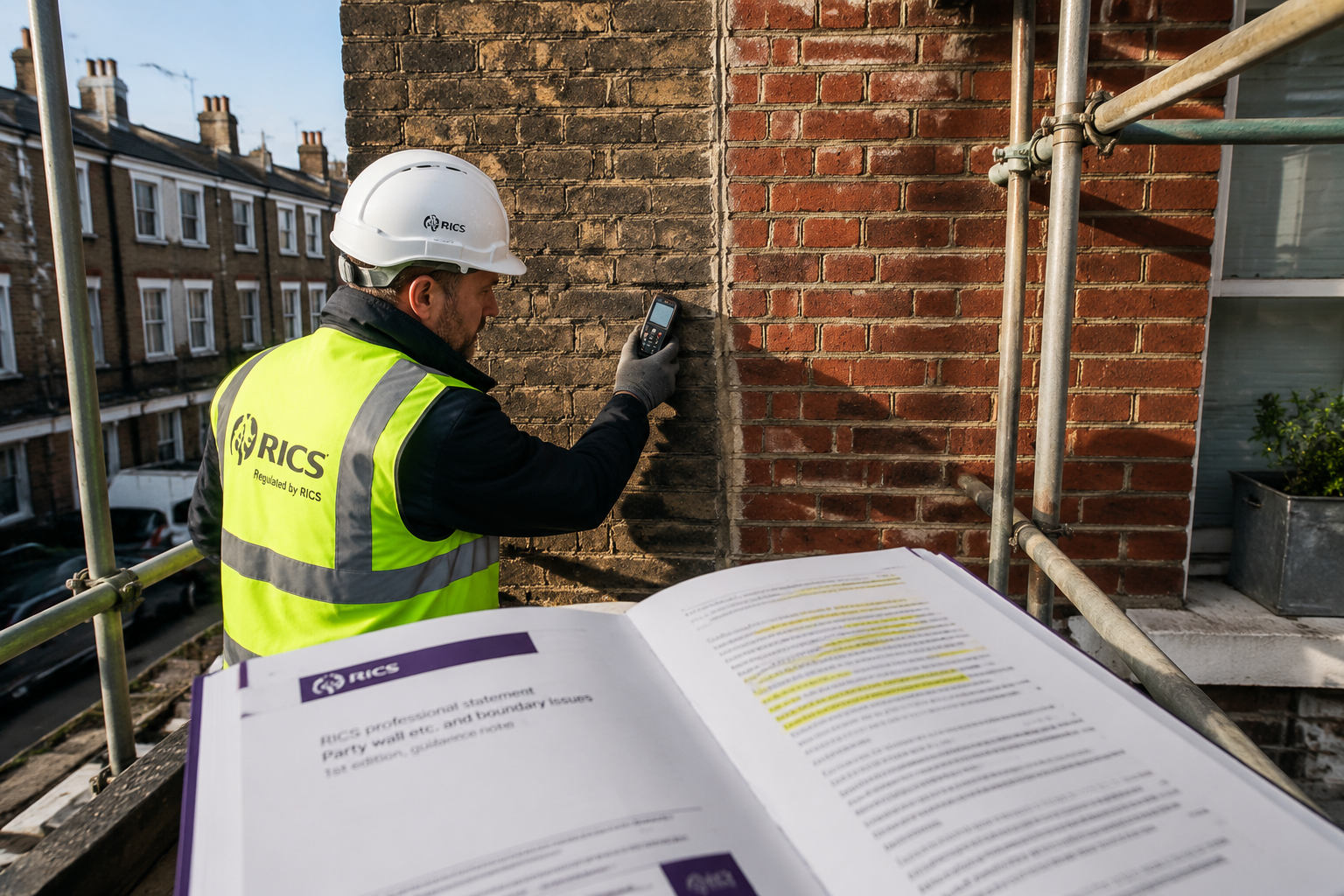
Understanding the RICS Working Group Framework and Its 2026 Relevance
The RICS Boundaries and Party Walls Working Group is the specialist body responsible for producing and updating the profession's core guidance notes on two closely related but legally distinct areas: party wall procedure and boundary identification. Understanding how these two strands interact is essential for surveyors working on 2026 projects.
The 7th Edition: What Changed and Why It Matters
The Party Wall Legislation and Procedure Guidance Note reached its 7th Edition in January 2022, replacing the 6th Edition [1][8]. For surveyors still referencing older editions, this is a critical update. The architectural technology profession noted the 7th Edition as a significant milestone, reflecting the profession's evolving understanding of the Act's application in complex urban environments [8].
Key refinements in the 7th Edition include:
- Clearer definitions of what constitutes a "building owner" and "adjoining owner" in multi-occupancy scenarios
- Updated protocols for serving notices under Sections 1, 2, and 6 of the Party Wall etc. Act 1996
- Revised guidance on the preparation and content of party wall awards
- Stronger emphasis on the surveyor's duty of impartiality in agreed surveyor appointments
- Expanded commentary on the use of a third surveyor in contested disputes
💡 Pull Quote: "The 7th Edition does not simply update language — it recalibrates the profession's entire approach to impartiality, notice validity, and award drafting in an era of increasingly complex urban development."
For surveyors handling party wall matters in 2026, the 7th Edition is the non-negotiable baseline. Any award or notice procedure that deviates from its protocols risks legal challenge.
The October 2022 Boundaries Procedures Update
Running in parallel, the RICS Boundaries Procedures for Boundary Identification, Demarcation and Dispute Resolution (October 2022) provides the profession's most current framework for resolving boundary questions [2]. This update is particularly relevant as boundary disputes frequently arise in the same contexts as party wall works — particularly in terraced housing, semi-detached properties, and infill developments.
The October 2022 update reinforced:
- The primacy of title deeds and conveyance documents in establishing the legal boundary
- Protocols for physical demarcation once a boundary has been identified
- A structured three-stage dispute resolution pathway: informal negotiation → expert determination → litigation
- Guidance on when a boundary expert (as distinct from a party wall surveyor) should be appointed
RICS Boundaries and Party Walls Working Group Guidance Note: Key Updates for Surveyors in 2026 Projects — Notice Procedures and Award Protocols
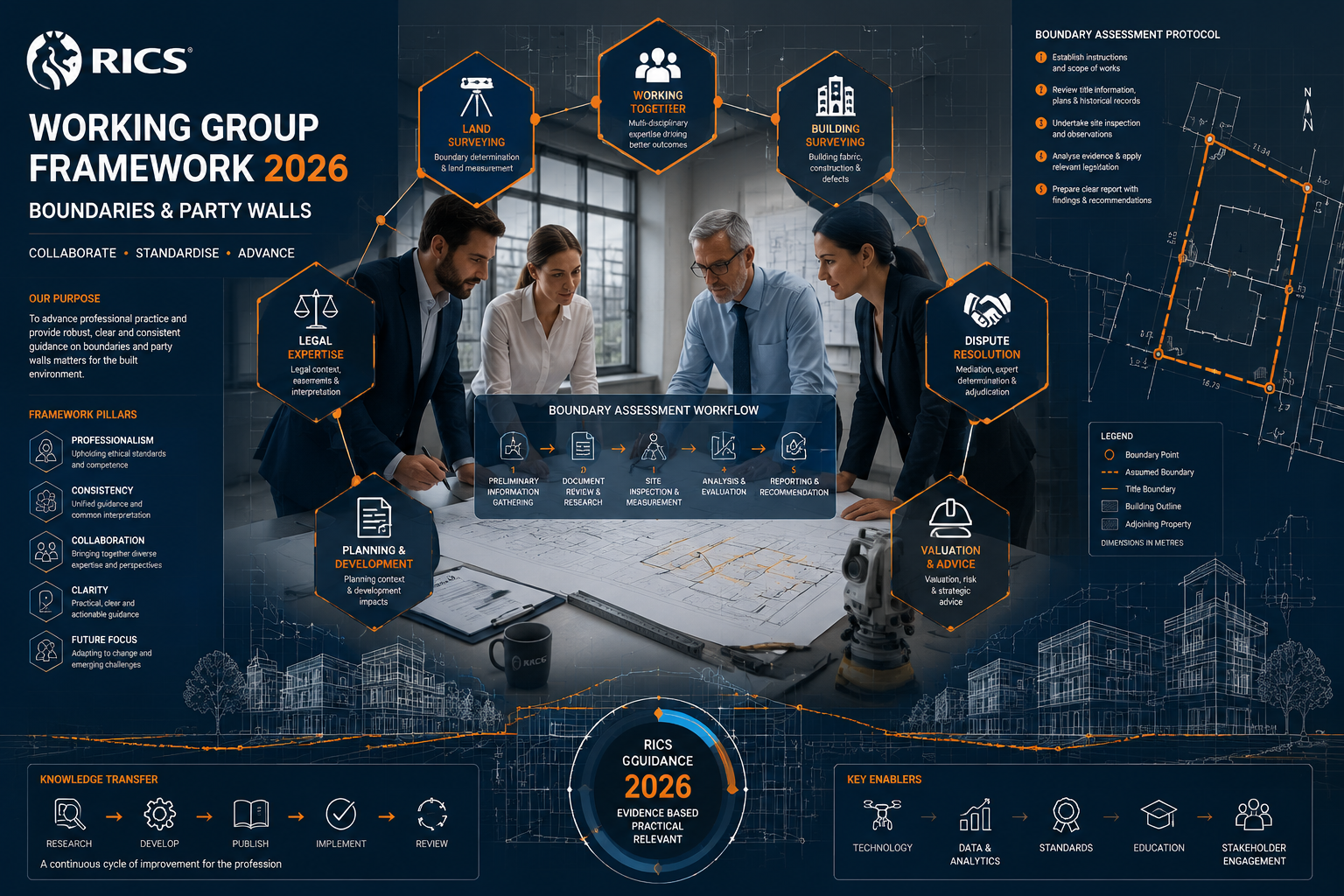
The most operationally significant aspect of the RICS Boundaries and Party Walls Working Group Guidance Note: Key Updates for Surveyors in 2026 Projects concerns the procedural requirements for notices and awards. Getting these right is the difference between a smooth project and a costly legal dispute.
Notice Validity: A 2026 Checklist
Under the Party Wall etc. Act 1996, three types of notice are relevant:
| Notice Type | Section | Trigger |
|---|---|---|
| Party Structure Notice | Section 2 | Works to an existing party wall or structure |
| Line of Junction Notice | Section 1 | Building on or at the boundary line |
| Adjacent Excavation Notice | Section 6 | Excavation within 3m or 6m of adjoining structure |
The 7th Edition clarifies that notice validity depends on more than just serving within the correct timeframe. Surveyors must ensure:
- ✅ The notice correctly identifies the nature of the proposed works
- ✅ The building owner is accurately named and has legal standing
- ✅ The notice is served on all adjoining owners, including tenants with leases over one year
- ✅ The correct notice period is observed (one or two months depending on notice type)
- ✅ The method of service meets legal requirements
Failure on any of these points can render a notice invalid — a situation explored in detail in guidance on what happens if no party wall notice is served.
⚠️ Important: In 2026, with more homeowners undertaking loft conversions involving party walls and basement excavations, the volume of Section 6 notices has increased significantly. Surveyors must be especially vigilant about the 6-metre rule for deeper excavations.
Party Wall Awards: Current Best Practice
The award remains the central legal document in any party wall dispute. The 7th Edition provides detailed guidance on award content, and surveyors should ensure every award includes [1]:
- A clear description of the permitted works
- Method statements where technically complex works are involved
- Schedule of condition for the adjoining owner's property (pre-works)
- Access provisions for surveyors and contractors
- Dispute resolution mechanisms within the award itself
- Costs allocation — who pays the surveyor's fees
For projects involving party wall consent, surveyors should note that an agreed surveyor appointment — where one surveyor acts for both parties — is only appropriate where there is genuine agreement and no conflict of interest. The 7th Edition strengthens the guidance on this point considerably [1].
Excavation Notices and Urban Densification
One of the most pressing issues for 2026 projects is the rise in basement conversions and deep-foundation works in urban areas. The excavation notice requirements under the Party Wall Act are triggered at 3 metres for foundations at or below the level of the adjoining owner's foundations, and at 6 metres for deeper works.
The 7th Edition guidance emphasises that surveyors must:
- Commission structural engineering assessments before finalising awards for excavation works
- Ensure method statements address groundwater management and vibration monitoring
- Consider the cumulative impact of works on shared chimneys and other party structures
Surveyors working on projects with complex structural implications may also find value in reviewing beam calculations guidance to ensure award conditions align with structural engineering requirements.
RICS Boundaries and Party Walls Working Group Guidance Note: Boundary Identification, Dispute Resolution, and Professional Development in 2026
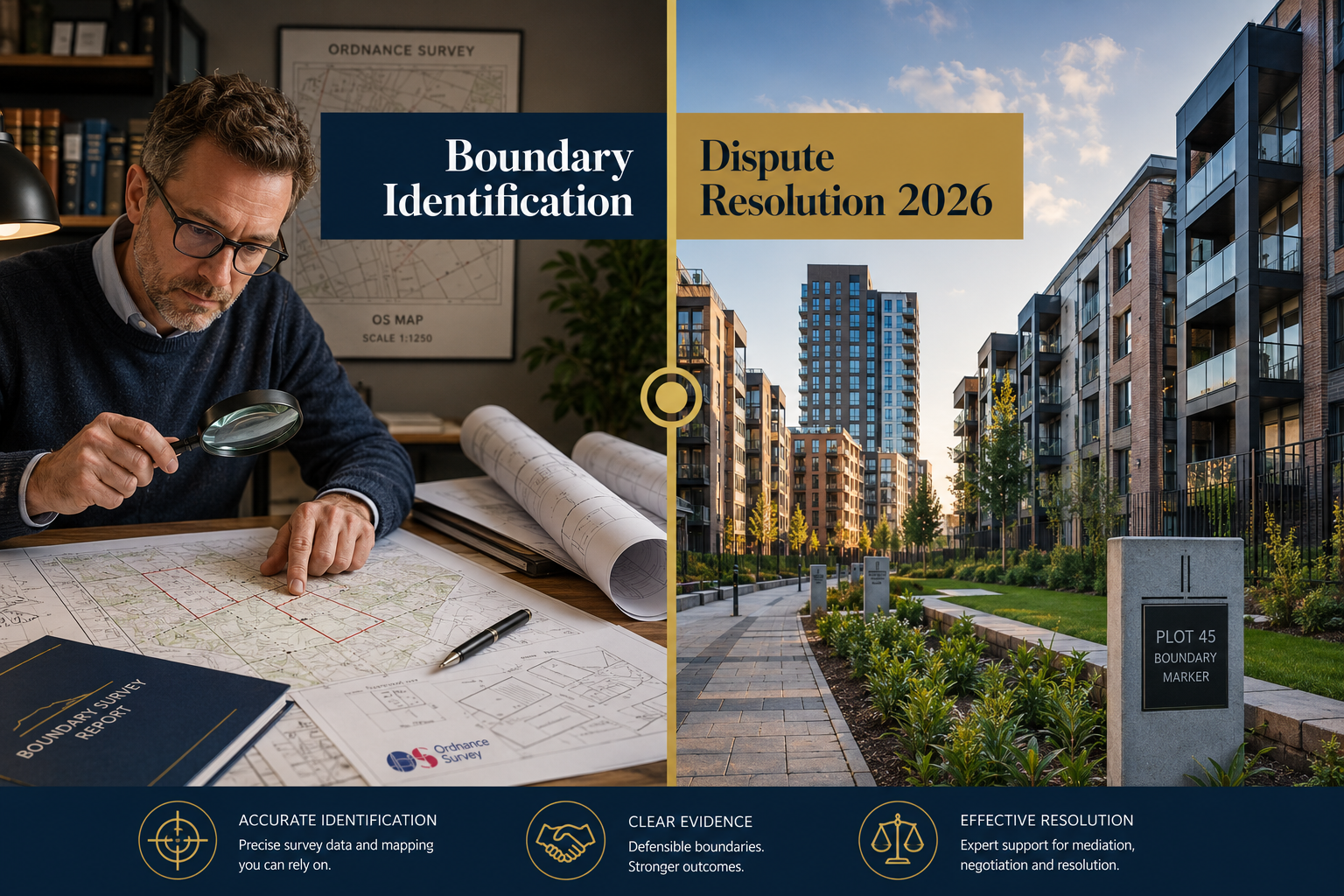
The boundary identification strand of the RICS Boundaries and Party Walls Working Group Guidance Note has seen its own significant evolution, with the October 2022 update providing a more structured and legally robust framework than its predecessor [2].
Boundary Identification: The October 2022 Framework
The updated procedures establish a clear hierarchy of evidence for boundary identification [2]:
- Title deeds and conveyance plans — the primary legal source
- Ordnance Survey data — indicative only, not legally definitive
- Physical features — walls, fences, hedges (interpreted in context)
- Historical evidence — aerial photographs, old maps, witness statements
- Expert surveyor opinion — synthesising all available evidence
💡 Pull Quote: "Ordnance Survey maps show general boundaries, not legal ones. Surveyors who treat OS data as definitive are setting their clients up for costly disputes."
A critical point reinforced in the October 2022 update is that the general boundary rule under English land law means that title plans rarely define the exact legal boundary. This has profound implications for surveyors advising clients on boundary disputes adjacent to proposed party wall works.
Dispute Resolution Pathways
When boundary disputes cannot be resolved informally, the October 2022 guidance outlines a structured escalation pathway [2]:
Stage 1 — Expert Determination: Both parties appoint (or agree to appoint) a single boundary expert. This is faster and cheaper than litigation and is now the RICS-recommended first formal step.
Stage 2 — Mediation: Where expert determination fails or is refused, RICS-accredited mediation provides a structured negotiation environment.
Stage 3 — Litigation: As a last resort, the matter proceeds to the First-tier Tribunal (Property Chamber) or the County Court, depending on the nature of the dispute.
Surveyors should also be aware of the risks when a neighbour carries out works without a party wall agreement, as this frequently intersects with boundary disputes in practice.
Professional Development: Staying Current in 2026
RICS has actively supported the dissemination of working group guidance through its "Party Walls & Boundaries Essential Update" roadshow programme [9]. These events, delivered to surveying firms across England and Wales, cover:
- The practical application of the 7th Edition in live projects
- Case studies on notice disputes and award challenges
- Boundary identification methodology under the October 2022 framework
- Q&A sessions with working group members
Industry commentary, including podcast coverage featuring expert practitioners discussing the 7th Edition's implications, has further helped surveyors understand nuanced aspects of the guidance [7]. RICS also maintains a Find a Surveyor helpline providing regulated member firms with access to 30-minute initial consultations on party wall matters [6] — a valuable resource for surveyors encountering novel situations in 2026 projects.
Practical Implications for Common 2026 Project Types
The table below summarises how the updated guidance applies to the most common project types surveyors encounter in 2026:
| Project Type | Key Guidance Note Reference | Primary Risk Area |
|---|---|---|
| Loft conversion | 7th Edition, Section 2 notices | Inadequate structural description in award |
| Basement excavation | 7th Edition, Section 6 notices | Failure to trigger 6m excavation notice |
| Side extension to boundary | 7th Edition, Section 1 + October 2022 | Boundary identification before works |
| Infill development | October 2022 Boundaries Procedures | Multiple boundary disputes simultaneously |
| Party wall insulation | 7th Edition, Section 2 | Access rights and damage liability |
Surveyors working on party wall insulation projects should note that the 7th Edition provides specific commentary on works that alter the thermal or acoustic properties of a party structure — an increasingly common scenario as energy efficiency retrofits accelerate in 2026.
Conclusion: Actionable Steps for Surveyors in 2026 🎯
The RICS Boundaries and Party Walls Working Group Guidance Note: Key Updates for Surveyors in 2026 Projects represents a mature, evidence-based framework that — when applied correctly — protects building owners, adjoining owners, and the surveyors who serve them. The combination of the 7th Edition party wall guidance and the October 2022 boundaries procedures provides a comprehensive toolkit for navigating even the most complex urban development scenarios.
Actionable next steps for surveyors and property owners in 2026:
- Audit your notice templates against the 7th Edition checklist to ensure validity on every project [1]
- Download and read the October 2022 Boundaries Procedures update — particularly if your practice handles boundary disputes alongside party wall work [2]
- Attend RICS professional development events — the roadshow programme is the fastest way to stay current with working group thinking [9]
- Use the RICS Find a Surveyor helpline for complex or novel situations before committing to an award position [6]
- Review your schedule of condition protocols — this is consistently the area where awards face the most legal challenge
- Consult a structural engineer on all Section 6 excavation notices before finalising award conditions
For property owners and developers unsure about their obligations, the first step is always to consult a qualified party wall surveyor who is current with RICS working group guidance. The cost of getting it right at the notice stage is always a fraction of the cost of resolving a dispute after works have commenced.
References
[1] Jan 22 Party Wall Legislation And Procedure 7th Edition – https://www.rics.org/content/dam/ricsglobal/documents/standards/jan_22_party_wall_legislation_and_procedure_7th_edition.pdf
[2] Boundaries Procedures for Boundary Identification Demarcation and Dispute Resolution October 2022 – https://www.rics.org/content/dam/ricsglobal/documents/standards/Boundaries%20procedures%20for%20boundary%20identification_%20demarcation%20and%20dispute%20resolution_October%202022.pdf
[3] Boundaries Procedures For Boundary Identification Demarcation And Dispute Re – https://www.scribd.com/document/616638935/Boundaries-Procedures-for-Boundary-Identification-Demarcation-and-Dispute-Re
[4] Boundaries Procedures For Boundary Identification 7967231 – https://www.readkong.com/page/boundaries-procedures-for-boundary-identification-7967231
[6] Party Walls Helpline – https://www.ricsfirms.com/helplines/party-walls/
[7] Pwp Podcast Episode 9 With Michael Cooper On Rics Party Wall Guidance 7th Edition – https://partywallpro.co.uk/podcast/pwp-podcast-episode-9-with-michael-cooper-on-rics-party-wall-guidance-7th-edition/
[8] Seventh Edition Of Rics Guidance Note Party Wall Legislation And Procedure Published – https://architecturaltechnology.com/resource/seventh-edition-of-rics-guidance-note-party-wall-legislation-and-procedure-published.html
[9] Rics Party Walls Boundaries Essential Update Roadshow – https://delvapatmanredler.co.uk/latest-news/rics-party-walls-boundaries-essential-update-roadshow/