By 2026, the volume of property-related data available to surveyors has grown by an estimated 300% compared to just five years ago — yet many professionals report that making reliable valuation decisions has become harder, not easier. The paradox at the heart of Evolving Valuation Challenges in 2026: Technology's Impact on Surveyor Access to Data and RICS Standards is this: more data does not automatically mean better valuations. It means greater responsibility, sharper governance demands, and a profession navigating unprecedented change under the watchful eye of updated RICS frameworks.

Key Takeaways 📌
- The RICS Responsible AI Standard became mandatory on 9 March 2026, reshaping how all regulated firms must document and govern AI use in valuation work.
- AI must augment, not replace, surveyor judgment — full automation of professional opinions does not meet current RICS requirements.
- A significant professional liability gap exists: insurance policies have not kept pace with AI adoption, leaving surveyors fully responsible for AI-assisted outputs.
- The 2026 International Valuation Standards (IVS) Exposure Draft introduces mandatory requirements around AI and technology-based tools in data and valuation approaches.
- Surveyors face a dual challenge: harnessing powerful new data tools while managing data quality risks, skills gaps, and geopolitical market uncertainty.
The Data Flood: Opportunity or Overload?
The UK property market in 2026 is awash with data. Land Registry transactions, energy performance certificates, planning portals, satellite imagery, drone surveys, automated valuation models (AVMs), and social infrastructure datasets all feed into the modern surveyor's workflow. For those seeking a Red Book valuation on a Manchester property, the depth of comparable evidence now accessible digitally would have been unimaginable a decade ago.
But quantity is not quality. The surveying industry faces mounting challenges around data consistency and transparency [2]. Many AI-driven platforms operate as "black box" models — producing outputs without clearly explaining how those outputs were reached. For a profession built on defensible, documented professional opinion, this opacity creates real risk.
💬 "More data does not equal better decisions. It equals more decisions to make — and more places to go wrong."
What Data Sources Are Surveyors Using in 2026?
| Data Source | Use Case | Key Risk |
|---|---|---|
| Automated Valuation Models (AVMs) | Rapid comparable analysis | Black box transparency issues |
| Drone + AI imagery | Roof, structural, and site surveys | Regulatory compliance, data accuracy |
| Land Registry / HM Land Registry | Transaction comparables | Lag in registration data |
| EPC databases | Energy efficiency benchmarking | Incomplete or outdated records |
| Planning portal APIs | Development potential assessment | Local authority data inconsistency |
| Social/demographic datasets | Rental demand forecasting | Bias in model training data |
The opportunity is real. AI tools can deliver faster analysis of large datasets, automated cash flow modelling, improved forecasting of rents and yields, and enhanced scenario analysis [2]. However, these benefits only materialise when the underlying data is reliable and when the professional using the tool understands its limitations.
RICS Standards in 2026: The Mandatory AI Framework
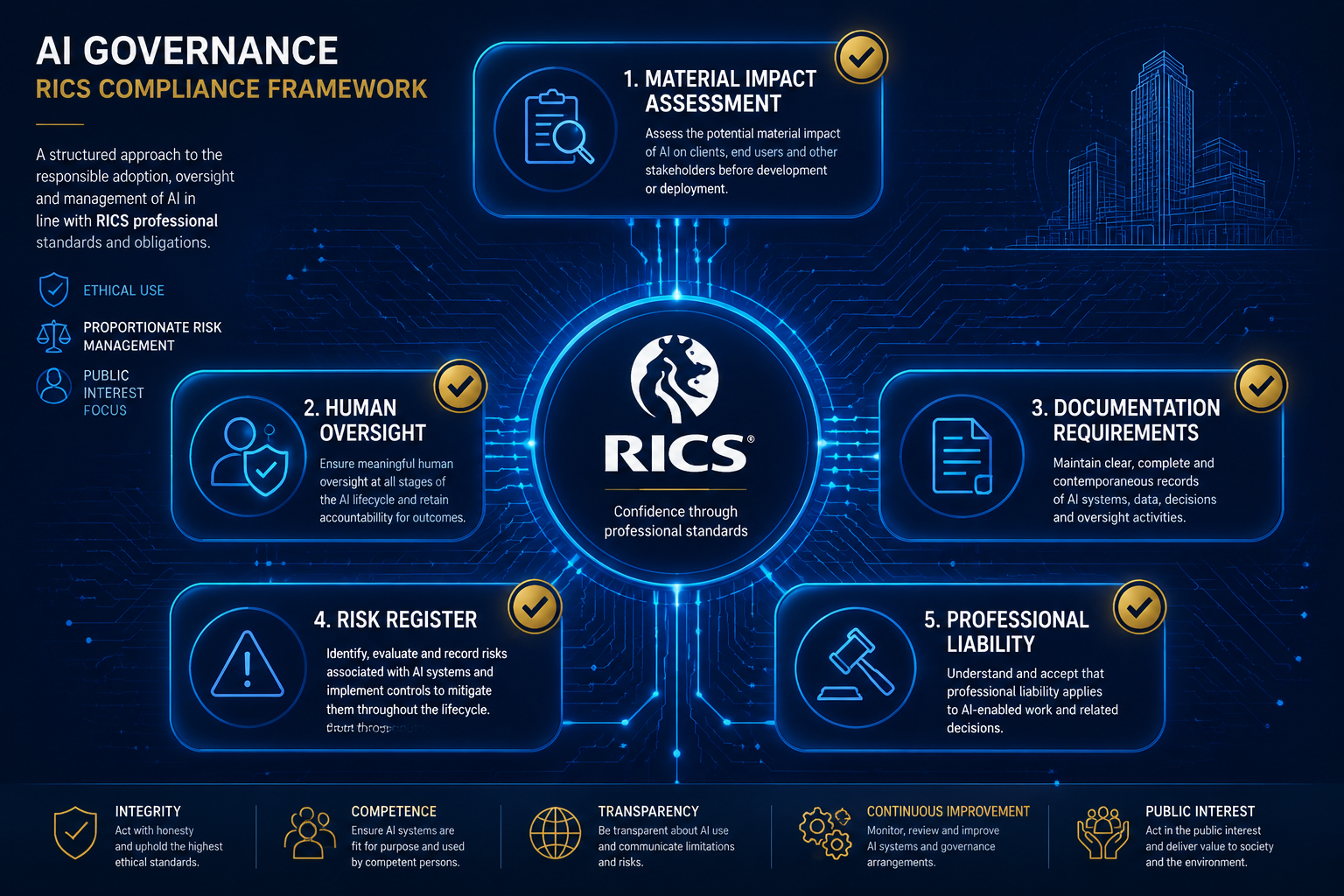
The most significant regulatory development shaping Evolving Valuation Challenges in 2026: Technology's Impact on Surveyor Access to Data and RICS Standards is the RICS Professional Standard for the Responsible Use of Artificial Intelligence in Surveying Practice, which came into mandatory effect on 9 March 2026 [1].
Published in September 2025, this standard applies to all RICS members and regulated firms. It is not optional guidance — it is a compliance requirement.
What Does "Material Impact" Mean?
The standard centres on a critical concept: material impact. It applies specifically to AI outputs capable of influencing service delivery in a meaningful way [1]. Examples include:
- ✅ Summarising legal or planning documents used in valuation reports
- ✅ Composing opinion sections within professional reports
- ✅ Identifying building areas requiring further investigation
- ✅ Generating risk flags based on predefined indicators
If an AI tool's output meets this threshold, the firm must follow the full governance framework — regardless of how routine the task may seem.
The Three Pillars of Compliance
RICS-regulated firms must now demonstrate compliance across three core areas [1]:
- Documentation: Firms must record in writing whether AI use has material impact and the reasoning behind that determination.
- System Governance: A written governance assessment must be completed before any AI system is implemented in practice.
- Policy Development: Firms must develop a responsible AI use policy informed by a risk register specific to their services.
For professionals offering RICS valuations across residential and commercial sectors, this means embedding AI governance into standard operating procedures — not treating it as an afterthought.
Human Oversight: Non-Negotiable
The standard is unambiguous on one point: AI should augment, not replace, surveyor judgment [2]. Full automation of high-stakes professional opinions — such as a market value determination or a lease extension valuation — is unlikely to meet RICS standards without meaningful human involvement.
Professional responsibility cannot be outsourced to an algorithm. The surveyor who signs off on a report remains fully liable for its contents, regardless of which tools generated the underlying analysis [2].
The Professional Liability Gap: A Critical 2026 Risk
One of the most underreported challenges in the current landscape is the mismatch between AI capability and professional insurance coverage. As of 2026, professional liability insurance policies contain no built-in flexibility to accommodate AI-generated outputs [2]. This creates a dangerous grey area.
Surveyors retain ultimate responsibility for:
- Physical inspection and site access
- Data analysis and interpretation
- Report composition and professional opinion
- Sign-off on all advice provided to clients
If an AI tool produces a flawed output — a misclassified material, an inaccurate comparable, or a missed structural anomaly — the professional who relied on that output without adequate oversight carries the liability. Insurance will not absorb the risk simply because technology was involved [5].
⚠️ Key Risk Alert: Using AI tools without documented governance processes could invalidate professional indemnity insurance coverage in the event of a claim.
This risk is particularly acute for complex instructions such as commercial property valuations or shared ownership valuations, where the stakes are high and the data inputs are often more variable.
International Valuation Standards 2026: Aligning with Technology
The 2026 IVS Exposure Draft represents a landmark shift in how international standards address technology-driven valuation practice. RICS has formally supported the inclusion of mandatory requirements for significant AI and technology-based tool use within two core IVS sections [3]:
- IVS 104 (Data and Inputs): Governs how valuers source, assess, and document the data underpinning their conclusions.
- IVS 105 (Valuation Approaches): Addresses the methodologies used to arrive at value, including automated and model-driven approaches.
The Three-Test Framework for Automated Models
When using automated models under the updated IVS requirements, valuers must demonstrate [3]:
| Test | Requirement |
|---|---|
| Suitability | The methodology is appropriate for the specific asset type being valued |
| Market Alignment | Model inputs reflect genuine market participant assumptions |
| Output Validation | Model outputs have been thoroughly analysed before being relied upon |
This framework directly addresses the black box problem. A valuer cannot simply accept an AVM output at face value — they must interrogate it, test it against market evidence, and document why it is or is not appropriate for the instruction at hand.
Drone Technology and AI: Expanding Surveyor Access

One of the most practical developments reshaping Evolving Valuation Challenges in 2026: Technology's Impact on Surveyor Access to Data and RICS Standards is the integration of drone technology with AI-powered analysis tools [2].
Drones now enable rapid, safe access to:
- 🏠 Rooftops and high-level structural elements
- 🏗️ Large commercial or industrial sites
- 🌳 Hard-to-reach land parcels and rural properties
When combined with AI classification systems, these tools can identify roofing materials, flag structural anomalies, assess drainage gradients, and detect environmental stress indicators — all in real time, across large portfolios [2].
For chartered surveyors operating across regions such as London or the wider South East, where portfolio instructions are common and access constraints are frequent, drone-AI integration offers genuine efficiency gains.
However, these tools still require trained professionals to interpret outputs, validate findings, and take responsibility for conclusions. The drone sees the roof; the surveyor understands what the condition means for value.
What AI Can and Cannot Do in 2026
Permissible AI automation tasks (with human oversight) [2]:
- Routine valuation modelling and sensitivity analysis
- Photo classification and condition tagging
- Template-driven report section generation
- Risk flagging based on predefined indicators
- Cash flow modelling and yield forecasting
Tasks requiring direct professional judgment:
- Final market value determination
- Professional opinion on unusual or complex assets
- Interpretation of geopolitical or macroeconomic risk factors
- Legal and planning advice integration
- Client-facing recommendations
The Skills Gap: Bridging Technology and Professional Practice
A challenge that sits beneath much of the current debate is a straightforward but serious one: many surveyors lack the AI and data science training needed to use these tools effectively [2].
This skills gap has several consequences:
- Professionals may over-rely on AI outputs without understanding their limitations
- Firms may under-use powerful tools due to lack of confidence
- Governance documentation may be incomplete or inadequate
- Training costs may create competitive disadvantages for smaller practices
Addressing this gap requires investment at both the individual and firm level. RICS CPD requirements in 2026 increasingly reflect the need for technology literacy alongside traditional valuation competencies.
For those working on specialist instructions — such as Help to Buy valuations or freehold valuations — understanding which data tools are appropriate, and how to document their use, is now a core professional skill.
Geopolitical Caution and Market Uncertainty in 2026
No discussion of valuation challenges in 2026 is complete without acknowledging the geopolitical backdrop. Elevated interest rate uncertainty, shifting trade relationships, and post-pandemic structural changes in commercial demand all create market volatility that data alone cannot resolve.
AI models trained on historical data may not adequately capture:
- Rapid shifts in occupier demand driven by geopolitical events
- Changes in lender appetite affecting comparable transaction volumes
- Policy-driven adjustments to permitted development or planning frameworks
- ESG-related repricing of assets with poor energy performance
This is precisely why the RICS standard emphasises human judgment as the irreplaceable element in professional practice. A model built on 2022–2024 data may produce outputs that are technically accurate but contextually misleading in 2026's market conditions.
Surveyors must apply critical professional scepticism to every AI-generated output — asking not just "what does the model say?" but "does this make sense given what is happening in the market right now?"
Conclusion: Navigating the New Valuation Landscape
The Evolving Valuation Challenges in 2026: Technology's Impact on Surveyor Access to Data and RICS Standards are not a threat to the profession — they are a call to elevate it. Technology offers genuine power: faster data access, broader market insight, and enhanced analytical capability. But that power comes with proportionate responsibility.
Actionable Next Steps for Surveyors and Firms 🎯
- Audit current AI tool use against the RICS Responsible AI Standard — document every system with material impact on service delivery.
- Complete written governance assessments for all AI systems before or during current use, as required by the March 2026 standard.
- Develop a firm-wide responsible AI policy informed by a risk register tailored to your service types.
- Invest in AI and data literacy training for all fee-earning staff — this is now a core competency, not an optional extra.
- Review professional indemnity insurance with your broker to understand current coverage in the context of AI-assisted work.
- Apply the IVS three-test framework (suitability, market alignment, output validation) to every automated model output before reliance.
- Maintain robust human oversight at every critical decision point — technology supports the valuation; the surveyor owns it.
The profession that thrives in 2026 will not be the one that uses the most AI — it will be the one that uses AI most responsibly, with the clearest documentation, the strongest governance, and the sharpest professional judgment at its core.
References
[1] AI Responsible Use Standard – https://ww3.rics.org/uk/en/journals/construction-journal/ai-responsible-use-standard.html
[2] What Surveyors Think AI – https://ww3.rics.org/uk/en/modus/technology-and-data/surveying-tools/what-surveyors-think-ai.html
[3] Finalised IVS Consultation Response – https://www.rics.org/content/dam/ricsglobal/documents/standards/Finalised-IVS-consultation-response.pdf
[4] AI-Driven Precision in Property Surveying: How Artificial Intelligence Is Revolutionizing Workflows in 2026 – https://nottinghillsurveyors.com/blog/ai-driven-precision-in-property-surveying-how-artificial-intelligence-is-revolutionizing-workflows-in-2026
[5] RICS Introduces Mandatory AI Standard for Surveyors: What Insurers and Their Clients Need to Know – https://cms.law/en/gbr/legal-updates/rics-introduces-mandatory-ai-standard-for-surveyors-what-insurers-and-their-clients-need-to-know