Nearly one in three construction projects in the UK results in some form of dispute — and the quality of expert evidence often determines who wins. Defective Construction Claims: Expert Witness Building Surveys for Courtroom Evidence in 2026 sit at the intersection of technical precision, legal procedure, and professional credibility. When walls crack, roofs leak, or foundations shift, the difference between a successful claim and a dismissed case frequently comes down to one thing: the rigour of the building survey and the authority of the surveyor who presents it.
This guide explains how chartered surveyors investigate construction defects, compile court-compliant reports, and deliver expert testimony that stands up to cross-examination — drawing on the latest forensic methodologies and legal standards.
Key Takeaways
- 🔍 Visual inspections alone are not enough — root cause analysis requires multi-disciplinary forensic investigation covering design errors, code inconsistencies, material failures, and workmanship defects.
- 📄 CPR Part 35 compliance is non-negotiable — expert witness reports must meet strict Civil Procedure Rules standards to be admissible in court.
- 🏗️ Modern tools like laser scanning and BIM significantly strengthen the evidentiary value of building surveys and improve resistance to legal challenges.
- ⚖️ Causation is everything — the most persuasive expert testimony links technical findings directly to measurable damage, not just observed defects.
- 🎓 Surveyor credentials matter — RICS-qualified experts with litigation experience and a track record of prior testimony carry the most weight in proceedings.
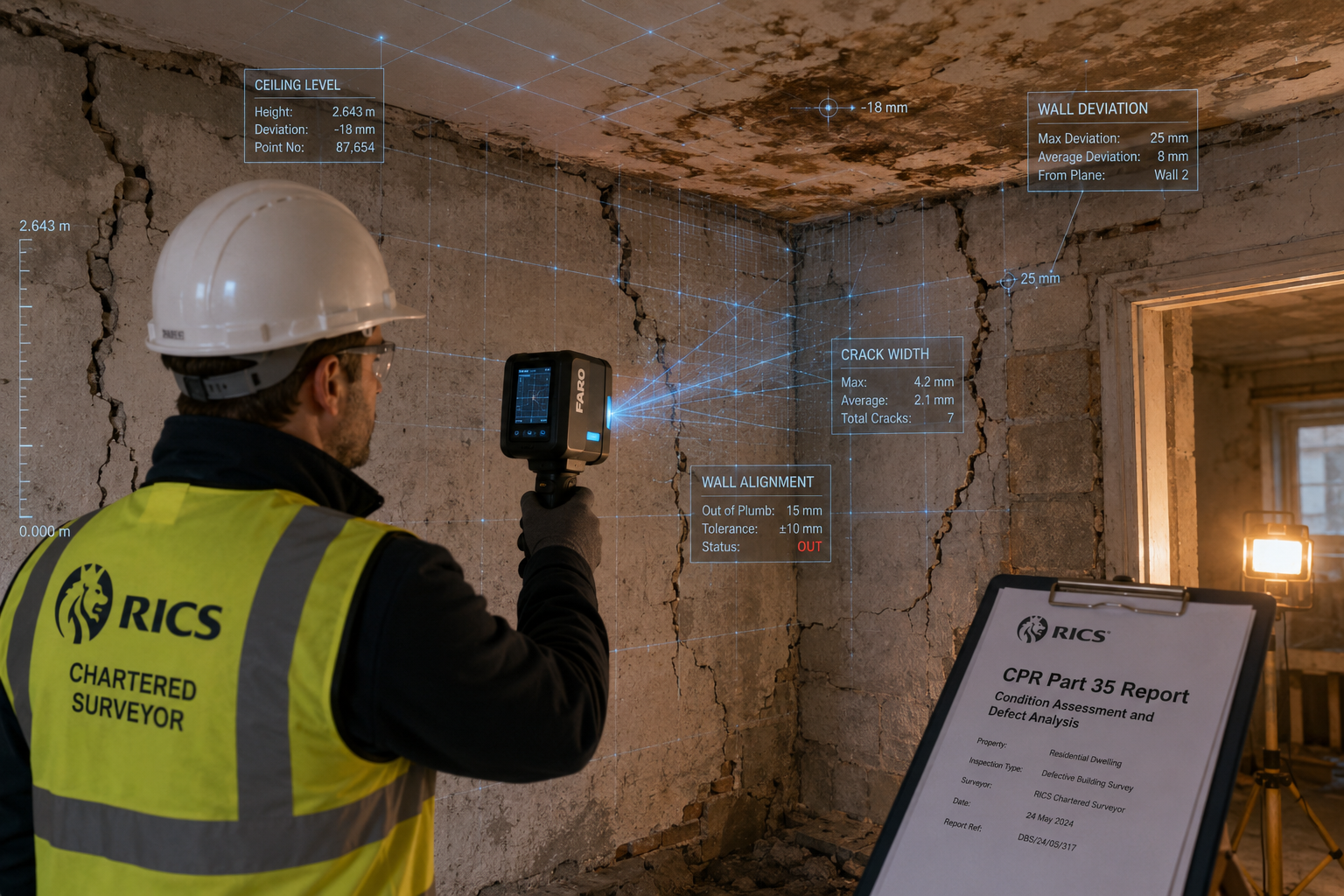
What Makes a Building Survey Admissible as Courtroom Evidence?
When a defective construction claim reaches litigation, the court does not simply accept any survey report placed before it. Evidence must satisfy specific legal and procedural thresholds before a judge will consider it. Understanding these requirements is the first step for any claimant or defendant preparing a case.
The CPR Part 35 Framework
In England and Wales, expert witnesses in civil proceedings are governed by Civil Procedure Rules (CPR) Part 35. This framework requires that:
- The expert's primary duty is to the court, not to the instructing party
- Reports must be objective, impartial, and within the expert's area of competence
- Statements of truth must be signed by the expert personally
- Any limitations in the investigation must be clearly disclosed
A qualified expert witness surveyor operating under CPR Part 35 cannot simply advocate for their client's position. Courts have struck out expert reports that read more like advocacy documents than independent technical assessments.
Why Qualifications Signal Credibility
Expert witnesses in construction defect cases must address a wide range of issues: structural failures, water intrusion, code violations, design errors, materials defects, and workmanship disputes [5]. This demands multi-disciplinary technical knowledge combined with litigation experience. RICS-chartered surveyors hold a particularly strong position because their professional code of conduct independently reinforces the impartiality required by CPR Part 35.
When evaluating an expert, courts and legal teams consider:
| Evaluation Criterion | Why It Matters |
|---|---|
| Technical credentials (RICS, CEng) | Establishes professional authority |
| Prior testimony record | Demonstrates courtroom experience |
| Litigation case results | Signals effectiveness under cross-examination |
| Industry reputation | Adds weight to opinions |
| Scope of relevant experience | Ensures competence on specific defect type |
[5]
💬 "The most persuasive expert testimony strengthens causation arguments by linking technical evidence to specific defects, demonstrating how they directly caused measurable damage or failure." [5]
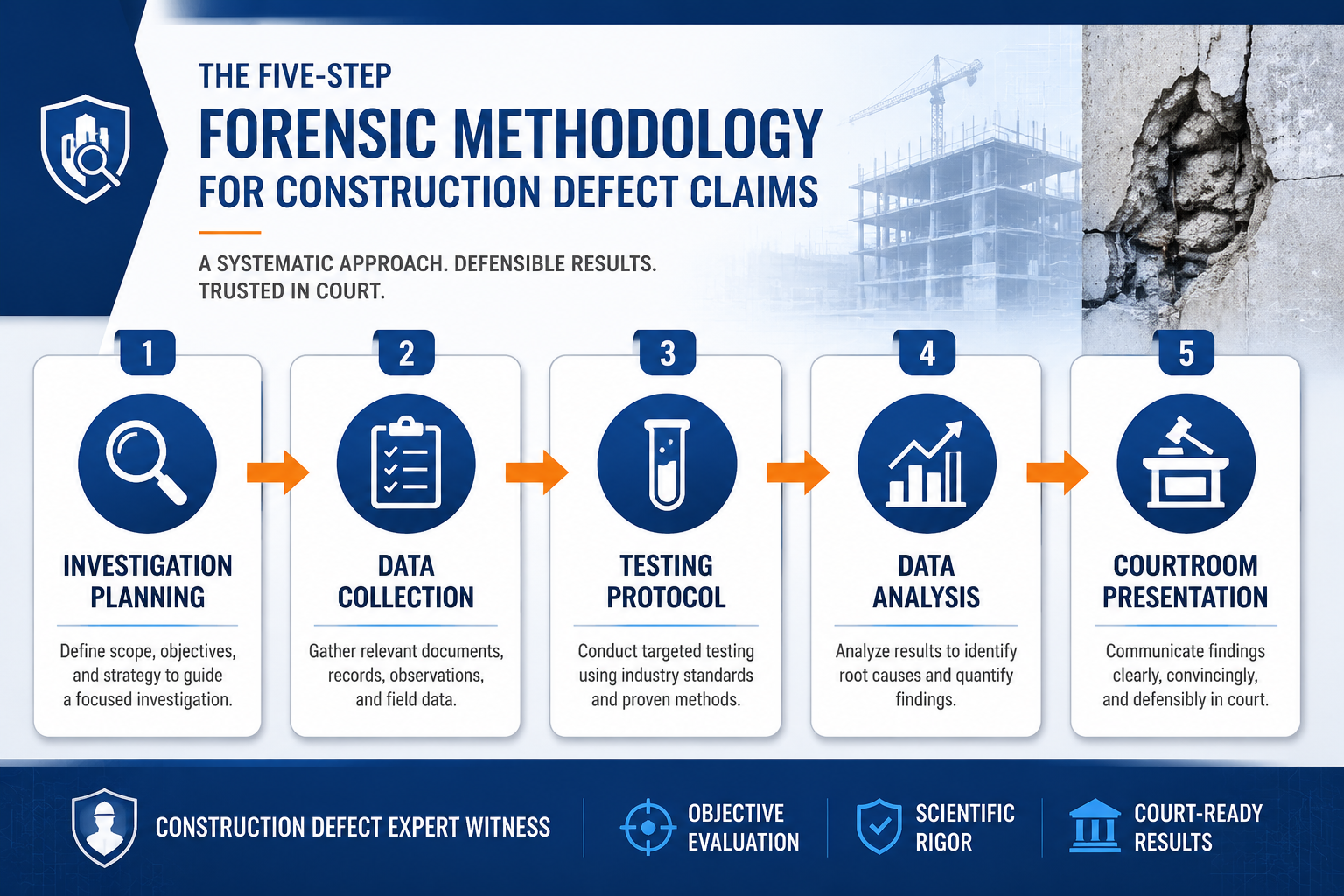
The Five-Step Forensic Methodology Behind Expert Witness Building Surveys for Courtroom Evidence in 2026
Forensic engineers and chartered surveyors investigating construction claims follow a structured, five-phase methodology that has become standard protocol in defective construction claims [3]. Each phase must be executed with legal admissibility in mind from the outset.
Phase 1: Investigation Planning and Evidence Preservation
Before a single measurement is taken, the investigation must be carefully planned. This phase determines whether sufficient evidence exists and identifies potential spoliation concerns — situations where evidence may be at risk of being altered, destroyed, or lost [3].
Early preservation planning is critical. Photographs taken by untrained parties, incomplete maintenance records, or premature repair work can all undermine a claim. A chartered surveyor instructed early can issue formal preservation notices and document conditions before they change.
This is also the stage where the scope of the structural survey is defined — whether it will cover foundations, envelope, services, or all elements.
Phase 2: Data Collection and Site Investigation
Data collection goes far beyond a visual walkthrough. Comprehensive root cause analysis must assess all likely failure mechanisms, including:
- ✅ Design or specification errors
- ✅ Building code requirement inconsistencies
- ✅ Unexpected site condition changes
- ✅ Maintenance or operational gaps
- ✅ Material degradation over time [3]
Visual observations alone are limited to current conditions and cannot reliably establish cause [3]. Surveyors use a range of diagnostic tools at this stage:
- Moisture meters and thermal imaging for damp and water intrusion — a damp survey can reveal hidden moisture pathways invisible to the naked eye
- Crack monitoring gauges to establish whether movement is active or historic — monitoring surveys provide time-series data essential for causation arguments
- Ground investigation for subsidence-related claims, including a subsidence survey to assess soil conditions and foundation behaviour
- Laser scanning to create millimetre-accurate 3D records of as-built conditions
Phase 3: Testing Protocol Development
Once initial data is gathered, the surveyor develops a targeted testing protocol. This might include laboratory analysis of material samples, load testing of structural elements, or specialist subcontractor assessments. Every test must be documented with chain-of-custody records to ensure results are legally defensible.
Phase 4: Data Analysis and Root Cause Determination
This is where technical expertise transforms raw data into legal argument. The surveyor must:
- Identify the primary failure mechanism
- Rule out alternative explanations
- Establish a causal chain from defect to damage
- Quantify the extent of damage and remediation costs
The analysis must be reproducible. Courts expect that another qualified expert, given the same data, would reach the same conclusions using the same methodology [3].
Phase 5: Presentation of Conclusions
The final phase covers both the written report and oral testimony. A well-structured expert report will include:
- Executive summary of findings
- Methodology and site access details
- Photographic and technical evidence appendices
- Clear statement of opinions and their basis
- Confirmation of CPR Part 35 compliance
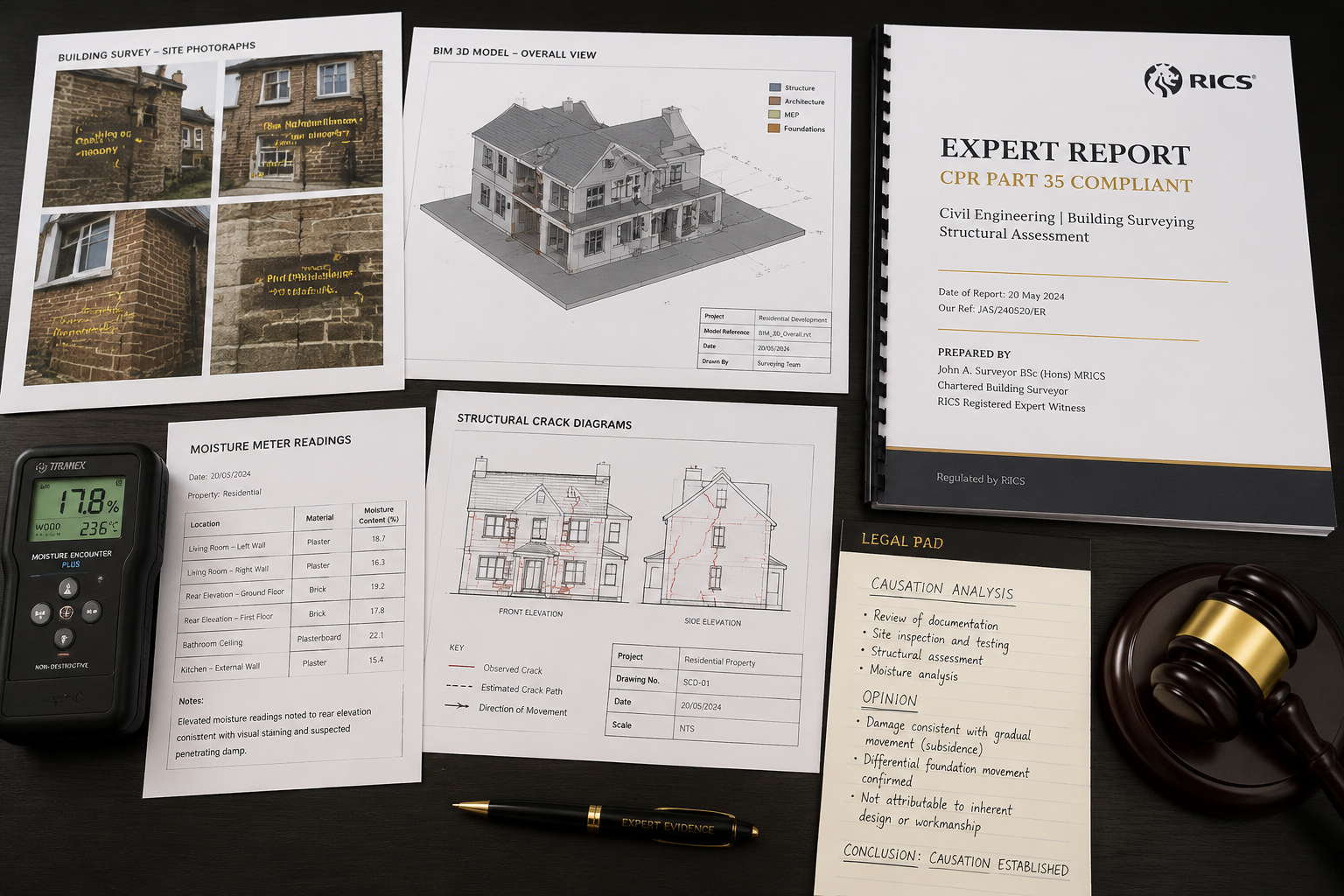
Technology, BIM, and Laser Scanning in Defective Construction Claims: Expert Witness Building Surveys for Courtroom Evidence in 2026
The technological landscape for construction claims evidence has shifted dramatically. Two innovations in particular — Building Information Modeling (BIM) and laser scanning — are redefining what counts as compelling courtroom evidence in 2026.
BIM as a Time-Stamped Evidence Trail
BIM embedded in construction contracts now provides time-stamped records of design decisions, change orders, and as-built conditions [3]. When a dispute arises over whether a defect stems from the original design or a contractor's deviation, BIM data can answer the question definitively. This has established new standards for expert testimony admissibility and has significantly streamlined the claims documentation process.
For example, in a boundary dispute involving a newly constructed party wall, BIM records can show precisely when structural decisions were made and by whom — evidence that is far more persuasive than conflicting witness recollections.
Laser Scanning and Daubert Challenge Resistance
Digital forensic tools, particularly laser scanning, create comprehensive as-built records that withstand legal challenges more effectively than traditional documentation methods [3]. In the US context, this is framed around Daubert challenges — tests of whether expert methodology is scientifically sound. In English courts, the equivalent scrutiny comes through cross-examination and opposing expert reports.
A laser-scanned point cloud of a defective floor slab, for instance, provides objective geometric data that cannot be disputed as subjective interpretation. When combined with a solid floor slab survey, this creates an evidence package that is extremely difficult to undermine.
Common Defect Categories Requiring Specialist Expertise
Different defect types demand different specialist knowledge [1]. The table below summarises the most frequently litigated categories in 2026:
| Defect Category | Key Evidence Required | Specialist Survey Type |
|---|---|---|
| Water intrusion / damp | Moisture readings, thermal imaging | Damp survey |
| Structural movement | Crack mapping, monitoring data | Structural / subsidence survey |
| Foundation failure | Ground investigation, load analysis | Subsidence survey |
| Building code violations | Code compliance audit, as-built drawings | Level 3 building survey |
| Workmanship defects | Specification comparison, material testing | Forensic building survey |
| Delay claims | Programme analysis, BIM records | Expert report with scheduling data |
[1][4]
The Role of Schedule of Condition Reports
Before construction work begins — particularly work affecting neighbouring properties — a schedule of condition report establishes a documented baseline. In boundary and party wall disputes, this pre-works record is often the most powerful piece of evidence available. Without it, attributing post-construction damage to the works rather than pre-existing conditions becomes a matter of expert opinion rather than documented fact.
Selecting and Instructing the Right Expert Witness Surveyor
Not every chartered surveyor is equipped to serve as an expert witness. The selection process requires careful consideration of both technical competence and litigation readiness.
Essential Qualifications and Experience
Construction defect expert witnesses should be evaluated across multiple dimensions [5]:
- RICS membership — provides an independent professional standard
- Relevant technical specialism — structural, building envelope, geotechnical, or mechanical depending on the defect type
- Litigation experience — familiarity with CPR Part 35, court procedures, and cross-examination
- Prior testimony record — courts give greater weight to experts with a demonstrated track record
- Geographic knowledge — local building practices, soil conditions, and planning contexts matter
A RICS Level 3 building survey provides the most comprehensive technical baseline for residential defect claims, covering structure, fabric, services, and grounds in detail appropriate for litigation purposes.
Multi-Disciplinary Expert Networks
Complex construction defect cases rarely involve a single defect type. Major firms provide expert services across architectural, structural, civil, and fire protection disciplines for both residential and commercial properties, spanning forensic evaluations, repair recommendations, and standard of care analysis [4]. In practice, this means the lead expert witness surveyor may need to coordinate with structural engineers, geotechnical specialists, or mechanical and electrical consultants.
Boundary and Party Wall Disputes: A Specific Application
Boundary disputes and party wall cases represent a significant proportion of construction-related litigation. In these cases, the expert witness surveyor's role includes:
- Establishing the physical boundary through measured survey and title plan analysis
- Documenting pre-existing conditions using schedule of condition evidence
- Attributing damage to specific works using before-and-after comparison
- Opining on compliance with the Party Wall etc. Act 1996
The expert must be able to explain complex technical findings to a lay judge in plain, accessible language — a skill that distinguishes effective expert witnesses from technically competent surveyors who struggle in the witness box.
Red Flags to Avoid When Instructing an Expert
⚠️ Watch out for experts who:
- Offer opinions outside their core competence
- Produce reports that read as advocacy rather than independent analysis
- Have limited or no prior court experience
- Cannot clearly explain their methodology under cross-examination
- Fail to acknowledge limitations in their investigation
Conclusion: Actionable Steps for Defective Construction Claims in 2026
Defective Construction Claims: Expert Witness Building Surveys for Courtroom Evidence in 2026 demand a level of technical and procedural rigour that goes well beyond a standard property inspection. The stakes are high — poorly prepared expert evidence can sink an otherwise strong claim, while a well-executed forensic survey can resolve disputes before they ever reach a courtroom.
Actionable Next Steps
- Instruct early — engage a qualified expert witness surveyor as soon as a defect is identified, before evidence is disturbed or repairs are made.
- Preserve evidence — do not carry out remedial works without first documenting conditions through photography, measurement, and formal survey.
- Choose the right specialist — match the surveyor's technical expertise to the specific defect type; structural failures need structural expertise, damp issues need moisture specialists.
- Demand CPR Part 35 compliance — ensure any report intended for litigation meets the procedural requirements from the outset.
- Use modern forensic tools — insist on laser scanning, thermal imaging, and BIM data analysis where available to strengthen evidentiary value.
- Plan for multi-disciplinary input — complex claims may require coordinated expert teams covering different technical disciplines.
The quality of the building survey is, in most cases, the quality of the claim. Investing in rigorous, independent, court-ready expert evidence is not a luxury — it is a strategic necessity.
References
[1] Construction Claims Disputes – https://www.lexvisio.com/expert-witnesses/construction-claims-disputes
[2] Construction Expert Witness – https://seakexperts.com/specialties/construction-expert-witness?state=indiana
[3] Construction Claims And Disputes – https://rimkus.com/article/construction-claims-and-disputes/
[4] Construction Defect Litigation – https://www.charlestaylor.com/en/claims-solutions/technical-services-overview/engineering-technical-services/construction-defect-litigation/
[5] Construction Defect – https://www.expertinstitute.com/expert-witness/construction-defect/
[6] Construction Defect Investigations – https://www.yagroup.com/services/construction-defect-investigations/
[7] Construction Defects – https://witnessdirectory.com/USAexpertwitnesses/non-medical-experts/construction-defects/