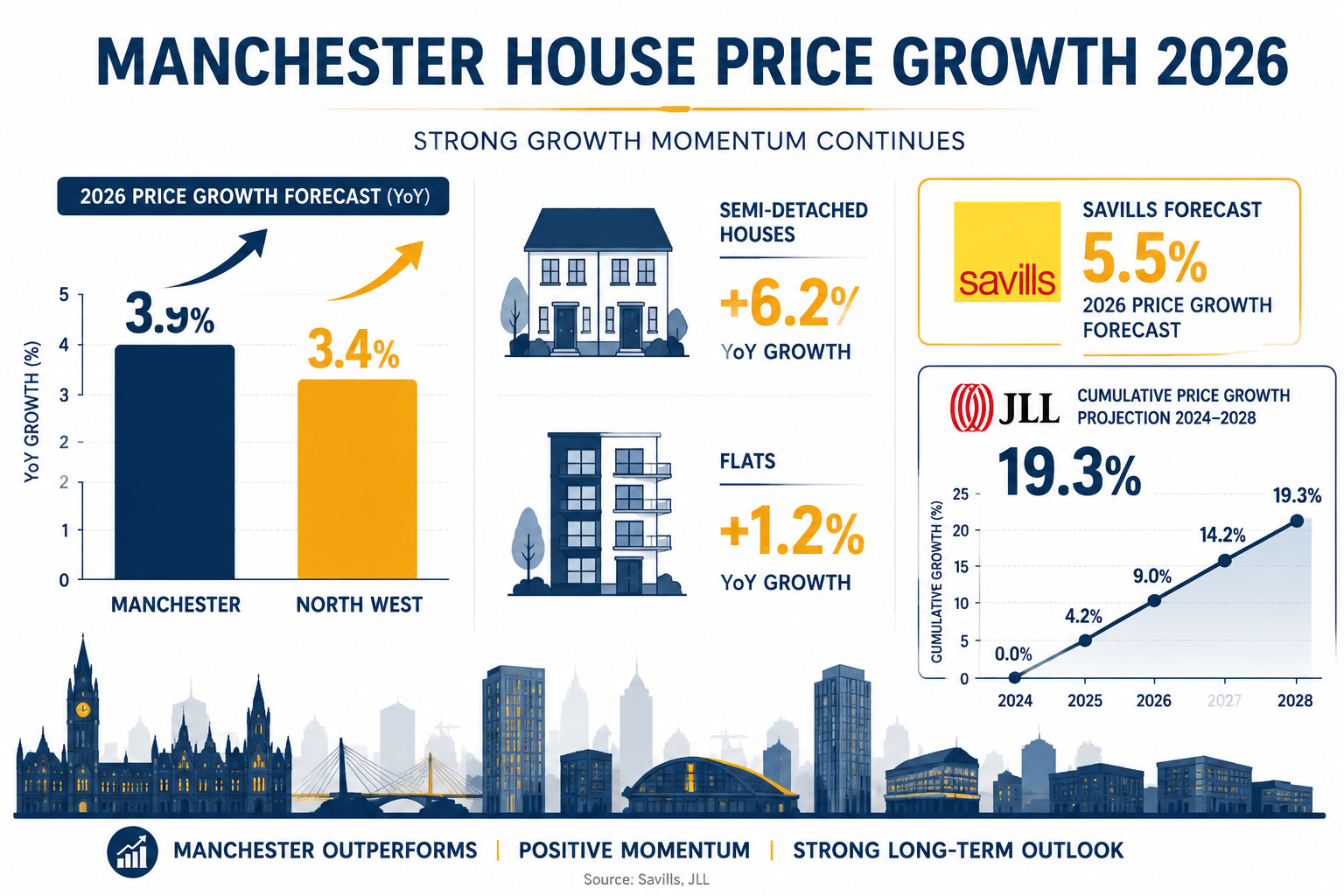
Manchester's average house price hit £251,000 in February 2026 — up 3.9% year-on-year, outpacing the wider North West's 3.4% growth and cementing the city's reputation as one of the UK's most compelling property markets. For buyers, sellers, and investors navigating the Manchester property market 2026 regeneration house prices growth story, understanding why values are rising — and where the risks lie — has never been more important.
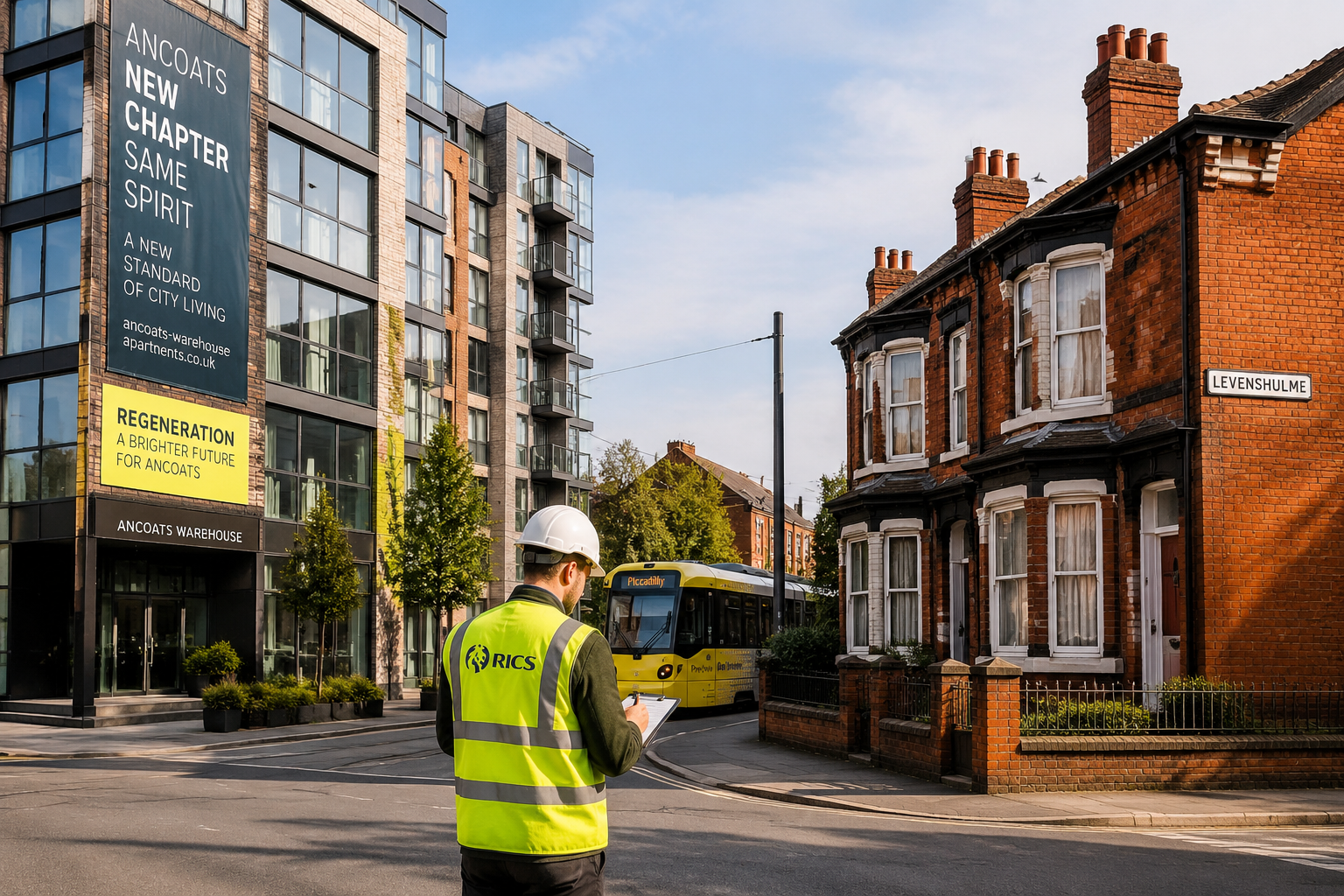
At Manchester Surveyors, our RICS chartered team works across Greater Manchester every week, inspecting everything from freshly converted warehouse apartments in Ancoats to Edwardian terraces in Levenshulme. This article brings together the latest data, regeneration intelligence, and professional surveying insight to give you a complete picture.
Key Takeaways 🏠
- Average Manchester house price: £251,000 (February 2026, ONS), up 3.9% YoY — above the North West average
- Savills forecasts 5.5% growth for Manchester in 2026; JLL projects 19.3% cumulative growth between 2024 and 2028
- Semi-detached homes lead with +6.2% YoY growth; flats lag at +1.2%
- The £1bn Good Growth Fund and Bee Network transport upgrades are the primary structural drivers of neighbourhood-level price rises
- Survey type matters: newly regenerated stock and period terraces carry very different risk profiles — choosing the right RICS survey protects your investment
What the Numbers Really Tell Us About Manchester Property Market 2026 Regeneration House Prices Growth
The Headline Figures
The 3.9% year-on-year rise to £251,000 is encouraging, but the detail beneath that headline is where the real story lives.
| Property Type | YoY Price Change (2026) |
|---|---|
| Semi-detached | +6.2% |
| Detached | +4.1% (est.) |
| Terraced | +3.8% (est.) |
| Flats / apartments | +1.2% |
Semi-detached homes are the standout performer, driven by family buyers moving outward from the city core into areas like Levenshulme, Hulme, and Chorlton, where space and relative affordability combine. The flat market's modest 1.2% growth reflects a significant oversupply of new-build city-centre apartments — a dynamic buyers and investors must weigh carefully.
"Manchester's residential market is not one market — it is a dozen micro-markets moving at different speeds."
The Longer View
Manchester has recorded 33% house price growth over the past five years, far exceeding a 20-city average of 15%. Looking forward, JLL ranks Manchester as the second strongest city for house price growth until 2028, projecting 19.3% cumulative growth — ahead of the national forecast of 17.6%. Savills is more conservative for 2026 specifically, forecasting 5.5% growth for the year.
Rental yields reinforce the investment case. Gross yields average 6% to 6.6% across Manchester, with well-located apartments achieving 8%+, significantly outperforming the UK average. Rental values are projected to grow at 4% per year until 2028, underpinned by a population that has grown approximately 23% since 2011 and is expected to reach around 635,000 by 2026.
Why Supply Remains Tight
Approximately 100,000 people are projected to live in Manchester city centre by 2026. Graduate retention is high, with the city's universities feeding a young professional population that rents first and buys later. New completions, while increasing, have not kept pace with demand — particularly for family-sized homes — keeping upward pressure on prices.
Regeneration Drivers: The Engine Behind Manchester Property Market 2026 House Prices Growth
The £1 Billion Good Growth Fund
The Greater Manchester Good Growth Fund is the single most significant structural driver of neighbourhood-level price appreciation right now. Supporting more than 30 regeneration projects across the city-region, the fund is expected to deliver:
- 🏗️ Nearly 3,000 new homes
- 💼 Over 22,000 new jobs
- 🏢 2 million sq ft of employment space
Key schemes include the Bury Interchange redevelopment and the Salford Crescent multi-modal transport hub. These are not cosmetic improvements — they are structural changes that reshape commuter patterns, retail footfall, and ultimately, residential desirability.
The Bee Network: Transport as a Price Driver
The Bee Network — Greater Manchester's integrated tram, bus, and cycling network — is quietly one of the most powerful property price drivers in the North of England. Improved connectivity between previously overlooked neighbourhoods and the city centre compresses effective commute times, making areas like Hulme and New Islington viable for buyers who might previously have looked elsewhere.
Transport investment historically adds a measurable premium to properties within walking distance of new or upgraded stops. As the Bee Network expands through 2026 and beyond, buyers purchasing ahead of full connectivity stand to benefit most.
Major Regeneration Zones to Watch 📍
Ancoats & New Islington remain the city's most talked-about regeneration success story. Former industrial land has transformed into a destination neighbourhood, and prices reflect that — though early-mover gains are now largely priced in.
Levenshulme is the current value proposition. Strong community identity, improving transport links, and a wave of independent businesses have created the conditions for sustained price growth. Semi-detached Victorian stock here is particularly sought after.
Hulme benefits from proximity to Manchester Metropolitan University and ongoing public realm investment. Demand from young professionals and academic staff keeps the lettings market tight.
Northern Gateway / Victoria North represents the largest single regeneration canvas — a £1.5 billion project introducing thousands of new homes and commercial space north of the city centre. Build-to-Rent completions here are reshaping the northern skyline and creating new owner-occupier demand.
Trafford Waters and Salford Quays / MediaCityUK continue to attract both domestic and international buyers, with the creative and digital economy providing a stable employment base.
Choosing the Right Survey: New Regeneration Stock vs. Period Terraces
This is where professional advice becomes genuinely valuable — and where buyers most often underestimate their risk.
RICS Level 2 (Home Survey): When It's Appropriate
A RICS Home Survey (Level 2) is a condition-focused report suited to conventional properties in reasonable condition. For a well-maintained 1990s apartment in a regenerated block, or a recently refurbished mid-terrace, a Level 2 survey provides a proportionate assessment of visible defects, maintenance priorities, and any issues requiring further investigation.
It is not sufficient for:
- Properties over 100 years old with original fabric
- Converted industrial or commercial buildings
- Homes with suspected structural movement, damp, or non-standard construction
RICS Level 3 (Building Survey): When You Need It
For period terraces in Levenshulme, Hulme, or Ancoats — or any converted warehouse or mill apartment — a full RICS Building Survey (Level 3) is the appropriate tool. This is the most comprehensive survey available, covering:
- Structural integrity and movement analysis
- Roof condition (particularly relevant for older terraces — see our roof survey guidance)
- Damp and moisture — a persistent issue in Manchester's Victorian stock (damp surveys are often recommended as a follow-up)
- Non-standard construction elements common in converted industrial buildings
- Drainage conditions, especially in older properties
💡 Pro tip: Buyers purchasing newly converted apartments in regeneration zones should also consider a snagging report to identify defects in new-build or recently converted units before legal completion.
What Our Surveyors Commonly Find
In newly regenerated stock, we frequently identify inadequate soundproofing between converted units, incomplete fire-stopping, and mechanical/electrical systems that are technically new but poorly commissioned. In period terraces, rising damp, failing lintels, and roof spread are the most common significant findings.
A RICS-certified property inspection gives you the evidence to renegotiate the purchase price, budget for repairs, or — in serious cases — walk away before exchange.
For buyers who also need an independent valuation, our RICS Red Book Valuation service provides a formal, lender-accepted assessment of market value.
Conclusion: Act on Evidence, Not Enthusiasm
The Manchester property market 2026 regeneration house prices growth story is real, data-backed, and likely to continue. With Savills forecasting 5.5% growth this year, JLL projecting 19.3% cumulative growth to 2028, and the Good Growth Fund reshaping entire neighbourhoods, the structural case for Manchester property remains strong.
But growth does not eliminate risk — it concentrates it. Rising prices mean that defects hidden in a £280,000 terrace or a newly converted apartment carry proportionally greater financial consequences than they did five years ago.
Your Next Steps ✅
- Identify your target area using the neighbourhood data in this article — Levenshulme and Hulme offer the best value-growth combination right now
- Commission the right survey — Level 2 for conventional modern stock; Level 3 for period or converted properties
- Get an independent valuation if you are purchasing in a fast-moving regeneration zone where comparable evidence is thin
- Don't skip the snagging report on any new-build or recently converted unit
Our RICS chartered surveyors cover the whole of Greater Manchester. Get a quote today or learn more about who we are before you make one of the most significant financial decisions of your life.