Over 60% of electrical fires in England occur in privately rented homes — yet until 2026, no single regulatory framework forced landlords to remediate these hazards within legally binding timeframes. That gap is now closing. From October 2026, Awaab's Law extends to fire and electrical hazards in the private rented sector (PRS), creating a seismic shift in how valuers must assess, quantify, and defend adjustments for affected properties. Understanding Valuation Adjustments for Fire and Electrical Hazards Under Awaab's Law 2026: Risk Quantification for PRS Properties is no longer optional — it is a core professional competency.
Key Takeaways 📋
- Awaab's Law expands to PRS properties in October 2026, adding fire and electrical hazards to its prescribed list of regulated defects alongside excess cold/heat, structural risks, and falls. [2][3]
- Landlords face strict response timelines: investigate within 10 working days, provide written findings within 3 working days, and begin repairs within 5 working days. [2]
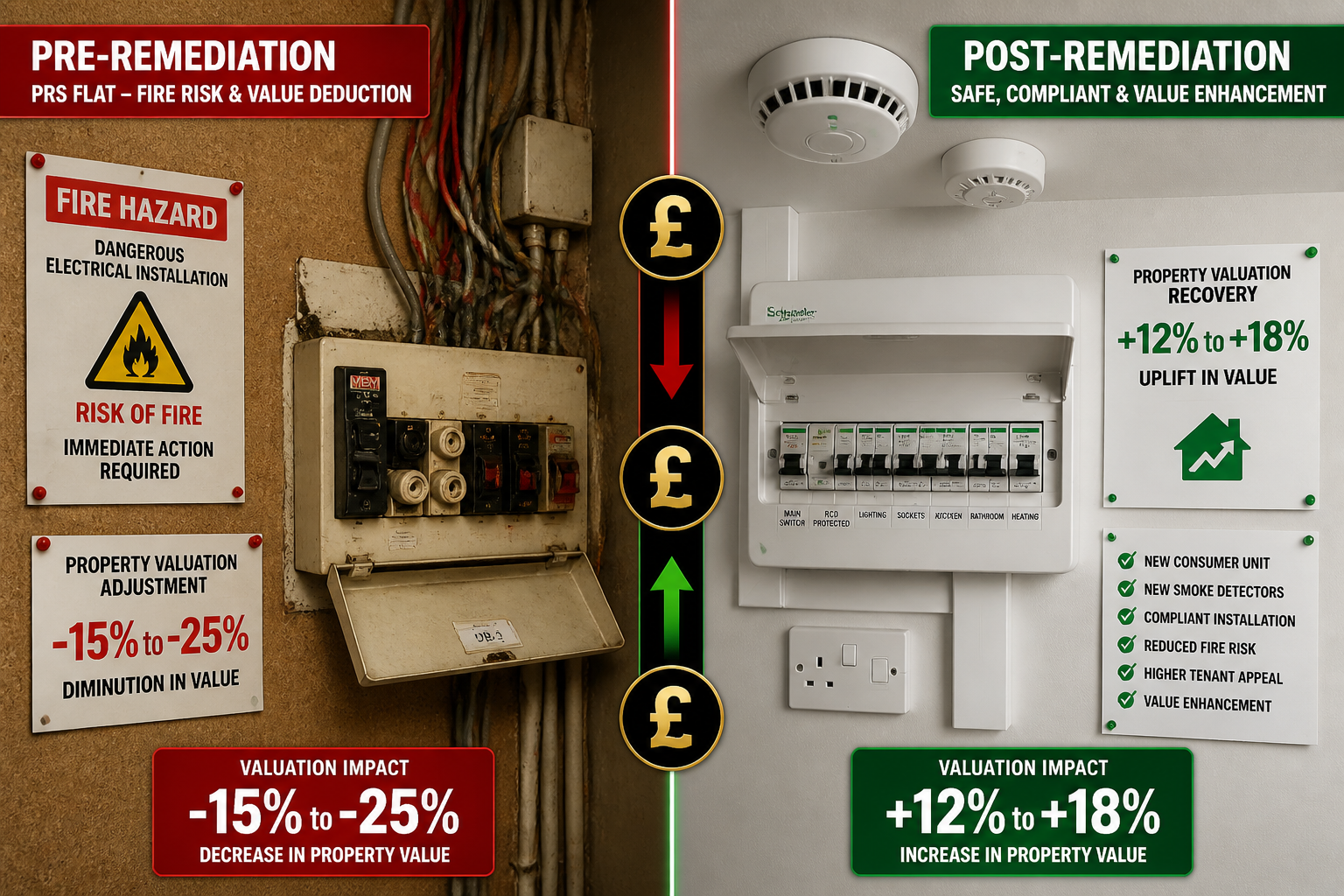
- Valuation adjustments for non-compliant properties typically range from 5% to 25%+ diminution, depending on hazard severity, remediation cost, and tenant vulnerability.
- Risk quantification must now be person-centred, reflecting individual tenant circumstances rather than generic HHSRS category ratings. [5]
- Surveyors face increased liability exposure if fire and electrical hazard assessments are omitted or inadequately reported in PRS valuations. [1]
What Awaab's Law 2026 Actually Changes for PRS Valuations
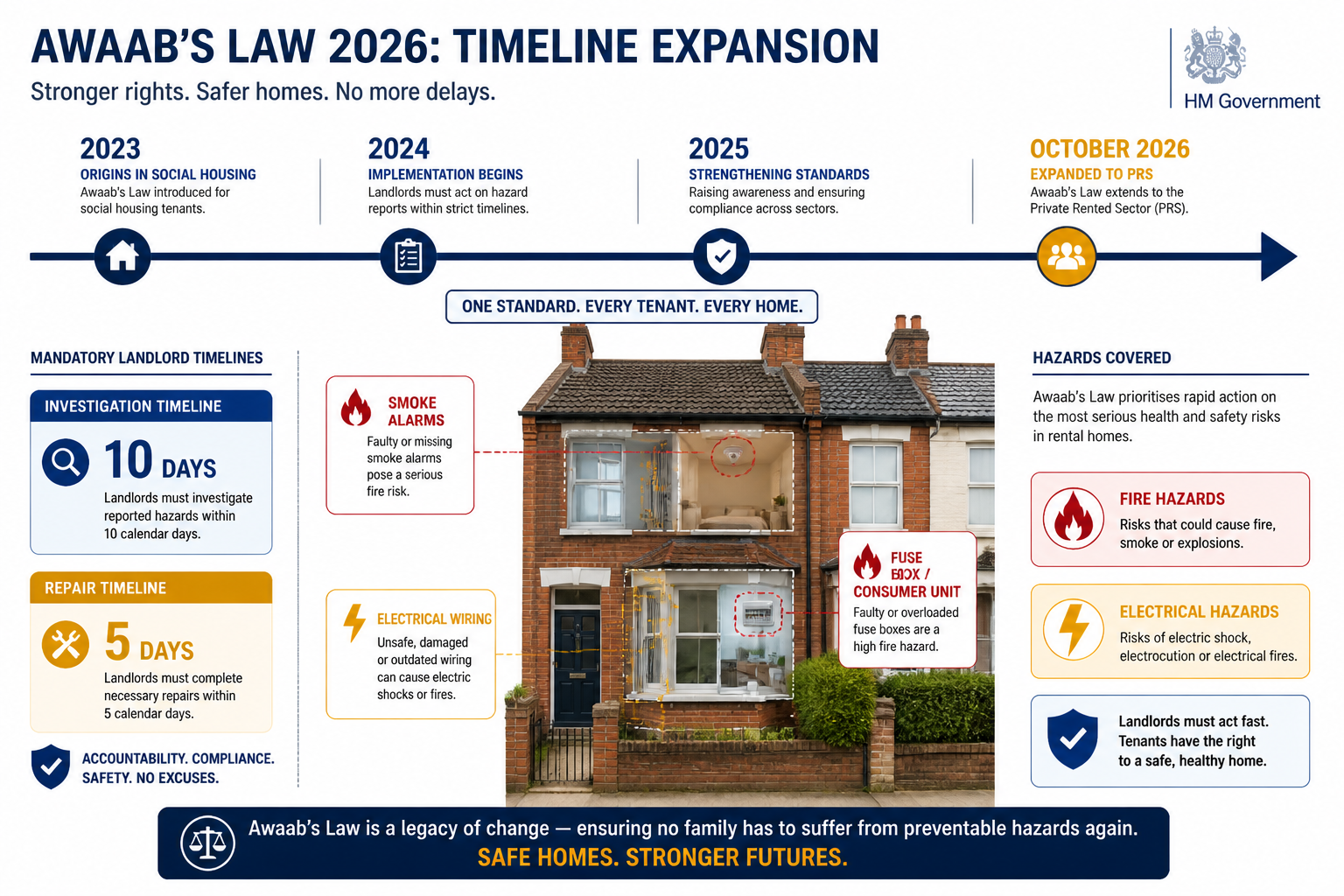
Awaab's Law originated from the tragic death of two-year-old Awaab Ishak in 2020, caused by prolonged exposure to mould in a social housing property. The Social Housing (Regulation) Act 2023 initially introduced mandatory repair timelines for social landlords. However, the 2026 extension fundamentally broadens the law's reach. [3]
From October 2026, the following hazard categories become prescribed under Awaab's Law for PRS properties:
| Hazard Category | Prescribed from October 2026? |
|---|---|
| Damp and mould | ✅ Yes (already covered) |
| Excess cold / excess heat | ✅ Yes |
| Fire hazards | ✅ Newly added |
| Electrical hazards | ✅ Newly added |
| Structural collapse risks | ✅ Yes |
| Falls on stairs / level surfaces | ✅ Yes |
💡 Pull Quote: "The October 2026 expansion means that a PRS property with an outdated consumer unit or inadequate fire detection is no longer just a maintenance issue — it is a legally prescribed hazard with mandatory remediation timelines attached."
This matters enormously for valuers. A property that previously attracted a modest maintenance deduction may now carry statutory non-compliance risk, which demands a materially different adjustment methodology. [1][2]
The Regulatory Framework: Timelines That Drive Valuation Risk
Understanding the mandatory timelines is essential for quantifying risk accurately. Under Awaab's Law 2026, landlords must comply with the following sequence when a prescribed hazard — including fire or electrical — is reported: [2]
- Investigate the hazard within 10 working days of notification
- Provide written findings to the tenant within 3 working days of completing the investigation
- Begin repairs within 5 working days of the investigation conclusion
- Complete emergency repairs (where there is immediate risk to life) within 24 hours
Failure to comply exposes landlords to enforcement action, civil liability, and — critically for valuers — a demonstrable reduction in the property's investment value and marketability.
Crucially, the assessment approach under Awaab's Law is person-centred. Hazards are evaluated based on individual tenant circumstances rather than standardised Housing Health and Safety Rating System (HHSRS) category ratings. [5] A property housing elderly tenants or young children therefore carries a higher risk profile than the same property with different occupants — a nuance valuers must reflect in their adjustment methodology.
Valuation Adjustments for Fire and Electrical Hazards Under Awaab's Law 2026: A Risk Quantification Framework

Quantifying diminution for fire and electrical hazards requires a structured, defensible methodology. The following framework draws on established RICS Red Book principles, the HHSRS scoring system, and the emerging compliance obligations under Awaab's Law 2026.
Step 1: Hazard Identification and Classification
Before any adjustment is applied, the valuer must identify and classify the specific hazard. For fire and electrical risks, this typically involves reviewing:
- Electrical Installation Condition Reports (EICR) — mandatory for PRS properties every 5 years
- Fire Risk Assessments (FRA) — particularly relevant for HMOs and multi-unit buildings
- Evidence of smoke/CO detector compliance under the Smoke and Carbon Monoxide Alarm Regulations 2022
- Age and condition of consumer units (fuse boards)
- Wiring type and age (e.g., rubber-insulated wiring pre-1966 carries significantly elevated risk)
A specific defect report is often the most appropriate survey product to isolate and document these hazards before a formal valuation is undertaken.
Step 2: Remediation Cost Assessment
Remediation cost is a primary driver of valuation adjustment. Typical remediation cost ranges for fire and electrical hazards in PRS properties include:
| Defect Type | Typical Remediation Cost (2026) |
|---|---|
| Consumer unit replacement | £400 – £900 |
| Full rewire (2-bed flat) | £3,000 – £6,000 |
| Full rewire (3-bed house) | £5,000 – £10,000 |
| Fire detection system upgrade | £500 – £2,500 |
| Fire door replacement (per door) | £300 – £800 |
| Emergency lighting installation | £1,000 – £4,000 |
These costs feed directly into the diminution calculation, but they are not the only factor. The valuer must also account for:
- Void period risk during remediation works
- Enforcement action risk if works are not completed within statutory timelines
- Tenant compensation liability under the Homes (Fitness for Human Habitation) Act 2018
- Insurance premium uplift for non-compliant properties
For properties where reinstatement cost is a relevant consideration, an insurance reinstatement valuation should be obtained alongside the market valuation.
Step 3: Applying the Valuation Adjustment
The adjustment is typically expressed as a percentage diminution from Market Value (MV) as defined under RICS Red Book Global Standards. The following indicative ranges apply for 2026:
| Hazard Severity | Indicative Diminution Range |
|---|---|
| Minor (e.g., single EICR advisory, smoke detector missing) | 2% – 5% |
| Moderate (e.g., unsatisfactory EICR, outdated consumer unit) | 5% – 15% |
| Significant (e.g., partial rewire required, fire door failures) | 15% – 20% |
| Severe (e.g., full rewire required, systemic fire safety failure) | 20% – 30%+ |
⚠️ Important: These ranges are indicative starting points. The actual adjustment must be supported by comparable market evidence of transactions involving similar hazard profiles, remediation cost calculations, and a documented rationale in the valuation report.
The person-centred assessment principle under Awaab's Law 2026 means that the same physical defect may warrant a higher adjustment in a property occupied by vulnerable tenants, because the landlord's statutory obligation — and therefore the enforcement risk — is materially greater. [5]
Market Impact Analysis: How Buyers and Lenders Are Responding in 2026
The October 2026 extension of Awaab's Law has already begun to influence PRS market behaviour. Several trends are now observable:
🏦 Lender caution is increasing. Mortgage lenders are increasingly requesting evidence of EICR compliance and fire safety certification before advancing funds on PRS properties. Properties with outstanding electrical hazards are attracting special conditions or retention clauses in mortgage offers.
📉 Yield compression for non-compliant stock. Investors are applying higher yield requirements — effectively discounting prices — for PRS properties with unresolved fire or electrical hazards. A property that would trade at a 5.5% yield when compliant may be priced at 6.5%–7.0% to reflect the compliance risk premium.
📋 Due diligence is intensifying. Buyers of PRS portfolios are commissioning stock condition surveys and dilapidation surveys as standard pre-acquisition tools to identify Awaab's Law exposure across entire portfolios.
⚖️ Dispute frequency is rising. Landlord-tenant disputes involving fire and electrical hazards are increasingly being referred to the First-tier Tribunal (Property Chamber), with valuation evidence required to quantify rent reduction and compensation claims. [1][4]
The government's own impact assessment acknowledges significant compliance costs across the PRS sector, with the total cost of Awaab's Law implementation running into hundreds of millions of pounds across affected properties. [4]
Surveyor Liability and Reporting Obligations Under Awaab's Law 2026
The 2026 expansion of Awaab's Law creates heightened professional liability for surveyors who fail to identify or adequately report fire and electrical hazards. [1] The key obligations include:
What Surveyors Must Now Report
- EICR status — whether a valid report exists and its outcome (satisfactory/unsatisfactory)
- Consumer unit type and age — old-style fuse boards without RCD protection represent a Category 2 or Category 1 hazard under HHSRS
- Wiring condition — visible evidence of deterioration, overloading, or non-standard installation
- Fire detection provision — type, location, and apparent condition of smoke and CO alarms
- Fire door compliance — particularly in HMOs and converted properties
- Escape route adequacy — especially in upper-floor flats and multi-storey properties
A RICS Building Survey (Level 3) provides the most comprehensive framework for identifying these hazards, though a homebuyer survey should also flag material fire and electrical concerns where visible.
Defending Valuations in Disputes
When a valuation is challenged — whether in a mortgage dispute, a tribunal claim, or a negligence action — the valuer must be able to demonstrate:
- That the hazard was identified (or that it was not reasonably visible at inspection)
- That the adjustment methodology is logical and evidence-based
- That comparable market evidence supports the quantum of adjustment
- That the Awaab's Law compliance risk was explicitly considered
Valuers should cross-reference their adjustments against RICS reinstatement and build cost valuations where structural remediation is also involved, ensuring that all cost components are captured and not double-counted.
Practical Risk Quantification: A Worked Example
Scenario: A two-bedroom mid-terrace PRS property in Manchester, currently let at £900/month. The EICR (completed 2023) returned an unsatisfactory result, citing a C2 code for the lack of RCD protection on the consumer unit. A fire risk assessment identified two missing fire doors in the converted loft conversion.
Step 1 — Remediation costs:
- Consumer unit replacement: £650
- Two fire doors (supply and fit): £1,400
- Total remediation: £2,050
Step 2 — Compliance risk premium:
- Under Awaab's Law 2026, the landlord must begin repairs within 5 working days of investigation. [2]
- Failure to comply risks enforcement action and potential rent repayment orders.
- Estimated void risk during works: 2 weeks = £415
Step 3 — Adjustment calculation:
- Market Value (compliant): £185,000
- Direct cost deduction: £2,050
- Risk premium (enforcement, void, tenant compensation): £3,500 (estimated)
- Total adjustment: £5,550 ≈ 3.0% diminution
- Adjusted Market Value: £179,450 (reported as £179,500)
This example illustrates a moderate hazard scenario. Where hazards are more severe — such as a full rewire requirement alongside systemic fire safety failures — adjustments in the £15,000–£40,000 range (8%–22% of value) become entirely justifiable and defensible.
For properties where capital gains tax implications arise on sale of a non-compliant investment property, a valuation for capital gains tax should reflect the adjusted market value at the relevant date, incorporating any Awaab's Law compliance discount applicable at that time.
Conclusion: Actionable Next Steps for Valuers and PRS Stakeholders
The October 2026 extension of Awaab's Law to fire and electrical hazards is not a distant regulatory change — it is a present-day valuation reality that demands updated methodologies, clearer reporting standards, and stronger professional frameworks.
For RICS valuers and chartered surveyors:
- ✅ Update inspection checklists to explicitly capture EICR status, consumer unit age, fire door compliance, and fire detection provision
- ✅ Develop a documented adjustment matrix — similar to the indicative ranges above — that can be referenced and defended in dispute situations
- ✅ Ensure all PRS valuation reports include an explicit section on Awaab's Law compliance risk
- ✅ Commission specific defect reports where fire or electrical hazards require specialist investigation before a valuation can be finalised
For PRS landlords and investors:
- ✅ Audit your portfolio for EICR compliance and fire safety certification before October 2026
- ✅ Obtain updated valuations that reflect post-remediation values to support refinancing and portfolio management decisions
- ✅ Factor Awaab's Law compliance costs into acquisition pricing models for all PRS purchases
For mortgage lenders and legal advisors:
- ✅ Require explicit Awaab's Law compliance confirmation as part of standard PRS mortgage conditions
- ✅ Instruct valuers to provide a specific commentary on fire and electrical hazard status in all PRS valuation reports
The legal landscape has shifted. The valuers and landlords who adapt their risk quantification frameworks now will be best positioned to protect asset values, avoid enforcement action, and operate with confidence in a more regulated PRS market.
References
[1] Electrical Hazards And Fire Risk Assessment In Building Surveys Awaabs Law 2026 Extensions And Surveyor Liability – https://nottinghillsurveyors.com/blog/electrical-hazards-and-fire-risk-assessment-in-building-surveys-awaabs-law-2026-extensions-and-surveyor-liability
[2] Awaabs Law 2026 A Complete Guide – https://prbge.co.uk/awaabs-law-2026-a-complete-guide/
[3] Awaabs Law And The Future Of Social Housing Standards In England – https://www.darwingray.com/insights/awaabs-law-and-the-future-of-social-housing-standards-in-england/
[4] Awaabs Law Final Stage Impact Assessment – https://assets.publishing.service.gov.uk/media/685b9240454906840a44d654/Awaab_s_Law_Final_Stage_Impact_Assessment.pdf
[5] Awaabs Law Guidance For Social Landlords Timeframes For Repairs In The Social Rented Sector – https://www.gov.uk/government/publications/awaabs-law-guidance-for-social-landlords/awaabs-law-guidance-for-social-landlords-timeframes-for-repairs-in-the-social-rented-sector
[6] Awaabs Law What Is It And Impact – https://alertelectrical.com/blog/post/awaabs-law-what-is-it-and-impact