Over 2 million people in England live in social housing with a serious damp or mould problem — yet until recently, landlords faced no legally enforceable deadlines to fix them. That changes dramatically in October 2026, when Phase 2 of Awaab's Law comes into force, bringing domestic and personal hygiene hazards into the scope of prescribed compliance requirements for the first time [1][2].
For building surveyors, this is not a minor administrative update. The expansion of Awaab's Law in 2026 fundamentally reshapes how hygiene-related hazards must be identified, documented, and reported during property inspections. Understanding Domestic and Personal Hygiene Hazards in Building Surveys: Awaab's Law 2026 Expansion and Surveyor Standards is now essential knowledge for any professional working in the residential and social housing sectors.
Key Takeaways 📋
- Phase 2 of Awaab's Law activates in October 2026, adding domestic and personal hygiene hazards to the list of prescribed hazards that social landlords must respond to within strict timeframes [2].
- Domestic and personal hygiene hazards include inadequate sanitation facilities, poor ventilation, and conditions that compromise food safety — all now subject to mandatory landlord action [1].
- The law is delivered through the Hazards in Social Housing (Prescribed Requirements) (England) Regulations 2025, which sets clear response deadlines once a significant hazard is identified [2].
- Building surveyors must adapt their inspection protocols to assess, score, and document hygiene hazards in line with HHSRS criteria and Awaab's Law compliance requirements.
- Detailed record-keeping — including correspondence, contractor engagement, and reasons for any delays — is a legal obligation under the regulations [3].
What Is Awaab's Law and Why Does 2026 Matter?
Awaab's Law was named after two-year-old Awaab Ishak, who died in December 2020 from a respiratory condition caused by prolonged exposure to mould in a social housing flat in Rochdale. The subsequent inquest and public outcry led to landmark legislation embedded within the Social Housing (Regulation) Act 2023.
The law creates a legal duty for social landlords to investigate and repair hazardous conditions within prescribed timeframes. It is delivered through secondary legislation — specifically, the Hazards in Social Housing (Prescribed Requirements) (England) Regulations 2025 — which defines exactly which hazards are covered and how quickly landlords must act [2].
The Three-Phase Rollout
Awaab's Law is being introduced in stages:
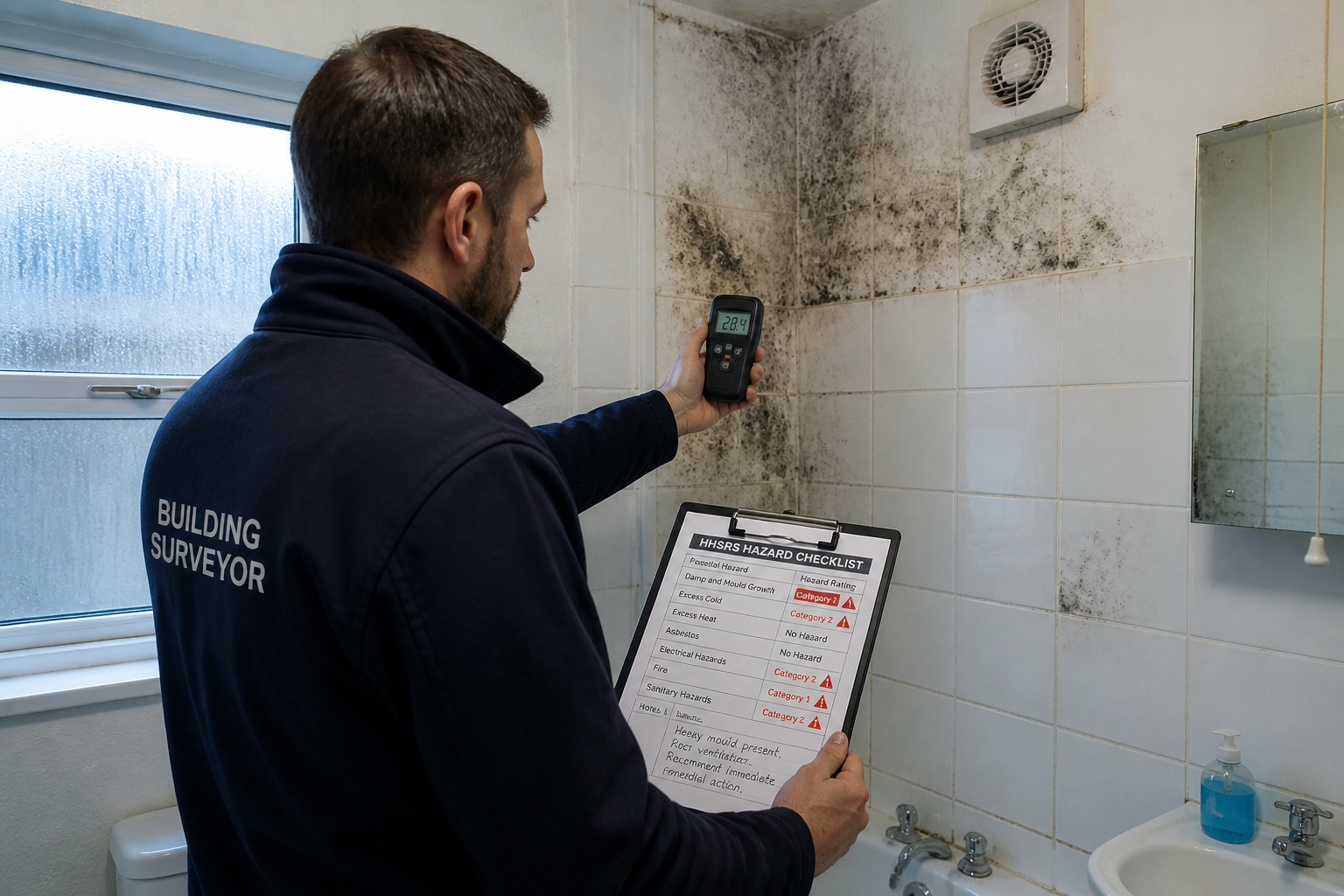
| Phase | Date | Hazards Covered |
|---|---|---|
| Phase 1 | October 2025 | Damp and mould |
| Phase 2 | October 2026 | Domestic & personal hygiene, excess cold/heat, falls, structural collapse, fire, electrical hazards |
| Phase 3 | October 2027 | All remaining HHSRS hazards (except overcrowding) presenting significant risk [8] |
💬 "A significant hazard is one presenting a significant risk of harm to tenant health or safety — a risk that a reasonable landlord would treat as requiring urgent action." [4]
Phase 2 is the most expansive update to date. It does not just add one or two new categories — it introduces an entire cluster of hazards that surveyors must now assess with the same rigour previously reserved for damp and mould.
Understanding Domestic and Personal Hygiene Hazards in Building Surveys: Awaab's Law 2026 Expansion and Surveyor Standards
What Are Domestic and Personal Hygiene Hazards?
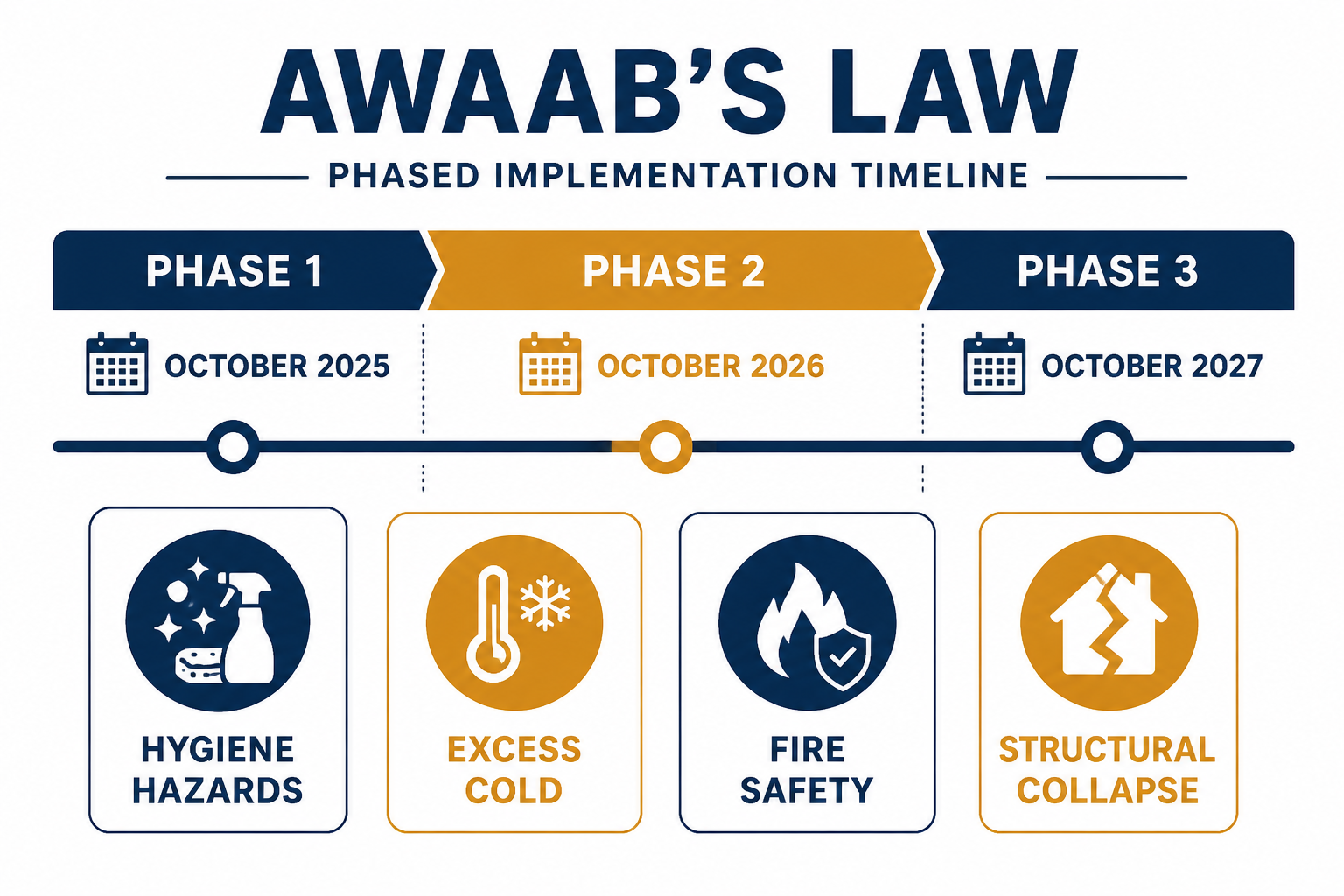
Under the Housing Health and Safety Rating System (HHSRS), domestic and personal hygiene hazards relate to conditions that affect a resident's ability to maintain basic sanitation and cleanliness. These include:
- 🚿 Inadequate or defective sanitation facilities — broken toilets, non-functional baths or showers
- 💧 Insufficient hot water supply for personal washing or food preparation
- 🌬️ Poor ventilation in kitchens and bathrooms leading to moisture accumulation
- 🍽️ Inadequate food safety infrastructure — lack of proper food storage, preparation surfaces, or pest ingress points
- 🧹 Waste disposal deficiencies — absence of suitable facilities for refuse storage or removal
These hazards may seem less dramatic than structural collapse or fire risk, but their health consequences are serious. Poor sanitation is directly linked to gastrointestinal illness, skin infections, and respiratory conditions. For vulnerable residents — including the elderly, immunocompromised individuals, and young children — these risks are acute.
What Counts as a "Significant Hazard"?
Not every defective tap or worn bathroom tile triggers Awaab's Law obligations. The threshold is a significant risk of harm — meaning a reasonable landlord, presented with the evidence, would consider the condition to require urgent remediation [4].
For surveyors, this means applying HHSRS scoring methodology carefully. A hazard score that places a condition in Band A or Band B is generally considered significant. However, the regulations do not rely solely on numerical scores — professional judgement about the likelihood of harm and the vulnerability of the occupant group also matters [7].
Phase 2 Hazard Categories in Full
Beyond domestic and personal hygiene, Phase 2 also prescribes the following hazard categories [2]:
- ❄️ Excess cold — inadequate heating systems, poor insulation
- 🌡️ Excess heat — lack of cooling or ventilation in extreme temperatures
- 🪜 Falls associated with baths and stairs — defective fixtures, poor lighting, uneven surfaces
- 🏗️ Structural collapse and explosions — compromised load-bearing elements, gas safety failures
- 🔥 Fire hazards — inadequate fire detection, blocked escape routes
- ⚡ Electrical hazards — outdated wiring, unsafe installations
Each of these categories demands a distinct assessment approach. For surveyors already conducting RICS Level 3 Building Surveys, many of these elements will already feature in inspection protocols — but the legal weight attached to findings is now considerably greater.
How Building Surveyors Must Respond: Updated Standards and Protocols
Adapting Inspection Methodology
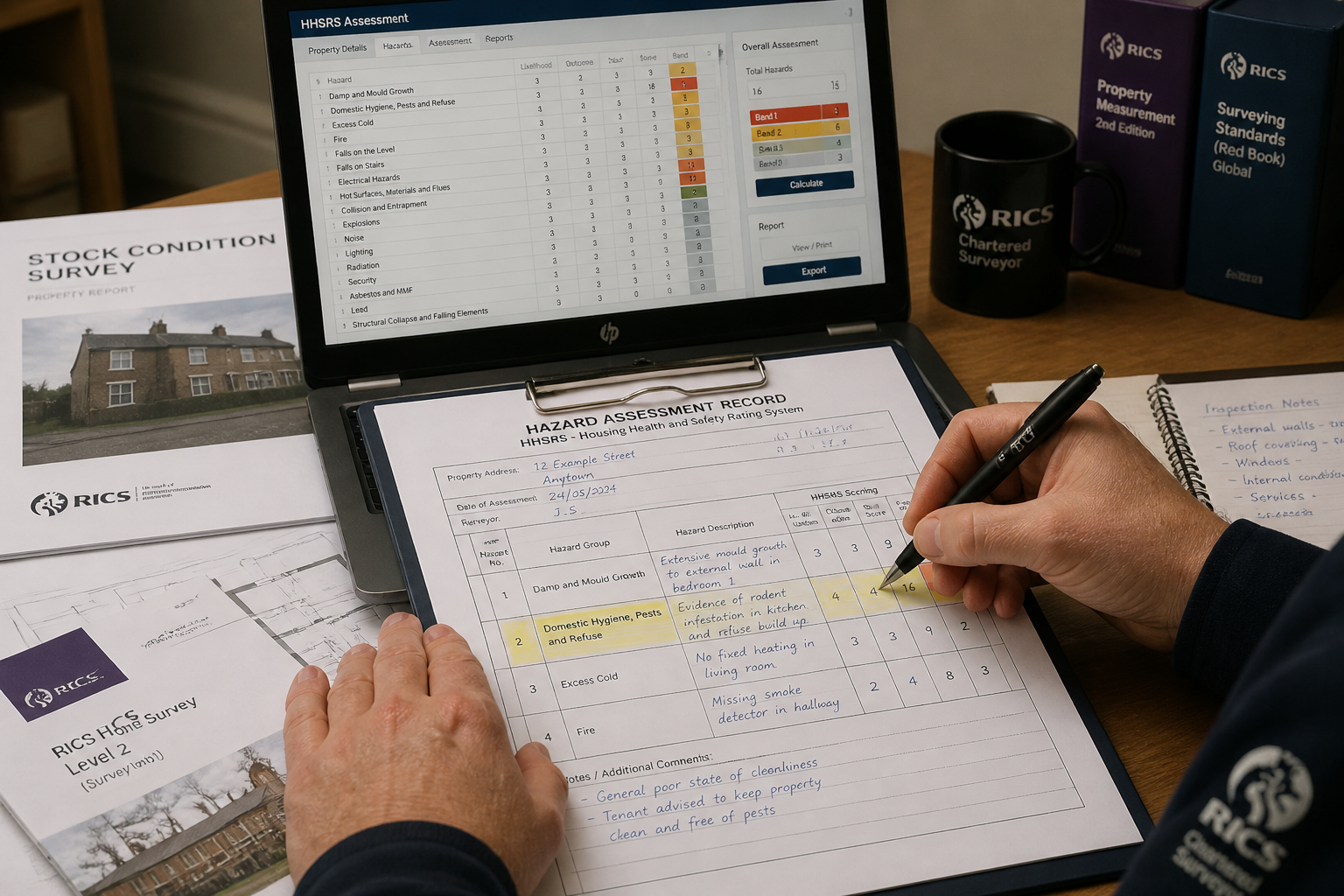
The arrival of Domestic and Personal Hygiene Hazards in Building Surveys: Awaab's Law 2026 Expansion and Surveyor Standards as a compliance framework requires surveyors to make tangible adjustments to how they conduct inspections and structure reports.
Key changes include:
- Explicit HHSRS hazard scoring for domestic hygiene categories, not just structural defects
- Ventilation assessment — recording the presence, condition, and adequacy of mechanical and natural ventilation in wet rooms
- Sanitation fixture condition — noting not just cosmetic wear but functional adequacy
- Food safety infrastructure review — checking kitchen layouts, pest ingress points, and waste management provisions
- Occupant vulnerability profiling — factoring in the likely resident profile when assessing risk severity
For those conducting stock condition surveys across social housing portfolios, this represents a significant expansion of the inspection scope. Surveyors working with registered providers must ensure their reporting templates are updated before October 2026.
Documentation and Record-Keeping Obligations
One of the most operationally significant aspects of Awaab's Law is its emphasis on record-keeping. Landlords must maintain clear records of:
- All hazard reports received from tenants
- Correspondence with residents about identified hazards
- Contractor engagement and repair timelines
- Reasons for any delays, particularly where circumstances were beyond the landlord's control [3]
For surveyors, this creates an indirect obligation: the reports they produce must be sufficiently detailed to support a landlord's compliance audit trail. Vague descriptions like "bathroom in poor condition" are no longer adequate. Reports must specify the nature of the hazard, its likely cause, the affected areas, and a recommended response timeframe.
💬 "Clear, timestamped documentation is not just good practice under Awaab's Law — it is a legal safeguard for both landlord and surveyor."
Response Timeframes Under the Regulations
The regulations prescribe specific response windows once a significant hazard is identified [7]:
| Hazard Type | Investigation Deadline | Repair Deadline |
|---|---|---|
| Emergency hazard (immediate risk) | 24 hours | 24 hours |
| Significant hazard (Phase 2 categories) | 14 days | Reasonable period (typically up to 8 weeks) |
These timeframes apply to landlords, not surveyors directly. However, surveyors who identify a Phase 2 hazard during an inspection have a professional duty to communicate findings clearly and promptly. Delayed or ambiguous reporting could expose both the surveyor and the landlord to liability.
The Role of Specific Defect Reports
Where a hygiene hazard is identified during a broader building survey, a specific defect report may be the most appropriate follow-up tool. These focused assessments allow surveyors to:
- Isolate the root cause of a hygiene-related defect (e.g., inadequate extract ventilation causing persistent condensation)
- Provide targeted remediation recommendations
- Create a standalone document that supports the landlord's compliance record
This approach is particularly valuable when a full RICS Building Survey has already been completed and a specific hygiene concern emerges post-inspection.
Surveyor Readiness: Practical Steps for October 2026 Compliance
With Phase 2 activation just months away, the surveying profession needs to move from awareness to action. Here is a practical checklist for professionals preparing for the October 2026 changes:
✅ Pre-October 2026 Preparation Checklist
- Review HHSRS guidance for domestic and personal hygiene hazard categories
- Update inspection templates to include explicit hygiene hazard fields
- Calibrate scoring methodology for Phase 2 hazard categories
- Brief clients — particularly registered providers and local authorities — on the expanded scope
- Establish reporting protocols that generate Awaab's Law-compliant documentation
- Engage with CPD on Phase 2 hazard assessment techniques
- Review PI insurance to ensure coverage reflects expanded liability exposure
Working with Social Housing Providers
The majority of Awaab's Law obligations fall on registered providers of social housing — housing associations and local councils. Surveyors working in this sector should be proactive in advising clients on:
- Portfolio-wide risk assessments to identify properties most likely to contain Phase 2 hazards
- Prioritisation frameworks for inspection scheduling ahead of October 2026
- Staff training on recognising and reporting domestic hygiene hazards
For surveyors who want to understand the full scope of what a professional inspection should cover, the RICS Chartered Building Survey framework provides a robust foundation that can be adapted for Awaab's Law compliance purposes.
Does Awaab's Law Apply to Private Rented Sector Properties?
As of 2026, Awaab's Law applies only to social housing — properties managed by registered providers. However, the government has signalled its intention to extend similar obligations to the private rented sector in future legislation. Surveyors working across both sectors should treat Phase 2 as a template for best practice, even where it is not yet legally mandated.
For those advising private landlords or buyers, a homebuyer survey or full building survey that flags hygiene hazards proactively will increasingly be seen as a mark of professional quality — and may become a legal requirement in the not-too-distant future.
The Broader HHSRS Picture: Looking Ahead to October 2027
Phase 2 is significant, but it is not the final step. In October 2027, Awaab's Law will expand again to cover all remaining HHSRS hazards (with the exception of overcrowding) where they present a significant risk of harm [8].
This means that by late 2027, virtually the entire HHSRS framework will carry the enforcement weight of Awaab's Law. Surveyors who begin adapting their practice now — building hygiene hazard assessment into standard inspection workflows — will be well ahead of the curve.
For professionals seeking to understand the full range of hazard categories they may encounter, consulting the why choose an RICS Chartered Building Surveyor resource offers useful context on the breadth of professional expertise required.
Conclusion: Action Steps for Surveyors in 2026
The October 2026 expansion of Awaab's Law is a watershed moment for building surveying practice. Domestic and personal hygiene hazards — once treated as secondary concerns in property inspections — now carry legally prescribed response obligations and must be assessed, scored, and documented with the same rigour as structural defects or fire safety risks.
Actionable Next Steps 🚀
- Update your inspection toolkit — ensure moisture meters, ventilation assessment tools, and HHSRS scoring sheets cover Phase 2 hazard categories before October 2026.
- Revise your report templates — generic condition descriptions are insufficient; reports must specify hazard type, severity, cause, and recommended action timescales.
- Engage your social housing clients now — help registered providers build their compliance audit trails and prioritise high-risk properties for inspection.
- Invest in CPD — seek out training specifically focused on domestic hygiene hazard assessment under the HHSRS framework.
- Stay ahead of Phase 3 — begin familiarising yourself with the full HHSRS hazard list in preparation for the October 2027 expansion.
The surveying profession has always been at the forefront of protecting people from unsafe housing conditions. Awaab's Law 2026 expansion is not a burden — it is an opportunity to demonstrate that professional expertise, when properly applied, saves lives.
References
[1] How Awaabs Law Changes The Rules On Hazards In Social Housing – https://england.shelter.org.uk/professional_resources/news_and_updates/how_awaabs_law_changes_the_rules_on_hazards_in_social_housing
[2] Awaabs Law Phase 2 Is Coming What Social Landlords Need To Know About Additional Hazard Compliance In 2026 – https://www.mobysoft.com/resources/blogs/awaabs-law-phase-2-is-coming-what-social-landlords-need-to-know-about-additional-hazard-compliance-in-2026/
[3] Awaabs Law – https://www.housing.org.uk/resources/awaabs-law/
[4] How Awaabs Law Will Be Stress Tested In 2026 – https://theintermediary.co.uk/2026/02/how-awaabs-law-will-be-stress-tested-in-2026/
[5] Awaabs Law Is Coming Home – https://housingdigital.co.uk/awaabs-law-is-coming-home/
[6] Housing Ombudsman Statement On Awaabs Law – https://www.housing-ombudsman.org.uk/2025/02/06/housing-ombudsman-statement-on-awaabs-law/
[7] Awaabs Law Guidance For Social Landlords Timeframes For Repairs In The Social Rented Sector – https://www.gov.uk/government/publications/awaabs-law-guidance-for-social-landlords/awaabs-law-guidance-for-social-landlords-timeframes-for-repairs-in-the-social-rented-sector
[8] 61450 Government Issues Draft Guidance For Awaab S Law Set To Come Into Force From October 2025 – https://www.localgovernmentlawyer.co.uk/housing-law/397-housing-news/61450-government-issues-draft-guidance-for-awaab-s-law-set-to-come-into-force-from-october-2025
[9] Awaab S Law Is Now In Force In The Social Housing Sector – https://www.cih.org/news/awaab-s-law-is-now-in-force-in-the-social-housing-sector/