Over 40% of private rented sector (PRS) properties in England still contain at least one Category 1 hazard under the Housing Health and Safety Rating System (HHSRS) — and from 2026 onwards, every single one of those hazards carries direct financial consequences for landlords who fail to act. The expansion of Awaab's Law into the private rented sector marks one of the most significant shifts in residential property regulation in a generation, and surveyors now sit at the front line of quantifying what that shift means for asset values.
Valuation Adjustments for Expanded Awaab's Law Hazards in PRS Properties: Surveyor Strategies Post-2026 Extensions is no longer a niche compliance topic — it is a core valuation discipline. This article explores the new hazard categories introduced under Phase 2 extensions, the financial exposure landlords face, and the evidence-based strategies RICS-qualified surveyors are deploying to produce defensible, compliant valuations in 2026.
Key Takeaways 📋
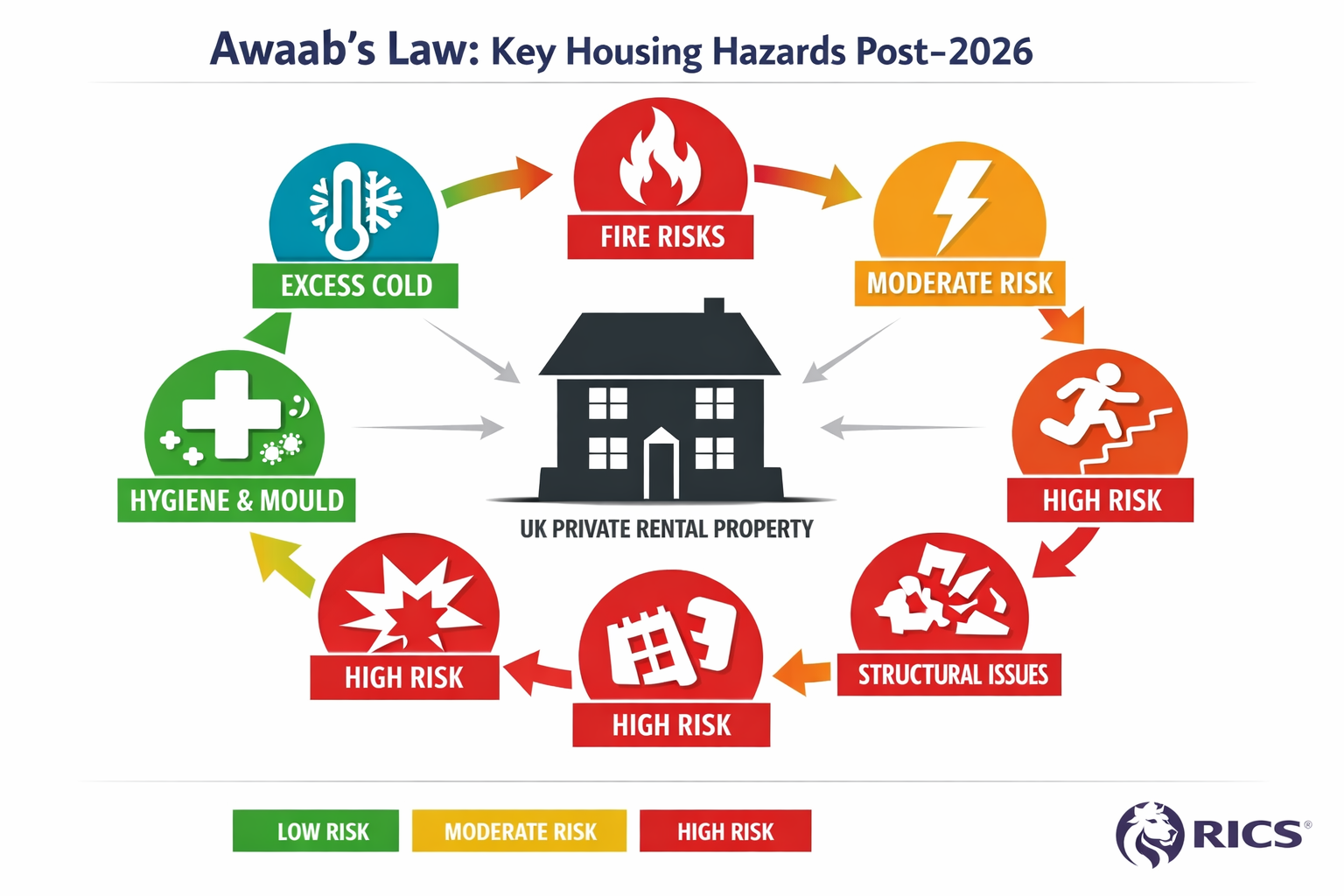
- Phase 2 of Awaab's Law (2026) extends coverage beyond damp and mould to seven new hazard categories including excess cold, fire, falls, electrical hazards, and structural collapse.
- PRS properties are now included following secondary legislation under the Rental Reform Act, meaning all private landlords face the same compliance obligations as social housing providers.
- Non-compliance carries severe financial penalties, including enforcement orders, tenant compensation, loss of rental income, and landlord liability even where third-party contractors carry out repairs.
- Surveyors must apply structured valuation adjustments using RICS Red Book methodology, HHSRS scoring, and documented evidence to reflect hazard-related risk in market valuations.
- Section 8 disputes and rent review challenges are already increasing, making pre-instruction hazard assessments an essential part of the surveyor's toolkit.
What Awaab's Law Phase 2 Actually Changes for PRS Landlords
Awaab's Law was originally introduced through the Social Housing (Regulation) Act 2023, named after two-year-old Awaab Ishak who died in 2020 as a result of prolonged exposure to mould in a social housing property. Phase 1 focused on damp and mould remediation timelines for social landlords. Phase 2, effective from 2026, dramatically widens both the scope of hazards covered and the range of landlords who must comply [2].
The Seven New Hazard Categories
Phase 2 introduces the following hazard categories beyond damp and mould [2]:
| Hazard Category | Description |
|---|---|
| Excess Cold | Inadequate heating, poor insulation, draughts |
| Excess Heat | Overheating risk, particularly in upper-floor flats |
| Falls | Associated with baths, level surfaces, stairs, and between levels |
| Structural Collapse | Unsafe walls, roofs, ceilings, or foundations |
| Explosions | Gas leak risk, unsafe boiler installations |
| Fire Hazards | Inadequate fire doors, alarms, escape routes |
| Electrical Hazards | Unsafe wiring, overloaded circuits, faulty installations |
| Domestic/Personal Hygiene & Food Safety | Inadequate sanitation, pest infestation, kitchen safety |
💬 "The person-centred approach required under Awaab's Law means landlords can no longer apply a one-size-fits-all remediation standard — vulnerability of the occupant directly affects the legal threshold for action." [2]
Extension to the Private Rented Sector
Critically, secondary legislation under the Rental Reform Act has extended Awaab's Law obligations to all private landlords [1]. This is not a gradual phase-in — from 2026, PRS landlords face the same "reasonable lessor" standard and response timeline obligations that social housing providers have been subject to since Phase 1. Failure to meet those timelines can result in enforcement orders, mandatory tenant compensation, landlord assumption of tenant legal costs, and — in the most serious cases — complete loss of rental income if a property is deemed uninhabitable [2].
Landlords also retain full liability even when third-party contractors perform the repairs. Contracts with maintenance providers must now explicitly reference Awaab's Law Phase 2 and Phase 3 hazard categories to provide any meaningful protection [2].
How Expanded Hazards Drive Valuation Adjustments for PRS Properties
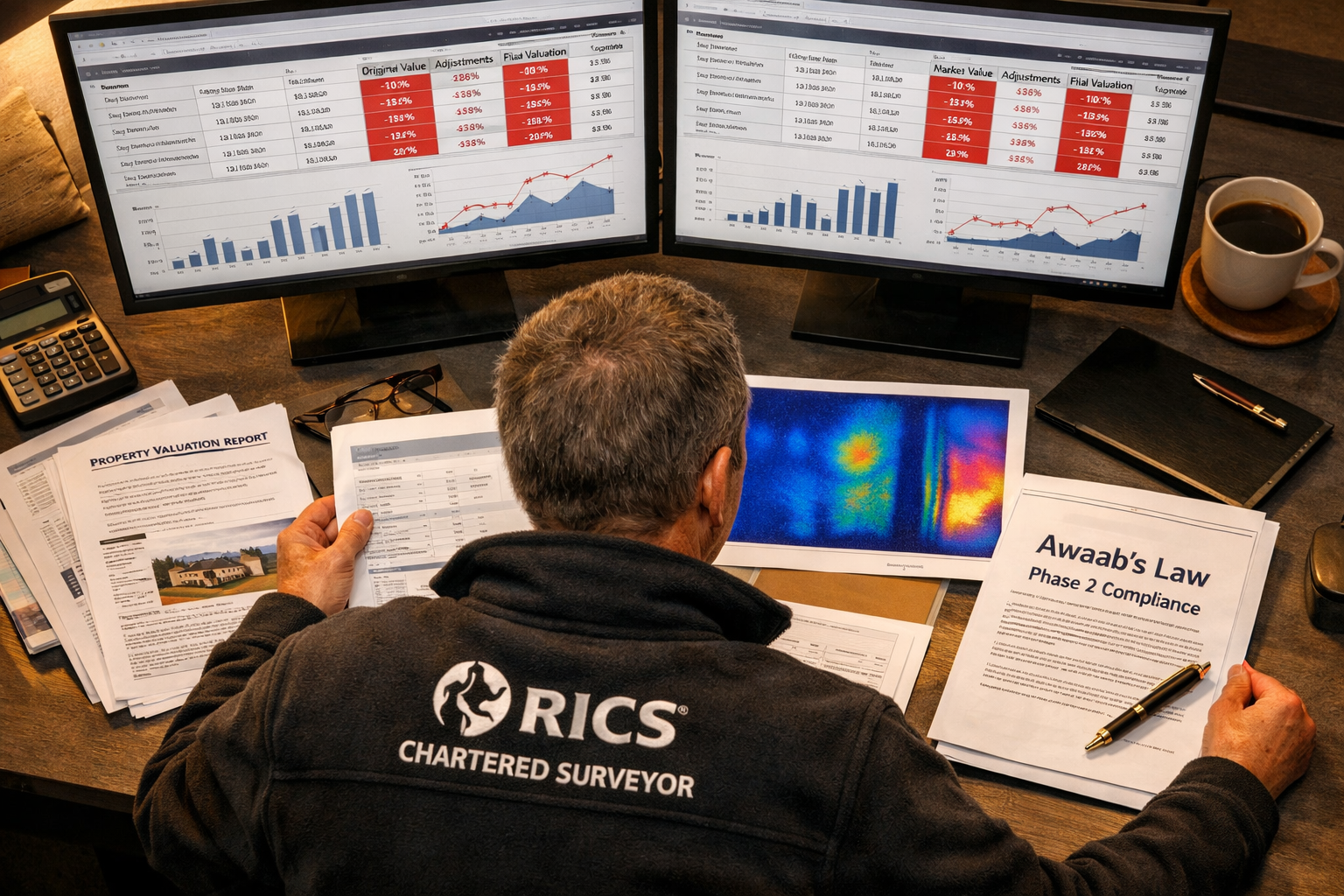
Understanding the legal framework is only the starting point. The real challenge for surveyors in 2026 is translating compliance risk into quantified, defensible valuation adjustments. This is where Valuation Adjustments for Expanded Awaab's Law Hazards in PRS Properties: Surveyor Strategies Post-2026 Extensions becomes a practical discipline rather than an abstract regulatory concern.
The HHSRS-to-Value Bridge
The Housing Health and Safety Rating System (HHSRS) has always provided a scoring mechanism for hazards, but its direct link to market value has historically been underexplored. Post-2026, that link is explicit. A property with unresolved Category 1 hazards under the expanded Awaab's Law categories faces:
- Immediate rental income risk — tenants may withhold rent or seek rent repayment orders
- Capital value discount — buyers and lenders price in remediation costs and legal exposure
- Mortgage availability constraints — lenders are increasingly requiring HHSRS compliance certificates before advancing funds on PRS investment purchases
For RICS-qualified surveyors, the factors of valuation framework provides the structure to apply these adjustments systematically. The key inputs are:
- Estimated remediation cost (contractor quotes or elemental cost data)
- Probability and severity of enforcement (based on local authority enforcement history)
- Rental income at risk (void period modelling)
- Stigma discount (market perception beyond direct costs)
Practical Adjustment Ranges by Hazard Type
While every property requires individual assessment, the following ranges reflect emerging surveyor practice in 2026:
| Hazard Type | Typical Valuation Discount Range |
|---|---|
| Excess Cold (EPC F/G) | 8–15% of open market value |
| Electrical Hazards (no EICR) | 5–12% |
| Fire Hazards (inadequate alarms/doors) | 6–10% |
| Structural Collapse Risk | 15–30%+ |
| Falls (unsafe stairs/bathrooms) | 4–8% |
| Combined Multiple Hazards | Up to 35%+ |
⚠️ Important: These ranges are indicative only. A formal RICS valuation report must reflect the specific property, local market conditions, and documented evidence.
The Role of Stock Condition Surveys
Before any valuation adjustment can be applied with confidence, surveyors need a comprehensive baseline of the property's physical condition. A stock condition survey provides exactly this — a systematic assessment of all building elements against current standards, including the expanded Awaab's Law hazard categories. For PRS portfolio owners, this is now an essential pre-valuation step rather than an optional extra.
Surveyor Strategies for Defensible Valuations Post-2026 Extensions
The expansion of Awaab's Law creates both risk and opportunity for surveyors. Those who develop robust, evidence-based methodologies for quantifying hazard impacts will be in high demand — from lenders, investors, landlords facing enforcement, and tenants pursuing compensation claims. The following strategies reflect best practice for Valuation Adjustments for Expanded Awaab's Law Hazards in PRS Properties: Surveyor Strategies Post-2026 Extensions.
Strategy 1: Pre-Instruction Hazard Screening 🔍
Before accepting a valuation instruction on a PRS property, surveyors should conduct a rapid hazard screen covering all eight Awaab's Law Phase 2 categories. This does not replace a full HHSRS assessment but flags whether specialist sub-reports (electrical, structural, thermal) will be needed before a Red Book valuation can be completed.
Key screening questions include:
- When was the last Electrical Installation Condition Report (EICR) completed?
- Does the property have a current Gas Safety Certificate?
- What is the EPC rating, and does it meet the proposed Minimum Energy Efficiency Standards?
- Are all staircases, bathrooms, and balconies compliant with current Building Regulations?
For properties with complex hazard profiles, a building surveyor with dilapidations expertise should be engaged alongside the valuer to ensure remediation costs are accurately scoped.
Strategy 2: RICS Red Book Compliance in Hazard-Adjusted Valuations
All formal valuations must comply with RICS Valuation – Global Standards (the Red Book). Post-2026, surveyors must ensure that RICS Red Book valuations explicitly address Awaab's Law compliance status as a material valuation consideration. This means:
- Disclosing known hazards in the assumptions and special assumptions section
- Quantifying remediation costs as a deduction from gross development value or open market value
- Noting enforcement risk where local authority action is probable
- Documenting comparable evidence that supports the applied discount
Failure to address these factors in a Red Book valuation could expose surveyors to professional negligence claims — particularly as Section 8 disputes and tenant compensation cases increase through 2026 and beyond [1].
Strategy 3: Scenario Modelling for Investment Valuations
For PRS investment properties, surveyors are increasingly using scenario modelling to present landlords with a clear picture of their options:
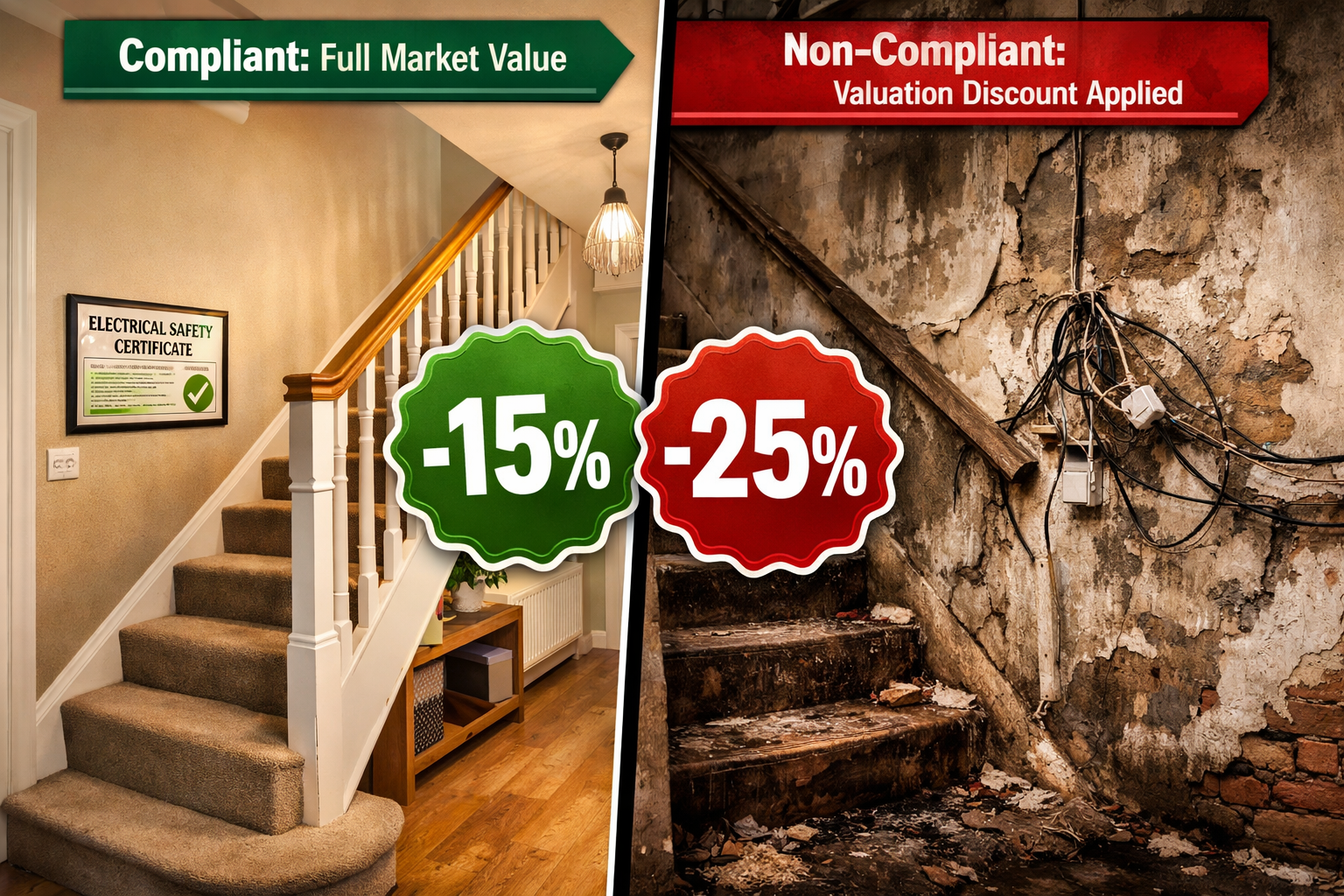
Scenario A — Compliant Property (No Hazards)
Full market value, unrestricted mortgage availability, standard yield capitalisation.
Scenario B — Hazards Present, Remediation Planned
Market value less remediation costs, adjusted for void period during works, with a residual stigma discount of 2–5%.
Scenario C — Hazards Present, No Remediation Plan
Full discount applied including enforcement risk, potential rent repayment order liability, and lender restriction. This scenario can result in valuations 25–40% below Scenario A for properties with multiple Category 1 hazards.
This three-scenario approach is particularly useful for RICS valuations instructed in connection with portfolio disposals, refinancing, or matrimonial proceedings where the impact of compliance status needs to be clearly communicated to non-specialist clients.
Strategy 4: Integrating Thermal Imaging and Digital Evidence
The "person-centred approach" and "reasonable lessor" standard under Awaab's Law [2] mean that subjective assessments of hazard severity are increasingly challenged in enforcement proceedings and court cases. Surveyors who rely solely on visual inspection are exposed to challenge.
Best practice in 2026 includes:
- 🌡️ Thermal imaging surveys to evidence excess cold and heat hazards
- 📸 Timestamped photographic records of all observed defects
- 📊 HHSRS scoring worksheets completed for every applicable hazard
- 🔌 EICR and gas safety certificate review as part of every PRS valuation
A schedule of condition report prepared at the point of valuation creates a defensible baseline that can be used in subsequent enforcement or compensation proceedings.
Strategy 5: Advising on Remediation Sequencing
Where multiple hazards are present, surveyors can add significant value by advising landlords on the optimal sequence of remediation works to minimise void periods and maximise the speed of value recovery. The general principle is:
- Address life-safety hazards first (fire, electrical, structural collapse, gas)
- Tackle thermal comfort next (excess cold, EPC improvements)
- Resolve hygiene and fall hazards (bathrooms, kitchens, staircases)
- Commission post-remediation HHSRS assessment to confirm Category 1 hazard clearance
This sequencing approach also helps landlords demonstrate the "reasonable lessor" standard of proactive action, which can be material in defending enforcement proceedings [2].
Section 8 Disputes, Rent Reviews, and the Valuation Implications
The expansion of Awaab's Law is already driving an increase in Section 8 possession proceedings where tenants raise hazard-related counterclaims, and in rent review disputes where hazard presence is used to challenge proposed rent increases [1]. Surveyors instructed as expert witnesses in these proceedings need to be able to:
- Quantify the rental value impact of specific hazards
- Demonstrate whether the landlord's response met the "reasonable lessor" standard
- Assess whether remediation works actually resolved the hazard or merely addressed symptoms
💡 Key point for surveyors: In rent review arbitrations, a tenant can now argue that a property with unresolved Awaab's Law hazards should be valued at a discount to the headline market rent — and that argument has regulatory backing in 2026.
For landlords, the message is equally clear: the cost of proactive compliance is almost always lower than the combined cost of enforcement, compensation, and valuation discount. A property that achieves full Awaab's Law compliance can command a compliance premium of 5–10% above comparable non-compliant stock in some urban PRS markets.
Conclusion: Actionable Next Steps for Surveyors and Landlords in 2026
The post-2026 regulatory landscape demands a fundamental recalibration of how PRS property hazards are identified, documented, and priced. Valuation Adjustments for Expanded Awaab's Law Hazards in PRS Properties: Surveyor Strategies Post-2026 Extensions is not a theoretical exercise — it is a live, financially material discipline that affects every PRS valuation instruction.
Actionable Next Steps ✅
For RICS Surveyors:
- Update your pre-instruction screening checklist to include all eight Awaab's Law Phase 2 hazard categories
- Ensure Red Book valuations explicitly address compliance status as a material factor
- Invest in thermal imaging capability or establish referral relationships with specialists
- Develop three-scenario modelling templates for PRS investment valuations
- Build familiarity with HHSRS scoring for the expanded hazard categories
For PRS Landlords:
- Commission a stock condition survey across your portfolio before the end of 2026
- Review all contractor agreements to ensure Awaab's Law Phase 2 obligations are explicitly covered
- Prioritise EICR, gas safety, and fire risk assessments for properties not recently inspected
- Seek a formal RICS valuation that reflects current compliance status — not a pre-2026 desktop estimate
The surveyors who develop genuine expertise in hazard-adjusted PRS valuations will be well-positioned as enforcement activity increases and the market begins to price compliance risk more explicitly. The time to build that expertise is now.
References
[1] Preparing For 2026 Key Real Estate Law Reforms – https://www.tlt.com/insights-and-events/insight/preparing-for-2026-key-real-estate-law-reforms
[2] Awaabs Law Comes Into Force What Does It Mean For Construction – https://www.trowers.com/insights/2025/november/awaabs-law-comes-into-force-what-does-it-mean-for-construction
[3] Valuation Impacts Of New Pet Friendly Rules In Renters Rights Act 2026 Surveyor Adjustments For Landlord Risk Assessments – https://nottinghillsurveyors.com/blog/valuation-impacts-of-new-pet-friendly-rules-in-renters-rights-act-2026-surveyor-adjustments-for-landlord-risk-assessments
[4] Building Surveys For Excess Cold And Fire Hazards In Prs Post Awaabs Law 2026 Protocols For Private Landlord Compliance – https://nottinghillsurveyors.com/blog/building-surveys-for-excess-cold-and-fire-hazards-in-prs-post-awaabs-law-2026-protocols-for-private-landlord-compliance