
Over 4.6 million households in England now rent privately — and from May 2026, every single one of those tenancies operates under a fundamentally different legal framework. The Renters' Rights Act 2026 has reshaped the landlord-tenant relationship overnight, and disputes over pet permissions and rent levels are already flowing toward ombudsman services and the First-tier Tribunal (Property Chamber). At the centre of these disputes sits a critical but underexplored question: what standard of expert witness evidence is actually required to win?
Expert Witness Evidence Standards for Renters' Rights Act 2026 Disputes: Valuation Protocols for Pet Permissions and Rent Challenges is now a live and urgent professional discipline. Whether a landlord is defending a rent increase or a tenant is challenging a pet refusal, the quality of valuation evidence presented can determine the outcome entirely.
Key Takeaways 📋
- The Renters' Rights Act 2026 creates statutory rights for tenants to keep pets and to challenge rent increases, both of which require robust valuation evidence in disputes.
- RICS-accredited expert witnesses must follow strict admissibility standards, including independence, methodology transparency, and comparable evidence protocols.
- Pet permission valuations require surveyors to quantify wear-and-tear risk adjustments using market data, not subjective landlord preference.
- Rent challenge disputes demand comparable rental evidence drawn from verified databases, including Unique Property Reference Numbers (UPRNs) and actual rent paid data. [1]
- Tribunal and ombudsman decisions increasingly mirror judicial standards for expert evidence, meaning poorly prepared reports risk being disregarded entirely.
The Renters' Rights Act 2026: What Changed and Why Valuation Evidence Matters
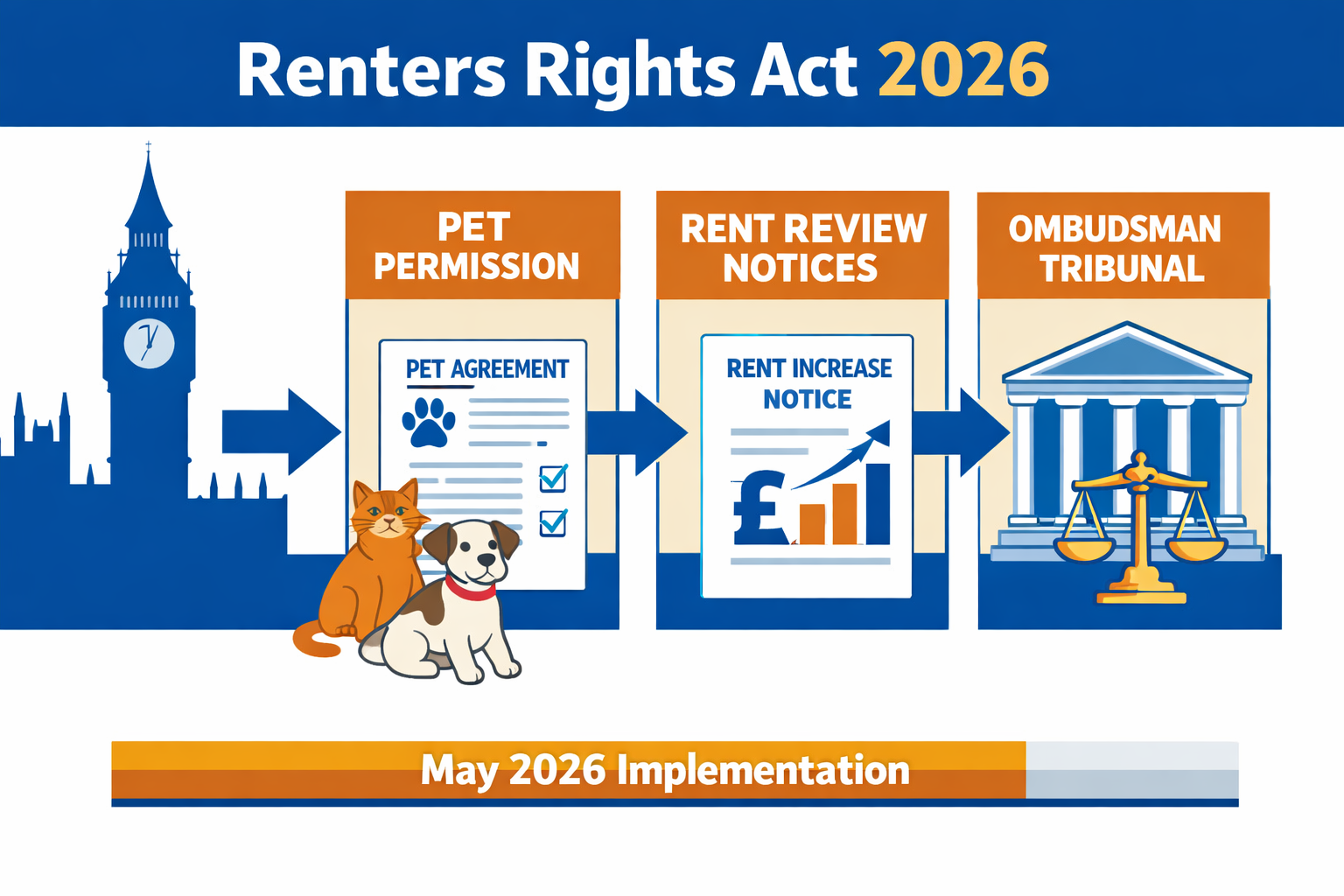
The Renters' Rights Act 2026 came into force in May 2026, abolishing assured shorthold tenancies and replacing them with a single system of periodic tenancies. Two provisions generate the most disputes requiring expert valuation input:
-
Pet Permissions — Landlords can no longer refuse a pet request without reasonable grounds. Where a landlord objects, or where a tenant disputes a conditional refusal, the matter can be referred to the Property Ombudsman or tribunal.
-
Annual Rent Reviews — Rent increases are now limited to once per year and must reflect the open market rate. Tenants have a statutory right to challenge any increase through the First-tier Tribunal.
Both pathways require evidence. And not just any evidence — admissible, methodologically sound, independently prepared valuation evidence that meets the standards expected of expert witnesses in civil proceedings.
💬 "The quality of valuation evidence presented can determine the outcome entirely — a poorly structured report is worse than no report at all."
The TDS Charitable Foundation's evidence to the Housing, Communities and Local Government Committee recommended that the Act's supporting database infrastructure use Unique Property Reference Numbers (UPRNs) for property verification, automatic safety document checks via APIs, actual rent paid information, and annual updates on property size and rent levels. [1] This establishes a clear baseline: expert witnesses should be drawing on verified, structured data — not anecdotal market knowledge.
Understanding Expert Witness Evidence Standards for Renters' Rights Act 2026 Disputes
The Legal Framework for Expert Evidence
Expert witnesses in UK property tribunals are bound by the Civil Procedure Rules (CPR) Part 35, which require that:
- The expert's primary duty is to the tribunal, not to the instructing party
- Reports must be independent and objective
- The expert must state the facts and assumptions underlying their opinion
- Where there is a range of opinion, the expert must summarise the range and give reasons for their own view
These rules apply in the First-tier Tribunal (Property Chamber) by analogy, and the Residential Property Tribunal Wales follows similar principles. The Property Ombudsman, while not a court, increasingly expects evidence to meet comparable standards before making binding determinations.
Lessons from International Precedent
The 2025 California case of Emmons v. Jesso offers a compelling cross-jurisdictional lesson. In that dispute, expert leasing witness testimony proved decisive in clarifying industry standards and lease interpretation, and the case established precedent for the admissibility and impact of expert leasing testimony in complex landlord-tenant disputes involving regulatory compliance. [2] The key lesson: expert witnesses who could demonstrate deep knowledge of industry norms and market standards — rather than simply reciting facts — carried significantly more weight with the decision-maker.
UK tribunals are moving in the same direction. A surveyor who can explain why a particular comparable is relevant, and how market conditions affect a specific property's rental value, will always outperform one who simply lists figures.
What Makes a Report Admissible?
| Requirement | Detail |
|---|---|
| Independence | No financial interest in the outcome |
| Qualifications | RICS membership or equivalent demonstrated expertise |
| Methodology | Clear explanation of how comparables were selected |
| Data sources | Verified, traceable (e.g., UPRN-referenced, Land Registry, Zoopla/Rightmove with caveats) |
| Assumptions | All stated explicitly |
| Range of opinion | Acknowledged where relevant |
| Declaration | Signed statement of truth and independence |
For RICS valuations specifically, the Red Book (RICS Valuation — Global Standards) provides the professional framework within which expert witnesses must operate. Departures from Red Book methodology must be justified in writing.
Valuation Protocols for Pet Permissions: What Surveyors Must Assess

The Landlord's Risk Assessment Challenge
Under the Renters' Rights Act 2026, a landlord who wishes to refuse a pet request must demonstrate reasonable grounds. One legitimate ground is the risk of damage to the property. But here is where many landlords fall short: stating a risk is not the same as evidencing it. [3]
A qualified surveyor preparing a valuation or risk assessment for pet permission purposes must address:
- 🐾 Baseline property condition — documented via a schedule of condition before any pet is introduced
- 🐾 Material vulnerability — carpets, hardwood floors, plasterwork, garden surfaces, and fitted furniture
- 🐾 Breed and size considerations — relevant to risk quantification (a goldfish presents different risks to a large dog)
- 🐾 Insurance implications — whether the landlord's buildings or contents insurance is affected
- 🐾 Comparable market data — what premium, if any, the open market applies to pet-friendly rentals
The schedule of condition is a foundational document here. Originally associated with party wall matters, its application to tenancy disputes is increasingly recognised as best practice.
Quantifying Wear-and-Tear Risk Adjustments
A surveyor acting as expert witness in a pet permission dispute must be able to quantify the risk adjustment, not merely assert it. The methodology typically involves:
- Comparable rental analysis — identifying similar properties in the local market, with and without pet permissions, to establish any rent differential
- Reinstatement cost modelling — estimating the cost of likely damage scenarios (e.g., carpet replacement, floor refinishing) and expressing this as an annualised risk figure
- Deposit adequacy assessment — under the Act, landlords may require a higher deposit for pet-keeping tenants; the surveyor must evidence the appropriate quantum
For reinstatement valuation purposes, the expert must use current materials and labour costs, not historic figures. A report citing 2022 carpet replacement costs in a 2026 dispute will be challenged immediately.
The Pet Premium: Market Evidence
Interestingly, research and market commentary in 2026 suggests that pet-friendly properties can command a rental premium in certain markets, particularly in urban areas with high pet ownership. [3] This cuts both ways in disputes:
- A tenant challenging a refusal may argue the landlord is foregoing a premium by refusing, weakening the economic case for refusal
- A landlord justifying a higher rent for a pet-friendly property may use this premium as supporting evidence
Either way, the expert witness must present actual market comparables — not generalised assertions about market trends.
Rent Challenge Disputes: Valuation Protocols for Expert Witnesses
How the First-tier Tribunal Assesses Rent
When a tenant refers a rent increase to the First-tier Tribunal (Property Chamber), the tribunal's task is to determine the open market rent for the property. The expert witness's job is to assist the tribunal in reaching that figure.
The tribunal will consider:
- Comparable lettings in the same locality
- Property condition and specification
- Lease terms and any restrictions (including pet permissions)
- Local market trends at the date of the proposed increase
💬 "Tribunals are not bound by the landlord's proposed figure or the tenant's counter-offer — they will determine the market rent independently, and the best evidence wins."
Building a Comparable Evidence Base
The foundation of any rent challenge expert report is the comparable evidence schedule. This must meet the following standards:
- Recency — comparables should ideally be within 6 months of the dispute date
- Proximity — same street, same neighbourhood, or demonstrably similar micro-market
- Similarity — same property type, size (sq ft/sq m), condition, and specification
- Verified data — drawn from Land Registry, the new Renters' Rights Act database, or verified letting agent records
The TDS Charitable Foundation's recommendation for actual rent paid information (rather than advertised asking rents) as part of the Act's database infrastructure is particularly significant here. [1] Asking rents can be inflated; actual achieved rents are the correct metric for market value assessment.
For those seeking to understand the factors of valuation that underpin any comparable analysis, the methodology is consistent whether the context is a sale, a rent review, or a tribunal challenge.
Rent Reviews vs. Tribunal Challenges: A Key Distinction
It is important to distinguish between a contractual rent review and a statutory rent challenge:
| Feature | Contractual Rent Review | Statutory Rent Challenge (Act 2026) |
|---|---|---|
| Trigger | Lease clause | Tenant's statutory right |
| Frequency | As per lease | Maximum once per year |
| Mechanism | Agreed or arbitrated | First-tier Tribunal |
| Evidence standard | RICS Red Book / agreed | Tribunal expert evidence rules |
| Outcome | Binding per lease | Tribunal determination |
For commercial properties or mixed-use assets, rent reviews follow a different pathway, but the underlying valuation methodology — market comparables, yield analysis, condition adjustments — remains broadly consistent.
Colorado's Transparency Precedent: A Useful Comparator
In the United States, Colorado's 2026 tenant laws now require landlords to disclose the true total monthly cost of living in rental units, including fees previously charged separately such as common area maintenance charges, property tax pass-throughs, rent processing fees, and repair-related fees. [5] While this is a US jurisdiction, it signals a global regulatory direction: total occupancy cost transparency is becoming the standard.
UK expert witnesses preparing rent challenge reports should note this trend. A tribunal assessing "market rent" will increasingly expect evidence that accounts for the total cost of occupation, not just the headline rent figure.
Preparing Expert Witness Reports That Stand Up to Scrutiny
Structure of a Compliant Expert Report
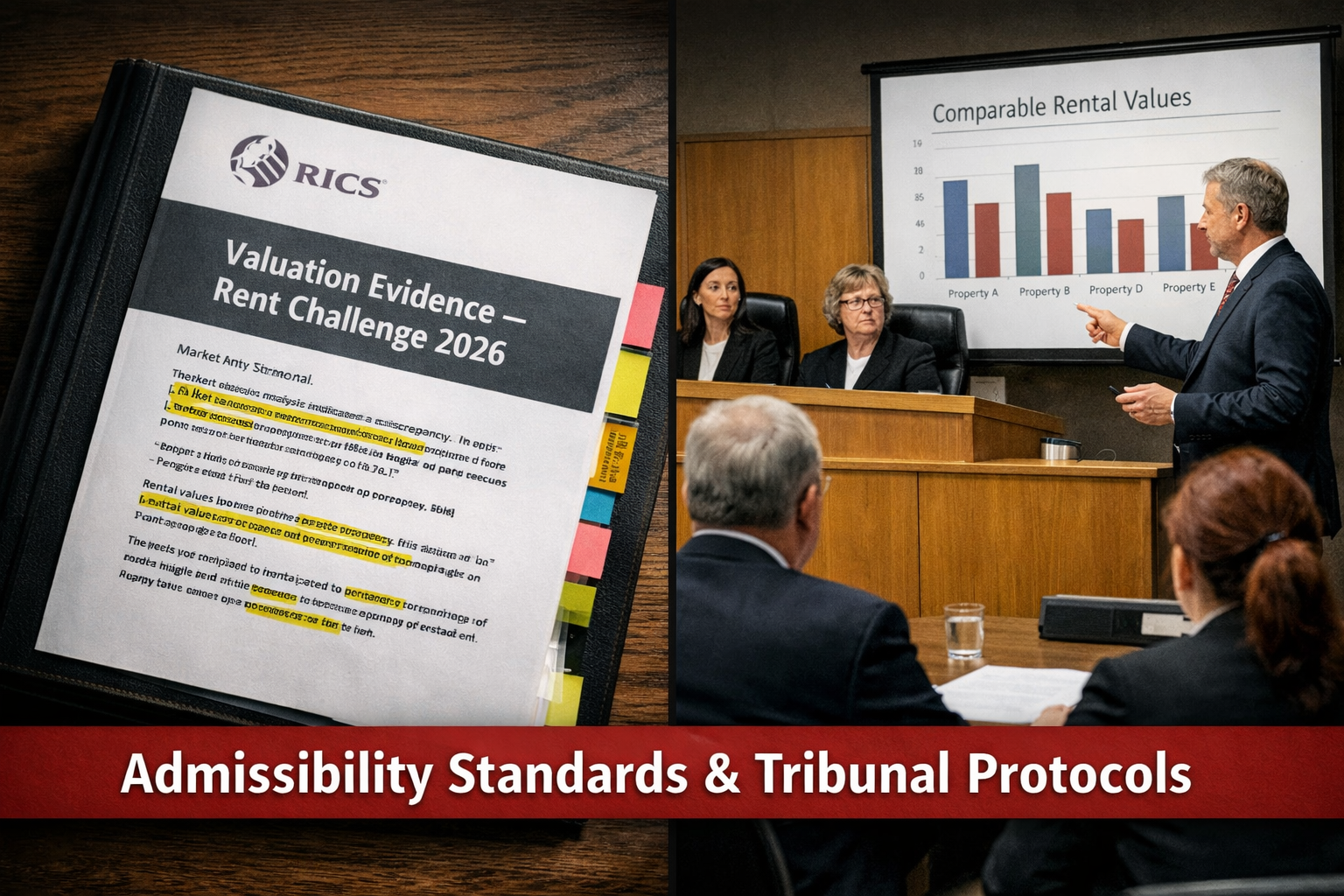
A well-structured expert witness report for Renters' Rights Act 2026 disputes should contain:
- Executive Summary — key opinions stated upfront
- Qualifications and Independence Declaration
- Instructions Received — what the expert was asked to determine
- Facts and Assumptions
- Methodology — how comparables were identified and weighted
- Comparable Evidence Schedule — with full property details and adjustments
- Analysis and Opinion
- Range of Opinion (where relevant)
- Conclusion
- Statement of Truth
Common Failures That Undermine Reports
❌ Relying on asking rents rather than achieved rents
❌ Using comparables outside the relevant micro-market without justification
❌ Failing to adjust for condition differences between comparables and the subject property
❌ Omitting the independence declaration
❌ Expressing opinion without evidential foundation
❌ Failing to address the opposing party's evidence
Why RICS Accreditation Matters
An RICS-chartered building surveyor brings not just technical competence but professional accountability. RICS members are bound by the Rules of Conduct, which require honesty, competence, and service to the public interest. In tribunal proceedings, this professional standing carries weight — a tribunal is more likely to accept the methodology of an RICS-accredited expert than an unregulated valuer.
For complex disputes involving both structural and valuation questions — for example, where a landlord argues that pet damage has affected the structural integrity of a property — a building survey may be required alongside the valuation report, with both feeding into the expert's overall opinion.
The Role of the Single Joint Expert
In lower-value disputes before the Property Ombudsman or in cases where both parties agree, a Single Joint Expert (SJE) may be appointed. The SJE's report is prepared for both parties and the tribunal, and their independence is paramount. Key considerations:
- The SJE must not favour either party's position
- Both parties may submit written questions to the SJE
- The SJE's opinion carries significant weight precisely because of their neutrality
Understanding the valuation costs involved in commissioning expert reports is also important for parties managing dispute budgets — costs can be recovered in some tribunal proceedings where a party has acted unreasonably.
Conclusion: Actionable Next Steps for Landlords, Tenants, and Advisers
The Renters' Rights Act 2026 has created a new landscape where valuation evidence is no longer optional — it is the currency of dispute resolution. Whether the issue is a contested pet permission or a challenged rent increase, the party with the better expert evidence will almost always prevail.
Here are the key actionable steps:
✅ Landlords: Commission a schedule of condition before any tenancy begins, and ensure any pet risk assessment is prepared by a qualified RICS surveyor with comparable market data — not just a generic refusal letter.
✅ Tenants: When challenging a rent increase, gather comparable rental evidence from verified sources. Request that the tribunal appoint a Single Joint Expert if the landlord's evidence appears inflated.
✅ Solicitors and advisers: Ensure any expert witness report you commission meets CPR Part 35 standards and includes an independence declaration, a comparable evidence schedule with UPRN-referenced data where possible, and an explicit methodology section.
✅ Surveyors acting as experts: Stay current with the Act's database infrastructure developments, use actual achieved rents (not asking rents) as comparables, and ensure all risk adjustments for pet permissions are quantified — not merely asserted.
✅ All parties: Engage RICS-accredited professionals early. A well-prepared expert report submitted at the outset of a dispute is far more cost-effective than attempting to repair a weak evidential position at a hearing.
The standards for Expert Witness Evidence Standards for Renters' Rights Act 2026 Disputes: Valuation Protocols for Pet Permissions and Rent Challenges will continue to evolve as case law develops through 2026 and beyond. Staying ahead of those standards — with rigorous, transparent, and independently prepared valuation evidence — is the single most important step any party to a dispute can take.
References
[1] Ensuring The Renters Rights Act Raises Standards Tds Charitable Foundation Evidence To The Hclg Co – https://www.tdsgroup.uk/post/ensuring-the-renters-rights-act-raises-standards-tds-charitable-foundation-evidence-to-the-hclg-co
[2] Leasing Expert Witness Testimony Shapes Outcome In Emmons V Jesso A Landmark Expert Witness Case – https://www.expertwitnessblog.com/leasing-expert-witness-testimony-shapes-outcome-in-emmons-v-jesso-a-landmark-expert-witness-case/
[3] Valuation Impacts Of New Pet Friendly Rules In Renters Rights Act 2026 Surveyor Adjustments For Landlord Risk Assessments – https://nottinghillsurveyors.com/blog/valuation-impacts-of-new-pet-friendly-rules-in-renters-rights-act-2026-surveyor-adjustments-for-landlord-risk-assessments
[5] Colorados 2026 Tenant Laws What Renters Actually Need To Know – https://smartcitylocating.com/blog/colorados-2026-tenant-laws-what-renters-actually-need-to-know/