


Single-storey bungalows account for approximately 9% of England's housing stock, yet their unique construction characteristics—large roof-to-floor-area ratios, extensive ceiling perimeters, and often dated insulation standards—make them disproportionately vulnerable to excess cold hazards. With Awaab's Law expanding in 2026 to include excess cold alongside damp and mould, surveyors conducting assessments on these properties face unprecedented compliance requirements that demand specialized protocols and person-centred evaluation approaches.
Understanding Building Survey Protocols for Bungalow Excess Cold Hazards Under Awaab's Law 2026: Level 3 Essentials has become critical for chartered surveyors, landlords, and property professionals navigating the Private Rented Sector (PRS). The legislation's strict timeframes—10 working days for investigation, written summaries within 3 days, and repair commencement within 5 days—leave no margin for inadequate assessment methodologies.[3]
Key Takeaways
- 🏠 Bungalows face heightened excess cold risks due to large roof surface areas, extensive thermal bridging at ceiling perimeters, and typically older insulation standards compared to multi-storey properties
- ⏱️ Strict compliance timeframes apply: Landlords must investigate significant excess cold hazards within 10 working days, provide written summaries within 3 days after investigation, and commence repairs within 5 days of investigation conclusion[3]
- 👥 Person-centred assessment is mandatory: Mild excess cold affecting vulnerable occupants (elderly residents, those with cardiovascular disease, infants under one year) escalates from minor to significant hazard status[2]
- 📋 Level 3 surveys provide comprehensive coverage: RICS Building Survey protocols offer the detailed thermal performance analysis, insulation assessment, and heating system evaluation required for Awaab's Law compliance
- ⚖️ Legal consequences for non-compliance: Failure to meet investigation and repair timeframes can result in enforcement action, financial penalties, and potential prosecution under housing health and safety regulations
Understanding Awaab's Law 2026 Expansion and Excess Cold Inclusion
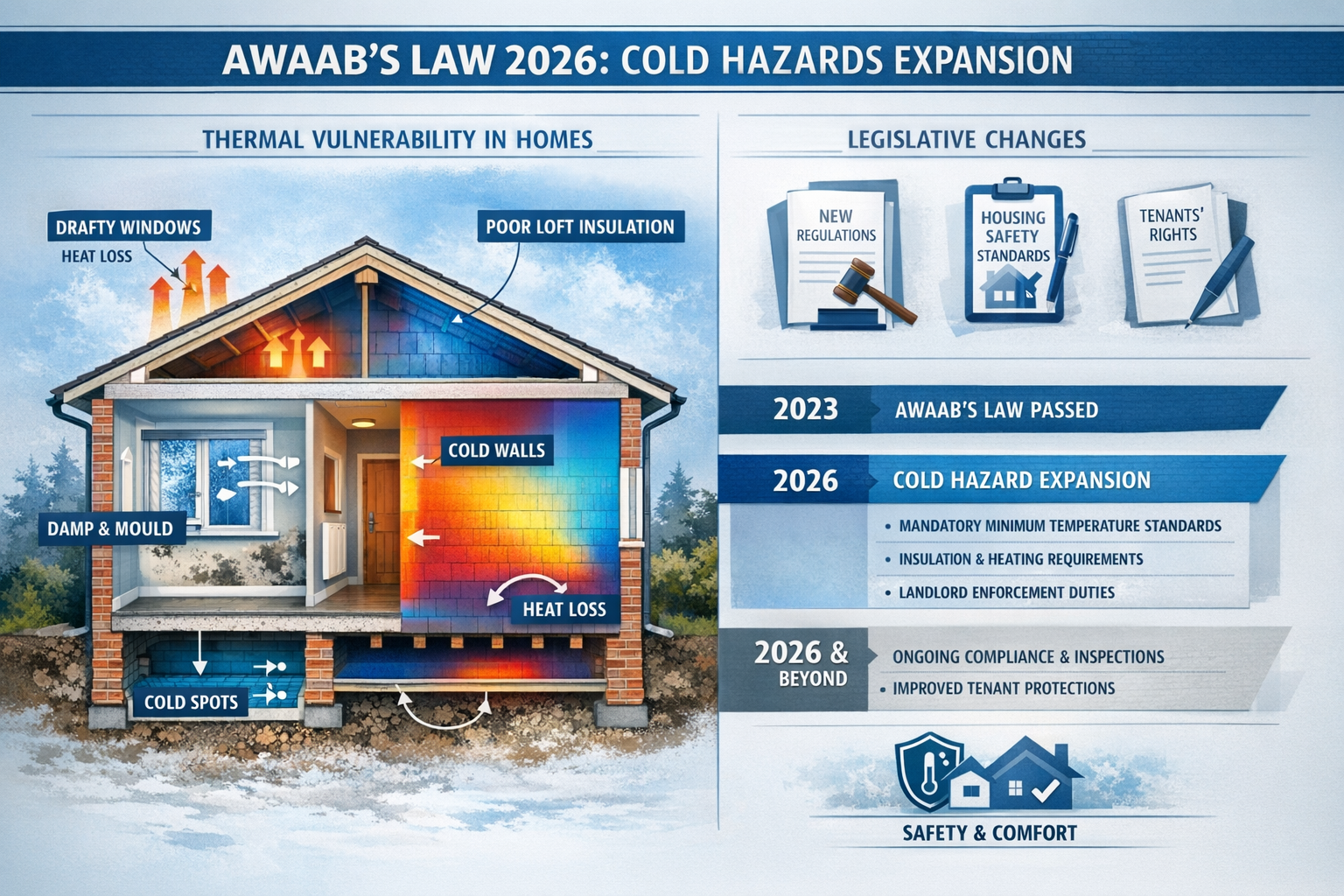
Awaab's Law, named after two-year-old Awaab Ishak who died from prolonged exposure to mould in his family's social housing flat, initially focused on damp and mould hazards when introduced. The 2026 expansion represents a significant broadening of scope, now encompassing excess cold as a Category 1 hazard requiring immediate landlord action when it presents a risk of harm to occupants.[7][9]
What Constitutes Excess Cold Under the Legislation
Excess cold is defined within the Housing Health and Safety Rating System (HHSRS) as temperatures within a dwelling that pose health risks to occupants. The World Health Organization recommends minimum indoor temperatures of 18°C for general living areas and 16°C for bedrooms, with higher thresholds needed for vulnerable populations.[2]
Key threshold indicators include:
- Living area temperatures consistently below 18°C during heating season
- Bedroom temperatures falling below 16°C overnight
- Inability to achieve recommended temperatures despite heating system operation
- Thermal imaging revealing significant cold spots or thermal bridging
- Occupant-reported health impacts related to cold conditions
The legislation specifically requires landlords to investigate excess cold hazards within 10 working days of becoming aware of the issue, with written investigation summaries provided to tenants within 3 working days after investigation concludes.[3] For complex remediation works—such as structural improvements to prevent excess cold—landlords must commence work within 5 working days of investigation completion, with final completion no later than 12 weeks after investigation.[3]
Why Bungalows Present Unique Excess Cold Challenges
Bungalows exhibit distinct thermal performance characteristics that differentiate them from multi-storey dwellings:
Roof-to-floor-area ratio: Single-storey construction means the entire living space sits directly beneath the roof structure, maximizing heat loss through the ceiling plane. Multi-storey properties benefit from intermediate floors that reduce per-room roof exposure.
Perimeter thermal bridging: Bungalows have extensive wall-to-ceiling junctions where thermal bridging commonly occurs. The ratio of perimeter length to floor area is significantly higher than in compact multi-storey designs.
Construction era considerations: Many bungalows were built between 1945-1980 when insulation standards were minimal. Typical loft insulation depths of 50-100mm fall far short of current Building Regulations requiring 270mm.
Heating distribution challenges: Single-storey layouts often feature long circulation routes from central heating boilers, resulting in heat loss through pipework and uneven temperature distribution across the property.
Ventilation complications: Efforts to improve thermal efficiency through draught-proofing can inadvertently reduce ventilation rates, creating condensation issues that compound cold conditions.
For RICS Building Surveys Level 3 assessments, these factors necessitate specialized evaluation protocols that go beyond standard survey methodologies.
Building Survey Protocols for Bungalow Excess Cold Hazards: Level 3 Assessment Framework
A comprehensive Level 3 Building Survey provides the most thorough assessment of excess cold hazards in bungalow properties, offering detailed analysis of thermal performance, insulation adequacy, heating system effectiveness, and structural factors contributing to heat loss. Unlike Level 2 Homebuyer Surveys, Level 3 assessments include invasive investigations and specialist testing when required.[5]
Pre-Survey Preparation and Documentation Review
Effective Building Survey Protocols for Bungalow Excess Cold Hazards Under Awaab's Law 2026: Level 3 Essentials begin before site attendance. Surveyors should obtain and review:
Property documentation:
- Original construction drawings and specifications
- Energy Performance Certificate (EPC) with thermal performance ratings
- Previous survey reports or maintenance records
- Heating system service history and boiler specifications
- Insulation upgrade documentation
- Planning permissions for extensions or alterations
Occupancy information:
- Tenant vulnerability factors (age, health conditions, mobility limitations)
- Reported cold-related complaints or health impacts
- Heating usage patterns and utility consumption data
- Previous excess cold investigations or enforcement notices
Regulatory context:
- Local authority housing standards enforcement history
- Previous HHSRS assessments
- Outstanding improvement notices or prohibition orders
This documentation establishes baseline conditions and identifies areas requiring focused investigation during the site survey.
On-Site Inspection Protocols for Bungalow Cold Hazards
Thermal Imaging and Temperature Monitoring
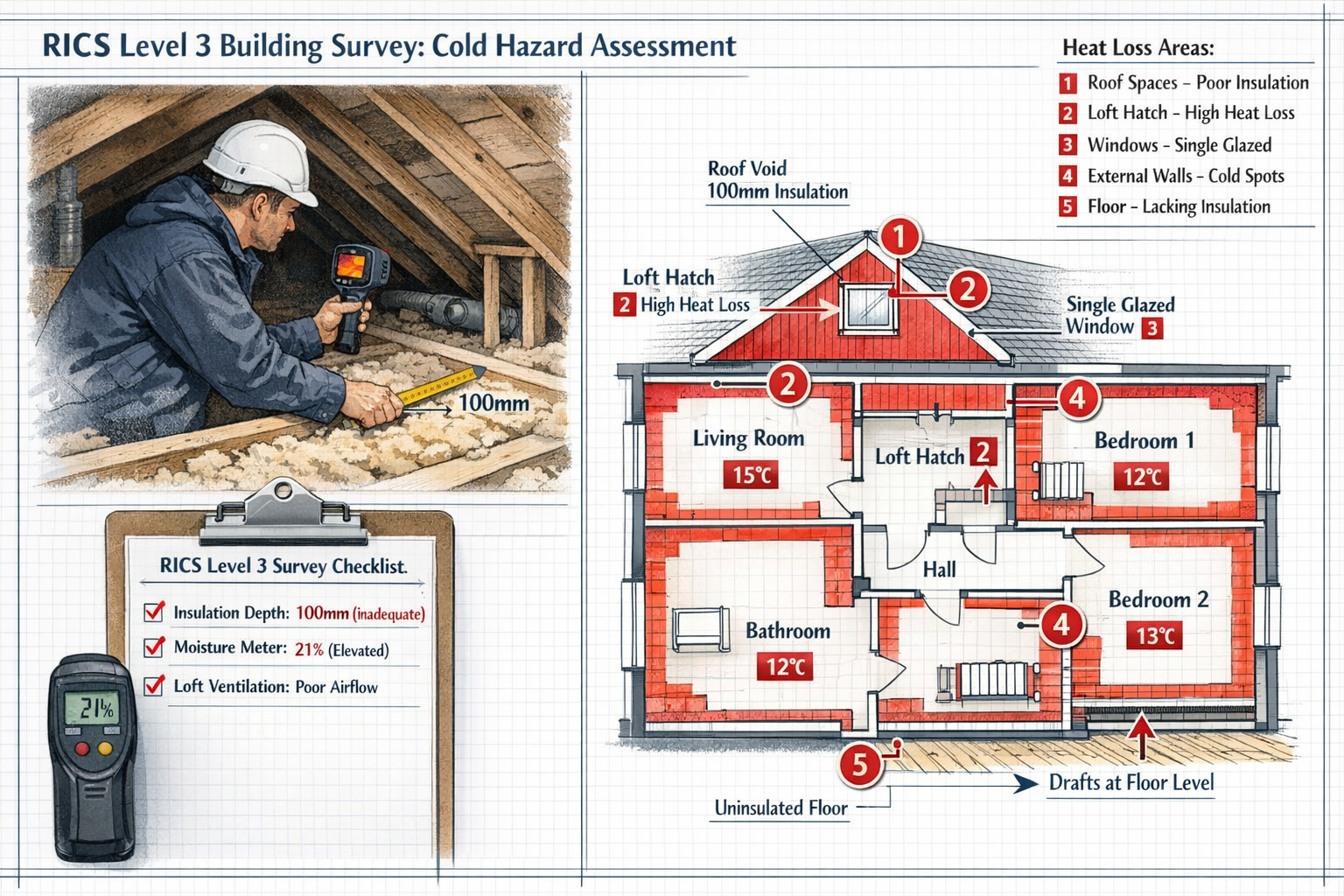
Thermal imaging cameras provide invaluable diagnostic capability for identifying cold spots, thermal bridging, insulation voids, and air leakage paths. Survey protocols should include:
- Systematic thermal scanning of all external walls, ceilings, and floors
- Temperature differential mapping between internal and external surfaces
- Thermal bridge identification at wall-ceiling junctions, window reveals, and service penetrations
- Air leakage detection around doors, windows, and service entry points
- Comparative analysis against expected thermal performance standards
Surveyors should conduct thermal imaging during appropriate conditions—ideally when temperature differentials between interior and exterior exceed 10°C, and when the property has been heated for at least 12 hours prior to assessment.[5]
Loft Space and Insulation Assessment
Bungalow loft spaces require particularly thorough examination:
Insulation depth and coverage:
- Measure insulation depth at multiple locations (minimum 12 measurement points)
- Document insulation type, material condition, and compression
- Identify gaps, voids, or areas of inadequate coverage
- Assess insulation around loft hatches, eaves, and service penetrations
Ventilation adequacy:
- Verify soffit ventilation provision and functionality
- Check for blocked or inadequate ventilation paths
- Assess condensation risk factors
- Document any signs of moisture accumulation or previous condensation damage
Structural factors:
- Examine roof construction type and thermal performance
- Identify cold bridging through structural elements
- Assess ceiling joist depth and insulation accommodation capacity
- Document any roof defects contributing to heat loss
Current Building Regulations require 270mm of mineral wool insulation (or equivalent U-value of 0.16 W/m²K) in loft spaces. Many bungalows fall significantly short of this standard.
Heating System Evaluation
Comprehensive heating system assessment forms a critical component of excess cold hazard evaluation:
Boiler and heat source:
- Document boiler type, age, output capacity, and efficiency rating
- Verify adequate sizing for property volume and heat loss calculations
- Check service history and maintenance compliance
- Assess control systems and thermostat functionality
Heat distribution:
- Inspect radiator sizing, positioning, and output adequacy
- Verify balanced heating across all rooms
- Check pipework insulation and routing efficiency
- Identify cold spots or rooms with inadequate heating provision
Controls and programming:
- Evaluate thermostat accuracy and positioning
- Assess programmability and zone control capability
- Verify thermostatic radiator valve (TRV) functionality
- Document occupant understanding of control operation
For structural surveys requiring specialist input, heating engineers may need to conduct detailed heat loss calculations and system capacity assessments.
Building Fabric and Envelope Assessment
The building envelope's thermal performance directly impacts excess cold risk:
Wall construction and insulation:
- Identify wall construction type (cavity, solid, timber frame)
- Assess cavity wall insulation presence and effectiveness
- Document external wall insulation or render systems
- Identify thermal bridging at structural elements
Windows and glazing:
- Document glazing type (single, double, triple)
- Assess frame condition and air-tightness
- Identify failed sealed units or condensation between panes
- Evaluate window reveals and thermal bridging
Doors and draught-proofing:
- Assess external door construction and insulation value
- Check draught-proofing effectiveness
- Document air leakage around frames
- Evaluate threshold details and underfloor ventilation
Floor construction:
- Identify floor type (suspended timber, solid concrete)
- Assess underfloor insulation presence and condition
- Check for excessive ventilation causing cold floors
- Document any signs of rising damp or moisture issues
Person-Centred Assessment Requirements Under Awaab's Law
A critical element of Building Survey Protocols for Bungalow Excess Cold Hazards Under Awaab's Law 2026: Level 3 Essentials is the person-centred assessment approach mandated by the legislation. This requires surveyors to consider individual tenant circumstances when evaluating hazard severity.[2]
Vulnerability factors that escalate hazard classification:
- Age: Elderly residents (65+) and infants (under 1 year) have reduced thermoregulation capacity
- Health conditions: Cardiovascular disease, respiratory conditions, arthritis, immune system compromise
- Mobility limitations: Reduced ability to generate body heat through activity
- Socioeconomic factors: Fuel poverty limiting heating usage
- Occupancy patterns: Extended periods at home increasing exposure duration
A mild excess cold condition that might constitute a Category 2 hazard for healthy adults can escalate to Category 1 status when affecting vulnerable occupants. Surveyors must document tenant demographics, health conditions (with appropriate consent), and specific vulnerability factors in their assessment reports.
Compliance Checklists and Reporting Requirements for PRS Properties
Private Rented Sector landlords face specific compliance obligations under Awaab's Law 2026, with Level 3 Building Surveys providing the evidential foundation for meeting these requirements.
Investigation Timeline Compliance Checklist
Day 0 – Hazard Identification:
- ✅ Document date landlord became aware of excess cold hazard
- ✅ Record method of notification (tenant report, inspection, third-party notification)
- ✅ Acknowledge receipt of complaint to tenant within 24 hours
- ✅ Commission Level 3 Building Survey from qualified surveyor
Days 1-10 – Investigation Period:
- ✅ Complete comprehensive building survey including thermal imaging
- ✅ Conduct person-centred assessment of occupant vulnerability
- ✅ Perform heating system evaluation and capacity calculations
- ✅ Document all findings with photographic and thermal imaging evidence
- ✅ Classify hazard severity under HHSRS methodology
- ✅ Identify root causes and required remediation measures
Days 11-13 – Reporting Period:
- ✅ Prepare written investigation summary
- ✅ Provide summary to tenant within 3 working days of investigation completion[3]
- ✅ Include clear explanation of findings in accessible language
- ✅ Specify proposed remediation measures and timescales
- ✅ Document tenant's right to challenge findings
Days 14-18 – Remediation Commencement:
- ✅ Commence remediation works within 5 working days of investigation completion[3]
- ✅ Provide tenant with work schedule and access arrangements
- ✅ Engage qualified contractors for complex works
- ✅ Implement interim measures if full remediation requires extended timeframes
Weeks 3-12 – Completion Period:
- ✅ Complete all remediation works within 12 weeks of investigation[3]
- ✅ Conduct post-remediation verification survey
- ✅ Provide completion certificate to tenant
- ✅ Update property records and compliance documentation
Level 3 Survey Report Content Requirements
Comprehensive survey reports supporting Awaab's Law compliance must include:
Executive Summary:
- Property address and description
- Survey date and surveyor credentials
- Hazard classification and severity rating
- Immediate risk assessment
- Remediation recommendations summary
Detailed Findings:
- Thermal performance analysis with temperature measurements
- Thermal imaging results with annotated photographs
- Insulation assessment findings
- Heating system evaluation
- Building fabric condition assessment
- Ventilation and moisture risk evaluation
Person-Centred Assessment:
- Occupant vulnerability factors
- Health impact documentation
- Exposure duration and pattern analysis
- Hazard severity justification based on occupant circumstances
Remediation Specifications:
- Prioritized list of required works
- Technical specifications for each measure
- Estimated costs and timeframes
- Alternative solutions where applicable
- Compliance verification methodology
Appendices:
- Thermal imaging gallery
- Temperature monitoring data
- Heating system specifications
- Insulation depth measurements
- Regulatory compliance checklist
For properties requiring RICS Chartered Building Surveyor expertise, reports should meet RICS professional standards and provide defensible evidence for regulatory compliance.
Common Remediation Measures for Bungalow Excess Cold Hazards
Based on typical bungalow construction characteristics, remediation measures frequently include:
Insulation upgrades:
- Loft insulation enhancement to 270mm minimum depth
- Cavity wall insulation installation (where suitable)
- External wall insulation systems for solid wall construction
- Floor insulation for suspended timber floors
- Insulated plasterboard installation on cold walls
Heating system improvements:
- Boiler replacement with appropriately sized modern condensing unit
- Radiator upgrades to increase heat output
- Heating controls enhancement with programmable thermostats
- Zone control installation for efficient heat distribution
- Pipework insulation to reduce distribution losses
Building fabric enhancements:
- Window replacement with high-performance double or triple glazing
- Draught-proofing installation around doors and windows
- Thermal bridging mitigation at structural junctions
- Ventilation improvement to prevent condensation while maintaining thermal efficiency
Cost implications:
- Loft insulation upgrade: £400-£800
- Cavity wall insulation: £700-£1,200
- External wall insulation: £8,000-£15,000
- Boiler replacement: £2,500-£4,000
- Window replacement: £4,000-£8,000
Landlords must balance cost considerations against legal obligations and tenant welfare requirements. The 12-week completion timeframe allows for complex works but requires prompt commencement.[3]
Advanced Diagnostic Technologies for Excess Cold Detection
Modern survey methodologies increasingly incorporate advanced diagnostic technologies that enhance excess cold hazard identification and provide robust compliance evidence.
Thermal Imaging Best Practices
Thermal imaging cameras detect infrared radiation and convert it to visible images showing temperature variations across building surfaces. For bungalow excess cold assessments:
Optimal survey conditions:
- Temperature differential between interior and exterior of at least 10°C
- Property heated to normal occupancy temperature for 12+ hours prior
- Survey conducted during evening or early morning when external temperatures are lowest
- Windows and doors closed for minimum 4 hours before assessment
- No direct sunlight on external walls during or immediately before survey
Systematic scanning methodology:
- Complete external envelope scan from interior
- Ceiling scan covering 100% of surface area
- Floor scan identifying cold bridging or underfloor issues
- Window and door reveals showing thermal bridging
- Service penetrations and junction details
Image documentation standards:
- Calibrated temperature scales on all images
- Reference measurements with contact thermometers
- Annotated images identifying specific defects
- Comparative images showing temperature differentials
- Time and date stamping for verification
Data Logging and Continuous Monitoring
For properties where initial assessments reveal borderline conditions or where occupant heating behavior may influence results, data logging provides objective evidence:
Temperature data loggers:
- Multi-point installation in living areas and bedrooms
- Continuous recording over minimum 7-day period
- Capture of temperature variations throughout heating cycles
- Correlation with external temperature conditions
- Documentation of temperature recovery rates after heating activation
Humidity monitoring:
- Relative humidity measurement alongside temperature
- Identification of condensation risk conditions
- Correlation between cold temperatures and moisture accumulation
- Verification of ventilation adequacy
Energy consumption tracking:
- Heating system runtime monitoring
- Fuel or electricity consumption analysis
- Identification of excessive energy use indicating poor thermal performance
- Cost implications for tenants in fuel poverty
Real-time sensor technologies are increasingly being integrated into Level 3 Building Surveys to detect Awaab's Law hazards before they escalate to significant health risks.[5]
Blower Door Testing for Air Leakage
Air leakage significantly contributes to excess cold conditions in bungalows. Blower door testing quantifies air-tightness:
Test methodology:
- Temporary sealing of intentional ventilation openings
- Installation of calibrated fan in external doorway
- Pressurization and depressurization of property
- Measurement of airflow required to maintain pressure differential
- Calculation of air changes per hour (ACH) at 50 Pascals pressure
Interpretation of results:
- Modern Building Regulations target: <5 m³/h/m² @ 50Pa
- Typical older bungalow performance: 10-15 m³/h/m² @ 50Pa
- Excessive air leakage: >15 m³/h/m² @ 50Pa requiring remediation
Air leakage identification:
- Smoke pencil testing at suspected leakage points during pressurization
- Thermal imaging during test showing air leakage paths
- Prioritization of remediation measures based on leakage severity
Legal Implications and Enforcement Mechanisms
Understanding the legal framework surrounding Building Survey Protocols for Bungalow Excess Cold Hazards Under Awaab's Law 2026: Level 3 Essentials is crucial for compliance and risk management.
Enforcement Powers and Penalties
Local housing authorities hold enforcement powers for Awaab's Law violations:
Improvement Notices:
- Issued when landlord fails to meet investigation or repair timeframes
- Specify required remediation works and completion deadlines
- Non-compliance can result in prosecution
- Maximum fine: £30,000 per offense
Prohibition Orders:
- Issued when excess cold hazard poses imminent risk to occupant health
- Prohibits property occupation until remediation completed
- Landlord remains responsible for tenant rehousing costs
- Can significantly impact rental income and property value
Rent Repayment Orders:
- Tenants can apply for rent repayment for periods when significant hazards existed
- Up to 12 months' rent repayable in serious cases
- Applies when landlord failed to meet statutory investigation and repair obligations
Prosecution:
- Criminal prosecution for serious or persistent non-compliance
- Unlimited fines in Crown Court
- Potential imprisonment for up to 6 months for summary offenses
- Reputational damage affecting future rental business
Evidential Requirements for Defense
Landlords facing enforcement action require robust evidence of compliance efforts. Level 3 Building Survey reports provide critical defense documentation:
Evidence of prompt action:
- Timestamped records of hazard notification receipt
- Survey commissioning documentation within investigation period
- Contractor quotations and work scheduling evidence
- Interim measures implemented pending full remediation
Technical justification:
- Professional survey reports from qualified surveyors
- Thermal imaging and diagnostic test results
- Heating system capacity calculations
- Cost-benefit analysis of remediation options
Tenant communication records:
- Written summaries provided within 3-day timeframe[3]
- Access arrangement correspondence
- Progress updates during remediation period
- Completion notifications and verification documentation
For complex cases requiring expert witness reports, surveyors must provide defensible opinions based on recognized professional standards and methodologies.[1]
Insurance and Liability Considerations
Excess cold hazards create significant liability exposure for landlords:
Occupier's liability:
- Landlords owe duty of care to tenants for property safety
- Excess cold causing health harm may constitute negligence
- Personal injury claims for cold-related illnesses
- Potential damages for vulnerable occupants suffering serious health consequences
Professional indemnity:
- Surveyors conducting Awaab's Law assessments require adequate PI insurance
- Coverage should include regulatory compliance advice
- Minimum £2 million cover recommended for residential survey work
- Enhanced cover for high-value properties or complex cases
Landlord insurance implications:
- Failure to comply with Awaab's Law may void landlord insurance policies
- Improvement notices and enforcement action must be disclosed to insurers
- Premium increases likely following enforcement action
- Some insurers now require annual excess cold hazard assessments
Best Practice Recommendations for Surveyors and Landlords
Implementing robust protocols ensures compliance and protects occupant welfare:
For Chartered Surveyors
Maintain specialized competence:
- Complete CPD training on Awaab's Law requirements and HHSRS methodology
- Develop expertise in thermal imaging and diagnostic technologies
- Understand person-centred assessment approaches
- Stay current with Building Regulations and energy efficiency standards
Adopt systematic protocols:
- Use standardized checklists for bungalow excess cold assessments
- Implement quality assurance review processes
- Maintain calibrated equipment and regular testing schedules
- Document all findings with comprehensive photographic evidence
Provide clear, actionable reports:
- Use plain language accessible to non-technical readers
- Prioritize remediation recommendations by urgency and cost-effectiveness
- Include specific technical specifications for contractors
- Clearly state compliance status against Awaab's Law timeframes
Manage professional liability:
- Maintain adequate professional indemnity insurance
- Document scope of instructions and limitations
- Provide appropriate disclaimers for areas outside expertise
- Recommend specialist input when required (heating engineers, structural engineers)
For Private Rented Sector Landlords
Implement proactive assessment programs:
- Commission Level 3 Building Surveys for all bungalow properties in portfolio
- Conduct annual thermal performance reviews during heating season
- Install temperature monitoring systems in properties housing vulnerable tenants
- Maintain comprehensive property maintenance records
Establish rapid response protocols:
- Create documented procedures for excess cold hazard notifications
- Maintain relationships with qualified surveyors for rapid commissioning
- Pre-qualify contractors for common remediation works
- Implement interim measure protocols (portable heaters, temporary insulation)
Prioritize preventive maintenance:
- Annual boiler servicing and heating system checks
- Regular insulation condition inspections
- Proactive window and door seal maintenance
- Draught-proofing renewal programs
Maintain compliance documentation:
- Comprehensive filing system for survey reports and remediation records
- Timestamped tenant communication logs
- Contractor certificates and warranty documentation
- Energy Performance Certificates and improvement recommendations tracking
For landlords managing diverse property portfolios, stock condition surveys provide strategic oversight of excess cold hazard risks across multiple properties.
Conclusion
The expansion of Awaab's Law in 2026 to include excess cold hazards represents a significant shift in landlord obligations and surveyor responsibilities. Bungalows, with their unique thermal performance challenges—extensive roof areas, perimeter thermal bridging, and often inadequate insulation—require specialized assessment protocols that go beyond standard survey methodologies.
Building Survey Protocols for Bungalow Excess Cold Hazards Under Awaab's Law 2026: Level 3 Essentials provide the comprehensive framework necessary for identifying, documenting, and remediating these hazards while meeting strict legal timeframes. The person-centred assessment approach ensures that vulnerable occupants receive appropriate protection, recognizing that mild excess cold conditions can pose significant health risks to elderly residents, those with cardiovascular disease, and infants.
Landlords must act decisively when excess cold hazards are identified, completing investigations within 10 working days, providing written summaries within 3 days, and commencing remediation within 5 days of investigation completion.[3] The 12-week maximum timeframe for complex works demands efficient project management and contractor coordination.
Actionable Next Steps
For landlords:
- Commission Level 3 Building Surveys for all bungalow properties in your portfolio
- Implement temperature monitoring systems in properties housing vulnerable tenants
- Develop documented rapid response protocols for hazard notifications
- Budget for proactive insulation and heating system upgrades
- Establish relationships with qualified contractors for rapid remediation deployment
For surveyors:
- Complete specialized training in Awaab's Law compliance and HHSRS methodology
- Invest in thermal imaging equipment and diagnostic technologies
- Develop standardized bungalow excess cold assessment checklists
- Enhance report templates to address person-centred assessment requirements
- Build referral networks with heating engineers and specialist contractors
For tenants:
- Document cold conditions with temperature measurements and photographic evidence
- Report excess cold hazards to landlords in writing with clear descriptions
- Keep records of all communications and landlord responses
- Seek advice from local housing authority if landlord fails to meet timeframes
- Understand your rights under Awaab's Law including rent repayment provisions
The integration of advanced diagnostic technologies, systematic assessment protocols, and person-centred evaluation approaches ensures that bungalow properties meet the thermal performance standards necessary to protect occupant health and welfare. By implementing these essential protocols, surveyors and landlords can navigate the 2026 regulatory landscape with confidence while fulfilling their fundamental duty of care to vulnerable tenants.
References
[1] Expert Witness Preparation For Awaabs Law 2026 Expansions Testifying On New Rental Hazards Like Fire And Electrical Risks – https://nottinghillsurveyors.com/blog/expert-witness-preparation-for-awaabs-law-2026-expansions-testifying-on-new-rental-hazards-like-fire-and-electrical-risks
[2] Awaabs Law Policy Web Version 10 – https://www.southernhousing.org.uk/media/cxvlllnp/awaabs-law-policy-web-version-10.pdf
[3] Awaabs Law Is Here The Surveyors Guide For Compliance – https://www.surventrix.com/blog/awaabs-law-is-here-the-surveyors-guide-for-compliance
[5] Real Time Sensors In Level 3 Building Surveys Detecting Awaabs Law Hazards Before 2026 Mandates Hit Rentals – https://nottinghillsurveyors.com/blog/real-time-sensors-in-level-3-building-surveys-detecting-awaabs-law-hazards-before-2026-mandates-hit-rentals
[7] Awaab S Law Final Stage Impact Assessment – https://assets.publishing.service.gov.uk/media/685b9240454906840a44d654/Awaab_s_Law_Final_Stage_Impact_Assessment.pdf
[9] Awaabs Law Guidance For Social Landlords Timeframes For Repairs In The Social Rented Sector – https://www.gov.uk/government/publications/awaabs-law-guidance-for-social-landlords/awaabs-law-guidance-for-social-landlords-timeframes-for-repairs-in-the-social-rented-sector









