A region can post the strongest annual house price growth in Britain while individual streets inside it go nowhere at all. That is exactly what is happening right now. Nationwide's latest figures show the North West holding firm at 3.9% annual growth, more than double the already-halved UK average, and Manchester surveyors are fielding a wave of valuation queries from owners trying to work out which number actually applies to their own front door.
North West house prices October 2026 Manchester data tells a story of resilience against a backdrop of national slowdown, rising mortgage costs, and tightening rental regulation. Understanding the gap between headline growth and street-level reality has never mattered more for anyone buying, selling, remortgaging, or letting property across Greater Manchester.
Key Takeaways
- The North West recorded 3.9% annual house price growth in Q3 2026, unchanged from Q2 and the strongest of any English region tracked by Nationwide.
- UK-wide annual growth halved to 0.8% in September 2026, the weakest pace since December 2025, according to Nationwide chief economist Robert Gardner.
- Manchester's average house price sits at £252,000, up 1.2% year on year, though long-term annual growth since 2005 has outpaced the UK average.
- Average two-year and five-year fixed mortgage rates have both pushed above 5.9%, squeezing affordability even as regional prices rise.
- Regional averages mask sharp differences between postcodes, property types, and conditions, making independent valuations essential before pricing or remortgaging.
The Two-Speed Market: National Slowdown Meets North West House Prices October 2026 Manchester Strength
Nationwide's Q3 2026 House Price Index, published 2 October 2026, put the UK average property price at £276,157, with annual growth of 1.2 percent, down from 2.2 percent in Q2. Quarterly change was negative 0.4 percent on a seasonally adjusted basis. The September snapshot was softer still: a monthly average of £274,251, annual growth of just 0.8 percent, and a 0.2 percent monthly fall. Robert Gardner, Nationwide's chief economist, summed it up plainly: "September saw UK annual house price growth halve to 0.8%, the weakest rate of growth since December 2025."
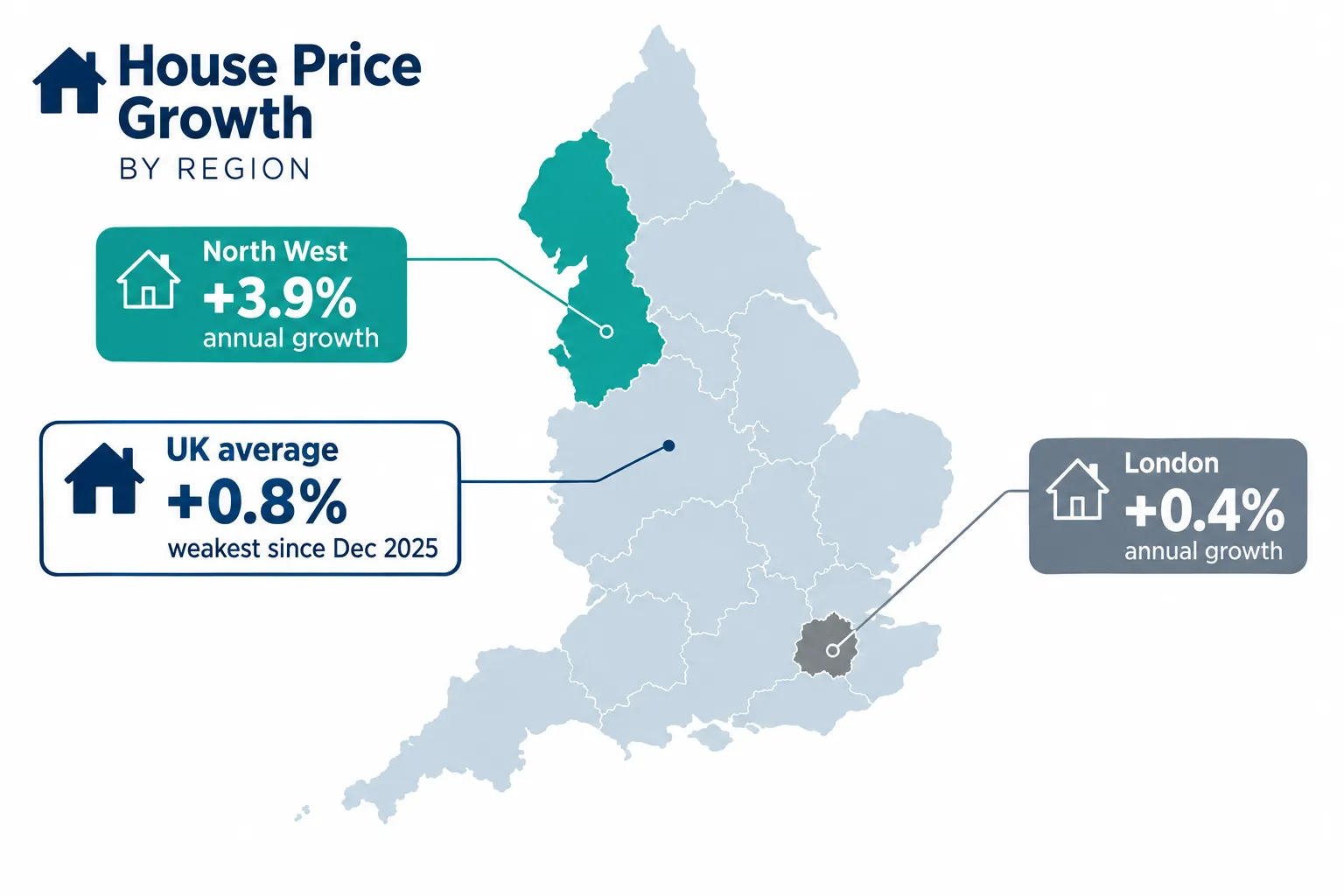
Against that backdrop, the North West stands out. The region posted an average price of £231,360 with 3.9 percent annual growth, exactly matching its Q2 figure. Compare that with London at £529,720 and just 0.4 percent growth, the Outer Metropolitan area down 0.2 percent, and the Outer South East flat at 0.0 percent. Gardner also noted a silver lining for buyers nationally: "Underlying affordability is improving, as house price growth has been well below earnings growth for some time." That affordability improvement is arguably even more pronounced in the North West, where lower entry prices combine with stronger wage growth relative to property costs.
ONS figures released 16 September 2026 reinforce the regional divergence, though with a different leader. The ONS put the UK average at £273,000, up 1.4 percent in July 2026, with England at £293,000 and 1.1 percent growth. The North East actually recorded the highest English house price inflation at 4.9 percent, while London fell 3.3 percent to £569,000. Crucially, private rents in the North West and North East both rose 5.8 percent in the year to August 2026, the joint highest rental inflation in England, against a UK average rent increase of 3.8 percent to £1,400. The next ONS release lands 21 October 2026 and will be watched closely for confirmation of this trend.
Manchester's Numbers Behind the North West House Prices October 2026 Manchester Averages
Zoopla's September index, reported by Property Notify on 13 October 2026, showed North West prices up 3.1 percent year on year against just 0.8 percent nationally, broadly consistent with Nationwide's picture even if the exact figures differ slightly between indices. ONS local data placed Manchester's average house price at £252,000, up 1.2 percent year on year. More striking is the long-term trend: Manchester's average annual growth since 2005 has run at roughly 4.7 percent, compared with around 3.2 percent for the UK as a whole. That two-decade outperformance is the real story behind today's headline figures.
Kate Faulkner OBE, a respected property market commentator, offered a useful caution in that same Property Notify coverage: "property price averages don't tell the full story." That warning applies directly to anyone trying to use the North West's 3.9 percent figure, or Manchester's 1.2 percent, to estimate what a specific semi-detached house in Stockport or a terraced property in Salford is actually worth today.
Why Regional Averages Can Mislead at Street Level
Averages blend everything: new-build flats, Victorian terraces, suburban semis, and rural outliers. A regional growth rate of 3.9 percent does not mean every property in Trafford or Bolton gained that much value. Three factors commonly explain the gap between headline and reality:
- Property mix shifts. If more higher-value detached homes sell in a given quarter, averages rise even if individual property values are flat.
- Condition and modernisation. A renovated kitchen or new boiler can add thousands, while deferred maintenance drags a specific property below the local trend.
- Hyperlocal demand. Streets near tram stops, good schools, or regeneration zones often outperform the wider borough significantly.
This is precisely why a professional valuation, rather than an online estimate pulled from a postcode-level index, remains the only reliable way to price a Greater Manchester property accurately in late 2026.
Mortgage Rates, Remortgaging and Buy-to-Let Implications
Borrowing costs are tightening the picture for anyone relying on finance. Figures reported by Tembo on 15 October 2026 show the average two-year fixed mortgage rate at 5.97 percent, up from 5.68 percent just a month earlier, while the average five-year fix stands at 5.99 percent, having crossed 6 percent earlier in October for the first time in nearly three years. The Bank of England base rate has held at 3.75 percent since December 2025, with the next decision due 5 November 2026; some market commentators see a possible rise rather than a cut. HSBC and NatWest have nonetheless trimmed selected fixed rates from 15 October, offering some relief to borrowers shopping around.
For landlords, the picture is further complicated by regulation. Manchester and Salford councils strengthened Renters' Rights Act enforcement from 27 December 2025, introducing fines of up to £7,000 for standard breaches and up to £40,000 for serious or repeat offences. Combined with rising rents across the North West, now at 5.8 percent annual growth, landlords face a market that rewards compliance and good property condition but punishes neglect financially. Anyone remortgaging a buy-to-let or residential property in the current environment should secure an up-to-date valuation well before their existing deal expires, particularly with the Autumn Budget due 28 October 2026 likely to influence lender pricing and tax policy.
How Surveyors Value Homes in a Rising-but-Slowing Market
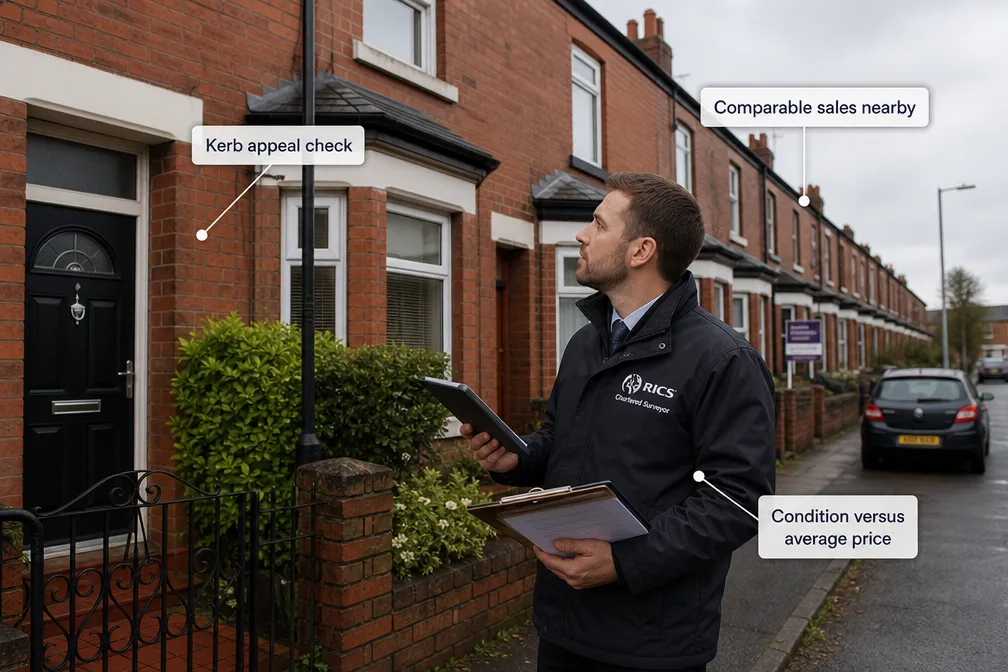
RICS chartered surveyors do not rely on regional index figures alone. A proper valuation weighs recent comparable sales within a tight radius, the specific property's condition, local planning activity, and current mortgage lending criteria. In a market where national growth has halved but the North West continues climbing, this independent judgement matters more than usual. Sellers who price purely on a 3.9 percent regional uplift risk overvaluing a property that has not been updated, while cautious owners may undervalue a well-maintained home in a strong Manchester micro-location.
For homeowners planning to sell, remortgage, or settle a probate or matrimonial matter before the end of 2026, an independent RICS valuation provides a defensible, evidence-based figure that reflects both the regional trend and the realities on a specific street.
Frequently Asked Questions
Is the North West really the strongest housing market in the UK right now?
Yes, based on Nationwide's Q3 2026 figures. The region recorded 3.9 percent annual growth, the highest of any English region tracked, while UK-wide growth slowed to just 0.8 percent by September.
Does Manchester always match the North West regional average?
Not exactly. Manchester's own ONS-reported growth was 1.2 percent year on year to £252,000, lower than the regional figure, though its longer-term trend since 2005 has outpaced the UK average.
How are rising mortgage rates affecting North West buyers?
Average two-year and five-year fixed rates have climbed above 5.9 percent as of mid-October 2026, raising monthly repayment costs and tempering some demand despite strong price growth.
Should landlords worry about Renters' Rights Act enforcement in Manchester?
Yes. Manchester and Salford have strengthened enforcement since late December 2025, with fines reaching £40,000 for serious breaches, making compliance and property condition financially important.
Why do I need a professional valuation if regional data already shows growth?
Regional and city averages blend many different property types and conditions. A chartered surveyor assesses the specific property against genuine local comparables, avoiding the pitfalls of relying on broad index figures alone.
Conclusion
The headline is genuinely encouraging for North West homeowners: 3.9 percent annual growth against a national rate that has halved to 0.8 percent is a meaningful outperformance, and Manchester's two-decade growth trend backs up the region's long-term strength. But averages, as Kate Faulkner rightly notes, do not tell the full story. Rising mortgage rates, tightening rental regulation, and wide variation between streets mean that anyone buying, selling, remortgaging, or letting in Greater Manchester should treat index figures as context, not confirmation. Before the November Bank of England decision and the Autumn Budget reshape the lending landscape further, securing an independent RICS valuation is the most reliable next step toward an accurate, defensible property figure.