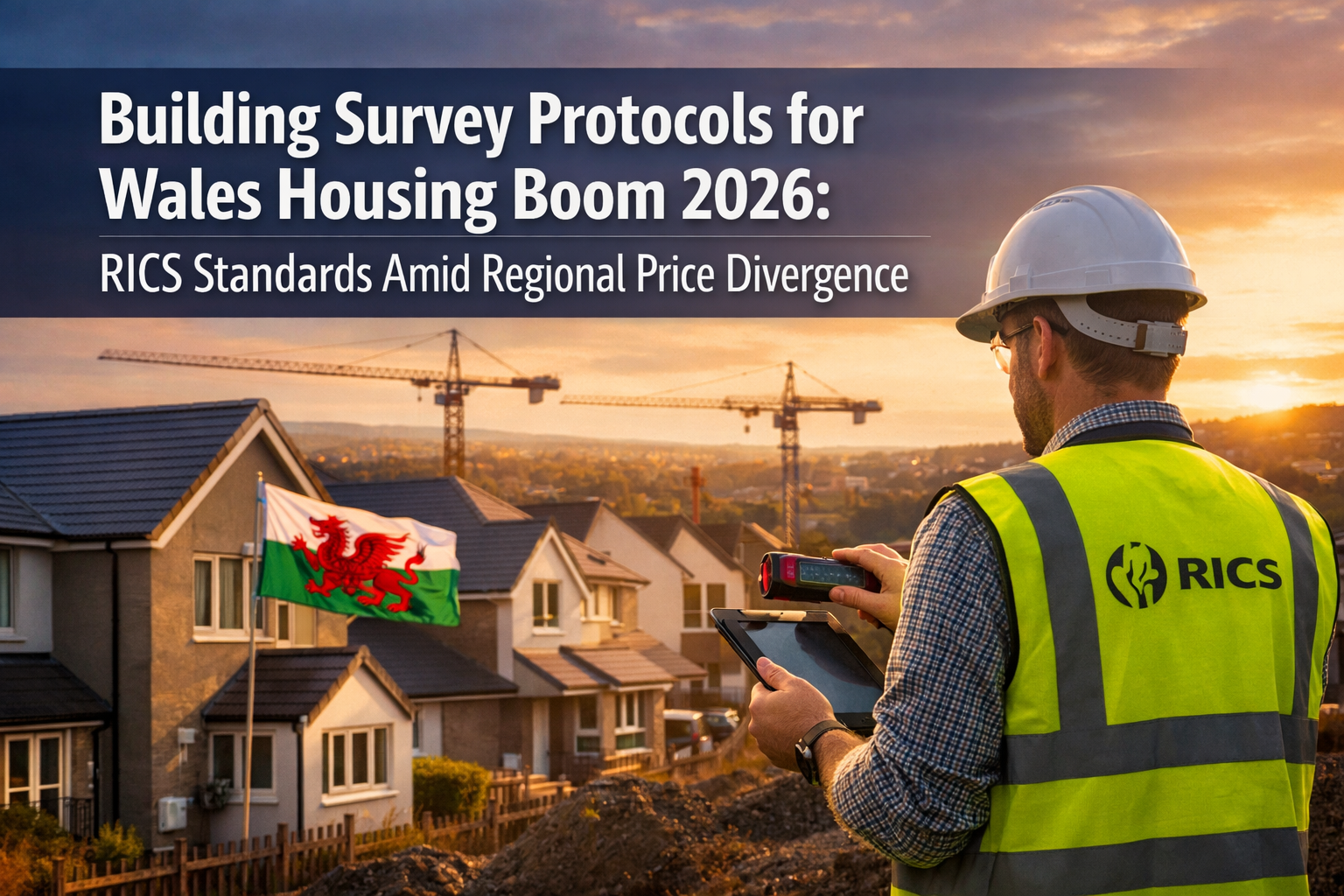
The Welsh housing market is experiencing an extraordinary transformation in 2026, with unprecedented buyer activity creating a perfect storm of opportunity and risk. As Building Survey Protocols for Wales Housing Boom 2026: RICS Standards Amid Regional Price Divergence become increasingly critical, property professionals face the challenge of maintaining rigorous inspection standards while navigating stark regional variations in pricing, construction quality, and market velocity. This comprehensive guide examines how RICS-compliant surveying practices are adapting to Wales's dynamic property landscape.
Key Takeaways
- 🏴 Wales is experiencing a remarkable housing surge in Q1 2026, driving unprecedented demand for comprehensive building surveys and RICS-compliant inspection protocols
- 📊 Regional price divergence across Wales requires tailored survey approaches, with urban centers showing different defect patterns than rural properties
- ✅ Updated RICS Home Survey Standard (2nd edition) introduces enhanced requirements including AI technology integration, retrofit assessments, and drone inspections
- 💷 Survey costs vary significantly by property type and inspection level, ranging from £300-£500 for Level 1 reports to £750-£1,500+ for comprehensive Level 3 building surveys
- 🔍 Fragile built environment confidence and skills shortages make professional RICS surveyor selection more critical than ever for protecting buyer investments
Understanding the Wales Housing Boom Context in 2026
The Welsh property market has defied national trends in early 2026, with regional data showing remarkable resilience despite broader economic headwinds. According to recent market analysis, Wales is experiencing a "remarkable surge" in residential transactions during the first quarter of 2026, creating intense pressure on surveying services and property inspection infrastructure [4].
This boom occurs against a backdrop of increasing fragility in Wales's built environment confidence. RICS data reveals that construction activity has lost momentum, commercial demand has softened, and persistent skills shortages continue to constrain growth across the sector [3]. These contradictory forces create a unique environment where residential demand surges while professional capacity struggles to keep pace.
Regional Price Divergence: The New Normal
The 2026 Welsh housing market is characterized by pronounced regional price divergence, with urban centers like Cardiff experiencing different growth trajectories compared to rural areas in North and Mid Wales. This geographic variation demands sophisticated survey protocols that account for:
- Local construction methods and traditional building materials prevalent in specific regions
- Climate-related defect patterns varying between coastal, valley, and upland properties
- Heritage considerations in areas with high concentrations of period properties
- New-build quality variations across different development zones and builders
Understanding these regional nuances is essential when selecting appropriate RICS building surveys that match property characteristics and local risk profiles.
Affordability Barriers and Market Pressures
Despite the housing boom, affordability remains a major barrier for both renters and buyers across Wales [3]. This creates a challenging dynamic where buyers face intense competition for properties while simultaneously needing to make financially prudent decisions based on comprehensive survey findings.
Investment in social housing is providing a construction boost, but private market participants must navigate complex decisions about property condition, renovation costs, and long-term value. Professional building surveys become not just due diligence tools but critical financial planning instruments in this environment.
Building Survey Protocols for Wales Housing Boom 2026: RICS Standards Framework
The Royal Institution of Chartered Surveyors (RICS) provides the authoritative framework for building survey protocols in the UK, with specific standards evolving to meet the challenges of Wales's 2026 housing boom. Understanding these protocols is essential for buyers, sellers, and property professionals navigating the current market.
The Three-Tier RICS Survey System
RICS maintains a structured approach to residential property surveys, with three distinct levels designed to match different property types, conditions, and buyer requirements. When considering Building Survey Protocols for Wales Housing Boom 2026: RICS Standards Amid Regional Price Divergence, selecting the appropriate survey level becomes paramount.
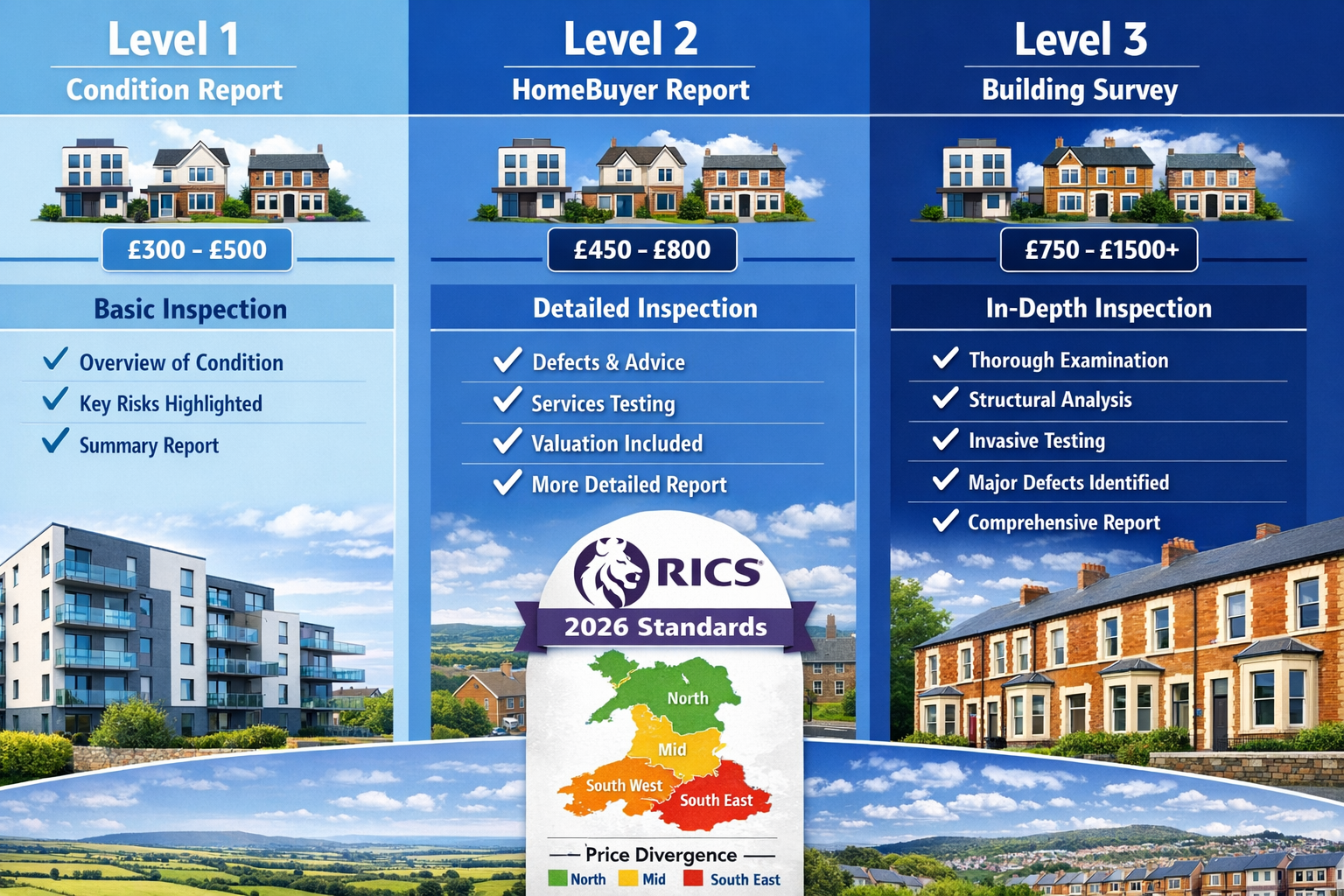
Level 1: RICS Condition Report
The most basic survey option provides a traffic-light rating system assessing property condition without detailed defect analysis. Typical costs range from £300-£500 [6], making this suitable for:
- Modern new-build properties with NHBC warranties
- Standard flats in good condition
- Properties built within the last 10 years with no visible concerns
However, in Wales's 2026 market with its rapid transaction pace, Level 1 surveys may provide insufficient protection for buyers facing competitive bidding situations. The limited scope means potential defects could remain undetected until after purchase completion.
Level 2: RICS HomeBuyer Report
The most popular survey type in the UK [6], Level 2 reports cost between £450-£800 and include:
- Visual inspection of readily accessible property elements
- Checks for damp, condensation, and structural problems
- Assessment of services (heating, plumbing, electrical systems)
- Identification of urgent defects requiring immediate attention
- General maintenance advice
This RICS home survey level suits most conventional homes built after 1960 in reasonable condition, representing the sweet spot for many Welsh property transactions in 2026.
Level 3: RICS Building Survey
The most comprehensive option, costing £750-£1,500+ [6], provides in-depth structural analysis essential for:
- Properties built before 1960
- Homes of unusual construction or materials
- Properties showing visible defects or previous alterations
- Listed buildings or those in conservation areas
- Buyers planning significant renovation work
Given Wales's substantial stock of period properties and traditional construction, Level 3 surveys are particularly relevant. The detailed defect analysis, repair recommendations, and maintenance guidance justify the higher investment for older Welsh homes.
For properties requiring specialized attention, consider supplementary assessments like structural surveys or subsidence surveys depending on specific concerns.
RICS Home Survey Standard 2nd Edition: 2026 Updates
RICS released a progress update on the Home Survey Standard 2nd edition in February 2026 [5], signaling significant modernization of surveying practices. These updates directly address the challenges of Building Survey Protocols for Wales Housing Boom 2026: RICS Standards Amid Regional Price Divergence.
Key enhancements include:
🔧 Greater Clarity on Survey Levels
The revised standard provides clearer differentiation between survey types, helping buyers select appropriate inspection depth for their specific property and circumstances.
🤖 Technology and AI Integration
Recognition of emerging technologies including thermal imaging, moisture detection devices, and artificial intelligence-assisted defect identification. This modernization enables more accurate assessments while maintaining professional judgment standards.
💰 Optional Valuation Services
All survey levels will include optional valuation components, allowing buyers to obtain market value assessments alongside condition reports. This integration proves particularly valuable in Wales's divergent regional markets where local valuation expertise is essential.
⚠️ 'Additional Risk' Dwelling Guidance
Enhanced protocols for properties presenting elevated risk factors, including those with non-standard construction, heritage designations, or environmental concerns. This addresses Wales's diverse building stock effectively.
🌱 Retrofit Building Surveys
New guidance for assessing properties' suitability for energy efficiency improvements, renewable energy installations, and decarbonization measures. This reflects growing importance of sustainability in property decisions.
🚁 Drone Inspection Services
Formal recognition of drone surveys for roof and high-level inspections, improving safety while enhancing inspection quality for difficult-to-access areas common in Welsh properties.
Regulatory Compliance Scheme Proposal
RICS is developing a regulatory scheme requiring members conducting home surveys in the UK to meet specific requirements, with members subject to additional reporting and audit requirements [5]. This enhanced oversight aims to:
- Ensure consistent quality standards across all RICS surveyors
- Provide greater consumer protection in fast-moving markets
- Establish accountability mechanisms for survey quality
- Create transparent complaint and resolution processes
For buyers navigating Wales's 2026 housing boom, engaging RICS chartered building surveyors provides assurance of professional standards and recourse options if issues arise.
Tailored Building Survey Checklists for Welsh Properties
Building Survey Protocols for Wales Housing Boom 2026: RICS Standards Amid Regional Price Divergence require specialized checklists addressing the unique characteristics of Welsh housing stock. Professional surveyors adapt their inspection protocols based on regional construction patterns, climate factors, and common defect profiles.
Essential Inspection Points for Welsh Properties
Traditional Welsh Construction Elements
Wales's housing stock includes significant numbers of properties built with traditional methods requiring specialized assessment:
Stone Construction
- Solid stone walls (common in rural and period properties)
- Pointing condition and weathering patterns
- Moisture penetration through porous stone
- Lime mortar deterioration requiring specialist repair
- Cavity wall tie corrosion in later constructions
Slate Roofing
- Welsh slate condition and delamination
- Roof pitch and water shedding effectiveness
- Valley and flashing integrity
- Historic nail fixings and potential slippage
- Sarking board condition beneath slates
Timber Frame Elements
- Period timber framing in older properties
- Beam condition and structural integrity
- Woodworm, rot, and decay indicators
- Modern timber frame construction in new builds
- Moisture barriers and ventilation adequacy
Climate-Specific Defect Patterns
Wales's maritime climate creates particular vulnerability to certain defects that surveyors must prioritize:
Damp and Moisture Issues
- Penetrating damp from driving rain (especially coastal and upland properties)
- Rising damp in properties without effective damp-proof courses
- Condensation problems in poorly ventilated spaces
- Mold growth in high-humidity environments
- Ground water ingress in valley locations
Wind Exposure Damage
- Roof covering displacement or damage
- Chimney stack stability and pointing condition
- Render cracking and detachment
- Window and door weather-tightness
- Exposed timber decay
Regional Variation Considerations
Survey protocols must adapt to specific regional characteristics:
Urban Cardiff and South Wales
- Victorian and Edwardian terraced housing stock
- Conversion quality in multi-occupancy buildings
- Modern apartment construction standards
- Subsidence risks in mining-affected areas
- Traffic vibration impacts on older structures
North Wales Coastal Areas
- Salt spray corrosion on metal components
- Accelerated weathering of external materials
- Flood risk assessments for low-lying properties
- Holiday let wear patterns and maintenance standards
- Heritage property conservation requirements
Rural Mid Wales
- Agricultural building conversions
- Septic tank and private drainage systems
- Access track condition and maintenance
- Outbuilding structural integrity
- Land drainage and water management
Technology-Enhanced Inspection Protocols
Modern RICS surveyors employ advanced technology to enhance traditional inspection methods, particularly valuable in Wales's 2026 market where speed and accuracy are both essential:
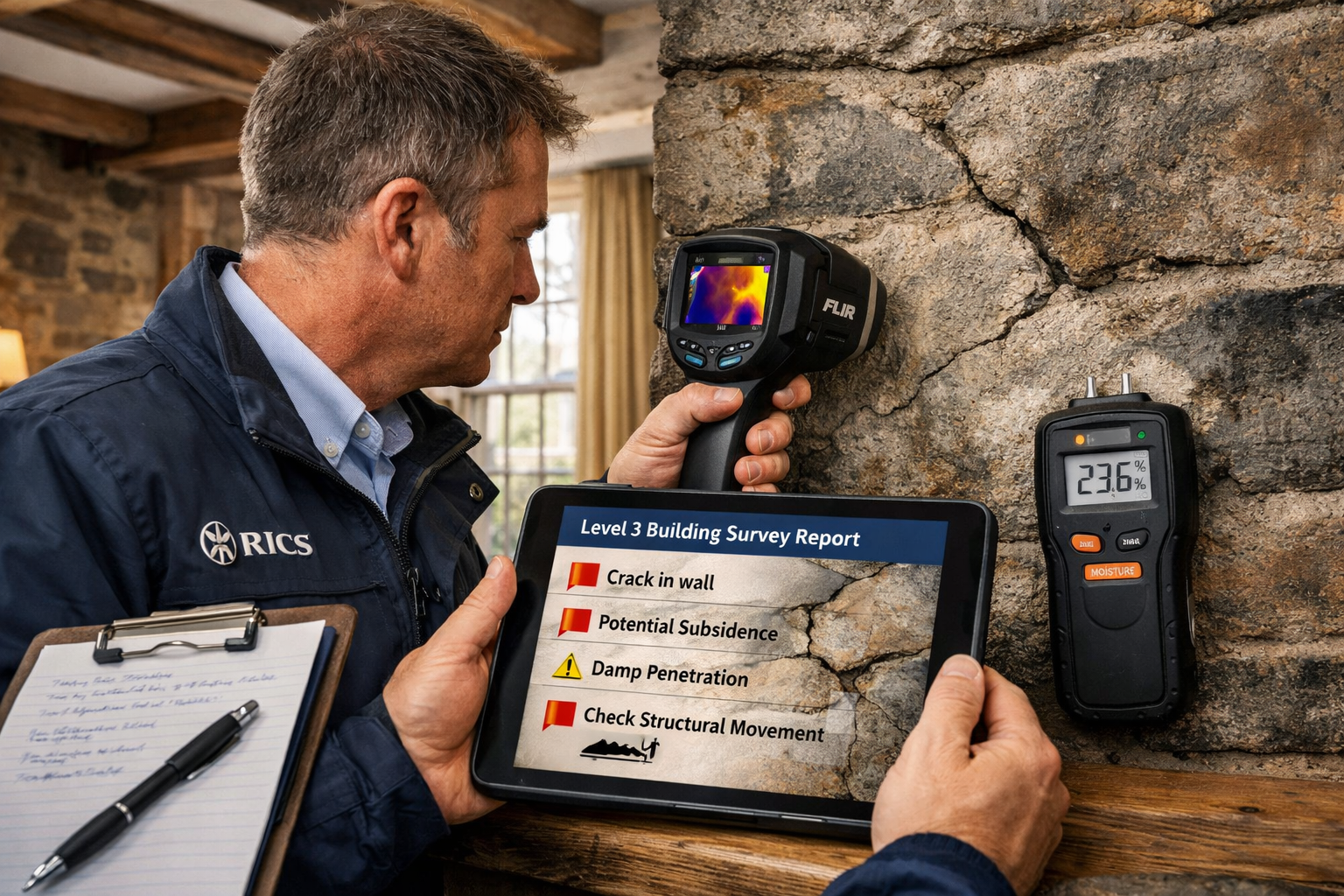
Thermal Imaging Cameras
Identify hidden moisture, insulation defects, and thermal bridging invisible to visual inspection alone. Particularly effective for detecting concealed damp in solid wall construction common in Welsh properties.
Moisture Meters
Provide quantitative moisture readings in walls, floors, and timbers, distinguishing between surface condensation and deeper penetrating damp requiring different remediation approaches.
Drone Surveys
Enable safe, detailed inspection of roofs, chimneys, and high-level elements without scaffolding or access equipment. Essential for properties with steep Welsh slate roofs or complex roof geometries.
Laser Distance Measurers
Ensure accurate dimensional surveys and identification of structural irregularities that might indicate settlement or movement.
Borescope Inspection
Allow visual examination of cavity walls, beneath floors, and within roof spaces through minimal-access points, revealing concealed defects without destructive investigation.
Defect Prioritization in Fast-Moving Markets
In Wales's accelerated 2026 market, surveyors must effectively communicate defect severity to enable rapid buyer decision-making. Professional reports categorize findings as:
🔴 Category 3: Urgent Defects
Issues requiring immediate attention or posing safety risks:
- Active structural movement or instability
- Dangerous electrical installations
- Serious damp penetration causing decay
- Roof defects allowing water ingress
- Unsafe chimneys or flues
🟠 Category 2: Significant Defects
Problems requiring repair or replacement but not immediately dangerous:
- Deteriorating roof coverings approaching end of life
- Aging heating systems requiring replacement
- Damp issues requiring remediation
- Drainage problems needing attention
- Window and door replacement requirements
🟢 Category 1: Minor Defects
Routine maintenance items and cosmetic issues:
- Redecoration requirements
- Minor pointing repairs
- Gutter cleaning and maintenance
- Garden maintenance
- Cosmetic improvements
This clear categorization enables buyers to quickly assess whether to proceed, negotiate price reductions, or request seller remediation before completion.
Navigating Regional Price Divergence Through Survey Intelligence
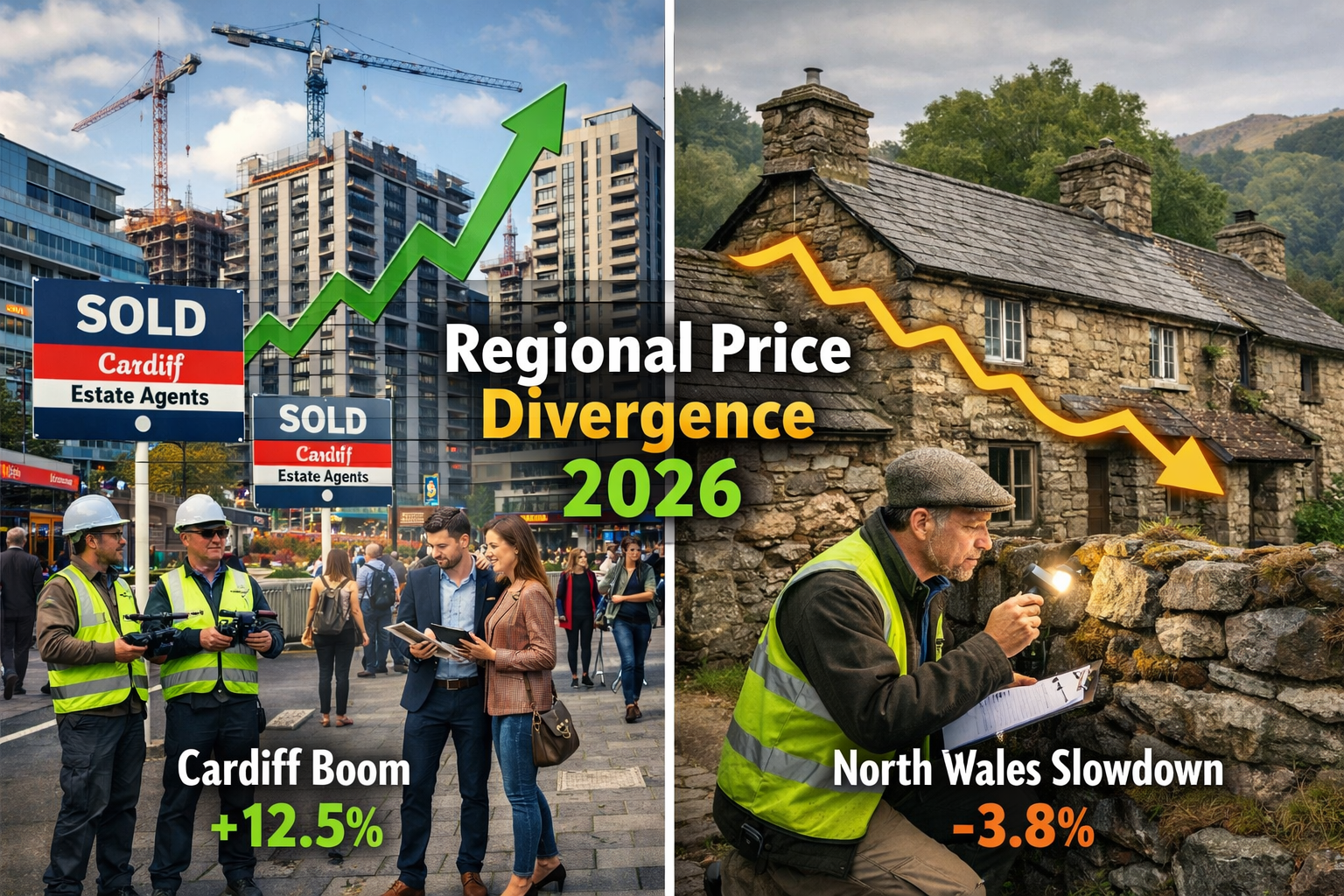
Building Survey Protocols for Wales Housing Boom 2026: RICS Standards Amid Regional Price Divergence must account for the complex relationship between property condition, local market dynamics, and valuation outcomes. Professional surveyors provide critical intelligence that extends beyond defect identification to inform strategic buying decisions.
Survey Findings and Negotiation Leverage
In competitive markets, comprehensive survey reports provide essential negotiation tools:
Quantified Repair Cost Estimates
Professional surveyors provide estimated costs for identified defects, enabling buyers to:
- Request price reductions reflecting repair requirements
- Negotiate seller contributions toward remediation work
- Make informed decisions about post-purchase renovation budgets
- Compare properties on a like-for-like condition basis
Market-Specific Valuation Context
When surveys include optional valuation services, buyers gain insight into whether asking prices reflect property condition within specific Welsh regional markets. A property priced at Cardiff levels but with condition issues more typical of lower-value markets presents clear negotiation opportunities.
Risk Assessment Documentation
Detailed survey reports provide evidence supporting mortgage lender decisions and insurance underwriting, potentially affecting:
- Loan-to-value ratios offered by lenders
- Insurance premium calculations
- Mortgage product availability
- Lender retention requirements pending repairs
Comparing Survey Types for Different Welsh Property Scenarios
Selecting appropriate survey levels requires matching inspection depth to property characteristics and market conditions:
| Property Type | Recommended Survey | Key Considerations | Typical Cost Range |
|---|---|---|---|
| New-build apartment (Cardiff) | Level 1 or Level 2 | NHBC warranty coverage, snagging issues | £300-£600 |
| 1980s semi-detached (Swansea) | Level 2 | Standard construction, routine condition | £450-£700 |
| Victorian terrace (Newport) | Level 2 or Level 3 | Age-related defects, possible alterations | £600-£1,200 |
| Pre-1900 stone cottage (Snowdonia) | Level 3 | Traditional construction, specialist knowledge required | £900-£1,500+ |
| Listed building (any location) | Level 3 + specialist | Conservation requirements, heritage materials | £1,200-£2,000+ |
| Converted barn (rural) | Level 3 | Non-standard construction, drainage concerns | £1,000-£1,800 |
For detailed comparison of survey options, review guidance on comparing different types of survey.
The Role of Specialist Surveys in Welsh Properties
Beyond standard RICS survey levels, certain Welsh properties benefit from additional specialist assessments:
Structural Engineering Reports
When surveyors identify potential structural issues requiring detailed analysis, engaging structural engineers provides:
- Calculation-based assessment of load-bearing capacity
- Detailed movement monitoring recommendations
- Specific remediation design and specifications
- Professional indemnity coverage for structural opinions
Damp and Timber Surveys
Properties showing significant moisture or timber decay indicators may require specialist investigation determining:
- Exact damp causes and sources
- Timber treatment requirements and specifications
- Remediation methodology and guarantees
- Insurance-backed warranty options
Environmental and Contamination Surveys
Properties with industrial heritage or specific site history may need:
- Soil contamination testing
- Radon gas assessment (particularly relevant in certain Welsh geological areas)
- Asbestos surveys for properties built 1950-2000
- Japanese knotweed identification and management plans
Drainage Surveys
Older properties or those with drainage concerns benefit from CCTV drainage surveys identifying:
- Pipe condition and material type
- Root ingress or structural damage
- Connection points and system layout
- Repair or replacement requirements
RICS Valuation Services in Divergent Markets
Professional valuations become increasingly important when regional price divergence creates uncertainty about appropriate pricing levels. RICS Red Book valuations provide:
Market Value Assessments
Independent professional opinion of market value based on:
- Comparable sales evidence in the specific locality
- Property condition and specification
- Market trends and demand indicators
- Regional economic factors
Mortgage Lending Valuations
Lender-focused assessments determining:
- Adequate security for proposed loan amount
- Property marketability and liquidity
- Risk factors affecting lending decision
- Retention requirements for identified defects
For properties requiring formal valuation services, consider engaging RICS valuation surveyors who provide Red Book compliant reports.
Commercial Property Considerations
Wales's 2026 housing boom extends beyond residential properties, with commercial property investors also requiring robust survey protocols. RICS commercial building surveys address additional factors including:
- Business use suitability and compliance
- Commercial lease obligations and dilapidations
- Accessibility and building regulation compliance
- Energy performance and sustainability requirements
- Development potential and planning considerations
RICS Policy Advocacy and Future Standards for Wales
The Royal Institution of Chartered Surveyors actively engages with Welsh policymakers to address systemic challenges affecting the built environment and property sector. Understanding this advocacy context helps property professionals anticipate future regulatory changes and market developments.
Wales Manifesto 2026: Key Policy Priorities
RICS launched its Wales Manifesto 2026 ahead of the Senedd election, calling on the next Welsh Government to address critical issues affecting the property sector [1]:
Housing Delivery Strategy
RICS advocates for comprehensive housing delivery strategy development through:
- Cross-tenure targets balancing social, affordable, and market housing
- Clear development ambitions with measurable outcomes
- Integration of sustainability and quality standards
- Regional variation recognition in housing need assessments
Planning System Modernization
The manifesto emphasizes creating a "truly functional planning system" by:
- Embedding specialist skills in local planning authorities
- Improving developer contribution systems
- Implementing effective biodiversity net gain mechanisms
- Streamlining approval processes without compromising quality
Residential Leaseholder Protections
RICS calls for Welsh government action to protect residential leaseholders through:
- Modern, UK-aligned standards replacing outdated historic versions
- Enhanced transparency in service charge calculations
- Improved dispute resolution mechanisms
- Professional management standards for leasehold properties
Future Homes and Building Standards
The publication of Future Homes and Building Standards represents significant regulatory development affecting new construction quality and existing property retrofit requirements [2]. These standards will influence:
New Build Survey Requirements
Enhanced construction standards mean surveyors must assess:
- Compliance with updated energy efficiency requirements
- Installation quality of heat pumps and renewable systems
- Ventilation and indoor air quality measures
- Thermal performance and airtightness achievement
Retrofit Assessment Protocols
Existing properties face increasing pressure to improve energy performance, creating demand for:
- Pre-retrofit condition surveys
- Suitability assessments for different improvement measures
- Post-installation verification surveys
- Energy performance certification
Skills Shortages and Professional Capacity
RICS data highlights persistent skills shortages constraining Wales's built environment sector growth [3]. This capacity challenge affects:
Survey Availability and Timing
High demand combined with limited surveyor availability creates:
- Extended booking lead times during peak market periods
- Premium pricing for rapid-turnaround surveys
- Quality risks if buyers engage unqualified inspectors
- Importance of advance survey booking in competitive transactions
Professional Development Investment
The surveying profession must invest in:
- Training programs for emerging technologies
- Welsh-specific construction knowledge development
- Mentorship and qualification pathways for new entrants
- Continuing professional development in evolving standards
Consumer Education
Property buyers need better understanding of:
- Differences between qualified RICS surveyors and unregulated inspectors
- Value proposition of comprehensive surveys versus basic inspections
- Survey report interpretation and defect significance
- Rights and recourse when survey quality concerns arise
Practical Guidance for Buyers in Wales's 2026 Market
Successfully navigating Building Survey Protocols for Wales Housing Boom 2026: RICS Standards Amid Regional Price Divergence requires strategic planning and informed decision-making throughout the property acquisition process.
Selecting the Right RICS Surveyor
Not all RICS-qualified surveyors possess equal expertise with Welsh property characteristics. Buyers should prioritize:
Local Knowledge and Experience
- Surveyors with extensive Welsh property portfolio experience
- Understanding of regional construction methods and materials
- Familiarity with local defect patterns and climate factors
- Knowledge of area-specific issues (mining subsidence, flood risk, etc.)
Relevant Qualifications and Specializations
- RICS membership status (MRICS or FRICS designation)
- Building surveying specialization rather than general practice
- Additional qualifications in structural engineering or specific property types
- Professional indemnity insurance coverage adequacy
Technology Capabilities
- Access to thermal imaging and moisture detection equipment
- Drone survey capabilities for comprehensive roof inspection
- Digital reporting systems enabling rapid report delivery
- Photographic documentation quality and comprehensiveness
Communication and Responsiveness
- Availability for pre-survey consultation
- Willingness to discuss findings and answer questions
- Clear, jargon-free reporting style
- Post-survey support for interpreting recommendations
Timing Survey Commissioning Strategically
In Wales's fast-moving 2026 market, survey timing significantly impacts transaction success:
Pre-Offer Survey Considerations
In highly competitive situations, commissioning surveys before making offers provides:
- Confidence in offer pricing based on actual condition
- Competitive advantage over buyers making conditional offers
- Reduced risk of post-offer survey surprises
- Faster transaction completion timelines
However, this approach carries risk of survey cost loss if offers are unsuccessful.
Post-Offer Survey Timing
Traditional approach of surveying after offer acceptance requires:
- Including appropriate survey contingency clauses in offers
- Realistic timelines for survey booking and completion
- Clear communication with sellers about survey timing
- Preparedness to renegotiate or withdraw based on findings
Understanding Survey Report Findings
Professional survey reports contain extensive technical information requiring careful interpretation:
Executive Summary Priority
Focus initially on:
- Overall condition rating and summary assessment
- Category 3 urgent defects requiring immediate attention
- Estimated total repair cost ranges
- Recommendations for specialist further investigation
Detailed Section Review
Subsequently examine:
- Element-by-element condition descriptions
- Photographic evidence of identified defects
- Maintenance recommendations and timelines
- Legal and regulatory compliance issues
Seeking Clarification
Don't hesitate to:
- Request surveyor explanation of technical terminology
- Ask about repair cost estimate assumptions
- Discuss prioritization of multiple identified issues
- Obtain recommendations for specialist contractors
Acting on Survey Findings
Survey reports inform multiple potential courses of action:
Proceeding Without Adjustment
When surveys reveal only minor issues consistent with property age and asking price, buyers may proceed without negotiation, accepting identified maintenance requirements as part of ownership.
Price Renegotiation
Significant defects justify requesting price reductions reflecting:
- Estimated repair costs from survey report
- Market adjustment for condition versus comparable properties
- Risk premium for uncertainty about defect extent
- Buyer inconvenience and project management burden
Seller Remediation Requests
Alternative to price reduction, buyers may request sellers complete specific repairs before completion, ensuring:
- Work completed to appropriate standards
- Professional guarantees and warranties obtained
- Reinspection confirming satisfactory completion
- Retention of funds pending verification
Transaction Withdrawal
Serious structural issues, prohibitive repair costs, or unacceptable risks may justify withdrawing from transactions, protecting buyers from poor investments despite sunk survey costs.
Conclusion: Protecting Your Investment in Wales's Dynamic Market
Building Survey Protocols for Wales Housing Boom 2026: RICS Standards Amid Regional Price Divergence represent essential due diligence tools in one of the UK's most dynamic regional property markets. As Wales experiences remarkable residential demand growth amid pronounced regional variations, comprehensive RICS-compliant building surveys provide the intelligence necessary for confident property acquisition decisions.
The updated RICS Home Survey Standard 2nd edition, with its integration of modern technologies, retrofit assessments, and enhanced clarity, ensures surveying practices evolve alongside market demands. From basic Level 1 Condition Reports suitable for modern properties through comprehensive Level 3 Building Surveys essential for period homes, the RICS framework offers appropriate inspection depth for every property type and buyer requirement.
Key Action Steps for Property Buyers
✅ Prioritize RICS Qualification
Engage only RICS chartered building surveyors with demonstrated Welsh property experience and appropriate professional indemnity coverage.
✅ Match Survey Level to Property
Select inspection depth appropriate to property age, construction type, condition, and your risk tolerance. When in doubt, opt for more comprehensive assessment rather than basic inspection.
✅ Account for Regional Variations
Ensure your surveyor understands specific regional construction methods, climate factors, and common defect patterns relevant to your target property's location.
✅ Leverage Technology-Enhanced Inspections
Request surveyors utilize thermal imaging, drone surveys, and moisture detection equipment for comprehensive assessment beyond visual inspection alone.
✅ Budget Appropriately
Allocate £300-£1,500+ for professional surveys depending on property characteristics, recognizing this investment protects against far larger potential losses from undiscovered defects.
✅ Act Decisively on Findings
Use survey intelligence to negotiate effectively, request appropriate remediation, or withdraw from unsuitable transactions before legal commitment.
The confluence of Wales's 2026 housing boom, evolving RICS standards, and regional market divergence creates both opportunity and complexity. Professional building surveys transform this complexity into actionable intelligence, enabling buyers to navigate competitive markets while protecting their most significant financial investments.
Whether purchasing a modern Cardiff apartment, a Victorian Newport terrace, or a traditional Snowdonia stone cottage, comprehensive RICS survey protocols provide the foundation for confident property acquisition in Wales's dynamic housing market. As regulatory standards continue evolving and market conditions fluctuate, the fundamental value of professional building surveys remains constant: protecting buyers through expert, independent assessment of property condition, risks, and value.
For more information about specific survey types and services, explore our comprehensive guides on RICS building surveys, structural surveys, and comparing different types of survey to make informed decisions about your property investment.
References
[1] Wales Manifesto 2026 Launch – https://www.rics.org/news-insights/wales-manifesto-2026-launch
[2] Rics Ceo Comments On The Publication Of The Future Homes And Building Standards – https://www.rics.org/news-insights/rics-ceo-comments-on-the-publication-of-the-future-homes-and-building-standards
[3] Uk Influence And Advocacy Update January 2026 – https://www.rics.org/news-insights/uk-influence-and-advocacy-update-january-2026
[4] Party Wall Surveys For Wales Housing Boom Rics Compliance Amid Accelerating Regional Demand In Q1 2026 – https://nottinghillsurveyors.com/blog/party-wall-surveys-for-wales-housing-boom-rics-compliance-amid-accelerating-regional-demand-in-q1-2026
[5] Home Survey Standards – https://www.rics.org/profession-standards/rics-standards-and-guidance/sector-standards/building-surveying-standards/home-surveys/home-survey-standards
[6] Rics Survey Cost – https://surveymatch.co.uk/rics-survey-cost/