
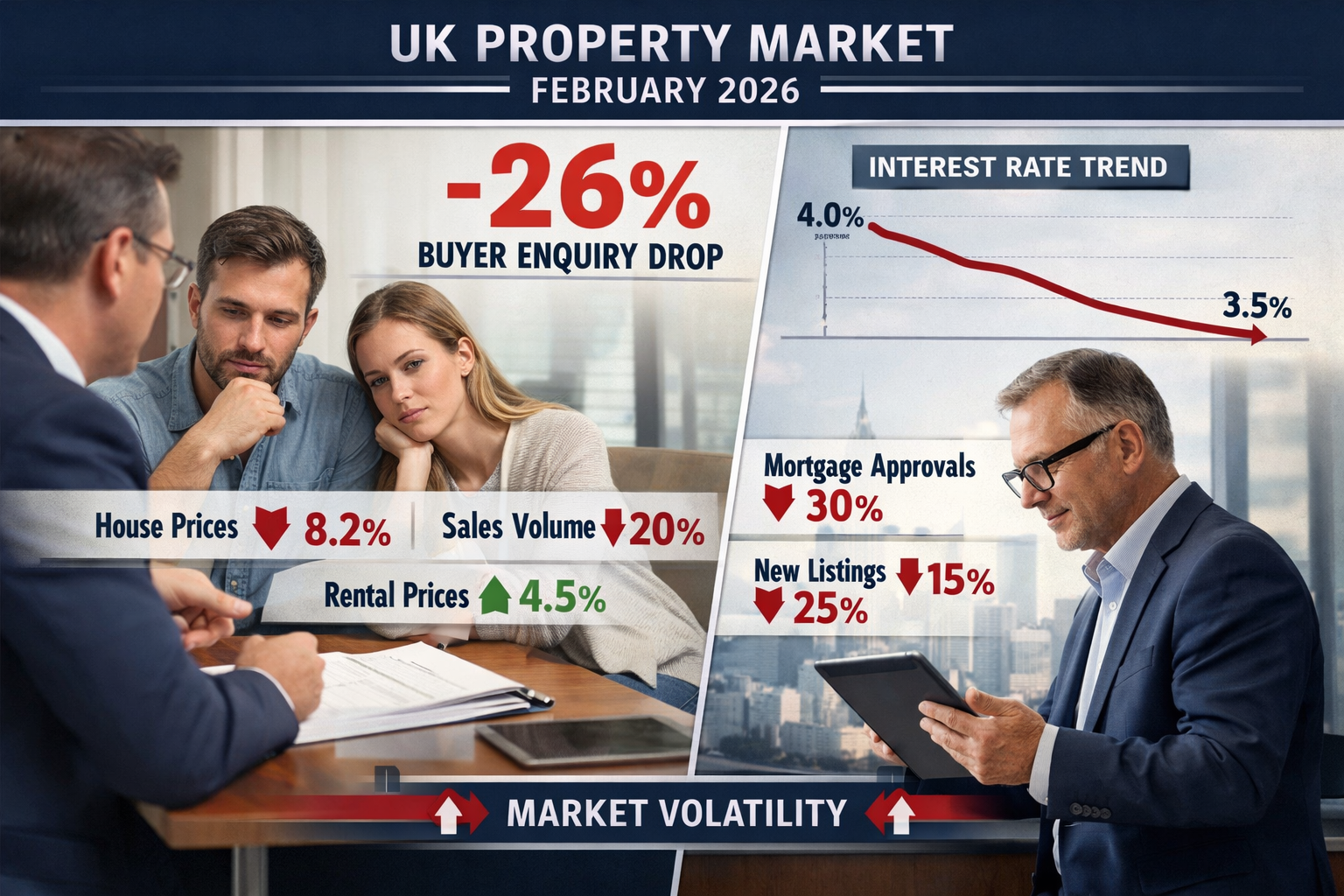
The UK property market has entered turbulent waters in 2026, with February data revealing a striking -26% drop in buyer enquiries that has sent shockwaves through the real estate sector. This dramatic decline, driven by renewed interest rate concerns and lending uncertainty, has created a perfect storm for valuation disputes requiring expert witness testimony. As property transactions stall and parties disagree on asset values in this volatile environment, understanding Expert Witness Strategies for 2026 Interest Rate Volatility Disputes: RICS Evidence Post-February Buyer Dip has become critical for surveyors, legal professionals, and property stakeholders navigating litigation.
The convergence of RICS's newly updated 5th edition professional standards for expert witnesses and unprecedented market conditions demands a fresh approach to dispute preparation. With interest rates expected to decline to 3.5% by mid-2026 but gilt yields remaining unpredictable, expert witnesses must adapt their methodologies to address valuation challenges in an uncertain lending landscape [5].
Key Takeaways
- 📉 February 2026 saw a 26% collapse in buyer enquiries, creating widespread valuation disputes as market sentiment shifted dramatically due to interest rate uncertainty
- 📋 RICS's 5th edition expert witness standard introduces stricter protocols for conditional fees, report alterations, and oral evidence that directly impact dispute preparation strategies
- 💷 Interest rate volatility between 3.5-4% creates complex valuation scenarios requiring expert witnesses to demonstrate sophisticated understanding of lending environment impacts
- ⚖️ Enhanced compliance requirements mandate expert witnesses obtain prior consent before meeting opposing experts and report material settlement prospects immediately
- 🎯 Evidence-based methodologies incorporating post-February market data, regional variations, and transaction volume analysis are essential for credible expert testimony in 2026 disputes
Understanding the February 2026 Market Disruption and Its Impact on Valuation Disputes
The February 2026 buyer enquiry collapse represents more than a temporary market blip—it signals a fundamental shift in property market dynamics that expert witnesses must comprehend thoroughly. This -26% decline occurred against a backdrop of flat UK economic growth and persistent uncertainty about the Bank of England's monetary policy trajectory [5].
The Interest Rate Volatility Context
The current interest rate environment presents unique challenges for property valuations. While base rate cuts are anticipated in March or April 2026, with expectations for rates to reach 3.5%, the path remains uncertain [5]. Two-year gilt yields have already declined from approximately 4% in early autumn 2025 to 3.5%, but longer-term yields continue to fluctuate based on global economic trends [5].
This volatility creates several dispute scenarios:
- Transaction timing disputes: Parties disagreeing on whether valuations should reflect pre-February or post-February market conditions
- Mortgage valuation challenges: Lenders and borrowers contesting property values as lending criteria tighten
- Development appraisal conflicts: Developers and funders disputing feasibility studies based on changing finance costs
- Lease renewal disagreements: Commercial property disputes over rental values in uncertain economic conditions
Regional Variations and Market Segmentation
The February dip has not affected all markets equally. Expert witnesses must recognize that regional price variations and property type differences create nuanced valuation scenarios [3]. Properties in areas with strong employment fundamentals may have experienced minimal impact, while markets heavily dependent on mortgage finance saw sharper corrections.
When preparing expert witness testimony, professionals must demonstrate understanding of:
- Transaction volume analysis by region and property type
- Mortgage approval rate changes across different lender categories
- Days on market trends pre and post-February
- Price reduction patterns indicating genuine market adjustment versus temporary hesitation
The Lending Environment's Role in Disputes
The uncertain lending environment has become a central feature of 2026 valuation disputes. Mortgage lenders have responded to interest rate volatility by tightening lending criteria, reducing loan-to-value ratios, and increasing scrutiny of borrower affordability. These changes directly impact property valuations, particularly for:
- First-time buyers relying on high LTV mortgages
- Buy-to-let investors facing stricter stress testing
- Commercial property purchasers dependent on development finance
- Homeowners seeking remortgage valuations
Expert witnesses must be prepared to explain how lending conditions at the valuation date influence market value, distinguishing between temporary liquidity constraints and fundamental value changes. This requires comprehensive knowledge of RICS valuation standards and their application in volatile markets.
Expert Witness Strategies for 2026 Interest Rate Volatility Disputes: RICS Evidence Standards and Compliance
The RICS 5th edition professional standard for expert witnesses, which underwent public consultation through October 2025, introduces significant changes that directly impact how professionals prepare for and deliver testimony in interest rate volatility disputes [4]. Understanding these updated requirements is essential for Expert Witness Strategies for 2026 Interest Rate Volatility Disputes: RICS Evidence Post-February Buyer Dip scenarios.
Key Changes in the 5th Edition Standard
Conditional Fee Restrictions
The updated standard imposes stricter scrutiny on conditional fees, limiting them to only "exceptional" circumstances [2]. This change has profound implications for dispute preparation:
| Fee Structure | Previous Standard | 5th Edition Standard | Impact on 2026 Disputes |
|---|---|---|---|
| Conditional fees | Permitted with disclosure | Only in exceptional circumstances | Requires upfront fee agreements in most volatility disputes |
| Success-based elements | Allowed if disclosed | Heavily restricted | Expert independence more clearly demonstrated |
| Fee transparency | General disclosure | Enhanced reporting requirements | Greater scrutiny of potential bias |
For expert witnesses involved in property valuation disputes arising from the February buyer dip, this means establishing clear, non-contingent fee arrangements that demonstrate independence from case outcomes.
Report Alteration Protocols
The new standard explicitly requires members to mandate that instructing parties correct any alterations to expert reports that don't accord with the expert's true opinion [2]. If corrections aren't made, the expert must escalate the matter to RICS.
This protocol is particularly relevant when:
- Legal teams request modifications to valuation conclusions to strengthen their position
- Clients pressure experts to adjust opinions based on settlement negotiations
- Opposing parties misrepresent expert findings in court documents
- Market data interpretation is selectively edited to support specific arguments
Expert witnesses must maintain comprehensive documentation of all report versions, communications requesting changes, and responses declining inappropriate alterations. This creates a clear audit trail demonstrating compliance with professional standards.

Meeting and Communication Protocols
The 5th edition introduces stricter meeting protocols that expert witnesses must follow when dealing with opposing experts and settlement discussions [2]:
Pre-Meeting Requirements
Expert witnesses must obtain prior knowledge and consent from their instructing client before meeting with other expert witnesses. This requirement ensures:
- ✅ Transparency in all expert-to-expert communications
- ✅ Client awareness of potential settlement discussions
- ✅ Protection against unauthorized concessions
- ✅ Proper documentation of meeting purposes and outcomes
Settlement Prospect Reporting
When meetings reveal material settlement prospects, experts must report these immediately to the instructing party [2]. In 2026 interest rate volatility disputes, this becomes particularly important when:
- Experts discover their valuation methodologies produce similar results despite different approaches
- Market data interpretation differences narrow significantly
- Technical disputes over comparable evidence can be resolved through agreed parameters
- Interest rate assumption differences can be reconciled through sensitivity analysis
Oral Evidence Requirements
For the first time, oral evidence is formally regulated under the Professional Standard [2]. Expert witnesses must make specific declarations to tribunals regarding:
- Expertise scope: Clearly defining the boundaries of professional competence
- Duty to provide truthful opinions: Confirming independence from instructing party interests
- Impartiality commitment: Demonstrating objectivity in evidence presentation
- Opinion change disclosure: Mandatory revelation if opinions shift following other evidence
In interest rate volatility disputes, oral evidence often focuses on:
- Explaining valuation methodology choices in uncertain markets
- Defending comparable evidence selection post-February market disruption
- Responding to challenges about interest rate assumption reasonableness
- Clarifying how lending environment changes impact market value conclusions
Expert witnesses should prepare for cross-examination by anticipating questions about market timing, data reliability, and methodology appropriateness in volatile conditions. Working with chartered surveyors experienced in RICS standards can strengthen evidence preparation.
Documentation and Evidence Management
The enhanced standards require meticulous documentation practices:
Essential Documentation for 2026 Volatility Disputes:
- 📊 Market data sources: Complete records of transaction evidence, including dates and verification methods
- 📈 Interest rate assumptions: Documented rationale for rate selections with supporting economic forecasts
- 🏘️ Comparable selection criteria: Clear explanation of property matching methodology
- 📅 Valuation date justification: Evidence supporting chosen valuation date in rapidly changing markets
- 💼 Instruction scope: Written confirmation of expert's remit and any limitations
- 📧 Communication logs: Records of all material discussions with instructing parties and opposing experts
This documentation becomes critical when defending RICS valuations against challenges that market conditions have changed materially since the valuation date.
Practical Evidence Preparation Strategies for Post-February Buyer Dip Disputes
Developing robust evidence for Expert Witness Strategies for 2026 Interest Rate Volatility Disputes: RICS Evidence Post-February Buyer Dip requires systematic approaches that address the unique challenges of the current market environment.
Market Data Analysis Frameworks
Transaction Evidence Hierarchy
In volatile markets, establishing a clear hierarchy of transaction evidence strengthens expert witness credibility:
Tier 1 Evidence (Highest Weight):
- Completed transactions post-February 2026 with verified sale prices
- Arms-length transactions between unconnected parties
- Properties with similar characteristics in the same micro-market
- Transactions with confirmed mortgage finance at current interest rates
Tier 2 Evidence (Supporting Weight):
- Agreed transactions pending completion with confirmed mortgage offers
- Transactions in adjacent areas with similar market dynamics
- Properties requiring modest adjustments for characteristic differences
- Recent rental evidence for investment property valuations
Tier 3 Evidence (Contextual Weight):
- Pre-February transactions requiring significant market condition adjustments
- Properties in different market segments requiring substantial adjustments
- Asking prices and offers subject to survey (not completed transactions)
- Historical trend data for context but not direct comparison
Expert witnesses should explicitly categorize evidence within this framework when preparing reports, demonstrating methodological rigor that withstands cross-examination.
Interest Rate Sensitivity Analysis
Given the central role of interest rate volatility in 2026 disputes, expert witnesses must present comprehensive sensitivity analyses showing how valuation conclusions respond to different rate scenarios:
Example Sensitivity Framework:

Base Case (3.5% base rate, 5.0% mortgage rate):
Property Value: £450,000

Scenario 1 (3.0% base rate, 4.5% mortgage rate):
Property Value: £465,000 (+3.3%)

Scenario 2 (4.0% base rate, 5.5% mortgage rate):
Property Value: £435,000 (-3.3%)

Analysis demonstrates moderate sensitivity to rate changes,
with primary value drivers being location fundamentals
and property characteristics rather than pure financing costs.
This approach demonstrates professional sophistication and acknowledges market uncertainty while supporting a defensible primary valuation conclusion.
Addressing the Lending Environment Impact
Expert witnesses must articulate how lending conditions affect market value without conflating market value with mortgage lending value. Key distinctions include:
- Market value reflects the price a willing buyer would pay and a willing seller would accept in an arms-length transaction
- Mortgage lending value incorporates lender-specific risk assessments and may be more conservative
- Forced sale value applies when transaction timing constraints prevent normal marketing
In post-February disputes, parties often conflate these concepts. Expert witnesses should clearly define which valuation basis applies and explain how lending conditions affect buyer behavior and transaction volumes without necessarily changing underlying property value.
For properties requiring RICS homebuyer surveys or building surveys, expert witnesses should reference survey findings that may affect value independent of interest rate considerations.
Regional Market Differentiation
The February buyer dip has affected regions differently, requiring expert witnesses to demonstrate granular market knowledge:
High-Impact Regions:
- Areas with high first-time buyer concentration
- Markets dependent on London commuter demand
- Regions with elevated price-to-earnings ratios
- Areas with limited cash buyer presence
Lower-Impact Regions:
- Markets with strong local employment fundamentals
- Areas with significant cash buyer activity
- Regions with below-average price-to-earnings ratios
- Markets with diverse buyer demographics
Expert witnesses should present regional transaction data demonstrating how the specific property location experienced the February market disruption, avoiding generalized national statistics that may not reflect local conditions.
Comparable Evidence Adjustment Methodology
In volatile markets, the adjustments applied to comparable evidence require particular scrutiny. Expert witnesses should:
- Explicitly state adjustment rationale: Explain each adjustment with reference to market evidence
- Quantify adjustments with supporting data: Avoid arbitrary percentage adjustments without justification
- Address timing adjustments transparently: Clearly explain how pre-February comparables are adjusted for market changes
- Acknowledge adjustment uncertainty: Recognize limitations in adjustment precision during volatile periods
"The credibility of expert witness testimony in 2026 interest rate volatility disputes depends fundamentally on transparent methodology and acknowledgment of market uncertainty, rather than false precision in valuation conclusions."
Incorporating Economic Forecasts Appropriately
While expert witnesses should reference economic forecasts, including expectations for inflation to fall below 2% in Q3 2026 [5], they must avoid:
- ❌ Basing valuations primarily on future economic predictions
- ❌ Selecting forecasts that support predetermined conclusions
- ❌ Ignoring forecast uncertainty and range of possible outcomes
- ❌ Conflating economic trends with specific property value impacts
Instead, economic context should frame the market environment at the valuation date without becoming the primary valuation driver.
Cross-Examination Preparation
Expert witnesses should anticipate common challenges in 2026 interest rate volatility disputes:
Typical Cross-Examination Questions:
- "How can you be certain of your valuation when the market fell 26% in buyer enquiries?"
- "Didn't you cherry-pick comparables that support your client's position?"
- "Why should we trust your interest rate assumptions when economists disagree?"
- "Isn't your valuation already outdated given continuing market changes?"
- "How do you explain the difference between your valuation and the opposing expert's conclusion?"
Preparation should include:
- Rehearsing clear, concise responses that reference documented evidence
- Preparing visual aids that illustrate methodology and data sources
- Developing analogies that explain technical concepts to non-specialists
- Practicing acknowledgment of limitations without undermining conclusions
- Preparing responses to hypothetical scenarios testing methodology robustness
Working with legal teams to understand case strategy while maintaining independence ensures expert witnesses can effectively support their instructing party while fulfilling their overriding duty to the court or tribunal.
For complex disputes involving matrimonial valuations or collective enfranchisement, additional specialized knowledge may be required alongside general market understanding.
Technology and Data Tools for Enhanced Expert Witness Credibility
Modern expert witnesses can leverage technology to strengthen evidence quality and presentation in 2026 interest rate volatility disputes:
Market Data Platforms
- Land Registry data analysis: Automated extraction of comparable transactions with filtering capabilities
- Mortgage approval tracking: Real-time data on lending volumes and approval rates
- Interest rate monitoring: Historical and current rate tracking across lender categories
- Economic indicator dashboards: Integrated views of inflation, employment, and growth data
Presentation Technology
- Interactive valuation models: Demonstrating sensitivity to key assumptions during testimony
- Geographic mapping tools: Visualizing comparable evidence location and market boundaries
- Timeline visualizations: Showing market condition changes relative to valuation dates
- Data verification systems: Demonstrating source reliability and data integrity
Collaboration Platforms
Secure platforms for expert-to-expert communication that maintain compliance with RICS protocols while facilitating efficient dispute resolution.
Conclusion: Navigating 2026 Volatility with Professional Excellence
The convergence of February 2026's dramatic buyer enquiry collapse and RICS's enhanced expert witness standards creates both challenges and opportunities for property professionals involved in valuation disputes. Expert Witness Strategies for 2026 Interest Rate Volatility Disputes: RICS Evidence Post-February Buyer Dip must balance rigorous methodology with acknowledgment of genuine market uncertainty.
Key Success Factors
Professional Compliance 🎯
Strict adherence to RICS 5th edition standards, including conditional fee restrictions, report alteration protocols, and meeting requirements, protects professional standing and enhances testimony credibility.
Evidence-Based Methodology 📊
Systematic transaction analysis, transparent comparable selection, and comprehensive interest rate sensitivity analysis demonstrate professional sophistication that withstands cross-examination.
Market Knowledge Depth 🏘️
Granular understanding of regional variations, lending environment impacts, and buyer behavior changes post-February distinguishes expert witnesses from generalists.
Communication Excellence 💬
Clear explanation of complex valuation concepts, appropriate use of visual aids, and balanced acknowledgment of limitations build tribunal confidence in expert opinions.
Actionable Next Steps
For surveyors preparing to serve as expert witnesses in 2026 interest rate volatility disputes:
- Review the RICS 5th edition standard thoroughly and implement compliant documentation practices immediately
- Develop regional market databases tracking post-February transaction volumes, pricing trends, and days on market
- Create interest rate sensitivity frameworks applicable to different property types and market segments
- Establish clear fee structures that demonstrate independence and comply with conditional fee restrictions
- Invest in presentation technology that enhances evidence clarity during oral testimony
- Build relationships with legal professionals who understand the technical complexities of property valuation disputes
For property stakeholders involved in disputes:
- Engage qualified RICS expert witnesses early in dispute processes to assess case strength
- Provide comprehensive instructions defining scope, limitations, and specific questions requiring expert opinion
- Ensure expert independence by avoiding pressure for predetermined conclusions
- Support thorough evidence gathering including access to property, transaction data, and relevant documentation
- Understand the distinction between advocacy and expert opinion in dispute resolution
The volatile interest rate environment and post-February market disruption will continue generating valuation disputes throughout 2026. Expert witnesses who combine technical excellence, professional compliance, and clear communication will provide invaluable service to tribunals navigating these complex cases. By embracing the enhanced RICS standards and developing sophisticated evidence preparation strategies, property professionals can maintain the integrity of expert witness testimony while supporting fair dispute resolution in uncertain market conditions.
The path forward requires commitment to professional development, investment in data and technology capabilities, and unwavering adherence to the principle that expert witnesses serve the tribunal first, not the instructing party. Those who rise to this challenge will find significant demand for their services as the property market continues adjusting to 2026's economic realities.
References
[1] Expert Witness Challenges In 2026 Interest Rate Volatility Disputes Rics Data Driven Preparation – https://nottinghillsurveyors.com/blog/expert-witness-challenges-in-2026-interest-rate-volatility-disputes-rics-data-driven-preparation
[2] New Expert Witness Guidance For Rics Members – https://www.nmrk.com/en-gb/perspectives/new-expert-witness-guidance-for-rics-members
[3] Valuation Strategies For First Time Buyers In 2026 Leveraging Affordability Gains And Regional Price Variations – https://nottinghillsurveyors.com/blog/valuation-strategies-for-first-time-buyers-in-2026-leveraging-affordability-gains-and-regional-price-variations
[4] Rics Launches Global Consultation On Updated Expert Witness Standard – https://www.rics.org/news-insights/rics-launches-global-consultation-on-updated-expert-witness-standard
[5] Uk Economy Property Update February 2026 – https://www.rics.org/content/dam/ricsglobal/documents/market-surveys/uk-economy-property-update-february-2026.pdf