{"cover":"Professional landscape format (1536×1024) hero image featuring bold text overlay 'Valuing Prime London Properties Under 2026 High-Value Tax Fees' in extra large 72pt white sans-serif font with dark shadow and semi-transparent navy overlay box, positioned in upper third. Background shows iconic prime London property facades in Kensington with Georgian architecture, elegant townhouses, and subtle financial charts overlay. A professional RICS surveyor with clipboard inspecting property exterior visible in lower third. Color scheme: deep navy blue, gold accents, crisp white text. Magazine cover aesthetic, editorial quality, high contrast, professional real estate photography style with depth of field.","content":["Detailed landscape format (1536×1024) image showing professional surveyor conducting property valuation assessment in elegant prime London interior. Scene features surveyor with tablet and laser measuring device examining period features in high-ceiling reception room with ornate cornicing. Overlay graphics show £2 million threshold marker, HVCTS fee bands (£2,500-£7,500), and valuation methodology checklist. Split-screen composition with left side showing physical inspection, right side displaying digital valuation report with property value bands. Color palette: professional grey, burgundy accents, gold trim. Documentary photography style with infographic elements, RICS branding subtle in corner.","Comprehensive landscape format (1536×1024) infographic visualization showing tax burden comparison across prime London property price points. Central focus on detailed bar chart comparing total capitalized taxes at £1.5m (11.45%), £1.99m (12.4%), and £2m (14.9%) thresholds with color-coded segments for SDLT, Council Tax, and HVCTS. Background features faded London skyline silhouette. Annotations highlight the £2m 'cliff edge' effect with arrow graphics and percentage callouts. Include transaction volume decline graph showing 31% drop in H2 2025. Professional financial presentation style with clean typography, data visualization best practices, navy and burgundy color scheme, Excel-quality charts with clear legends.","Detailed landscape format (1536×1024) split-composition image showing surveyor adjustment methodologies for £2m+ properties. Left panel: close-up of RICS valuation report with highlighted sections showing comparable sales analysis, adjustment factors, and market conditions assessment. Right panel: professional surveyor team meeting reviewing property documentation with London property market reports, valuation bands documentation, and five-year revaluation timeline charts spread on conference table. Include visual elements: magnifying glass over £2 million threshold, calendar showing 2026-2031 revaluation cycle, and property comparison matrices. Warm professional lighting, business documentary style, depth of field focusing on key documents, corporate real estate aesthetic."]

The prime London property market has entered uncharted territory in 2026. New high-value tax fees targeting properties worth £2 million and above are reshaping how surveyors approach valuations, creating unprecedented challenges for property professionals and investors alike. With transaction volumes collapsing and prices stagnating, understanding Valuing Prime London Properties Under 2026 High-Value Tax Fees: Surveyor Adjustments for £2M+ Thresholds has become essential for anyone operating in this transformed landscape.
The introduction of the High-Value Council Tax Surcharge (HVCTS) marks a fundamental shift in how wealth taxes affect property valuations. For chartered surveyors working across London's most prestigious postcodes, these changes demand new methodologies, enhanced market analysis, and sophisticated adjustment techniques to accurately reflect the true market value of properties caught in the £2 million threshold crossfire.
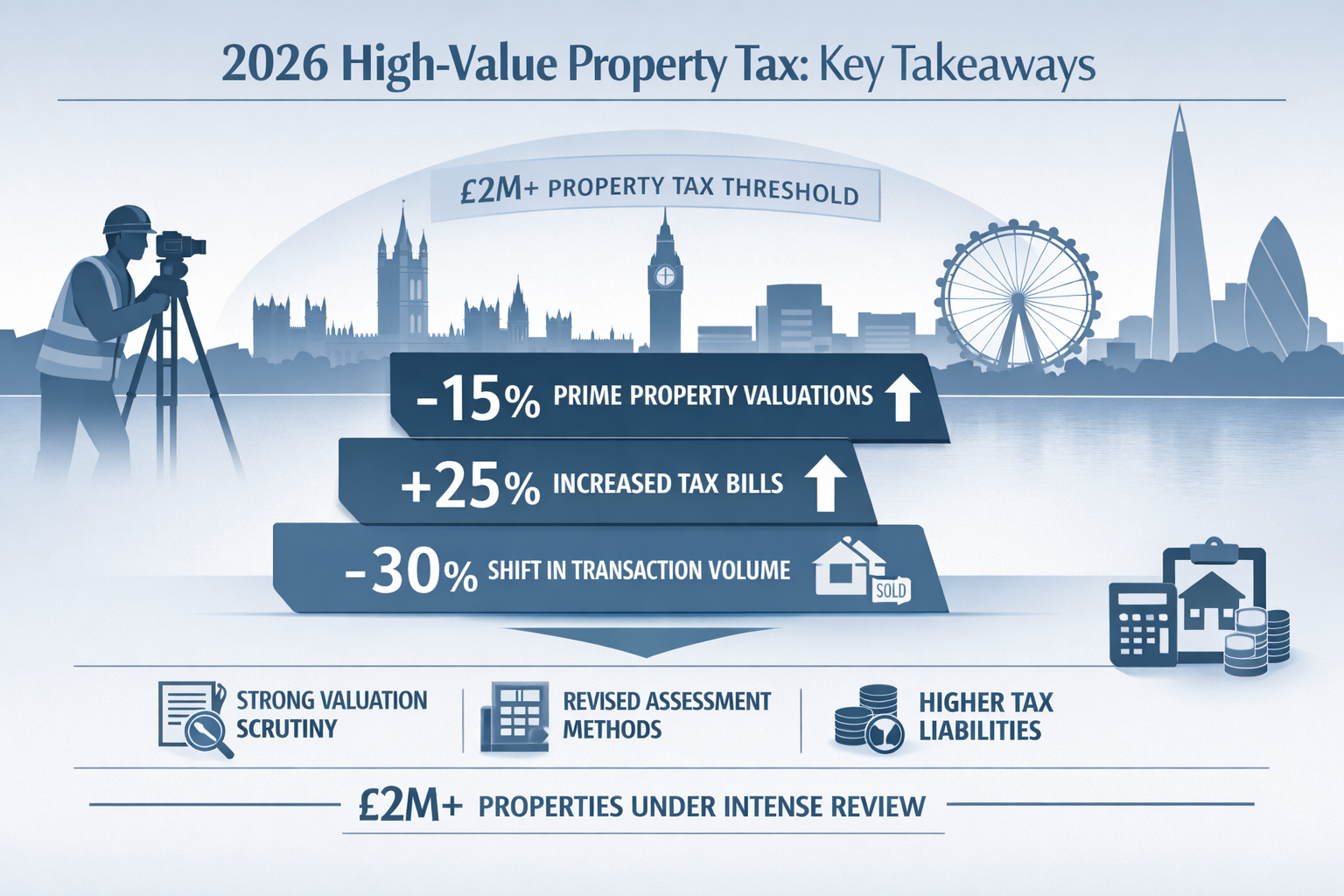
Key Takeaways
- 💷 HVCTS charges range from £2,500 to £7,500 annually for properties valued over £2 million, with valuations conducted as of 2026 and revalued every five years
- 📊 The combined tax burden jumps dramatically at the £2m threshold, increasing from 12.4% at £1.99m to 14.9% at £2m—creating a significant valuation "cliff edge"
- 📉 Prime London transactions collapsed 31% in late 2025, with prices effectively flat and many Central London areas reverting to 2013 price levels
- 🎯 The £1.5m price point represents the "sweetest spot" with combined capitalized taxes of just 11.45%, making it significantly more tax-efficient than £2m+ properties
- 🔄 Surveyors must now incorporate tax burden modeling into valuation adjustments, accounting for annual holding costs that significantly impact net property value
Understanding the 2026 High-Value Council Tax Surcharge Framework
The HVCTS represents the most significant change to property taxation in prime London markets in over a decade. Implemented following the Autumn Budget announcements, this surcharge specifically targets residential properties valued at or above £2 million, creating a new tier of annual taxation that sits alongside existing Stamp Duty Land Tax (SDLT) and standard Council Tax obligations[5].
How HVCTS Charges Are Calculated
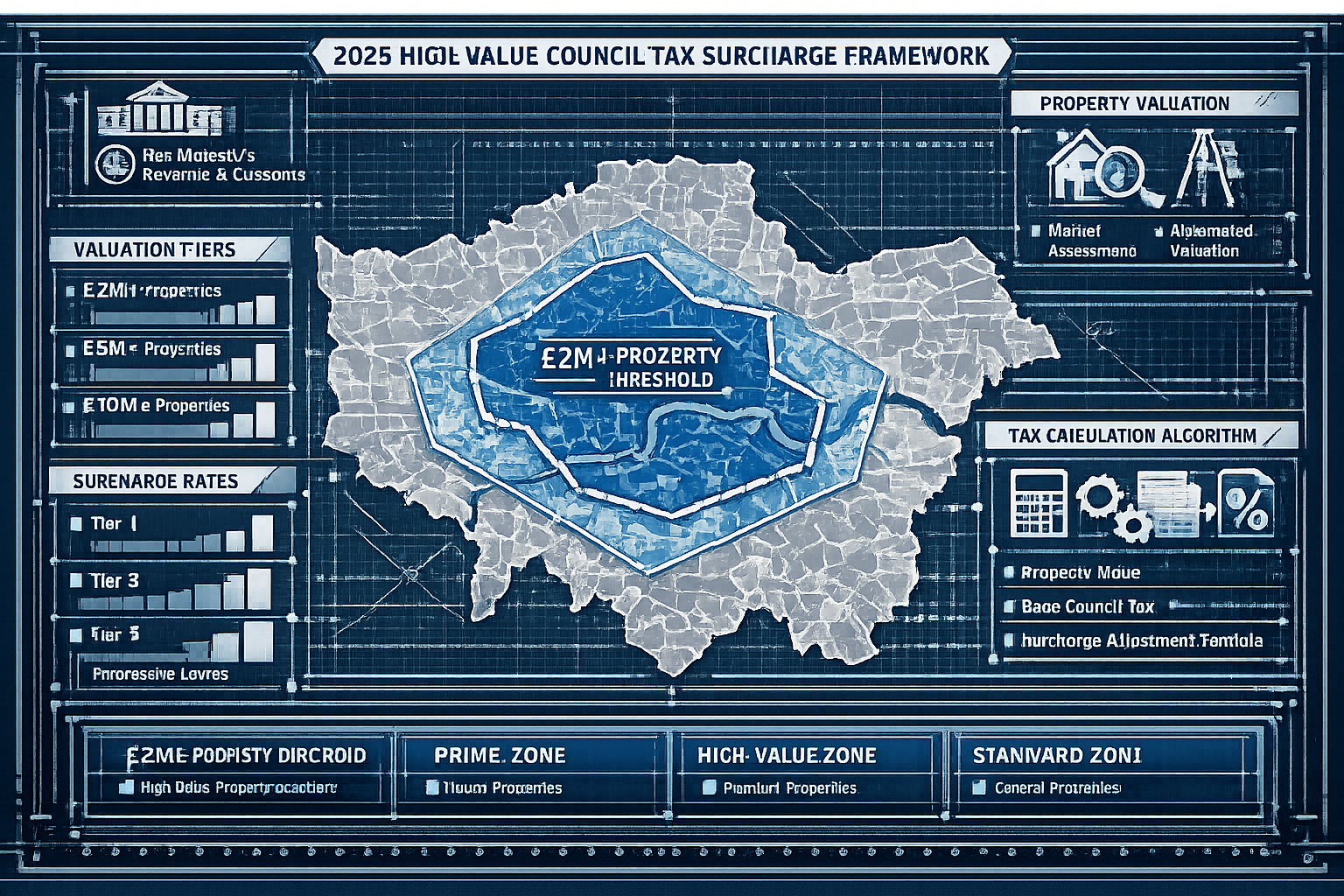
The surcharge operates on a banded structure tied directly to property valuations:
| Property Value Band | Annual HVCTS Charge |
|---|---|
| £2m – £3m | £2,500 |
| £3m – £5m | £5,000 |
| £5m+ | £7,500 |
These charges are based on Council Tax revaluations conducted as of 2026, with properties scheduled for revaluation every five years thereafter[5]. This means the initial 2026 valuation will determine HVCTS liability through 2031, making accuracy in current assessments critically important.
The £2 Million Threshold Effect
The impact of crossing the £2 million threshold cannot be overstated. Analysis shows that the combined tax burden—incorporating SDLT, Council Tax, and now HVCTS when capitalized over a typical holding period—increases from 12.4% at £1.99 million to 14.9% at £2 million[2]. This 2.5 percentage point jump is equivalent to the entire tax burden on a £600,000 property.
For surveyors conducting valuations near this threshold, the implications are profound. A property valued at £2.05 million faces significantly different tax treatment than one valued at £1.95 million, potentially affecting buyer demand, negotiating positions, and ultimate market value.
Market Impact: Transaction Volumes and Price Stagnation
The announcement and implementation of these tax changes have already sent shockwaves through the prime London market. Understanding these market dynamics is essential for surveyors making accurate valuation adjustments.
Transaction Volume Collapse
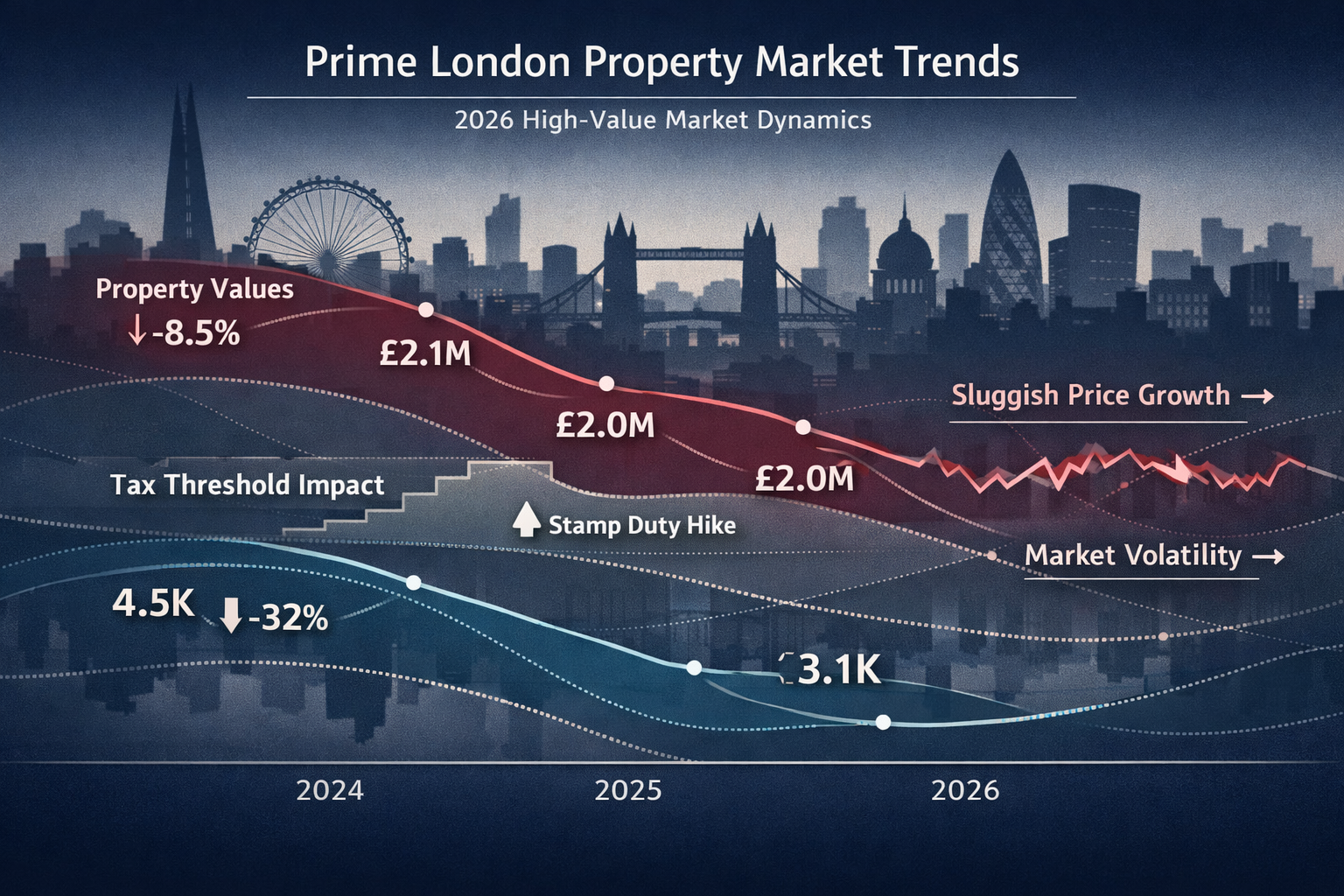
Prime London property transactions fell by a staggering 31% in the second half of 2025, with average monthly completions dropping sharply as buyers and sellers alike reacted to the announced tax changes[1]. This dramatic decline in liquidity has created significant challenges for comparable sales analysis—a cornerstone of property valuation methodology.
"Liquidity thins sharply above £1m, with the £3m-£5m range now characterized as a 'long, low plateau' in transaction activity." [2]
For chartered surveyors in West London and other prime areas, finding truly comparable recent sales has become increasingly difficult, requiring greater reliance on adjusted historical data and cross-market comparisons.
Price Performance and Market Sentiment
London prime property prices were effectively flat in Q4 2025, rising just 0.1%[4]. More concerning for valuation purposes, prices in many Central London hotspots have fallen back to 2013 levels according to Coutts' Prime Property Index[4]. This price stagnation, combined with reduced transaction volumes, creates a challenging environment for establishing current market values.
The £1.5 million price point has emerged as the market's "sweetest spot," where combined capitalized taxes amount to just 11.45% of property value[2]. This creates a natural ceiling effect, with buyers showing strong preference for properties priced below the £2 million HVCTS threshold.
Surveyor Adjustments for Valuing Prime London Properties Under 2026 High-Value Tax Fees
Professional surveyors must now incorporate sophisticated tax burden modeling into their valuation methodologies. Traditional comparable sales approaches require significant enhancement to account for the new tax landscape.
Incorporating Tax Burden into Market Value Assessments
The HVCTS creates an annual holding cost that must be factored into net present value calculations. When a property crosses the £2 million threshold, buyers face an additional £2,500 minimum annual expense that continues indefinitely. Capitalized over a typical 10-year holding period at current discount rates, this represents approximately £20,000-£22,000 in present value terms.
For chartered surveyors in Islington, Hampstead, and Richmond—areas where properties frequently cluster around the £2 million mark—this calculation becomes crucial.
Key adjustment factors include:
- Annual HVCTS charge based on relevant value band
- Typical holding period for the property type and location
- Appropriate discount rate reflecting current market conditions
- Buyer profile sensitivity to ongoing tax obligations
- Comparable properties positioned just below threshold
Threshold Proximity Adjustments
Properties valued between £1.9 million and £2.1 million require special consideration. Market evidence suggests buyers are willing to pay a premium for properties that can be legitimately valued below the £2 million threshold, while properties just above this point may trade at a discount relative to their intrinsic characteristics.
Surveyors conducting RICS Building Surveys Level 3 assessments must carefully document any factors that might influence whether a property falls above or below the threshold, including:
- 🏠 Condition issues that might reduce value
- 📐 Measurement accuracy and GIA calculations
- 🎨 Specification and finish quality relative to comparables
- 🌳 Location factors within the broader postcode area
- 📅 Market timing and recent transaction evidence
The Five-Year Revaluation Cycle
Unlike SDLT, which is a one-time transaction cost, HVCTS valuations will be refreshed every five years[5]. This creates both opportunities and risks for property owners and requires surveyors to consider future valuation trajectories.
A property valued at £1.95 million in 2026 might appreciate to £2.2 million by the 2031 revaluation, triggering HVCTS liability. Conversely, a property valued at £2.1 million today might fall below the threshold if market conditions deteriorate. These scenarios must be factored into long-term value assessments and valuation reports.
RICS Guidance and Professional Standards for £2M+ Valuations
The Royal Institution of Chartered Surveyors (RICS) has established clear frameworks for conducting valuations in complex tax environments. Adherence to these standards is non-negotiable when valuing properties affected by HVCTS.
Red Book Compliance Requirements
All formal valuations must comply with RICS Valuation – Global Standards (the "Red Book"). For properties at or near the £2 million threshold, this requires:
✅ Clear identification of valuation purpose – whether for taxation, lending, sale, or other purposes
✅ Comprehensive market analysis – including tax burden comparisons across price points
✅ Transparent assumptions – particularly regarding future tax liabilities and revaluations
✅ Appropriate comparable evidence – adjusted for tax position differences
✅ Professional skepticism – regarding valuations that conveniently fall just below thresholds
Chartered surveyors in Hammersmith, Chiswick, and Battersea must ensure their methodologies can withstand scrutiny from HMRC, lenders, and other stakeholders who may question valuations positioned strategically relative to tax thresholds.
Market Value Definition in the HVCTS Context
RICS defines market value as "the estimated amount for which an asset should exchange on the valuation date between a willing buyer and a willing seller in an arm's length transaction, after proper marketing and where the parties had each acted knowledgeably, prudently and without compulsion."
In the 2026 context, a "knowledgeable" buyer understands the full tax implications of purchasing at different price points. This means market value inherently reflects tax burden considerations—surveyors aren't artificially reducing values to account for taxes, but rather recognizing that the market itself has already made these adjustments through buyer behavior and transaction evidence.
Documentation and Audit Trail Requirements
Given the financial significance of £2 million threshold determinations, surveyors must maintain exceptional documentation standards:
- 📋 Detailed comparable analysis with tax burden calculations
- 📊 Market data supporting adjustments and threshold effects
- 🔍 Inspection notes documenting property condition and specifications
- 📸 Photographic evidence of key features affecting value
- 📝 Clear reasoning for all significant valuation judgments
This documentation becomes particularly important for valuation for probate, insurance reinstatement valuations, and other purposes where values may be challenged or reviewed.
Practical Valuation Methodologies for Properties at the Threshold
Surveyors have developed several sophisticated approaches to accurately value properties in the £1.8 million to £2.5 million range where HVCTS considerations are most acute.
Comparative Method with Tax Burden Adjustments
The traditional comparative method remains the primary valuation approach, but requires enhancement:
Step 1: Identify Comparable Sales
Select recent transactions of similar properties, noting whether each comparable falls above or below the £2 million HVCTS threshold.
Step 2: Calculate Base Value
Establish a baseline value using standard adjustments for size, condition, location, and specification.
Step 3: Apply Tax Position Adjustment
If the subject property and comparables have different tax positions relative to the threshold, apply an adjustment reflecting the capitalized value of the annual HVCTS charge difference.
Step 4: Market Evidence Verification
Cross-reference the adjusted value against broader market trends and price-per-square-foot benchmarks for the area.
Residual Value Approach for Development Properties
For properties with development potential, the residual value method must now incorporate HVCTS implications for the completed development. A luxury refurbishment that pushes a property from £1.9 million to £2.3 million creates not only construction costs but also triggers ongoing HVCTS liability that affects development viability.
Chartered surveyors in Buckinghamshire and surrounding Home Counties areas working on high-value refurbishments must factor these costs into residual calculations alongside traditional development expenses.
Investment Method for Rental Properties
For prime London properties held as investments, the investment method requires recalibration. The HVCTS reduces net annual income by £2,500 to £7,500 depending on value band, directly impacting yield calculations and capital values.
Traditional calculation:
Net Annual Income ÷ Required Yield = Capital Value
2026 adjusted calculation:
(Net Annual Income – HVCTS Charge) ÷ Required Yield = Capital Value
This adjustment can reduce capital values by £50,000 to £150,000 depending on yield requirements and HVCTS band, representing a significant impact on valuation of commercial property and high-value residential investments.
Strategic Considerations for Different Property Types
The impact of HVCTS varies significantly across different segments of the prime London market, requiring tailored valuation approaches.
Period Properties and Conservation Areas
Georgian townhouses, Victorian villas, and other period properties in areas like Camden and Clapham present unique challenges. These properties often have:
- High restoration costs that may justify values below replacement cost
- Conservation restrictions limiting development potential
- Specification variations making comparable analysis more complex
- Condition issues that can legitimately reduce values
Surveyors must carefully document these factors, as they provide defensible justification for valuations that may cluster below the £2 million threshold despite substantial property size.
New-Build and Luxury Developments
Newly constructed luxury apartments and houses face different dynamics. These properties typically have:
- ✨ Premium specifications that command higher values
- 🏗️ Warranty coverage reducing risk premiums
- 📐 Precise measurements with less valuation ambiguity
- 💰 Developer pricing that may not fully reflect tax implications
For chartered surveyors in Hounslow and other areas with significant new development, understanding how developers are pricing relative to HVCTS thresholds provides valuable market intelligence for valuation purposes.
Flats vs. Houses: Different Threshold Dynamics
The £2 million threshold affects houses and flats differently:
Houses in prime areas frequently exceed £2 million, making HVCTS an expected cost. Buyers in this segment may be less sensitive to the threshold, focusing instead on absolute property quality and location.
Flats more commonly cluster around the threshold, with buyers showing strong preference for properties priced below £2 million. This creates more pronounced threshold effects in the flat market.
Surveyors must calibrate their approaches based on property type, with specific defect reports and condition assessments playing a larger role in flat valuations near the threshold.
International Buyer Considerations and Non-Dom Changes
The prime London market has historically relied heavily on international buyers, but the 2026 tax landscape has dramatically altered this dynamic.
Extreme Tax Burdens for Overseas Purchasers
International buyers purchasing prime London properties as second homes face extraordinary tax burdens. Analysis shows that a £5 million second-home purchase currently incurs approximately £900,000 in total government taxes[3], creating significant downward pressure on values in the ultra-prime segment.
This tax burden includes:
- 💷 SDLT surcharges for additional properties
- 🌍 Non-resident surcharges on stamp duty
- 🏛️ HVCTS annual charges at the £7,500 maximum rate
- 📊 Annual Tax on Enveloped Dwellings (ATED) for corporate ownership structures
For chartered surveyors in Barnes, Twickenham, and other areas popular with international buyers, understanding these combined tax effects is essential for accurate market value assessments.
Non-Dom Rule Changes Impact
Changes to non-domiciled tax status rules have removed many of the tax advantages that previously made UK property ownership attractive to international wealthy individuals[1]. This has contributed to the 31% transaction volume decline and requires surveyors to adjust their market analysis to reflect a buyer pool that is now more domestically focused.
Future-Proofing Valuations: The 2031 Revaluation Horizon
Professional surveyors must look beyond immediate 2026 valuations to consider the five-year revaluation cycle and its implications.
Anticipating Market Movements
Properties valued at £1.85 million to £1.95 million in 2026 sit in a precarious position. Even modest appreciation of 2-3% annually would push these properties above the HVCTS threshold by 2031. Conversely, properties at £2.05 million to £2.15 million might fall below the threshold if market conditions remain flat or decline.
This creates a "valuation buffer zone" where long-term tax liability remains uncertain. Surveyors should note this uncertainty in valuation reports, particularly for:
- 📄 Lease extension valuations
- 🏛️ Collective enfranchisement assessments
- 💰 Long-term investment analyses
- 🏠 Right to buy valuations
Political Risk and Policy Reversal Potential
Conservative leader Kemi Badenoch has committed to scrapping Stamp Duty to boost home ownership and revive the housing market[3]. While HVCTS is distinct from SDLT, this political commitment indicates potential policy reversal should there be a change in government.
Surveyors operating in areas like Bromley, Bexley, and South East London should consider how policy uncertainty affects long-term value projections, particularly for properties being valued for probate or long-term holding purposes.
Building in Flexibility and Contingency
Best practice for 2026 valuations includes:
- 🔄 Scenario analysis showing values under different tax policy assumptions
- 📊 Sensitivity testing for properties near thresholds
- 📝 Clear caveats regarding future revaluation risks
- 🎯 Range valuations where appropriate rather than single-point estimates
This approach provides clients with a more complete understanding of value uncertainty while maintaining professional standards and RICS compliance.
Technology and Data Analytics in Modern Prime Property Valuation
The complexity of valuing prime London properties under 2026 high-value tax fees has accelerated adoption of advanced technology and data analytics tools.
Automated Valuation Models (AVMs) and Their Limitations
AVMs have become increasingly sophisticated, incorporating tax burden calculations and threshold effects. However, they remain limited for prime properties where:
- 🎨 Specification quality varies dramatically
- 🏛️ Period features and architectural merit affect value
- 📍 Micro-location differences create value variations
- 🔨 Condition factors require expert assessment
Professional surveyors must use AVMs as one data point among many, never as a substitute for detailed inspection and analysis, particularly for properties requiring structural surveys or dilapidation surveys.
Big Data and Comparable Analysis
Modern valuation platforms now aggregate transaction data with tax burden calculations, providing surveyors with powerful analytical tools. These systems can:
- 📈 Identify transaction patterns around tax thresholds
- 🔍 Filter comparables by tax position
- 💹 Calculate tax-adjusted price-per-square-foot benchmarks
- 📊 Generate heat maps showing value concentrations
Surveyors working across multiple London boroughs can leverage these tools to maintain consistent methodology while adapting to local market conditions in areas from Harrow to Kilburn.
Blockchain and Property Valuation Transparency
Emerging blockchain-based property registries promise greater transparency in transaction data, potentially improving comparable evidence quality. While still in early stages, these technologies may help address the liquidity challenges that make current prime market valuations more difficult.
Practical Steps for Property Owners and Investors
For property owners and investors navigating the 2026 tax landscape, understanding how valuations are conducted provides strategic advantages.
Commissioning Pre-Sale Valuations
Before listing a property near the £2 million threshold, commissioning an independent RICS valuation provides clarity on:
- ✅ Realistic market positioning
- 💰 Tax burden implications for potential buyers
- 🎯 Optimal pricing strategy
- 📋 Documentation supporting the valuation
This investment typically costs £500-£1,500 but can prevent costly mispricing that extends time on market or leaves money on the table.
Challenging HVCTS Valuations
Property owners who believe their property has been overvalued for HVCTS purposes have appeal rights. Success requires:
- 📊 Professional valuation evidence from qualified surveyors
- 🏠 Comparable sales data supporting a lower value
- 🔍 Documentation of defects or condition issues
- 📸 Photographic evidence supporting valuation arguments
Engaging chartered surveyors experienced in tax valuation appeals significantly improves success rates.
Strategic Timing for Transactions
The five-year revaluation cycle creates strategic timing considerations:
- Selling before 2031 revaluation may be advantageous for properties likely to appreciate above the next HVCTS band
- Purchasing after revaluation provides certainty on tax liability for the next five-year period
- Renovation timing should consider impact on 2031 revaluation if improvements push value across thresholds
Conclusion
Valuing prime London properties under 2026 high-value tax fees represents one of the most significant challenges facing property professionals today. The introduction of HVCTS, combined with existing stamp duty burdens and market uncertainty, has created a complex valuation environment where traditional methodologies require substantial enhancement.
The £2 million threshold has emerged as a critical inflection point, creating a "cliff edge" effect where tax burdens jump by 2.5 percentage points—equivalent to the entire tax burden on a £600,000 property. This has driven transaction volumes down 31% and created strong buyer preference for properties priced below the threshold, fundamentally altering market dynamics.
Professional surveyors must now incorporate sophisticated tax burden modeling into their valuations, maintain exceptional documentation standards, and navigate reduced comparable evidence due to market liquidity challenges. RICS compliance remains non-negotiable, requiring transparent assumptions, comprehensive market analysis, and professional skepticism regarding valuations positioned strategically relative to tax thresholds.
Actionable Next Steps
For Property Owners:
- 📞 Commission an independent RICS valuation if your property is valued near £2 million
- 📋 Gather documentation supporting your property's condition and any factors reducing value
- 🎯 Consider strategic timing for sales or improvements relative to the 2031 revaluation cycle
For Property Investors:
- 💰 Recalculate investment yields incorporating HVCTS charges into annual costs
- 🔍 Focus acquisition strategies on the £1.5 million "sweet spot" where tax efficiency is optimal
- 📊 Model multiple scenarios including potential policy changes under future governments
For Property Professionals:
- 🎓 Ensure your valuation methodologies fully incorporate HVCTS considerations
- 📚 Maintain detailed documentation and audit trails for all valuations near thresholds
- 🔄 Stay current with RICS guidance and market data as this landscape continues evolving
The prime London property market will continue adapting to these new realities throughout 2026 and beyond. Those who understand the intricacies of valuing properties under high-value tax fees—and who work with qualified professionals to navigate these complexities—will be best positioned to make informed decisions in this transformed market landscape.
For expert assistance with property valuations in the current tax environment, consider getting a quote from experienced RICS chartered surveyors who understand the nuances of valuing prime London properties under 2026's challenging conditions.
References
[1] Prime London Transactions Fall 31 As Tax Changes And Non Dom Rules Bite – https://landlordknowledge.co.uk/prime-london-transactions-fall-31-as-tax-changes-and-non-dom-rules-bite/
[2] Market Insights 2026 Property Tax Value Prime Uk – https://middletonadvisors.com/2026/03/24/market-insights-2026-property-tax-value-prime-uk/
[3] March 2026 – https://www.black-brick.com/insights/market-update/march-2026/
[4] London Prime Property Market Poised For Renewed Momentum In 2026 – https://www.paminsight.com/epc/article/london-prime-property-market-poised-for-renewed-momentum-in-2026
[5] 102lwl4 Autumn Budget Impact On The Prime And Super Prime Property Market – https://www.charlesrussellspeechlys.com/en/insights/quick-reads/102lwl4-autumn-budget-impact-on-the-prime-and-super-prime-property-market/