
Surrey's property market stands at a pivotal moment in 2026. With undersupply constraining inventory, exceptional school catchments attracting families, and robust rail connections to London creating unprecedented demand, the county is positioned to outperform the capital's property market. For prospective buyers seeking family homes in commuter hotspots like Guildford, Woking, and Reigate, understanding Building Surveys for Surrey's 2026 Outperformance: RICS Protocols for Family Housing in Commuter Hotspots has become essential to unlocking hidden value and avoiding costly surprises.
Regional forecasts project 2-4% growth across Surrey's residential market, driven by families prioritizing space, quality schools, and manageable commutes. However, this competitive environment demands rigorous due diligence. RICS-compliant building surveys provide the professional assessment framework necessary to identify structural issues, negotiate pricing, and make informed investment decisions in this high-stakes market.
Key Takeaways
- 🏠 Surrey's market fundamentals include undersupply, top-rated schools, and excellent rail connectivity, positioning the region for 2-4% growth in 2026
- 📋 RICS Level 3 surveys offer comprehensive inspection protocols specifically suited to Surrey's diverse housing stock, from Victorian terraces to modern family homes
- 🔍 Tailored inspection checklists for commuter properties must address drainage, roof structures, thermal efficiency, and transport-related wear patterns
- 💰 Professional surveys unlock negotiating power by identifying defects that can reduce purchase prices by 5-15% in competitive markets
- ⚖️ RICS protocols ensure standardized quality, providing buyers with defensible professional opinions when making six-figure family housing investments
Understanding Surrey's 2026 Property Market Dynamics
Surrey's position as a commuter haven has intensified throughout 2026, with fundamental supply-demand imbalances creating opportunities for informed buyers. The county's proximity to London, combined with hybrid working patterns that permit flexible commuting schedules, has sustained strong demand for family-sized properties.
The Undersupply Challenge
Housing stock in desirable Surrey postcodes remains constrained, with planning restrictions and Green Belt protections limiting new development. This scarcity has created a seller's market in many areas, making thorough property assessment even more critical. Buyers competing for limited inventory cannot afford to overlook structural issues that could compromise long-term value.
School Catchment Premium
Surrey boasts some of England's highest-performing state and independent schools. Properties within catchment areas for Outstanding-rated schools command significant premiums, often 15-25% above comparable homes outside these zones. This premium makes comprehensive building surveys essential—overpaying for a property with hidden defects in a premium catchment area compounds financial risk.
Rail Connectivity Value
Commuter towns with direct services to London Waterloo, Victoria, and London Bridge have seen sustained demand. Properties within walking distance of stations in Guildford, Woking, Weybridge, and Reigate maintain premium valuations. However, proximity to rail infrastructure can introduce specific property challenges—vibration damage, noise insulation requirements, and accelerated wear on building components—that require specialized survey attention.
RICS Survey Levels: Choosing the Right Protocol for Surrey Family Homes
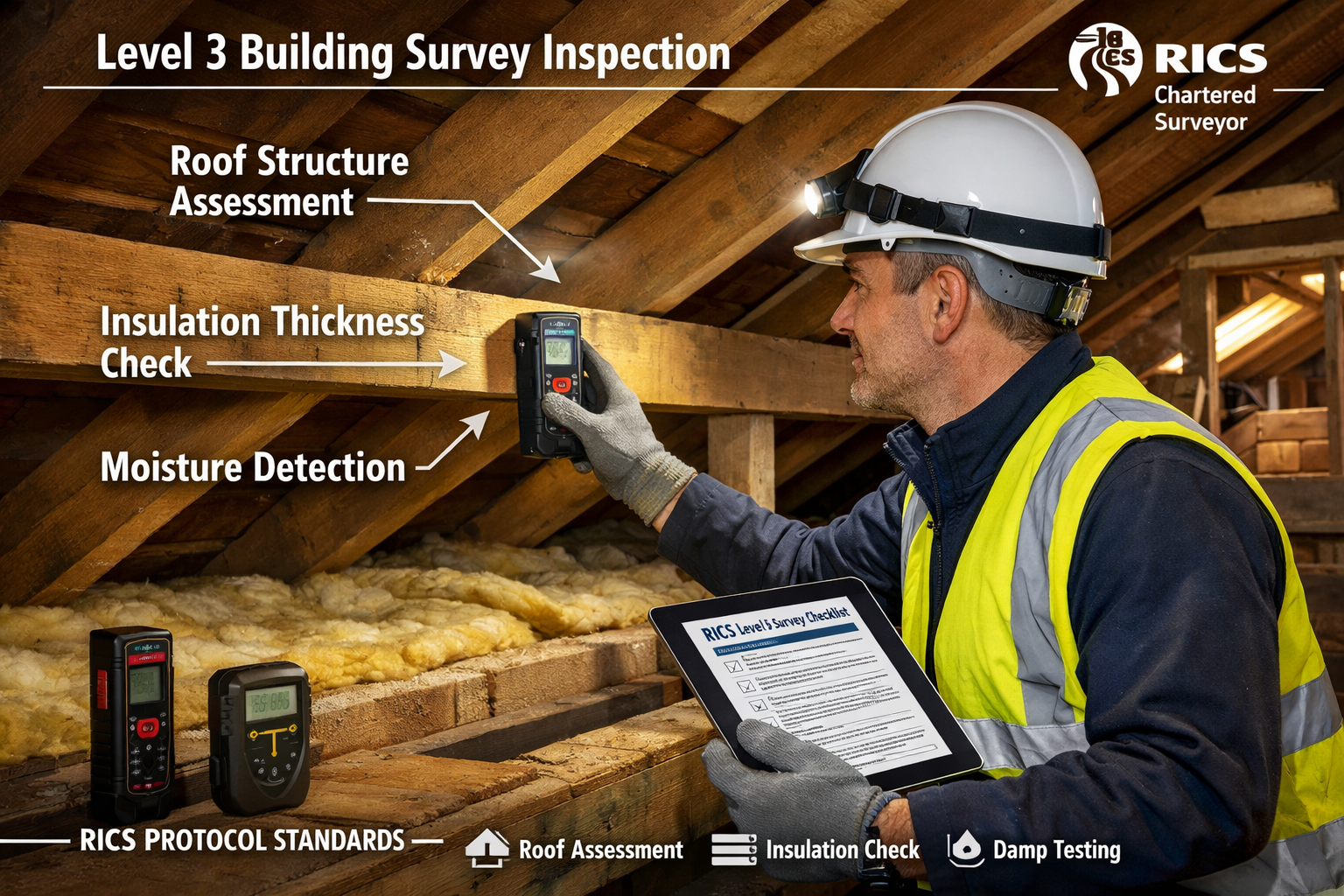
The Royal Institution of Chartered Surveyors (RICS) provides three standardized survey levels, each tailored to different property types and client needs[1]. For Surrey's family housing market, understanding these distinctions determines the quality of information available for purchase decisions.
Level 1: RICS Condition Report
This basic survey suits newer properties (typically less than 15 years old) in good condition. For Surrey's predominantly Victorian, Edwardian, and inter-war housing stock, Level 1 surveys rarely provide sufficient detail. These reports offer traffic-light condition ratings but lack the comprehensive analysis required for older family homes.
When appropriate:
- Modern new-build properties in developments
- Properties under 10 years old with NHBC warranties
- Low-risk purchases where minimal inspection depth suffices
Level 2: RICS HomeBuyer Report
The Level 2 HomeBuyer Survey represents the middle tier, suitable for conventional properties in reasonable condition. This survey includes:
- Visual inspection of accessible areas
- Condition ratings for major elements
- Identification of urgent defects
- Advice on necessary repairs
For many Surrey family homes built between 1920-1980 in standard construction, Level 2 surveys provide adequate coverage. However, properties with extensions, conversions, or visible defects warrant more comprehensive assessment.
Level 3: Building Survey (Comprehensive)
The Level 3 Building Survey delivers the most thorough examination, making it the preferred choice for Surrey's diverse housing stock[1]. This comprehensive protocol is essential for:
- Victorian and Edwardian properties (pre-1919)
- Properties with extensions or alterations
- Homes in need of renovation
- Unusual construction types
- Properties over £500,000 where investment protection justifies detailed analysis
Level 3 surveys include thorough inspection of roof spaces, with surveyors entering the roof space to visually inspect roof structure, examining thermal insulation thickness and type, and repositioning lightweight possessions for more thorough access where safe and permitted[5]. This level of detail proves invaluable in Surrey's competitive market, where understanding true property condition informs negotiation strategy.
Building Surveys for Surrey's 2026 Outperformance: Tailored Inspection Checklists

Applying RICS protocols effectively in Surrey's commuter hotspots requires tailored inspection priorities that address regional housing characteristics and market-specific concerns. Professional chartered surveyors in Surrey adapt standard frameworks to local conditions.
Roof Structure and Insulation Assessment
Surrey's housing stock includes significant proportions of properties with original roof structures requiring careful evaluation. Level 3 surveys mandate entering roof spaces to conduct visual inspection of roof structure, examining thermal insulation thickness and type[5]. For family homes in commuter areas, specific considerations include:
Victorian and Edwardian properties:
- Original slate or tile condition and remaining lifespan
- Timber roof structure integrity (checking for woodworm, rot, or structural movement)
- Inadequate insulation requiring upgrading for energy efficiency
- Lead valley gutters and flashings requiring specialist assessment
1930s-1970s family homes:
- Concrete tile condition and potential for delamination
- Purlin and rafter condition in larger roof spans
- Insulation adequacy against current Building Regulations (minimum 270mm)
- Roof space conversions and their compliance with Building Regulations
Professional roof surveys can provide additional specialist assessment when significant concerns arise during initial building survey inspection.
Window and Door Operation Testing
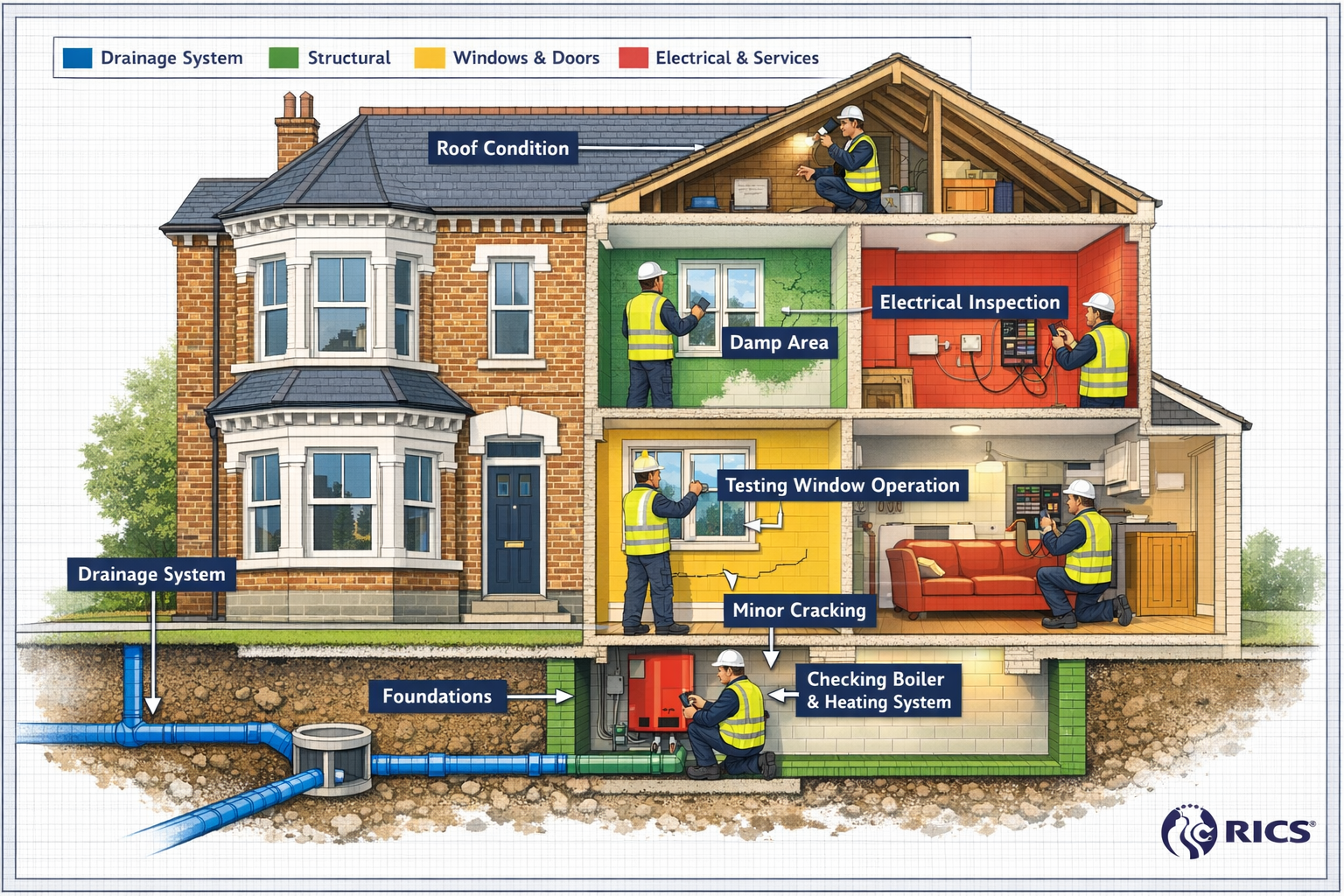
RICS Level 3 protocols require attempting to open all windows where possible, with surveyors documenting any restrictions to client inspection[5]. In Surrey's period properties, this reveals critical information:
- Sash window condition: Original sash windows in Victorian properties often require complete overhaul, costing £800-1,500 per window
- Timber casement deterioration: Rot in lower sills and frames, particularly on north-facing elevations
- Double glazing failures: Sealed unit failures in 1980s-1990s installations requiring replacement
- Security and safety: Inadequate locking mechanisms and safety catches, particularly important for family homes
For commuter properties, window condition directly impacts energy efficiency and running costs—a consideration for families managing mortgage payments alongside season ticket expenses.
Drainage System Inspection
Drainage inspection constitutes a key Level 3 component, with surveyors lifting accessible inspection chamber covers to drains and septic tanks (where safe) and observing drain operation in everyday use[5]. Surrey's clay soils and mature tree populations create specific drainage vulnerabilities:
Common drainage issues in Surrey properties:
- Tree root ingress into clay drainage pipes
- Settlement and cracking in older clay pipe systems
- Inadequate surface water drainage causing damp issues
- Combined drainage systems requiring separation under current regulations
- Soakaway failures in clay soil conditions
Properties with persistent drainage problems can require £5,000-15,000 remediation, making thorough inspection essential. When significant concerns arise, specialist drainage surveys using CCTV camera inspection provide definitive assessment.
Structural Movement and Settlement
Surrey's London Clay geology creates specific settlement patterns that experienced surveyors recognize. Family homes on clay soils exhibit characteristic movement, particularly during drought periods followed by wet seasons. Key inspection points include:
- Crack patterns: Distinguishing settlement cracks from thermal movement
- Door and window alignment: Evidence of progressive structural movement
- External wall bulging: Particularly in Victorian solid wall construction
- Foundation adequacy: Older properties often have shallow foundations vulnerable to clay heave
Understanding whether movement is historic and stabilized versus progressive and ongoing determines whether properties require costly underpinning (£15,000-50,000+). Professional structural surveys and monitoring can provide definitive assessment when initial building surveys identify concerns.
Damp and Moisture Penetration
Surrey's climate and older housing stock create multiple damp risk factors requiring systematic assessment:
Rising damp:
- Failed or absent damp-proof courses in pre-1920s properties
- Bridged damp-proof courses from raised external ground levels
- Inadequate sub-floor ventilation in suspended timber floors
Penetrating damp:
- Defective rainwater goods (gutters and downpipes)
- Failed render and external wall coatings
- Inadequate cavity wall tie condition in 1930s-1960s properties
Condensation and ventilation:
- Inadequate ventilation in bathrooms and kitchens
- Single-glazed windows creating cold surfaces
- Insufficient background ventilation in sealed properties
Damp issues can indicate underlying structural problems or simply require targeted remediation costing £2,000-8,000. Accurate diagnosis through comprehensive survey prevents expensive misdiagnosis.
RICS Protocols for Commuter Property-Specific Concerns
Properties in Surrey's commuter hotspots face unique stresses and considerations that standard survey protocols must address with local expertise.
Transport Infrastructure Impact
Homes within 100-200 meters of railway lines require specific assessment:
- Vibration damage: Checking for progressive cracking related to train movements
- Noise insulation: Assessing adequacy of sound insulation measures
- Foundation stability: Evaluating whether vibration has affected structural integrity
- Future infrastructure changes: Considering planned railway improvements or electrification
Properties significantly affected by transport infrastructure may require specialist vibration monitoring or acoustic assessment beyond standard building surveys.
Extension and Conversion Quality
Surrey family homes frequently feature extensions and loft conversions to maximize space. RICS surveys must verify:
- Building Regulations compliance: Whether extensions have proper approvals and certificates
- Structural adequacy: Quality of foundations, wall ties, and roof structures
- Thermal performance: Insulation standards and energy efficiency
- Integration quality: How well extensions integrate with original structures
Unauthorized or substandard extensions can affect property values by 10-20% and create future sale complications. Comprehensive surveys identify these issues before exchange of contracts.
Energy Efficiency and Running Costs
For families managing significant commuting costs, property running expenses matter. Building surveys should assess:
- EPC ratings: Current energy performance and improvement potential
- Heating system condition: Boiler age, efficiency, and replacement timelines
- Insulation standards: Roof, wall, and floor insulation adequacy
- Window efficiency: Single versus double glazing and upgrade requirements
Properties with poor energy efficiency may require £10,000-25,000 investment to achieve modern standards—information that informs purchase negotiations.
Interpreting Survey Results: Negotiation Strategies for Surrey's Market
Professional building surveys provide powerful negotiation tools in competitive markets. Understanding how to interpret and leverage survey findings maximizes value.
Categorizing Defects by Urgency and Cost
Effective negotiation requires categorizing identified defects:
Category 1: Urgent repairs (immediate safety risks)
- Structural instability requiring emergency shoring
- Dangerous electrical installations
- Major roof failures causing water ingress
- Immediate fire safety hazards
Category 2: Significant repairs (essential within 12 months)
- Roof recovering requirements (£8,000-15,000)
- Damp-proof course renewal (£3,000-8,000)
- Window replacement programs (£10,000-25,000)
- Heating system replacement (£3,000-6,000)
Category 3: Future maintenance (2-5 year timeline)
- External redecoration (£4,000-8,000)
- Minor drainage repairs (£1,000-3,000)
- Gutter and downpipe replacement (£1,500-3,000)
Negotiation Approaches in Competitive Markets
Surrey's supply-constrained market limits negotiation leverage, requiring strategic approaches:
Price reduction requests:
- Focus on Category 1 and 2 defects with quantified repair costs
- Request reductions of 50-70% of estimated repair costs (recognizing buyer inconvenience)
- Present professional survey reports as objective evidence
Retention strategies:
- Negotiate retention of funds in solicitor accounts pending repairs
- Particularly effective for urgent defects sellers agree to remedy
Conditional offers:
- Make offers conditional on specific repairs being completed pre-completion
- Suitable for smaller defects where seller cooperation is likely
Walking away:
- Some properties with extensive defects exceed acceptable risk thresholds
- Survey information prevents expensive mistakes in emotional purchase decisions
Selecting RICS Chartered Surveyors for Surrey Properties
The quality of building survey depends entirely on surveyor expertise and local knowledge. Selecting appropriately qualified professionals ensures reliable assessment.
RICS Accreditation Requirements
Always engage RICS chartered surveyors who maintain:
- Full RICS membership (MRICS or FRICS designation)
- Professional indemnity insurance (minimum £1 million coverage)
- Continuing Professional Development (CPD) compliance
- Complaints handling procedures through RICS framework
RICS accreditation ensures surveyors follow standardized protocols and maintain professional standards[1]. Understanding why to choose an RICS chartered building surveyor provides additional context on professional qualifications.
Local Surrey Market Knowledge
Beyond qualifications, effective surveyors possess:
- Regional construction familiarity: Understanding Surrey's typical building methods and materials
- Local geology awareness: Recognizing clay soil behavior and settlement patterns
- Market context: Appreciating property values and typical defect costs
- Specialist networks: Access to structural engineers, damp specialists, and drainage contractors for follow-up investigations
Survey Pricing and Value
Building survey costs typically range £600-1,500 for Surrey family homes, varying by property size and complexity. While survey pricing represents a significant upfront expense, the investment provides:
- Risk mitigation: Avoiding properties with £20,000+ hidden defect costs
- Negotiation leverage: Achieving price reductions of 5-15% on defective properties
- Purchase confidence: Making informed decisions on six-figure investments
- Future planning: Understanding maintenance requirements and timelines
Comparing different types of survey helps determine which level provides appropriate coverage for specific properties.
Additional Specialist Surveys for Complex Properties
Some Surrey family homes require specialist assessments beyond standard building surveys to fully evaluate condition and compliance.
Asbestos Surveys
Properties built or refurbished between 1950-1999 may contain asbestos materials. Asbestos surveys identify:
- Asbestos insulating board in ceiling and partition walls
- Asbestos cement roofing and soffits
- Textured coatings (Artex) containing asbestos fibers
- Pipe lagging and boiler insulation
Management or refurbishment asbestos surveys cost £200-500 but prevent dangerous exposure and legal liabilities.
Specific Defect Reports
When building surveys identify particular concerns requiring detailed investigation, specific defect reports provide targeted assessment:
- Structural movement requiring monitoring or engineering analysis
- Complex damp issues needing specialist diagnosis
- Timber defects requiring detailed inspection and treatment specification
- Building services failures requiring mechanical/electrical specialist input
Boundary Surveys
Surrey properties with unclear boundaries or potential disputes benefit from boundary surveys establishing:
- Legal boundary positions from title deeds
- Physical boundary conditions and encroachments
- Rights of way and access arrangements
- Potential boundary dispute risks
Boundary clarity matters particularly in high-value Surrey markets where garden size significantly affects property values.
Integrating Survey Findings with Purchase Decisions
Professional building surveys provide information—buyers must integrate findings into holistic purchase decisions considering market conditions, personal circumstances, and long-term plans.
Risk Assessment Framework
Evaluate survey findings against personal risk tolerance:
Low-risk properties:
- Minor defects totaling under £5,000
- Well-maintained with regular upgrades
- Standard construction with no unusual features
- Suitable for risk-averse buyers or those with limited renovation budgets
Medium-risk properties:
- Significant defects totaling £10,000-25,000
- Deferred maintenance requiring systematic attention
- Some non-standard features requiring specialist work
- Suitable for buyers with contingency budgets and project management capability
High-risk properties:
- Major defects exceeding £30,000
- Structural issues requiring engineering intervention
- Extensive non-compliance with Building Regulations
- Suitable only for experienced renovators with substantial budgets
Long-Term Value Considerations
Surrey's 2026 market dynamics favor properties with:
- Improvement potential: Homes where addressing defects adds value exceeding repair costs
- School catchment positions: Properties within Outstanding-rated school zones
- Transport accessibility: Walking distance to stations with direct London services
- Garden space: Family homes with gardens commanding premiums in post-pandemic market
Properties with significant defects but excellent fundamentals may represent better value than pristine homes in less desirable locations.
Financial Planning Integration
Survey findings inform comprehensive financial planning:
Immediate costs:
- Purchase price adjustments based on defects
- Essential repairs required pre-occupation
- Professional fees for follow-up investigations
Short-term costs (Year 1-2):
- Significant repairs identified in survey
- Compliance work for Building Regulations
- Energy efficiency improvements
Medium-term costs (Years 3-5):
- Planned maintenance from survey recommendations
- Systematic upgrades and improvements
- Contingency for unexpected issues
Integrating survey findings with mortgage capacity and savings ensures sustainable homeownership without financial stress.
Future-Proofing Surrey Family Homes: Beyond Initial Surveys
Building surveys provide snapshots of property condition at purchase. Forward-thinking buyers consider future requirements and regulatory changes.
Building Regulations Evolution
The 7th edition of the RICS Code of Measuring Practice is scheduled for 2026 release with Q1 consultation planned, providing updated guidance for property measurement standards[2]. Ongoing regulatory evolution affects:
- Energy efficiency requirements: Future EPC minimum standards for residential properties
- Fire safety regulations: Enhanced requirements following building safety legislation
- Accessibility standards: Evolving requirements for adaptable housing
- Climate resilience: Flood risk, overheating, and sustainable drainage requirements
Properties requiring extensive upgrading to meet future standards may face value challenges, making current compliance assessment important.
Climate Adaptation Considerations
Surrey's climate risks require forward-looking assessment:
- Flood risk: Properties in flood zones requiring resilience measures
- Overheating risk: South-facing properties with inadequate ventilation
- Drought impact: Clay soil properties vulnerable to subsidence during dry periods
- Extreme weather: Roof and drainage capacity for intense rainfall events
Building surveys should note climate vulnerabilities and potential adaptation requirements.
Maintenance Planning
Professional surveys provide maintenance roadmaps for 5-10 year planning:
- Roof life expectancy: Planning for recovering or replacement
- External decoration cycles: Budgeting for 5-7 year redecoration
- Heating system replacement: Anticipating boiler replacement timelines
- Window and door replacement: Planning systematic upgrade programs
Systematic maintenance preserves property values and prevents emergency repair costs.
Conclusion: Maximizing Value Through Professional Survey Protocols
Surrey's 2026 property market offers significant opportunities for families seeking quality homes with excellent schools and London connectivity. However, competitive conditions and 2-4% growth forecasts create environments where informed decision-making separates successful purchases from expensive mistakes.
Building Surveys for Surrey's 2026 Outperformance: RICS Protocols for Family Housing in Commuter Hotspots provide the professional assessment framework necessary to navigate this complex market. RICS-standardized survey levels—particularly comprehensive Level 3 building surveys—deliver detailed property condition information that informs negotiation, financial planning, and long-term value assessment.
Actionable Next Steps
For prospective buyers in Surrey's commuter hotspots:
- Determine appropriate survey level based on property age, type, and condition—Level 3 surveys suit most pre-1980s family homes
- Engage RICS chartered surveyors with Surrey market experience and local construction knowledge
- Budget appropriately for survey costs (£600-1,500) and potential follow-up specialist investigations
- Review survey reports thoroughly with surveyors, asking questions about significant defects and repair priorities
- Integrate findings into negotiations with quantified repair costs and strategic price reduction requests
- Plan long-term maintenance using survey recommendations to budget for future property care
- Consider specialist surveys for complex properties with asbestos risks, boundary issues, or structural concerns
The RICS Governing Council's prioritization of engagement with the next generation of Chartered Surveyors[3] ensures continued professional standards evolution, maintaining survey quality and reliability for property buyers.
In Surrey's competitive 2026 market, professional building surveys represent essential due diligence—not optional extras. The investment in comprehensive RICS-compliant assessment protects six-figure purchase decisions, unlocks negotiation value, and provides confidence in family housing investments positioned to benefit from regional outperformance. By following established protocols and engaging qualified professionals, buyers can navigate Surrey's commuter hotspots with clarity, securing properties that deliver both immediate family needs and long-term value appreciation.
References
[1] Building Survey Protocols For New Build Properties In 2026 Spotting Defects Amid 2 5 Price Growth Forecasts – https://nottinghillsurveyors.com/blog/building-survey-protocols-for-new-build-properties-in-2026-spotting-defects-amid-2-5-price-growth-forecasts
[2] Building Survey Protocols For Uk Office To Residential Conversions Rics Standards Amid 2026 Urban Recovery – https://nottinghillsurveyors.com/blog/building-survey-protocols-for-uk-office-to-residential-conversions-rics-standards-amid-2026-urban-recovery
[3] Summary Of The Governing Council Meeting 22 23 January 2026 – https://www.rics.org/news-insights/summary-of-the-governing-council-meeting-22-23-january-2026
[5] Scope Of Inspection Home Survey Level Three – https://www.rics.org/profession-standards/rics-standards-and-guidance/sector-standards/building-surveying-standards/home-surveys/scope-of-inspection-home-survey-level-three