
The property investment landscape is experiencing a seismic shift as capital flows north. While southern markets stagnate under pricing pressure and economic uncertainty, Manchester and Liverpool are emerging as the UK's most dynamic urban renewal zones. With over £14 billion in combined regeneration projects launching throughout 2026, property professionals face an unprecedented opportunity to capture exceptional yields—but only if they deploy the right valuation strategies.
Understanding Valuation Strategies for 2026 Northern Renewal Projects: Capturing Yields in Manchester and Liverpool Booms is no longer optional for surveyors, investors, and developers seeking to capitalize on this northern renaissance. The question isn't whether these cities will deliver returns, but rather how to accurately assess value in rapidly transforming markets where traditional comparables may not exist.
Key Takeaways
- 🏗️ Manchester and Liverpool are deploying over £14 billion in regeneration projects throughout 2026, creating high-yield opportunities that outpace southern markets
- 📊 RICS Red Book valuation methodologies provide essential frameworks for assessing properties in emerging renewal zones where traditional comparables are limited
- 🎯 Strategic valuation approaches must account for infrastructure improvements, planning policy changes, and phased development timelines to capture true investment potential
- 💰 Rental yields in northern renewal districts are exceeding 6-8% compared to 3-4% in established southern markets, but require specialized assessment techniques
- ⚡ Early-stage valuation expertise creates competitive advantages for investors entering regeneration zones before price discovery peaks
Understanding the Northern Renewal Landscape in 2026
The Scale of Transformation
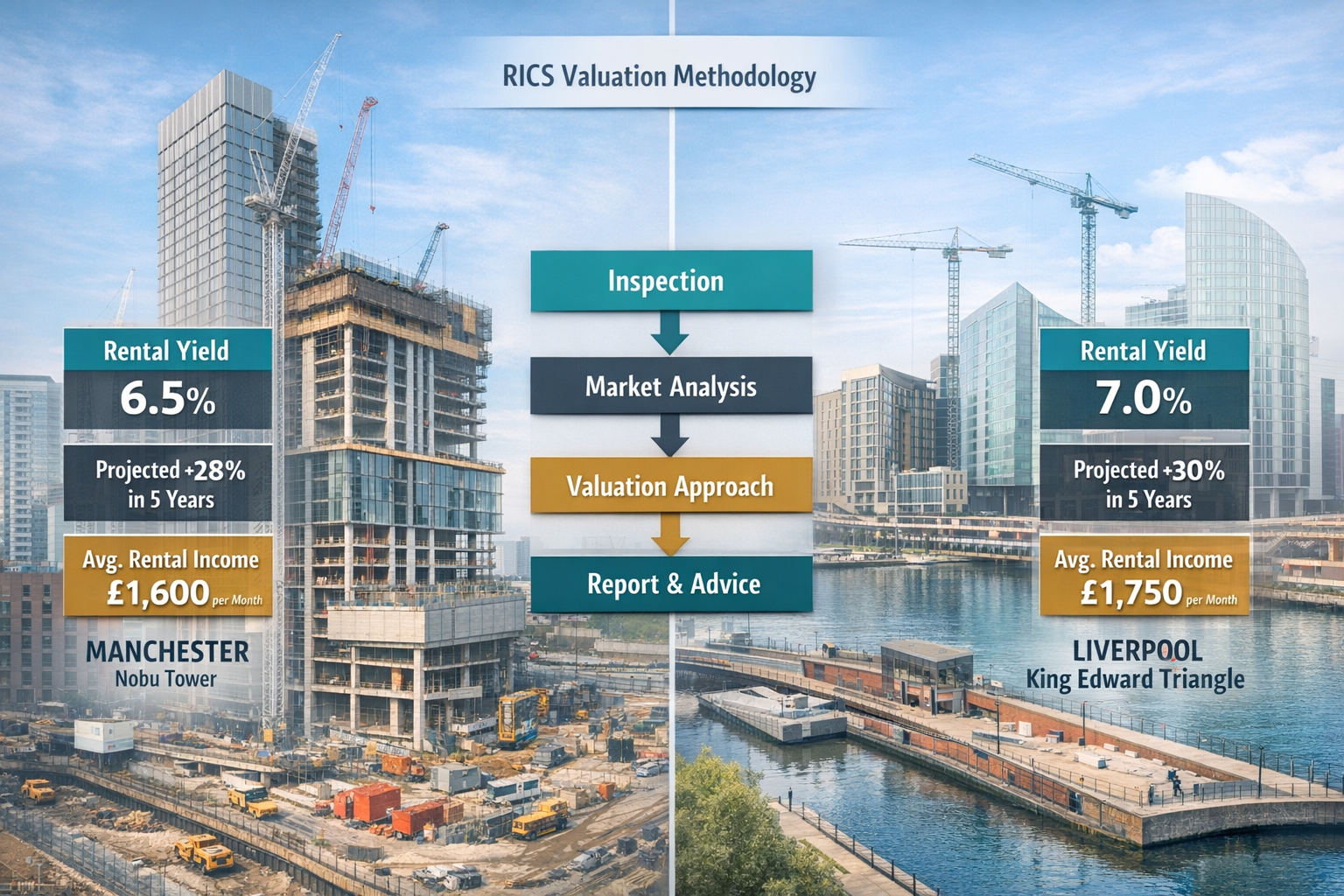
The magnitude of investment flowing into Manchester and Liverpool represents the largest coordinated urban renewal effort since post-war reconstruction. Liverpool alone has secured over £7 billion in committed regeneration projects spanning residential, commercial, and infrastructure developments[1]. Manchester's pipeline, anchored by landmark projects like the 76-storey Nobu Tower and the £7 billion Old Trafford regeneration, positions the city as the UK's fastest-growing urban economy[2][5].
This isn't speculative development—these are funded, shovel-ready projects with planning approvals progressing throughout 2026. The Liverpool Waters masterplan encompasses five distinct districts across 150 acres of waterfront, while Manchester's city center is undergoing its most significant transformation in three decades.
Key Projects Driving Value Creation
Liverpool's Flagship Developments:
- King Edward Triangle (Northern Waterfront): £1 billion private residential scheme delivering approximately 3,000 homes in high-rise clusters, with first 28-storey planning applications submitted in 2025[1]
- Liverpool Waters Central Docks: 26-acre site generating over 2,000 new homes with comprehensive infrastructure improvements[1]
- Festival Gardens Redevelopment: 27-acre brownfield transformation with 440 homes including 110 affordable units, planning application expected late 2026[1][2]
- Pall Mall Office and Hotel Scheme: 341,000 sq ft of Grade A office space representing the first new CBD office development in 13 years[2]
- Everton Stadium at Bramley-Moore Dock: Anchor project catalyzing the North Liverpool New Town programme across L4, L5, and L6 postcodes[6]
Manchester's Transformative Projects:
- Nobu Manchester: 76-storey mixed-use tower with 160-room luxury hotel and 452 branded residences, construction starting 2026[5]
- Old Trafford Regeneration: £7 billion, 400-acre district designed by Allies and Morrison[2]
- City Center Connectivity Improvements: Enhanced transport links supporting residential and commercial density
Why Traditional Valuation Methods Fall Short
Standard residential valuation approaches rely heavily on comparable sales evidence from similar properties in established markets. However, renewal zones present unique challenges:
- Limited comparable data in newly emerging districts
- Rapid value appreciation that renders historical data obsolete
- Infrastructure improvements not yet reflected in market pricing
- Planning policy changes creating new development rights
- Phased delivery where early phases establish pricing for later phases
For investors and developers navigating these complexities, professional Manchester valuation services become essential for accurate risk assessment and opportunity identification.
Valuation Strategies for 2026 Northern Renewal Projects: Core Methodologies

RICS Red Book Valuation Framework
The RICS Valuation – Global Standards (Red Book) provides the authoritative framework for assessing properties in development zones. For northern renewal projects, specific Red Book principles become particularly relevant:
Market Value vs. Investment Value: Understanding the distinction is critical. Market value represents the estimated amount for which an asset should exchange on the valuation date, while investment value reflects worth to a specific investor with particular objectives. In emerging renewal zones, these can diverge significantly.
Professional RICS valuation services ensure compliance with these standards while adapting methodologies to renewal zone characteristics.
Comparative Method Adaptations
When direct comparables are scarce, surveyors must employ adjusted comparison techniques:
Geographic Expansion: Examine comparable regeneration zones in similar UK cities (Birmingham's Digbeth, Leeds' South Bank) to establish baseline metrics, then adjust for local market conditions.
Time-Adjusted Comparables: Use historical data from earlier regeneration phases in the same district, applying growth rate adjustments to project current values.
Property Type Substitution: Where new-build apartment comparables are limited, analyze renovated warehouse conversions or heritage redevelopments with similar characteristics.
| Valuation Adjustment Factor | Typical Range | Application in Renewal Zones |
|---|---|---|
| Location Premium | +15% to +35% | Waterfront vs. inland positioning |
| New Build Premium | +10% to +20% | Modern specification vs. conversion |
| Infrastructure Proximity | +8% to +25% | Distance to transport nodes |
| Amenity Development | +5% to +15% | Planned vs. existing retail/leisure |
| Planning Policy Uplift | +20% to +50% | Zoning changes enabling higher density |
Investment Method for Rental Properties
For buy-to-let investors targeting northern renewal zones, the investment method provides superior insight:
Gross Yield Calculation:
Gross Yield = (Annual Rental Income / Property Purchase Price) × 100
Net Yield Calculation:
Net Yield = [(Annual Rental Income - Annual Costs) / Property Purchase Price] × 100
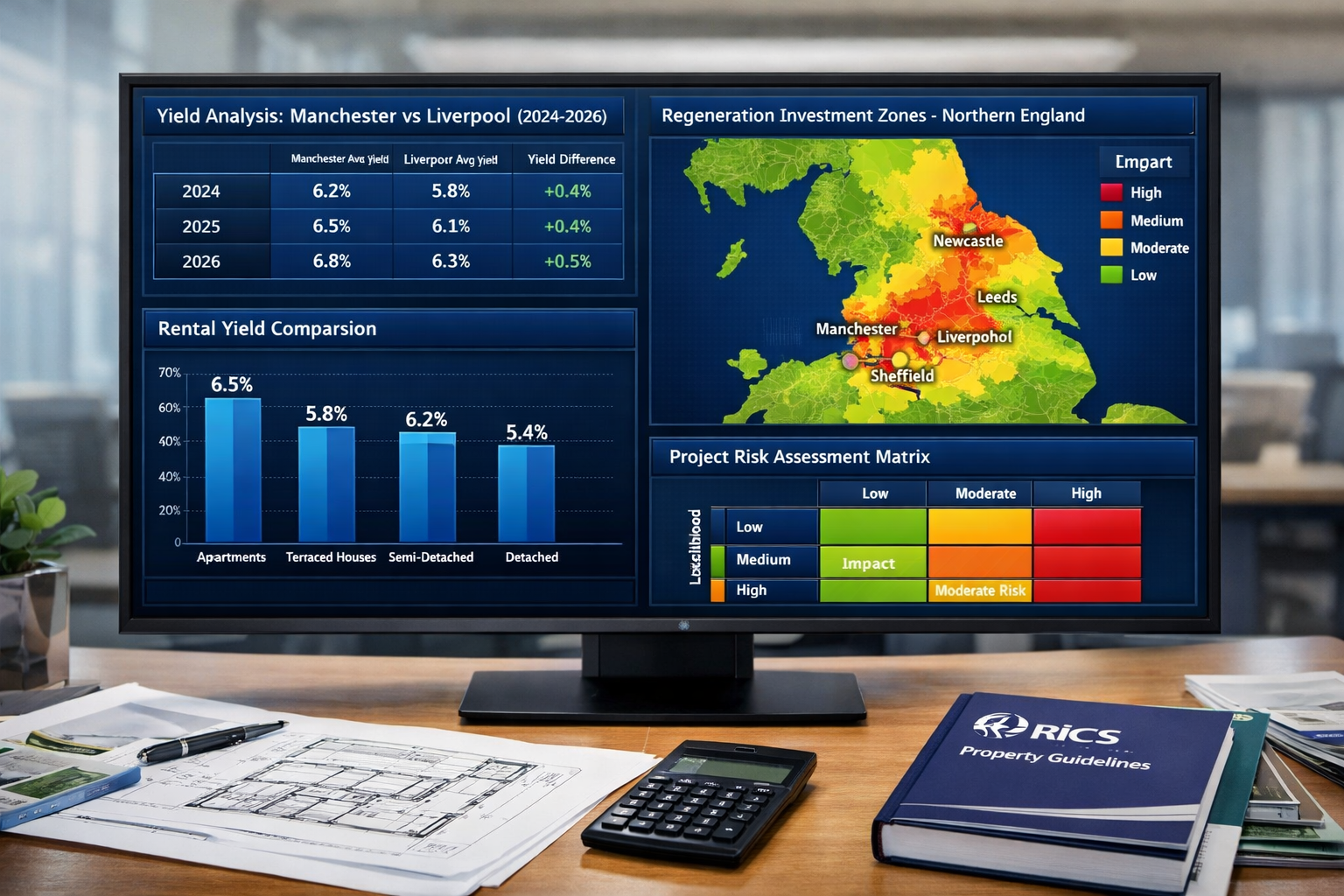
Current market data shows rental yields in Liverpool's regeneration districts ranging from 6.5% to 8.2%, compared to 3.5% to 4.5% in established southern markets. Manchester's emerging districts deliver similar returns, with premium developments in Ancoats and New Islington achieving 6% to 7% net yields.
Residual Valuation for Development Sites
For development opportunities within renewal zones, residual valuation determines land value by working backward from completed development value:
Residual Value Formula:
Land Value = Gross Development Value - (Construction Costs + Professional Fees + Finance Costs + Developer's Profit + Contingency)
This methodology proves particularly valuable when assessing brownfield sites within regeneration zones, where contamination remediation, infrastructure contributions, and phased delivery affect viability.
For complex projects requiring structural assessment, structural engineering services provide essential input data for accurate residual calculations.
Capturing Yields: Practical Implementation Strategies
Identifying High-Yield Opportunities
Early-Phase Entry: The highest yields emerge when entering regeneration zones during planning and early construction phases, before price discovery reaches market equilibrium. Liverpool's Festival Gardens development, with planning applications expected late 2026, represents this opportunity profile[1][2].
Infrastructure Catalysts: Properties positioned near major infrastructure improvements capture disproportionate value growth. Liverpool's £5 billion city center regeneration vision includes improved transport connectivity between Liverpool Central Station and Lime Street, creating a 86-acre value corridor[1].
Mixed-Use Proximity: Residential properties within 500 meters of new commercial, retail, and leisure developments benefit from amenity premiums. The Pall Mall scheme's 341,000 sq ft of Grade A office space will drive demand for nearby residential properties[2].
Risk Assessment and Mitigation
Development Delivery Risk: Not all announced projects reach completion. Assess developer track records, funding security, and planning status. The Littlewoods Film and Television Facility's £70 million proposal awaits central government funding discussions, introducing uncertainty[1].
Market Absorption Risk: Large-scale developments may saturate local demand. Liverpool Waters' 3,000-home King Edward Triangle requires phased absorption analysis to avoid oversupply scenarios[1].
Specification Risk: Premium developments may struggle if specifications exceed local market expectations. Nobu Manchester's luxury positioning requires careful comparable analysis to validate pricing assumptions[5].
For properties in heritage buildings undergoing conversion, building surveys identify hidden costs that impact residual valuations and yield calculations.
Specialized Valuation Scenarios
Shared Ownership Schemes: Many northern renewal projects include affordable housing components. Festival Gardens includes 110 affordable units requiring specialized shared ownership valuation methodologies[1][2].
Listed Building Conversions: Liverpool's Heaps Mill (Grade II-listed rice mill from the 1700s) and the Littlewoods building require heritage-sensitive valuation approaches that account for restoration costs and restrictions[1][3].
Leasehold Properties: New-build apartments typically feature 999-year leases, but understanding lease extension valuation principles helps assess secondary market opportunities in earlier regeneration phases.
Tax-Efficient Structures: High-value properties may benefit from ATED valuation strategies for corporate ownership structures.
Due Diligence Essentials
Environmental Assessments: Brownfield regeneration sites require comprehensive environmental due diligence. Groundwater sampling and contamination assessments impact development costs and timelines.
Structural Integrity: Heritage conversions and warehouse transformations need structural engineering evaluation to quantify remediation requirements.
Damp and Moisture: Northern England's climate makes damp surveys essential for both existing properties and new-build quality assurance.
Defect Identification: For off-plan purchases, snagging reports protect buyer interests by documenting construction defects before completion.
Market Intelligence: 2026 Yield Projections
Comparative Yield Analysis
| Market Segment | Liverpool Yields | Manchester Yields | London Comparison |
|---|---|---|---|
| City Center Apartments (New Build) | 6.5% – 7.5% | 6.0% – 7.0% | 3.5% – 4.2% |
| Waterfront Developments | 7.0% – 8.2% | N/A | 3.2% – 3.8% |
| Heritage Conversions | 6.8% – 7.8% | 6.5% – 7.5% | 3.8% – 4.5% |
| Suburban Regeneration Zones | 7.5% – 9.0% | 7.0% – 8.5% | 4.0% – 5.0% |
Capital Growth Projections
Property consultancies project capital appreciation of 15% to 25% over the 2026-2028 period for properties in core regeneration zones, driven by:
- Infrastructure completion reducing perceived location risk
- Amenity development improving liveability metrics
- Investor recognition as projects reach practical completion
- Rental growth as professional populations expand
The Peel Waters development at Miller's Quay achieved full occupancy within weeks of completion, demonstrating strong demand fundamentals[1].
Rental Market Dynamics
Tenant Profiles: Northern renewal zones attract diverse tenant demographics:
- Young professionals relocating from southern markets for affordability
- Corporate relocations (BBC, Channel 4, and numerous financial services firms)
- International students at expanding university campuses
- Empty nesters downsizing from suburban properties
Rental Growth Rates: Rental values in regeneration districts are growing at 4% to 6% annually, compared to 2% to 3% in established markets, creating yield expansion opportunities.
Professional Valuation Services: When to Engage Specialists
Scenarios Requiring Professional Valuation
✅ Purchase decisions exceeding £250,000 in emerging regeneration zones
✅ Development site acquisitions requiring residual valuation analysis
✅ Portfolio rebalancing from southern to northern markets
✅ Lending security where lenders require RICS-compliant valuations
✅ Tax planning including capital gains, inheritance, and ATED scenarios
✅ Matrimonial settlements requiring matrimonial valuations
✅ Probate and estate planning for inherited properties in development zones
Selecting the Right Valuation Partner
RICS Accreditation: Ensure valuers hold RICS Registered Valuer status with specific experience in regeneration zones. Learn more about why RICS chartered surveyors matter.
Local Market Knowledge: Northern markets have distinct characteristics. Valuers with established track records in Manchester and Liverpool provide superior insight compared to national firms without regional presence.
Specialization Alignment: Match valuer expertise to property type—residential, commercial, mixed-use, or heritage conversions each require different technical knowledge.
Technology Integration: Modern valuation practices incorporate data analytics, comparable databases, and market modeling tools that enhance accuracy.
Understanding Valuation Costs
Professional valuation fees typically range from £400 to £2,500 depending on property value, complexity, and report detail requirements. Investment-grade valuations for properties exceeding £1 million may command higher fees but provide essential risk mitigation.
For budget planning, review survey pricing structures and compare different survey types to understand service tiers.
Future-Proofing Your Northern Investment Strategy
Beyond 2026: Long-Term Value Drivers
Transport Connectivity: Northern Powerhouse Rail proposals and HS2 extensions (despite modifications) will continue enhancing Manchester and Liverpool connectivity, supporting sustained value growth.
Commercial Expansion: Office space demand in both cities remains robust, with Liverpool's first new CBD office development in 13 years signaling institutional confidence[2].
Cultural and Leisure Investment: The proposed Littlewoods Film and Television Facility positions Liverpool as a media production hub, creating employment and cultural amenity value[1].
Demographic Trends: Net migration from southern England to northern cities accelerated post-pandemic and shows no signs of reversal, ensuring sustained residential demand.
Portfolio Diversification Benefits
Northern renewal projects offer portfolio diversification away from overheated southern markets:
- Lower correlation with London property cycles
- Superior yield profiles supporting cash flow requirements
- Growth potential from emerging market status
- Affordability enabling larger portfolio construction
Monitoring and Review Protocols
Successful investors in regeneration zones implement quarterly review cycles:
- Track development progress against published timelines
- Monitor rental market data for yield validation
- Assess comparable sales as price discovery evolves
- Review planning applications for nearby developments
- Evaluate infrastructure delivery against published schedules
Conclusion
The Valuation Strategies for 2026 Northern Renewal Projects: Capturing Yields in Manchester and Liverpool Booms represent a generational opportunity for property professionals who approach these markets with appropriate analytical rigor. With over £14 billion in committed regeneration investment, these cities are experiencing transformation that rivals any UK urban renewal program in the past three decades.
The key to success lies in adapting traditional valuation methodologies to the unique characteristics of emerging regeneration zones—limited comparables, rapid value appreciation, infrastructure improvements, and phased delivery all require specialized assessment techniques. RICS Red Book frameworks provide the essential foundation, but practical application demands local market knowledge, development expertise, and risk assessment capabilities.
For investors, the yield differential between northern renewal zones (6.5% to 8.2%) and established southern markets (3.5% to 4.5%) creates compelling return profiles, particularly when combined with capital growth projections of 15% to 25% over the 2026-2028 period. However, these opportunities require professional valuation support to navigate development delivery risk, market absorption challenges, and specification appropriateness.
Next Steps for Property Professionals
- Engage RICS-accredited valuers with specific northern regeneration experience for any investment exceeding £250,000
- Conduct comprehensive due diligence including environmental assessments, structural surveys, and planning policy analysis
- Monitor flagship project progress including King Edward Triangle, Nobu Manchester, and Liverpool Waters developments
- Establish local market intelligence through regular site visits and rental market monitoring
- Implement quarterly portfolio reviews to track value creation against projections
The northern property renaissance is no longer speculative—it's happening now, with cranes dominating skylines and institutional capital flowing into once-overlooked districts. Those who deploy sophisticated valuation strategies today will capture the exceptional yields that define this historic urban transformation.
Ready to assess opportunities in Manchester and Liverpool's regeneration zones? Get a professional valuation quote from RICS-accredited specialists with proven northern market expertise.
References
[1] Liverpools Regeneration To Take Major Step Forward In 2026 – https://www.buyassociationgroup.com/en-us/news/liverpools-regeneration-to-take-major-step-forward-in-2026/
[2] North West Developments To Watch Out For In 2026 – https://www.placenorthwest.co.uk/north-west-developments-to-watch-out-for-in-2026/
[3] Watch – https://www.youtube.com/watch?v=FIXy_FJSDj8
[5] New Developments Greater Manchester 2026 – https://secretmanchester.com/new-developments-greater-manchester-2026/
[6] The North Liverpool New Town Reset How 2026 Regeneration Is Lifting Local Home Values – https://www.northwooduk.com/guides/liverpool/the-north-liverpool-new-town-reset-how-2026-regeneration-is-lifting-local-home-values/