
{"cover":"Professional landscape format (1536×1024) hero image featuring bold text overlay 'Party Wall Surveys for Modular and Prefab Housing in 2026: Managing Agreements in Offsite Construction Boom' in extra large 72pt white sans-serif font with dark gradient shadow, positioned in upper third. Background shows split composition: left side displays modern modular housing units being craned into position on a construction site in northern England, right side shows surveyor with clipboard examining shared boundary wall between properties. Color scheme: industrial blue, steel grey, safety orange accents. High contrast, magazine cover quality, editorial construction industry aesthetic with professional lighting and sharp detail.","content":["Detailed landscape format (1536×1024) image showing close-up of RICS-certified surveyor conducting party wall assessment at modular housing development site. Foreground features surveyor in high-visibility vest holding tablet displaying digital Schedule of Condition documentation, measuring tape extended along prefabricated wall panel. Mid-ground shows two adjacent modular units positioned near shared boundary with visible foundation work. Background displays construction crane and additional prefab modules awaiting installation. Include annotated measurement markers, boundary line indicators, and professional survey equipment. Industrial construction site setting with safety signage, northern UK housing estate context, natural daylight, documentary photography style with sharp focus on technical details.","Detailed landscape format (1536×1024) infographic-style image illustrating party wall notice timeline and agreement process for modular construction. Central flowchart shows three main stages: pre-installation notice period, surveyor appointment, and award documentation. Left side displays calendar icons with 2-month notice requirement highlighted, middle section shows two property owners with appointed surveyors meeting at boundary line, right side features completed Party Wall Award document with official stamps. Include modular housing silhouettes, clock symbols indicating time-sensitive deadlines, checkmark icons for completed steps, and warning symbols for common pitfalls. Clean professional design with construction blueprint aesthetic, blue and orange color coding, clear typography, educational diagram style suitable for property owners and developers.","Detailed landscape format (1536×1024) wide-angle photograph of completed modular housing development in Welsh or northern England setting showing successful party wall management. Foreground features row of modern prefabricated homes with clearly defined shared boundary walls, neat landscaping, and visible property demarcation. Mid-ground shows satisfied homeowners standing at their respective properties with surveyor between them holding completed documentation. Background displays additional modular units in terraced formation demonstrating efficient land use for affordable housing. Include visible party wall structures, proper drainage systems, maintained boundaries, and professional completion signage. Natural lighting, community development atmosphere, documentary style photography emphasizing successful dispute-free construction outcome and neighbor cooperation in modern offsite construction project."]"}
The UK housing crisis has reached a tipping point, and modular construction is emerging as the solution. As cranes lift prefabricated homes into position across northern England and Wales, a critical question arises: how do traditional party wall agreements adapt to the speed and complexity of offsite construction? With modular housing developments accelerating to meet affordable housing targets, property owners and developers face unprecedented challenges in managing shared boundary works under the Party Wall Act 1996.
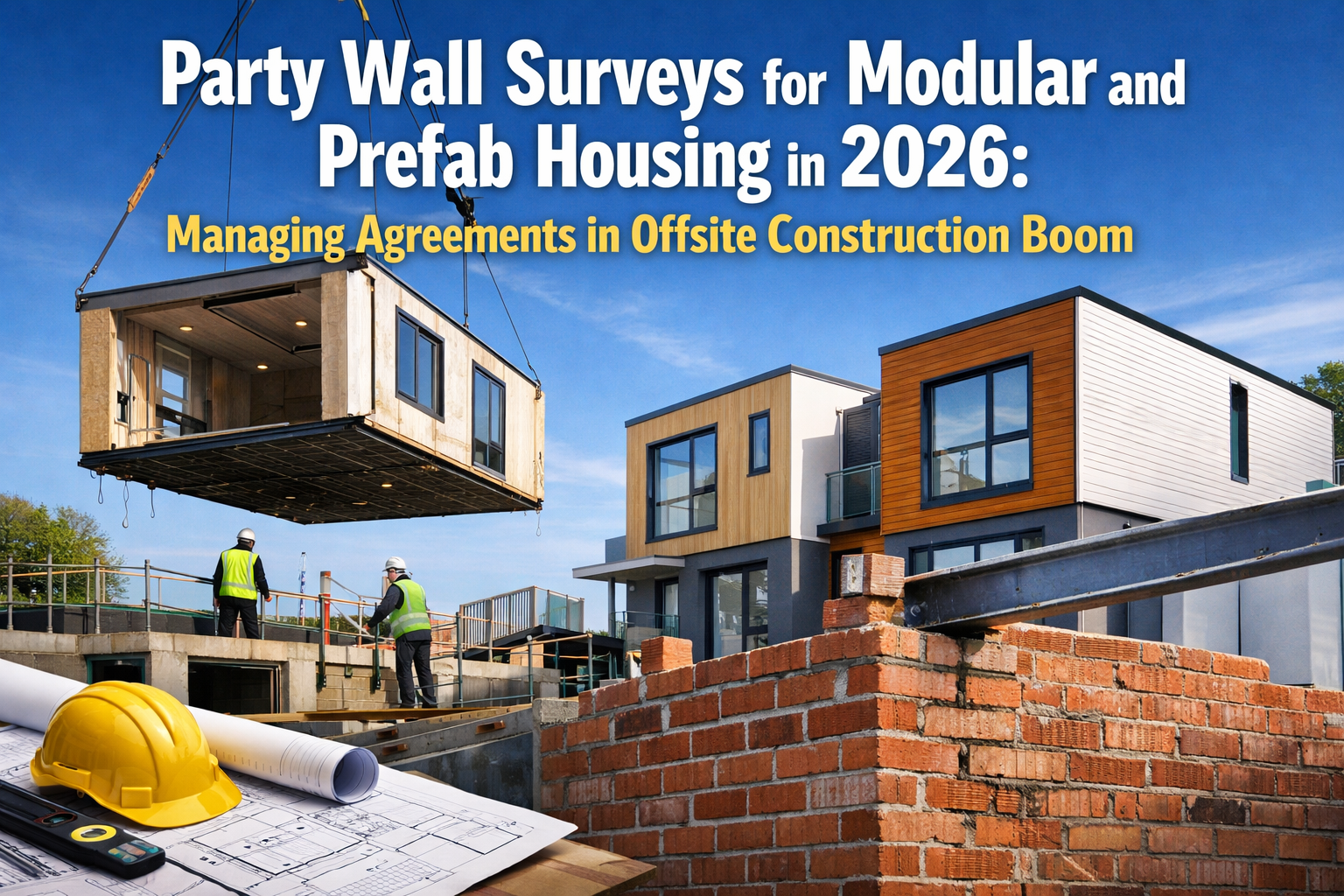
Party Wall Surveys for Modular and Prefab Housing in 2026: Managing Agreements in Offsite Construction Boom represents a fundamental shift in how surveyors approach boundary disputes and neighbor agreements. The rapid installation of prefabricated units—often completed in days rather than months—compresses traditional notice periods and demands streamlined assessment processes while maintaining RICS compliance standards.
Key Takeaways
- ⚡ Modular construction speed requires accelerated party wall notice procedures, with 2-month minimum notice periods often conflicting with rapid installation schedules
- 📋 RICS-compliant Schedule of Condition assessments must adapt to prefabricated components, documenting both onsite and offsite construction phases
- 🏘️ Northern England and Wales are experiencing the highest concentration of modular affordable housing projects, creating regional hotspots for party wall survey demand
- 💷 Cost efficiencies of modular construction (30-50% faster than traditional builds) can be undermined by party wall disputes if proper agreements aren't secured early
- 🤝 Proactive neighbor engagement and professional surveyor appointment prevent 90% of potential disputes in modular housing developments
Understanding Party Wall Requirements in Modern Modular Construction
The modular housing boom is reshaping the UK's approach to affordable housing delivery. According to recent industry analysis, modular construction can reduce building time by 30-50% compared to traditional methods [5], making it an attractive solution for addressing supply shortages. However, this accelerated timeline creates unique challenges for party wall procedures.
What Makes Modular Housing Different for Party Wall Surveys?
Modular and prefabricated housing differs fundamentally from traditional construction in several ways that impact party wall agreements:
Speed of Installation 🏗️
Traditional builds progress gradually, allowing neighbors to observe work and raise concerns incrementally. Modular units arrive substantially complete, with installation occurring in 1-3 days. This compressed timeline means party wall notices must be served well before the actual installation date, often while the modules are still being manufactured offsite.
Foundation and Excavation Work
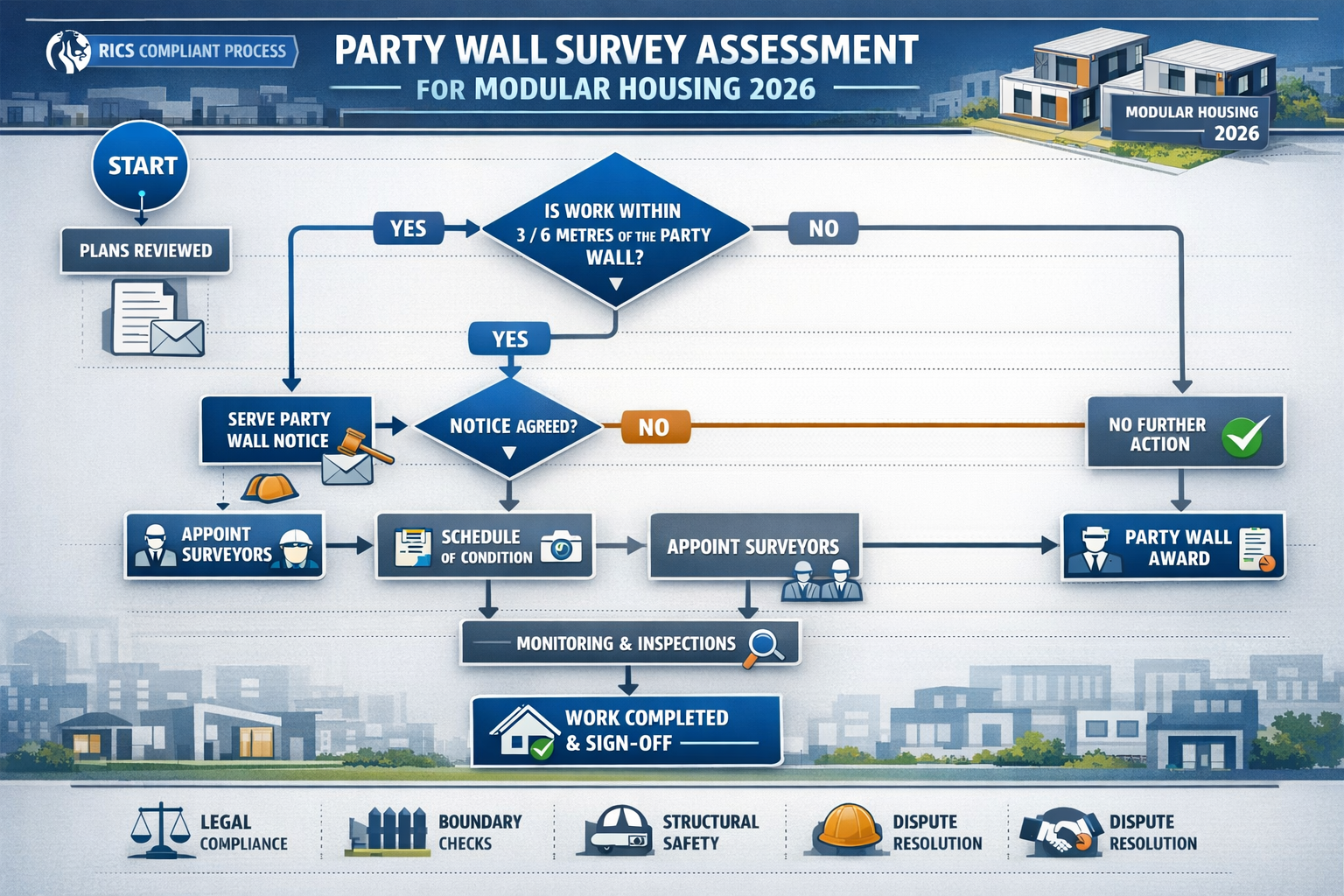
While the modules themselves are built offsite, significant groundwork occurs onsite. Foundation excavation near shared boundaries triggers the excavation notice requirements under Section 6 of the Party Wall Act. The 3-metre rule applies: any excavation within three metres of a neighboring building that goes deeper than its foundations requires formal notice [1].
Shared Wall Modifications
When modular units are positioned adjacent to existing properties, connections to shared walls may be necessary for structural support or utilities. These modifications fall under Section 2 of the Party Wall Act, requiring proper surveyor assessment and agreement.
The Party Wall Act 1996 and Prefabricated Construction
The Party Wall etc. Act 1996 was designed for traditional construction methods, yet its principles remain legally binding for modular projects. Three key sections apply to modular housing developments:
| Section | Application to Modular Housing | Notice Period |
|---|---|---|
| Section 1 | Building new walls on boundary lines | 1 month |
| Section 2 | Working on existing party walls or structures | 2 months |
| Section 6 | Excavation within 3-6 metres of neighbor's building | 1 month |
For modular developments, Section 6 is most frequently triggered. When foundation work begins near existing properties, developers must serve proper notice and allow neighbors time to respond. Understanding the 3-metre rule is essential for project managers coordinating offsite manufacturing with onsite installation schedules.
Party Wall Surveys for Modular and Prefab Housing in 2026: RICS-Compliant Assessment Procedures
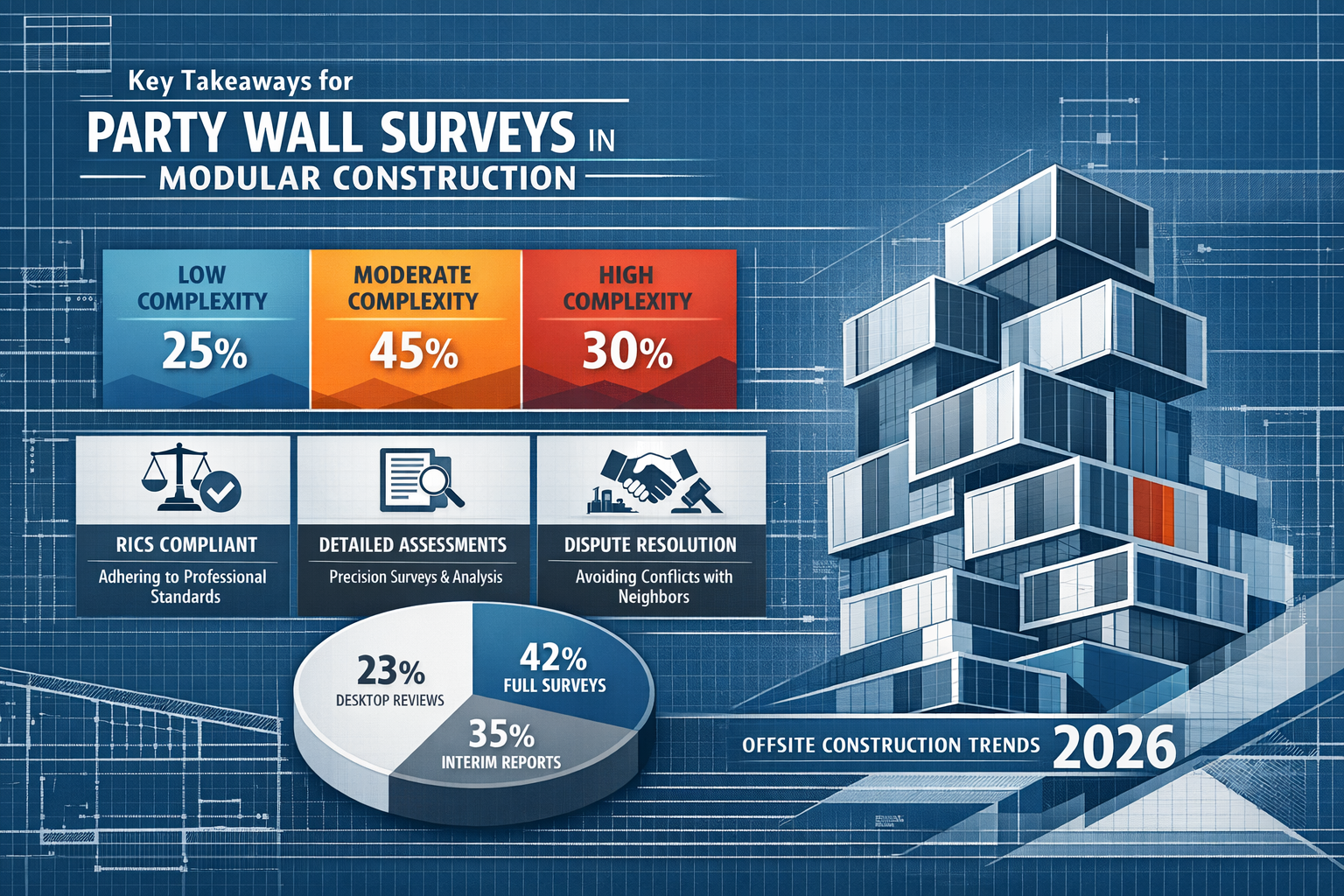
The Royal Institution of Chartered Surveyors (RICS) provides the professional framework for conducting party wall surveys, but 2026 brings new considerations specific to the modular construction boom. Surveyors must adapt traditional methodologies to accommodate the unique characteristics of prefabricated housing while maintaining rigorous documentation standards.
Schedule of Condition: Documenting Pre-Installation Status
A comprehensive Schedule of Condition forms the foundation of any party wall agreement. For modular housing projects, this documentation serves dual purposes:
Protecting Neighboring Properties 🏠
Before any groundwork begins, surveyors must thoroughly document the condition of adjacent properties. This includes:
- Photographic evidence of walls, foundations, and structural elements
- Crack mapping and measurement of existing defects
- Assessment of drainage systems and ground conditions
- Documentation of finishes, landscaping, and boundary features
The Schedule of Condition guidance emphasizes that this baseline record protects both parties. If disputes arise about damage caused during installation, the Schedule provides objective evidence of pre-existing conditions.
Addressing Unique Modular Challenges
Modular installation involves heavy lifting equipment, substantial vibration from crane operations, and potential ground movement during foundation work. Surveyors must specifically assess:
- Structural integrity of neighboring buildings to withstand vibration
- Ground stability and potential settlement risks
- Access routes for delivery vehicles and cranes
- Temporary works that may affect adjoining properties
Accelerated Notice Procedures for Rapid Installation
The traditional 2-month notice period for Section 2 works presents challenges when modular units are manufactured offsite with fixed delivery schedules. Best practices for 2026 include:
Early Engagement Strategy 📅
Progressive developers now serve party wall notices during the planning permission stage, months before manufacturing begins. This approach:
- Allows adequate time for neighbor responses and surveyor appointments
- Prevents costly delays when modules arrive onsite
- Demonstrates good faith and professional project management
- Reduces risk of disputes escalating to formal proceedings
Concurrent Manufacturing and Agreement Processes
While modules are being built offsite (typically 8-12 weeks), the party wall agreement process runs in parallel. By the time units arrive for installation, all necessary awards should be in place.
The Role of Party Wall Surveyors in Modular Projects
RICS-qualified party wall surveyors serve three distinct roles in modular housing developments:
Building Owner's Surveyor 👷
Appointed by the developer, this surveyor ensures the project complies with the Party Wall Act while protecting the building owner's interests. Responsibilities include:
- Drafting and serving proper notices
- Coordinating with project managers on installation schedules
- Preparing technical specifications for boundary works
- Negotiating reasonable access and working hours
Adjoining Owner's Surveyor 🏘️
Appointed by neighboring property owners, this surveyor protects their interests throughout the process. Key duties include:
- Reviewing proposed works and assessing potential impacts
- Conducting independent Schedule of Condition surveys
- Negotiating protective measures and monitoring protocols
- Ensuring fair compensation for any damage or inconvenience
Agreed Surveyor ⚖️
When both parties consent, a single impartial surveyor can act for both sides, reducing costs and streamlining the process. This approach works well when:
- Works are relatively straightforward
- Neighbors have good existing relationships
- Both parties trust the surveyor's impartiality
- Cost efficiency is a priority for affordable housing projects
Party Wall Awards for Modular Installations
The Party Wall Award is the formal document that authorizes boundary works to proceed. For modular housing, awards must address specific considerations:
Installation Methodology 🏗️
The award should detail:
- Crane positioning and swing radius over adjoining land
- Foundation specifications and excavation depths
- Temporary works and protective measures
- Schedule of works with specific installation dates
Monitoring and Inspection Protocols
Given the rapid installation timeline, the award typically requires:
- Pre-installation joint inspection with both surveyors present
- Real-time monitoring during crane operations
- Post-installation inspection within 7 days
- Follow-up inspection after 3 months to assess settlement
Cost Allocation and Dispute Resolution
The award clarifies:
- Who pays surveyor fees (typically the building owner)
- Responsibility for any damage repairs
- Process for addressing disputes during installation
- Provisions for unforeseen complications
Managing Party Wall Agreements in Northern and Welsh Affordable Housing Hotspots
The geography of the Party Wall Surveys for Modular and Prefab Housing in 2026: Managing Agreements in Offsite Construction Boom phenomenon is concentrated in specific regions experiencing acute housing shortages. Northern England and Wales have emerged as primary markets for modular affordable housing, creating regional expertise among surveyors and establishing best practices for managing agreements at scale.
Regional Hotspots for Modular Development
Greater Manchester 🏙️
As a major metropolitan area with ambitious affordable housing targets, Greater Manchester has seen substantial investment in modular construction. Local authorities are partnering with modular manufacturers to deliver:
- Social housing estates with 50-200 units
- Mixed-tenure developments combining affordable and market-rate homes
- Infill projects on brownfield sites with complex boundary conditions
The concentration of projects has created a network of experienced party wall surveyors familiar with modular-specific challenges. This regional expertise accelerates the agreement process and reduces dispute rates.
Liverpool and Merseyside
Urban regeneration initiatives across Merseyside have embraced modular construction for rapid delivery. The region's terraced housing stock means most new developments involve party wall considerations with existing Victorian and Edwardian properties.
Leeds and West Yorkshire
With strong manufacturing infrastructure, West Yorkshire hosts several modular housing factories, reducing transportation costs and delivery times. This proximity enables better coordination between offsite manufacturing and onsite party wall compliance.
Cardiff and South Wales 🏴
Welsh Government initiatives supporting affordable housing have driven modular adoption across South Wales. The region's valleys present unique topographical challenges, with sloped sites requiring careful excavation planning near neighboring properties.
Common Party Wall Challenges in Modular Affordable Housing
High-Density Developments
Affordable housing projects maximize land use, often positioning modular units in close proximity. This creates multiple simultaneous party wall considerations:
- Shared boundaries between multiple new units
- Interfaces with existing properties on all sides
- Complex drainage and utility connections
- Limited access for construction equipment
Existing Housing Stock Conditions
Many modular developments occur in areas with aging housing stock. Neighboring properties may have:
- Structural deficiencies that increase vulnerability to vibration
- Poorly maintained foundations susceptible to settlement
- Existing cracks and defects requiring careful documentation
- Owners unfamiliar with party wall procedures
Cost Pressures on Affordable Housing
Developers working within tight affordable housing budgets may be tempted to cut corners on party wall procedures. However, failure to serve proper notices can result in:
- Injunctions halting construction if no party wall notice is served
- Costly legal proceedings and project delays
- Damage claims without the protection of a party wall award
- Reputational damage affecting future development opportunities
Best Practices for Large-Scale Modular Developments
Phased Notice Strategy 📋
For multi-unit developments, serving all party wall notices simultaneously can overwhelm neighbors and surveyors. Progressive developers implement phased approaches:
- Phase 1: Perimeter properties adjacent to existing buildings
- Phase 2: Internal party walls between new modular units
- Phase 3: Utility connections and shared infrastructure
This sequencing aligns notice periods with construction phasing, ensuring agreements are in place when needed without unnecessary early notifications.
Community Engagement Programs
Successful modular developments in northern and Welsh hotspots incorporate proactive neighbor engagement:
- Pre-notice information sessions explaining modular construction
- Site tours showing modular units before installation
- Direct contact channels for concerns and questions
- Regular updates throughout the construction process
Template Awards for Standardized Units
When installing multiple identical modular units, surveyors can develop template party wall awards covering standard scenarios. This approach:
- Reduces surveyor time and costs
- Ensures consistency across the development
- Speeds up the agreement process
- Maintains RICS compliance standards
Dispute Prevention and Resolution
Despite best efforts, party wall disputes occasionally arise in modular projects. Common triggers include:
Installation Timing Conflicts ⏰
Neighbors may object to early morning crane operations or weekend work. Party wall awards should specify:
- Permitted working hours (typically 8am-6pm weekdays)
- Restrictions on noisy activities
- Advance notice requirements for exceptional circumstances
- Compensation for unavoidable disruption
Access Disputes
Modular installation may require temporary access to neighboring land for:
- Crane outrigger positioning
- Delivery vehicle maneuvering
- Utility connections
- Safety barriers and protective measures
The party wall award can authorize necessary access, but must balance the building owner's needs with the adjoining owner's reasonable objections.
Damage Claims
When neighbors allege damage from modular installation, the Schedule of Condition becomes critical evidence. Surveyors must:
- Compare current conditions to pre-installation documentation
- Assess whether damage is attributable to the works
- Determine appropriate remediation measures
- Negotiate fair compensation if damage is confirmed
Technical Considerations for Party Wall Surveys in Prefab Construction
The technical aspects of Party Wall Surveys for Modular and Prefab Housing in 2026: Managing Agreements in Offsite Construction Boom require surveyors to understand both traditional boundary law and modern construction methodologies. Prefabricated housing introduces engineering considerations that differ significantly from conventional builds.
Foundation Systems and Excavation Requirements
Modular housing typically employs one of three foundation approaches, each with distinct party wall implications:
Strip Foundations 🏗️
Traditional strip foundations remain common for modular housing, particularly in developments mimicking conventional appearance. Excavation depths of 1-1.5 metres are typical, frequently triggering Section 6 notice requirements when within three metres of neighboring buildings.
Piled Foundations
For challenging ground conditions or brownfield sites, piled foundations minimize excavation but introduce vibration concerns. Party wall awards must address:
- Vibration monitoring during pile installation
- Protective measures for vulnerable neighboring structures
- Alternative piling methods (e.g., continuous flight auger vs. driven piles)
- Structural surveys before and after piling works
Raft Foundations
Reinforced concrete raft slabs distribute loads across wider areas, reducing excavation depths. However, they require substantial groundwork that may still affect adjoining properties through:
- Ground compaction and settlement
- Drainage pattern alterations
- Temporary works and excavation for services
Modular Unit Connection Methods
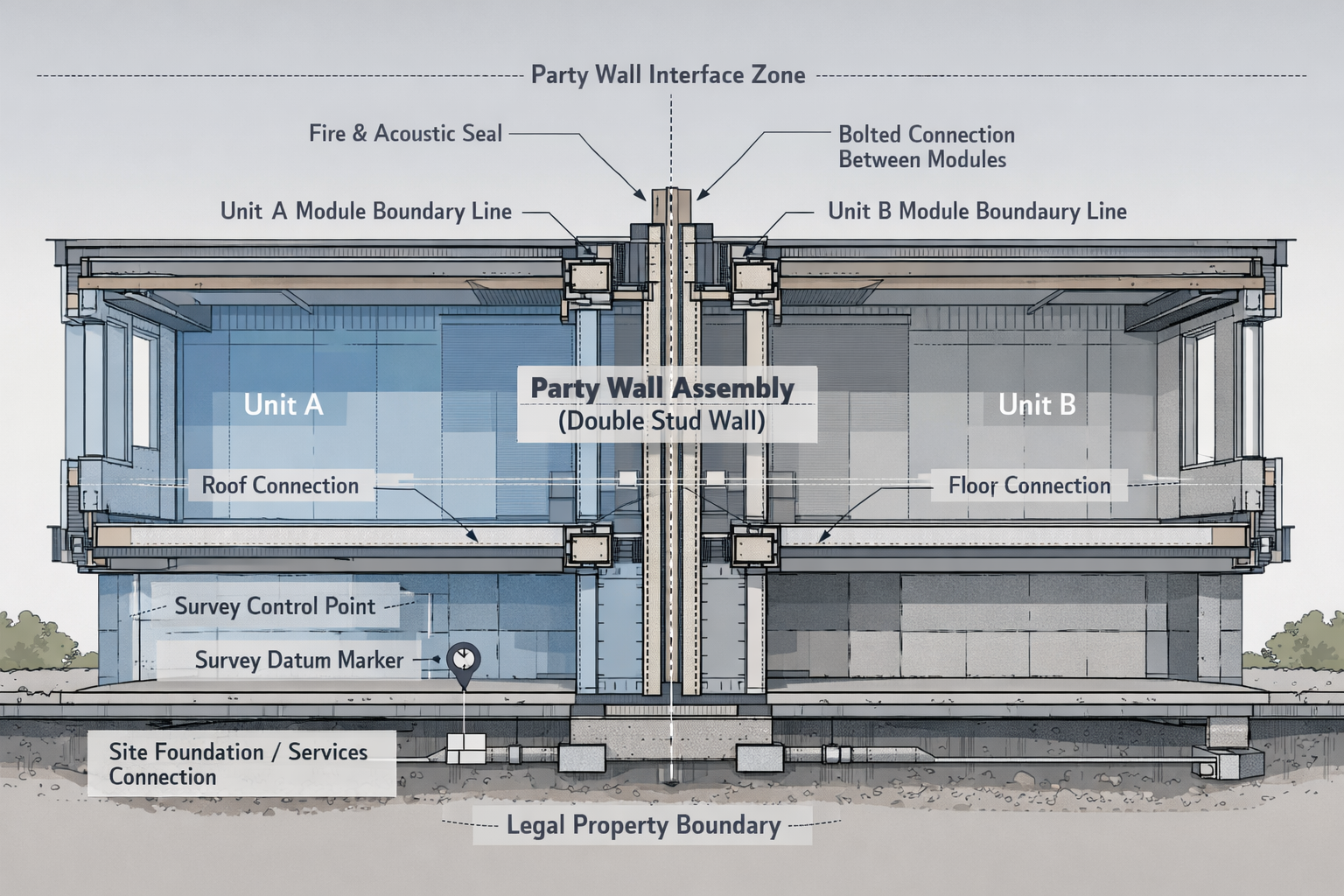
How prefabricated modules connect to each other and to existing structures creates specific party wall considerations:
Inter-Module Connections 🔗
When modules are stacked or positioned side-by-side, structural connections may involve:
- Bolted steel frame assemblies
- Welded connection plates
- Timber frame interlocking systems
- Load transfer through party walls
Surveyors must assess whether these connections constitute work "on" a party wall under Section 2, requiring formal notices and awards.
Interface with Existing Buildings
Modular extensions or infill developments may require connections to existing party walls. Common scenarios include:
- Flashing and weatherproofing at the junction
- Structural tie-ins for stability
- Shared chimney stacks requiring modification
- Utility penetrations through party walls
These works clearly fall under the Party Wall Act and require careful specification in the party wall award. For projects involving shared chimneys, additional considerations apply regarding structural integrity and future maintenance access.
Crane Operations and Temporary Works
The installation phase of modular construction presents unique party wall challenges related to temporary works:
Crane Positioning and Oversailing 🏗️
Mobile cranes lifting modular units into position often require:
- Outrigger placement on or near boundary lines
- Boom swing over adjoining properties
- Temporary ground protection systems
- Safety exclusion zones affecting neighbors
While crane oversailing is technically a trespass requiring neighbor consent, it's typically addressed within the party wall award rather than through separate agreements. The award should specify:
- Maximum oversailing height and duration
- Insurance coverage for aerial operations
- Emergency procedures and contact protocols
- Compensation for any disruption
Temporary Support Structures
During installation, temporary works may include:
- Scaffolding extending over boundary lines
- Protective hoarding and barriers
- Temporary drainage and pumping systems
- Site access routes crossing adjoining land
Building Regulations and Party Wall Compliance
While building regulations and party wall requirements are separate legal frameworks, they intersect in modular construction:
Sound Insulation Standards 🔊
Party walls between modular units must meet Building Regulations Approved Document E requirements for sound insulation. Party wall surveyors should verify that modular manufacturers have:
- Tested party wall assemblies for acoustic performance
- Provided certification of compliance
- Specified proper installation procedures
- Addressed potential sound flanking paths
Fire Resistance Requirements
Party walls must achieve specified fire resistance ratings (typically 60 minutes for residential). Modular construction must demonstrate:
- Fire-rated party wall construction
- Proper sealing of junctions and penetrations
- Cavity barriers preventing fire spread
- Compliance with Approved Document B
Structural Adequacy
Party walls must support their intended loads without imposing undue stress on adjoining structures. For modular housing, this includes:
- Load calculations for stacked modules
- Foundation capacity verification
- Settlement predictions and monitoring
- Long-term stability assessments
Cost Implications and Financial Planning for Party Wall Compliance
Understanding the cost of party wall procedures is essential for developers budgeting modular housing projects. While modular construction offers significant cost savings through offsite manufacturing efficiencies—with some projects achieving 20-30% cost reductions compared to traditional builds [2]—party wall compliance represents an unavoidable expense that must be factored into project budgets.
Typical Party Wall Survey Costs for Modular Projects
Surveyor Fees 💷
Professional surveyor fees vary based on project complexity:
- Simple projects (single modular unit, straightforward boundary): £700-£1,200 per surveyor
- Medium complexity (multiple units, some excavation work): £1,200-£2,500 per surveyor
- Complex developments (large-scale, multiple boundaries, challenging conditions): £2,500-£5,000+ per surveyor
For modular developments, building owners typically pay for both their own surveyor and the adjoining owner's surveyor, effectively doubling these costs. However, when neighbors agree to an agreed surveyor arrangement, costs can be reduced by 30-40%.
Schedule of Condition Documentation
Comprehensive pre-installation surveys of neighboring properties cost £400-£800 per property, depending on size and complexity. For large developments with multiple adjoining properties, this can represent significant expense:
- 10 neighboring properties: £4,000-£8,000
- 20 neighboring properties: £8,000-£16,000
- 50+ neighboring properties: Negotiated bulk rates may apply
Party Wall Award Preparation
Drafting and serving the formal party wall award involves:
- Legal document preparation: £500-£1,000
- Service of notices and awards: £200-£400
- Follow-up correspondence and clarifications: £300-£600
Hidden Costs and Contingencies
Dispute Resolution ⚖️
When neighbors dissent to proposed works or disputes arise, costs escalate significantly:
- Third surveyor appointment (for resolving surveyor disagreements): £1,500-£3,000
- Extended negotiation and correspondence: £1,000-£2,500
- Legal proceedings if disputes escalate: £5,000-£20,000+
Project Delays
The most significant cost risk in modular construction comes from installation delays. When party wall agreements aren't secured before module delivery:
- Storage costs for manufactured units: £500-£1,500 per week
- Crane hire rescheduling fees: £2,000-£5,000
- Extended site setup costs: £1,000-£3,000 per week
- Contractor standby time: £3,000-£8,000 per week
For a modular project with a two-week delay, total costs can easily exceed £20,000—far more than the cost of proper party wall compliance.
Damage Remediation
Without a party wall award, building owners bear full responsibility for any damage to neighboring properties:
- Crack repairs and redecoration: £1,000-£5,000 per property
- Structural repairs for serious damage: £10,000-£50,000+
- Legal liability without award protection: Potentially unlimited
Cost-Benefit Analysis of Early Party Wall Engagement
Investment in Proactive Compliance 📊
Developers who budget adequately for party wall procedures from project inception typically spend:
- 1-2% of total project costs on party wall compliance
- £3,000-£8,000 per modular unit in party wall-related expenses
- £50,000-£150,000 for a 20-unit affordable housing development
Returns on Investment
This upfront investment delivers measurable benefits:
- Time savings: Projects proceed on schedule without delays
- Risk mitigation: Legal protection against damage claims
- Neighbor relations: Reduced conflict and community acceptance
- Reputation: Professional approach enhances developer credibility
For affordable housing projects operating on thin margins, these cost considerations are critical. However, the alternative—proceeding without proper party wall compliance—presents far greater financial risks.
Future Trends: Party Wall Surveys for Modular and Prefab Housing Beyond 2026
As the UK continues addressing its housing crisis, modular construction is projected to grow substantially beyond 2026. Industry forecasts suggest modular housing could represent 15-20% of new residential construction by 2030, up from approximately 7-10% in 2026 [4]. This growth will drive continued evolution in party wall survey practices.
Technological Innovations in Party Wall Assessment
Digital Documentation Systems 📱
Traditional paper-based Schedules of Condition are giving way to digital alternatives:
- Tablet-based survey apps with integrated photography
- 3D scanning and photogrammetry for precise condition recording
- Cloud-based document sharing for real-time collaboration
- Blockchain verification for tamper-proof documentation
These technologies improve accuracy, reduce surveyor time onsite, and provide more defensible evidence in dispute situations.
Remote Monitoring and Sensors
Advanced monitoring systems are becoming standard for complex modular installations:
- Vibration sensors on neighboring buildings during crane operations
- Crack monitoring gauges detecting movement in real-time
- Ground settlement monitoring throughout installation
- Automated alerts when thresholds are exceeded
This data-driven approach provides objective evidence of construction impacts, reducing subjective disputes about damage causation.
Building Information Modeling (BIM) Integration
As modular manufacturers increasingly use BIM for design and manufacturing, party wall surveyors can access:
- Precise 3D models of proposed installations
- Clash detection with existing structures
- Load calculations and structural analysis
- Visualization tools for neighbor communication
Regulatory Developments and Policy Changes
Streamlined Procedures for Affordable Housing 🏘️
Government recognition of housing supply urgency may drive regulatory reforms:
- Reduced notice periods for pre-approved modular designs
- Standardized party wall agreements for common scenarios
- Fast-track dispute resolution for affordable housing projects
- Financial support for party wall compliance in social housing
Enhanced Consumer Protections
As modular housing becomes mainstream, consumer protection frameworks may expand:
- Mandatory party wall compliance verification before occupation
- Insurance requirements covering party wall risks
- Standardized disclosure requirements for modular home buyers
- Enhanced enforcement of Party Wall Act compliance
Industry Standardization and Best Practices
Modular Manufacturer Certification ✅
Leading modular housing manufacturers are developing standardized approaches:
- Pre-approved foundation designs minimizing party wall impacts
- Standard connection details for party wall interfaces
- Certified installation procedures reducing damage risks
- Training programs for installers on party wall awareness
Professional Surveyor Specialization
The growing modular sector is creating demand for specialized expertise:
- RICS training modules specific to modular construction
- Professional certifications in prefab housing assessment
- Regional networks of modular-experienced surveyors
- Knowledge-sharing platforms for best practices
Sustainability and Party Wall Considerations
Modular construction's environmental benefits—reduced waste, improved energy efficiency, and lower carbon emissions—align with UK sustainability goals. Party wall procedures must adapt to support these objectives:
Retrofit and Renovation Projects ♻️
Modular additions to existing buildings for energy efficiency upgrades require careful party wall management:
- External wall insulation affecting party wall junctions
- Modular roof extensions for additional accommodation
- Prefabricated utility connections and service upgrades
Circular Economy Approaches
As modular units become designed for disassembly and relocation, party wall considerations evolve:
- Temporary installations with reversible foundations
- Modular units moving between sites during their lifecycle
- Party wall agreements addressing future removal
- Documentation following units across multiple installations
Conclusion: Navigating Party Wall Compliance in the Modular Housing Revolution
The Party Wall Surveys for Modular and Prefab Housing in 2026: Managing Agreements in Offsite Construction Boom represents both challenge and opportunity for the UK construction industry. As modular housing accelerates to address critical affordable housing shortages—particularly in northern England and Wales—proper party wall compliance becomes essential for project success.
Key Success Factors for Developers and Property Owners
Early Planning and Professional Engagement 🎯
The compressed timelines of modular construction demand proactive party wall management:
- Serve party wall notices during planning stages, not installation phases
- Engage RICS-qualified surveyors experienced in modular projects
- Budget adequately for party wall compliance costs (1-2% of project value)
- Coordinate offsite manufacturing schedules with notice periods
RICS-Compliant Documentation
Comprehensive Schedules of Condition and properly drafted party wall awards provide essential protection:
- Document neighboring properties thoroughly before any works begin
- Address modular-specific issues like crane operations and rapid installation
- Include monitoring protocols and inspection schedules
- Specify dispute resolution procedures and cost allocations
Neighbor Relations and Community Engagement
Professional communication prevents most disputes before they arise:
- Explain modular construction benefits and processes clearly
- Provide regular updates throughout the project
- Address concerns promptly and professionally
- Demonstrate commitment to protecting neighboring properties
Actionable Next Steps
For Developers Planning Modular Projects: 📋
- Identify party wall requirements during site acquisition and feasibility assessment
- Appoint experienced party wall surveyors at least 3-4 months before planned installation
- Serve all required notices with adequate lead time for the 1-2 month response periods
- Coordinate with modular manufacturers to align production schedules with party wall agreement timelines
- Budget comprehensively for surveyor fees, documentation, and potential contingencies
For Property Owners Adjacent to Modular Developments: 🏠
- Respond promptly to party wall notices—silence constitutes dissent and triggers formal procedures
- Consider appointing your own surveyor to protect your interests, even if costs are covered by the developer
- Insist on comprehensive Schedule of Condition documentation before any works begin
- Understand your rights under the Party Wall Act and don't accept inadequate protection
- Maintain open communication with developers and surveyors throughout the process
For Surveyors Adapting to Modular Construction: 🔍
- Develop specialized knowledge of modular construction methods and party wall implications
- Build relationships with modular manufacturers to understand their processes and timelines
- Create template documents for common modular scenarios while maintaining RICS standards
- Invest in technology for digital documentation and remote monitoring
- Network with other surveyors experienced in modular projects to share best practices
The Path Forward
The modular housing revolution offers tremendous potential to address the UK's housing crisis efficiently and sustainably. Proper party wall management—adapted to the unique characteristics of prefabricated construction—ensures this potential is realized without unnecessary disputes, delays, or damage to existing properties.
As 2026 progresses and modular developments continue expanding across northern England, Wales, and beyond, the integration of traditional party wall principles with modern construction methods will define successful projects. Developers who invest in proper compliance, surveyors who adapt their practices to new construction realities, and property owners who engage professionally with the process will all benefit from the affordable housing boom.
The Party Wall Surveys for Modular and Prefab Housing in 2026: Managing Agreements in Offsite Construction Boom is not merely a technical challenge—it represents an opportunity to demonstrate that rapid, efficient housing delivery can coexist with proper legal protections and professional standards. By following RICS guidance, engaging experienced surveyors, and prioritizing neighbor relations, the modular housing sector can achieve its ambitious targets while maintaining the trust and cooperation essential for sustainable community development.
For more information about party wall procedures and professional surveying services, visit our comprehensive party wall guidance resources or contact our team of RICS-certified specialists.
References
[1] The Ultimate Guide To Buying A Modular Home In 2026 – https://www.championhomes.com/blog/the-ultimate-guide-to-buying-a-modular-home-in-2026
[2] What Is Modular Construction – https://goreport.com/what-is-modular-construction/
[3] Manufactured Homes In Essential Facts Every Buyer Should Know – https://www.amerisave.com/learn/manufactured-homes-in-essential-facts-every-buyer-should-know
[4] Pre Purchasing Modular Housing – https://nationalhousingcrisis.org/app/uploads/2025/03/Pre-Purchasing-Modular-Housing.pdf
[5] Modular Vs Traditional Construction In 2026 Cost Speed Roi Compared – https://www.s2amodular.com/2026/01/30/modular-vs-traditional-construction-in-2026-cost-speed-roi-compared/