When property prices shift from decline to recovery, expert witnesses face their most challenging moment: defending valuations in a turning market. The January 2026 RICS survey reveals a pivotal transition—national prices stabilising at a -10% net balance while 12-month outlooks surge to +43%, creating unprecedented complexity for Expert Witness Valuations in Stabilising National Prices: RICS Evidence Standards from January 2026 Survey. For chartered surveyors navigating mortgage disputes, boundary disagreements, and matrimonial settlements, understanding how to apply updated RICS evidence standards in this evolving landscape isn't just professional duty—it's essential to delivering defensible, tribunal-ready valuations.
The convergence of RICS's 5th edition expert witness standard consultation, the Red Book Global Standards implementation from January 2025, and fresh market stabilisation data creates a critical juncture for valuation professionals in 2026. This comprehensive guide examines how expert witnesses can leverage these frameworks to produce robust, evidence-based valuations that withstand scrutiny in dispute resolution proceedings.
Key Takeaways
✅ Market Transition Complexity: January 2026 data shows prices stabilising at -10% net balance while 12-month outlooks improve to +43%, requiring expert witnesses to navigate valuation timing and market sentiment carefully
✅ Enhanced RICS Standards: The 5th edition expert witness standard reinforces primary duty to tribunals, integrates AI and digital evidence provisions, and provides clearer conflict of interest guidance
✅ Global Red Book Compliance: Red Book Global Standards effective from January 2025 establish mandatory frameworks for all RICS valuations, directly impacting expert witness report preparation
✅ Defensible Methodology: Expert witnesses must demonstrate independence, stay within proven expertise boundaries, and apply transparent valuation approaches that account for market volatility
✅ Professional Protection: Updated fee guidance on conditional arrangements and enhanced disclosure requirements protect both surveyors and clients in dispute scenarios
Understanding the January 2026 Market Context for Expert Witness Valuations
The Stabilisation Phenomenon: What -10% Net Balance Really Means
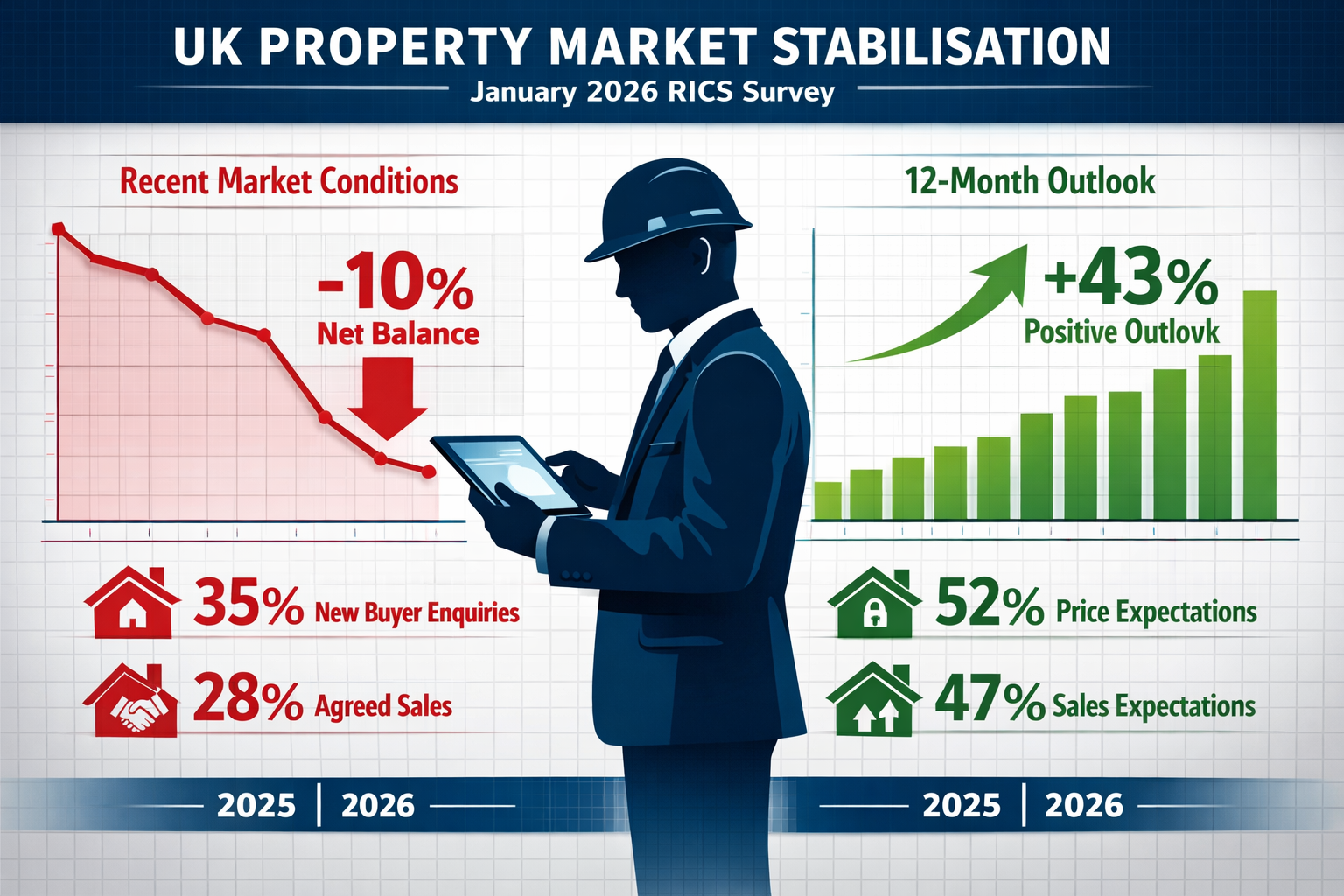
The January 2026 RICS residential market survey presents a nuanced picture that expert witnesses must interpret carefully. A -10% net balance indicates that 10% more surveyors reported price decreases than increases—a significant improvement from deeper negative territory in previous quarters. This stabilisation represents neither recovery nor continued decline, but rather a market equilibrium point where downward pressure has substantially eased.
For expert witnesses preparing RICS valuations, this creates specific challenges:
- Valuation date sensitivity: Properties valued in December 2025 versus February 2026 may reflect materially different market conditions
- Comparable evidence selection: Recent transactions may not accurately reflect current stabilised values
- Market sentiment integration: The psychological shift toward optimism affects buyer behaviour and achievable prices
The +43% improvement in 12-month outlook represents a dramatic sentiment shift. Expert witnesses must distinguish between current market value (reflecting present conditions) and market expectations (forward-looking sentiment that may influence but not determine today's values).
Regional Variations and National Trends
While national figures provide context, expert witnesses must recognise significant regional disparities. Properties in areas with strong employment fundamentals may have already returned to positive territory, while others remain under pressure. When preparing expert witness reports, surveyors should:
- Contextualise national data within specific local market conditions
- Reference regional RICS survey data where available
- Identify local market drivers that may diverge from national trends
- Document market timing explicitly in valuation reports
This granular approach ensures that Expert Witness Valuations in Stabilising National Prices: RICS Evidence Standards from January 2026 Survey reflect genuine market conditions rather than broad generalisations.
RICS 5th Edition Expert Witness Standard: Key Updates for 2026
Primary Duty Reinforcement and Independence Requirements
The consultation on the 5th edition of "Surveyors acting as expert witnesses" marks the first major update since 2014, addressing fundamental principles that govern expert witness work [1]. The updated standard reinforces unequivocally that an expert witness's primary duty is to the tribunal or court, not to the instructing party.
This principle has profound implications for valuation work in 2026's stabilising market:
"The expert witness must provide independent, unbiased evidence that falls strictly within their area of genuine expertise, regardless of whether it supports the client's position."
For chartered surveyors undertaking matrimonial valuations or mortgage dispute work, this means:
- Resisting pressure to adopt optimistic or pessimistic assumptions that align with client interests
- Disclosing limitations when market volatility creates valuation uncertainty
- Acknowledging alternative methodologies that other competent experts might reasonably adopt
- Maintaining transparency about how stabilisation data influenced valuation conclusions
The standard explicitly requires that all evidence remains within the surveyor's true area of expertise. In a transitioning market, this may mean declining instructions where market forecasting rather than current valuation forms the central dispute issue.
Global Application with Local Legal Recognition
The 5th edition applies worldwide while recognising jurisdictional differences in legal systems [1]. This global scope matters for UK-based surveyors who may be instructed on international property disputes or cross-border transactions.
Key considerations include:
- Adapting report formats to meet specific tribunal requirements in different jurisdictions
- Understanding procedural rules that govern expert evidence in various legal systems
- Maintaining RICS core principles while respecting local legal frameworks
- Coordinating with legal representatives to ensure compliance with jurisdiction-specific rules
For most UK practitioners, this means understanding how RICS Homebuyer Surveys Level 2 and other standard products translate into expert witness contexts under English, Scottish, or Northern Irish legal procedures.
Integrating Red Book Global Standards into Expert Witness Valuations
Red Book Effective Date and Mandatory Compliance
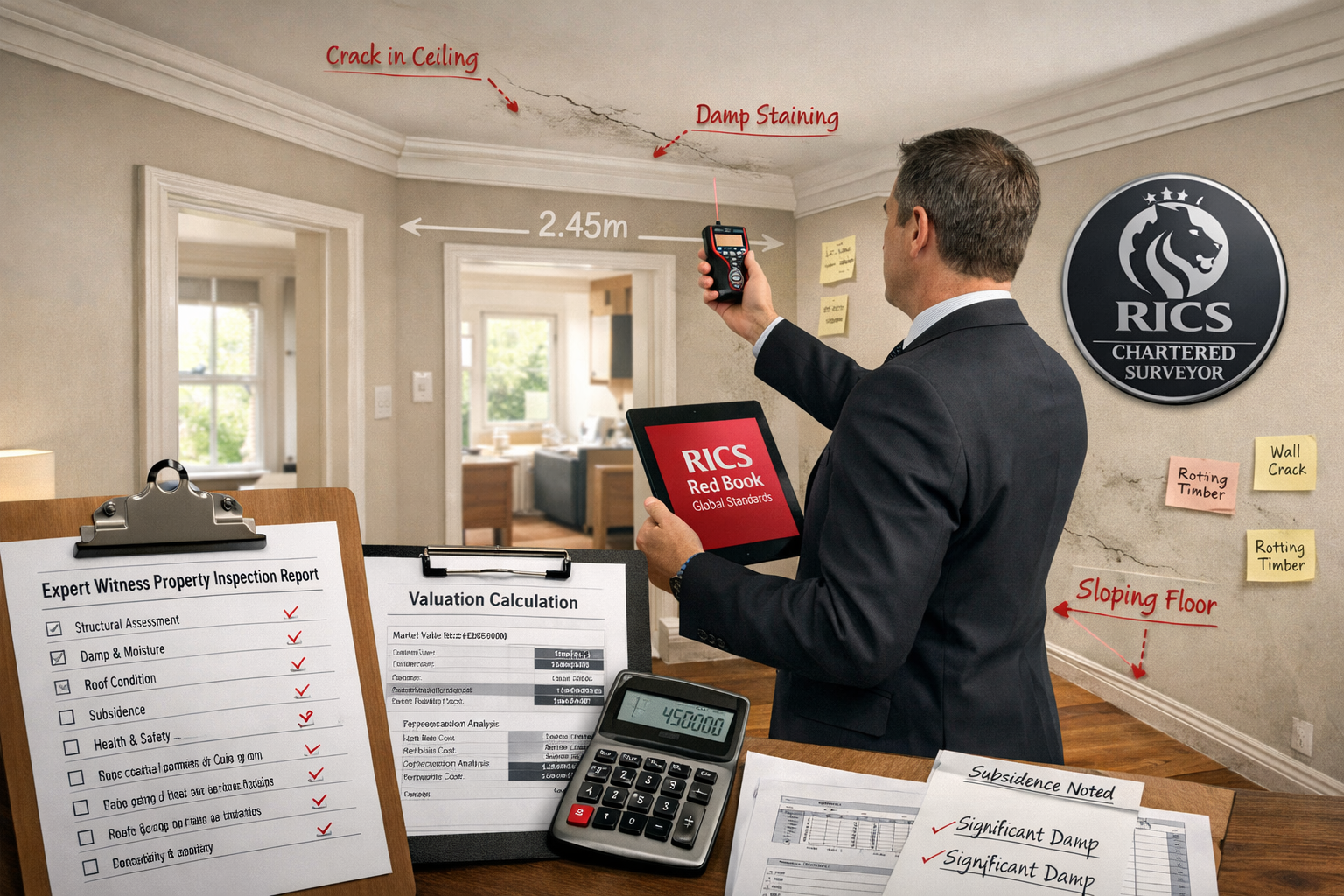
The RICS Valuation – Global Standards (Red Book) became effective on 31 January 2025, applying to all RICS members and regulated firms undertaking valuations [3]. This timing is significant: expert witness valuations prepared in 2026 must comply with these updated standards, which incorporate International Valuation Standards (IVS).
The Red Book establishes mandatory requirements for:
- Basis of value selection: Market value, investment value, or other appropriate bases clearly defined
- Assumptions and special assumptions: Explicitly stated and justified
- Valuation approach: Income, market, or cost approaches applied transparently
- Reporting standards: Comprehensive documentation of methodology and reasoning
For Expert Witness Valuations in Stabilising National Prices: RICS Evidence Standards from January 2026 Survey, Red Book compliance provides a defensible framework that demonstrates professional rigour. Tribunals increasingly expect expert witnesses to reference recognised professional standards, and Red Book adherence signals methodological soundness.
Valuation Approaches in Transitioning Markets
The Red Book recognises three primary valuation approaches, each with specific applications in stabilising markets:
| Approach | Application in Stabilising Markets | Strengths | Limitations |
|---|---|---|---|
| Market Approach | Comparable sales analysis adjusted for market timing | Reflects actual transaction evidence | Recent comparables may not reflect current stabilisation |
| Income Approach | Capitalisation of rental income with adjusted yields | Less volatile than sales prices | Requires accurate yield assessment in uncertain conditions |
| Cost Approach | Depreciated replacement cost | Useful when transaction evidence is sparse | May not reflect market sentiment shifts |
Expert witnesses should document which approach was primary and explain why it was most appropriate given the January 2026 market context. When preparing capital gains tax valuations or matrimonial valuations, the selected approach must be justified with reference to available evidence and market conditions.
Special Assumptions and Market Stabilisation
The Red Book requires clear identification of special assumptions—assumptions that differ from what would be assumed in a standard valuation. In a stabilising market, expert witnesses may need to adopt special assumptions such as:
- Market conditions at specific dates: Assuming the property was marketed during a particular phase of market transition
- Completed development: For properties under construction when market conditions were changing
- Alternative use: When highest and best use may shift as market confidence returns
Each special assumption must be clearly stated, justified, and its impact on value explained. This transparency is crucial for Expert Witness Valuations in Stabilising National Prices: RICS Evidence Standards from January 2026 Survey, as it allows tribunals to understand exactly what the valuation represents.
Practical Application: Defensible Valuation Methodologies for 2026
Comparable Evidence Selection in Transitioning Markets
Selecting appropriate comparable evidence represents perhaps the greatest challenge in stabilising markets. The -10% net balance and +43% outlook shift mean that transactions from different periods reflect materially different market conditions.
Best practices for comparable selection include:
- Time-adjust systematically: Apply transparent adjustments for market movement between comparable transaction dates and valuation date
- Weight recent evidence: Prioritise transactions from the stabilisation period (Q4 2025 onwards) over earlier distressed sales
- Analyse transaction circumstances: Distinguish between forced sales, motivated sellers, and arms-length transactions
- Document rejection rationale: Explain why certain potential comparables were excluded
- Consider market depth: Acknowledge when limited transaction volume creates uncertainty
When conducting RICS Right to Buy valuations or Help to Buy valuations, expert witnesses must be particularly careful about comparable selection, as these schemes may have specific valuation requirements that interact with market timing considerations.
Addressing Valuation Uncertainty Transparently
The January 2026 market presents genuine uncertainty—prices have stabilised but future direction remains unclear despite improved sentiment. Expert witnesses must acknowledge this uncertainty rather than project false precision.
Effective approaches include:
- Valuation ranges: Providing a justified range rather than a single point estimate when uncertainty is material
- Sensitivity analysis: Demonstrating how different reasonable assumptions affect value conclusions
- Confidence levels: Explicitly stating the degree of confidence in the valuation given market conditions
- Alternative scenarios: Presenting valuations under different market trajectory assumptions when relevant
This transparency strengthens rather than weakens expert witness credibility. Tribunals recognise that markets involve uncertainty, and experts who acknowledge this demonstrate professional integrity.
Integrating Market Outlook Data Appropriately
The +43% improved 12-month outlook is sentiment data, not a valuation input. Expert witnesses must distinguish between:
- Current market value: What a willing buyer would pay a willing seller today
- Market expectations: What participants believe may happen in future
While market expectations influence buyer behaviour and therefore current values, they should not be directly incorporated as valuation adjustments. Instead, expert witnesses should:
- Reference outlook data as context: Explain the market environment without using it as a direct valuation input
- Consider behavioural impacts: Assess whether improved sentiment has already influenced achievable prices
- Avoid forecasting: Unless specifically instructed to provide investment value or other forward-looking assessments
- Maintain valuation date discipline: Value the property as at the specified date, not as it might be valued in future

Modern Practice Integration: AI, Digital Evidence, and New Procedures
AI and Technology in Expert Witness Valuations
The 5th edition expert witness standard explicitly addresses AI use and digital evidence—a recognition that technology increasingly supports valuation work [1]. In 2026, expert witnesses may leverage AI for:
- Automated valuation models (AVMs): As supporting evidence or cross-checks, not primary valuation basis
- Market data analysis: Processing large datasets to identify trends and comparable properties
- Document analysis: Reviewing extensive transaction records efficiently
- Predictive analytics: Understanding market dynamics (with appropriate caveats about forecasting limitations)
Critical requirements for AI integration:
- Transparency: Disclose when AI tools were used and how they influenced conclusions
- Validation: Verify AI outputs against professional judgment and alternative sources
- Limitations acknowledgment: Explain AI tool constraints and potential biases
- Professional responsibility: The expert remains accountable for all conclusions regardless of tools used
When preparing building surveys or structural surveys that inform expert witness valuations, technology can enhance efficiency but cannot replace professional expertise.
Digital Evidence Standards and Verification
Digital evidence—property listing data, online transaction records, digital photographs—forms an increasing proportion of valuation support materials. The updated RICS standards emphasise quality and relevance of all evidence [1].
Expert witnesses should:
- Verify digital sources: Confirm authenticity and accuracy of online data
- Document provenance: Clearly identify where digital evidence originated
- Assess reliability: Evaluate whether digital sources meet tribunal evidence standards
- Maintain audit trails: Preserve digital evidence in formats that demonstrate it hasn't been altered
- Consider admissibility: Understand legal requirements for digital evidence in specific jurisdictions
For lease extension valuations or freehold valuations, digital Land Registry data and online property records provide valuable evidence, but expert witnesses must verify accuracy rather than accepting information uncritically.
Conflict of Interest Management and Fee Arrangements
Enhanced Disclosure Requirements
The 5th edition provides clearer requirements for identifying and disclosing conflicts of interest [1]. In a stabilising market where property values are contested, conflicts may arise from:
- Previous work for parties: Having valued the same property previously for one of the disputing parties
- Ongoing client relationships: Regular instruction by one party creating perceived bias
- Financial interests: Direct or indirect financial stakes in valuation outcomes
- Personal relationships: Connections with parties, properties, or related interests
Expert witnesses must:
- Conduct thorough conflict checks before accepting instructions
- Disclose all potential conflicts to instructing parties and tribunals
- Obtain informed consent where conflicts exist but work can proceed
- Decline instructions when conflicts cannot be managed appropriately
When undertaking valuation for capital gains tax or other tax-related expert work, independence is particularly critical as HMRC and taxpayers have directly opposing interests.
Fee Guidance: Conditional and Deferred Arrangements
The updated standard provides clear guidance on fee structures [1], addressing a longstanding area of uncertainty. Key principles include:
- Conditional fees: Generally inappropriate for expert witness work as they create outcome dependency
- Deferred fees: Acceptable if structured to avoid linking payment to favourable outcomes
- Hourly or fixed fees: Preferred approaches that maintain independence
- Fee transparency: Clear fee agreements documented before work commences
Prohibited fee structures:
❌ Success fees based on valuation amount achieved
❌ Percentage-based fees linked to dispute settlement value
❌ Bonus payments for favourable tribunal outcomes
❌ Fee reductions if testimony doesn't support client position
For commercial property valuations in expert witness contexts, fee arrangements must be structured to preserve independence regardless of the property's ultimate assessed value.
Case Applications: Expert Witness Valuations Across Dispute Types
Mortgage Disputes and Lending Valuations
In stabilising markets, mortgage disputes frequently arise when:
- Borrowers challenge valuations that they believe underestimate recovery potential
- Lenders dispute valuations used for loan-to-value calculations during refinancing
- Repossession proceedings require accurate market value assessments
Expert witnesses must distinguish between mortgage valuations and surveys, applying appropriate standards for each context. The January 2026 stabilisation data is particularly relevant, as it may support arguments that recent downward valuations no longer reflect current market conditions.
Key considerations:
- Document whether the valuation reflects market conditions at the original lending date or current date
- Address whether improved outlook affects current market value or merely future expectations
- Consider forced sale scenarios if relevant to the dispute
- Apply appropriate valuation basis (market value vs. mortgage lending value)
Matrimonial and Divorce Settlements
Matrimonial valuations in 2026 must navigate the challenge of equitable division when property values have recently stabilised after decline. Disputes may centre on:
- Valuation date selection: Whether to value at separation date, petition date, or settlement date
- Market timing: How to account for value changes during proceedings
- Selling costs: Realistic assessment of achievable sale prices in current market
- Joint ownership implications: How stabilisation affects buyout calculations
Expert witnesses should provide clear analysis of how the -10% net balance and improved outlook affect the specific property, avoiding generalised market commentary in favour of property-specific assessment.
Boundary Disputes and Property Rights
When boundary disputes involve property valuations—such as assessing the value impact of disputed land—expert witnesses must apply careful methodology. The stabilising market may affect:
- Development potential: Whether improved sentiment makes development of disputed land more viable
- Comparable land values: How recent land transactions reflect current market conditions
- Ransom value: Whether market recovery affects the strategic value of landlocked parcels
These specialist valuations require integration of surveying expertise (boundary identification) with valuation expertise (value impact assessment), often necessitating collaboration between different specialists.
Professional Development and Continuing Competence
Staying Current with RICS Standards Evolution
The 5th edition consultation process demonstrates that expert witness standards continue to evolve [1]. Professional surveyors must maintain competence through:
- Regular CPD: Focused on expert witness procedures, valuation methodology, and legal developments
- Standards monitoring: Tracking RICS standard updates and consultation outcomes
- Case law awareness: Understanding how tribunals interpret and apply expert evidence standards
- Peer review: Participating in professional networks that discuss expert witness practice
RICS members can access resources through the RICS valuation governance framework [3], which provides ongoing guidance on professional standards compliance.
Building Expert Witness Credentials
Establishing credibility as an expert witness requires:
- Demonstrable expertise: Substantial experience in the specific property type and valuation context
- Professional qualifications: RICS membership and relevant specialist designations
- Training completion: Formal expert witness training courses
- Report writing skills: Ability to communicate complex valuation issues clearly
- Tribunal experience: Practical experience giving evidence and being cross-examined
Surveyors should consider specialist training in areas such as Red Book valuation standards and RICS-registered valuer requirements to enhance their expert witness credentials.
Practical Checklist: Preparing Expert Witness Valuations in 2026
Pre-Instruction Phase
✅ Conflict check: Verify no conflicts of interest exist
✅ Competence assessment: Confirm expertise in property type and dispute context
✅ Fee agreement: Establish independent fee structure in writing
✅ Scope clarification: Understand exactly what valuation questions must be answered
✅ Timeline confirmation: Ensure sufficient time for thorough work
Investigation Phase
✅ Property inspection: Conduct comprehensive chartered surveyor inspection
✅ Document review: Examine all relevant property documentation
✅ Market research: Gather comparable evidence and market data
✅ January 2026 context: Specifically consider stabilisation data relevance
✅ Alternative methodologies: Consider different defensible approaches
Report Preparation Phase
✅ Red Book compliance: Ensure all mandatory Red Book requirements met
✅ Independence demonstration: Clearly state primary duty to tribunal
✅ Methodology transparency: Explain valuation approach and reasoning
✅ Comparable analysis: Document comparable selection and adjustments
✅ Uncertainty acknowledgment: Address valuation uncertainty appropriately
✅ Special assumptions: Clearly identify and justify any special assumptions
✅ AI disclosure: Disclose any technology tools used and their role
Pre-Hearing Phase
✅ Expert discussions: Engage constructively with opposing experts
✅ Joint statement: Prepare joint statement identifying agreements and disagreements
✅ Question preparation: Anticipate cross-examination questions
✅ Evidence verification: Confirm all evidence remains current and accurate
✅ Report review: Re-read report thoroughly before giving evidence
Conclusion: Excellence in Expert Witness Valuations for 2026's Stabilising Market
The convergence of January 2026's market stabilisation data, updated RICS expert witness standards, and Red Book Global Standards implementation creates both challenges and opportunities for valuation professionals. Expert Witness Valuations in Stabilising National Prices: RICS Evidence Standards from January 2026 Survey require sophisticated understanding of market dynamics, rigorous application of professional standards, and unwavering commitment to independence.
The -10% net balance indicates genuine price stabilisation, while the +43% improved 12-month outlook signals returning confidence—but expert witnesses must carefully distinguish current market value from future expectations. By applying the enhanced RICS 5th edition standards, maintaining Red Book compliance, and adopting transparent methodologies that acknowledge uncertainty, chartered surveyors can deliver expert witness valuations that withstand tribunal scrutiny and serve the interests of justice.
Actionable Next Steps
For surveyors seeking to strengthen their expert witness practice:
- Review the 5th edition consultation materials and provide feedback during the consultation period to shape final standards
- Audit current expert witness procedures against updated RICS requirements, identifying any gaps
- Develop market stabilisation protocols that systematically address January 2026 data in valuation reports
- Invest in CPD focused on expert witness skills, Red Book updates, and market analysis techniques
- Build digital evidence capabilities while maintaining robust verification procedures
- Establish clear conflict checking systems that identify potential issues before accepting instructions
- Consider obtaining specialist expert witness report training to enhance tribunal effectiveness
For property professionals engaging expert witnesses:
- Select RICS-qualified surveyors with demonstrated expertise in the specific property type and dispute context
- Ensure fee arrangements preserve expert independence
- Provide comprehensive documentation and property access to enable thorough investigation
- Understand that expert witnesses serve the tribunal, not your interests, and value this independence
- Request clear explanation of how January 2026 market conditions affect the specific valuation
The property market's transition from decline to stabilisation presents unique valuation challenges, but chartered surveyors equipped with updated RICS standards, Red Book compliance, and rigorous methodology can deliver expert witness valuations that meet the highest professional standards. By embracing transparency, acknowledging uncertainty, and maintaining unwavering independence, expert witnesses contribute to fair, evidence-based dispute resolution that serves all parties and the broader property market.
For professional assistance with expert witness valuations or to discuss how January 2026 market conditions affect your specific property dispute, contact experienced RICS chartered surveyors who can provide independent, tribunal-ready valuation evidence.
References
[1] Rics Launches Global Consultation On Updated Expert Witness Standard – https://www.rics.org/news-insights/rics-launches-global-consultation-on-updated-expert-witness-standard
[2] Red Book Global Standards Incorporating Ivs – https://www.rics.org/content/dam/ricsglobal/documents/standards/Red-Book-Global-Standards-incorporating-IVS.pdf
[3] Valuation Governance – https://www.rics.org/profession-standards/rics-standards-and-guidance/sector-standards/valuation-standards/valuation-governance
[4] Valuation Standards – https://www.rics.org/profession-standards/rics-standards-and-guidance/sector-standards/valuation-standards
[5] Valuation Standards Local Requirements – https://ww3.rics.org/uk/en/journals/property-journal/valuation-standards-local-requirements.html
[6] Expert Witness Valuations In 2026s Stabilizing Market Rics Standards For Mortgage Disputes And Property Disagreements – https://nottinghillsurveyors.com/blog/expert-witness-valuations-in-2026s-stabilizing-market-rics-standards-for-mortgage-disputes-and-property-disagreements