The surveying sector stands at a critical turning point. After years of market uncertainty, 2026 is forecasted as a year of recovery and growth, with major lenders anticipating a significant uplift in volumes and a strong start to the year[1]. For surveying firms, this presents both an opportunity and a challenge: how to scale operations, recruit talent, and manage workflow effectively during the anticipated surge in demand. The firms that prepare now will capture market share, while those caught unprepared risk losing clients and damaging their reputation.
The stakes are high. With buyer enquiries improving significantly—showing a -15% net balance in January 2026, up from -21% in December 2025[4]—and potential government reforms on the horizon that could make property condition assessments a standard upfront requirement[1], surveying firms must act decisively. Surveyor capacity planning for 2026 market recovery isn't just about hiring more people; it's about building resilient teams, implementing smart technology, and creating workflows that can flex with market demands.

Key Takeaways
- Major lenders are forecasting increased volumes with strong growth expected throughout 2026, requiring immediate capacity planning[1]
- Buyer enquiries improved by 6 percentage points between December 2025 and January 2026, signaling market recovery momentum[4]
- Government reforms may mandate upfront property assessments, potentially transforming survey demand patterns and timing[1]
- Technology adoption and digital tools are essential for scaling operations without proportional staff increases
- Strategic recruitment and training pipelines must be established now to meet anticipated Q2-Q3 2026 demand peaks
Understanding the 2026 Market Recovery Landscape
Lending Volume Forecasts and Market Indicators
The surveying sector is experiencing a fundamental shift. After a challenging period marked by rising interest rates and economic uncertainty, 2026 represents a turning point for property market activity. Major lenders are not just cautiously optimistic—they're actively forecasting increased volumes and preparing for sustained growth[1].
Several key indicators support this optimistic outlook:
📈 Buyer Sentiment Improvements
- New buyer enquiries showed a 6-point improvement from December 2025 to January 2026[4]
- Professional and institutional landlords remain bullish, continuing investment activities[1]
- First-time buyer activity is stabilizing as mortgage products become more competitive
🏦 Lender Positioning
Major financial institutions are expanding their surveying panels and increasing approved capacity, signaling confidence in sustained volume growth. This institutional preparation provides strong evidence that the recovery is not merely speculative but backed by concrete business planning.
🏘️ Property Market Dynamics
The market is witnessing a shift from the "wait and see" approach that dominated 2024-2025 to active engagement. Sellers are becoming more realistic with pricing, while buyers are recognizing that waiting for further rate drops may mean missing opportunities. This convergence is creating the conditions for increased transaction volumes.
For surveying firms, understanding these dynamics is crucial for effective capacity planning. The recovery won't be uniform across all property types or regions, requiring sophisticated resource allocation strategies.
Regional Variations and Demand Hotspots
Not all markets will recover at the same pace. London and the South East are expected to lead the recovery, with chartered surveyors in Central London and surrounding areas likely to experience the earliest and strongest demand surges.
High-Growth Areas for 2026:
| Region | Growth Drivers | Capacity Requirements |
|---|---|---|
| Central London | Professional landlord activity, foreign investment | High – immediate scaling needed |
| West London | Family home market, school catchments | Medium-High – Q2 preparation |
| South East | Commuter belt recovery, hybrid working | Medium – flexible capacity |
| Regional Cities | Affordability, local economic growth | Medium – targeted expansion |
Chartered surveyors in West London and chartered surveyors in Surrey should prepare for sustained activity, particularly in the £500,000-£1.5 million price bracket where buyer confidence is returning strongest.
Government Reform Impact on Survey Demand
Perhaps the most significant factor in surveyor capacity planning for 2026 market recovery is the potential for transformative government reform. The government is currently consulting on whether property condition assessments should become a standard upfront requirement in the homebuying process[1].
Potential Reform Implications:
✅ Earlier Survey Timing – Surveys would move from post-offer to pre-listing phase
✅ Increased Volume – Every listed property could require assessment
✅ Different Workflow Patterns – Seller-commissioned rather than buyer-commissioned surveys
✅ Quality Standardization – Likely increased regulatory oversight and reporting standards
If these reforms proceed, the impact on surveying capacity requirements could be substantial. Firms need to monitor the consultation process closely and develop contingency plans for different reform scenarios. The shift from buyer-commissioned to seller-commissioned surveys would fundamentally alter when and how capacity needs to be deployed throughout the year.
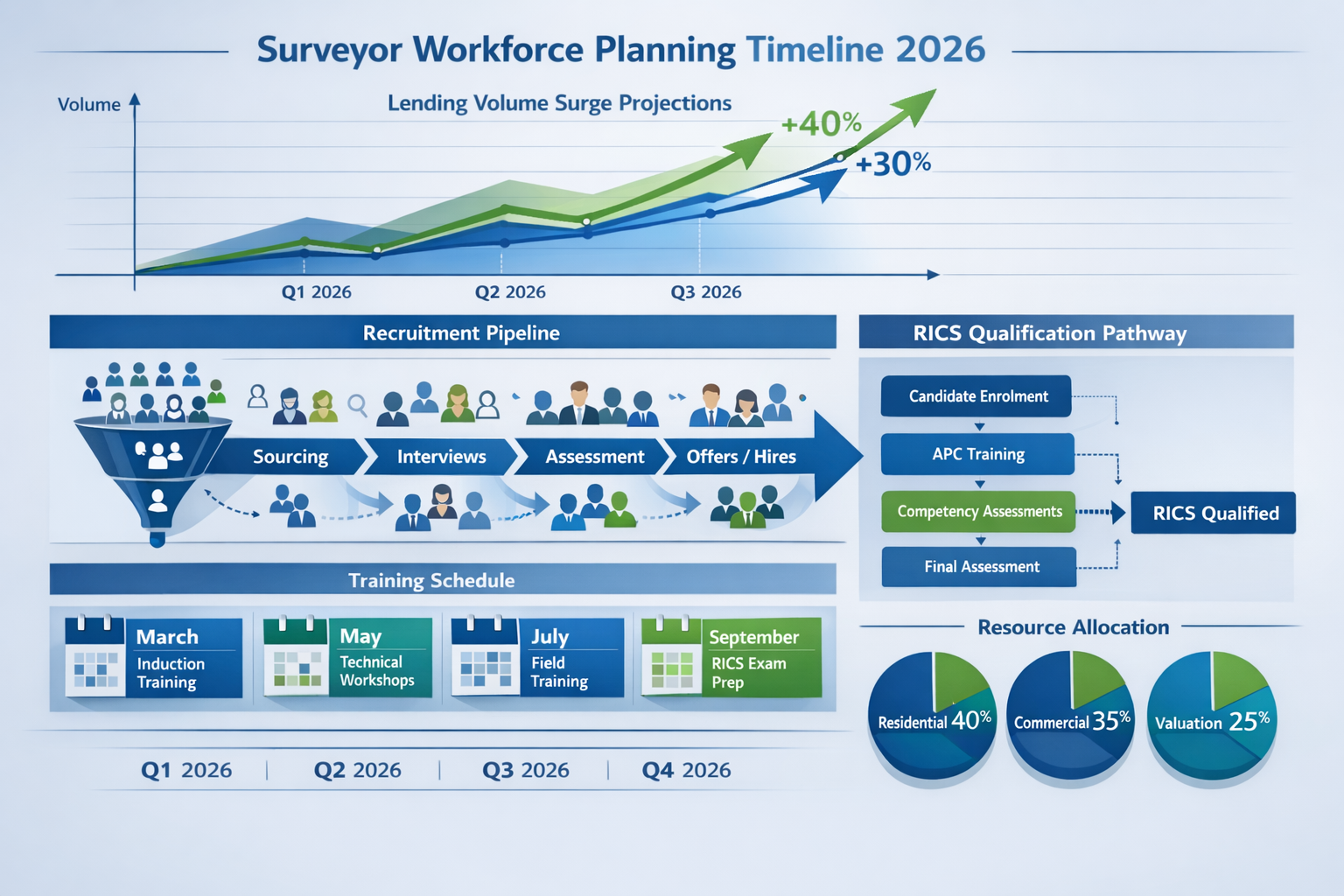
Strategic Workforce Planning for Surveyor Capacity Planning for 2026 Market Recovery
Assessing Current Capacity and Future Needs
Before expanding teams, surveying firms must conduct a thorough capacity audit. This involves more than counting surveyors—it requires understanding productivity levels, specialization mix, and geographic coverage.
Key Capacity Metrics to Evaluate:
📊 Surveyor Utilization Rates
- Current surveys completed per surveyor per week
- Average turnaround times from instruction to report delivery
- Percentage of time spent on surveys vs. administrative tasks
- Peak capacity vs. sustainable capacity
📊 Service Mix Analysis
Different survey types require different time investments. A RICS Homebuyer Survey typically requires 2-4 hours including travel and reporting, while structural surveys demand significantly more time and expertise.
Capacity Planning Formula:
Required Surveyors = (Projected Weekly Instructions × Average Survey Hours) / (Available Hours per Surveyor × Utilization Target)
For example, if a firm expects 100 weekly instructions averaging 4 hours each, with surveyors working 35 hours weekly at 80% utilization:
- Required capacity = (100 × 4) / (35 × 0.80) = 14.3 surveyors
This calculation should be performed for different scenarios (baseline, moderate growth, high growth) to establish hiring targets.
Building Recruitment Pipelines
The surveying profession faces a talent shortage that predates the 2026 recovery. RICS is actively working on clearer pathways for graduates to gain qualifications[1], but firms cannot wait for industry-wide solutions. Proactive recruitment strategies are essential.
Multi-Channel Recruitment Approach:
🎯 Experienced Surveyor Recruitment
- Competitive compensation packages with performance bonuses
- Flexible working arrangements (hybrid models proving attractive)
- Clear career progression pathways
- Investment in CPD and professional development
🎯 Graduate and Trainee Programs
Developing internal talent pipelines provides long-term capacity solutions. Firms should:
- Partner with universities offering surveying programs
- Offer structured APC (Assessment of Professional Competence) support
- Provide mentorship from senior RICS chartered surveyors
- Create clear 2-3 year pathways to qualification
🎯 Returner Programs
Many qualified surveyors have left the profession or reduced hours. Targeted returner programs can tap this experienced talent pool with:
- Flexible part-time arrangements
- Refresher training on current standards and technology
- Supportive reintegration with manageable initial workloads
Timeline Considerations:
The recruitment process for qualified surveyors typically takes 8-12 weeks from job posting to start date. For firms anticipating peak demand in Q2-Q3 2026, recruitment should be well underway by early 2026. Graduate recruitment operates on even longer timelines, with university partnerships needing establishment 12-18 months ahead of hiring.
Training and Professional Development Strategies
Hiring is only the first step. Effective onboarding and continuous professional development are crucial for maintaining quality standards during rapid expansion.
Structured Training Framework:
📚 Technical Competency Development
- Standardized training on survey methodologies and reporting standards
- Specialization tracks for different property types (residential, commercial, heritage)
- Defect identification training with focus on contemporary issues (RAAC, cladding concerns)[4]
- RICS valuation methodology for surveyors offering valuation services
📚 Technology and Systems Training
Modern surveying increasingly relies on digital tools. New team members need training on:
- Digital survey software and mobile applications
- Report generation systems and templates
- Workflow management platforms
- Client communication systems
📚 Quality Assurance and Mentorship
During expansion, maintaining quality standards is paramount. Implement:
- Peer review systems for new surveyors' reports
- Senior surveyor mentorship assignments
- Regular quality calibration sessions
- Client feedback integration into training
RICS is enhancing its CPD platforms with improved digital tools and a new RICS member app[1], providing valuable resources for ongoing professional development. Firms should leverage these industry resources while supplementing with internal training programs.
Quality Control During Rapid Expansion:
⚠️ The Quality-Speed Balance
As volumes increase, the temptation to rush surveys or reduce thoroughness can be strong. However, compromising quality damages reputation and increases professional indemnity risk. Strategies to maintain standards include:
- Clear quality benchmarks and checklists
- Adequate time allocation per survey type
- Senior surveyor spot-checks on reports
- Client satisfaction monitoring
- Professional indemnity insurer engagement on risk management

Technology and Operational Efficiency in Surveyor Capacity Planning for 2026 Market Recovery
Digital Tools for Scaling Operations
Technology is the force multiplier that enables surveying firms to handle increased volumes without proportional staff increases. Smart technology adoption can improve productivity by 20-30% while maintaining or improving quality standards.
Essential Technology Stack for 2026:
💻 Survey Management Software
Centralized platforms that handle:
- Instruction intake and client onboarding
- Surveyor scheduling and assignment
- Document management and report generation
- Client communication and report delivery
- Invoice generation and payment tracking
💻 Mobile Survey Applications
Field surveyors need robust mobile tools that enable:
- Offline data collection and photo capture
- Voice-to-text note-taking functionality
- Instant access to property information and previous surveys
- Real-time communication with office teams
- GPS tracking for time and location verification
💻 Automated Reporting Systems
Modern reporting tools can:
- Auto-populate standard sections from field data
- Generate consistent formatting and branding
- Include interactive elements (photo galleries, defect summaries)
- Integrate with valuation calculations for combined services
- Provide multiple output formats (PDF, interactive web reports)
💻 Client Portal Systems
Self-service portals improve client experience while reducing administrative burden:
- Online booking and scheduling
- Document upload capabilities
- Real-time survey status tracking
- Secure report access and download
- Feedback and review collection
ROI on Technology Investment:
While technology requires upfront investment, the returns are substantial. A surveyor spending 2 hours on administrative tasks per day can redirect that time to productive survey work with proper systems—effectively increasing capacity by 25% without additional hiring.
Workflow Optimization and Process Improvement
Beyond technology, process optimization is crucial for handling increased volumes efficiently. Many surveying firms operate with legacy workflows that create unnecessary bottlenecks.
Critical Workflow Areas to Optimize:
🔄 Instruction to Assignment Process
Reduce the time from client instruction to surveyor assignment through:
- Automated surveyor availability checking
- Geographic assignment algorithms (minimizing travel time)
- Skill-based routing for specialized surveys
- Instant client confirmation and surveyor notification
🔄 Survey Execution Efficiency
Help surveyors work more efficiently in the field:
- Pre-survey property information packages
- Standardized inspection checklists
- Digital measurement and documentation tools
- Reduced duplicate data entry
🔄 Report Production and Review
Streamline the report generation process:
- Template-based reporting with customization flexibility
- Parallel review processes (technical and administrative review simultaneously)
- Clear revision and approval workflows
- Automated quality checks (completeness, consistency)
🔄 Client Delivery and Follow-up
Efficient completion processes:
- Automated report delivery with tracking
- Structured follow-up for questions and clarifications
- Feedback collection for continuous improvement
- Invoice generation and payment processing
Lean Principles for Surveying:
Applying lean methodology to surveying operations identifies and eliminates waste:
- Waiting time – Reduce delays between process steps
- Over-processing – Eliminate unnecessary report sections or redundant checks
- Transportation – Optimize surveyor routing and scheduling
- Inventory – Manage instruction backlog to prevent bottlenecks
- Motion – Streamline surveyor movements during inspections
- Defects – Prevent quality issues through robust processes
Managing Subcontractor Networks
Many firms will need to supplement permanent staff with subcontractor networks during peak periods. Effective subcontractor management ensures capacity flexibility while maintaining quality standards.
Subcontractor Management Best Practices:
✅ Rigorous Vetting and Onboarding
- Verify qualifications and professional indemnity insurance
- Conduct sample survey reviews before assignment
- Provide firm-specific training on standards and systems
- Establish clear contractual terms and expectations
✅ Quality Assurance Systems
- Higher initial review rates for new subcontractors
- Regular quality audits and feedback
- Client satisfaction tracking by surveyor
- Clear performance standards and consequences
✅ Relationship Management
- Fair and prompt payment terms
- Consistent work allocation to reliable performers
- Professional development opportunities
- Clear communication channels
✅ Technology Integration
Subcontractors should use the same systems as permanent staff:
- Access to survey management platforms
- Standardized reporting templates
- Integrated scheduling systems
- Consistent client communication approaches
Risk Management Considerations:
While subcontractors provide flexibility, they also introduce risks. Firms remain responsible for work quality and client satisfaction regardless of who conducts the survey. Robust quality assurance, clear contracts, and adequate professional indemnity insurance coverage are essential. Regular legal review of subcontractor agreements ensures compliance with employment law and professional standards.
Financial Planning and Business Sustainability
Investment Requirements and ROI
Surveyor capacity planning for 2026 market recovery requires significant investment. Firms must balance growth ambitions with financial sustainability, ensuring that expansion investments generate appropriate returns.
Key Investment Categories:
💰 Personnel Costs
- Salaries and benefits for new surveyors (£35,000-£65,000+ depending on experience)
- Recruitment costs (advertising, agency fees, onboarding)
- Training and professional development
- Professional indemnity insurance increases
💰 Technology Infrastructure
- Survey management software (£100-£300 per user monthly)
- Mobile devices and field equipment
- Report generation systems
- Client portal development
💰 Operational Expansion
- Additional office space or vehicle fleet
- Marketing to capture increased market share
- Administrative support staff
- Professional fees (legal, accounting, HR)
ROI Calculation Framework:
Expansion investments should be evaluated against revenue potential:
Break-even Volume = Fixed Investment / (Average Survey Fee - Variable Cost per Survey)
For example, if a firm invests £150,000 in expansion (new surveyors, technology, marketing), with average survey fees of £600 and variable costs of £200:
- Break-even = £150,000 / (£600 – £200) = 375 additional surveys
At a rate of 4 surveys per surveyor per week, this represents approximately 18-19 weeks of capacity from two new surveyors—a reasonable payback period given the anticipated multi-year recovery.
Pricing Strategies for Growth Markets
As demand increases, surveying firms face important pricing decisions. While market recovery might suggest pricing power, competitive dynamics and client expectations require sophisticated approaches.
Strategic Pricing Considerations:
📊 Value-Based Pricing
Rather than purely cost-plus pricing, consider the value delivered:
- Homebuyer surveys preventing costly purchase mistakes
- Commercial building surveys informing major investment decisions
- Specialized services like dilapidations surveys protecting client interests
📊 Tiered Service Offerings
Create clear service tiers with transparent survey pricing:
- Essential tier (standard surveys, basic reporting)
- Professional tier (enhanced reporting, faster turnaround)
- Premium tier (comprehensive surveys, same-day scheduling, dedicated support)
📊 Volume and Relationship Pricing
For institutional clients and repeat business:
- Volume discounts for panel agreements
- Retainer arrangements for consistent work
- Loyalty programs for repeat private clients
📊 Dynamic Pricing for Capacity Management
Use pricing as a capacity management tool:
- Premium pricing for rush services (24-48 hour turnaround)
- Incentive pricing for off-peak scheduling
- Geographic pricing reflecting travel and local market conditions
Competitive Positioning:
Understanding competitor pricing is essential, but competing solely on price is rarely sustainable. Focus on differentiation through:
- Superior service quality and client experience
- Faster turnaround times
- Technology-enabled convenience (online booking, digital reports)
- Specialized expertise in emerging issues (RAAC, cladding, sustainability)[4]
Client Experience and Service Quality
Maintaining Standards During Growth
The greatest risk during rapid expansion is quality degradation. Firms that compromise standards to chase volume inevitably face reputational damage, complaints, and potential professional liability claims.
Quality Assurance Framework:
🎯 Standard Operating Procedures
Document and enforce consistent approaches to:
- Survey methodologies for different property types
- Defect identification and description standards
- Report structure and content requirements
- Client communication protocols
🎯 Quality Metrics and Monitoring
Track key performance indicators:
- Client satisfaction scores (target: 4.5+/5.0)
- Report revision rates (target: <5%)
- Complaint frequency (target: <1%)
- Turnaround time adherence (target: 95%+)
- Surveyor productivity (surveys per week)
🎯 Continuous Improvement Systems
- Regular client feedback analysis
- Surveyor performance reviews
- Process improvement initiatives
- Industry best practice adoption
🎯 Professional Standards Compliance
Ensure all work meets:
- RICS standards and guidance
- Professional indemnity insurance requirements
- Regulatory compliance (building regulations, safety standards)
- Ethical obligations to clients
Client Communication and Expectation Management
Clear communication prevents misunderstandings and builds trust. As volumes increase, systematic communication processes become essential.
Communication Best Practices:
📞 Initial Instruction Phase
- Clear explanation of service scope and limitations
- Transparent pricing and payment terms
- Realistic turnaround time commitments
- Written confirmation of instructions
📞 Survey Execution Phase
- Appointment confirmation and reminders
- Access requirement clarification
- Surveyor identification and credentials
- On-site professionalism and courtesy
📞 Report Delivery Phase
- Timely delivery meeting commitments
- Clear report structure and findings
- Follow-up availability for questions
- Additional service offerings (re-inspections, specialist investigations)
📞 Post-Survey Support
- Reasonable question answering period
- Guidance on next steps and recommendations
- Referrals to specialists where appropriate
- Feedback solicitation
Managing Increased Demand Pressures:
When demand exceeds capacity, transparent communication is crucial:
- Honest turnaround time estimates
- Options for expedited service at premium pricing
- Referrals to trusted partners when unable to accommodate
- Waitlist management with regular updates
Overpromising and underdelivering damages relationships far more than honest capacity acknowledgment. Clients appreciate transparency and will often wait for preferred providers rather than accept rushed, lower-quality alternatives.
Conclusion
Surveyor capacity planning for 2026 market recovery represents both a significant opportunity and a complex challenge for the surveying profession. With major lenders forecasting increased volumes, buyer enquiries improving substantially, and potential government reforms on the horizon, firms that prepare strategically will thrive while unprepared competitors struggle.
The path forward requires integrated action across multiple dimensions:
✅ Strategic workforce planning – Begin recruitment immediately, develop training pipelines, and create flexible capacity through subcontractor networks
✅ Technology adoption – Invest in digital tools that multiply surveyor productivity and improve client experience
✅ Process optimization – Eliminate workflow bottlenecks and implement lean principles to handle increased volumes efficiently
✅ Quality assurance – Maintain rigorous standards even during rapid growth to protect reputation and manage professional liability
✅ Financial discipline – Make calculated investments with clear ROI expectations and sustainable pricing strategies
✅ Client focus – Deliver exceptional experiences that build loyalty and generate referrals in a competitive market
The surveying sector's recovery is not a distant possibility—it's happening now. Firms must act decisively in early 2026 to build the capacity needed for Q2-Q3 demand peaks. Those who wait for certainty will find themselves unable to capitalize on the opportunity, while proactive firms capture market share and establish competitive advantages that persist beyond the immediate recovery period.
Actionable Next Steps
For surveying firms preparing for the 2026 market recovery:
- Conduct a comprehensive capacity audit this month to establish baseline metrics and identify gaps
- Initiate recruitment processes immediately for anticipated Q2-Q3 needs, recognizing 8-12 week lead times
- Evaluate and implement technology solutions that improve productivity and client experience
- Develop quality assurance frameworks that scale with growth and protect standards
- Establish financial models for different growth scenarios with clear investment criteria
- Monitor government reform consultations and develop contingency plans for different outcomes
- Engage with RICS resources including enhanced CPD platforms and member support tools[1]
The firms that approach surveyor capacity planning for 2026 market recovery with strategic rigor, operational excellence, and unwavering commitment to quality will emerge as industry leaders. The recovery is here—the question is whether your firm is ready to meet the moment.
References
[1] Surveying In 2026 Reform Recovery And Renewed Demand – https://www.lrg.co.uk/news-and-insights/surveying-in-2026-reform-recovery-and-renewed-demand/
[4] Building Survey Priorities In 2026 Market Recovery Raac Cladding And Latent Defects For Stabilising Prices – https://nottinghillsurveyors.com/blog/building-survey-priorities-in-2026-market-recovery-raac-cladding-and-latent-defects-for-stabilising-prices