Nearly one in four new-build buyers reported a problem serious enough to affect their enjoyment of the property within the first two years of ownership, according to homeowner advocacy data [4]. Yet a persistent belief circulates among buyers, and even some estate agents, that a builder's warranty makes an independent survey unnecessary. That belief is wrong, and it costs homeowners money.
This article addresses the question "Do I need a survey when buying a new-build home? Warranty, defects and independent inspection" head-on, separating what a warranty actually covers from what only an independent inspection can catch.
Key Takeaways
- A structural warranty such as NHBC Buildmark is not a substitute for an independent snagging survey, the two serve different purposes.
- From 2 March 2026, the New Homes Quality Code Version 2 gives buyers a legal right to a pre-completion inspection, but that inspection is not the same as hiring your own RICS-qualified surveyor.
- New-build homes average between 100 and 150 defects at handover, ranging from cosmetic snags to structural faults [2].
- An independent snagging survey typically costs £300,£600 and can identify defects that a developer's own sign-off process misses [5].
- Defects reported after the two-year defects liability period may fall outside warranty cover, making early independent inspection even more important.
What a Builder's Warranty Actually Covers
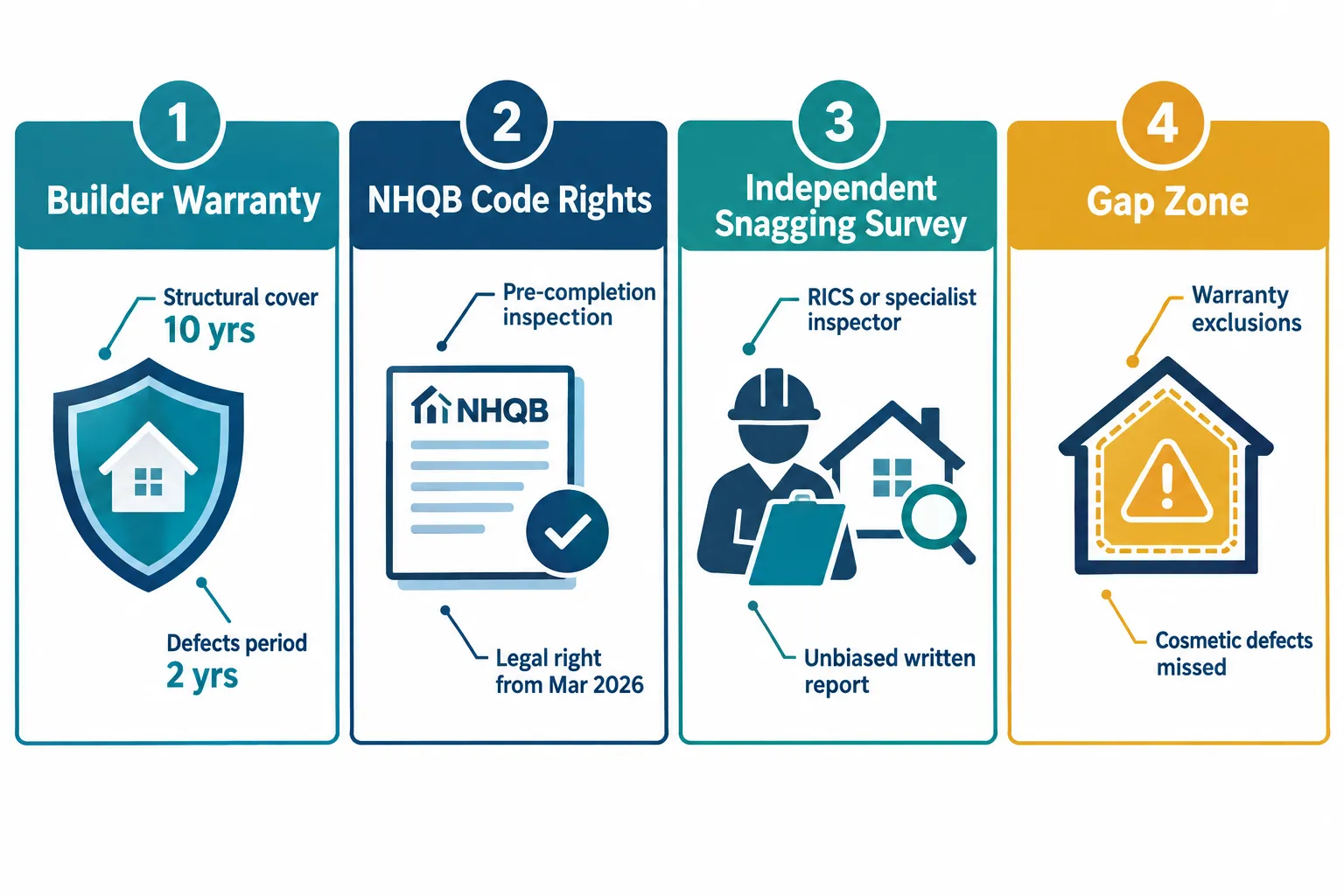
Most new-build homes in England and Wales come with a 10-year structural warranty. NHBC Buildmark is the most widely recognised, covering roughly 80% of new homes registered each year [3]. Similar products include Premier Guarantee, LABC Warranty and Build-Zone.
These warranties operate in layers:
| Period | What is covered | Who resolves it |
|---|---|---|
| Years 1-2 (Defects Period) | Builder must fix defects that breach NHBC technical standards | The developer |
| Years 3-10 (Insurance Period) | Major structural damage only | NHBC insurance |
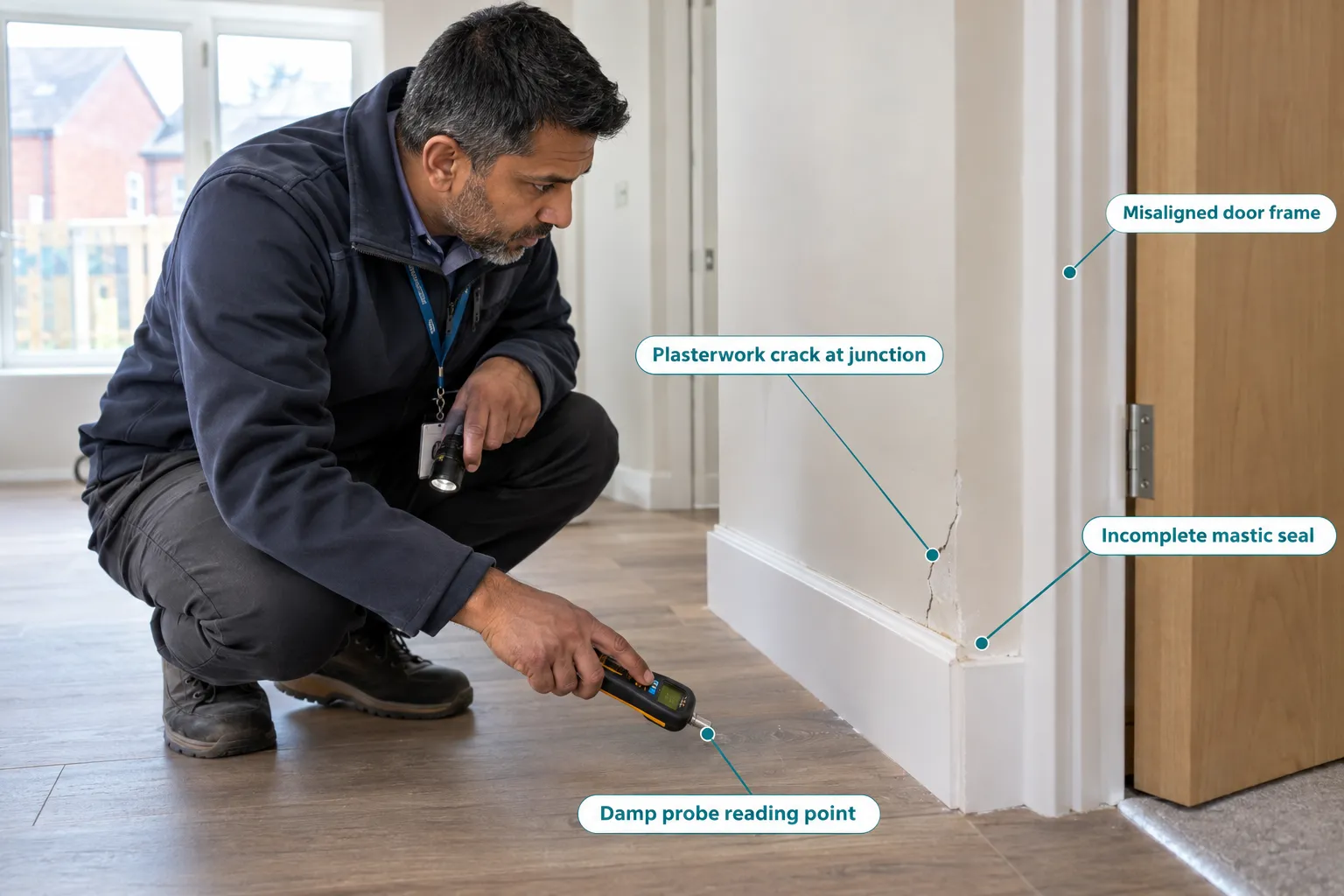
The defects period is not the same as a snagging period. NHBC's standards define a defect as a failure to meet their technical requirements, not every cosmetic or workmanship issue qualifies. Scratched windows, poorly fitted kitchen units, incomplete decoration and misaligned doors are common complaints that developers dispute as warranty claims [4].
The warranty also does not cover:
- Condensation and minor damp where ventilation was not used correctly
- Shrinkage cracks considered "normal" by the developer
- Damage caused by the homeowner after completion
- Anything the buyer accepted at handover without recording
This is the gap that an independent inspection is designed to close. For a broader look at how different types of survey compare, see comparing different types of survey.
The New Homes Quality Code 2026, Rights You Now Have
From 2 March 2026, Version 2 of the New Homes Quality Code came into force. Developers registered with the New Homes Quality Board (NHQB) must now give buyers a legal right to a pre-completion inspection before they hand over the keys [6].
This is a meaningful step forward. Before this change, many developers refused access to independent inspectors before legal completion, leaving buyers unable to document defects until they had already exchanged.
However, the code right has limits buyers should understand:
- It applies only to developers registered with the NHQB, not all builders are members.
- The inspection must be arranged within a specific window before completion; buyers who miss the window lose the right [6].
- The code sets out timelines for fixing defects: emergency issues within 24 hours, urgent defects within five working days, and routine snags within 30 calendar days [6].
- The code does not specify that the inspector must be RICS-qualified or independent, it is the buyer's responsibility to appoint a competent person.
The NHQB's own guidance distinguishes between a pre-completion inspection (a walkthrough to note visible snags) and a full independent snagging survey (a systematic, documented inspection by a qualified professional) [10]. Both are useful; they are not interchangeable.
Why "Do I Need a Survey When Buying a New-Build Home?" Still Gets Asked
The misconception persists for several reasons. Developers often tell buyers that the property has passed building control sign-off and that the warranty provides full protection. Some mortgage lenders commission only a valuation, which confirms the property is worth the loan amount, not that it is defect-free. And buyers, already stretched by deposits and legal fees, are reluctant to spend more.
The data tells a different story. NHBC registered 47,535 new homes in Q2 2026 alone [3]. At the same time, customer satisfaction scores for new-build homes have been falling. BBC reporting in 2026 documented cases where buyers moved into properties with missing insulation, defective roofing and drainage failures that were not visible on a simple walkthrough [1][9].
Homeowner groups consistently advise that a professional snagging survey is one of the most cost-effective steps a new-build buyer can take [2]. The average new-build home has between 100 and 150 defects at handover [2]. Most are minor, but some, such as incorrectly installed fire-stopping, inadequate structural ties or defective drainage, carry long-term consequences that a warranty claim alone may not resolve quickly or fully.
For buyers asking whether the cost is justified, the building survey price trends 2026-2027 article sets out how due-diligence spending has shifted in the current market.
What an Independent Snagging Survey Checks
A professional snagging survey is not a Level 2 or Level 3 RICS building survey, though some RICS surveyors offer both. It is a systematic inspection focused on workmanship, finish and compliance with the developer's own specifications and NHBC technical standards.
A qualified inspector will typically examine:
External
- Roof covering, ridge tiles, flashings and guttering
- Brickwork, render and pointing
- Window and door frames, seals and operation
- Drainage falls and gully positions
- Driveway and path levels
Internal
- Plastering, skimming and paint finish
- Floor coverings, thresholds and transitions
- Joinery, doors, skirting, architrave, staircase
- Kitchen and bathroom fitting, tiling and grouting
- Electrical sockets, switches and consumer unit labelling
- Heating system operation and controls
- Ventilation, particularly in bathrooms and kitchens
The inspection takes three to four hours on a typical three-bedroom house and results in a written report, usually delivered within 48 hours [5]. That report becomes the formal record submitted to the developer.
For a detailed breakdown of what surveyors look for specifically on new-build properties, the new build snagging and defects liability guide covers pre- and post-completion inspections in depth.
Costs, Timing and How to Instruct an Inspector
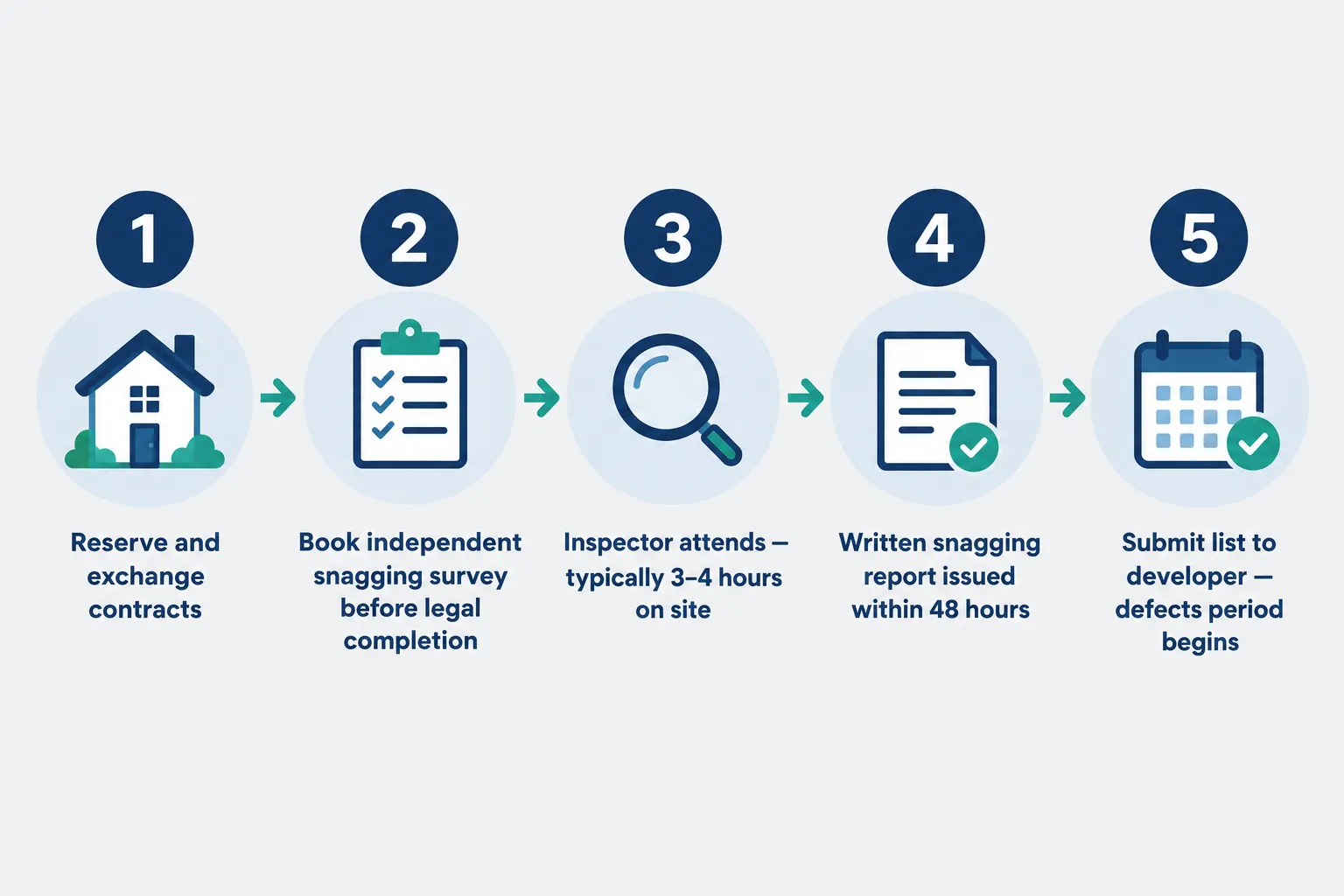
Independent snagging surveys in 2026 typically cost between £300 and £600 for a three- to four-bedroom new-build home, depending on location and the inspector's qualifications [5]. Some firms charge by floor area; others by property type.
Timing is critical. The ideal moment is after the developer has declared the property ready for handover but before legal completion. This gives the buyer documented evidence before they are contractually committed. Under the NHQB code, registered developers must allow this access [6].
If access before completion is refused or not available, the next best option is within the first few days of moving in, before the developer's team clears the site. Defects become harder to attribute to the builder once the buyer has been in occupation for several months.
Who should carry out the inspection?
Look for:
- RICS-qualified surveyors with new-build experience
- Members of the Residential Property Surveyors Association (RPSA)
- Specialist snagging companies with verifiable professional indemnity insurance
Avoid inspectors who cannot provide a written report, who have no professional indemnity cover, or who are introduced by the developer. Independence matters, a surveyor paid by the builder has a conflict of interest [8].
For context on what a full RICS building survey involves, the RICS building surveys Level 2 and Level 3 explained page sets out the differences clearly.
After the Inspection, Defects, Disputes and the Warranty
Once the snagging report is submitted, the developer is obliged (under the NHQB code, where applicable, and under the terms of the warranty) to respond within set timescales [6]. In practice, some developers dispute items, classify defects as "normal settlement" or delay remediation.
If a developer fails to act, buyers have several routes:
- NHQB complaints process, available to buyers of homes built by registered developers
- NHBC resolution service, for warranty-covered defects
- New Homes Ombudsman, for unresolved complaints under the code
- Legal action, as a last resort, using the snagging report as evidence
The snagging report is a legal document. A professionally prepared, dated report from a qualified inspector carries far more weight in a dispute than a buyer's own photographs or notes [8]. This is particularly relevant for defects that emerge in years two to ten, where the boundary between the defects period and the structural insurance period can be contested.
Buyers who discover defects after the two-year defects period has expired face a higher burden of proof. An early independent inspection, with a written report, provides a baseline that can be referred back to years later. For guidance on what constitutes professional negligence in surveying, see surveyor negligence: what counts and how to prove it.
FAQ
Does a mortgage valuation replace a snagging survey?
No. A mortgage valuation confirms the property is adequate security for the loan. It is not a condition report and does not assess workmanship or snags.
Can I do my own snagging inspection?
A buyer's own walkthrough is useful but not sufficient. Most buyers lack the technical knowledge to identify structural deficiencies, ventilation failures or non-compliant installations. A professional report carries legal weight; a buyer's notes generally do not.
What if the developer refuses access before completion?
Under the NHQB code (for registered developers), refusal is a breach. Document the refusal in writing and contact the NHQB. For developers not registered with the NHQB, buyers have less leverage before completion, making post-completion speed essential.
Is a snagging survey the same as a Level 2 or Level 3 RICS survey?
Not exactly. A snagging survey focuses on new-build workmanship and specification compliance. A Level 3 building survey is broader and more appropriate for older or complex properties. Some RICS surveyors combine elements of both for new-build clients. See the RICS home survey page for a full explanation.
How long does a developer have to fix snags?
Under the NHQB code (2026 version): emergency defects within 24 hours, urgent defects within five working days, routine snags within 30 calendar days [6].
What happens if defects appear after the two-year defects period?
Structural defects may still be covered under the warranty's insurance period (years 3-10), but the threshold for a valid claim is higher. Non-structural defects after year two are generally the homeowner's responsibility.
Conclusion
A builder's warranty and an independent snagging survey are not alternatives, they operate at different stages and serve different purposes. The warranty is an insurance product with defined thresholds; the independent inspection is a professional assessment of what has actually been built and how well.
The 2026 updates to the New Homes Quality Code strengthen buyers' rights to pre-completion access, but they do not remove the need to appoint a qualified, independent inspector. Developers' own sign-off processes have a clear conflict of interest, and the average new-build home still reaches handover with over 100 defects [2].
Practical next steps for new-build buyers:
- Confirm whether your developer is registered with the NHQB and understand your pre-completion inspection rights under the 2026 code.
- Appoint an independent RICS-qualified surveyor or RPSA-registered inspector, not one introduced by the developer.
- Book the inspection for the window between the developer declaring the property ready and your legal completion date.
- Submit the written snagging report to the developer in writing, keep a copy, and record all responses.
- If defects are disputed or unresolved, use the NHQB complaints process or NHBC resolution service before considering legal action.
For buyers in the North West, the chartered surveyors and valuers in Manchester page explains what local RICS surveyors look for during a property inspection.
References
[1] BBC News article on new-build defects – bbc.com
[2] Need Snagging List New Build Home – hoa.org.uk
[3] NHBC New Home Statistics Review Q2 2026 – nhbc.co.uk
[4] Fix Problems In A New Build Home – hoa.org.uk
[5] Snagging Survey Cost – hoa.org.uk
[6] A Homeowner Guide To Snagging V2 May 2026 – nhqb.org.uk
[7] Buying A New Build Top Tips – samconveyancing.co.uk
[8] New Build Buyers Urged to Use Snagging Checklist – newsshopper.co.uk
[9] BBC News article on new-build buyer experiences – bbc.co.uk
[10] A Homeowner Guide To Snagging – nhqb.org.uk