One in five homebuyers in 2026 still skip a property survey entirely, despite data showing that those who commission one save an average of £2,600 on their purchase price [4]. The buyers who skip surveys are not saving money, they are deferring costs, often catastrophically. A surveyor's report is not a formality; it is a decision-making document. Yet many buyers receive one, feel overwhelmed by the technical language, and proceed anyway without understanding which findings are genuinely serious.
This guide cuts through that confusion. Understanding the core Surveyor's Report Red Flags: 10 Findings That Should Trigger Renegotiation or Withdrawal gives buyers a clear framework for action, not vague anxiety. Some findings warrant a price reduction. Others mean walking away entirely. Knowing the difference can protect both finances and long-term safety.
Key Takeaways
- Not all survey findings are equal, the ten red flags below represent the most serious categories that directly affect value, safety, and mortgageability.
- Multiple Condition Rating 3 scores in a RICS Level 2 survey are a formal signal that immediate action is required.
- Some defects, such as active subsidence, Japanese knotweed, and undisclosed hazardous materials, may justify full withdrawal rather than renegotiation.
- A high cost-to-value imbalance, where repair costs approach or exceed the negotiating headroom, is a financial red flag, not just a structural one.
- Buyers who act on survey findings save significantly more than the cost of the survey itself.
Why Surveyor's Reports Carry So Much Weight
A RICS-aligned survey is the most authoritative independent assessment a buyer can obtain before exchanging contracts. The RICS Level 2 Home Survey (formerly the HomeBuyer Report) uses a traffic-light condition rating system: Condition Rating 1 (no action needed), Condition Rating 2 (repairs or maintenance required), and Condition Rating 3 (serious defects requiring immediate attention) [7]. A Level 3 Building Survey provides even greater depth for older or non-standard properties.
The traffic-light system exists precisely to help non-specialists prioritise. A single Condition Rating 3 warrants serious attention. Multiple Condition Rating 3 scores across different elements of the same property represent a compounding risk that should trigger immediate renegotiation or withdrawal [3].
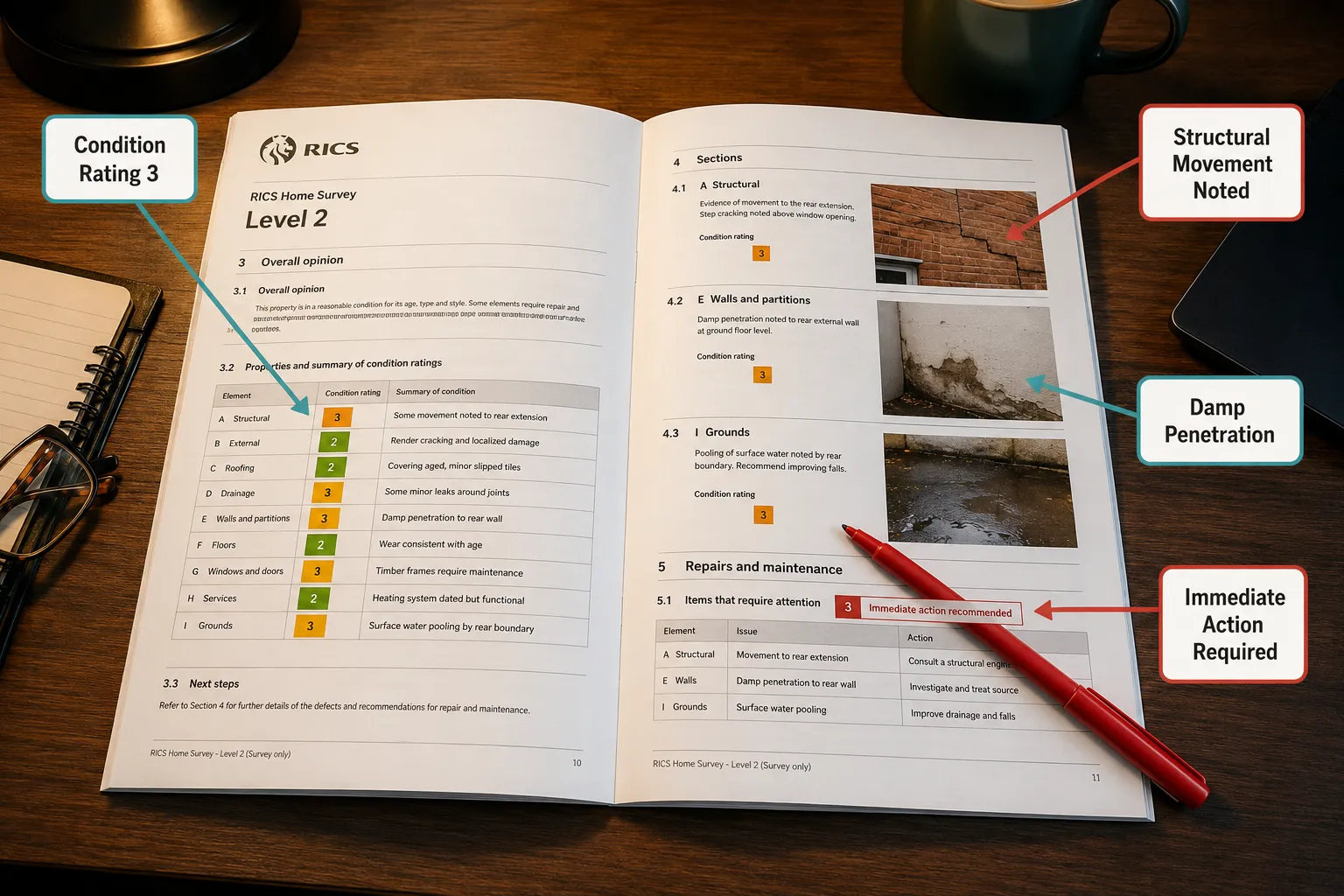
Buyers sometimes assume that a surveyor's role is to validate a purchase. It is not. The surveyor's duty is to report what they find, objectively. When the findings are serious, the buyer's next step is to quantify repair costs through specialist quotes and then decide: renegotiate the price, request remediation before completion, or withdraw entirely.
The 10 Surveyor's Report Red Flags That Demand Action
Understanding the Surveyor's Report Red Flags: 10 Findings That Should Trigger Renegotiation or Withdrawal requires looking at each finding in terms of three factors: severity, cost, and impact on mortgageability.
1. Active Structural Movement or Subsidence
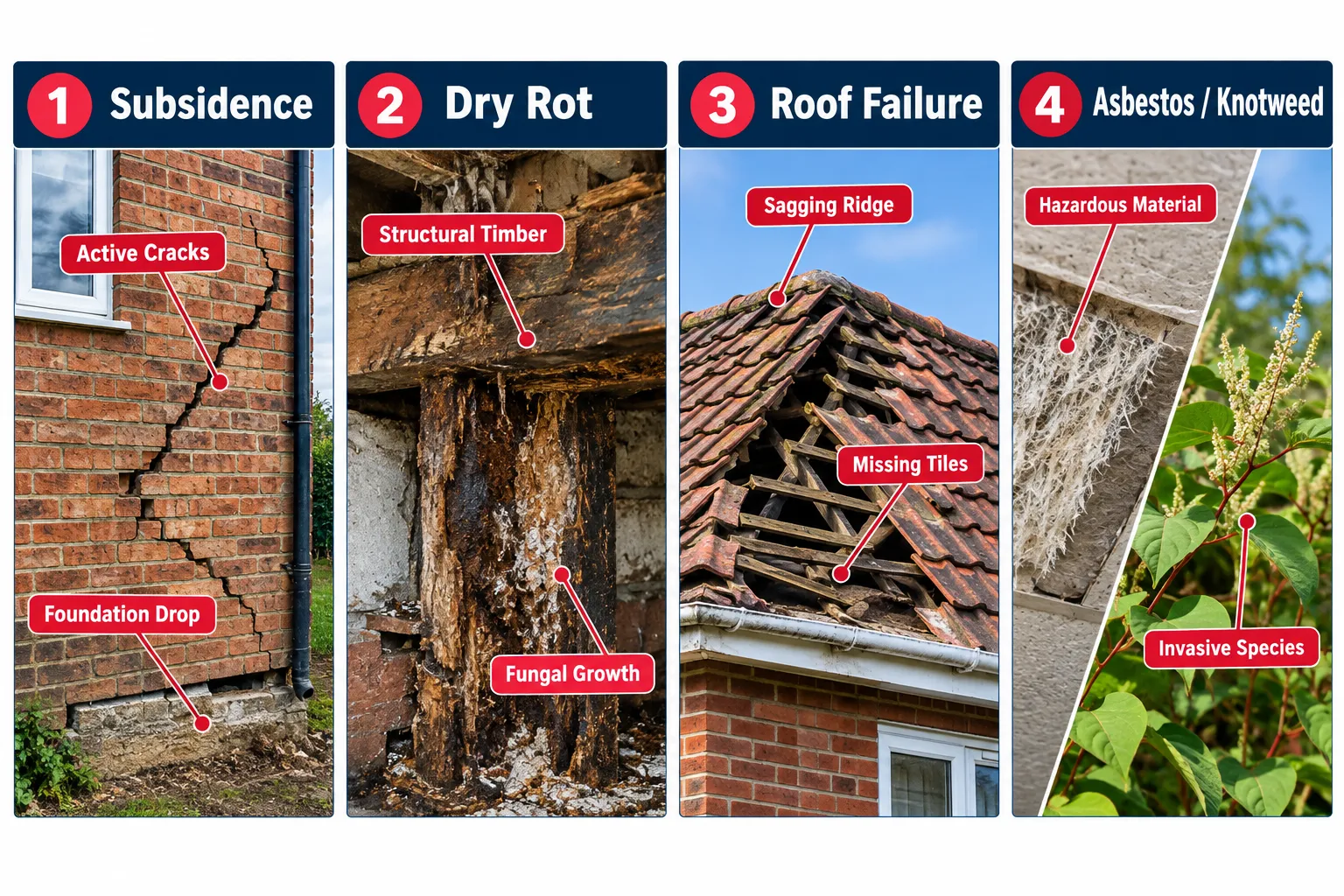
Subsidence, where the ground beneath a property shifts and causes the structure to sink unevenly, is among the most serious findings a surveyor can make. The critical distinction is between historic, stable movement (which may be manageable) and active, ongoing movement (which is not). Active cracking, sloping floors, and doors or windows that no longer close properly are visible indicators [2].
Remediation through underpinning can cost £10,000 to £50,000 or more depending on the extent of the damage. Many insurers will refuse standard cover, and some mortgage lenders will decline to lend entirely. This finding almost always warrants either a significant price reduction or withdrawal.
2. Extensive Damp and Dry Rot Affecting Structural Timbers
Surface damp is common in older properties and is often treatable. The red flag is when damp has progressed to the point where it has caused dry rot, a fungal decay that destroys structural timber. Dry rot spreads rapidly through masonry and can compromise floor joists, roof timbers, and wall plates [9].
Treatment requires removing all affected timber, treating surrounding masonry, and replacing structural elements. Costs can run from £5,000 to well over £20,000 depending on the spread. A surveyor who notes dry rot in multiple locations is flagging a systemic problem, not an isolated repair.
3. Major Roof Failure and Significant Roof Defects
A roof in poor condition is one of the most commonly cited findings in property surveys [2]. Minor issues, a handful of slipped tiles, sit at Condition Rating 2. Major roof failure, sagging ridge lines, widespread felt deterioration, failed flashings, or structural rafter damage, is a Condition Rating 3 finding.
Full roof replacement on a standard three-bedroom house typically costs £5,000 to £15,000. On larger or period properties, costs rise considerably. Buyers should obtain at least two independent roofing contractor quotes before renegotiating, as costs vary widely.
4. Hazardous Materials: Asbestos and Japanese Knotweed
Asbestos is present in a large proportion of properties built before 2000, particularly in artex ceilings, floor tiles, and pipe lagging. When undisturbed, it may not require immediate removal. When damaged or friable, it poses a serious health risk and requires licensed specialist removal, which can cost thousands of pounds per room [3].
Japanese knotweed is a separate but equally serious concern. This invasive plant can penetrate foundations, damage drainage systems, and render a property unmortgageable with many lenders. Some mortgage providers require a professional management plan before they will lend, and eradication programmes can span three to five years [9].
Both findings require specialist assessment beyond the survey itself before any renegotiation figure can be established.
5. Serious Electrical, Gas, or Services Defects
Outdated or dangerous electrical installations, such as older fuse boxes without RCD protection, aluminium wiring, or ungrounded sockets, represent immediate safety risks. Similarly, gas installations that have not been maintained or that show signs of unsafe modification require urgent attention [2].
A surveyor will typically recommend an EICR (Electrical Installation Condition Report) and a Gas Safe inspection when concerns are noted. If these specialist reports return unsatisfactory results, the cost of full rewiring or gas system replacement must be factored into any renegotiation.
6. Flooding History and Environmental Risk
A property's flood history is a material fact that affects both insurability and mortgageability. Surveyors will flag properties in Flood Zone 2 or 3 designations, and buyers should obtain a full environmental search independently [7]. Properties with a confirmed history of flooding may face:
- Significantly higher insurance premiums or refusal of cover
- Reduced resale value and buyer pool
- Lender restrictions or declined mortgage applications
This is a finding where withdrawal may be more appropriate than renegotiation, particularly if the flood risk is ongoing rather than historic.
7. Defects That Threaten Mortgageability
Some defects do not just affect the property's condition, they affect whether a mortgage lender will lend against it at all. Common examples include:
| Defect Type | Typical Lender Response |
|---|---|
| Japanese knotweed within 7 metres | Decline or require management plan |
| Active subsidence | Decline pending specialist report |
| Short lease (under 70 years) | Decline or require extension |
| Structural defects without warranty | Retention or decline |
| Non-standard construction (unresolved) | Decline or specialist lender only |
If a survey reveals defects that fall into these categories, buyers should contact their mortgage broker before proceeding. A declined mortgage application can still affect credit records if not handled carefully.
8. Multiple Condition Rating 3 Scores in a RICS Survey
A single Condition Rating 3 is serious. A cluster of them, across the roof, structure, damp, and services, is a compounding signal that the property has been systematically undermaintained [3]. This pattern, sometimes called a cluster of "evergreen" red flags, suggests that visible defects are likely accompanied by hidden ones.
"When multiple serious defects occur together, the total cost of remediation almost always exceeds the sum of its parts, because access, disruption, and follow-on damage multiply the bill."
Buyers facing multiple Condition Rating 3 findings should commission a full Level 3 Building Survey if they have not already done so, and obtain specialist quotes for every flagged item before making any renegotiation offer [8].
9. High Cost-to-Value Imbalance
Even a single major defect can create a situation where the cost of repair is disproportionate to the available negotiating headroom. This is the cost-to-value imbalance red flag: where the asking price, minus the realistic discount a seller will accept, still leaves the buyer facing significant out-of-pocket repair costs on top of their purchase costs.
A practical framework:
- Obtain specialist quotes for all Condition Rating 3 items.
- Calculate the total remediation cost.
- Assess the realistic discount the seller is likely to accept given market conditions.
- If the gap between the two figures is large, withdrawal protects the buyer's financial position.
This is not an emotional decision, it is arithmetic. Buyers who proceed despite a clear cost-to-value imbalance often find themselves in negative equity or unable to sell without taking a loss [5].
10. Undisclosed or Misrepresented Serious Defects
When a survey uncovers serious defects that the seller failed to disclose, or that contradict representations made during the sale, the buyer has both a practical and a potential legal basis for renegotiation or withdrawal [8]. Sellers in England and Wales are required to complete a TA6 Property Information Form, which includes questions about known defects, disputes, and alterations.
If a survey reveals, for example, that an extension was built without building regulations approval, or that a damp problem was cosmetically concealed, the buyer's solicitor should be informed immediately. This finding can support a price reduction, a requirement for remediation before completion, or, in serious cases, withdrawal on the grounds of misrepresentation.
How to Respond: Renegotiate, Remediate, or Withdraw
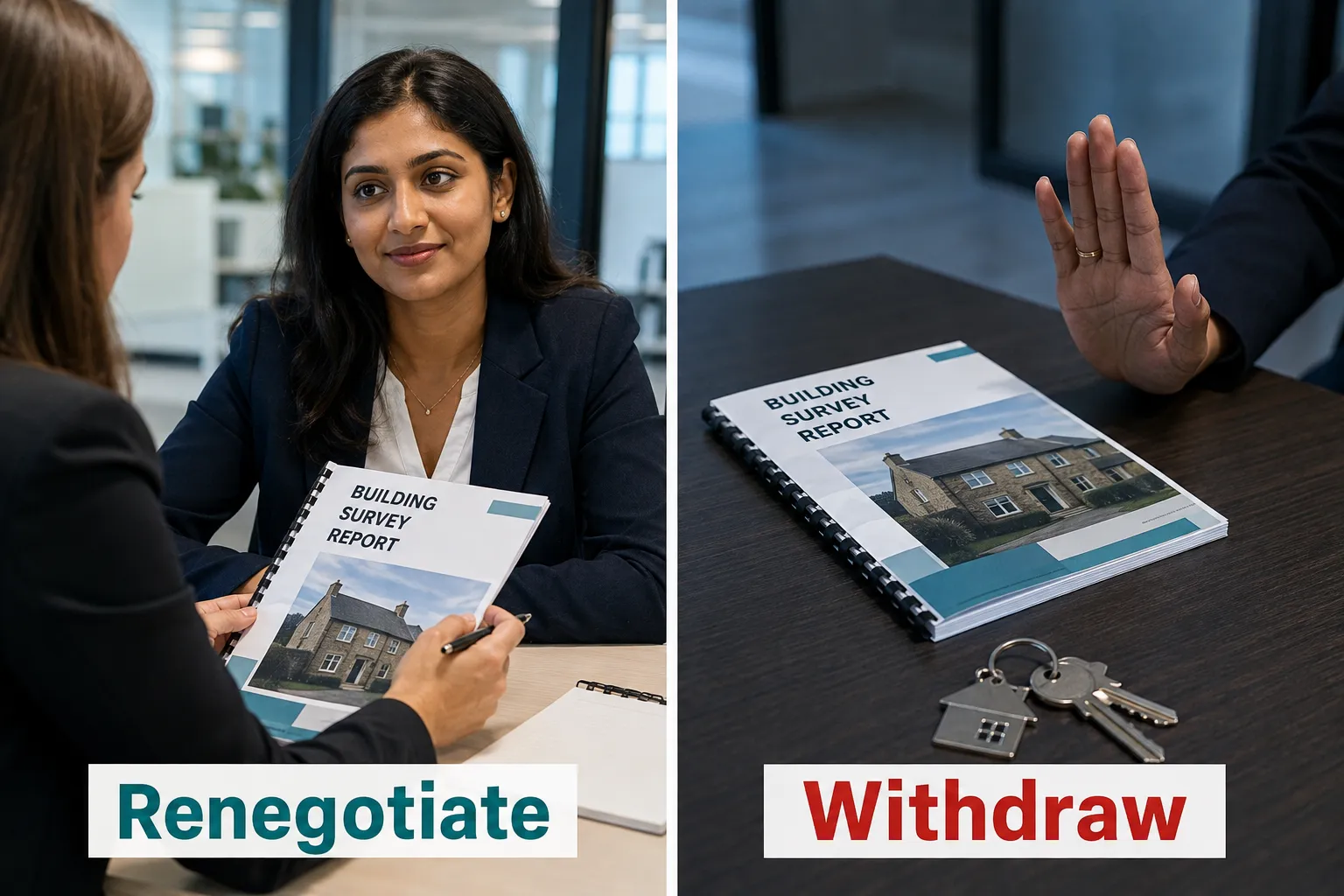
When the Surveyor's Report Red Flags: 10 Findings That Should Trigger Renegotiation or Withdrawal appear in a report, buyers have three practical options. The right choice depends on the severity of the finding, the seller's likely response, and the buyer's risk appetite.
Renegotiate the price when:
- The defect is well-defined and has a clear, quotable remediation cost
- The seller is motivated and the market is buyer-friendly
- The defect does not affect mortgageability or insurability
Request remediation before completion when:
- The defect poses a safety risk that cannot wait
- The seller has the means and willingness to carry out works
- Building regulations or warranty implications require professional sign-off
Withdraw when:
- The defect threatens mortgageability and the lender will not proceed
- The cost-to-value imbalance makes the purchase financially untenable
- The seller has misrepresented the property's condition and trust has broken down
- Multiple serious red flags cluster together, suggesting systemic problems
Research consistently shows that buyers who act on survey findings, rather than proceeding regardless, achieve better financial outcomes [4][5]. The survey fee is not a sunk cost that commits a buyer to a purchase; it is an investment in information that may save far more than it costs.
Working With Your Surveyor and Solicitor After a Red Flag Finding
Receiving a survey with serious findings is not the end of a transaction, it is the beginning of a negotiation. The following steps create the strongest position for the buyer:
- Read the full report carefully, not just the summary. Condition ratings are supported by narrative text that provides important context.
- Contact the surveyor directly to clarify any findings that are unclear. Surveyors are available to discuss their reports and can often indicate the urgency and likely cost range of defects [7].
- Commission specialist reports for any flagged items, structural engineers for movement, damp specialists for rot, asbestos surveyors for hazardous materials, and Gas Safe engineers for services.
- Obtain written quotes from at least two contractors for all Condition Rating 3 items before submitting a renegotiation request.
- Instruct your solicitor to raise formal enquiries if undisclosed defects or planning/building regulations issues have emerged.
- Prepare a written renegotiation request that references the survey findings and specialist quotes directly, rather than making a verbal or informal approach [8].
A structured, evidence-based approach to renegotiation is far more effective than an emotional one. Sellers and their agents respond to documented costs, not general concerns.
Conclusion
A surveyor's report is one of the most powerful tools available to a property buyer, but only if its findings are understood and acted upon. The ten red flags covered in this guide represent the findings most likely to affect safety, value, and the ability to obtain a mortgage or insurance. They are not reasons to panic, but they are reasons to pause, investigate further, and make a decision based on evidence rather than emotion.
Actionable next steps for buyers in 2026:
- If a survey returns multiple Condition Rating 3 findings, do not exchange contracts until specialist quotes have been obtained for every item.
- Use the cost-to-value framework to assess whether renegotiation or withdrawal is the financially sound choice.
- Engage a solicitor immediately if undisclosed defects or misrepresentation is suspected.
- Remember that walking away before exchange costs nothing beyond the survey and legal fees already incurred, proceeding with a fundamentally flawed property can cost tens of thousands of pounds more.
The buyers who treat their survey report as a decision-making document, rather than a box-ticking exercise, are the ones who protect their investment and avoid the most expensive mistakes in property ownership.
References
[1] Final Nextgen Homebuyer Report 2025 – nationalmi.com
[2] Property Survey Red Flags – surveyorlocal.co.uk
[3] Evergreen Red Flags In Building Surveys Updating Rics Checklists For Stabilising National Prices – princesurveyors.co.uk
[4] One In Five Homebuyers Skip Surveys Despite Two Thousand Six Hundred Pounds Average Saving – aviva.com
[5] Renegotiating After Homebuyer Survey – ashallsurveyors.co.uk
[6] Nar 2025 Profile Of Home Buyers Sellers Reveals Market Extremes – nar.realtor
[7] A Rics Survey Tells Prospective Homebuyers What They Need To Know About A Property Heres What To Do If The Survey Reveals Significant Issues – blog.nisurveys.co.uk
[8] How To Renegotiate An Offer After A Home Survey – cjbloor.co.uk
[9] Property Survey Red Flags – surveyorlocal.co.uk
[10] One In Five Homebuyers Skip Surveys Despite Two Thousand Six Hundred Pounds Average Saving – aviva.com