Fewer decisions in property litigation carry more consequence than choosing the wrong type of expert. A mismatch between the dispute's central question and the expert's discipline can undermine an otherwise strong case, draw judicial criticism, and waste significant costs. The question of Expert Witness Surveyor vs Structural Engineer: Who to Instruct for Defect and Valuation Disputes is therefore not merely procedural, it goes to the heart of whether expert evidence will be accepted, weighted, and acted upon by a tribunal.
This article sets out the qualifications, typical instructions, and evidential strengths of each discipline, giving solicitors and clients a practical framework for making the right choice.
Key Takeaways
- A chartered surveyor expert witness is the appropriate choice for disputes about survey quality, valuation accuracy, and diminution in value caused by defects.
- A structural engineer expert witness is the appropriate choice where the central question involves structural failure, design adequacy, code compliance, or complex causation analysis.
- RICS standards require experts to stay within their own discipline and not stray into areas beyond their competence [10].
- High-value or safety-critical disputes increasingly involve both disciplines simultaneously, with each expert addressing a defined domain.
- Instructing the wrong expert type risks having evidence rejected or given limited weight by the tribunal.
Understanding the Two Disciplines: Qualifications and Scope
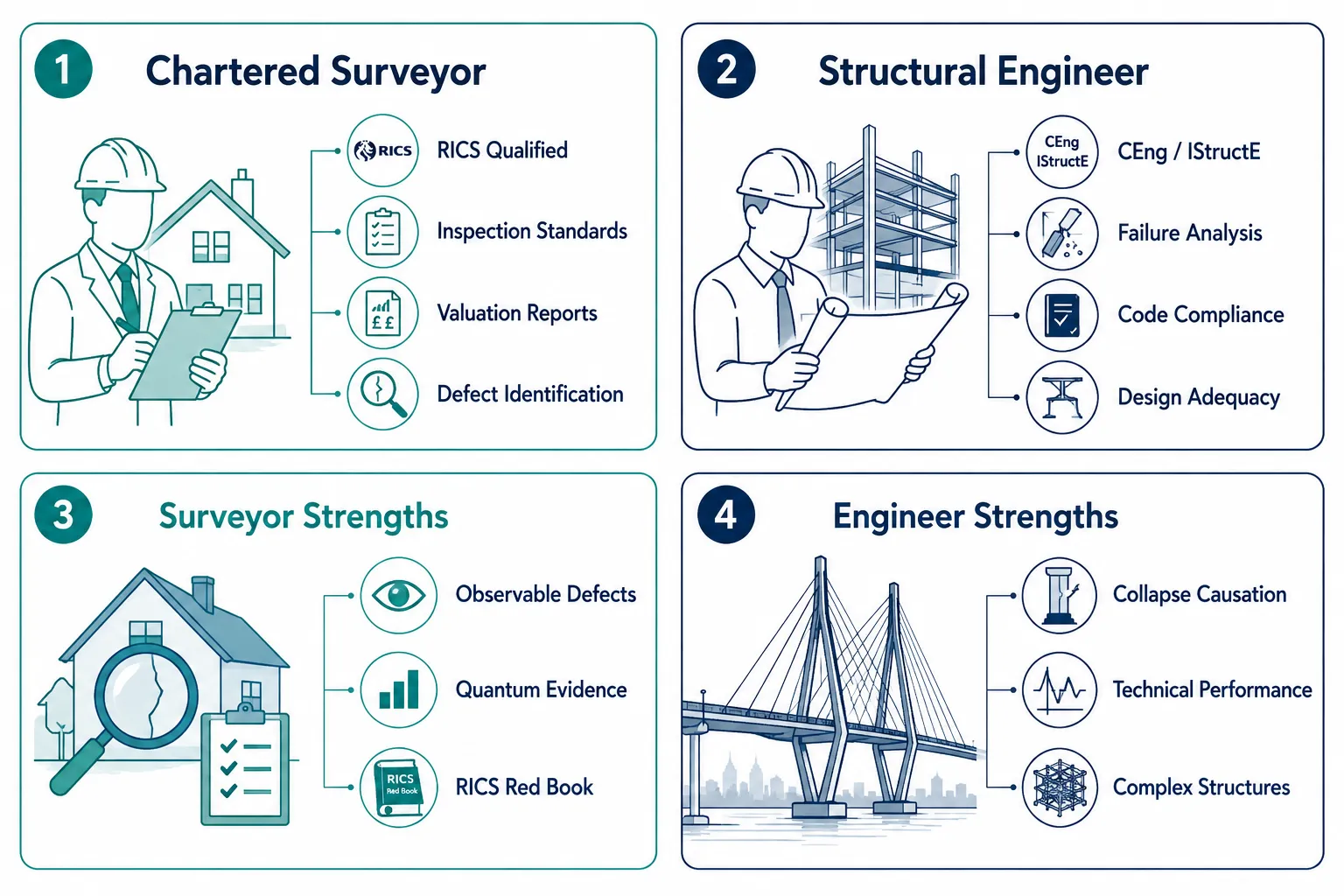
Before addressing which expert to instruct, it is worth understanding what each professional is actually qualified to do, and where their authority ends.
Chartered Surveyors
A chartered surveyor holds membership of the Royal Institution of Chartered Surveyors (RICS), typically at MRICS or FRICS level. Depending on their specialism, they may be a building surveyor, a valuation surveyor, or a quantity surveyor. Their training centres on the inspection, assessment, and valuation of property, as well as the management of construction contracts and defects within a contractual framework.
Building surveyors are trained to identify defects that are visible or reasonably discoverable during an inspection. Valuation surveyors are trained to assess market value, diminution in value, and the financial impact of defects or disrepair. Quantity surveyors focus on cost planning, final accounts, and the financial consequences of defects in construction contracts.
RICS valuation standards, set out in the Red Book Global Standards, make clear that a valuation inspection is not equivalent to a full building survey, and that a valuer's responsibility to investigate structure and defects must be explicitly defined in their terms of engagement [1][6]. This distinction is central to many valuation disputes.
Structural Engineers
A structural engineer holds a degree in structural or civil engineering and typically holds Chartered Engineer (CEng) status through the Institution of Structural Engineers (IStructE) or the Institution of Civil Engineers (ICE). Their expertise covers the design, analysis, and performance of load-bearing structures, foundations, frames, slabs, walls, and connections.
Where a dispute requires analysis of why a structure failed, whether a design met relevant codes, whether fabrication was defective, or how a structural system performed under load, a structural engineer is the appropriate expert. Specialist forensic structural engineers provide independent analysis of design inadequacies, code non-compliance, fabrication faults, and failure causation in construction defect cases [15].
The key distinction is this: surveyors assess what was observable and what it was worth; engineers analyse how and why a structure performed as it did.
When to Instruct an Expert Witness Surveyor vs Structural Engineer for Defect and Valuation Disputes
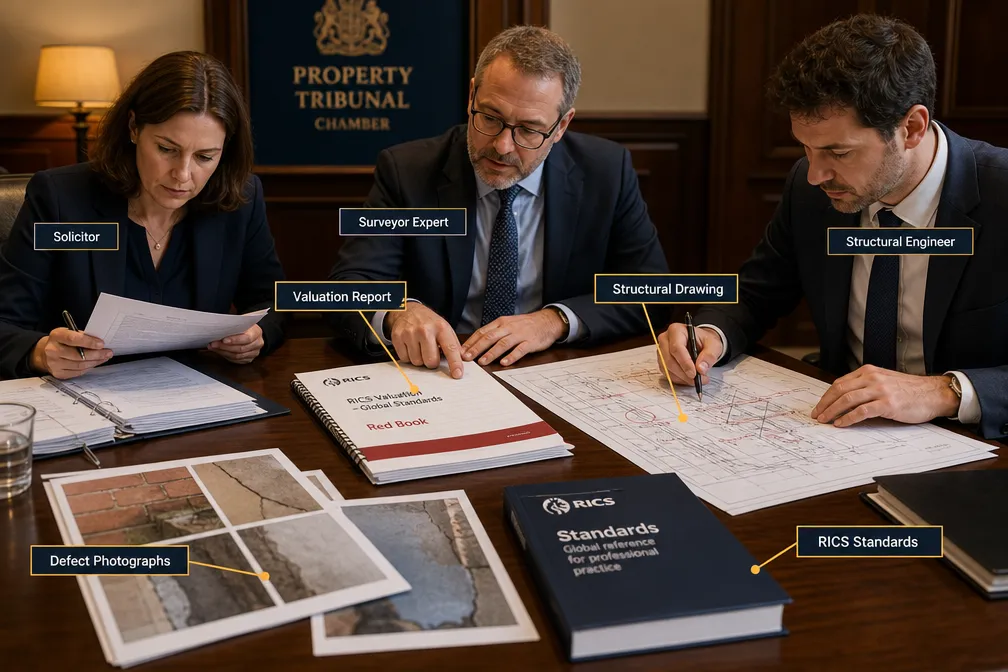
The central question in any instruction decision is: what is the dispute actually about?
Disputes That Call for a Surveyor Expert Witness
A chartered surveyor expert witness is the right choice when the dispute turns on one or more of the following:
- Survey quality and scope: Did the surveyor carry out a Level 2 or Level 3 survey to the required standard? Were defects reasonably observable at the time of inspection?
- Adequacy of reporting: Were defects identified and reported clearly? Were appropriate caveats and recommendations included?
- Valuation accuracy: Did the valuation reflect the property's true market value? Were defects properly reflected in the figure?
- Diminution in value: What is the financial impact of a defect or disrepair on market value?
- Surveyor negligence: Did the surveyor's conduct fall below the standard expected of a reasonably competent RICS member?
Research published in peer-reviewed analysis of building survey evidence found that surveyor evidence was most frequently accepted in disputes involving material non-compliance and structural defects where physical conditions could be directly correlated with recognised standards [3]. In structural defect disputes, surveyor evidence had an acceptance rate of 78%, and in moisture ingress disputes, 71% [3]. These figures reflect the fact that tribunals place significant weight on surveyor evidence for observable, measurable defects, particularly when tied to RICS standards and guidance.
RICS guidance on expert witness work confirms that surveyors acting as experts have an overriding duty to the tribunal, must remain independent, and may only give opinions within their own expertise [10]. Where structural engineering issues exceed a surveyor's competence, a structural engineer should be separately instructed [10].
In practice, surveyor negligence instructions typically focus on: the scope and standard of the original survey, what was reasonably observable at the time, the adequacy and clarity of reporting, and quantum evidence on diminution in value or repair costs [14]. These are squarely within a chartered surveyor's domain.
Disputes That Call for a Structural Engineer Expert Witness
A structural engineer expert witness is the right choice when the dispute turns on:
- Structural failure or collapse: What caused the failure? Was it design, construction, materials, or maintenance?
- Design adequacy: Did the original design meet relevant codes and standards?
- Code compliance: Was the structure built in accordance with Building Regulations, Eurocodes, or other applicable technical standards?
- Complex defect causation: Is the cracking in this concrete frame the result of design error, poor workmanship, or differential settlement?
- Fabrication faults: Were structural components manufactured to specification?
Structural engineering expert witnesses provide independent analysis of design inadequacies, code non-compliance, fabrication faults, structural performance, and failure causation in construction defects and failure cases [15]. Common matters in construction defect litigation handled by structural engineers include concrete cracking, structural failures, defects in slabs, balconies, cladding, and historic structural systems [7][8].
The dividing line is causation versus condition. A surveyor can tell the tribunal what was visible and what it was worth. An engineer can tell the tribunal why it happened and whether the design was adequate.
The Role of Quantity Surveyors in Defect Disputes
It is worth noting a third specialism that often sits alongside both types of expert. RICS guidance on final account procedures distinguishes between patent defects (discoverable by reasonable inspection) and latent defects (not discoverable by reasonable inspection), and explains that surveyors, particularly quantity surveyors and contract administrators, may be instructed to advise on the cost implications of defects in final accounts [4]. Structural engineers are typically involved when there is contention about the technical nature, severity, or cause of the defect before cost and valuation impacts are assessed [4].
This points to a practical workflow: the engineer establishes causation and severity; the quantity surveyor or valuation surveyor then quantifies the financial consequence.
Instruct a Chartered Surveyor if the dispute is about: survey standard, valuation accuracy, defect identification, diminution in value, or quantum of repair costs.
Instruct a Structural Engineer if the dispute is about: structural failure, design adequacy, code compliance, fabrication defects, or complex causation analysis.
Consider both if the dispute involves: a high-value or safety-critical claim where causation and valuation impact are both contested.
Practical Guidance on Instructing the Right Expert for Your Dispute
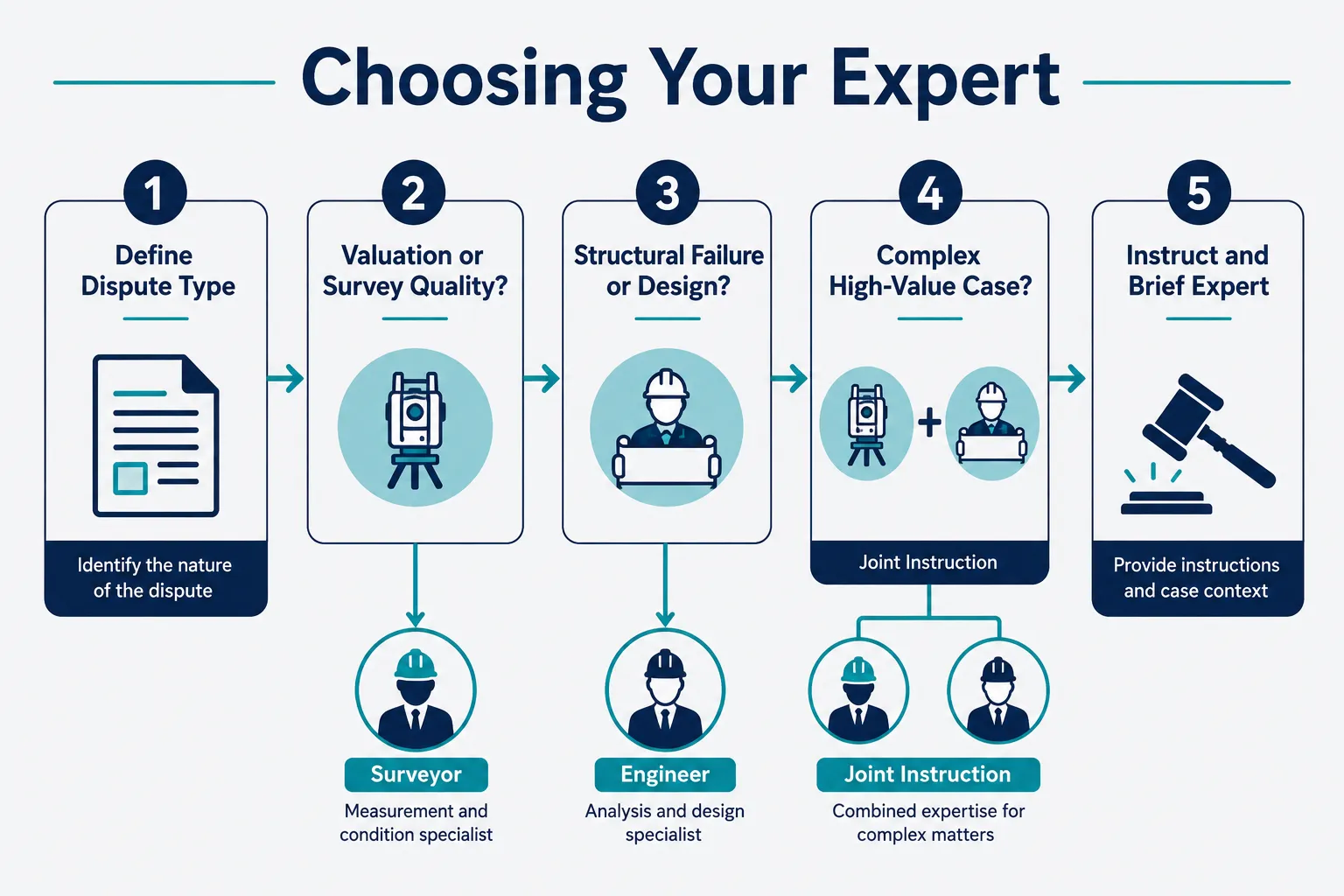
Understanding the theoretical distinction is one thing. Applying it in practice requires attention to the specific facts, the pleaded issues, and the evidence that will actually be needed at tribunal.
Step 1: Identify the Central Issue
Strip the dispute back to its core question. If a client is claiming that a surveyor failed to identify damp penetration and the property was overvalued as a result, the central issues are: (a) was the damp reasonably observable? and (b) how did it affect value? Both questions are within a chartered surveyor's competence.
If the client is claiming that a building collapsed because the structural frame was inadequately designed, the central issue is design adequacy, a question for a structural engineer.
Step 2: Consider Whether Both Disciplines Are Needed
In large, complex disputes, both types of expert may be required simultaneously. RICS expert witness standards and associated updates reinforce the principle that experts must not stray beyond their discipline, suggesting a practical division of labour: surveyors handle inspection standards, reporting adequacy, contractual context, and valuation or quantum, while structural engineers handle technical structural performance, design, code compliance, and failure causation [10]. Casework examples from specialist consultancies illustrate that large, complex disputes often involve both types of expert, each providing opinions in their defined domain and coordinated for tribunal use [5][8][15].
Step 3: Check Independence and Discipline Match
RICS guidance on expert witness work defines an expert witness as someone called to give technical knowledge beyond the tribunal's experience, and advises clients to select experts with the appropriate discipline and independence for the dispute [10]. Independence is non-negotiable: an expert who has a prior relationship with a party, or who has previously advised on the same project in a non-expert capacity, may face challenges to their independence.
Step 4: Brief the Expert Clearly on Scope
RICS valuation standards stress that a valuer's responsibility to investigate and comment on structure or defects must be explicitly limited in the terms of engagement [1][6]. The same principle applies to expert instructions: the letter of instruction should define precisely what the expert is being asked to address, and should not ask them to opine on matters outside their discipline.
If a structural engineer is instructed on causation, the instruction should not ask them to opine on diminution in value, that is a surveyor's role. If a building surveyor is instructed on survey adequacy, the instruction should not ask them to provide a detailed structural analysis of failure mechanisms.
Step 5: Coordinate Evidence Across Disciplines
Where both a surveyor and a structural engineer are instructed, their evidence must be coordinated so that it is complementary rather than contradictory. The structural engineer's findings on causation and severity should feed into the surveyor's assessment of valuation impact and quantum. Joint statements and expert meetings are standard in multi-disciplinary instructions, and tribunals increasingly expect clear separation between valuation or quantum evidence and technical causation analysis.
Common Errors to Avoid
| Error | Consequence |
|---|---|
| Instructing a surveyor to opine on structural design adequacy | Evidence given limited weight; expert may be criticised for exceeding competence |
| Instructing a structural engineer to opine on diminution in value | Valuation evidence rejected; quantum gap in the claim |
| Failing to instruct a structural engineer in a collapse case | Causation left unproven; claim fails on liability |
| Instructing a surveyor who previously advised the client on the same property | Independence challenged; evidence potentially excluded |
| Asking both experts to address the same issue without coordination | Conflicting evidence; tribunal confusion; adverse costs risk |
Looking Ahead: The Direction of Travel in Expert Witness Instructions
The landscape for expert evidence in defect and valuation disputes is not static. Building safety regulation has become significantly more complex in recent years, and tribunals are becoming more sophisticated in their expectations of expert evidence.
RICS expert witness standards, updated in mid-2026, reinforce the principle that experts must not stray beyond their discipline [10]. The RICS client guide on expert witnesses advises that for disputes about survey quality, valuation accuracy, or diminution in value, clients should appoint a chartered surveyor, while for disputes about structural adequacy or collapse, a structural engineer should be appointed as the technical expert, often alongside a surveyor for valuation and quantum issues [10].
Over the next several years, defect and valuation disputes are likely to feature more structured joint instructions of surveyors and structural engineers, with tribunals expecting clear separation between valuation or quantum evidence and technical causation analysis. This is driven by increasing structural complexity, evolving building safety regulations, and growing scrutiny of professional standards. Instructing both disciplines together, rather than choosing one or the other, will probably become standard in high-value and safety-critical disputes.
For solicitors and clients, the practical implication is clear: start with the central issue, match the expert to the question, and do not ask any expert to stray beyond their competence.
Conclusion
The question of Expert Witness Surveyor vs Structural Engineer: Who to Instruct for Defect and Valuation Disputes comes down to a disciplined analysis of what the tribunal actually needs to decide.
- Where the dispute is about survey quality, valuation accuracy, or the financial impact of defects, instruct a chartered surveyor with the relevant specialism and RICS accreditation.
- Where the dispute is about structural failure, design adequacy, code compliance, or complex causation, instruct a chartered structural engineer.
- Where both are in issue, as they often are in high-value claims, instruct both, with clearly defined and coordinated scopes.
Actionable next steps for solicitors and clients:
- Identify the central issue in the dispute before approaching any expert.
- Review the pleaded case and the evidence needed to prove each element.
- Match the expert discipline to the question, not to the professional who is most readily available.
- Ensure the letter of instruction defines scope precisely and does not ask the expert to stray beyond their competence.
- In complex or high-value disputes, consider a joint instruction from the outset, with a coordination plan for expert meetings and joint statements.
Getting this decision right at the outset is one of the most cost-effective steps available in any property dispute.
References
[1] 2021 11 25 Rics Valuation Global Standards Effective 2022 – rics.org
[2] Structural Engineering Expert Witness – seakexperts.com
[3] 7 1 1 664 – civilengineeringjournals.com
[4] Final Account Procedures 1st Edition Rics – rics.org
[5] Experts – veritasexpertwitness.com
[6] Red Book Global – rics.org
[7] Structural Engineering Expert – robsonforensic.com
[8] Expert Witness – ridge.co.uk
[9] Structural Engineering – experts.com
[10] Surveyors acting as expert witnesses – rics.org