
nn
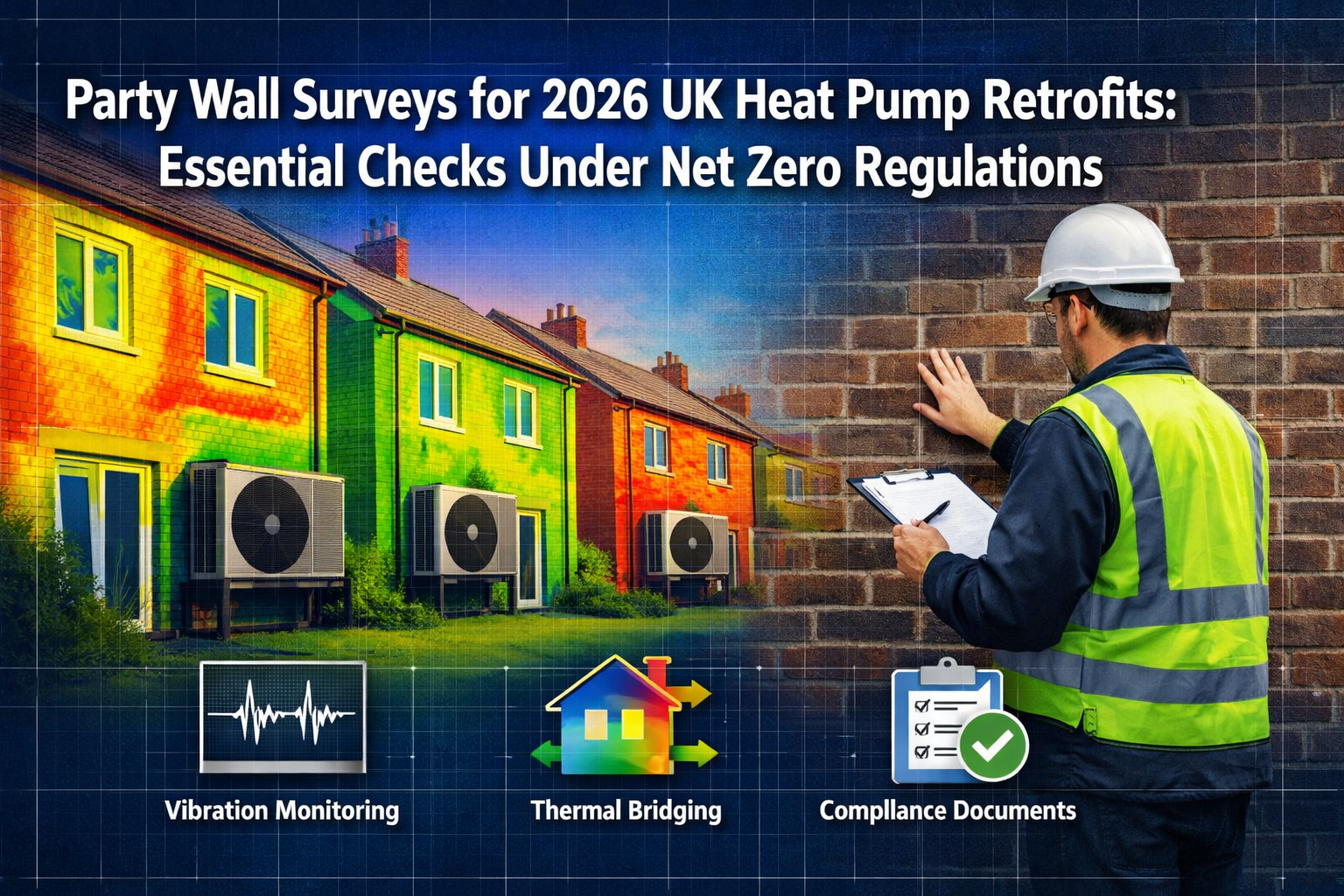
As the UK accelerates toward net zero targets, thousands of homeowners and landlords face a critical challenge: installing heat pumps in terraced houses and semi-detached properties without triggering costly disputes with neighbours. With new Energy Performance Certificate regulations launching in October 2026 and compliance deadlines looming for rental properties, Party Wall Surveys for 2026 UK Heat Pump Retrofits: Essential Checks Under Net Zero Regulations have become essential tools for protecting both property owners and their neighbours from vibration damage, thermal bridging issues, and legal complications.
The convergence of government mandates, updated assessment methodologies, and the physical realities of shared-wall construction creates a complex landscape that requires careful navigation. Understanding the intersection between the Party Wall etc. Act 1996 and modern heat pump installations can mean the difference between a smooth retrofit and months of legal disputes.
Key Takeaways
- 🏠 New EPC metrics launching October 2026 will require pre-retrofit assessments using the Home Energy Model (HEM) methodology, fundamentally changing how properties are evaluated for heat pump suitability
- ⚖️ Party Wall Act compliance is mandatory when heat pump installations involve work on or near shared walls, with 2-month notice periods required before commencing work
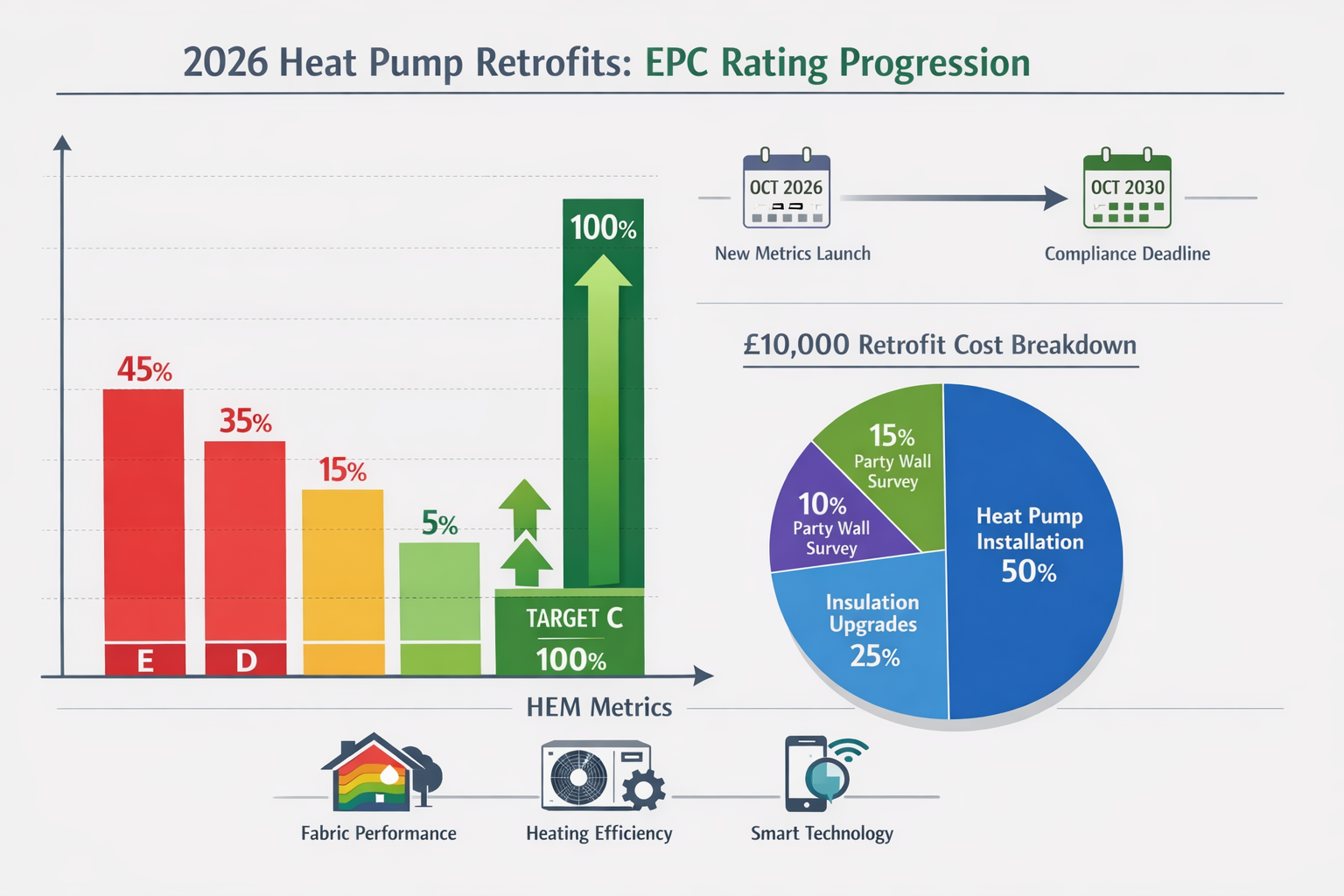
- 💰 £10,000 cost cap for landlords includes party wall survey expenses, making early planning essential to stay within compliance budgets by the October 2030 deadline
- 🔊 Vibration and noise assessments must be documented in Schedule of Condition reports to protect against future neighbour disputes and potential damage claims
- 📋 Thermal bridging checks are critical for party wall installations to prevent heat loss, condensation issues, and reduced system efficiency that could invalidate warranty claims
Understanding Party Wall Surveys for 2026 UK Heat Pump Retrofits: Essential Checks Under Net Zero Regulations
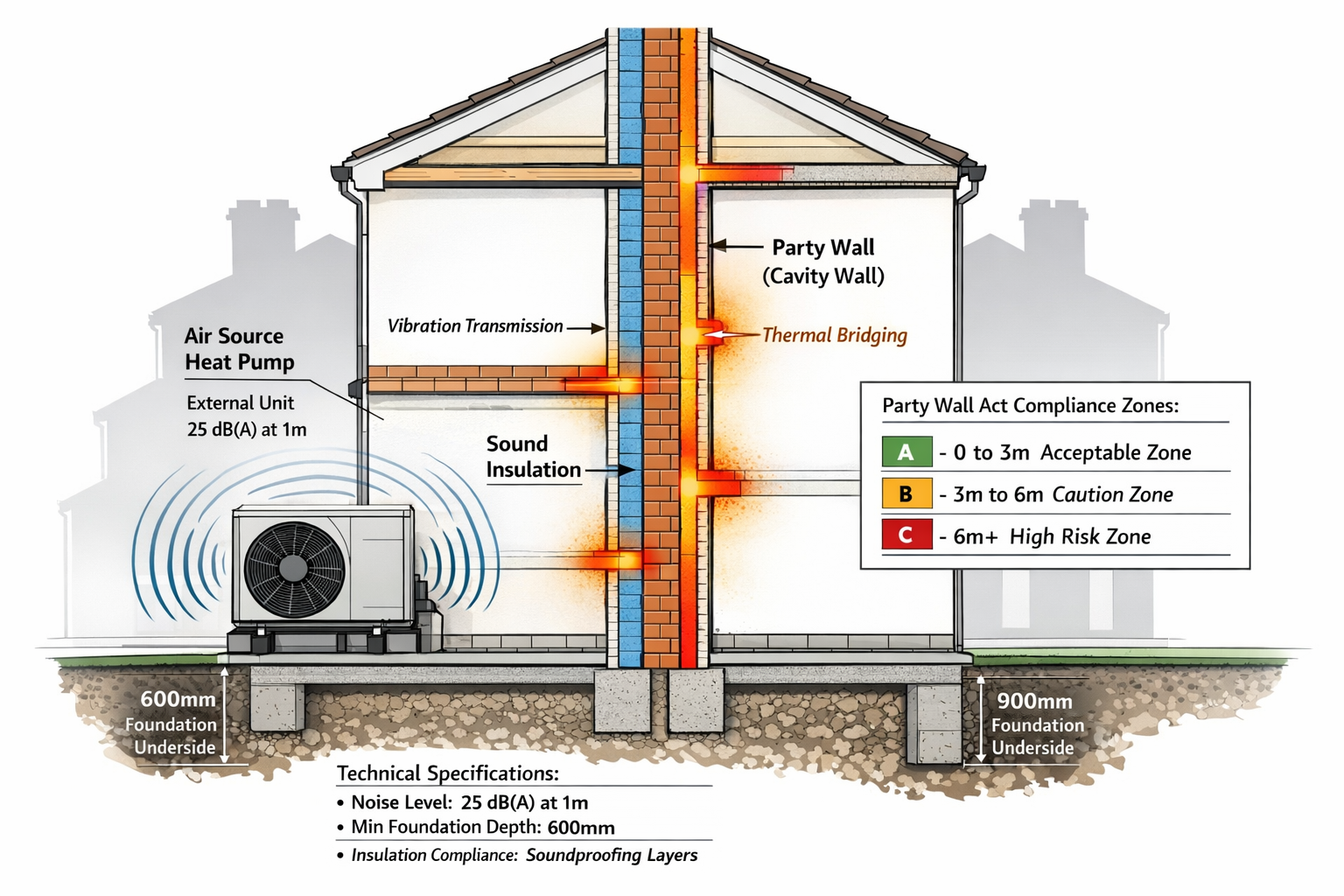
The Party Wall etc. Act 1996 governs building work on or near boundaries between properties in England and Wales. When installing heat pumps in properties with shared walls, several scenarios typically trigger Party Wall Act requirements:
When Party Wall Procedures Apply to Heat Pump Installations:
- Mounting external heat pump units on party walls or within 3 meters of the boundary
- Installing pipework that penetrates or runs through party walls
- Excavating foundations for ground source heat pump systems near boundary lines
- Removing or altering chimney breasts on party walls to accommodate new heating systems
- Installing insulation that affects the party wall structure
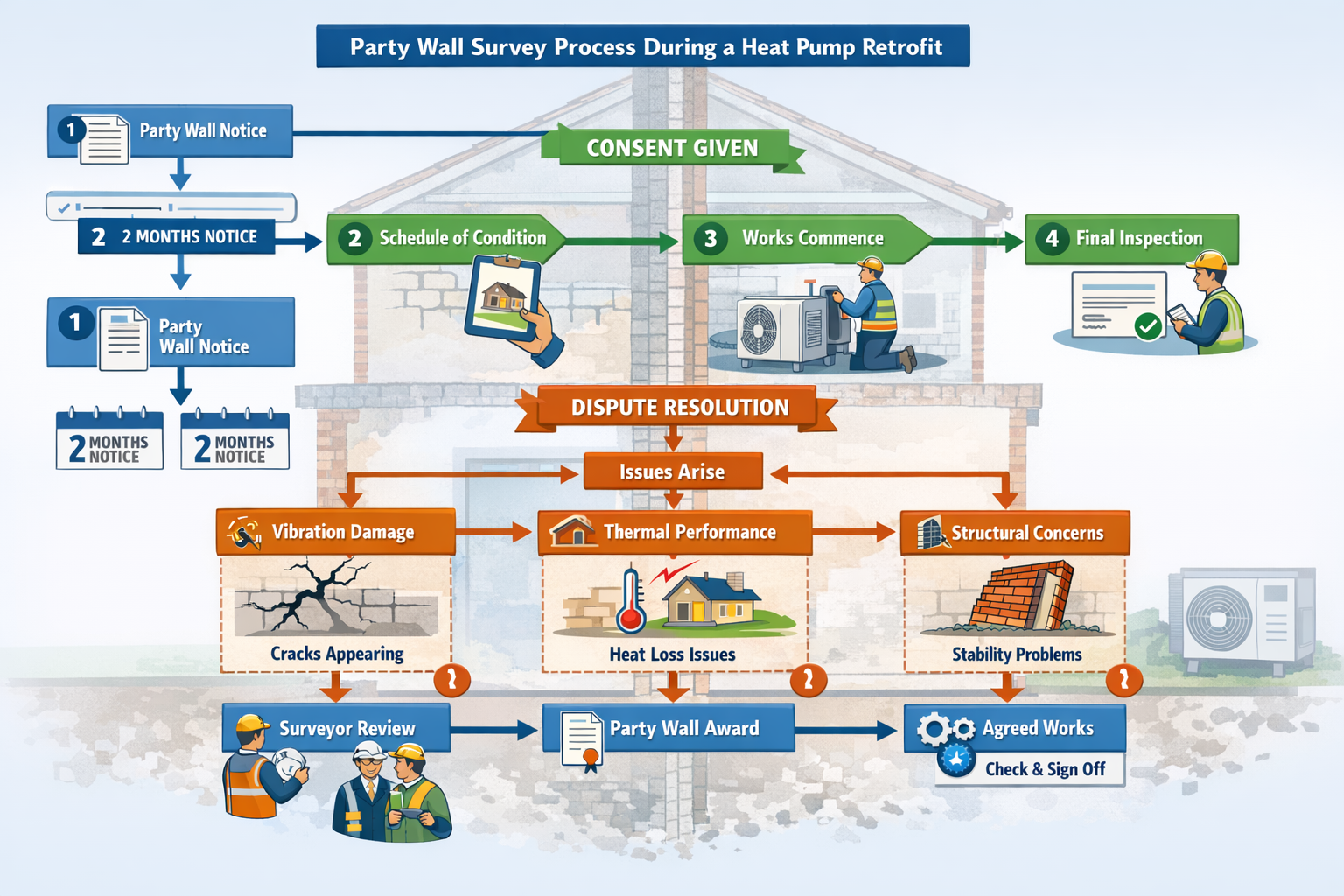
The process begins with serving a Party Wall Notice to affected neighbours, typically 2 months before work commences. Without proper party wall consent, property owners risk legal action, work stoppages, and costly retrospective compliance measures.
The Role of Surveyors in Heat Pump Retrofits
Professional party wall surveyors perform several critical functions specific to heat pump installations:
- Pre-Installation Condition Surveys: Documenting the existing state of party walls, adjacent properties, and structural elements through detailed Schedule of Condition reporting
- Vibration Risk Assessment: Evaluating potential vibration transmission from heat pump compressors through party wall structures
- Thermal Performance Analysis: Identifying thermal bridging risks where heat pump pipework penetrates party walls
- Compliance Documentation: Ensuring all work meets Building Regulations Part L (conservation of fuel and power) alongside Party Wall Act requirements
- Dispute Resolution: Acting as impartial experts when neighbours disagree about proposed installations
"The integration of heat pump technology with Victorian and Edwardian terraced housing stock presents unique challenges. Party wall surveys must now account for vibration frequencies, thermal performance, and acoustic transmission in ways that weren't considered five years ago." – RICS Building Surveying Guidance
New 2026 EPC Regulations and Their Impact on Party Wall Requirements
The government's reformed Energy Performance Certificate system, launching in October 2026, fundamentally changes how heat pump retrofits must be approached. The new Home Energy Model (HEM) introduces three key metrics that directly impact party wall considerations[1]:
Key HEM Metrics Affecting Party Wall Installations
| Metric | Impact on Party Wall Work | Survey Requirements |
|---|---|---|
| Fabric Performance | Insulation improvements may require party wall alterations | Thermal imaging of party walls to identify bridging points |
| Heating System Performance | Heat pump positioning affects efficiency and vibration transmission | Vibration baseline measurements before installation |
| Smart Technology Characteristics | Smart controls may require additional wiring through party walls | Documentation of all penetrations and cable routes |
Properties not meeting EPC rating C must commission a new EPC assessment using the updated HEM methodology before beginning retrofit work[2]. This requirement creates a critical timeline consideration: party wall procedures should commence simultaneously with EPC assessments to avoid delays.
Private Rented Sector Compliance Deadlines
Landlords face particularly tight timelines. By October 1, 2030, all private rental properties must achieve EPC rating C, with most requiring heat pump installations or solar panels alongside insulation improvements[3]. The £10,000 cost cap for compliance measures includes:
- Heat pump equipment and installation (£7,000-£13,000 typical)
- Insulation upgrades (£2,000-£5,000)
- EPC assessment costs (£100-£150)
- Party wall survey and agreement costs (£700-£2,000)
Understanding what happens if you do not have a party wall agreement becomes financially critical when working within these budget constraints.
Essential Checks: Party Wall Surveys for 2026 UK Heat Pump Retrofits Under Net Zero Regulations
Professional surveyors conducting party wall assessments for heat pump installations must address specific technical considerations that differ from traditional building work.
Vibration and Noise Transmission Assessment
Modern air source heat pumps operate with compressors that generate vibration frequencies between 40-120 Hz. When mounted on or near party walls, these vibrations can transmit through structural elements, causing:
- Structural fatigue in older brick and mortar joints
- Acoustic disturbance to neighbouring properties
- Secondary damage to plasterwork, decorative finishes, and fixtures
Essential Survey Checks:
✅ Baseline vibration measurements using accelerometers at multiple party wall locations
✅ Structural integrity assessment of mortar joints and brick condition
✅ Mounting position evaluation to minimize direct contact with party wall structures
✅ Isolation specification recommending anti-vibration mounts and acoustic barriers
✅ Predicted noise level calculations at neighbour boundaries (MCS Planning Standards require <42dB at 1m)
The Schedule of Condition must include photographic evidence of existing cracks, settlement, and structural conditions to distinguish pre-existing issues from installation-related damage.
Thermal Bridging and Condensation Risk
Heat pump pipework penetrating party walls creates potential thermal bridges—pathways for heat loss that reduce system efficiency and can cause condensation problems. These issues affect both properties sharing the wall.
Critical Survey Elements:
- Penetration Point Mapping: Documenting exact locations where refrigerant lines, condensate drains, and electrical cables cross party walls
- Insulation Continuity Planning: Specifying how insulation will be maintained around penetrations to prevent cold spots
- Vapour Barrier Integrity: Ensuring moisture barriers aren't compromised during installation
- Condensation Risk Zones: Identifying areas where temperature differentials could cause interstitial condensation
Party wall surveyors should reference party wall insulation best practices to ensure thermal performance isn't compromised.
Structural Load and Foundation Considerations
Ground source heat pumps require excavation that may affect party wall foundations, while external air source units add weight to wall structures. Survey checks must include:
Foundation Proximity Assessment:
- Distance from excavation to party wall foundations (minimum 3m typically required)
- Soil type and bearing capacity analysis
- Underpinning requirements if excavation falls within 45-degree influence zone
- Temporary support specifications during installation
Wall Loading Calculations:
- Additional dead load from heat pump unit (30-70kg typical)
- Wind loading on wall-mounted equipment
- Bracket fixings and their impact on wall integrity
- Long-term structural implications for older properties
When no party wall notice has been served, retrospective surveys become more complex and expensive, often requiring additional structural investigations.
Navigating the Party Wall Act Process for Heat Pump Installations
The formal Party Wall Act procedure follows a structured timeline that must be integrated with heat pump retrofit planning.
Step-by-Step Process
1. Initial Assessment (Weeks 1-2)
- Determine if Party Wall Act applies to your heat pump installation
- Commission professional party wall surveyor
- Obtain heat pump specifications and installation plans
- Review cost of party wall procedures to budget appropriately
2. Notice Serving (Week 3)
- Serve Party Wall Notice to all affected neighbours (minimum 2 months before work)
- Include detailed drawings showing heat pump position, pipework routes, and foundation work
- Specify proposed start date and estimated duration
- Provide surveyor contact details
3. Neighbour Response Period (Weeks 3-10)
- Consent Given: Proceed with agreed works, maintaining photographic records
- Consent Withheld or No Response: Appoint party wall surveyors (one for each party or agreed surveyor)
- Dispute Raised: Surveyors prepare Party Wall Award detailing how work will proceed
Understanding what is a party wall dispute helps property owners prepare for potential disagreements.
4. Award Preparation (Weeks 11-14)
If surveyors are appointed, they will:
- Conduct joint inspection of properties
- Prepare detailed Schedule of Condition
- Specify working methods and protective measures
- Set monitoring requirements during installation
- Establish dispute resolution procedures
- Issue Party Wall Award (legally binding document)
5. Installation Phase (Weeks 15+)
- Notify neighbours 48 hours before work commences
- Implement protective measures specified in Award
- Allow surveyor access for monitoring inspections
- Document any variations from agreed plans
- Complete work within specified timeframe
6. Post-Installation (Within 2 months of completion)
- Conduct final inspection comparing to Schedule of Condition
- Address any damage claims promptly
- Provide completion certificates
- Archive all documentation for future reference
Common Complications and Solutions
Issue: Neighbour Refuses Surveyor Access
Solution: Party Wall Act grants legal right of access with 14 days' notice. Persistent refusal may require legal intervention, but this rarely occurs with professional surveyor involvement.
Issue: Heat Pump Position Conflicts with Neighbour's Plans
Solution: Early communication and flexible positioning. Consider alternative mounting locations or ground source options if air source proves incompatible.
Issue: Discovered Structural Issues During Installation
Solution: Party Wall Award should include provisions for unforeseen conditions. Additional surveyor inspections may be required, with costs typically borne by building owner.
Integrating Party Wall Compliance with Broader Retrofit Planning
Successful heat pump retrofits in shared-wall properties require coordination across multiple disciplines and regulatory frameworks.
Multi-Disciplinary Survey Requirements
Building Regulations Compliance:
- Part L (Conservation of fuel and power): Heat pump sizing and efficiency
- Part F (Ventilation): Ensuring adequate ventilation with new heating system
- Part E (Resistance to sound): Acoustic performance of party wall after modifications
Planning Permission Considerations:
- Permitted development rights for heat pumps (within specific noise and positioning limits)
- Conservation area restrictions
- Listed building consent requirements
Warranty and Insurance Implications:
- MCS (Microgeneration Certification Scheme) installation standards
- Manufacturer warranty conditions regarding installation quality
- Building insurance notifications for structural alterations
Professional party wall services should coordinate with heating engineers, building control officers, and insurance providers to ensure comprehensive compliance.
Cost-Benefit Analysis for Different Property Types
| Property Type | Typical Party Wall Survey Cost | Heat Pump Installation Complexity | Risk Level |
|---|---|---|---|
| Mid-terrace | £1,200-£1,800 | High (two party walls) | High |
| End-terrace | £800-£1,200 | Medium (one party wall) | Medium |
| Semi-detached | £700-£1,000 | Medium (one party wall) | Medium |
| Detached | Not applicable | Low | Low |
For landlords working within the £10,000 compliance cap, party wall costs can consume 7-18% of the available budget, making early assessment crucial for financial planning.
Special Considerations for Shared Chimneys and Historic Properties
Older terraced properties often feature shared chimney stacks that present unique challenges when transitioning from gas boilers to heat pumps.
Chimney Breast Removal and Party Wall Implications
Many homeowners consider removing redundant chimney breasts to create space for heat pump equipment or improve insulation. This work always triggers Party Wall Act requirements when the chimney is shared.
Survey Requirements for Chimney Work:
- Structural engineer assessment of load-bearing function
- Specification of support beams if breast removed at ground floor
- Protection measures for neighbour's remaining chimney portion
- Smoke test verification that flues are truly redundant
- Long-term monitoring for settlement or movement
Detailed guidance on party wall shared chimneys addresses these complex scenarios.
Heritage and Conservation Area Constraints
Listed buildings and properties in conservation areas face additional restrictions:
Enhanced Survey Documentation:
- Heritage impact assessment for external heat pump units
- Alternative positioning strategies (rear gardens, outbuildings)
- Acoustic enclosure specifications for noise mitigation
- Reversibility requirements for listed building consent
- Coordination with conservation officer requirements
Ground source heat pumps often prove more suitable for heritage properties, as underground collectors avoid visual impact, though excavation requires particularly careful party wall management.
2026 Technology Advances Affecting Party Wall Considerations
Heat pump technology continues evolving, with several 2026 developments affecting party wall survey requirements.
Low-Noise and Low-Vibration Models
Manufacturers now offer "party wall friendly" heat pump models featuring:
- Inverter-driven compressors: Variable speed operation reducing vibration amplitude
- Acoustic enclosures: Integrated sound dampening reducing noise by 5-10dB
- Smart scheduling: Operating during daytime hours to minimize neighbour disturbance
- Hybrid systems: Combining heat pumps with retained gas boilers for peak demand periods
Party wall surveys should specify minimum acoustic performance standards (typically <35dB at 1m for party wall installations) and require manufacturer certification.
Integrated Monitoring Systems
Modern heat pump installations increasingly include:
- Vibration sensors: Continuous monitoring alerting to excessive transmission
- Performance analytics: Identifying efficiency losses from thermal bridging
- Remote diagnostics: Enabling rapid response to neighbour complaints
- Usage optimization: AI-driven scheduling minimizing noise during sensitive hours
These systems provide valuable evidence if disputes arise, documenting that installations operate within agreed parameters.
Practical Checklist: Party Wall Surveys for 2026 UK Heat Pump Retrofits
Property owners planning heat pump installations should use this comprehensive checklist to ensure Party Wall Act compliance:
Pre-Installation Phase ✓
- Confirm property type and identify all party walls affected
- Obtain detailed heat pump specifications (model, dimensions, weight, noise ratings)
- Commission EPC assessment using new HEM methodology (if not current)
- Engage RICS-qualified party wall surveyor with heat pump experience
- Review installation plans with surveyor to identify potential issues
- Budget for party wall costs within overall retrofit expenditure
- Identify all neighbours requiring notice (including those above/below in flats)
Notice and Agreement Phase ✓
- Prepare detailed drawings showing heat pump position and all penetrations
- Serve Party Wall Notice minimum 2 months before planned start date
- Provide neighbours with surveyor contact information
- Respond promptly to neighbour questions or concerns
- Appoint surveyors if consent withheld or no response received
- Participate in joint inspections and Schedule of Condition preparation
- Review and understand Party Wall Award terms before signing
- Arrange payment of surveyor fees as specified in Award
Installation Phase ✓
- Provide 48-hour notice before commencing work
- Ensure installer has copies of Party Wall Award and Schedule of Condition
- Implement all protective measures specified in Award
- Allow surveyor access for monitoring inspections
- Document any deviations from approved plans immediately
- Maintain communication with neighbours throughout installation
- Address concerns promptly before they escalate to formal disputes
- Keep detailed photographic records of all stages
Post-Installation Phase ✓
- Conduct final inspection with surveyor comparing to baseline condition
- Commission acoustic testing to verify noise compliance
- Provide neighbours with heat pump operating instructions and contact details
- Address any damage claims within timeframes specified in Award
- Obtain completion certificates from Building Control and MCS installer
- Update building insurance with details of alterations
- Archive all party wall documentation for future reference
- Schedule 6-month follow-up inspection to verify no delayed issues
Regional Variations and Local Authority Requirements
While the Party Wall Act applies uniformly across England and Wales, local authority requirements for heat pump installations vary significantly.
London Boroughs
Many London boroughs have supplementary planning guidance for heat pumps:
- Noise assessments: Required for installations within 5m of neighbouring habitable rooms
- Conservation area approvals: Additional design restrictions on external equipment
- Air quality considerations: Prioritizing electric heat pumps in Low Emission Zones
- Permitted development limitations: Stricter rules in Article 4 Direction areas
Scotland and Northern Ireland
These regions don't have Party Wall Act legislation but have equivalent provisions:
Scotland:
- Common law rights govern party wall matters
- Building (Scotland) Regulations require neighbour notification
- Dispute resolution through sheriff courts or mediation
Northern Ireland:
- Access to Neighbouring Land Act (Northern Ireland) 2006
- Party wall matters handled through common law and building regulations
- Different EPC requirements and timelines
Property owners in these regions should seek region-specific surveyor advice.
Future-Proofing: Preparing for Post-2030 Requirements
The 2030 compliance deadline represents a minimum standard, not the end of net zero requirements. Forward-thinking property owners should consider:
Anticipated Regulatory Developments
- EPC rating B requirements: Likely by 2035-2040 for rental properties
- Embodied carbon assessments: Future EPCs may include whole-life carbon metrics
- Heat network connections: Mandatory connections where available
- Smart grid integration: Requirements for demand-response capable systems
Party Wall Implications
Installing heat pumps that exceed current minimum standards may require:
- Additional electrical capacity affecting party wall cable routes
- Larger thermal stores requiring structural modifications
- Future-proofing for battery storage integration
- Provision for heat network connection points
Party Wall Awards should include provisions for future upgrades to avoid repeating the entire process for incremental improvements.
Conclusion: Navigating Party Wall Surveys for 2026 UK Heat Pump Retrofits Successfully
As the UK property sector transitions toward net zero, Party Wall Surveys for 2026 UK Heat Pump Retrofits: Essential Checks Under Net Zero Regulations have evolved from simple neighbour notifications to comprehensive technical assessments addressing vibration, thermal performance, and long-term structural implications.
The convergence of new EPC metrics launching in October 2026, the October 2030 compliance deadline for rental properties, and increasingly sophisticated heat pump technology creates both challenges and opportunities. Property owners who approach party wall requirements proactively—integrating surveys with broader retrofit planning, budgeting appropriately, and engaging experienced professionals—will avoid costly disputes and installation delays.
Actionable Next Steps
For Homeowners:
- Commission an EPC assessment using the new HEM methodology to understand your property's retrofit requirements
- Engage a RICS-qualified party wall surveyor with specific heat pump installation experience
- Discuss plans with neighbours informally before serving formal notices
- Budget £700-£2,000 for party wall procedures within your overall retrofit costs
- Request multiple heat pump quotes specifying low-vibration models suitable for party wall installations
For Landlords:
- Audit your portfolio to identify properties requiring heat pump retrofits by October 2030
- Prioritize properties with straightforward party wall situations (end-terrace, semi-detached)
- Factor party wall costs into your £10,000 compliance budget from the outset
- Consider phased approaches addressing multiple properties to develop expertise and supplier relationships
- Maintain detailed records of all party wall procedures for future compliance demonstrations
For All Property Owners:
- Don't delay—party wall procedures add minimum 2 months to project timelines
- Choose surveyors who understand both traditional party wall work and modern heat pump technology
- Maintain open communication with neighbours throughout the process
- Document everything photographically before, during, and after installation
- Consider party wall requirements as investment in neighbour relationships, not just regulatory compliance
The transition to heat pump heating in the UK's extensive terraced housing stock represents one of the most significant challenges in achieving net zero targets. Professional party wall surveys provide the framework for managing this transition fairly, safely, and legally—protecting both property owners and their neighbours while advancing national climate objectives.
By understanding the essential checks, following proper procedures, and engaging qualified professionals, property owners can navigate the complex intersection of heritage building stock, modern heating technology, and neighbour rights successfully. The 2026 regulatory changes create urgency, but also clarity about requirements and pathways to compliance.
References
[1] Home Energy Model Hem Methodology For Assessing Existing Dwellings And Producing New Energy Performance Certificates Metrics Accessible Webpage – https://www.gov.uk/government/consultations/home-energy-model-energy-performance-certificates/home-energy-model-hem-methodology-for-assessing-existing-dwellings-and-producing-new-energy-performance-certificates-metrics-accessible-webpage
[2] Prs Homes Energy Performance Government Response – https://assets.publishing.service.gov.uk/media/69722b193f2908a349040547/prs-homes-energy-performance-government-response.pdf
[3] New Epc Rules – https://theindependentlandlord.com/new-epc-rules/