Roughly one in three party wall disputes in England and Wales stems not from genuine disagreement between neighbours, but from a notice that was served incorrectly, or never served at all. For UK homeowners planning extensions in 2026, that is an avoidable and potentially costly mistake. The Party Wall etc. Act 1996 remains the governing statute, unchanged in its core requirements, and the official GOV.UK guidance updated in August 2026 confirms that notice obligations are as firm as ever [1]. This Party Wall Notices: Step-by-Step Template Guide for UK Homeowners Planning Extensions sets out exactly what you need to serve, when to serve it, and how to draft each notice type correctly.
Key Takeaways
- The Party Wall etc. Act 1996 requires formal written notice before most extension works that affect a shared wall, boundary, or excavation near a neighbour's structure.
- Three main notice types apply to extensions: Section 1 (new wall on boundary), Section 3 (works to an existing party wall), and Section 6 (excavation near neighbouring foundations).
- Notice must be served one to two months before work starts, depending on the notice type.
- Neighbours have 14 days to consent or dissent; silence triggers a deemed dispute, which requires a surveyor.
- Serving a defective or late notice can delay your build, expose you to injunctions, and damage neighbour relations, getting the template right from the start avoids all of this.
Understanding When the Party Wall Act Applies to Your Extension
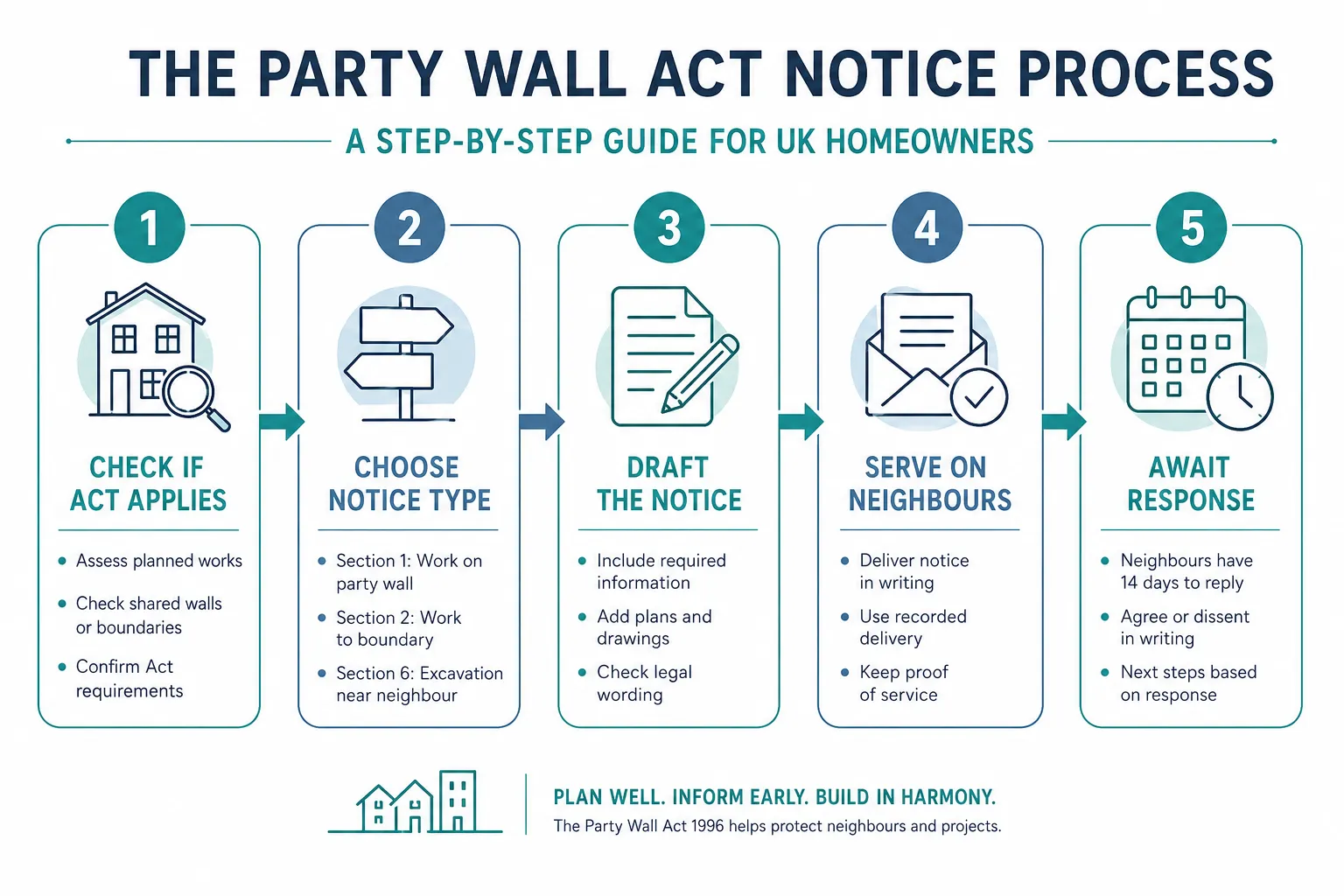
Not every extension triggers the Act, but most do. The legislation covers three distinct scenarios that commonly arise during home extension projects [1]:
- Building a new wall on or at the boundary line (Section 1)
- Carrying out works to an existing party wall or party fence wall (Section 3), such as cutting into it to insert a beam, raising its height, or underpinning it
- Excavating within three metres of a neighbouring building or structure where the excavation goes deeper than the neighbour's foundations, or within six metres where it intersects a 45-degree line drawn from the base of those foundations (Section 6)
A rear single-storey extension, for example, will almost always trigger at least a Section 6 notice if it requires new footings close to the boundary. A two-storey side extension built against a shared wall will typically require a Section 3 notice. Some projects need more than one notice type simultaneously [2].
What the Act does NOT cover:
- Internal alterations that do not affect the party wall itself
- Garden walls that are not party fence walls
- Works entirely within your own property that involve no excavation near the boundary
If there is any doubt, the RICS consumer guide recommends seeking a brief consultation with a party wall surveyor before assuming the Act does not apply [3].
The Statutory Framework in 2026
The Party Wall etc. Act 1996 has not been amended. The GOV.UK guidance, refreshed in August 2026, confirms that all notice periods, response windows, and procedural requirements remain unchanged [1]. Analysts have noted that post-2026 building safety reforms may eventually interact with party wall procedures, particularly around structural safety documentation, but as of 2026, no legislative changes have come into force [7]. Homeowners should follow the existing framework without modification.
Party Wall Notices: Step-by-Step Template Guide, Notice Types, Contents, and Wording
This is the practical core of any Party Wall Notices: Step-by-Step Template Guide for UK Homeowners Planning Extensions. Each notice type has specific statutory requirements for its contents. Serving a notice that omits required information renders it invalid, restarting the clock and potentially delaying your project by months.
Section 1 Notice, New Wall on or at the Boundary
When it applies: You intend to build a new wall astride the boundary line or up against it (wholly on your own land).
Lead-in time: One month before work starts [1].
Required contents, checklist:
| Element | Detail Required |
|---|---|
| Your full name and address | As the building owner |
| Address of the building where works will be carried out | |
| Description of the proposed works | Including wall dimensions and materials |
| Intention to build astride or adjacent to the boundary | State which |
| Proposed start date | Must be at least one month away |
| Statement that the notice is served under the Party Wall etc. Act 1996, Section 1 | |
| Signature and date |
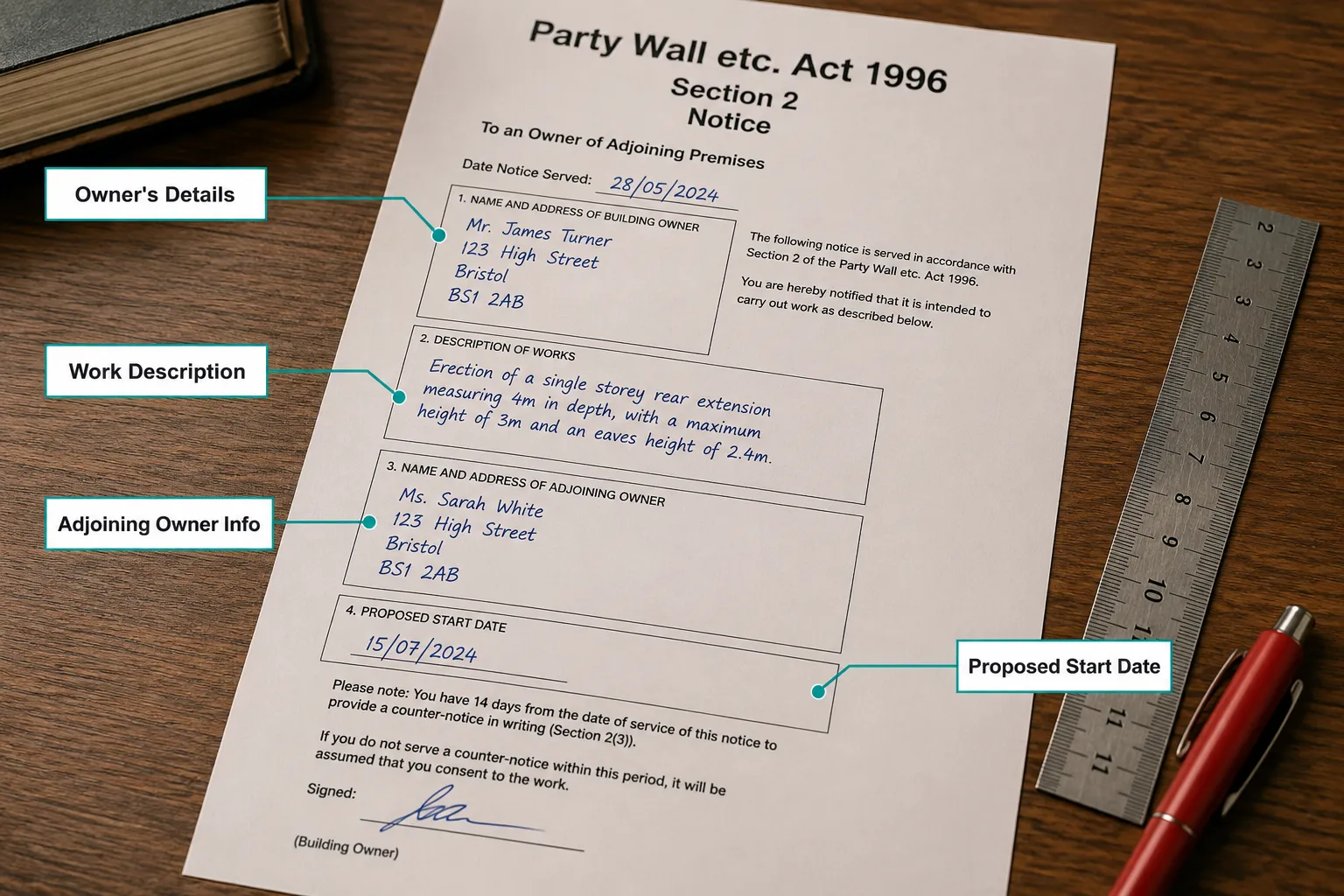
Template wording (Section 1):
To: [Adjoining Owner's Full Name]
Of: [Adjoining Owner's Address]NOTICE UNDER SECTION 1 OF THE PARTY WALL ETC. ACT 1996
I/We, [Your Full Name], of [Your Address], being the owner of [Property Address], hereby give you notice of my/our intention to build a new wall [astride the line of junction / on my/our own land adjacent to the line of junction] between our properties.
The proposed works are: [Brief description, e.g., "construction of a single-storey rear extension requiring a new boundary wall approximately 4.5 metres in length and 2.4 metres in height, constructed in facing brick to match the existing property"].
The works are proposed to commence on or after [date at least one month from service].
This notice is served in accordance with Section 1 of the Party Wall etc. Act 1996.
Signed: _________________ Date: _________________
Section 3 Notice, Works to an Existing Party Wall
When it applies: You intend to cut into, raise, underpin, demolish and rebuild, or otherwise alter an existing party wall or party structure [1].
Lead-in time: Two months before work starts [1].
Required contents, checklist:
| Element | Detail Required |
|---|---|
| Your full name and address | |
| Description of the proposed works | Specific and detailed |
| Proposed start date | At least two months away |
| Statement that the notice is served under Section 3 | |
| Plans and sections (if the works involve cutting into the wall) | Recommended; required if complex |
| Signature and date |
Template wording (Section 3):
NOTICE UNDER SECTION 3 OF THE PARTY WALL ETC. ACT 1996
I/We, [Your Full Name], of [Your Address], hereby give notice of intention to carry out the following works to the party wall/party structure between [Your Property Address] and [Adjoining Owner's Address]:
Description of works: [e.g., "cutting into the party wall to insert a rolled steel joist at first-floor level to support a new rear extension; the joist will be located approximately 2.1 metres above finished floor level; making good to both sides on completion"].
Proposed start date: [date at least two months from service].
This notice is served under Section 3 of the Party Wall etc. Act 1996.
Signed: _________________ Date: _________________
Section 6 Notice, Excavation Near Neighbouring Foundations
When it applies: Excavation within three metres (or six metres under the 45-degree rule) of a neighbouring structure [1].
Lead-in time: One month before work starts [1].
Required contents, checklist:
| Element | Detail Required |
|---|---|
| Your full name and address | |
| Description of the excavation | Depth, proximity to boundary, purpose |
| Plans showing the site and depth of excavation | Mandatory under Section 6 |
| Proposed start date | At least one month away |
| Statement that the notice is served under Section 6 | |
| Signature and date |
Template wording (Section 6):
NOTICE UNDER SECTION 6 OF THE PARTY WALL ETC. ACT 1996
I/We, [Your Full Name], of [Your Address], hereby give notice of intention to excavate within [X] metres of the building/structure at [Adjoining Owner's Address] to a depth of approximately [X] metres below ground level for the purpose of [e.g., "constructing the foundations of a single-storey rear extension"].
Plans showing the site and depth of the proposed excavation are enclosed.
Proposed start date: [date at least one month from service].
This notice is served under Section 6 of the Party Wall etc. Act 1996.
Signed: _________________ Date: _________________
Key point: Always enclose a simple site plan with Section 6 notices. Without it, the notice is technically defective [4].
Serving the Notice, Neighbour Responses, and Resolving Disputes
Drafting the notice correctly is only half the task. Proper service and managing the response process are equally important stages in any practical Party Wall Notices: Step-by-Step Template Guide for UK Homeowners Planning Extensions.
How to Serve a Party Wall Notice
The Act permits service by [1]:
- Hand delivery to the adjoining owner personally
- Leaving it at the adjoining owner's usual or last-known residence or place of business
- Sending it by post to the adjoining owner's usual or last-known address
- In the case of a company, leaving it at or sending it to the registered office
Keep a record of service, a photograph of the envelope, a signed delivery receipt, or a certificate of posting. This evidence is essential if a dispute arises about whether notice was properly served [5].
If the adjoining owner cannot be found after reasonable enquiry, the Act allows notice to be fixed to a conspicuous part of the premises [1].
The 14-Day Response Window
Once a notice is served, the adjoining owner has 14 days to respond in writing [1]. There are three possible outcomes:
- Consent in writing, works may proceed as described on the notified start date
- Dissent and agreement to appoint a single agreed surveyor, both parties share one surveyor who produces an Award
- Dissent (or no response within 14 days), a deemed dispute arises; each party appoints their own surveyor, or they agree on one
Silence is not consent. If the adjoining owner does not respond within 14 days, a dispute is automatically deemed to have arisen under the Act [1][4]. This is one of the most common misunderstandings among homeowners.
The Party Wall Award
When a dispute arises (whether genuine or deemed), the appointed surveyor or surveyors produce a Party Wall Award. This is a legally binding document that sets out [3][4]:
- The works permitted
- The method and timing of construction
- Access rights for the surveyor
- A schedule of condition of the adjoining property before works begin
- Any compensation payable
The Award protects both parties. It is not an obstacle to building, it is a framework that allows works to proceed with confidence.
Costs
The building owner (the person doing the work) normally pays the reasonable fees of both surveyors [4]. In London, surveyor fees for a straightforward extension Award typically range from a few hundred to over a thousand pounds per surveyor, depending on complexity [5][10]. Attempting to avoid the process to save money frequently results in higher costs when disputes escalate or injunctions are sought.
London-Specific Considerations
London homeowners face a higher density of party wall situations than most of the UK. Terraced and semi-detached Victorian and Edwardian housing stock means that almost every extension project in inner London will engage the Act [5][10]. The London guidance from specialist surveyors notes that basement extensions, increasingly common in prime London boroughs, almost always trigger Section 6 notices and often require structural engineer input alongside the party wall process [5]. Homeowners in London are advised to instruct a party wall surveyor at the design stage rather than waiting until planning permission is granted [10].
RICS Standards and Professional Guidance
The RICS professional standard on party wall legislation and procedure provides the benchmark for how surveyors in England and Wales should conduct party wall matters [8]. The RICS consumer guide, available free of charge, is an accessible reference for homeowners that explains rights, responsibilities, and the surveyor appointment process in plain language [3][9]. RICS operates a consumer helpline where homeowners can obtain free initial guidance before deciding whether to instruct a surveyor [3].
A 2026 RICS consultation on updated practice guidance is underway, reflecting evolving expectations around digital service of notices and electronic Awards. Homeowners and surveyors should monitor RICS publications for any updates to recommended practice that emerge from this consultation [8].
Local Authority Guidance
Local planning authorities reinforce party wall obligations in their supplementary planning documents. Sefton Council's house extensions SPD, for example, explicitly reminds applicants that planning permission does not remove the need to comply with the Party Wall etc. Act 1996, and that the two processes run in parallel rather than sequentially [6]. This is a common misconception: receiving planning permission does not mean party wall obligations have been satisfied.

Conclusion
Serving a valid party wall notice is not a bureaucratic formality, it is a legal requirement that protects both the building owner and the adjoining owner throughout an extension project. The templates and checklists in this guide align with the current GOV.UK guidance and standard surveyor practice for 2026.
Actionable next steps for homeowners:
- Confirm whether the Act applies to your specific project by reviewing the three trigger scenarios (Sections 1, 3, and 6) against your architect's or structural engineer's drawings.
- Calculate your notice period, two months for Section 3 works, one month for Sections 1 and 6, and work backwards from your intended start date.
- Use the template wording in this guide as a starting point, customising the description of works to match your actual project.
- Serve notice by a traceable method and retain proof of service.
- Monitor the 14-day response window carefully; do not assume silence means consent.
- Consult a RICS-accredited party wall surveyor if your project is complex, if your neighbour dissents, or if you are unsure whether your notice is compliant. Free initial guidance is available via the RICS consumer helpline [3].
Getting the notice right at the start keeps your project on programme, protects your relationship with your neighbour, and ensures that any works to a shared structure are carried out within a legally sound framework.
References
[1] When How Tell Them – gov.uk
[2] Party Wall Act Explained – planwatch.co.uk
[3] Party Walls – rics.org
[4] Rics Consumer Guide Party Walls 1 – chpk.co.uk
[5] London Party Wall Extensions 2026 Rules Disputes And Neighbour Rights Explained – princesurveyors.co.uk
[6] Draft House Extensions Spd 2022 – sefton.gov.uk
[7] Party Wall Agreement Uk 2026 – pg-construction.co.uk
[8] Party Wall Legislation And Procedure – rics.org
[9] Party Walls Consumer Guide 2022 – rics.org
[10] Party Wall Guide For London Homeowners – hampsteadcharteredsurveyors.co.uk