Skipping a building survey to save a few hundred pounds is one of the most expensive decisions a UK property buyer can make, yet roughly one in three buyers still does it. Understanding how much does a building survey cost in 2027, and what drives that figure up or down by property type, is the clearest way to budget confidently before exchange of contracts.
This guide draws on 2024-2026 benchmark data from RICS-accredited surveyors and consumer guidance published through mid-2026, then projects realistic 2027 pricing bands so buyers, sellers, and conveyancers have a single, annually refreshed reference point.
Key Takeaways
- A Level 3 Building Survey (formerly Full Structural Survey) on a standard UK property typically costs between £500 and £1,500 in 2026, with 2027 prices expected to rise modestly by 3-6%.
- Survey fees scale with property value, size, age, and regional location, London and the South East carry a consistent premium of 20-30% over the rest of the UK.
- Three RICS survey levels exist; choosing the wrong level for the property type is a common and costly mistake.
- Older, extended, or non-standard construction properties always attract higher fees regardless of market value.
- Getting at least three quotes from RICS-registered surveyors is the single most effective way to control costs.
Understanding the Three RICS Survey Levels
Before examining specific costs, it helps to understand what each survey level actually covers. The Royal Institution of Chartered Surveyors (RICS) standardised its Home Survey product range in 2021, creating three clearly defined tiers that most UK surveyors now follow [1].
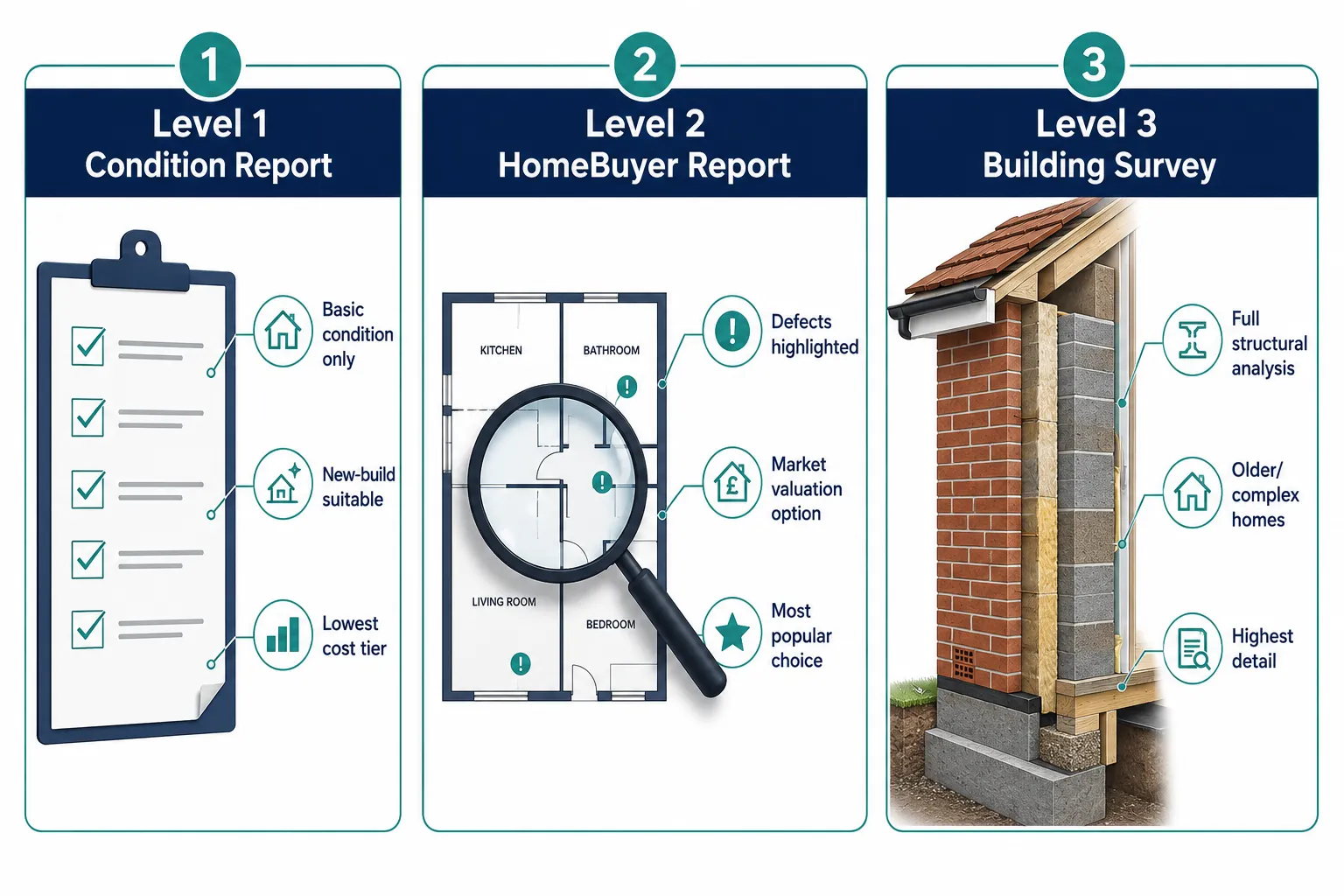
Level 1, Condition Report
The most basic option, this report uses a traffic-light rating system to flag visible defects. It does not include advice on repairs or a market valuation. It suits new-build or recently built conventional homes in good condition. Typical 2026 cost: £300,£500 [4].
Level 2, HomeBuyer Report (Survey only or Survey with Valuation)
By far the most popular choice for standard UK properties built after roughly 1900, the Level 2 report inspects accessible areas, rates defects, and highlights urgent issues. The version with a market valuation adds £100,£150 to the base price. Typical 2026 cost: £400,£1,000 depending on property value and location [2] [6].
Level 3, Building Survey (formerly Full Structural Survey)
The most comprehensive option, a Level 3 survey covers the full structure, roof space, under-floor areas where accessible, and non-standard construction features. It is strongly recommended for properties built before 1900, those with extensions, listed buildings, or any home showing signs of significant defects. Typical 2026 cost: £600,£1,500+ [3] [9].
"The Level 3 Building Survey is not just for old houses, any property with an extension, conversion, or unusual construction warrants the deeper inspection it provides.", Prince Surveyors, 2026 [3]
2026 Benchmark Costs by Property Value and Type
The clearest way to understand survey pricing is to map it against property value bands, because most surveyors in the UK use purchase price as their primary pricing variable [8].
Under £300,000
For properties valued below £300,000, a bracket covering a large share of homes outside London and the South East, 2026 benchmark costs are as follows:
| Survey Level | Typical 2026 Range |
|---|---|
| Level 1 Condition Report | £300, £450 |
| Level 2 HomeBuyer Report | £400, £600 |
| Level 3 Building Survey | £500, £900 |
Standard modern semi-detached or terraced homes in this price band sit toward the lower end. Older Victorian terraces or properties with rear extensions push fees toward the upper end even within this value bracket [2] [10].
£300,000, £600,000
This mid-range band covers a broad spread of property types, from larger suburban semis to period detached homes and city-centre flats in secondary markets.
| Survey Level | Typical 2026 Range |
|---|---|
| Level 1 Condition Report | £400, £550 |
| Level 2 HomeBuyer Report | £550, £850 |
| Level 3 Building Survey | £750, £1,200 |
Properties in this band with non-standard features, timber frames, thatched roofs, or substantial loft conversions, regularly attract quotes at the top of or above these ranges [9] [10].
£600,000 and Above
High-value properties, including large detached homes, country houses, and premium London flats, attract the highest survey fees. The complexity of inspection and the professional indemnity insurance costs for surveyors both rise with property value [1] [3].
| Survey Level | Typical 2026 Range |
|---|---|
| Level 1 Condition Report | £500, £700 |
| Level 2 HomeBuyer Report | £800, £1,200 |
| Level 3 Building Survey | £1,000, £1,800+ |
For listed buildings or very large country estates, bespoke Level 3 quotes above £2,000 are not unusual [10].
Regional Pricing: London, South East, and the Rest of the UK
Geography is one of the most significant cost drivers in UK survey pricing, and it is frequently underestimated by buyers relocating from lower-cost regions.
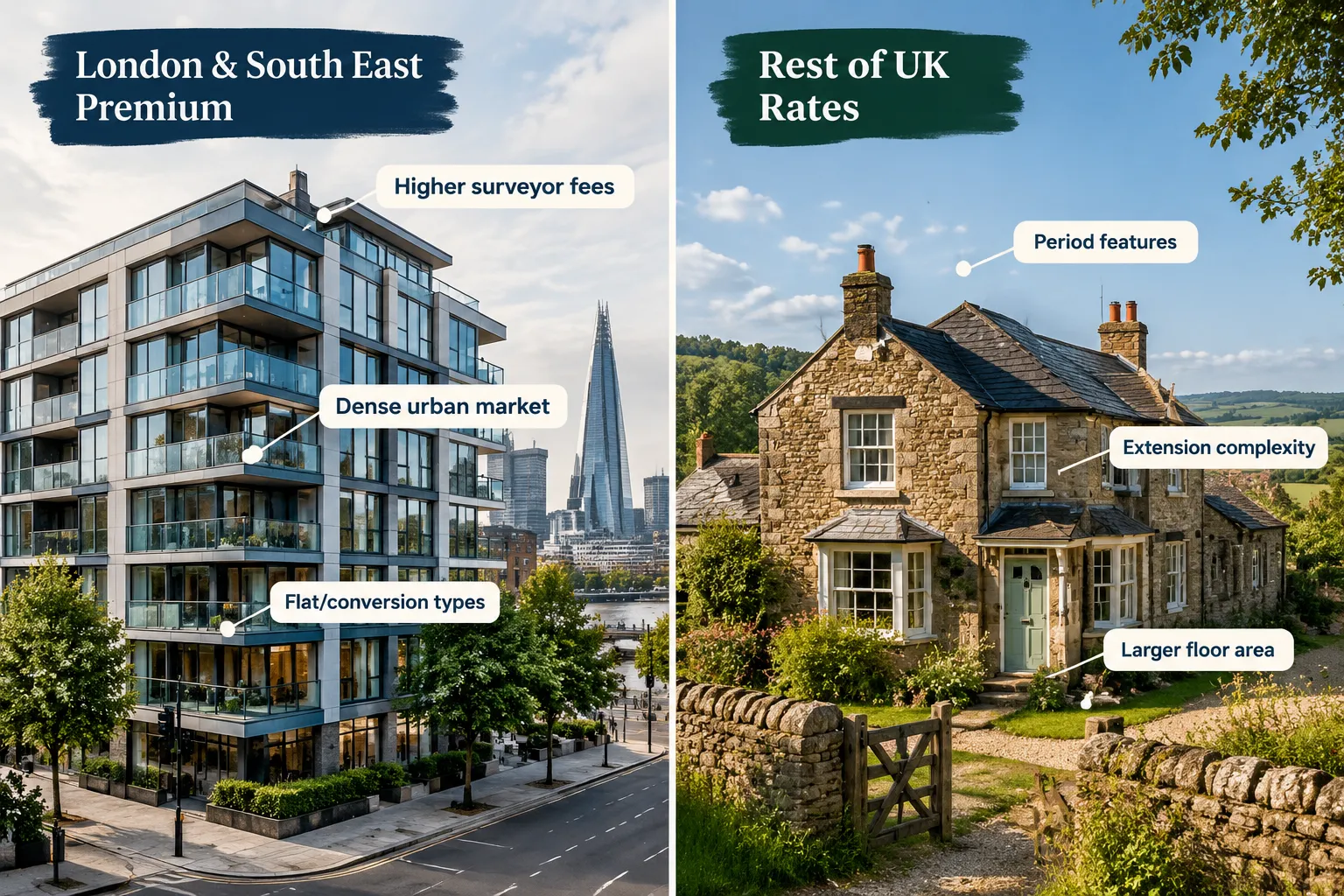
London and South East Premium
Surveyors operating in Greater London, Surrey, Berkshire, Hertfordshire, and parts of Kent and Essex consistently charge 20-30% more than the national average for equivalent survey types and property values [4] [8]. The reasons are structural:
- Higher surveyor overheads, office costs, travel time, and staff salaries all reflect the regional cost of living.
- Greater property density, more complex access arrangements, particularly for flats and converted properties.
- Professional indemnity insurance, premiums are partly linked to the value of properties being surveyed, which skews higher in these regions.
A Level 2 HomeBuyer Report on a £450,000 London flat might cost £700,£950, while the same report on a £450,000 detached house in the East Midlands could be quoted at £500,£700 [6] [8].
Rest of the UK
Outside London and the South East, pricing is more competitive. Wales, the North of England, the Midlands, and Scotland generally sit at or below the national average benchmarks shown in the tables above. Northern Ireland has its own surveying market and tends to be cheaper still for equivalent property types [4].
Practical rule of thumb for 2026: Add 25% to any national average quote if the property is in Greater London or the Home Counties.
How Property Type and Complexity Affect Your Quote
Property value and location set the baseline, but the specific characteristics of a building can move a quote significantly within, or beyond, the standard ranges.
Conventional Modern Homes (Post-1980)
Standard brick-and-block construction homes built after 1980 with no significant alterations are the simplest and cheapest to survey. A Level 2 report is usually sufficient, and quotes will sit toward the lower end of the relevant value band [2].
Victorian and Edwardian Properties (Pre-1919)
Older properties require more time on site and greater expertise. Surveyors must assess original materials, lime mortar, solid brick walls, original timber floors, alongside any subsequent alterations. A Level 3 Building Survey is almost always recommended, and fees reflect the additional inspection time [3] [9].
Extended or Altered Properties
Any property with a rear extension, loft conversion, garage conversion, or significant internal remodelling warrants a Level 3 survey. The surveyor must assess whether structural work was carried out correctly, whether building regulations approval was obtained, and whether any alterations have affected the original structure [10].
Flats and Leasehold Properties
Flats present unique challenges: shared structure, communal areas, and leasehold complications mean surveyors must assess both the individual unit and the wider building condition. Some surveyors charge a flat rate for flats; others price by floor area. A Level 2 report is standard for modern flats; older converted properties warrant Level 3 [1] [6].
Non-Standard Construction
Timber-framed homes, steel-framed properties, prefabricated concrete homes (BISF, Airey, Cornish Unit), and thatched properties all require specialist knowledge. Surveyors with relevant expertise may charge a premium, and some will recommend specialist structural or timber-and-damp reports in addition to the main survey [9] [10].
Specialist and Alternative Survey Types
Beyond the three RICS levels, buyers sometimes need specialist reports that sit outside the standard product range.
Snagging Surveys are specific to new-build properties and identify defects or incomplete work before legal completion. Costs typically range from £300 to £600 depending on property size, and they are usually commissioned by the buyer independently of the developer [4].
Measured Building Surveys are commissioned when accurate floor plans are required, for planning applications, extensions, or commercial purposes. These are priced by floor area and complexity, typically ranging from £500 to £2,500+ for residential properties [7].
Specialist Structural Reports, covering subsidence, Japanese knotweed, damp, or timber infestation, are often recommended as follow-up investigations after a Level 2 or Level 3 survey flags a concern. Individual specialist reports typically cost £200,£500 each [3] [10].
Projected 2027 Pricing: What to Expect
Note: The following projections are speculative estimates based on 2024-2026 cost trends and known market factors. They should be treated as indicative planning figures, not guaranteed quotes.
Several factors are expected to push survey costs modestly higher in 2027 [3] [5]:
- Professional indemnity insurance costs for surveyors have risen steadily since 2022 and are expected to continue rising as property values remain elevated.
- RICS regulatory updates, ongoing changes to professional standards and competency requirements increase the time and cost of maintaining accreditation.
- Overhead inflation, fuel, software, and administrative costs continue to rise across the professional services sector.
- Demand pressure, if the UK housing market remains active through 2026-2027, surveyor capacity constraints will support higher pricing.
Predicted 2027 Price Bands (Speculative)
Applying a conservative 3-6% uplift to 2026 benchmarks produces the following indicative 2027 ranges:
| Survey Type | Under £300k | £300k,£600k | £600k+ |
|---|---|---|---|
| Level 1 Condition Report | £320, £480 | £420, £580 | £530, £740 |
| Level 2 HomeBuyer Report | £420, £640 | £580, £900 | £850, £1,270 |
| Level 3 Building Survey | £530, £955 | £795, £1,270 | £1,060, £1,910+ |
London and South East buyers should apply the 20-30% regional premium to these figures [5] [8].
How to Get the Best Value on a Building Survey in 2027
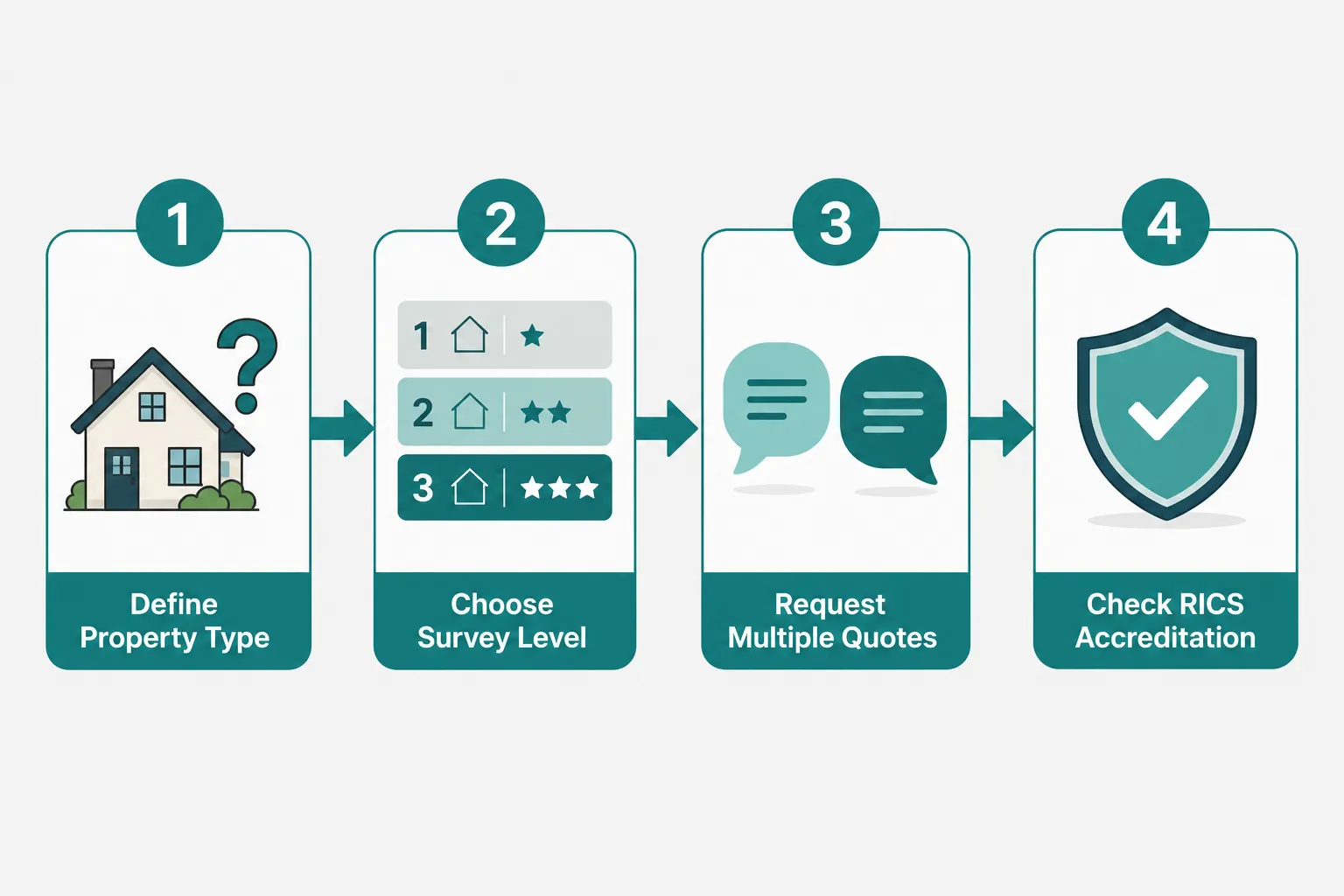
Getting a fair price does not mean choosing the cheapest quote. It means understanding what the quote includes and verifying that the surveyor is properly qualified.
Step 1, Define the property type accurately. Before contacting surveyors, know the approximate age, construction type, and any known alterations. This allows surveyors to quote accurately rather than adding contingency costs.
Step 2, Choose the right survey level. Underspecifying the survey level to save money is a false economy. A Level 2 report that misses a structural defect in an older property can cost tens of thousands of pounds in remediation.
Step 3, Request at least three quotes. Survey fees are not regulated, so prices vary between firms. Comparing three quotes from RICS-registered surveyors is the most effective way to identify fair market pricing for the specific property [1] [4].
Step 4, Check RICS accreditation. All surveyors should be RICS-registered. Verify membership at the RICS Find a Surveyor tool. Unregistered surveyors carry no professional indemnity obligations and offer no route to complaint resolution [1].
Step 5, Clarify what is included. Some Level 2 quotes include a market valuation; others do not. Some Level 3 reports include a schedule of condition; others charge extra for it. Read the scope of service before accepting any quote.
Step 6, Ask about turnaround time. In a competitive market, turnaround time matters. A surveyor quoting a lower fee but a three-week wait may cost more in mortgage rate exposure than a slightly higher-priced firm delivering within a week.
Conclusion
Understanding how much does a building survey cost in 2027 requires looking beyond a single headline figure. Costs vary meaningfully by RICS survey level, property value band, regional location, age of the building, and construction complexity. Based on 2026 benchmarks and a projected 3-6% uplift, UK buyers in 2027 should budget approximately £420,£640 for a standard Level 2 HomeBuyer Report on a property under £300,000, and £795,£1,270 for a Level 3 Building Survey on a mid-range home, with London and South East buyers adding a further 20-30% to those figures.
Actionable next steps:
- Identify the age, type, and any known alterations of the property before approaching surveyors.
- Match the survey level to the property's complexity, do not default to Level 2 for pre-1919 or extended homes.
- Obtain at least three quotes from RICS-registered surveyors, verify their accreditation, and compare scope as well as price.
- Factor specialist follow-up reports (damp, structural, snagging) into the total survey budget from the outset.
- Treat the survey fee as a fixed cost of purchase, not an optional saving, the information it provides protects one of the largest financial commitments most people will ever make.
References
[1] House Surveys Uk The Costs Types And Benefits Of An Rics Home Survey – rics.org
[2] Building Survey Cost Uk – bestbuilders.co.uk
[3] Building Survey Cost What To Expect 2026 – princesurveyors.co.uk
[4] How Much Does A House Survey Cost – hoa.org.uk
[5] Property Survey Cost Calculator Uk 2026 – ukcalculator.com
[6] Rics Home Survey Cost Guide – housey.co.uk
[7] Measured Building Survey Cost – blackacresurveyors.com
[8] House Survey Cost – surveyorlocal.co.uk
[9] Full Building Survey Cost What To Expect In 2026 En – surveymerchant.com
[10] Building Survey Costs – westvilleassociates.com